Adult ADHD: A Complete Guide to Symptoms, Diagnosis, and Treatment
Adult ADHD can affect focus, organization, motivation, and emotional regulation. This complete guide explains the symptoms of ADHD in adults, how diagnosis works, and treatment options available for adults in Pennsylvania and Delaware.
Adult attention-deficit/hyperactivity disorder (ADHD) is a neurodevelopmental condition that affects attention regulation, executive functioning, motivation, and emotional regulation.
Many individuals first begin to recognize ADHD symptoms in adults when they notice ongoing difficulties with focus, organization, and follow-through in daily life.
Research suggests that ADHD involves differences in the brain’s attention and reward systems, particularly involving dopamine and norepinephrine pathways in the prefrontal cortex.
For many adults, ADHD can affect work performance, relationships, time management, and overall well-being. The good news is that ADHD is highly treatable when properly diagnosed and managed.
This guide explains the most important things adults should know about ADHD symptoms, diagnosis, testing, and treatment.
Many adults searching for ADHD testing in Pennsylvania or Delaware begin by learning about the symptoms and diagnosis process. If you’ve been struggling with focus, organization, or follow-through, understanding ADHD is the first step toward getting the right support.
What Is Adult ADHD?
Adult ADHD is a neurological condition that affects the brain’s ability to regulate attention, motivation, and executive functions.
Executive functions are mental processes that help people:
• organize tasks
• manage time
• regulate emotions
• start and complete activities
• maintain focus
When these systems do not function efficiently, everyday tasks may feel overwhelming or mentally exhausting.
Many adults with ADHD report lifelong patterns of:
• procrastination
• forgetfulness
• disorganization
• difficulty completing tasks
• emotional reactivity
• inconsistent motivation
Common ADHD Symptoms in Adults
Symptoms of ADHD in adulthood often look different from childhood hyperactivity.
Common symptoms include:
Difficulty Sustaining Attention
Adults may struggle to remain focused during meetings, reading tasks, or detailed work.
Time Blindness
Many individuals experience a distorted perception of time, which can lead to chronic lateness or difficulty estimating how long tasks will take.
Executive Dysfunction
Executive function challenges can make planning, prioritizing, and starting tasks extremely difficult.
Some adults also experience difficulty starting tasks even when they want to complete them, sometimes referred to as ADHD task paralysis.
Emotional Dysregulation
Some adults experience strong emotional responses, frustration intolerance, or rejection sensitivity.
ADHD Burnout
When cognitive demands exceed mental energy for long periods, individuals may experience exhaustion known as ADHD burnout.
Many adults experiencing ADHD symptoms in adults, such as difficulty starting tasks or feeling overwhelmed, may benefit from understanding the root cause. Read more in our article on Why Adults with ADHD Feel Overwhelmed and How to Regain Control.
ADHD vs Anxiety
ADHD and anxiety can look similar because both conditions can cause:
• racing thoughts
• restlessness
• difficulty concentrating
• feeling overwhelmed
However, the underlying causes differ.
ADHD symptoms are related to attention regulation and executive function, while anxiety is driven by excessive worry and threat perception.
If you would like a deeper explanation, read:
👉 Read more: ADHD vs Anxiety: How Adults Can Tell the Difference
How ADHD Is Diagnosed in Adults
Diagnosing ADHD in adults requires a comprehensive clinical evaluation.
A proper adult ADHD diagnosis involves understanding long-standing patterns of attention difficulties, executive dysfunction, and functional impairment across multiple areas of life.
• a detailed clinical interview
• review of current symptoms
• history of symptoms beginning in childhood
• assessment of functioning in multiple areas of life
• screening for other mental health conditions
Because ADHD symptoms overlap with other conditions, a careful diagnostic process is essential.
ADHD Testing and Evaluation
Many adults search for ADHD testing, but it is important to understand what the evaluation process actually involves.
An ADHD evaluation may include:
• clinical assessment tools
• symptom rating scales
• evaluation of executive function difficulties
• assessment for anxiety, depression, or other conditions
You can learn more about this process here:
ADHD Testing & Evaluation for Adults in Pennsylvania & Delaware
ADHD Treatment Options
ADHD treatment often includes a combination of strategies tailored to the individual.
Common treatment approaches include:
Medication Management
Medications can help regulate neurotransmitter systems involved in attention and executive function.
Behavioral Strategies
Structured routines, time-management systems, and environmental modifications can improve functioning.
Therapy and Coaching
Cognitive behavioral therapy and ADHD coaching can help individuals develop practical strategies for managing symptoms.
ADHD Medication Options
ADHD medications generally fall into two categories:
Stimulant Medications
These medications increase dopamine and norepinephrine activity in the brain.
Non-Stimulant Medications
Non-stimulant options can also help regulate attention and impulse control.
More information about medication options can be found here:
ADHD Treatment & Medication Management for Adults in Pennsylvania & Delaware
When Adults Should Seek ADHD Evaluation
Adults should consider an ADHD evaluation if they experience persistent difficulties such as:
• chronic procrastination
• difficulty finishing tasks
• problems with organization
• forgetfulness
• emotional overwhelm
• struggles with time management
If these challenges have been present since childhood and interfere with daily functioning, ADHD may be a possibility.
If you’ve been experiencing persistent ADHD symptoms in adults, seeking a professional evaluation can help determine whether an adult ADHD diagnosis is appropriate.
Adult ADHD Care in Pennsylvania and Delaware
Adults living in Pennsylvania and Delaware who suspect ADHD may benefit from a comprehensive evaluation and individualized treatment plan.
ADHDPhiladelphia.com provides adult ADHD testing, diagnosis, and treatment through a structured telehealth model designed to help individuals understand their symptoms and develop effective strategies for managing ADHD.
Schedule an ADHD Evaluation
If you live in Pennsylvania or Delaware and have been struggling with focus, procrastination, or feeling overwhelmed, ADHD may be playing a role.
A structured ADHD evaluation can help provide clarity and a path forward.
👉 Book your appointment today at ADHDPhiladelphia.com
ADHD Testing by Location
If you are specifically searching for ADHD services in your area:
👉 Adult ADHD Testing in Philadelphia
👉 Adult ADHD Testing in Wilmington
👉 Adult ADHD Testing in Newark
👉 Adult ADHD Testing in Pittsburgh
👉 Adult ADHD Testing in Allentown
👉 Adult ADHD Testing in Harrisburg
👉 Adult ADHD Testing in Lancaster
Frequently Asked Questions About Adult ADHD
Can ADHD be diagnosed in adulthood?
Yes. Many adults are diagnosed later in life after recognizing long-standing patterns of inattention, disorganization, and difficulty with follow-through.
Is ADHD treatable in adults?
Yes. ADHD is highly treatable with the right combination of medication, structure, and behavioral strategies.
What is the difference between ADHD and anxiety?
ADHD affects attention regulation and executive functioning, while anxiety is driven by excessive worry and fear-based thinking.
Related ADHD Topics
• ADHD Task Paralysis: Why Adults Struggle to Start Tasks
• Executive Dysfunction in Adults With ADHD
• ADHD Procrastination vs Laziness
• ADHD Burnout in Adults
• ADHD Time Blindness
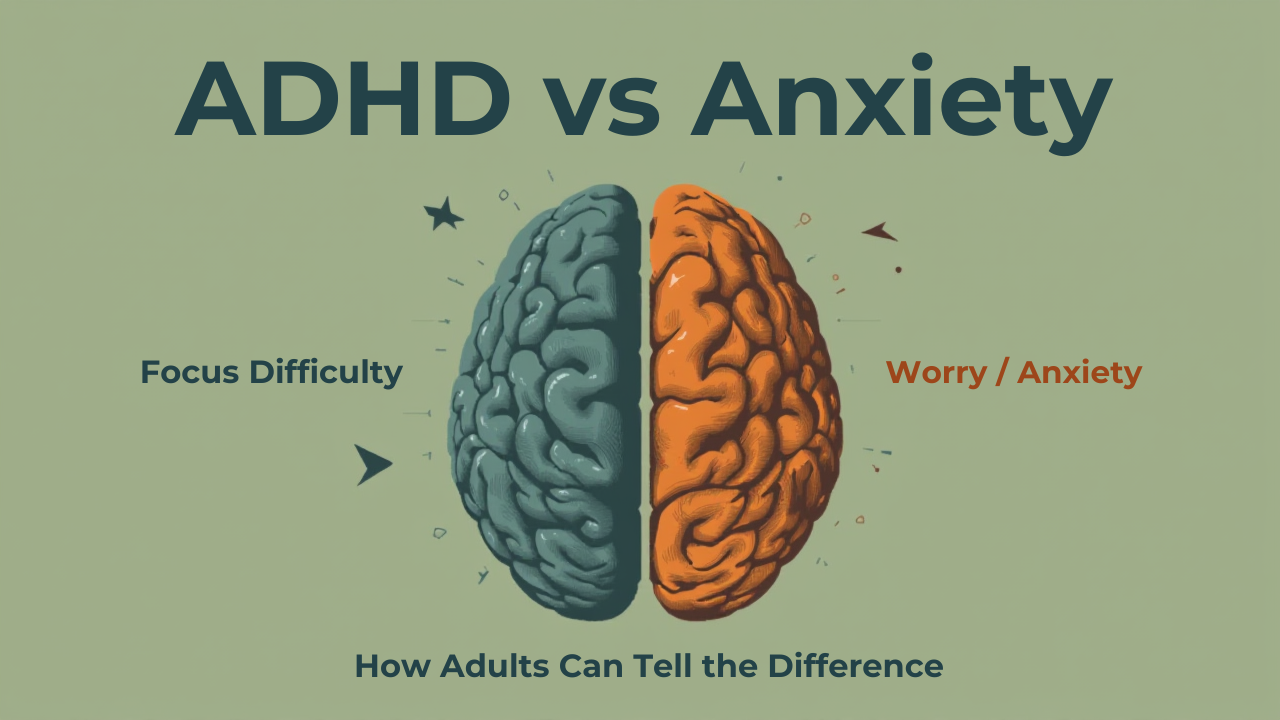
ADHD vs Anxiety: How Adults Can Tell the Difference
Many adults struggle with focus, racing thoughts, and overwhelm and assume anxiety is the cause. However, ADHD and anxiety often overlap. Learn how clinicians distinguish ADHD from anxiety and when adults in Pennsylvania and Delaware may benefit from ADHD testing.
Many adults who struggle with focus, racing thoughts, or difficulty completing tasks assume they may have anxiety.
However, symptoms of ADHD and anxiety often overlap, which can make it difficult to determine the underlying cause.
Understanding the difference can help individuals decide whether an ADHD evaluation for adults may be helpful.
Why ADHD and Anxiety Are Often Confused
Both conditions can involve:
• difficulty concentrating
• restlessness
• racing thoughts
• feeling overwhelmed
• trouble completing tasks
Many adults first begin exploring these questions when they recognizesigns of ADHD in adultsthat have affected them for years.
Key Differences Between ADHD and Anxiety
ADHD
ADHD primarily affects attention regulation and executive functioning.
Common patterns include:
• difficulty starting tasks
• losing items frequently
• procrastination
• time blindness
• impulsive decisions
These symptoms often occur even when a person feels calm.
Anxiety
Anxiety is primarily related to excessive worry or fear about future events.
Common patterns include:
• persistent worry
• physical tension
• difficulty relaxing
• fear of making mistakes
• overthinking decisions
Concentration problems usually occur because the mind is preoccupied with worry.
For some LGBTQ+ adults, ADHD and anxiety can be even harder to separate when masking, identity-related stress, burnout, and executive dysfunction overlap.
When ADHD and Anxiety Occur Together
Many adults experience both ADHD and anxiety.
In fact, untreated ADHD can lead to anxiety because individuals may struggle with:
• missed deadlines
• disorganization
• difficulty keeping up with responsibilities
Over time, this stress can increase anxiety symptoms.
When ADHD is identified and treated, many adults experience improvement in both focus and anxiety symptoms, especially when appropriate ADHD medications for adults are considered.
How ADHD Evaluations Help Clarify the Diagnosis
An ADHD evaluation typically includes:
• review of symptom history
• discussion of attention patterns
• evaluation of executive functioning
• screening for anxiety and other conditions
This process helps determine whether ADHD, anxiety, or a combination of factors may be affecting daily functioning.
ADHD Testing and Treatment for Adults
Adults located in Pennsylvania or Delaware who experience persistent focus difficulties may benefit from a professional ADHD evaluation for adults in Pennsylvania and Delaware.
ADHDPhiladelphia.com provides adult ADHD testing and treatment through telehealth and follow-up care.
Understanding the cause of attention challenges can help individuals develop effective strategies for improving focus, productivity, and quality of life.
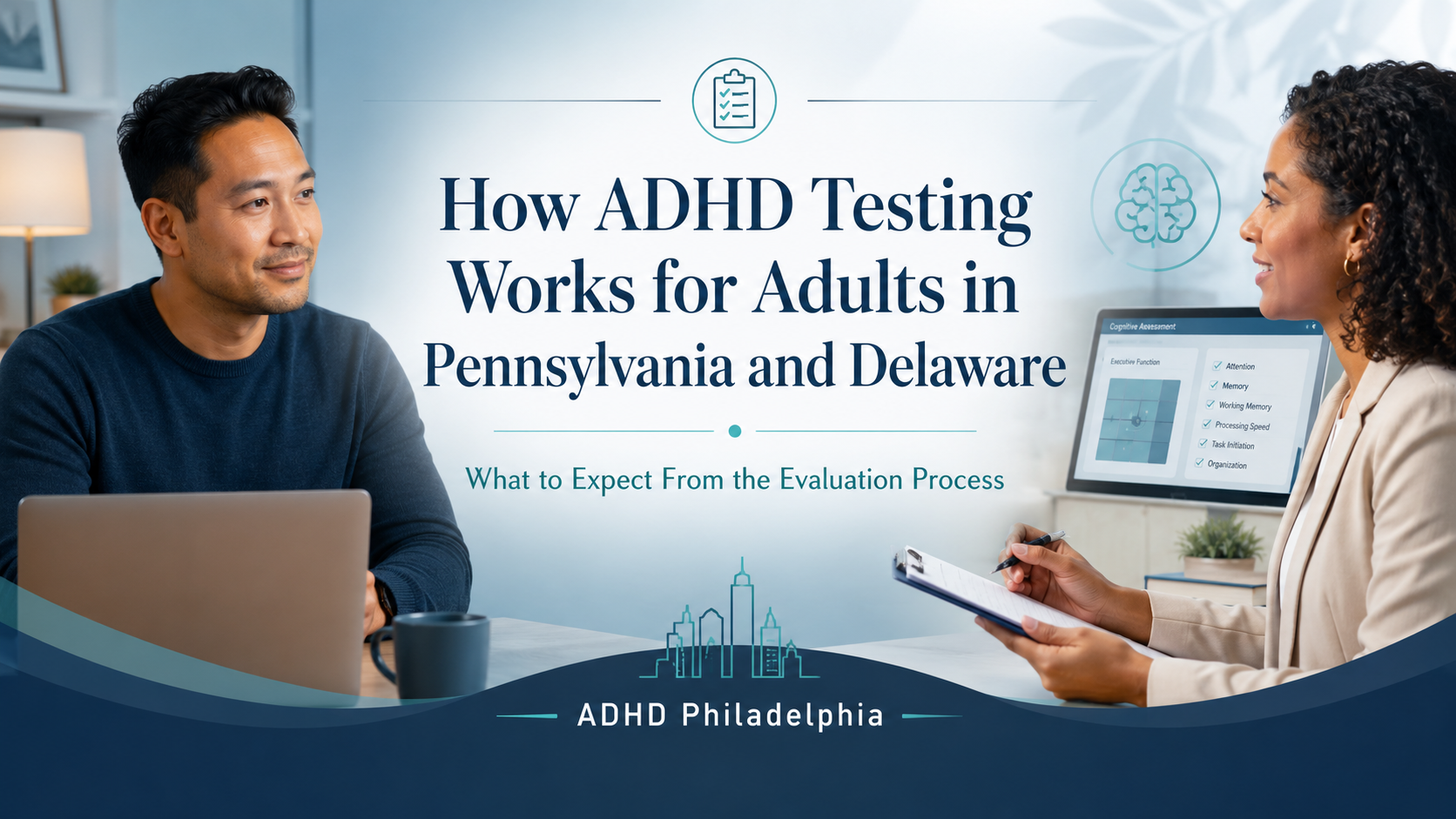
How ADHD Testing Works for Adults in Pennsylvania and Delaware
Many adults wonder how ADHD testing works and what happens during an ADHD evaluation. This guide explains the ADHD assessment process and how adults in Pennsylvania and Delaware can seek testing and treatment.
Many adults struggle with focus, procrastination, organization, emotional overwhelm, forgetfulness, and time management for years before wondering whether ADHD may be part of the picture.
They may assume they are lazy, burned out, anxious, unmotivated, or simply bad at routines. But for many adults, the real issue may be untreated ADHD affecting executive function, attention regulation, task initiation, and follow-through.
One of the most common questions people ask is:
“How does ADHD testing work for adults?”
Understanding the evaluation process can help adults know what to expect and decide whether seeking an ADHD evaluation may be helpful.
At ADHD Philadelphia, adult ADHD testing, evaluation, and treatment are available for adults in Pennsylvania and Delaware. Initial appointments begin through secure telehealth. In-person appointments may be scheduled after the first online appointment when clinically appropriate. There are no walk-in appointments.
Why Adults Seek ADHD Testing
Many adults begin exploring ADHD testing after recognizing patterns that have affected their work, relationships, school, home life, or confidence.
Common reasons adults seek ADHD testing include:
Difficulty sustaining attention
Chronic procrastination
Disorganization
Losing important items
Difficulty finishing tasks
Poor time management
Forgetfulness
Emotional overwhelm
Difficulty starting responsibilities
Trouble following through
Feeling scattered or mentally overloaded
Trouble staying consistent with routines
These symptoms can occur for many reasons, but when they are persistent, impairing, and long-standing, an ADHD evaluation may help clarify what is happening.
Many adults are not looking for an excuse. They are looking for an explanation.
After diagnosis, adult ADHD treatment may include education, executive function strategies, lifestyle changes, and medication management when clinically appropriate.
ADHD Testing Is More Than a Questionnaire
Online ADHD quizzes can be helpful starting points, but they are not the same as a clinical evaluation.
A questionnaire may show whether symptoms resemble ADHD, but it cannot fully determine whether ADHD is the main cause of those symptoms.
Difficulty concentrating can also be related to anxiety, depression, sleep problems, trauma, chronic stress, burnout, substance use concerns, medication side effects, or medical conditions.
That is why adult ADHD testing should involve a structured clinical process.
A complete evaluation should consider symptoms, history, functional impairment, executive functioning, mental health, medical factors, and other possible explanations.
The goal is diagnostic clarity — not just symptom labeling.
A careful adult ADHD diagnosis and evaluation reviews symptoms, history, impairment, executive functioning, and other possible explanations before treatment planning begins.

What Happens During Adult ADHD Testing?
An adult ADHD evaluation typically involves several important steps designed to understand how attention and executive functioning affect daily life.
The process may include:
A detailed clinical interview
Review of current symptoms
Review of childhood or earlier life patterns
Assessment of executive functioning
Review of work, school, home, and relationship impairment
Screening for anxiety, depression, sleep problems, trauma, substance use concerns, and other overlapping issues
Questionnaires or rating scales when clinically appropriate
Computerized ADHD testing when clinically appropriate
Discussion of diagnosis and treatment options
ADHD testing should not feel like a rushed checklist. It should help answer a deeper question:
“What is making daily functioning harder than it should be?”
Adults who want a deeper explanation can learn more about what happens during an adult ADHD evaluation, including symptom review, executive function assessment, rule-outs, testing, diagnosis review, and treatment planning.
Why Childhood History Still Matters
Adult ADHD is usually a long-standing condition. Many adults were never diagnosed as children, but they may still remember earlier signs.
Childhood or teenage patterns may have included:
Daydreaming in class
Losing homework
Forgetting assignments
Messy backpack, locker, or bedroom
Procrastinating until the last minute
Difficulty sitting still
Talking too much
Interrupting
Emotional sensitivity
Strong performance in some subjects but not others
Being called smart but inconsistent
Needing pressure to complete work
Reviewing earlier patterns helps determine whether symptoms are part of a long-term ADHD pattern or whether they may be better explained by something more recent, such as stress, burnout, sleep disruption, depression, anxiety, trauma, or substance use.
Many adults begin to recognize ADHD only after learning the signs you might have adult ADHD and not know it, especially when long-standing patterns with focus, organization, time, and follow-through finally make sense.
Why Functional Impairment Matters
ADHD diagnosis is not only about symptoms. It is also about impairment.
Functional impairment means the symptoms are affecting real life in meaningful ways.
Adult ADHD may affect:
Work performance
School responsibilities
Home organization
Parenting
Relationships
Finances
Appointments
Communication
Driving
Time management
Health routines
Self-confidence
Emotional well-being
For example, an adult may be able to focus sometimes but still struggle with missed deadlines, unfinished projects, chronic lateness, disorganization, forgotten appointments, emotional overwhelm, or inconsistent follow-through.
A strong evaluation looks at how symptoms affect daily functioning, not just whether they appear on a checklist.
Many adults seek testing because adult ADHD can make follow-through difficult even when you care, especially when executive function challenges affect task initiation, planning, working memory, and consistency.
Executive Function Is a Major Part of ADHD Testing
Many adults with ADHD do not struggle because they lack intelligence, effort, or ambition.
They struggle because executive function skills may not work consistently.
Executive function includes the brain skills involved in:
Planning
Prioritizing
Starting tasks
Managing time
Organizing information
Remembering steps
Regulating emotions
Controlling impulses
Switching between tasks
Following through
Completing responsibilities
An adult may know what to do, care about the outcome, and still feel unable to start or finish consistently.
This is why ADHD testing should include executive function questions. Attention is only part of the picture.
Problems with executive function in adults can affect planning, working memory, organization, emotional regulation, time management, task initiation, and follow-through.
ADHD Testing Should Consider Anxiety, Depression, and Sleep
ADHD symptoms often overlap with other conditions.
Anxiety can make it hard to concentrate.
Depression can reduce motivation and energy.
Poor sleep can affect attention and memory.
Trauma can affect emotional regulation and focus.
Chronic stress can make the brain feel overloaded.
Some adults have ADHD and anxiety. Some have ADHD and depression. Some have another condition instead of ADHD. Some have multiple concerns happening at the same time.
This is why adult ADHD testing should include screening for overlapping concerns.
A careful evaluation does not assume every focus problem is ADHD. It also does not ignore ADHD simply because anxiety or depression is present.
The goal is to understand the full picture.
For many adults, understanding ADHD vs anxiety in adults is important because both can affect concentration, restlessness, sleep, motivation, emotional regulation, and daily functioning.
Does ADHD Testing Include Computerized Testing?
Computerized ADHD testing may be used when clinically appropriate.
This type of testing can provide additional information about attention, impulsivity, response consistency, and sustained focus. It can be useful as one part of a broader evaluation.
However, computerized testing should not replace the clinical interview.
A test score alone does not diagnose ADHD.
A checklist alone does not diagnose ADHD.
A questionnaire alone does not explain the whole person.
Testing tools are most useful when they are interpreted alongside symptoms, history, impairment, executive functioning, clinical presentation, and rule-outs.
When clinically appropriate, adult ADHD testing in Pennsylvania and Delaware may include clinical interview, symptom review, functional impairment assessment, questionnaires, and computerized testing to support diagnostic clarity.
How Long Does ADHD Testing Take?
The length of ADHD testing depends on the person’s symptoms, history, complexity, and clinical needs.
Some evaluations are more straightforward. Others require more time because symptoms overlap with anxiety, depression, sleep problems, trauma, substance use concerns, medical issues, or previous treatment history.
A proper ADHD evaluation should be thorough enough to reduce the risk of misdiagnosis.
It should answer:
Are symptoms consistent with ADHD?
Are symptoms long-standing?
Are symptoms impairing daily life?
Are symptoms present in more than one setting?
Could another condition be contributing?
Is treatment clinically appropriate?
What treatment plan makes sense?
Adults wondering about timing can learn more about how long an adult ADHD evaluation takes in Pennsylvania or Delaware and why a structured process matters for diagnostic clarity.
What Happens After ADHD Testing?
After the evaluation, the provider should review the findings clearly.
Patients should understand:
Whether ADHD appears to be present
What symptoms are most impairing
Whether another condition may also be contributing
What treatment options may be appropriate
Whether medication may be clinically appropriate
What non-medication strategies may help
What follow-up care looks like
What safety monitoring may be needed
A good evaluation should help adults feel more informed, not more confused.
Patients who want to understand each step can review the ADHD Philadelphia patient journey before scheduling an evaluation.
Treatment Options After ADHD Diagnosis
If ADHD is diagnosed, treatment should be individualized.
Treatment may include:
ADHD education
Executive function strategies
Behavioral tools
Lifestyle and sleep review
Medication management when clinically appropriate
Therapy referrals when appropriate
Support for routines and planning
Ongoing monitoring
Treatment is not about changing who you are. It is about helping your brain work with less friction.
For some adults, medication may help improve focus, task initiation, emotional regulation, and daily functioning. For others, structure, behavioral tools, and lifestyle changes are central. Many adults benefit from a combination of approaches.
After diagnosis, adult ADHD treatment may include education, executive function strategies, lifestyle changes, and medication management when clinically appropriate.
Medication Management When Clinically Appropriate
Medication may be discussed if ADHD is diagnosed and medication treatment is clinically appropriate.
This conversation should include education, informed consent, medical history, psychiatric history, medication history, safety considerations, and follow-up expectations.
Stimulant medications are controlled substances and require responsible monitoring.
At ADHD Philadelphia, treatment response, side effects, functioning, safety, and appropriateness are reviewed during follow-up care. For stimulant medication, follow-up is typically required every 30 days for safety monitoring, treatment response, and dosage adjustments.
ADHD Philadelphia also reviews the prescription drug monitoring program as part of controlled-substance prescribing procedures.
Patients can review the Medication Management & Stimulant Treatment Policy to better understand ADHD Philadelphia’s expectations for stimulant medication monitoring, controlled-substance safety, follow-up visits, and treatment requirements.
When clinically appropriate, ADHD medication management for adults may support focus, task initiation, emotional regulation, and daily functioning as part of a monitored treatment plan.
Telehealth ADHD Testing in Pennsylvania and Delaware
ADHD Philadelphia provides adult ADHD testing and treatment for adults in Pennsylvania and Delaware.
Initial appointments begin through secure telehealth. This can make care more accessible for busy professionals, students, parents, entrepreneurs, healthcare workers, remote employees, and adults who have struggled to begin the evaluation process.
In-person appointments may be scheduled after the first online appointment when clinically appropriate. There are no walk-in appointments.
Telehealth can reduce barriers while still allowing for structured assessment, education, treatment planning, and follow-up.
Adults searching for ADHD testing in Pennsylvania can begin with a structured telehealth evaluation through ADHD Philadelphia.
Adults searching for ADHD testing in Delaware can also begin with a secure telehealth evaluation through ADHD Philadelphia.
Adults searching for adult ADHD testing in Philadelphia can begin with ADHD Philadelphia’s structured evaluation process.
Adults searching for ADHD testing in Wilmington, Delaware can begin care through ADHD Philadelphia’s Delaware telehealth services.
Frequently Asked Questions About ADHD Testing for Adults
How does ADHD testing work for adults?
Adult ADHD testing usually includes a clinical interview, symptom review, history review, functional impairment assessment, screening for overlapping conditions, and testing tools when clinically appropriate.
Is ADHD testing just a questionnaire?
No. Questionnaires can be helpful, but they should not replace a structured clinical evaluation. Adult ADHD diagnosis should include symptoms, history, impairment, executive functioning, and rule-outs.
Can adults be diagnosed with ADHD later in life?
Yes. Many adults are diagnosed later in life after years of struggling with focus, disorganization, procrastination, emotional regulation, forgetfulness, or follow-through.
Can anxiety or depression look like ADHD?
Yes. Anxiety, depression, sleep problems, trauma, chronic stress, and other concerns can affect focus, motivation, memory, and emotional regulation. This is why a careful evaluation matters.
Does ADHD Philadelphia provide ADHD testing in Pennsylvania and Delaware?
Yes. ADHD Philadelphia provides adult ADHD testing and treatment for adults in Pennsylvania and Delaware. Initial appointments begin through telehealth. In-person appointments may be scheduled after the first online appointment when clinically appropriate. No walk-in appointments are available.
What happens if ADHD is diagnosed?
If ADHD is diagnosed, the next step is an individualized treatment plan. This may include ADHD education, executive function strategies, behavioral tools, medication management when clinically appropriate, and ongoing monitoring.
Take the First Step
If you are wondering how ADHD testing works for adults, the first step is understanding that a proper evaluation should look at the full picture.
Adult ADHD can affect focus, organization, task initiation, time management, emotional regulation, decision-making, routines, and follow-through.
A structured evaluation can help clarify whether ADHD may be contributing to these patterns and whether treatment may be appropriate.
If you are an adult in Pennsylvania or Delaware and think ADHD may be affecting your life, ADHD Philadelphia can help you take the next step.
Adults in Pennsylvania or Delaware who want clarity about ADHD symptoms can schedule an adult ADHD evaluation today through ADHD Philadelphia.
Medical Disclaimer
This article is for educational purposes only and is not a substitute for medical advice, diagnosis, or treatment. If you are experiencing symptoms of ADHD, anxiety, depression, sleep problems, substance use concerns, or another mental health concern, consult a qualified healthcare professional.

Do I Have ADHD? 15 Signs Adults Should Not Ignore
Many adults live for years with symptoms of ADHD without realizing it. Learn 15 signs of ADHD in adults and how a professional evaluation can help you understand your focus, productivity, and mental health.
Many adults struggle with focus, organization, and productivity for years before realizing that ADHD may be the underlying cause. If these challenges sound familiar, learning more about adult ADHD testing and treatment may be an important first step.
Attention-Deficit/Hyperactivity Disorder (ADHD) is a neurodevelopmental condition that affects attention regulation, executive functioning, and impulse control. Although it is often associated with children, ADHD frequently continues into adulthood and may remain undiagnosed for many years.
Many adults describe feeling capable and intelligent, yet frustrated by their difficulty staying organized, completing tasks, or maintaining focus.
Many people experience several of these patterns without realizing they may reflect signs of undiagnosed ADHD in adults.
How to Tell if You Might Have ADHD as an Adult
Many adults wonder whether their difficulties with focus, organization, procrastination, or time management could be related to ADHD.
Common signs of ADHD in adults include difficulty starting tasks, losing important items, becoming easily distracted, trouble finishing projects, and feeling mentally restless.
While reading about symptoms can be helpful, ADHD can only be diagnosed through a professional evaluation that reviews symptom history, daily functioning, and other factors that may affect attention.
Adults experiencing these challenges may benefit from learning more about adult ADHD testing and treatment.
15 Signs Adults May Have ADHD
1. Chronic Procrastination
You often delay starting important tasks even when you know they are important.
2. Difficulty Starting Projects
Beginning tasks can feel overwhelming, even when the task itself is not complicated.
3. Trouble Finishing What You Start
Many adults with ADHD start projects with enthusiasm but struggle to complete them.
4. Losing Important Items
Keys, phones, wallets, and documents frequently go missing.
5. Forgetting Appointments or Deadlines
Even when you use calendars or reminders, it may still be difficult to keep track of commitments.
6. Disorganization
Your workspace, home, or digital files may feel constantly cluttered or difficult to manage.
7. Difficulty Managing Time
Many adults with ADHD experience “time blindness,” where tasks take much longer than expected.
8. Trouble Paying Attention During Conversations
You may unintentionally drift off during conversations, meetings, or lectures.
9. Feeling Mentally Restless
Even when sitting still, your mind may feel constantly active or racing.
10. Impulsive Decisions
You may make quick decisions without fully thinking through the consequences.
11. Difficulty Prioritizing Tasks
Knowing what to do first can feel overwhelming when multiple responsibilities compete for attention.
12. Becoming Easily Distracted
Small interruptions or background noise may quickly break your concentration.
13. Difficulty Completing Routine Tasks
Administrative tasks, paperwork, or repetitive work can feel particularly challenging.
14. Emotional Frustration With Productivity
Many adults with ADHD feel frustrated because they know they are capable of more.
15. Feeling Overwhelmed by Daily Responsibilities
Managing work, personal tasks, and responsibilities may feel exhausting.
Why ADHD Is Often Missed in Adults
Many adults grow up without being diagnosed because symptoms may be misunderstood as:
laziness
stress
anxiety
lack of motivation
However, ADHD is a neurological condition affecting how the brain regulates attention and executive functioning.
Because symptoms can overlap with anxiety, depression, and stress, many adults are diagnosed later in life after years of frustration. Many people also wonder about the differences between ADHD vs anxiety when trying to understand their symptoms.
When to Consider an ADHD Evaluation
If symptoms like these interfere with your work, relationships, or daily responsibilities, a professional evaluation may help clarify whether ADHD is contributing to these challenges. You can also learn more about how ADHD testing works for adults.
An ADHD evaluation typically includes:
review of symptom history
discussion of current functioning
screening for other conditions
clinical assessment of attention and executive function
ADHD Testing and Treatment for Adults
Adults located in Pennsylvania or Delaware who are experiencing persistent focus difficulties may benefit from a professional ADHD evaluation for adults in Pennsylvania and Delaware.
ADHDPhiladelphia.com provides adult ADHD testing and treatment through telehealth and follow-up care.
Understanding whether ADHD is present can help individuals develop effective strategies for improving focus, productivity, and overall quality of life.
Quick Self-Reflection: Do These ADHD Patterns Sound Familiar?
Many adults begin exploring ADHD after recognizing patterns in their daily lives. While reading about symptoms can be helpful, it is important to remember that only a qualified clinician can diagnose ADHD.
Consider whether several of the following experiences feel familiar:
Difficulty starting tasks even when they are important
Frequently losing or misplacing everyday items
Trouble finishing projects or assignments
Feeling overwhelmed by organization or time management
Struggling to stay focused during conversations or meetings
Forgetting appointments or deadlines
Feeling mentally restless even when trying to relax
Becoming easily distracted by small interruptions
If multiple patterns like these occur consistently and interfere with work, school, or daily responsibilities, it may be helpful to learn more about adult ADHD testing and treatment.
A professional evaluation can determine whether ADHD or another condition may be contributing to these challenges.
If you are wondering whether ADHD may be affecting your focus, organization, or productivity, learning more about adult ADHD testing and treatment may help clarify the next steps.
Many adults are surprised to learn that ADHD can continue into adulthood. Recognizing patterns like procrastination, difficulty focusing, and time management challenges can help people better understand their experiences and decide whether an ADHD evaluation may be helpful.
Frequently Asked Questions About Adult ADHD
Can ADHD go undiagnosed in adults?
Yes. Many adults are diagnosed later in life because symptoms may be mistaken for stress, anxiety, or personality traits.
How do adults know if they might have ADHD?
Common signs include difficulty focusing, procrastination, disorganization, losing items, and struggling with time management.
How do adults get tested for ADHD?
An ADHD evaluation typically involves reviewing symptom history, current functioning, and screening for other conditions that may affect attention.
Can ADHD testing be done through telehealth?
Yes. Many adults complete ADHD evaluations through telehealth appointments with qualified providers.
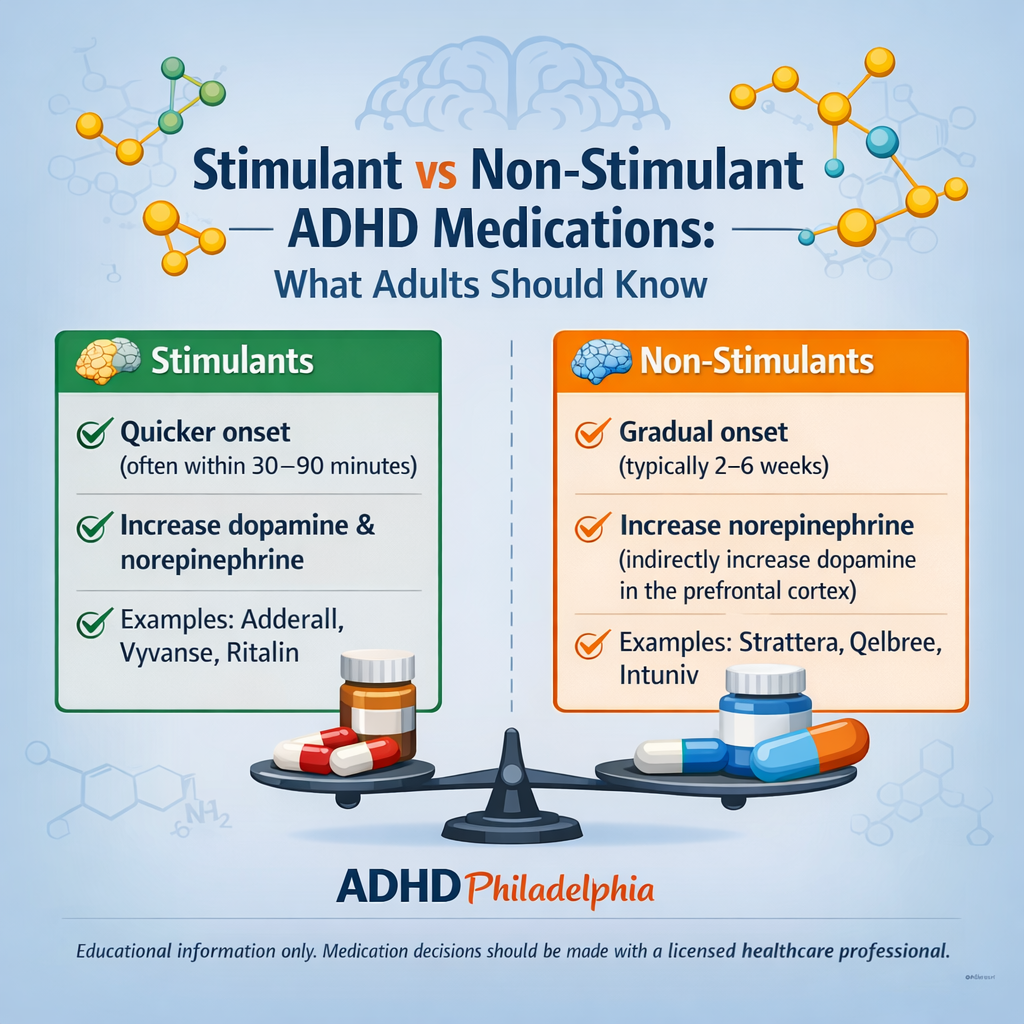
Stimulant vs Non-Stimulant ADHD Medications: What Adults Should Know
Stimulant and non-stimulant ADHD medications work differently in the brain. Learn how each option helps adults improve focus and executive function.
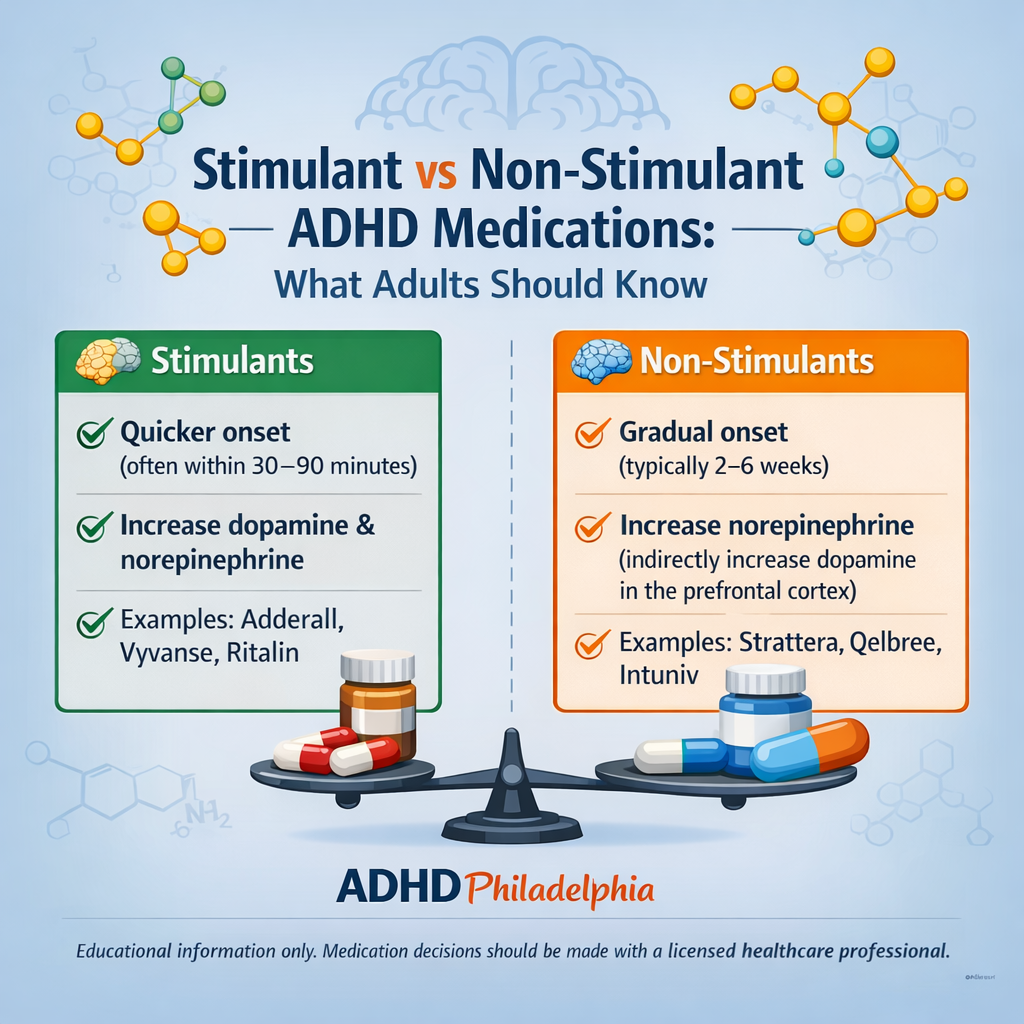
Many adults living with ADHD eventually ask the same question:
“What medication is best for ADHD — stimulants or non-stimulants?”
Understanding the difference can help patients feel more informed and confident about treatment decisions.
At ADHDPhiladelphia.com, we work with adults across Pennsylvania and Delaware who are seeking clear information about ADHD medications and how they affect the brain.
The goal is always the same: help the brain regulate focus, motivation, and executive function more effectively.
Some adults seek treatment for anxiety before realizing their symptoms may actually be related to ADHD. Because the two conditions can overlap, it’s important to understand the difference. Our article on ADHD vs anxiety in adults explains how clinicians distinguish between these conditions.
How ADHD Affects the Brain
ADHD is a neurodevelopmental condition that affects how the brain regulates attention, organization, and impulse control.
The brain regions most involved include:
• Prefrontal cortex
• Anterior cingulate cortex
• Dopamine reward pathways
• Norepinephrine attention systems
These systems help regulate:
• focus
• motivation
• working memory
• task completion
• emotional regulation
When these systems are underactive or dysregulated, everyday tasks can feel significantly harder than they should.
Medication is one of the tools that can help restore more balanced signaling in these networks.
What Are Stimulant ADHD Medications?
Stimulant medications are the most commonly prescribed treatment for ADHD.
They work by increasing the availability of dopamine and norepinephrine, two neurotransmitters that help regulate attention and motivation.
Common stimulant medications include:
• Adderall (amphetamine salts)
• Vyvanse (lisdexamfetamine)
• Ritalin (methylphenidate)
• Concerta (extended-release methylphenidate)
These medications help improve:
• sustained focus
• mental clarity
• task initiation
• impulse control
For many adults, stimulants work quickly and effectively and are often considered first-line treatment.
What Are Non-Stimulant ADHD Medications?
Non-stimulant medications are another option for treating ADHD.
They typically work more gradually by affecting norepinephrine signaling or other regulatory systems in the brain.
Examples include:
• Atomoxetine (Strattera)
• Guanfacine (Intuniv)
• Clonidine
• Certain antidepressants used off-label
Non-stimulants may be recommended when:
• stimulants cause side effects
• there is a medical reason stimulants are not appropriate
• patients prefer a non-stimulant option
• there is concern about misuse or dependence
These medications often take several weeks to reach full effectiveness.
How Doctors Decide Which Medication Is Best
Choosing the right ADHD medication is a personalized process.
Clinicians typically consider:
• symptom severity
• previous medication history
• sleep patterns
• anxiety or mood symptoms
• work demands
• medical history
The goal is to find a treatment plan that helps the brain function better while minimizing side effects.
ADHD Treatment Is More Than Medication
Medication can be a powerful tool, but it works best alongside other strategies:
• structured routines
• sleep optimization
• exercise
• ADHD coaching
• therapy when needed
Many adults experience meaningful improvement when treatment is individualized and monitored carefully.
ADHD Testing and Treatment in Pennsylvania and Delaware
If you’re an adult struggling with focus, procrastination, or mental overload, an ADHD evaluation may help provide answers.
At ADHDPhiladelphia.com, we provide:
✔ Adult ADHD evaluations
✔ Medication management
✔ Telehealth appointments across Pennsylvania and Delaware
✔ Ongoing treatment monitoring
Many adults discover that ADHD has been affecting their work, education, and daily life for years without realizing it.
The good news is that effective treatments are available.
Schedule an ADHD Evaluation
Learn more or schedule an appointment at:
https://www.ADHDPhiladelphia.com
—
Charles T
Psychiatric Nurse Practitioner
Adult ADHD Specialist

Why Adults With ADHD Struggle With Focus — and How Treatment Helps the Brain Work Better
Adults with ADHD often struggle with focus, organization, and motivation. Learn how ADHD affects the brain and how professional testing and treatment in Philadelphia and Delaware can help improve attention and daily functioning.
Why Adults With ADHD Struggle With Focus — and How Treatment Helps the Brain Work Better
Many adults believe their difficulty focusing is simply a matter of discipline or motivation. They may blame themselves for procrastination, unfinished projects, or feeling overwhelmed by tasks that seem easy for others.
However, for millions of adults, these struggles are not a character flaw. They are often symptoms of Attention-Deficit/Hyperactivity Disorder (ADHD) — a neurodevelopmental condition that affects how the brain regulates attention, motivation, and executive functioning.
Understanding what is happening in the brain can help people realize that effective treatment is available and that improvement is possible.
ADHD Is a Brain Regulation Condition
ADHD affects the brain systems responsible for executive functioning, which includes:
Sustaining attention
Organizing tasks
Managing time
Prioritizing responsibilities
Regulating impulses
Maintaining motivation
These skills rely heavily on activity in the prefrontal cortex, a region of the brain responsible for planning, decision-making, and attention regulation.
Research shows that people with ADHD often experience differences in dopamine and norepinephrine signaling within these brain networks, which can make it more difficult to maintain consistent attention and motivation.
This means a person with ADHD can focus, but often struggles to do so when they need to, for as long as they need to, or on tasks that are not immediately rewarding. manual-executive-function-adhd-…
Common Signs of Undiagnosed Adult ADHD
Many adults do not realize their symptoms may be related to ADHD. Some of the most common experiences include:
• Difficulty finishing projects
• Losing focus during conversations
• Forgetting appointments or deadlines
• Feeling overwhelmed by organization tasks
• Procrastinating even on important responsibilities
• Struggling with time management
• Frequently switching between tasks without completing them
Because ADHD often persists from childhood into adulthood, many people have lived with these challenges for years without realizing there may be an underlying explanation.
Why ADHD Often Goes Undiagnosed in Adults
Adult ADHD is commonly overlooked for several reasons:
1️⃣ Symptoms may have been misunderstood during childhood
2️⃣ Adults develop coping strategies that mask symptoms
3️⃣ Many people assume ADHD only affects children
4️⃣ Symptoms overlap with stress, anxiety, or depression
As a result, adults may struggle silently while assuming their challenges are simply part of their personality.
The Good News: ADHD Is Treatable
The encouraging reality is that ADHD is one of the most treatable conditions in mental health.
Treatment may include:
Evidence-based medication options
Behavioral strategies
Executive function skill development
Structured routines and planning systems
Stimulant and non-stimulant medications are among the most researched and effective treatments available for ADHD when prescribed and monitored appropriately. manual-advances-management-adhd
Many adults experience significant improvement in focus, productivity, and overall quality of life once treatment begins.
ADHD Testing and Treatment in Pennsylvania and Delaware
At ADHDPhiladelphia.com, we specialize in evaluating and treating adult ADHD through a structured, professional process designed to help individuals better understand their symptoms and develop an effective treatment plan.
Services include:
Adult ADHD evaluation
Medication management when appropriate
Ongoing monitoring and follow-up care
Personalized treatment planning
Appointments begin through secure telehealth, allowing patients to receive care from the comfort of home.
When appropriate, in-person appointments may be scheduled after the initial telehealth visit.
When to Consider ADHD Testing
You may want to consider an evaluation if you regularly experience:
• Persistent difficulty focusing
• Chronic procrastination
• Trouble organizing tasks
• Problems finishing projects
• Frequent mental overwhelm
• Difficulty managing responsibilities
Seeking professional evaluation can provide clarity and help determine whether ADHD may be contributing to these challenges.
Moving Forward
If you believe ADHD may be affecting your focus or daily functioning, professional evaluation can provide answers and help guide effective treatment options.
You can learn more about testing and treatment options at:

Why Smart Adults Often Miss an ADHD Diagnosis (And What To Do About It)
High-functioning adults often compensate for ADHD symptoms until stress and burnout increase. Learn how intelligence can mask executive dysfunction and why a structured ADHD evaluation in Pennsylvania and Delaware matters.
Many high-achieving adults are surprised to learn they have ADHD.
They finished college.
They built careers.
They manage responsibilities.
So how could ADHD have been missed?
The answer is simple: intelligence can compensate — until it can’t.
For many adults in Pennsylvania and Delaware, ADHD isn’t obvious in childhood. Instead, it becomes more visible when life demands exceed coping strategies.
Why ADHD Is Often Overlooked in Smart Adults
ADHD is not a measure of intelligence.
In fact, many adults with ADHD are:
• Creative
• Verbally strong
• High-performing under pressure
• Capable of last-minute success
Strong cognitive ability can mask executive dysfunction for years.
Deadlines get met — but through stress.
Assignments get completed — but at the last minute.
Work gets done — but at personal cost.
Eventually, the compensatory strategies stop working.
This pattern is particularly common among high-achieving adults whose professional success may hide significant executive-function strain. Learn more in our guide to Adult ADHD Care for Professionals.
What Changes in Adulthood?
As responsibilities increase, ADHD symptoms become harder to hide.
Adults may begin noticing:
• Chronic procrastination
• Decision fatigue
• Difficulty initiating tasks
• Inconsistent productivity
• Emotional overwhelm
• Burnout despite effort
At this stage, many are misdiagnosed with anxiety, depression, or simple stress.
A structured adult ADHD evaluation helps clarify the difference.
You can learn more about our adult ADHD evaluation process here.
The Hidden Cost of Compensation
When ADHD is undiagnosed, adults often internalize the struggle.
They may think:
“I’m lazy.”
“I’m not disciplined.”
“I should be doing better.”
Over time, chronic stress can impact sleep, emotional regulation, and overall health.
Research suggests untreated ADHD may contribute to long-term risk patterns related to impulsivity and lifestyle instability.
You can read more about how undiagnosed ADHD may impact long-term health here.
Why Proper Diagnosis Matters
A comprehensive ADHD evaluation includes:
• Structured clinical interview
• Functional impairment assessment
• Review of childhood history
• Screening for overlapping conditions
• When appropriate, ADHD testing
Diagnosis is not based on intelligence.
It is based on persistent patterns of executive dysfunction and impairment.
If ADHD is diagnosed, structured treatment options are reviewed.
Learn more about our ADHD treatment and medication management approach.
What To Do If This Sounds Familiar
If you are a high-functioning adult who has always “managed” but never felt stable, it may be worth exploring whether ADHD is part of the picture.
Clarity is not about labeling.
It is about understanding how your brain works — and building sustainable systems around it.
Adult ADHD Care in Pennsylvania & Delaware
At ADHD Philadelphia, we specialize exclusively in adult ADHD diagnosis and structured treatment.
Telehealth appointments are available throughout Pennsylvania and Delaware.
In-person appointments may be scheduled after the initial evaluation when clinically appropriate.
There are no walk-in appointments.
Ready to Take the Next Step?
If you suspect ADHD may have been overlooked, a structured evaluation can provide clarity.

How Do You Know If ADHD Medication Is Working in Adults?
Learn how to tell if ADHD medication is working in adults. Discover what improvement should look like, when adjustments are needed, and how structured monitoring supports safe ADHD treatment in Pennsylvania and Delaware.
One of the most common questions adults ask after starting ADHD medication is:
“Is this actually working?”
For adults diagnosed with ADHD, improvement is not always dramatic. It is often subtle — but clinically meaningful.
Understanding what improvement should look like helps ensure treatment remains safe, appropriate, and effective.
If you are unsure how adult ADHD is diagnosed, you can learn more about our comprehensive evaluation process here.
What Improvement Should Look Like
When medication is properly matched and monitored, adults often notice:
• Improved task initiation
• Reduced procrastination
• Increased sustained attention
• Better organization
• Fewer careless mistakes
• Improved emotional regulation
It may not feel like a “burst of motivation.”
Instead, it often feels like:
“It’s easier to start.”
What Medication Should NOT Do
Medication should not:
• Make you feel euphoric
• Cause severe anxiety
• Dramatically alter personality
• Eliminate normal fatigue
• Replace healthy habits
If side effects outweigh benefits, adjustments are needed.
How Long Does It Take?
Stimulants may begin working the same day.
Non-stimulants may take several weeks.
However, effectiveness must be evaluated over time.
That’s why structured 30-day monitoring is important.
Medication effectiveness should always be evaluated in the context of overall functioning, medical history, and safety considerations.
👉 Learn more about our Medication Management & Stimulant Treatment Policy.
Measuring Functional Improvement
Medication success is measured by:
• Workplace performance
• Academic productivity
• Household task completion
• Time management
• Emotional stability
It is not measured by “feeling different.”
It is measured by functioning better.
When Adjustments Are Needed
You may need adjustment if:
• Benefits are inconsistent
• Focus improves but anxiety worsens
• Sleep becomes disrupted
• Blood pressure increases
• Motivation improves but organization does not
Medication is one tool — not the entire solution.
Comprehensive ADHD treatment often includes behavioral strategies, executive functioning support, and lifestyle optimization alongside medication management.
ADHD Treatment in Pennsylvania & Delaware
At ADHD Philadelphia, medication effectiveness is evaluated through structured follow-up and symptom review.
Treatment decisions are individualized and may include stimulant or non-stimulant options depending on clinical presentation.
You can also read our detailed comparison of stimulant vs non-stimulant ADHD medications here.
Telehealth available throughout Pennsylvania & Delaware.
In-person appointments may be scheduled after the initial visit.
We serve adults in Philadelphia, Montgomery County, Bucks County, Chester County, Wilmington, Newark, Dover, and surrounding communities.
Ready to Begin?
If you are an adult located in Pennsylvania or Delaware and unsure whether ADHD medication may be appropriate, schedule a comprehensive evaluation to review your symptoms, medical history, and treatment options.

ADHD vs Anxiety in Adults: How to Tell the Difference in Pennsylvania and Delaware
Many adults come to evaluation asking:
“Is this ADHD… or is it anxiety?”
The truth is — they can look similar.
Both can cause:
Difficulty concentrating
Restlessness
Sleep problems
Racing thoughts
Irritability
But they are not the same condition.
Understanding the difference matters. Treatment plans are very different.
The Core Difference: Regulation vs Worry
ADHD is primarily a disorder of executive function and self-regulation.
Anxiety is primarily a disorder of excessive fear and anticipatory worry.
In ADHD:
The mind jumps because it is under-regulated.
Focus drops when interest drops.
Time management collapses under low stimulation.
In anxiety:
Focus drops because worry consumes cognitive bandwidth.
Thoughts loop around fear-based themes.
Avoidance behaviors increase.
How ADHD Presents in Adults
Adult ADHD often includes:
Chronic procrastination
Time blindness
Difficulty starting tasks
Forgetfulness
Losing items
Interrupting conversations
Emotional impulsivity
These patterns are lifelong — even if they were masked in childhood.
If you haven’t read it yet, see:
👉 What Happens During an Adult ADHD Evaluation?
👉 How Long Does an Adult ADHD Evaluation Take?
How Anxiety Presents in Adults
Anxiety more often includes:
Excessive worry about worst-case outcomes
Physical tension
Panic episodes
Catastrophic thinking
Avoidance of feared situations
Sleep disruption due to rumination
The driver is fear — not executive dysfunction.
When ADHD and Anxiety Overlap
Many adults have both.
Chronic executive dysfunction can create secondary anxiety.
Missing deadlines repeatedly can create fear of failure.
This is why rushed diagnoses are risky.
A thorough ADHD evaluation includes differential diagnosis screening to ensure accuracy.
If you’ve ever wondered whether your symptoms are related to attention difficulties or worry-driven thinking patterns, our article on the difference between ADHD and anxiety in adults explains the key signs to look for.
Why Accurate Diagnosis Matters
Treating anxiety as ADHD may leave core fear untreated.
Treating ADHD as anxiety may leave executive dysfunction untreated.
Medication decisions differ.
Therapy approaches differ.
Behavioral systems differ.
If you're in Pennsylvania or Delaware and unsure which condition applies, a structured evaluation can clarify the difference.
Serving Adults in PA & DE
At ADHDPhiladelphia.com, adult evaluations are:
DSM-aligned
Executive-function informed
Differential-diagnosis focused
Designed to reduce misdiagnosis
Telehealth is available throughout Pennsylvania and Delaware.
In-person appointments are available after the initial telehealth visit. No walk-ins.
If you’ve been wondering whether your concentration difficulties are ADHD or anxiety, the next step is a careful evaluation.
👉Book your consultation today.

What Happens During an Adult ADHD Evaluation? A Step-by-Step Breakdown
What actually happens during an adult ADHD evaluation? This step-by-step breakdown explains the diagnostic process, DSM criteria review, executive function assessment, and rule-outs used for accurate ADHD diagnosis in Pennsylvania and Delaware.
Many adults consider ADHD testing only after years of struggling with focus, procrastination, disorganization, emotional overwhelm, forgetfulness, poor time management, and difficulty following through.
They may wonder whether ADHD explains why daily life feels harder than it should.
They may also feel nervous because they do not know what actually happens during an adult ADHD evaluation.
Will it be just a questionnaire?
Will the provider take enough time to understand the full picture?
Will anxiety, depression, sleep problems, or stress be considered?
Will treatment options be explained clearly?
Will medication be discussed responsibly?
At ADHD Philadelphia, the adult ADHD evaluation process is designed to provide clarity, not confusion. The goal is to understand your symptoms, history, functioning, executive function challenges, and treatment options in a structured and professional way.
ADHD Philadelphia provides adult ADHD testing, evaluation, and treatment for adults in Pennsylvania and Delaware. Initial appointments begin through secure telehealth. In-person appointments may be scheduled after the first online appointment when clinically appropriate. There are no walk-in appointments.
The National Institute of Mental Health explains that ADHD involves ongoing patterns of inattention, hyperactivity, and/or impulsivity that can interfere with daily functioning, and that symptoms may continue into adulthood.
Step 1: Understanding Why You Are Seeking an Evaluation
The first part of an adult ADHD evaluation is understanding what brought you in.
Many adults seek testing because they are tired of repeating the same patterns:
Difficulty focusing
Starting tasks but not finishing them
Missing deadlines
Feeling overwhelmed by simple responsibilities
Forgetting appointments or messages
Struggling with time management
Feeling emotionally reactive
Procrastinating even when tasks are important
Feeling mentally scattered
Having trouble staying organized
Losing momentum after interruptions
Feeling like they are working harder than everyone else just to keep up
The purpose of the first conversation is to understand your concerns in your own words.
ADHD evaluation should not begin with assumptions. It should begin with listening.
A structured adult ADHD testing and evaluation process can help clarify whether focus problems, procrastination, forgetfulness, disorganization, emotional overwhelm, and executive dysfunction may be related to ADHD.
Step 2: Reviewing Current ADHD Symptoms
Adult ADHD symptoms may look different from childhood ADHD.
Some adults are not visibly hyperactive. Instead, they may experience internal restlessness, mental clutter, racing thoughts, trouble relaxing, emotional reactivity, or a constant feeling of being behind.
Current ADHD symptoms may include:
Difficulty sustaining attention
Trouble organizing tasks
Avoiding tasks that require sustained mental effort
Forgetfulness
Losing items
Distractibility
Restlessness
Impulsivity
Interrupting
Difficulty waiting
Emotional reactivity
Poor follow-through
Difficulty finishing tasks
Problems with time management
The evaluation reviews these symptoms in the context of real life.
This matters because ADHD is not diagnosed only by having symptoms. Symptoms must also cause impairment in daily functioning.
Recognizing adult ADHD symptoms can help adults understand why focus problems, procrastination, disorganization, emotional overwhelm, and inconsistent follow-through may have a clinical explanation.
Step 3: Reviewing Childhood and Earlier Life Patterns
Adult ADHD does not usually appear suddenly for the first time in adulthood.
A strong evaluation looks at whether similar symptoms or patterns were present earlier in life, even if they were missed.
Some adults were never diagnosed as children because they were bright, quiet, anxious, high-achieving, or able to compensate. Others were labeled as smart but inconsistent, forgetful, disorganized, emotional, scattered, or not living up to their potential.
Earlier signs may have included:
Daydreaming in class
Losing homework
Forgetting assignments
Messy backpack or bedroom
Procrastinating until the last minute
Talking too much
Interrupting
Difficulty sitting still
Emotional sensitivity
Strong performance in some subjects but not others
Needing pressure to finish schoolwork
Being told you had potential but did not apply yourself
Reviewing earlier life patterns helps determine whether ADHD symptoms are part of a long-standing pattern.
Many adults begin to recognize ADHD only after learning the signs you might have adult ADHD and not know it, especially when long-standing patterns with focus, organization, time, and follow-through finally make sense.
Step 4: Looking at Functional Impairment
ADHD diagnosis requires more than symptoms. It also requires impairment.
Functional impairment means the symptoms are affecting daily life in meaningful ways.
Adult ADHD may affect:
Work performance
School responsibilities
Home organization
Parenting
Relationships
Finances
Appointments
Communication
Driving
Time management
Health routines
Self-confidence
Emotional well-being
For example, an adult may be able to focus sometimes, but still struggle with missed deadlines, unfinished tasks, chronic lateness, disorganization, forgetfulness, or emotional overwhelm.
The evaluation looks at how symptoms affect real life, not just whether symptoms exist on paper.
Many adults seek evaluation because adult ADHD can make follow-through difficult even when you care, especially when executive function challenges affect task initiation, planning, working memory, and consistency.
Step 5: Assessing Executive Function
Executive function refers to the brain skills that help people manage daily life.
These skills include:
Planning
Prioritizing
Organizing
Starting tasks
Managing time
Regulating emotions
Holding information in mind
Controlling impulses
Switching between tasks
Finishing responsibilities
Following through over time
Many adults with ADHD do not struggle because they lack intelligence or effort. They struggle because executive dysfunction interferes with turning intention into action.
They may know what to do.
They may care deeply.
They may understand the consequences.
They may even have the ability to complete the task.
But the brain may struggle to initiate, organize, sustain, and complete the behavior consistently.
That is why executive function is a major part of adult ADHD evaluation.
Problems with executive function in adults can affect planning, working memory, organization, emotional regulation, time management, task initiation, and follow-through.
Read our complete guide to planning skills in adults with ADHD to understand how planning challenges may affect deadlines, projects, preparation, and daily responsibilities.
Step 6: Screening for Anxiety, Depression, Sleep Problems, and Other Rule-Outs
A strong ADHD evaluation does not assume every focus problem is ADHD.
Many conditions can affect attention, motivation, memory, emotional regulation, and follow-through.
These may include:
Anxiety
Depression
Bipolar disorder
Trauma
Sleep disorders
Substance use concerns
Chronic stress
Burnout
Medical conditions
Medication side effects
Grief
Learning disorders
This is why adult ADHD diagnosis should involve clinical judgment.
A quick online quiz may be a starting point, but it cannot fully determine whether ADHD is the primary explanation for symptoms.
The evaluation should ask:
Could this be ADHD?
Could something else be contributing?
Could ADHD and another condition both be present?
The goal is diagnostic clarity.
For many adults, understanding ADHD vs anxiety in adults is important because both can affect concentration, restlessness, sleep, motivation, emotional regulation, and daily functioning.
Step 7: Reviewing DSM Criteria
Adult ADHD diagnosis should be based on a structured clinical process.
Part of that process includes reviewing whether symptoms are consistent with diagnostic criteria for ADHD.
This may include evaluating symptoms of inattention, hyperactivity, and impulsivity. It may also include reviewing whether symptoms were present earlier in life, occur in more than one setting, and create meaningful impairment.
For adults, ADHD may present as:
Poor focus
Difficulty completing tasks
Disorganization
Forgetfulness
Restlessness
Impulsivity
Emotional reactivity
Difficulty managing time
Difficulty sustaining effort
Trouble following through
The provider should interpret these symptoms clinically, not simply count them mechanically.
A careful adult ADHD diagnosis and evaluation reviews symptoms, history, impairment, executive functioning, and other possible explanations before treatment planning begins.
Step 8: Using Questionnaires or Computerized Testing When Clinically Appropriate
Adult ADHD evaluation may include rating scales, questionnaires, or computerized testing when clinically appropriate.
These tools can provide helpful information about attention, impulsivity, symptom patterns, and functional impairment.
However, testing tools should not replace the clinical interview.
A test score alone does not diagnose ADHD.
A checklist alone does not diagnose ADHD.
A questionnaire alone does not explain the whole person.
The best evaluation uses multiple sources of information, including symptoms, history, impairment, clinical presentation, and rule-outs.
Testing may support the diagnostic process, but it should be interpreted within the full clinical picture.
When clinically appropriate, adult ADHD testing in Pennsylvania and Delaware may include clinical interview, symptom review, functional impairment assessment, questionnaires, and computerized testing to support diagnostic clarity.
Step 9: Discussing Results Clearly
After the evaluation, the findings should be explained in clear language.
Patients should understand:
Whether ADHD appears to be present
What symptoms are most impairing
Whether other conditions may also be contributing
What treatment options may be appropriate
Whether medication may be clinically appropriate
What non-medication strategies may help
What follow-up care looks like
What safety monitoring may be needed
A good evaluation should help people feel more informed, not more confused.
At ADHD Philadelphia, the goal is to help adults understand what is happening and what steps may come next.
Understanding the ADHD Philadelphia patient journey can help adults know what to expect from evaluation, diagnosis, treatment planning, follow-up care, and ongoing monitoring.
Step 10: Creating an Individualized Treatment Plan
If ADHD is diagnosed, the next step is treatment planning.
Treatment may include:
ADHD education
Executive function strategies
Behavioral tools
Lifestyle and sleep review
Medication management when clinically appropriate
Therapy referrals when appropriate
Support for routines and planning
Ongoing monitoring
Treatment should be individualized.
One adult may need support with work performance and task initiation. Another may need help with emotional regulation, routines, or follow-through. Another may need medication management when clinically appropriate.
The goal is not perfection. The goal is better functioning, better understanding, and better support.
After diagnosis, adult ADHD treatment may include education, executive function strategies, lifestyle changes, and medication management when clinically appropriate.
Step 11: Discussing Medication Management When Appropriate
Medication may be discussed when clinically appropriate.
This conversation should include education, informed consent, review of health history, medication history, safety considerations, and follow-up expectations.
Stimulant medications are controlled substances and require responsible monitoring.
At ADHD Philadelphia, patients are monitored over time. Treatment response, side effects, functioning, safety, and appropriateness are reviewed during follow-up care.
For stimulant medication, follow-up is typically required every 30 days for safety monitoring, treatment response, and dosage adjustments. ADHD Philadelphia also reviews the prescription drug monitoring program as part of controlled-substance prescribing procedures.
Medication is not the only part of ADHD treatment, but for some adults it can be an important part of a structured plan.
Patients can review the Medication Management & Stimulant Treatment Policy to better understand ADHD Philadelphia’s expectations for stimulant medication monitoring, controlled-substance safety, follow-up visits, and treatment requirements.
When clinically appropriate, ADHD medication management for adults may support focus, task initiation, emotional regulation, and daily functioning as part of a monitored treatment plan.
Step 12: Planning Follow-Up Care
ADHD care should not stop after diagnosis.
Follow-up matters because symptoms, side effects, functioning, and treatment needs can change over time.
Follow-up appointments may review:
Symptom improvement
Medication response
Side effects
Sleep
Appetite
Mood
Anxiety
Blood pressure or other safety concerns when needed
Daily functioning
Work or school performance
Follow-through
Treatment goals
Plan adjustments
Ongoing care helps ensure treatment remains clinically appropriate and useful.
Many adults feel relief when they learn that ADHD treatment can help explain patterns they once blamed on laziness or lack of discipline.
Telehealth ADHD Evaluation in Pennsylvania and Delaware
ADHD Philadelphia provides adult ADHD evaluation and treatment for adults in Pennsylvania and Delaware.
Initial appointments begin through secure telehealth. This can make care more accessible for busy adults, professionals, students, parents, remote workers, healthcare workers, and people who have struggled to begin the evaluation process.
In-person appointments may be scheduled after the first online appointment when clinically appropriate. There are no walk-in appointments.
Telehealth can reduce barriers while still allowing for structured assessment, education, treatment planning, and follow-up.
Adults searching for ADHD testing in Pennsylvania can begin with a structured telehealth evaluation through ADHD Philadelphia.
Adults searching for ADHD testing in Delawarecan also begin with a secure telehealth evaluation through ADHD Philadelphia.
Adults searching for adult ADHD testing in Philadelphia can begin with ADHD Philadelphia’s structured evaluation process.
Adults searching for ADHD testing in Wilmington, Delaware can begin care through ADHD Philadelphia’s Delaware telehealth services.
Frequently Asked Questions About Adult ADHD Evaluation
Is adult ADHD testing just a questionnaire?
No. Questionnaires can be helpful, but adult ADHD evaluation should include a clinical interview, symptom history, functional impairment review, screening for overlapping conditions, and additional testing when clinically appropriate.
Can adults be diagnosed with ADHD for the first time?
Yes. Many adults are diagnosed later in life after years of struggling with focus, organization, procrastination, emotional regulation, forgetfulness, or follow-through.
What happens during the first ADHD appointment?
The first appointment usually includes a detailed conversation about symptoms, history, functioning, mental health, sleep, medical history, and how attention or executive function problems affect daily life.
Does ADHD Philadelphia offer computerized testing?
Computerized attention and impulse-control testing may be used when clinically appropriate. It is one part of the evaluation and is interpreted along with the clinical interview, symptom history, and functional impairment.
Can anxiety or depression look like ADHD?
Yes. Anxiety, depression, trauma, sleep problems, chronic stress, substance use, and other concerns can affect attention, motivation, memory, and emotional regulation. This is why a comprehensive evaluation is important.
Does ADHD Philadelphia evaluate adults in Pennsylvania and Delaware?
Yes. ADHD Philadelphia provides adult ADHD testing and treatment for adults in Pennsylvania and Delaware. Initial appointments begin through telehealth. In-person appointments may be scheduled after the first online appointment when clinically appropriate. No walk-in appointments are available.
What happens if ADHD is diagnosed?
If ADHD is diagnosed, the next step is an individualized treatment plan. This may include ADHD education, executive function strategies, lifestyle review, medication management when clinically appropriate, and ongoing monitoring.
Take the First Step
Getting evaluated for ADHD does not have to feel confusing or intimidating.
A structured ADHD evaluation can help you understand why focus, organization, time management, emotional regulation, and follow-through have felt harder than they should.
If you are an adult in Pennsylvania or Delaware and think ADHD may be affecting your life, ADHD Philadelphia can help you take the next step.
Schedule an adult ADHD evaluation today through ADHD Philadelphia.
Medical Disclaimer
This article is for educational purposes only and is not a substitute for medical advice, diagnosis, or treatment. If you are experiencing symptoms of ADHD, anxiety, depression, sleep problems, substance use concerns, or another mental health concern, consult a qualified healthcare professional.

How Long Does an Adult ADHD Evaluation Take in Pennsylvania or Delaware?
Wondering how long adult ADHD testing takes? Learn what to expect from ADHD evaluation in Pennsylvania and Delaware, including clinical interview, testing, diagnosis, treatment planning, and follow-up.
Many adults who are thinking about ADHD testing want to know what the process actually looks like.
One of the most common questions is:
“How long does an adult ADHD evaluation take?”
The answer depends on the structure of the evaluation. A proper ADHD evaluation should not feel like a rushed checklist. It should include a careful review of symptoms, history, daily functioning, executive function challenges, overlapping mental health concerns, and treatment options when appropriate.
At ADHD Philadelphia, the adult ADHD evaluation process is designed to be clear, structured, and practical for adults in Pennsylvania and Delaware.
Initial appointments begin through secure telehealth. In-person appointments may be scheduled after the first online appointment when clinically appropriate. There are no walk-in appointments.

Why the ADHD Evaluation Process Should Be Structured
Adult ADHD can affect focus, organization, time management, emotional regulation, procrastination, forgetfulness, task initiation, and follow-through.
But ADHD symptoms can also overlap with other concerns, including anxiety, depression, sleep problems, trauma, substance use, chronic stress, medication side effects, and medical conditions.
That is why an adult ADHD evaluation should involve more than a quick questionnaire.
A structured evaluation helps answer important questions:
Are the symptoms consistent with ADHD?
How long have the symptoms been present?
Did similar patterns exist earlier in life?
Are symptoms affecting work, school, home, relationships, or daily responsibilities?
Could another condition be contributing?
Would treatment be appropriate?
What type of treatment plan makes sense?
The goal is not just to label symptoms. The goal is diagnostic clarity.
A structured adult ADHD testing and evaluation process can help clarify whether poor focus, procrastination, forgetfulness, disorganization, emotional overwhelm, and executive dysfunction are related to ADHD.
How Long Does the First ADHD Appointment Take?
The first appointment is usually focused on understanding the patient’s current concerns, symptom history, daily functioning, and treatment goals.
This appointment may include discussion of:
Focus and concentration
Task completion
Organization
Time management
Procrastination
Forgetfulness
Emotional regulation
Sleep
Work or school performance
Home responsibilities
Relationships
Medical history
Mental health history
Current medications
Substance use concerns
Past treatment experience
The first appointment is important because adult ADHD does not exist in isolation. Symptoms need to be understood in the context of the whole person.
Some adults come in already feeling confident they have ADHD. Others are unsure and simply know that something has felt harder than it should for a long time.
Both situations deserve a careful evaluation.
A careful adult ADHD diagnosis and evaluation starts with understanding how symptoms affect daily functioning, work performance, relationships, emotional regulation, and follow-through.
Why ADHD Diagnosis Usually Takes More Than One Step
Adult ADHD diagnosis often requires more than one step because the clinician needs to understand both symptoms and impairment.
A person may have trouble focusing, but that does not automatically mean ADHD is the cause. Concentration problems can also come from anxiety, depression, poor sleep, grief, trauma, burnout, substance use, medication side effects, or other concerns.
A multi-step process helps reduce the risk of misdiagnosis.
It also gives the provider time to review whether symptoms are consistent, long-standing, impairing, and clinically appropriate for ADHD treatment.
At ADHD Philadelphia, the evaluation process is designed to provide clarity before treatment planning.
For many adults, understanding ADHD vs anxiety in adults is important because both can affect concentration, restlessness, sleep, motivation, emotional regulation, and daily functioning.
What Is Reviewed During an Adult ADHD Evaluation?
A strong adult ADHD evaluation reviews more than attention.
It may include:
Current symptoms
Childhood or earlier life patterns
Functional impairment
Executive function challenges
Mental health history
Medical history
Medication history
Sleep patterns
Substance use concerns
Work or school functioning
Relationship and home functioning
Treatment goals
Safety considerations
Computerized testing when clinically appropriate
This helps create a fuller picture of what is happening.
For example, an adult may say they are distracted at work. But the evaluation may reveal deeper patterns: difficulty starting tasks, losing track of time, emotional overwhelm, chronic procrastination, poor working memory, and inconsistent follow-through.
Those details matter because they help guide the treatment plan.
Adults who want a deeper explanation can learn more about the ADHD evaluation process at ADHD Philadelphia, including clinical interview, symptom review, executive function assessment, testing when appropriate, and treatment planning.
Why Executive Function Matters in ADHD Testing
Many adults do not seek ADHD testing because they are “unable to focus all the time.”
They seek help because they cannot reliably manage daily life.
They may know what to do but struggle to do it consistently. They may care deeply but still miss deadlines, forget tasks, avoid responsibilities, or feel overwhelmed by simple decisions.
This is where executive function becomes important.
Executive function includes brain-based skills such as:
Planning
Prioritizing
Starting tasks
Sustaining attention
Managing time
Organizing information
Regulating emotions
Remembering steps
Controlling impulses
Following through
Completing tasks
Adult ADHD often affects these skills. That is why ADHD evaluation should look at how symptoms show up in real life, not just how someone answers a checklist.
Problems with executive function in adults can affect planning, working memory, organization, emotional regulation, time management, task initiation, and follow-through.
Does ADHD Testing Include Computerized Testing?
Computerized ADHD testing may be used when clinically appropriate.
This type of testing can provide additional information about attention, response consistency, impulsivity, and sustained focus. It can be helpful as one part of the evaluation process.
However, computerized testing should not replace the clinical interview.
A test score alone does not diagnose ADHD. A questionnaire alone does not diagnose ADHD. A strong evaluation considers symptoms, history, impairment, clinical presentation, and other possible explanations.
The goal is to use testing as part of a broader diagnostic process.
When clinically appropriate, adult ADHD testing in Pennsylvania and Delaware may include clinical interview, symptom review, functional impairment assessment, and computerized testing to support diagnostic clarity.
Why Some Evaluations Take Longer Than Others
Not every adult ADHD evaluation is the same.
Some cases are straightforward. Others require more careful review.
An evaluation may take longer when:
Symptoms overlap with anxiety or depression
Sleep problems are present
There is a history of trauma
Substance use concerns need review
The patient has complex medical history
Past medication response needs clarification
Symptoms are inconsistent
There are safety concerns
Records or collateral information are needed
The patient has multiple diagnoses
This does not mean something is wrong. It means the provider is being careful.
A good evaluation should move efficiently, but it should not skip important clinical questions.
Understanding the ADHD Philadelphia patient journey can help adults know what to expect from evaluation, diagnosis, treatment planning, follow-up care, and ongoing monitoring.
What Happens After the Evaluation?
After the evaluation, the next step is reviewing the findings and creating a treatment plan if ADHD is diagnosed.
Treatment may include:
ADHD education
Executive function strategies
Behavioral tools
Lifestyle and sleep review
Medication management when clinically appropriate
Therapy referrals when appropriate
Routine-building support
Ongoing follow-up and monitoring
The treatment plan should be individualized. Adult ADHD affects people differently, and treatment should consider symptoms, goals, medical history, mental health history, safety, functioning, and treatment response.
At ADHD Philadelphia, the goal is not just to diagnose ADHD. The goal is to help adults understand what is happening and what can be done next.
After diagnosis, adult ADHD treatment may include education, executive function strategies, lifestyle changes, and medication management when clinically appropriate.
How Long Until Treatment Starts?
Treatment planning begins after the evaluation supports an ADHD diagnosis and the provider determines that treatment is clinically appropriate.
The exact timing depends on the person’s situation.
For some adults, treatment may begin after the diagnostic process is completed and safety considerations are reviewed. For others, additional information may be needed before medication or other treatment options are started.
This may include review of medical history, current medications, blood pressure, heart history, substance use concerns, psychiatric history, or other safety factors.
Responsible ADHD treatment should not be rushed.
The goal is to choose a treatment plan that is appropriate, safe, and clinically sound.
When clinically appropriate, ADHD medication management for adults may support focus, task initiation, emotional regulation, and daily functioning as part of a monitored treatment plan.
Why Follow-Up Matters After ADHD Diagnosis
ADHD care should not stop after the diagnosis.
Follow-up is important because treatment needs can change. Symptoms may improve, side effects may appear, life stressors may shift, and goals may evolve.
Follow-up appointments may review:
Symptom improvement
Medication response
Side effects
Sleep
Appetite
Mood
Anxiety
Blood pressure or other safety concerns when needed
Daily functioning
Work or school performance
Follow-through
Treatment goals
For stimulant medications, ongoing follow-up is required for safety monitoring, treatment response, and dosage adjustments. ADHD Philadelphia also reviews the prescription drug monitoring program as part of controlled-substance prescribing procedures.
Many adults feel relief when they learn that ADHD treatment can help explain patterns they once blamed on laziness or lack of discipline.
Telehealth ADHD Evaluation in Pennsylvania and Delaware
ADHD Philadelphia provides adult ADHD evaluation and treatment for adults in Pennsylvania and Delaware.
Initial appointments begin through secure telehealth. This can make care more accessible for adults who are busy, overwhelmed, working remotely, parenting, attending school, or struggling to begin the evaluation process.
In-person appointments may be scheduled after the first online appointment when clinically appropriate. There are no walk-in appointments.
Telehealth can reduce barriers while still allowing for structured assessment, education, treatment planning, and follow-up.
Adults searching for ADHD testing in Pennsylvania can begin with a structured telehealth evaluation through ADHD Philadelphia.
Adults searching for ADHD testing in Delaware can also begin with a secure telehealth evaluation through ADHD Philadelphia.
Adults searching for adult ADHD testing in Philadelphia can begin with ADHD Philadelphia’s structured evaluation process.
Adults searching for ADHD testing in Wilmington Delaware, can begin care through ADHD Philadelphia’s Delaware telehealth services.
Frequently Asked Questions About How Long ADHD Evaluation Takes
Can ADHD be diagnosed in one appointment?
Sometimes a clinician may gather significant information in one appointment, but adult ADHD diagnosis should still be based on a structured evaluation. Some cases require more than one step, especially when symptoms overlap with anxiety, depression, sleep problems, trauma, substance use, or other concerns.
Is adult ADHD testing just a questionnaire?
No. Questionnaires can be helpful, but adult ADHD evaluation should include a clinical interview, symptom history, functional impairment review, screening for overlapping conditions, and additional testing when clinically appropriate.
Why does ADHD evaluation take time?
ADHD evaluation takes time because the provider needs to understand symptoms, history, impairment, executive function, medical and mental health factors, and whether another condition may be contributing to the symptoms.
Does ADHD Philadelphia offer telehealth evaluations?
Yes. ADHD Philadelphia provides adult ADHD testing and treatment for adults in Pennsylvania and Delaware. Initial appointments begin through telehealth. In-person appointments may be scheduled after the first online appointment when clinically appropriate. No walk-in appointments are available.
What happens after ADHD is diagnosed?
If ADHD is diagnosed, the next step is an individualized treatment plan. This may include ADHD education, executive function strategies, lifestyle review, medication management when clinically appropriate, and ongoing monitoring.
Take the First Step
If you are wondering how long an adult ADHD evaluation takes, the bigger question may be whether the process is thorough enough to provide real clarity.
A structured ADHD evaluation can help you understand why focus, organization, time management, emotional regulation, and follow-through may feel harder than they should.
If you are an adult in Pennsylvania or Delaware and think ADHD may be affecting your life, ADHD Philadelphia can help you take the next step.
Schedule an adult ADHD evaluation today through ADHD Philadelphia.
Medical Disclaimer
This article is for educational purposes only and is not a substitute for medical advice, diagnosis, or treatment. If you are experiencing symptoms of ADHD, anxiety, depression, sleep problems, substance use concerns, or another mental health concern, consult a qualified healthcare professional.

Stimulant vs Non-Stimulant ADHD Medication for Adults in Pennsylvania & Delaware
Compare stimulant and non-stimulant ADHD medication options for adults in Pennsylvania and Delaware. Learn how structured diagnosis, $150 per visit medication management, and consistent follow-up support safe and effective treatment.
If you are searching for ADHD medication for adults, you may be wondering:
Should I take a stimulant?
Is a non-stimulant safer?
What is the difference?
The answer depends on your clinical history, symptom pattern, and treatment goals.
At ADHD Philadelphia, medication decisions are made only after a structured diagnostic evaluation has been completed. If you are unsure whether you meet criteria for ADHD, learn more about our Adult ADHD Diagnosis process before considering medication options.
Two Main Categories of ADHD Medication
There are two primary categories used in adult ADHD treatment:
• Stimulant medications
• Non-stimulant medications
Both can be effective. The right choice depends on individual factors.
Stimulant Medications
Stimulants are the most commonly prescribed medications for ADHD.
They work by increasing levels of dopamine and norepinephrine in areas of the brain responsible for attention regulation and executive functioning.
Common Benefits:
• Faster onset of symptom improvement
• Strong effect on focus and task completion
• Improved productivity and mental clarity
Important Considerations:
• Require careful monitoring
• May affect sleep or appetite
• Require monthly follow-up appointments
At ADHD Philadelphia, stimulant medications require monthly monitoring visits to ensure safety, symptom response, and dosage accuracy.
All medication management visits are $150 per appointment.
Structured monitoring supports responsible, evidence-based care.
Non-Stimulant Medications
Non-stimulants may be recommended when:
• Stimulants are not tolerated
• There is a history of side effects
• Anxiety is a significant concern
• A slower, steadier response is preferred
Non-stimulants typically take longer to show full benefit but may provide stable symptom improvement without stimulant-related side effects.
Monitoring Structure:
Follow-up appointments are typically scheduled every 30–90 days, depending on response and stability.
All visits remain $150 per appointment.
Which Is Better?
There is no universal “better” medication.
Treatment decisions are based on:
• Symptom severity
• Medical history
• Co-occurring conditions
• Lifestyle factors
• Functional impairment
• Patient preference
Medication is never prescribed casually.
Diagnosis requires structured clinical evaluation, functional assessment, and screening for overlapping conditions. If you have not yet completed evaluation, visit our ADHD Testing & Evaluation page to understand how diagnosis is established.
What Happens After Starting Medication?
Once medication begins:
• Follow-up schedule is clearly outlined
• Symptom response is reviewed
• Side effects are monitored
• Functional improvement is tracked
• Adjustments are made when clinically appropriate
The goal is not just symptom reduction — it is improved daily functioning.
Telehealth ADHD Medication Management in Pennsylvania & Delaware
Adult ADHD treatment at ADHD Philadelphia begins via secure telehealth consultation for adults residing in Pennsylvania and Delaware.
In-person appointments may be scheduled afterward when clinically appropriate.
There are no walk-in appointments.
Care is structured.
Monitoring is consistent.
Treatment decisions are evidence-based.
The Bottom Line
Stimulant and non-stimulant medications both have a role in adult ADHD treatment.
The key is not choosing a category at random.
The key is accurate diagnosis and structured follow-up.
If you are searching for:
• ADHD medication for adults
• ADHD doctor Pennsylvania
• ADHD psychiatrist Delaware
• ADHD treatment near me
Clarity begins with structured evaluation.

Do I Need ADHD Testing as an Adult in Pennsylvania or Delaware?
Not every adult needs computerized ADHD testing. Learn when ADHD testing is helpful, how structured evaluations work, and what to expect during adult ADHD diagnosis in Pennsylvania and Delaware.
If you are searching for “ADHD test for adults” or wondering whether you need ADHD testing before treatment, it is important to understand how adult ADHD is properly diagnosed.
ADHD testing can be helpful — but not every adult requires computerized testing to receive an accurate diagnosis.
At ADHD Philadelphia, diagnosis begins with a structured clinical evaluation conducted through secure telehealth appointments for adults residing in Pennsylvania and Delaware.
What Is ADHD Testing?
ADHD testing refers to structured tools used to measure:
• Attention regulation
• Impulse control
• Executive functioning performance
Testing may include:
• Computerized attention assessments
• Behavioral rating scales
• Symptom questionnaires
• Functional performance measures
Testing provides objective data. However, testing alone does not determine diagnosis.
For a full overview of structured diagnostic criteria, visit our Adult ADHD Diagnosis page.
Do All Adults Need ADHD Testing?
Not always.
Some adults present with a clear clinical history that supports diagnosis through structured interview and impairment review alone.
In other cases, testing strengthens diagnostic confidence — especially when symptoms overlap with anxiety, depression, trauma, or sleep concerns.
Testing decisions are made during your initial evaluation.
For a detailed breakdown of how testing fits into the full assessment process, visit our ADHD Testing & Evaluation page.
Why Online ADHD Quizzes Are Not Enough
Online ADHD quizzes can raise awareness, but they are not diagnostic tools.
A complete adult ADHD evaluation requires:
• Structured clinical interview
• Childhood symptom review
• Functional impairment assessment
• Screening for overlapping conditions
• Professional medical judgment
Diagnosis requires evidence of persistent symptoms and measurable functional impairment.
What Happens After Testing?
If ADHD is diagnosed:
• Treatment options are discussed
• Behavioral strategies may be recommended
• Medication may be considered when appropriate
Stimulant medications require monthly follow-up appointments.
Non-stimulant medications typically require follow-up every 30–90 days depending on stability.
All appointments are $150 per visit.
Structured monitoring supports safe, responsible care.
Telehealth ADHD Evaluation in Pennsylvania & Delaware
Adult ADHD evaluations begin via secure telehealth appointments.
In-person visits may be scheduled afterward when clinically appropriate.
There are no walk-in appointments.
The Bottom Line
ADHD testing is a tool — not a shortcut.
Accurate diagnosis requires structure, clinical judgment, and functional assessment.
If you are searching for:
• ADHD testing near me
• ADHD test for adults
• ADHD evaluation Pennsylvania
• ADHD assessment Delaware
Clarity begins with structured evaluation.
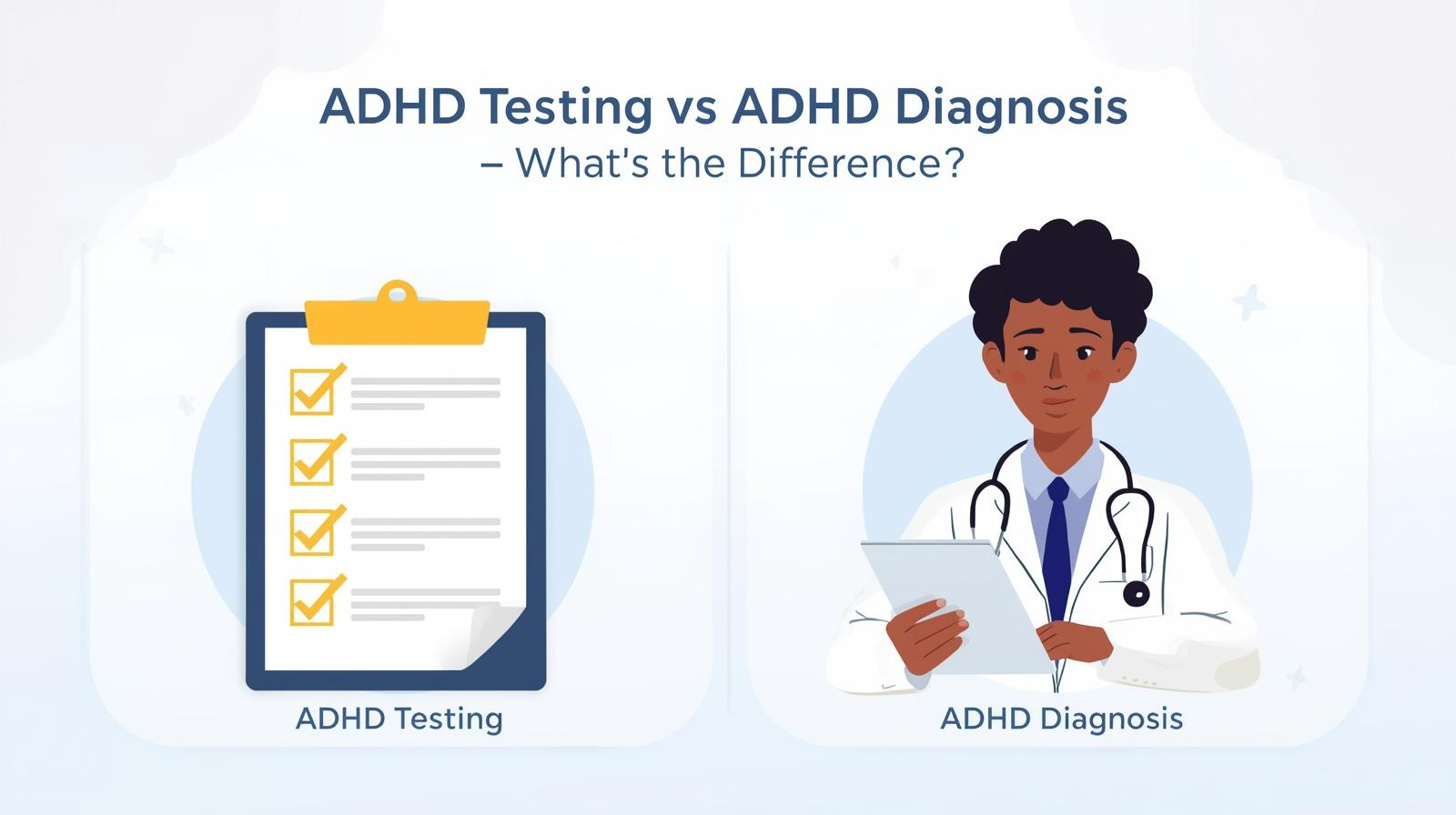
ADHD Testing vs ADHD Diagnosis — What’s the Difference?
ADHD testing and ADHD diagnosis are not the same. Learn how adult ADHD is evaluated in Pennsylvania and Delaware and why structured clinical assessment matters more than online quizzes.
If you are searching for “ADHD testing near me” or “ADHD diagnosis in Philadelphia,” you may not realize that ADHD testing and ADHD diagnosis are not the same thing.
Understanding the difference can prevent confusion — and ensure you receive the right evaluation.
At ADHD Philadelphia, we provide structured adult ADHD evaluations across Pennsylvania and Delaware, beginning with telehealth appointments and moving to in-person visits when clinically appropriate.
What Is ADHD Testing?
ADHD testing refers to objective tools used to measure attention, impulsivity, and executive functioning.
Testing may include:
Computerized attention assessments
Behavioral questionnaires
Symptom rating scales
Collateral reports when appropriate
Testing provides objective data. It measures performance patterns.
However, testing alone does not equal a diagnosis.
What Is ADHD Diagnosis?
ADHD diagnosis is a clinical decision made after reviewing:
Childhood history
Current symptoms
Functional impairment
Work and academic impact
Emotional regulation patterns
Rule-outs for overlapping conditions
Diagnosis requires clinical judgment.
Testing supports diagnosis — but does not replace a structured evaluation.
Why Testing Alone Is Not Enough
Some individuals complete online ADHD tests and assume the results confirm ADHD.
Online quizzes are not diagnostic tools.
A formal ADHD diagnosis requires:
Persistent symptoms
Functional impairment
Clinical interview
Medical and psychiatric review
Testing provides information.
Diagnosis provides clarity.
Do Adults Need ADHD Testing?
Not every adult requires computerized testing.
In some cases, a structured clinical interview is sufficient.
In other cases, testing strengthens diagnostic confidence.
The decision depends on:
Symptom presentation
History clarity
Functional impairment
Differential diagnosis considerations
A professional evaluation determines what is appropriate.
ADHD Evaluation in Pennsylvania & Delaware
Adult ADHD evaluations at ADHD Philadelphia begin with secure telehealth consultation.
After the initial appointment:
ADHD testing may be recommended
In-person visits may be scheduled when clinically appropriate
Treatment planning is discussed
There are no walk-in appointments.
The Bottom Line
ADHD testing measures performance.
ADHD diagnosis requires structured clinical evaluation.
If you are searching for ADHD testing in Philadelphia or ADHD evaluation in Delaware, make sure you are receiving a complete diagnostic process — not just a test.
Clarity begins with structured evaluation.
ADHD Testing vs ADHD Screening: What’s the Difference for Adults?
ADHD screening quizzes are not the same as comprehensive ADHD testing. Learn how adult ADHD evaluations work in Pennsylvania and Delaware and why structured diagnosis provides greater clarity.
Many adults searching for “ADHD test for adults” are unsure whether they need a quick screening or a full diagnostic evaluation.
While the terms are often used interchangeably online, ADHD screening and ADHD testing are not the same thing.
Understanding the difference helps ensure accurate diagnosis and appropriate treatment.
What Is ADHD Screening?
An ADHD screening is typically:
A short questionnaire
A self-report checklist
An online symptom quiz
Screening tools can identify whether ADHD symptoms may be present. However, they do not confirm a diagnosis.
Screenings are helpful starting points — not diagnostic decisions.
What Is ADHD Testing?
ADHD testing is part of a comprehensive diagnostic evaluation and may include:
Computerized attention testing
Behavioral questionnaires
Executive functioning measures
Testing provides objective data that supports the clinical interview.
However, ADHD diagnosis is never based on a single score.
Testing supports — but does not replace — a structured clinical evaluation.
Why a Comprehensive Evaluation Matters
Many conditions can mimic ADHD symptoms, including:
Anxiety disorders
Depression
Sleep disorders
Trauma-related conditions
A thorough adult ADHD evaluation includes:
Clinical interview
Symptom history review
Functional impairment assessment
Differential diagnosis screening
ADHD testing when appropriate
This structured process reduces misdiagnosis and improves treatment outcomes.
After Diagnosis: What Happens Next?
If ADHD is diagnosed, treatment may include:
Executive function strategies
Environmental and workflow adjustments
Medication management when appropriate
Stimulant medications require monthly follow-up appointments for monitoring and dosage adjustment.
Non-stimulant medications are typically monitored every 30–90 days depending on treatment response.
All treatment plans include structured follow-up.
Telehealth ADHD Testing in Pennsylvania & Delaware
Adult ADHD evaluations begin via secure telehealth appointments across Pennsylvania and Delaware.
In-person visits are scheduled afterward when clinically appropriate.
There are no walk-in appointments.
Take the Next Step
If you are searching for ADHD testing, ADHD assessment for adults, or ADHD diagnosis in Pennsylvania or Delaware, a comprehensive evaluation provides clarity beyond a screening quiz.
Schedule your adult ADHD evaluation today.
What Happens During an Adult ADHD Evaluation?
An adult ADHD evaluation includes a structured clinical interview, ADHD testing when appropriate, and differential diagnosis. Learn what to expect from a comprehensive ADHD assessment in Pennsylvania and Delaware.
Many adults searching for ADHD evaluation or ADHD testing near them feel unsure about what the process actually involves.
A comprehensive adult ADHD evaluation is structured, detailed, and designed to provide diagnostic clarity — not just a symptom checklist.
Step 1: Clinical Interview
The evaluation begins with a structured clinical interview reviewing:
Childhood symptom history
Current attention and executive functioning challenges
Academic and occupational functioning
Emotional regulation patterns
Sleep, anxiety, and mood history
Adult ADHD diagnosis requires evidence that symptoms are persistent and cause measurable functional impairment.
Step 2: ADHD Testing & Behavioral Measures
Depending on clinical presentation, evaluation may include:
Computerized ADHD testing
Self-report and observer questionnaires
Executive function screening tools
Testing supports the clinical interview but does not replace it.
ADHD is diagnosed through a comprehensive review — not a single score.
Step 3: Differential Diagnosis
Many conditions can mimic ADHD symptoms, including:
Anxiety disorders
Depression
Sleep disorders
Trauma-related conditions
A thorough evaluation helps rule out overlapping causes before confirming an ADHD diagnosis.
Step 4: Treatment Planning
If ADHD is diagnosed, next steps may include:
Behavioral strategy development
Executive function supports
Medication management when appropriate
Stimulant medications require monthly follow-up appointments for monitoring and safety.
Non-stimulant medications are typically monitored every 30–90 days depending on response and stability.
Telehealth ADHD Evaluations in Pennsylvania & Delaware
Adult ADHD evaluations begin via secure telehealth appointments for residents across Pennsylvania and Delaware. In-person visits are scheduled afterward when clinically appropriate.
There are no walk-in appointments.
Schedule Your ADHD Evaluation
If you are searching for ADHD evaluation, ADHD testing, or ADHD assessment for adults in Pennsylvania or Delaware, structured care can provide clarity.
Book your adult ADHD evaluation today.
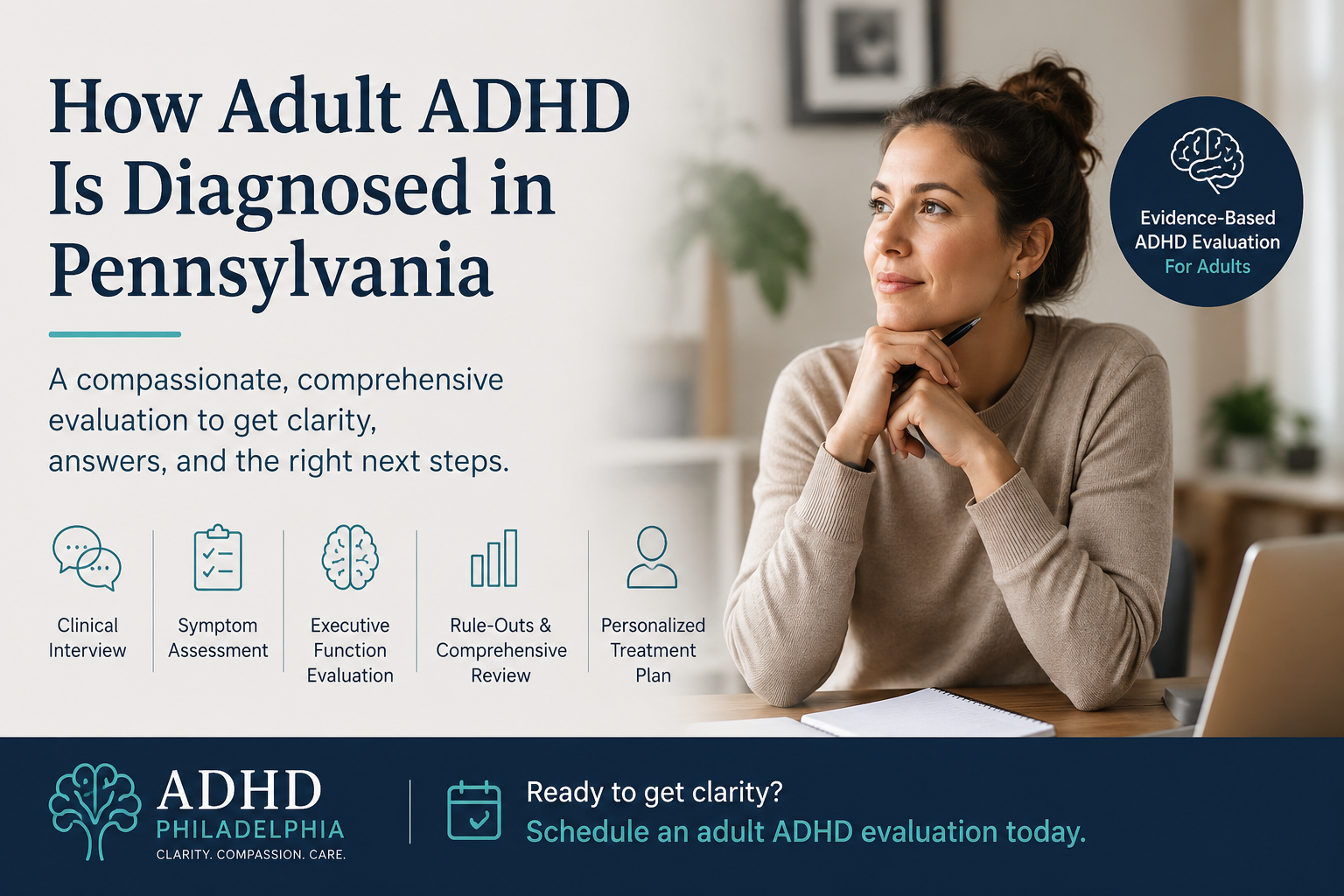
How Adult ADHD Is Diagnosed in Pennsylvania
Adult ADHD diagnosis involves more than a checklist. Learn how ADHD Philadelphia evaluates symptoms, executive function, impairment, testing results, and treatment options for adults in Pennsylvania.
Many adults in Pennsylvania search for ADHD diagnosis after years of struggling with focus, task completion, time management, procrastination, emotional overwhelm, or chronic disorganization. Often, these symptoms are misattributed to stress, anxiety, depression, burnout, or simply “not trying hard enough.”
But for many adults, the issue is not a lack of motivation or intelligence. It may be an untreated attention and executive function disorder that has been present for years.
Adult ADHD diagnosis is a structured clinical process. It is not based on a quick online quiz, a single checklist, or one symptom. A comprehensive ADHD evaluation involves reviewing developmental history, current symptoms, functional impairment, and ruling out other conditions that may mimic ADHD.
For adults in Pennsylvania and Delaware, getting the right evaluation can provide clarity, direction, and a better understanding of why certain patterns keep repeating.
At ADHD Philadelphia, the goal of an adult ADHD evaluation is not simply to label symptoms. The goal is to understand the full clinical picture and determine whether ADHD may be contributing to problems with focus, follow-through, organization, emotional regulation, and daily functioning.
What Is Adult ADHD?
Adult ADHD is a neurodevelopmental condition that affects attention regulation, impulse control, emotional regulation, planning, organization, time management, and follow-through. Many people think ADHD only affects children, but ADHD often continues into adulthood.
Our complete guide to emotional regulation in adults with ADHD explains why reactions may happen quickly, why recovery may take longer, and when further evaluation may be appropriate.
In adults, ADHD may look different than it does in children. A child may appear physically restless or disruptive in a classroom. An adult may appear outwardly successful while privately struggling to keep up with daily responsibilities, deadlines, appointments, bills, household tasks, or work demands.
Some adults with ADHD describe feeling like they are constantly working harder than everyone else just to stay even.
They may know exactly what they need to do but still struggle to start. They may care deeply about their responsibilities but still fall behind. They may create plans, lists, calendars, and reminders, only to find that consistency remains difficult.
That is why a proper diagnosis matters.
What an Adult ADHD Evaluation Includes
A structured adult ADHD diagnostic evaluation typically includes several important parts.
These may include:
A detailed clinical interview
Review of childhood and adult symptom history
Assessment of executive functioning challenges
Screening for anxiety, depression, sleep disorders, substance use concerns, trauma, and other overlapping conditions
Computerized ADHD testing and behavioral questionnaires when clinically appropriate
Review of functional impairment at work, school, home, and in relationships
The goal is diagnostic clarity — not just symptom labeling.
A structured adult ADHD testing and evaluation process can help clarify whether symptoms such as poor focus, forgetfulness, disorganization, procrastination, and executive dysfunction may be related to ADHD.
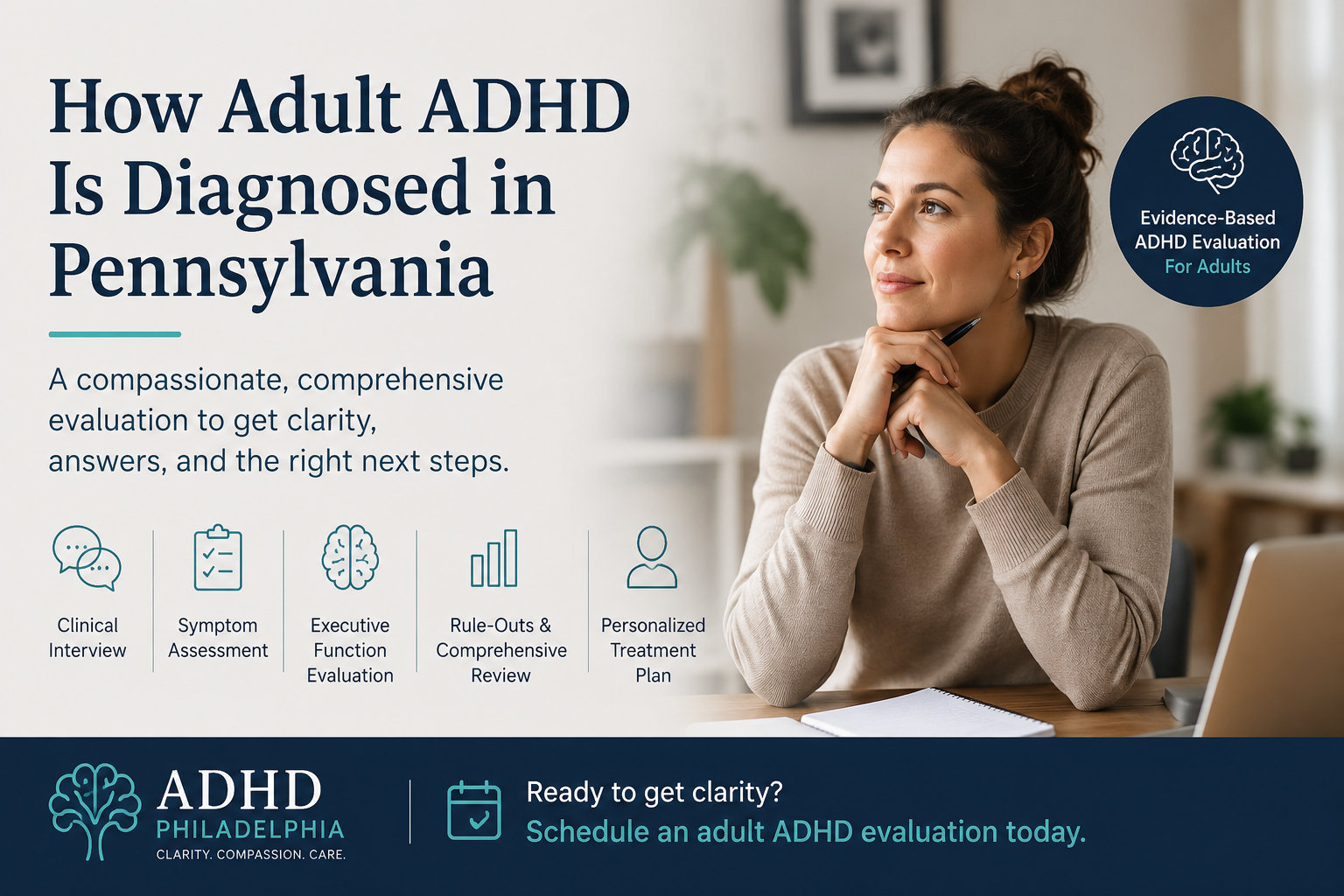
Why ADHD Is Often Missed in Adults
ADHD is often missed in adults because symptoms can be misunderstood.
In adulthood, ADHD may not look like the classic stereotype of someone who cannot sit still. Instead, it may show up as internal restlessness, unfinished projects, emotional reactivity, poor time management, chronic lateness, disorganization, difficulty completing tasks, or trouble staying consistent with routines.
Hyperactivity may present as internal restlessness.
Inattention may appear as chronic procrastination, distractibility, forgetfulness, or difficulty starting tasks.
Impulsivity may show up as emotional reactivity, interrupting, overspending, quick decisions, or inconsistent follow-through.
Many adults with ADHD have spent years developing coping strategies. They may rely on pressure, deadlines, urgency, caffeine, anxiety, or last-minute panic to get things done. These strategies can work for a while, but they often become exhausting.
Because symptoms overlap with other mental health conditions, many adults are misdiagnosed or partially treated before receiving a comprehensive ADHD evaluation.
For many adults, understanding ADHD vs anxiety in adults is important because both can affect concentration, restlessness, sleep, motivation, and daily functioning.
ADHD Diagnosis Requires More Than a Checklist
Online ADHD quizzes can be helpful starting points, but they are not the same as a clinical diagnosis.
A checklist may tell you whether your symptoms resemble ADHD, but it cannot fully determine whether ADHD is the primary cause of your difficulties. A proper evaluation considers symptom duration, onset, impairment, developmental history, and other possible explanations.
For example, difficulty concentrating can be caused by ADHD, anxiety, depression, poor sleep, trauma, substance use, grief, burnout, thyroid issues, medication side effects, or other medical and psychiatric concerns.
That is why adult ADHD diagnosis should involve a clinical professional who can look at the whole picture.
At ADHD Philadelphia, the diagnostic process is designed to help adults better understand whether ADHD may be contributing to their symptoms and whether treatment may be appropriate.
Common Reasons Adults Seek ADHD Testing
Adults often seek ADHD testing after years of feeling frustrated, overwhelmed, or confused by patterns they cannot seem to change.
Common reasons include:
Difficulty focusing at work
Trouble finishing tasks
Procrastination even with important responsibilities
Losing things often
Forgetting appointments, deadlines, or conversations
Feeling mentally scattered
Difficulty organizing home, work, or finances
Emotional overwhelm
Difficulty following through even when motivated
Trouble keeping routines consistent
Feeling like daily life requires too much effort
Many adults seeking ADHD testing are not looking for an excuse. They are looking for an explanation.
They want to know why they can perform well in some situations but struggle in others. They want to understand why urgency helps but routine feels impossible. They want to know why they care but still cannot consistently execute.
One reason adults seek evaluation is because adult ADHD can make follow-through difficult even when you care, especially when executive function challenges affect task initiation, planning, and consistency.
Why ADHD Can Be Missed in Women and Mothers
ADHD can be especially easy to miss in women. Many women with ADHD were not disruptive in school, so their symptoms may have been overlooked. Instead of being described as hyperactive, they may have been seen as daydreamy, sensitive, anxious, disorganized, forgetful, or “not living up to their potential.”
Some women become high-functioning maskers. They work harder, overprepare, over-apologize, and hide the amount of effort it takes to keep up.
Motherhood can make these symptoms much harder to ignore. Parenting adds constant demands, interruptions, emotional labor, scheduling, planning, cleaning, meals, school communication, appointments, and daily transitions.
For some women, motherhood is when long-standing ADHD symptoms finally become impossible to explain away.
ADHD can be missed in women for years, and many moms do not realize they have ADHD until motherhoodincreases the mental load and makes symptoms harder to ignore.
What Happens After an ADHD Diagnosis?
If ADHD is diagnosed, treatment may include several options depending on the person’s symptoms, health history, goals, and clinical needs.
Treatment may include:
Behavioral and executive function strategies
Environmental and workflow adjustments
Education about ADHD and symptom management
Medication management when appropriate
Ongoing monitoring of symptoms, side effects, and functioning
For stimulant medications, monthly follow-up appointments are required for safety monitoring, treatment response, and dosage adjustments.
For non-stimulant medications, follow-up appointments are typically scheduled every 30–90 days depending on treatment response, stability, and clinical appropriateness.
All treatment plans are individualized and include structured monitoring.
After diagnosis, adult ADHD treatment may include education, executive function strategies, lifestyle changes, and medication management when clinically appropriate.
Why Ruling Out Other Conditions Matters
A strong ADHD evaluation does not assume that every focus problem is ADHD.
Several conditions can affect attention, memory, motivation, emotional regulation, and follow-through. Anxiety can make it difficult to concentrate. Depression can reduce motivation and energy. Sleep problems can affect memory and executive functioning. Chronic stress can make the brain feel overloaded.
This is why a structured evaluation matters. The purpose is not only to ask, “Could this be ADHD?” The purpose is also to ask, “What else could be contributing to these symptoms?”
A careful diagnostic process can help reduce the risk of misdiagnosis and guide a more appropriate treatment plan.
Telehealth ADHD Diagnosis in Pennsylvania and Delaware
Adult ADHD evaluations at ADHD Philadelphia begin through secure telehealth appointments for adults throughout Pennsylvania and Delaware.
Telehealth can make it easier for busy adults, professionals, students, parents, and remote workers to access care without needing to travel for the first appointment.
In-person visits may be scheduled afterward when clinically appropriate.
There are no walk-in appointments.
This structure allows ADHD Philadelphia to provide organized, professional care while maintaining appropriate clinical monitoring and follow-up.
Frequently Asked Questions About Adult ADHD Diagnosis in Pennsylvania
Can adults be diagnosed with ADHD for the first time?
Yes. Many adults are diagnosed after years of struggling with focus, disorganization, procrastination, emotional reactivity, or difficulty completing tasks. A proper evaluation reviews both current symptoms and earlier life patterns.
Is ADHD testing just a questionnaire?
No. Questionnaires can be helpful, but adult ADHD diagnosis should include a clinical evaluation, symptom history, functional impairment review, and screening for other conditions that may mimic ADHD.
Can anxiety or depression look like ADHD?
Yes. Anxiety, depression, sleep problems, trauma, stress, and other medical or mental health conditions can affect attention and motivation. This is why a comprehensive evaluation is important.
Does ADHD Philadelphia provide evaluations in Pennsylvania and Delaware?
Yes. ADHD Philadelphia provides adult ADHD testing and treatment for patients in Pennsylvania and Delaware. Initial appointments begin through telehealth. In-person appointments may be scheduled after the first online appointment when clinically appropriate. No walk-in appointments are available.
What happens if ADHD is diagnosed?
If ADHD is diagnosed, the next step is an individualized treatment plan. This may include education, behavioral strategies, executive function support, and medication management when clinically appropriate.
Take the First Step
Adults in Pennsylvania who want clarity about ADHD symptoms can schedule an adult ADHD evaluation todaythrough ADHD Philadelphia.
Medical Disclaimer
This article is for educational purposes only and is not a substitute for medical advice, diagnosis, or treatment. If you are experiencing symptoms of ADHD, anxiety, depression, sleep problems, or another mental health concern, consult a qualified healthcare professional.

Why Adult ADHD Makes Decision-Making So Mentally Exhausting
Adults with ADHD often feel mentally drained by everyday decisions. Learn how executive dysfunction and working memory overload contribute to decision fatigue—and how proper ADHD testing and treatment can help.
Many adults with ADHD end the day feeling mentally depleted — even when they didn’t complete anything extraordinary.
The exhaustion isn’t always physical.
It’s cognitive.
Small decisions accumulate:
What to prioritize
When to respond
How to structure the day
What to say in a conversation
What to ignore
For an ADHD brain, every one of those choices carries extra weight.
Executive Dysfunction and Decision Load
Decision-making depends heavily on executive function. The brain must:
Hold multiple variables in working memory
Weigh consequences
Inhibit distractions
Filter irrelevant input
Choose and commit
In adult ADHD, working memory and inhibitory control require more effort. That means each decision consumes more mental energy than it would for someone without ADHD.
Why Even Simple Choices Feel Draining
When executive systems fatigue quickly, the brain has fewer resources left for sustained effort.
This can look like:
Avoiding decisions
Overthinking minor details
Delaying responses
Feeling paralyzed by options
Snapping after a long day
Over time, adults may internalize the belief that they are indecisive or inefficient — when in reality, their cognitive load is simply higher.
The Link Between Decision Fatigue and Burnout
When decision fatigue accumulates daily, it contributes to burnout.
Mental exhaustion increases emotional reactivity, reduces task initiation, and weakens follow-through — reinforcing the very patterns we discussed earlier in the week.
It’s not laziness.
It’s overload.
How ADHD Treatment Reduces Mental Exhaustion
When adult ADHD is properly identified, treatment aims to:
Improve executive efficiency
Reduce working memory strain
Support structured decision-making
Decrease cognitive overload
Many adults report clearer thinking and reduced mental fatigue once ADHD is addressed directly.
At ADHD Philadelphia, evaluation begins with structured telehealth appointments. In-person visits are scheduled after the initial online evaluation when appropriate. There are no walk-ins, allowing care to remain focused and individualized.
If decision-making feels disproportionately exhausting, ADHD may be part of the explanation.
Why Emotional Regulation Is So Difficult With Adult ADHD
Emotional regulation challenges are a core part of adult ADHD. Learn why frustration escalates quickly, how executive dysfunction affects emotional control, and how proper ADHD testing and treatment can help.
When people think of ADHD, they often think about attention.
But for many adults, the most disruptive symptom isn’t focus — it’s emotion.
Frustration rises quickly.
Disappointment feels sharper.
Stress escalates faster than expected.
This isn’t about personality.
It’s about regulation.
For a more comprehensive explanation of emotional intensity, recovery after stress, rejection sensitivity, overlapping conditions, and practical strategies, read our complete guide to emotional regulation in adults with ADHD.
ADHD and Emotional Control
Emotional regulation depends on executive function systems that help the brain:
Pause before reacting
Shift perspective
Moderate intensity
Recover after stress
In adult ADHD, those systems can be less efficient. Emotions don’t necessarily last longer — but they often feel stronger and harder to contain.
Why Reactions Feel Immediate
ADHD affects inhibitory control — the ability to slow down a reaction.
That split-second pause that allows someone to think, “Let me respond differently,” can be weaker. The result may look like:
Irritability
Impatience
Overwhelm
Emotional shutdown
This can create tension at work and in relationships, especially when others don’t understand what’s happening.
Stress Makes Emotional Regulation Harder
When the nervous system is already overloaded, emotional responses intensify.
Deadlines, multitasking, and decision fatigue drain executive resources. With fewer internal buffers, reactions feel bigger and faster.
Over time, adults may internalize shame about being “too sensitive” or “too reactive.”
But emotional dysregulation is a recognized component of adult ADHD.
How Treatment Supports Emotional Stability
Effective ADHD treatment doesn’t just improve attention — it helps regulate emotional intensity.
Care may focus on:
Strengthening executive function
Reducing nervous system overload
Improving pause-and-reflect capacity
Supporting consistent routines
Many adults experience more stability once their ADHD is properly addressed.
At ADHD Philadelphia, evaluation begins with structured telehealth appointments, with in-person visits scheduled afterward when appropriate. There are no walk-ins, allowing care to remain individualized and intentional.
If emotional reactions feel bigger than they should, ADHD may be part of the explanation.

Why Adult ADHD Makes Follow-Through So Difficult Even When You Care
Many adults with ADHD care deeply but still struggle to follow through. Learn how executive dysfunction affects task initiation, time management, consistency, and daily responsibilities.
Many adults with ADHD care deeply about their responsibilities.
They care about their work.
They care about their relationships.
They care about their health.
They care about their families.
They care about doing what they said they would do.
But caring does not always make follow-through easier.
Learn more about working memory in adults with ADHD, including why intentions disappear after distractions and which external systems may help.
This is one of the most painful parts of adult ADHD. Many adults know exactly what needs to be done, but they still struggle to start, stay consistent, finish tasks, or repeat the same helpful behavior over time.
From the outside, this can look like laziness, avoidance, irresponsibility, or lack of discipline. But for many adults with ADHD, the real issue is executive dysfunction.
Adult ADHD affects the brain systems involved in planning, time management, organization, motivation, emotional regulation, working memory, and task completion. That means follow-through is not simply about willpower. It is often about how the brain manages action.
Our complete guide to planning skills in adults with ADHD explains how to break long-term responsibilities into visible steps, anticipate obstacles, and prepare before deadlines become urgent.
At ADHD Philadelphia, we work with adults in Pennsylvania and Delaware who have spent years asking themselves, “Why can’t I just do what I know I need to do?” For many, ADHD testing and treatment finally help explain the pattern.
Follow-through begins with activation. Read more about why adults with ADHD can struggle to start tasks even when they want to begin.
Adults who lose track of the workday may benefit from learning how ADHD time blindness affects time estimation, transitions, and task initiation.
Follow-Through Is an Executive Function Skill
Follow-through sounds simple, but it actually requires several executive function skills working together.
To follow through on a task, the brain has to:
Remember what needs to be done
Prioritize the task
Estimate how long it will take
Start the task
Ignore distractions
Manage frustration
Stay with the task long enough to finish
Return to the task if interrupted
Repeat the behavior consistently over time
For adults with ADHD, one or more of these steps may break down.
This is why a person may have strong intentions but poor execution. They may genuinely care and still forget. They may want to finish and still get distracted. They may understand the consequences and still delay until the last minute.
The problem is not always motivation. The problem is often the brain’s ability to organize behavior over time.
A structured evaluation can help determine whether adult ADHD testing and evaluation may explain ongoing struggles with follow-through, procrastination, disorganization, time management, and executive dysfunction.
Why Caring Is Not Always Enough
Many adults with ADHD feel confused because they care so much.
They may say:
“I know it matters.”
“I really meant to do it.”
“I was planning to start.”
“I do not understand why I keep putting it off.”
“I care, but I still cannot seem to follow through.”
This can create shame because the person assumes that if they cared enough, they would do it.
But ADHD often creates a gap between intention and action. The desire is there. The goal is there. The consequences may even be clear. But the brain struggles to activate, organize, and sustain the behavior.
This is especially true when tasks are boring, repetitive, emotionally uncomfortable, unclear, delayed in reward, or not immediately urgent.
Many adults with ADHD can perform well in high-pressure situations because urgency gives the brain stimulation. But routine, maintenance-based tasks can feel much harder. Paying bills, answering emails, cleaning, scheduling appointments, finishing paperwork, or keeping up with daily routines may feel unusually difficult.
This does not mean the person does not care. It means their brain may need more structure, support, and treatment.
For many adults, adult ADHD diagnosis helps explain why caring, trying harder, and making promises may not be enough when executive function challenges interfere with action.
Task Initiation: Why Starting Feels So Hard
One major reason adults with ADHD struggle with follow-through is difficulty starting tasks.
Task initiation is the ability to begin something without needing extreme pressure, panic, or urgency. For adults with ADHD, starting can be one of the hardest parts.
A task may sit on the to-do list for days, weeks, or months. The person may think about it constantly, feel guilty about it, and still not start.
This can happen because the task feels too large, too boring, too emotionally uncomfortable, too unclear, or too disconnected from immediate reward.
The adult with ADHD may not be avoiding the task because they do not care. They may be stuck because their brain cannot easily shift from intention into action.
Common signs of task initiation problems include:
Waiting until the last minute
Needing pressure to start
Feeling frozen by simple tasks
Avoiding tasks that feel unclear
Starting easier tasks instead of important ones
Feeling mentally blocked even when the task matters
Knowing what to do but not being able to begin
Treatment can help adults understand these patterns and build systems that make starting easier.
Many adults seek help because ADHD-related procrastination can make even important tasks feel difficult to start until urgency or stress takes over.
Read our complete guide to Sustained Attention in Adults With ADHD for practical ways to use shorter focus intervals, visible goals, and reliable return cues.
Working Memory: Why Adults With ADHD Forget What They Meant To Do
Another reason follow-through is difficult is working memory.
Working memory is the ability to hold information in mind long enough to use it. Adults with ADHD may fully intend to do something, but the intention disappears once another demand appears.
They may walk into a room and forget why they went there.
They may remember an errand at the wrong time.
They may forget to respond to a message after reading it.
They may miss a deadline because it was not visible enough.
They may start one task and lose track of the original task.
This is not always carelessness. It may be a working memory problem.
Adults with ADHD often need external systems to hold information outside the brain. Reminders, calendars, visible lists, alarms, written plans, and structured routines can help reduce the pressure on working memory.
Treatment can also help by improving attention regulation and helping patients build realistic systems they can actually use.
Problems with executive function in adults can affect working memory, organization, time awareness, planning, and the ability to complete tasks consistently.
Time Blindness: Why Deadlines Sneak Up
Many adults with ADHD struggle with time blindness.
Time blindness means the brain has difficulty sensing, estimating, or managing time. A person may know a deadline exists but not feel it until it becomes urgent.
They may underestimate how long something will take.
They may overestimate how much time they have.
They may lose hours to distractions.
They may run late even when they tried to be on time.
They may feel like time is either “now” or “not now.”
This creates major follow-through problems.
A task that is not urgent may not feel real yet. Then suddenly, the deadline becomes immediate, stress increases, and the person rushes to finish. This pattern may work sometimes, but it often leads to burnout, mistakes, missed opportunities, and emotional exhaustion.
Treatment can help adults develop better planning systems, use external time supports, and reduce dependence on last-minute panic.
Many adults with ADHD struggle because ADHD can make routines hard to maintain, especially when time blindness, distractibility, and inconsistent motivation interfere with daily structure.
Learn more about how ADHD can affect duration estimates, starting times, transitions, and deadlines in our complete guide to time management and time blindness in adults with ADHD.
Emotional Overwhelm Can Block Follow-Through
Follow-through is not only about attention. It is also about emotion.
Many adults with ADHD avoid tasks because the task triggers discomfort. It may bring up boredom, frustration, shame, fear of failure, uncertainty, guilt, or anxiety.
For example:
An email may feel emotionally loaded.
A bill may bring up shame.
A project may feel too big.
A phone call may feel awkward.
A messy room may feel overwhelming.
A form may feel confusing before it even begins.
When the emotional weight of a task feels too high, the ADHD brain may avoid it. The person may distract themselves, switch tasks, scroll, clean something else, or wait until urgency becomes stronger than discomfort.
This can become a cycle.
Avoidance brings temporary relief.
The task remains unfinished.
Guilt increases.
The task feels even heavier.
Follow-through becomes harder.
ADHD treatment can help patients understand this cycle and develop strategies to lower the emotional barrier to starting.
Many adults with ADHD struggle with follow-through because adult ADHD can cause chronic overwhelm, making everyday responsibilities feel heavier and harder to begin.
Decision Fatigue Makes Follow-Through Harder
Follow-through also becomes harder when every task requires too many decisions.
Adults with ADHD may struggle with questions like:
Where do I start?
What is most important?
How long should this take?
What if I do it wrong?
Should I do this now or later?
What should I handle first?
When the brain has to make too many decisions before beginning, the task can become paralyzing. This is called decision fatigue.
Instead of starting, the person may freeze, delay, or switch to something easier. They may spend more time thinking about the task than doing the task.
This is why simple, clear, structured plans are important for adults with ADHD. The fewer decisions required at the point of action, the easier follow-through becomes.
For many adults, ADHD can make decision-making hard because executive dysfunction affects prioritizing, organizing options, and moving from thought into action.
Why Adults With ADHD Can Follow Through Sometimes
One confusing part of ADHD is inconsistency.
An adult with ADHD may follow through beautifully in one area and struggle deeply in another. They may perform well at work but struggle at home. They may meet deadlines for others but not for themselves. They may manage a crisis effectively but struggle with routine chores.
This inconsistency often causes people to misunderstand ADHD.
They may think, “If I can do it sometimes, why can’t I do it all the time?”
ADHD symptoms often change depending on interest, urgency, novelty, structure, stress level, reward, and accountability.
Tasks that are interesting, urgent, challenging, or externally structured may be easier. Tasks that are boring, repetitive, delayed in reward, or self-directed may be much harder.
This is why adults with ADHD often do not need more shame. They need better systems, better understanding, and appropriate treatment.
Many adults feel relief when they learn that ADHD treatment can help explain patterns they once blamed on laziness or lack of discipline.
Why Remote Work Can Make Follow-Through Worse
Remote and hybrid work can be especially difficult for adults with ADHD.
Working from home often removes external structure. There may be fewer transitions, fewer visual reminders, less accountability, and more distractions. The day can become blurry.
Adults with ADHD may struggle to:
Start work on time
Transition between tasks
Avoid household distractions
Manage emails and messages
Stay organized without external structure
Stop working at a healthy time
Prioritize tasks without immediate feedback
Remote work can be helpful for some people, but for adults with untreated ADHD, it can also expose executive function challenges that were previously hidden by office routines.
Treatment can help adults build structure into the workday and reduce reliance on urgency or panic.
For remote and hybrid workers, adult ADHD treatment may help improve structure, focus, time management, and follow-through during the workday.
ADHD Follow-Through Problems Are Not Moral Failures
Many adults with ADHD carry years of shame.
They may have been called lazy, irresponsible, messy, dramatic, forgetful, careless, or unreliable. Over time, they may begin to believe those labels.
But ADHD-related follow-through problems are not moral failures.
They are often signs of impaired executive functioning, attention regulation, working memory, emotional regulation, and time management.
This does not mean adults with ADHD are not responsible for their actions. It means they may need different tools, clinical support, and treatment strategies to function more consistently.
Understanding ADHD can replace shame with strategy.
Recognizing adult ADHD symptoms can help people understand that problems with follow-through, procrastination, distractibility, emotional overwhelm, and inconsistency may have a clinical explanation.
How ADHD Treatment Can Improve Follow-Through
ADHD treatment can help adults improve follow-through by addressing the underlying symptoms that make consistency difficult.
Treatment may include:
ADHD education
Executive function strategies
Medication management when clinically appropriate
Behavioral tools
Environmental structure
Sleep and lifestyle review
Support for routines and planning
Monitoring of symptoms and treatment response
The goal is not to become perfect. The goal is to reduce friction.
With treatment, adults may find it easier to start tasks, stay focused, remember responsibilities, manage emotions, reduce procrastination, and complete more of what they begin.
For some patients, medication may help improve attention, mental clarity, and task initiation. For others, non-medication strategies and structured systems are central. Many adults benefit from a combination of approaches.
At ADHD Philadelphia, treatment is individualized and monitored over time.
When clinically appropriate, ADHD medication management for adults may support focus, task initiation, emotional regulation, and follow-through as part of a structured treatment plan.
ADHD Evaluation in Pennsylvania and Delaware
Adults in Pennsylvania and Delaware can begin ADHD evaluation through ADHD Philadelphia using secure telehealth appointments.
Telehealth can make it easier for busy professionals, parents, students, entrepreneurs, healthcare workers, and remote employees to access care without unnecessary travel barriers.
In-person appointments may be scheduled after the first telehealth appointment when clinically appropriate. There are no walk-in appointments.
The evaluation process may include a review of symptoms, history, executive functioning, impairment, medical and mental health factors, and overlapping conditions that may affect focus and follow-through.
The goal is diagnostic clarity and a practical treatment plan.
Adults searching for ADHD testing in Pennsylvania can begin with a structured telehealth evaluation through ADHD Philadelphia.
Adults searching for ADHD testing in Delaware can also begin with a secure telehealth evaluation through ADHD Philadelphia.
When to Consider ADHD Testing
You may want to consider ADHD testing if you regularly struggle with:
Starting tasks
Finishing tasks
Following through on promises
Time management
Chronic procrastination
Disorganization
Forgetfulness
Missed deadlines
Emotional overwhelm
Inconsistent routines
Difficulty completing responsibilities
Feeling like you care but cannot execute consistently
If these patterns have affected your work, relationships, school, home life, finances, or self-confidence, an ADHD evaluation may help.
Many adults do not seek help because they think they should be able to fix the problem on their own. But if the same patterns keep repeating despite effort, it may be time to look deeper.
If follow-through problems are affecting daily life, adult ADHD testing may help clarify whether ADHD is contributing to difficulties with focus, procrastination, organization, and consistency.
Frequently Asked Questions About ADHD and Follow-Through
Why do adults with ADHD struggle to follow through?
Adults with ADHD may struggle with follow-through because ADHD affects executive function skills such as task initiation, planning, prioritizing, working memory, time management, emotional regulation, and sustained attention.
Does struggling with follow-through mean I am lazy?
No. Many adults with ADHD care deeply and still struggle to follow through. ADHD can create a gap between intention and action. This does not mean the person is lazy. It may mean their brain needs better support, structure, and treatment.
Why can I follow through sometimes but not all the time?
ADHD symptoms often change depending on interest, urgency, structure, reward, accountability, and emotional stress. This is why adults with ADHD may perform well in some situations but struggle in others.
Can ADHD treatment improve follow-through?
Yes. ADHD treatment may help improve focus, task initiation, planning, time management, emotional regulation, and consistency. Treatment may include education, executive function strategies, behavioral tools, and medication management when clinically appropriate.
Does ADHD Philadelphia treat adults with follow-through problems?
Yes. ADHD Philadelphia provides adult ADHD testing and treatment for patients in Pennsylvania and Delaware. Initial appointments begin through telehealth. In-person appointments may be scheduled after the first online appointment when clinically appropriate. No walk-in appointments are available.
Take the First Step
If you care deeply but still struggle to follow through, you are not alone.
Adult ADHD can make it difficult to start tasks, finish responsibilities, stay consistent, manage time, and keep promises even when your intentions are sincere.
The answer is not more shame. The answer may be better understanding, better systems, and appropriate treatment.
If you are an adult in Pennsylvania or Delaware and think ADHD may be affecting your follow-through, ADHD Philadelphia can help you take the next step.
Schedule an adult ADHD evaluation today through ADHD Philadelphia.
Medical Disclaimer
This article is for educational purposes only and is not a substitute for medical advice, diagnosis, or treatment. If you are experiencing symptoms of ADHD, anxiety, depression, sleep problems, substance use concerns, or another mental health concern, consult a qualified healthcare professional.