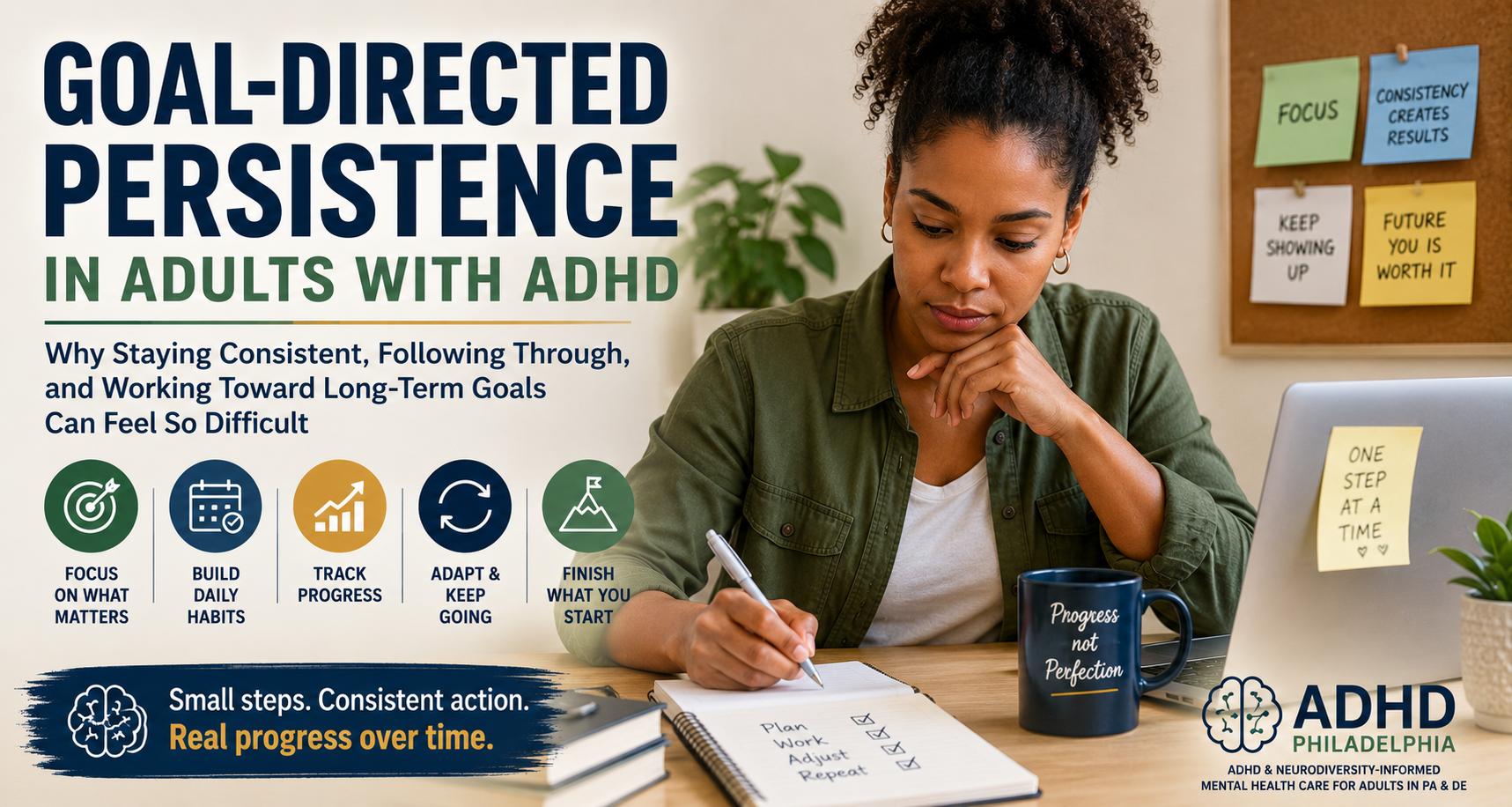
Goal-Directed Persistence in Adults With ADHD: Why Staying Consistent, Following Through, and Working Toward Long-Term Goals Can Feel So Difficult
Charles Thornton, PMHNP-BC | ADHD Philadelphia
Last clinically reviewed: August 21, 2026
You can want a goal deeply and still struggle to stay connected to it after the first burst of motivation fades.
Maybe you begin a certification program with energy and then stop opening the course after a difficult week. You create a workout routine, miss two days, and feel as though the entire plan has failed. You start a business project, home improvement plan, savings goal, or writing project, then become pulled toward something newer before the original goal is complete.
For many adults with ADHD, the problem is not a lack of ambition. The harder part may be goal-directed persistence: continuing to act in the direction of a longer-term goal when the reward is delayed, the work becomes repetitive, progress is slow, competing demands appear, or a setback interrupts the routine.
Goal-directed persistence is not a formal ADHD diagnostic criterion by itself, and difficulty following through can occur for many reasons. Depression, anxiety, chronic stress, burnout, sleep problems, medical conditions, substance use, environmental overload, unrealistic goals, and other factors can also interfere with consistency.
The practical goal is not perfect discipline. It is to build systems that help the goal remain visible, reduce the cost of restarting, and make progress possible even on ordinary days when motivation is lower.
What Is Goal-Directed Persistence?
Goal-directed persistence is the ability to keep behavior connected to a future outcome over time. It involves continuing, returning, adapting, and completing—not simply starting.
You use goal-directed persistence when you:
Continue a project after the interesting beginning is over.
Return to a routine after missing a day or week.
Work through a task whose reward will not arrive until much later.
Keep saving money even when there is no immediate payoff.
Finish a course, application, report, or credentialing process that unfolds across multiple steps.
Maintain a health routine through schedule changes and stressful periods.
Keep working toward a business, academic, career, or personal goal despite slow progress.
Adjust the plan after a setback instead of abandoning the goal entirely.
Goal-directed persistence is one part of executive functioning. It depends on several other skills working together, including working memory, planning, organization, prioritization, sustained attention, response inhibition, time management, task initiation, emotional regulation, and self-monitoring.
Persistence Is Not the Same as Motivation, Willpower, or Perfection
Motivation
Motivation is the desire, energy, or emotional pull to do something. It can rise and fall. A system that works only when motivation is high is usually fragile.
Willpower
Willpower is often used to describe effortful self-control. Effort matters, but repeatedly depending on effort alone can be exhausting. External structure can reduce how much effort must be recreated each day.
Perfection
Persistence does not mean following the original plan without interruption. Real persistence includes restarting after missed days, revising unrealistic expectations, reducing the size of the next step, and continuing from where you are now.
A useful definition is:
Persistence is the ability to keep returning to the direction of the goal.
Why Can Goal-Directed Persistence Be Difficult With Adult ADHD?
1. Delayed Rewards May Feel Too Far Away
Long-term goals often require effort now for a benefit that arrives weeks, months, or years later. NIMH notes that adults with ADHD may have difficulty completing large projects and may choose immediate rewards over future rewards or consequences.
When the future payoff feels psychologically distant, a smaller immediate reward—checking the phone, starting a new idea, watching another video, buying something, or switching tasks—may be more compelling.
2. The Goal Can Disappear From Working Memory
A goal may matter deeply but still become less mentally available when daily responsibilities, interruptions, and new information take over.
External goal cues can reduce this memory demand. Learn more about working memory in adults with ADHD.
3. Novelty Can Fade Before the Project Is Finished
The beginning of a goal may provide novelty, possibility, and rapid feedback. Later stages often involve repetition, maintenance, correction, paperwork, or waiting.
When novelty decreases, the task may require more deliberate structure to remain behaviorally important.
4. Long Goals Can Become Too Vague to Act On
“Build my business,” “get healthier,” “finish school,” or “save money” describes an outcome, not a next action.
Planning skills help translate the future outcome into concrete milestones and visible steps.
5. Time Blindness Can Make the Future Feel Abstract
When future time is difficult to feel or estimate, a deadline six weeks away may not generate enough urgency until it becomes a deadline three days away.
External time markers, milestone dates, and scheduled reviews can make the future more visible. Review Time Management and Time Blindness in Adults With ADHD.
6. Starting Again May Feel Harder Than Starting the First Time
Missing one day can create a new task: restart. Restarting often carries frustration, self-criticism, uncertainty about where to resume, and a higher activation barrier.
This is where task initiation and emotional regulation become important. A restart should be designed as its own small action, not treated as a test of character.
7. Competing Priorities Can Repeatedly Replace the Goal
Important long-term work is often quiet. New emails, requests, urgent errands, meetings, and household demands are louder.
Without a visible priority system, the long-term goal may be postponed day after day even while the person remains extremely busy.
8. Distractions and New Ideas Can Pull Attention Off Course
Sustained attention helps remain with the current work, while response inhibition helps resist acting on every competing idea or stimulus.
A strong persistence system should include a place to capture new ideas without immediately changing direction.
9. Emotional Setbacks Can Become All-or-Nothing Conclusions
A missed deadline, critical feedback, low-energy week, rejection, or disappointing result may quickly become “This is not working” or “I ruined the plan.”
Emotional regulation and cognitive flexibility help separate a setback from the entire goal.
What Goal-Directed Persistence Problems Can Look Like in Daily Life
At Work and in Business
Starting strategic projects but repeatedly allowing urgent daily work to replace them.
Creating strong plans but not returning to them after the first week.
Opening several initiatives before previous ones are completed.
Working intensely near deadlines but struggling with steady progress earlier.
Abandoning a project after feedback, delay, or an unexpected obstacle.
Spending more time redesigning the system than using it.
In School, Training, and Professional Development
Enrolling in a course with enthusiasm and falling behind after the initial modules.
Completing easier assignments while delaying a larger semester-long project.
Studying only when an exam or submission becomes urgent.
Beginning certifications, continuing education, or application processes without completing the final steps.
Losing track of long-range academic requirements while handling immediate assignments.
With Health and Wellness Goals
Starting exercise, sleep, meal, or self-care routines intensely and then stopping after a disruption.
Treating one missed day as proof that the routine has failed.
Changing the plan so frequently that there is not enough time to evaluate whether it works.
Depending on motivation instead of a scheduled, repeatable routine.
With Money and Financial Goals
Setting a savings goal but losing visibility of it during everyday spending.
Starting a budget and stopping after one difficult month.
Focusing on immediate purchases while long-term financial goals remain abstract.
Delaying paperwork, insurance, taxes, retirement tasks, or other multi-step financial responsibilities.
At Home
Starting decluttering, repairs, or home projects but leaving the final stages unfinished.
Creating organization systems that are not maintained after the initial setup.
Beginning routines repeatedly instead of simplifying and restarting the existing routine.
Accumulating several partially completed projects that compete for attention.
In Personal Goals and Creative Work
Beginning writing, art, content, business ideas, or hobbies with intense interest and then abandoning them when progress slows.
Confusing reduced excitement with evidence that the goal no longer matters.
Waiting for the “right mood” to continue.
Restarting from the beginning instead of continuing from the current point.
Practical Goal-Directed Persistence Strategies for Adults With ADHD
1. Choose One Primary Goal for the Current Season
Trying to make major progress on too many long-term goals at the same time can dilute attention and create constant reprioritization.
Choose one primary goal for the next several weeks or months. Other goals can remain active, but one should receive protected progress time.
2. Translate the Goal Into the Next Milestone
A future outcome is easier to pursue when the next measurable checkpoint is visible.
Instead of “finish the certification,” define “complete modules one through three by September 15.” Instead of “build the website,” define “publish the service page and test the booking flow.”
3. Make the Next Action Small Enough to Start
Every milestone should end in a visible next action.
Open the document. Review the instructions. Write the first heading. Schedule the appointment. Upload the form. Send the first email.
The next action should be concrete enough that you do not have to plan again before beginning.
4. Shorten the Reward Cycle
Long-term goals provide delayed rewards. Add smaller markers of completion along the way.
Track completed sessions, pages, applications, workouts, deposits, modules, or milestones. The progress marker should reflect behavior you can control rather than only the final outcome.
5. Put Progress Where You Can See It
Use a visible progress bar, checklist, calendar, whiteboard, milestone tracker, or simple percentage complete.
Visible evidence of progress helps the goal compete with more immediate stimuli.
6. Schedule Goal Time Before the Week Fills Up
Do not leave long-term work to “when I have time.” Schedule recurring blocks before reactive tasks occupy the entire week.
Even two protected sessions can keep the goal behaviorally alive.
7. Define a Minimum Progress Version
Create a version of the routine for low-energy or overloaded days.
If the ideal session is forty-five minutes, the minimum version might be ten minutes. If the ideal workout is an hour, the minimum may be a short walk. If the goal is writing, the minimum may be opening the document and writing one paragraph.
The minimum version protects continuity without pretending every day has equal capacity.
8. Create a Restart Rule Before You Need It
Decide in advance what happens after a missed day, disrupted week, vacation, illness, deadline, or setback.
Example: “If I miss a week, I do not redesign the plan. I schedule one ten-minute restart session and continue from the last completed step.”
9. Never Require Yourself to Start Over
Restarting from zero can turn a temporary interruption into a much larger task.
Continue from the last completed point unless there is a genuine reason the entire plan must be rebuilt.
10. Keep a “Not Now” List for Competing Ideas
New ideas do not need to be rejected, but they do not need to become today’s project.
Capture them in one place and review them during a scheduled planning period. This supports both response inhibition and prioritization.
11. Reduce Friction at the Point of Return
End each work session by preparing the next one.
Leave a note that says exactly where to resume. Keep the needed document accessible. Put materials together. Write the next action before stopping.
The goal is to make returning easier than reconstructing the entire context.
12. Use Accountability for Continuity, Not Shame
A trusted person, clinician, coach, colleague, study partner, or structured check-in can make progress more visible.
Accountability should answer: What did I complete? What is the next step? What barrier needs to be adjusted? It should not become a weekly judgment of character.
13. Review the System on a Schedule
Do not evaluate the goal every day based on mood.
Choose a review interval—weekly, every two weeks, or monthly—to decide whether the plan needs adjustment. Between reviews, follow the current plan unless a meaningful change requires action.
14. Reward Returning, Not Only Finishing
Completion deserves recognition, but so does returning after interruption.
When you resume after a difficult week, you are practicing the exact executive skill the goal requires.
15. Measure Direction, Not a Perfect Streak
A streak can be motivating, but it can also create all-or-nothing thinking when it breaks.
Ask instead: Am I still moving in the direction of the goal? How quickly am I returning after disruptions? Is the system producing more completed steps over time?
A 10-Minute Restart for a Goal You Have Stopped Working On
1. Name the Goal Without Reviewing the Entire History
Write one sentence describing the goal. Do not spend the restart session analyzing every reason progress stopped.
2. Find the Last Completed Step
Locate the last thing that was actually finished. This gives you a concrete starting point.
3. Choose One Next Action
Select an action that can be started immediately and is small enough to fit within the remaining restart time.
4. Remove One Barrier
Open the file, find the login, put the supplies together, move the phone, schedule the work block, or ask for the missing information.
5. Work for the Remaining Minutes
Do not wait for full motivation. Use the short session to re-establish contact with the goal.
6. Leave a Return Cue
Before stopping, write the exact next action and schedule the next work period.
The purpose of the restart is not to “catch up.” It is to make the goal active again.
How Goal-Directed Persistence Connects With Other Executive Functions
Working memory keeps the goal and next step mentally available.
Planning turns a distant outcome into milestones and actions.
Organization keeps materials, information, and progress easy to retrieve.
Prioritization protects long-term work from being replaced by every new demand.
Sustained attention helps maintain engagement during the work period.
Response inhibition helps resist switching immediately to a competing reward or idea.
Time management makes future milestones and recurring work periods visible.
Task initiation helps begin and restart each work session.
Emotional regulation helps recover after frustration, criticism, boredom, or a setback.
Self-monitoring helps determine whether the current strategy is producing progress or needs adjustment.
Explore the complete Executive Function in Adults With ADHD Resource Center.
Difficulty Following Through Is Not Always ADHD
Inconsistent follow-through can occur for many reasons. ADHD should not be assumed because a person abandons projects, misses routines, or struggles with motivation.
A comprehensive assessment may consider:
Depression, including reduced energy, interest, hope, and psychomotor activity.
Anxiety, including avoidance, perfectionism, indecision, and fear of making mistakes.
Burnout or chronic stress, which can reduce available cognitive and emotional resources.
Sleep deprivation, shift work, or untreated sleep disorders.
Trauma-related symptoms, including avoidance, hyperarousal, and difficulty tolerating certain tasks or situations.
Bipolar and other mood disorders, particularly when major changes in energy, sleep, risk-taking, or goal-directed activity occur episodically.
Substance use or medication effects.
Autism, learning disorders, or other neurodevelopmental differences.
Pain, hormonal changes, neurological conditions, or other medical concerns.
Goals that are unrealistic, poorly defined, externally imposed, or no longer meaningful.
Environmental barriers such as caregiving load, unstable housing, financial constraints, unpredictable work schedules, or inadequate support.
A sudden or marked change in motivation, judgment, sleep, energy, memory, personality, or ability to complete ordinary responsibilities should not automatically be attributed to ADHD. Significant new changes warrant appropriate medical or mental health assessment.
When to Consider an Adult ADHD Evaluation
Everyone has goals that fade, projects that stall, and routines that become inconsistent.
An adult ADHD evaluation may be appropriate when follow-through difficulties:
Have been present for many years and can be traced to childhood or adolescence.
Occur across more than one setting, such as work, school, home, finances, healthcare, or relationships.
Cause meaningful impairment despite repeated efforts to improve.
Are accompanied by persistent difficulties with attention, organization, working memory, time management, task initiation, impulsivity, or other ADHD symptoms.
Lead to repeated unfinished projects, missed requirements, late consequences, lost opportunities, or dependence on crisis-level urgency.
Continue even when the goal is genuinely important to the person.
ADHD diagnosis is based on a comprehensive clinical evaluation. No single executive-function difficulty, online quiz, or computerized cognitive test establishes the diagnosis by itself.
Learn more about adult ADHD diagnosis in Pennsylvania and Delaware.
The ADHD Philadelphia Evaluation Process
Step 1: Clinical Consultation
The initial appointment reviews current concerns, developmental and childhood history, attention and executive-function patterns, functional impairment, medical and mental health history, sleep, medications, substance-use considerations, and possible alternative or co-occurring conditions.
Step 2: ADHD Testing When Clinically Appropriate
Testing may include standardized ADHD rating scales and computerized cognitive assessment. Testing contributes additional information but is interpreted within the broader clinical picture rather than used as a stand-alone diagnosis.
Step 3: Diagnostic Review
Clinical history, symptoms across settings, functional impairment, testing information when used, and differential-diagnosis considerations are reviewed together.
Step 4: Individualized Treatment Planning
When ADHD is diagnosed, recommendations are based on symptoms, health history, goals, risks, preferences, and functional needs.
Review the ADHD Philadelphia Patient Journey for a step-by-step explanation before scheduling.
Evidence-Based Treatment and Goal-Persistence Support
ADHD Education and External Structure
Understanding how attention, reward, working memory, time awareness, and task initiation interact can help adults stop treating inconsistent follow-through as a character problem and start designing more reliable supports.
Cognitive Behavioral and Metacognitive Approaches
Research supports structured cognitive behavioral and metacognitive interventions for adults with ADHD. These approaches can teach practical skills in planning, organization, time management, problem-solving, and follow-through. They may also address unhelpful beliefs such as “If I missed a week, I failed” or “I should not need a system.”
Medication Management
When clinically appropriate, ADHD medication may reduce core symptoms and improve some aspects of executive-function behavior for some adults. Medication does not automatically create long-term goals, choose priorities, build routines, or repair a poorly designed system; practical supports remain important.
Learn more about adult ADHD treatment and medication management in Pennsylvania and Delaware.
Sleep, Stress, and Health Review
Persistence is harder when sleep is poor, stress is chronically high, or a medical or mental health condition is reducing available energy and cognitive resources. Treatment planning should consider these factors rather than assuming every difficulty is caused by ADHD.
Accountability and Environmental Supports
Calendar blocks, visible progress trackers, reminders, simplified workflows, supportive check-ins, workplace or educational accommodations when appropriate, and reduced distraction can help keep long-term goals behaviorally accessible.
Adult ADHD Care in Pennsylvania and Delaware
ADHD Philadelphia provides structured adult ADHD consultation, testing when clinically appropriate, diagnostic review, treatment planning, and medication management for adults throughout Pennsylvania and Delaware.
Initial appointments begin through secure telehealth. In-person appointments may be scheduled after the initial telehealth appointment when clinically appropriate. Walk-in appointments are not available.
Adults seek care from Philadelphia, Bala Cynwyd, West Chester, Bryn Mawr, Allentown, Lancaster, Harrisburg, Pittsburgh, Wilmington, Newark, Dover, Milford, New Castle County, and communities throughout Pennsylvania and Delaware.
Review Adult ADHD Testing and Treatment Locations in Pennsylvania and Delaware.
Frequently Asked Questions
Is starting many projects and finishing few a sign of ADHD?
It can occur with ADHD, but it is not diagnostic by itself. Follow-through can also be affected by depression, anxiety, stress, sleep problems, unrealistic goals, competing responsibilities, medical conditions, or other factors.
What does goal-directed persistence mean in ADHD?
It describes the ability to keep behavior connected to a longer-term goal after the initial excitement fades, rewards are delayed, obstacles appear, or the routine is interrupted. It is an executive-function concept rather than a stand-alone diagnostic criterion.
Why can I work intensely at the last minute but not consistently earlier?
Urgency can provide immediate stimulation, a clear deadline, and a narrowed decision field. Earlier in the process, the reward may feel distant and the next action may be less obvious. External milestones and scheduled work periods can reduce dependence on crisis-level urgency.
Why do I lose interest after starting something?
Novelty and immediate feedback are often strongest at the beginning. Later stages may become repetitive or provide slower rewards. Breaking the middle of the project into shorter milestones can help maintain behavioral contact with the goal.
Should I start over after I fall behind?
Usually not. Starting over can make the task larger and reinforce all-or-nothing thinking. In many situations it is more useful to identify the last completed step and restart from there.
How many long-term goals should I work on at once?
There is no universal number. However, giving one major goal protected priority for a defined period can reduce competition and make progress easier to measure.
Can ADHD medication improve follow-through?
Medication may improve core ADHD symptoms and some executive-function behaviors for some adults when appropriately prescribed and monitored. It does not replace planning, scheduling, environmental supports, or realistic goal design.
Can depression look like poor goal persistence?
Yes. Depression may reduce energy, motivation, pleasure, concentration, and hope. A comprehensive evaluation considers whether follow-through difficulty is best explained by ADHD, depression, another condition, or a combination.
What is the best way to restart a goal after weeks of avoiding it?
Reduce the restart to one short session. Identify the last completed step, choose one next action, remove one barrier, work briefly, and leave a clear return cue for the next session.
Does hyperfocus mean I have good goal-directed persistence?
Not necessarily. Hyperfocus describes intense engagement with a particular activity. Goal-directed persistence is broader: it includes staying connected to an important goal across time, including during less stimulating stages and after interruptions.
Can goal-directed persistence improve?
Many adults can improve follow-through by making goals visible, shortening milestones, protecting scheduled work periods, using external reminders and accountability, designing restart rules, and treating ADHD or other contributing conditions when appropriate.
How do I schedule an adult ADHD evaluation?
Use the Book a Same-Day Adult ADHD Appointment page to select an available appointment. You can review the ADHD Philadelphia Patient Journey first if you want a step-by-step explanation of the evaluation process.
Continue Exploring the Executive Function Resource Center
Goal-directed persistence works together with the other executive skills in the ADHD Philadelphia resource center.
Why Adults Choose ADHD Philadelphia
A practice focused on adult ADHD.
Structured clinical evaluation rather than diagnosis from a single test.
Transparent appointment pricing.
Secure telehealth access throughout Pennsylvania and Delaware.
In-person availability after the initial telehealth appointment when clinically appropriate.
Medication management with ongoing monitoring when appropriate.
Practical executive-function education focused on real-world functioning.
Respectful, individualized care.
Goal-directed persistence is not about forcing yourself to feel motivated every day. It is about keeping the goal visible, making the next action small enough to begin, protecting time for progress, and learning how to return after interruptions.
A strong system does not prevent every difficult week. It makes a difficult week less likely to become the end of the goal.
Schedule an Adult ADHD Evaluation
If difficulty with follow-through, attention, organization, time management, task initiation, impulsivity, emotional regulation, or other executive functions is interfering with daily life, a structured evaluation can help clarify what may be contributing.
ADHD Philadelphia provides adult ADHD evaluation and treatment throughout Pennsylvania and Delaware.
You can also review the ADHD Philadelphia Patient Journey before scheduling.
Related ADHD Philadelphia Resources
Medical Information Notice
This page provides general educational information about adult ADHD and executive functioning. It is not intended to diagnose ADHD or another medical or mental health condition and is not a substitute for individualized medical advice, diagnosis, psychotherapy, emergency assessment, or treatment.
If you experience a sudden or severe change in motivation, energy, sleep, judgment, cognition, mood, behavior, or ability to complete ordinary responsibilities, seek appropriate medical or mental health evaluation rather than assuming the change is caused by ADHD.
Author and Clinical Review Information
Charles Thornton, PMHNP-BC
Psychiatric Mental Health Nurse Practitioner
ADHD Philadelphia
ADHD Philadelphia provides adult ADHD evaluation, testing, treatment planning, and medication management for adults in Pennsylvania and Delaware.