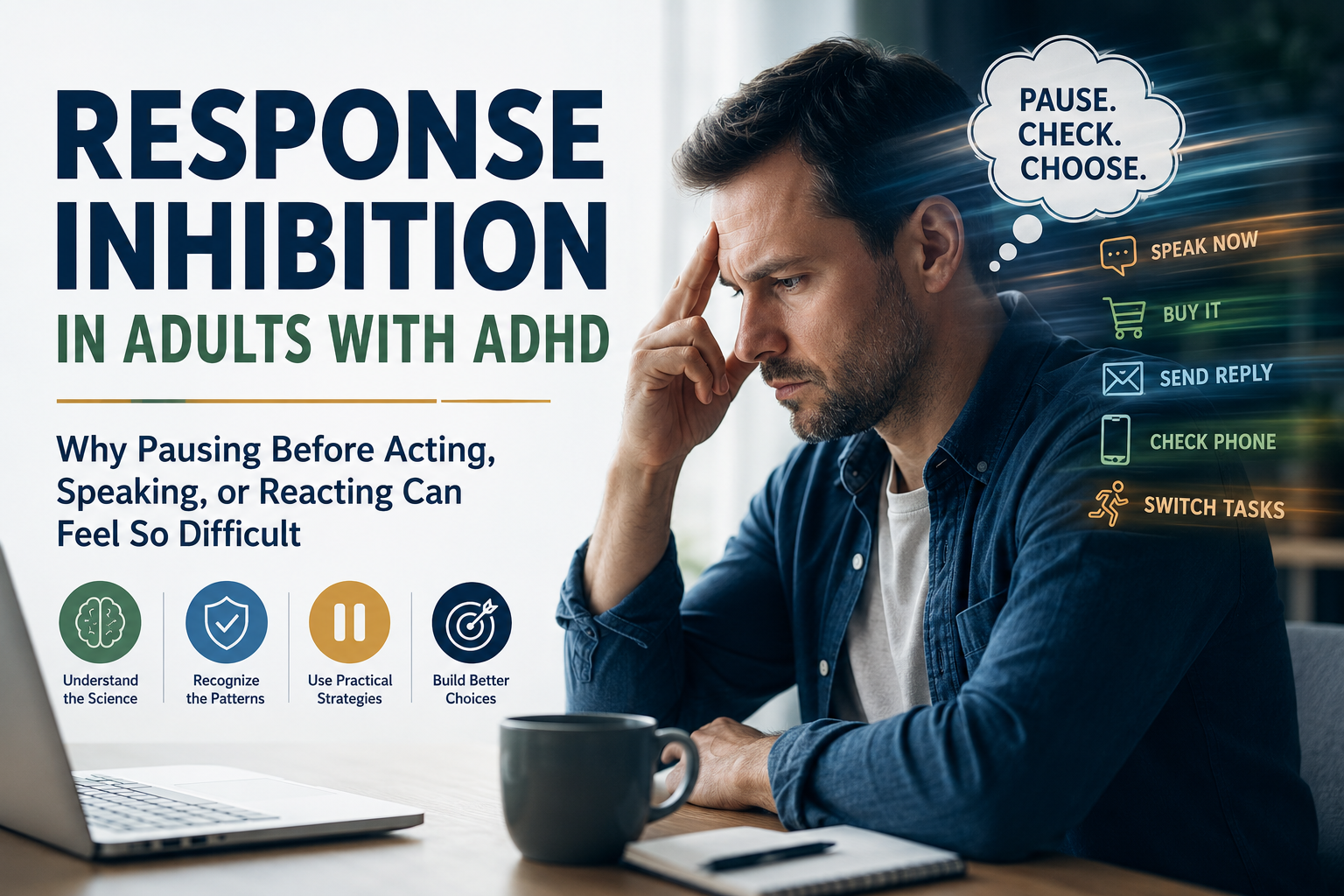
Response Inhibition in Adults With ADHD: Why Pausing Before Acting, Speaking, or Reacting Can Feel So Difficult
Charles Thornton, PMHNP-BC | ADHD Philadelphia
Last clinically reviewed: August 17, 2026
You know you should wait before answering, but the words are already out. You intend to stay focused in a meeting, yet you interrupt because the thought feels urgent. You open a shopping app for one item and make several unplanned purchases. A frustrating message arrives, and you feel an immediate pull to reply before you have fully considered the consequences.
For some adults with ADHD, the difficult moment is not knowing what the better choice is. The difficult moment is creating enough space between an impulse and an action to use that knowledge.
Response inhibition is an executive-function process that helps the brain pause, suppress or delay an automatic response, and choose what happens next. It contributes to conversational turn-taking, emotional restraint, safe decision-making, spending choices, driving behavior, digital communication, task persistence, and many other everyday situations.
ADHD does not mean that a person has no self-control. Response inhibition varies across people and situations, and impulsive behavior can have many causes. The practical goal is not to eliminate spontaneity. It is to create reliable pause points when the consequences matter.
What Is Response Inhibition?
Response inhibition is the ability to stop, delay, or modify a response long enough to consider the goal, the context, and the likely consequences. In laboratory research, inhibitory control is often measured with tasks such as the stop-signal task, but everyday response inhibition is broader than performance on any single test.
In daily life, response inhibition can help you:
Wait for another person to finish speaking before responding.
Pause before sending an emotionally charged email or text.
Resist checking a notification while completing an important task.
Delay an unplanned purchase long enough to review the budget.
Keep driving behavior aligned with safety rather than immediate frustration.
Stay with the chosen task instead of switching immediately to a more interesting one.
Notice an intense emotion without automatically acting on it.
Consider future consequences before making a high-impact decision.
Research in adults with ADHD has found group-level differences in inhibitory control, including a recent systematic review and meta-analysis of stop-signal studies. That finding supports response inhibition as a relevant area of study in adult ADHD, but it does not mean every adult with ADHD has the same difficulty or that an inhibition task can diagnose ADHD by itself.Review the adult ADHD inhibitory-control meta-analysis.
Response Inhibition, Impulsivity, and Self-Control Are Related—but Not Identical
Impulsivity describes behavior that may occur quickly, with limited forethought, or in response to immediate rewards or feelings. Response inhibition is one of the cognitive processes that can help interrupt that pattern. Self-control is a broader everyday concept that also depends on motivation, habits, values, emotional regulation, sleep, environment, planning, and learned strategies.
This distinction matters because an adult can understand consequences very well and still have difficulty creating a pause in the moment. Conversely, someone can behave impulsively for reasons unrelated to ADHD, including mood episodes, substance effects, sleep deprivation, acute stress, trauma-related reactions, or other medical or psychiatric conditions.
Why Can Response Inhibition Be Difficult With Adult ADHD?
1. The Immediate Response May Arrive Before the Future Consequence
ADHD can make immediate cues feel more behaviorally powerful than delayed consequences. The incoming message, interesting idea, sale notification, frustration, or urge to speak is happening now. The benefit of waiting may feel distant or abstract.
A pause strategy works best when it is available at the exact moment the impulse appears, rather than depending on remembering a rule later.
2. Working Memory May Not Keep the Rule Active
You may have a clear plan such as “Do not answer this until tomorrow” or “Ask one question before offering my opinion.” After an interruption or emotional shift, that rule may drop out of active awareness.
External reminders can reduce this memory demand. Learn more about working memory in adults with ADHD.
3. Emotional Intensity Can Compress the Pause
Anger, embarrassment, rejection, excitement, anxiety, or urgency can narrow attention toward immediate action. In that state, the brain may have less access to the slower questions: What is my goal? What happens next? Is this the response I want to be responsible for?
Response inhibition and emotional regulation often interact, especially during conflict or perceived criticism.
4. Novelty and Reward Can Pull Behavior Off Course
A new idea, notification, purchase, conversation, or side task may provide more immediate stimulation than the current responsibility. The problem may look like distractibility, but the key moment is often the unpaused switch from the chosen task to the new stimulus.
This is one reason response inhibition also supports sustained attention.
5. Time Pressure Can Increase Automatic Responding
When a person feels late, rushed, overloaded, or behind, there may be less perceived time to evaluate alternatives. Faster decisions can then produce more corrections, forgotten steps, or interpersonal friction.
External time supports can help. See Time Management and Time Blindness in Adults With ADHD.
6. Fatigue and Stress Can Reduce the Available Pause
Even adults who usually manage impulses well may notice more interruptions, reactive communication, spending, or task switching when they are sleep deprived, emotionally depleted, physically unwell, or under sustained stress.
This is one reason strategies should be designed for difficult days, not only ideal conditions.
7. The Environment May Make the Impulse Too Easy to Act On
One-click purchasing, constant notifications, open messaging applications, saved payment methods, snacks within reach, or a phone placed beside the keyboard can turn a brief impulse into an immediate action.
Changing the environment can add enough friction for the decision-making system to re-enter the process.
8. Priorities May Not Be Visible in the Moment
When the current goal is vague, a new stimulus can easily become the new priority. A visible “what matters now” cue makes it easier to judge whether an impulse supports or competes with the goal.
Review the Prioritization Skills in Adults With ADHD guide for ways to make the next important action more visible.
What Response-Inhibition Problems Can Look Like in Daily Life
In Conversations and Relationships
Interrupting because the thought feels urgent or may be forgotten.
Finishing another person’s sentence.
Giving advice before the other person has finished explaining.
Reacting to tone or criticism before clarifying what was meant.
Sending a text during conflict and regretting the wording later.
Saying yes to a request before checking time, energy, or existing commitments.
At Work
Replying to an email before reading the entire message.
Speaking in a meeting before deciding whether the comment supports the goal.
Switching to a new request immediately, even when a higher-priority task is unfinished.
Clicking notifications throughout focused work.
Making rapid decisions under frustration and then needing to reverse them.
Opening new projects faster than old projects are closed.
With Money and Shopping
Making an unplanned purchase because the reward is immediate.
Buying duplicates because checking what is already owned feels slower.
Upgrading, subscribing, or adding extras without reviewing the total cost.
Using shopping or spending as a fast response to boredom, stress, or excitement.
With Phones and Digital Media
Opening a notification without deciding whether it can wait.
Posting or commenting while emotionally activated.
Switching between apps automatically.
Scrolling beyond the intended stopping point.
Beginning a search for one fact and moving into unrelated content.
While Driving or in Other Safety-Sensitive Situations
Reacting quickly to another driver’s behavior.
Checking the phone despite intending not to.
Accelerating, changing lanes, or making another decision in frustration rather than after a deliberate safety check.
Allowing urgency to override established safety routines.
With Health and Daily Routines
Changing a treatment routine without first discussing it with the appropriate clinician.
Skipping a planned meal, sleep routine, or other health behavior in response to a more immediate activity.
Using substances, caffeine, food, or other immediate rewards reactively.
Acting before confirming instructions or reading the complete label or directions.
Practical Response-Inhibition Strategies for Adults With ADHD
1. Build a Default Pause Phrase
Use one short phrase that becomes automatic when the stakes are meaningful: “Give me a minute,” “I want to think before I answer,” or “Let me check before I commit.”
The phrase buys time without requiring you to explain ADHD or make a final decision immediately.
2. Use the Ten-Second Rule for Low-Stakes Impulses
For an urge that is not dangerous or urgent, count slowly to ten before acting. During the count, ask: What am I about to do? What is the goal? What changes if I wait?
Ten seconds will not solve every impulse, but it can interrupt automaticity.
3. Use a Longer Delay for High-Impact Decisions
Increase the delay as the consequences increase. A purchase, resignation, major relationship message, financial commitment, or other high-impact action deserves more than a ten-second pause.
Create a personal rule such as: no major purchase the same day it is discovered; no emotionally charged work email until it has been reread after a break; no new commitment until the calendar is checked.
4. Draft—Do Not Send
When communication is emotionally loaded, write the response without sending it. Save it as a draft, move away from the screen, and return when your body and attention are less activated.
On return, ask whether the message is accurate, necessary, appropriately timed, and consistent with your longer-term goal.
5. Add Friction to Predictable Impulses
Remove saved payment methods from shopping sites. Turn off nonessential notifications. Move social media off the home screen. Keep the phone outside the immediate work zone. Log out of applications that repeatedly pull attention.
The goal is not punishment. It is to create enough steps for conscious choice to catch up.
6. Put the Goal Where the Impulse Happens
A reminder is most useful at the point of decision. Place “Finish the report before email” beside the monitor, “Check calendar before saying yes” in a notes widget, or “24-hour purchase rule” inside a wallet or shopping reminder.
Do not rely on remembering the rule in a different context.
7. Use If-Then Plans
An if-then plan pre-decides the response: “If I feel the urge to interrupt, then I will write one word on my note and wait.” “If I want to buy something unplanned, then I will add it to a 24-hour list.”
Pre-deciding reduces the number of choices required during the high-impulse moment.
8. Create a Physical Stop Point
Use a physical action that marks the pause: put both feet on the floor, place the phone face down, take your hand off the mouse, close the shopping cart, or lean back before answering.
A body-based cue can make the mental pause easier to notice.
9. Ask One Consequence Question
Use one question consistently rather than trying to predict every possible outcome: “What problem could this create for tomorrow me?” or “What happens if I wait?”
The question brings the delayed consequence into the present decision.
10. Keep a Capture List for New Ideas
New ideas do not have to become new tasks immediately. Keep a single capture list for ideas, purchases, projects, questions, and side tasks.
This protects the current priority while preserving the idea. It also supports organization and planning.
11. Separate Urgency From Importance
An urge can feel urgent without being important. Before switching tasks, ask whether something changed in the real world or only in your attention.
If nothing important changed, return to the selected priority. See Prioritization Skills in Adults With ADHD.
12. Use a Return Cue After an Interruption
If you must respond to something immediately, leave a brief return cue before switching: “Continue paragraph four,” “Call next person on list,” or “Finish invoice and send.”
This makes it easier to resume the original task and supports sustained attention.
13. Track Triggers Without Judging Them
For one week, notice when impulsive actions are most likely. Common patterns include hunger, fatigue, conflict, boredom, alcohol or other substances, late-night phone use, deadlines, social pressure, and unstructured time.
The goal is pattern recognition. Once the trigger is predictable, the pause can be placed earlier.
14. Reduce Decisions During High-Risk Times
If evenings are consistently difficult, decide earlier what spending limit, screen cutoff, food plan, or communication boundary will apply.
A decision made in a lower-stress state can protect the later high-impulse state.
15. Practice Repair Instead of Perfection
No strategy prevents every interruption, reactive message, unnecessary purchase, or task switch. When an impulse wins, repair quickly: apologize, cancel, return, correct, reschedule, or restart the system.
Shame often prolongs the disruption. A short repair protects functioning better than an all-or-nothing response.
A Five-Step Pause for High-Emotion Moments
1. Stop the Output
Do not send, buy, post, resign, promise, or escalate for the next moment unless safety requires immediate action.
2. Name the State
Identify the strongest state in one or two words: angry, embarrassed, excited, rejected, rushed, afraid, or overstimulated.
3. Reconnect With the Goal
Ask: What outcome do I actually want from this situation?
4. Choose the Smallest Safe Delay
Use ten seconds, ten minutes, an overnight draft, or a scheduled conversation depending on the stakes.
5. Re-enter Deliberately
When you return, take one action that matches the goal rather than the original impulse.
How Response Inhibition Connects With Other Executive Functions
Working memory keeps the rule, goal, and consequence available while an impulse is occurring.
Emotional regulation helps the pause remain available during frustration, excitement, rejection, or conflict.
Sustained attention helps resist switching automatically to new stimuli while a chosen task is underway.
Prioritization helps determine whether the new urge deserves to replace the current responsibility.
Planning brings future consequences and preparation into the present decision.
Organization reduces environmental triggers and makes preferred actions easier to execute.
Time management creates enough margin to make deliberate choices instead of operating continuously under urgency.
Task initiation helps begin the chosen action after the impulse to avoid or switch has been paused.
Self-monitoring helps notice the impulse early enough to intervene.
Cognitive flexibility helps shift from the first response to a better alternative when new information appears.
Return to the Executive Function Resource Center to explore the complete cluster.
Response-Inhibition Problems Are Not Always ADHD
Impulsive or poorly inhibited behavior can occur for many reasons. ADHD should not be assumed from interrupting, spending, reacting quickly, risky choices, or difficulty waiting alone.
Other possible contributors include:
Anxiety, panic, or chronic stress.
Depression with irritability or impaired concentration.
Trauma-related hyperarousal or threat responses.
Bipolar-spectrum mood episodes, including mania or hypomania.
Sleep deprivation, untreated sleep disorders, or shift-work disruption.
Alcohol, cannabis, stimulants, sedatives, or other substance use, intoxication, or withdrawal.
Medication effects or interactions.
Autism or other neurodevelopmental differences.
Personality-related patterns or learned interpersonal habits.
Neurological illness, head injury, or other medical conditions that affect judgment or behavior.
High-stress environments that reward immediate reactions or provide little opportunity to pause.
A sudden or major change in judgment, impulse control, personality, speech, sleep need, energy, confusion, memory, or risky behavior deserves medical assessment rather than being assumed to be ADHD—especially after a head injury, medication change, substance exposure, or alongside other neurological or mood symptoms.
When to Consider an Adult ADHD Evaluation
Everyone interrupts, reacts too quickly, buys something impulsively, or changes course without enough thought sometimes. An ADHD evaluation becomes more relevant when the broader pattern is persistent, longstanding, impairing, and accompanied by other ADHD symptoms.
Consider discussing an evaluation when response-inhibition difficulties:
Have been present for many years and can be traced to childhood or adolescence.
Occur across more than one setting, such as work, home, relationships, finances, driving, school, or healthcare.
Cause meaningful problems despite repeated efforts to slow down or create rules.
Occur alongside persistent attention, organization, working-memory, time-management, task-initiation, or hyperactivity/restlessness symptoms.
Lead to repeated interpersonal, financial, occupational, academic, legal, or safety consequences.
Require extreme external structure or repeated rescue from others to prevent recurring problems.
ADHD diagnosis is based on a comprehensive clinical assessment. No single impulsive behavior, online quiz, rating scale, or computerized test establishes the diagnosis by itself. Read how adult ADHD is diagnosed in Pennsylvania and Delaware.
The ADHD Philadelphia Evaluation Process
ADHD Philadelphia uses a structured adult ADHD evaluation process designed to look at the complete clinical picture rather than one symptom or one test result.
Step 1: A clinical ADHD consultation reviewing current concerns, developmental history, functioning, medical and psychiatric history, and possible alternative explanations.
Step 2: ADHD testing and standardized measures when clinically appropriate, interpreted as part of the broader evaluation rather than as a stand-alone diagnosis.
Step 3: Diagnostic review and treatment planning based on the combined history, symptoms, functional impact, testing information, and clinical judgment.
Step 4: Ongoing treatment and monitoring when indicated.
For the step-by-step process before scheduling, review the ADHD Philadelphia Patient Journey.
Evidence-Based Treatment and Response-Inhibition Support
ADHD Education and Environmental Design
Understanding the situations that shorten the pause can help adults build external barriers before the high-risk moment. Notification settings, spending rules, written pause cues, device placement, and pre-decided communication boundaries can reduce reliance on willpower alone.
Cognitive Behavioral and Metacognitive Approaches
Cognitive behavioral and metacognitive approaches for adult ADHD can support practical self-management, including planning, organization, problem solving, awareness of patterns, and the use of compensatory strategies. Research supports CBT as a useful psychosocial treatment for adults with ADHD, although individual treatment goals and response vary.
Medication Management
When clinically appropriate, ADHD medication may reduce core ADHD symptoms for some adults and can make behavioral strategies easier to use. Medication is not a substitute for judgment, safety planning, communication skills, financial safeguards, or environmental supports. Treatment decisions should be individualized and monitored by an appropriate clinician.
Sleep, Stress, and Substance Review
Because fatigue, stress, substance use, and other health factors can worsen impulsive behavior, treatment planning should consider these contributors rather than treating every response-inhibition problem as an isolated ADHD symptom.
Learn more about adult ADHD treatment and medication management in Pennsylvania and Delaware.
Adult ADHD Care in Pennsylvania and Delaware
ADHD Philadelphia provides adult ADHD consultation, testing when clinically appropriate, diagnostic review, treatment planning, and ongoing medication management for adults ages 18 to 64 in Pennsylvania and Delaware.
Care is available through secure telehealth across both states. In-person appointments may be scheduled after the initial telehealth appointment when clinically appropriate. Walk-in appointments are not available.
Adults seek care from Philadelphia, Bala Cynwyd, Montgomery County, Delaware County, Chester County, Bucks County, West Chester, Bryn Mawr, Lancaster, Allentown, Harrisburg, Pittsburgh, Wilmington, Newark, Dover, Milford, New Castle County, and communities throughout Pennsylvania and Delaware.
View ADHD Philadelphia service locations in Pennsylvania and Delaware.
Frequently Asked Questions
Is poor impulse control always ADHD?
No. Impulsive behavior can occur with many psychiatric, neurological, medical, substance-related, sleep, stress, and situational conditions. ADHD requires a broader developmental and functional assessment.
What is response inhibition in ADHD?
Response inhibition is the ability to stop, delay, or modify an automatic response long enough to consider the goal and likely consequences. It is one executive-function process relevant to impulsivity, but it is not the whole of ADHD.
Why do I interrupt people even when I know it bothers them?
The thought may feel urgent, working memory may make you fear losing it, conversational stimulation may increase activation, or the pause may be too short. A simple strategy is to write one cue word and wait for the other person to finish.
Can ADHD cause impulsive spending?
ADHD can contribute to impulsive purchasing for some adults, but spending behavior also depends on finances, stress, mood, habits, environment, and other factors. Adding purchase delays and removing saved payment methods can create useful friction.
Why do I send messages and regret them later?
Emotion, urgency, and immediate access to messaging can compress the time available for reflection. Drafting without sending and using a delayed-review rule can create a safer pause.
Is hyperfocus the opposite of poor response inhibition?
Not exactly. Hyperfocus is an informal term for intense engagement in an activity. A person can remain highly engaged in one context and still have difficulty inhibiting switches, interruptions, or impulsive responses in another.
Can response inhibition improve with practice?
Practical pause cues, environmental changes, CBT-based skills, metacognitive strategies, and treatment of contributing ADHD symptoms can improve day-to-day functioning for many adults. Improvement is usually about building reliable supports, not achieving perfect inhibition.
Can medication help impulsivity in adult ADHD?
Medication may improve core ADHD symptoms, including impulsive symptoms, for some adults when clinically appropriate. Effects and risks vary, so medication decisions require individualized assessment and monitoring.
Can anxiety look like impulsivity?
Yes. Anxiety can produce rushed reassurance seeking, avoidance, rapid decisions, or reactive communication. A clinical evaluation considers whether anxiety, ADHD, both, or another condition better explains the pattern.
What if impulsive behavior suddenly becomes much worse?
A sudden major change should be medically evaluated rather than assumed to be ADHD, particularly when it occurs with reduced need for sleep, unusual energy, confusion, personality change, substance use, medication changes, head injury, or neurological symptoms.
Does a stop-signal test diagnose ADHD?
No. Stop-signal tasks are research and neuropsychological measures of inhibitory control. ADHD diagnosis requires a comprehensive clinical assessment and cannot be made from one computerized measure.
How do I schedule an adult ADHD evaluation?
Use the Book Now page to schedule. You can also review the ADHD Philadelphia Patient Journey first for a step-by-step explanation of the evaluation process.
Continue Exploring the Executive Function Resource Center
Response Inhibition in Adults With ADHD
Goal-Directed Persistence in Adults With ADHD — Coming Soon
Self-Monitoring in Adults With ADHD — Coming Soon
Cognitive Flexibility in Adults With ADHD — Coming Soon
Why Adults Choose ADHD Philadelphia
A practice focused on adult ADHD.
Structured clinical evaluation rather than a one-test diagnosis.
Clear, transparent appointment pricing.
Telehealth access throughout Pennsylvania and Delaware.
Medication management with ongoing monitoring when clinically appropriate.
Practical education focused on real-world executive-function challenges.
Compassionate, respectful, individualized care.
Schedule an Adult ADHD Evaluation
If longstanding impulsivity, attention problems, disorganization, time-management difficulties, or other executive-function challenges are interfering with work, relationships, finances, health, or daily responsibilities, a comprehensive adult ADHD evaluation can help clarify what is contributing to the pattern and what treatment options may be appropriate.
Related ADHD Philadelphia Resources
Medical Information Notice
This page provides general educational information and is not a substitute for individualized medical advice, diagnosis, psychotherapy, crisis assessment, or treatment. If you are experiencing an emergency, severe behavioral change, or immediate safety concern, seek appropriate emergency medical care.
Author and Clinical Review Information
Written and clinically reviewed by Charles Thornton, PMHNP-BC, for ADHD Philadelphia. Last clinical review: August 17, 2026.
Clinical References and Further Reading