
Why Adults With ADHD Feel Overwhelmed (And How Treatment Can Help)
Many adults with ADHD feel constantly overwhelmed by tasks, responsibilities, and mental clutter. Learn why ADHD creates this feeling and how proper diagnosis and treatment can help adults regain focus and control.
Many adults describe ADHD with a single word:
Overwhelmed.
Not just busy.
Not just stressed.
But mentally flooded by tasks, responsibilities, and unfinished thoughts.
For many adults across Pennsylvania and Delaware, this feeling can persist for years before they realize ADHD may be the underlying cause.
Understanding why ADHD creates this sense of overwhelm is the first step toward gaining clarity and regaining control.
One common reason adults with ADHD feel overwhelmed is difficulty initiating tasks, sometimes referred to as ADHD task paralysis, where the brain struggles to begin even simple tasks.
ADHD and the Brain’s Executive Function System
ADHD affects the brain’s executive functioning system — the network responsible for managing tasks, planning, prioritizing, and regulating attention.
Executive functions help the brain answer questions like:
What should I focus on first?
What task is most important?
How do I start this project?
What should I do next?
When this system is working well, people can organize information and take action efficiently.
However, ADHD affects this system in several ways.
Research has shown that ADHD involves differences in dopamine and norepinephrine signaling in the brain’s attention-regulation networks. These neurotransmitters help regulate motivation, reward processing, and sustained focus.
Because of this, adults with ADHD may experience difficulty with:
prioritizing tasks
initiating tasks
sustaining attention
organizing information
managing time
These challenges can create a constant sense of mental overload.
Why ADHD Often Feels Like Mental Overwhelm
Adults with ADHD frequently report that their minds feel like too many browser tabs open at once.
Tasks pile up mentally:
work deadlines
emails to answer
bills to pay
appointments to schedule
responsibilities at home
Instead of processing tasks in sequence, the brain may experience them all at once.
When overwhelm builds, routines are often one of the first things to fall apart, even when those routines were meant to reduce stress in the first place.
This can create several common experiences:
Task Paralysis
When too many tasks compete for attention, it can become difficult to start any of them.
People sometimes interpret this as procrastination or laziness, but in many cases it reflects difficulty with executive functioning.
Decision Fatigue
Adults with ADHD may struggle to prioritize tasks because everything feels equally urgent.
This can lead to:
difficulty choosing what to do first
frequent switching between tasks
unfinished projects
Over time, this creates frustration and mental exhaustion.
If ADHD symptoms are interfering with work, school, or daily responsibilities, adults across Pennsylvania and Delaware can schedule an ADHD evaluation online.
Emotional Overload
ADHD can also affect emotional regulation.
When responsibilities feel unmanageable, many adults experience:
anxiety
irritability
frustration
feelings of failure
These emotions often intensify the sense of overwhelm.
Some adults initially believe their symptoms are anxiety alone, but ADHD and anxiety can overlap. Understanding the difference between ADHD and anxiety in adults can help clarify the underlying cause.
Why Many Adults Do Not Realize ADHD Is the Cause
Many adults with ADHD were never diagnosed during childhood.
Some individuals performed well academically but struggled with organization or time management.
Others developed coping strategies that masked symptoms for years.
However, ADHD symptoms often become more noticeable when life becomes more complex.
Examples include:
demanding careers
graduate school
managing finances
parenting responsibilities
At this stage, the brain’s executive system may become overloaded.
For many adults, overwhelm and poor follow-throughare closely connected, especially when executive functioning demands keep stacking up faster than they can be managed.
Signs That ADHD May Be Contributing to Overwhelm
Adults who recognize these patterns may benefit from learning more about the adult ADHD diagnosis process and how clinicians determine whether ADHD symptoms are present.
Some adults experiencing chronic overwhelm notice patterns such as:
constantly feeling behind on tasks
difficulty starting projects
forgetting important responsibilities
trouble maintaining focus at work
frequent mental fatigue
feeling scattered despite strong effort
When these patterns persist over time, a professional ADHD evaluation for adults can help determine whether ADHD may be contributing to these challenges.
According to the Diagnostic and Statistical Manual of Mental Disorders (DSM-5-TR), ADHD involves persistent patterns of inattention and/or hyperactivity-impulsivity that interfere with functioning across multiple settings.
Understanding these patterns helps clinicians determine whether ADHD is present and whether treatment may be helpful.
How ADHD Treatment Helps Reduce Overwhelm
Effective ADHD treatment for adults often involves a structured approach that may include:
ADHD Evaluation
A comprehensive ADHD evaluation process for adults helps determine whether ADHD symptoms are present and whether other conditions may also be contributing.
Medication Management
For many adults, medication can help improve attention regulation, task initiation, and sustained focus.
When properly monitored, medication may help individuals:
maintain focus on important tasks
reduce mental clutter
improve productivity
Behavioral Strategies
Treatment may also include strategies designed to improve executive functioning, including:
task prioritization systems
time-management techniques
organizational structures
Research on executive functioning suggests that structured environments and external supports can significantly improve performance for individuals with ADHD.
The First Step Toward Clarity
If chronic overwhelm has become part of daily life, it may be helpful to explore whether ADHD could be contributing.
A structured evaluation can provide clarity about symptoms and identify appropriate treatment options.
For many adults, understanding ADHD is the beginning of regaining control over work, responsibilities, and daily life.
Book an ADHD Evaluation
Adults across Pennsylvania and Delaware can schedule an ADHD consultation online.
Learn more and book your ADHD consultation online.

ADHD vs Anxiety in Adults: How to Tell the Difference in Pennsylvania and Delaware
Many adults come to evaluation asking:
“Is this ADHD… or is it anxiety?”
The truth is — they can look similar.
Both can cause:
Difficulty concentrating
Restlessness
Sleep problems
Racing thoughts
Irritability
But they are not the same condition.
Understanding the difference matters. Treatment plans are very different.
The Core Difference: Regulation vs Worry
ADHD is primarily a disorder of executive function and self-regulation.
Anxiety is primarily a disorder of excessive fear and anticipatory worry.
In ADHD:
The mind jumps because it is under-regulated.
Focus drops when interest drops.
Time management collapses under low stimulation.
In anxiety:
Focus drops because worry consumes cognitive bandwidth.
Thoughts loop around fear-based themes.
Avoidance behaviors increase.
How ADHD Presents in Adults
Adult ADHD often includes:
Chronic procrastination
Time blindness
Difficulty starting tasks
Forgetfulness
Losing items
Interrupting conversations
Emotional impulsivity
These patterns are lifelong — even if they were masked in childhood.
If you haven’t read it yet, see:
👉 What Happens During an Adult ADHD Evaluation?
👉 How Long Does an Adult ADHD Evaluation Take?
How Anxiety Presents in Adults
Anxiety more often includes:
Excessive worry about worst-case outcomes
Physical tension
Panic episodes
Catastrophic thinking
Avoidance of feared situations
Sleep disruption due to rumination
The driver is fear — not executive dysfunction.
When ADHD and Anxiety Overlap
Many adults have both.
Chronic executive dysfunction can create secondary anxiety.
Missing deadlines repeatedly can create fear of failure.
This is why rushed diagnoses are risky.
A thorough ADHD evaluation includes differential diagnosis screening to ensure accuracy.
If you’ve ever wondered whether your symptoms are related to attention difficulties or worry-driven thinking patterns, our article on the difference between ADHD and anxiety in adults explains the key signs to look for.
Why Accurate Diagnosis Matters
Treating anxiety as ADHD may leave core fear untreated.
Treating ADHD as anxiety may leave executive dysfunction untreated.
Medication decisions differ.
Therapy approaches differ.
Behavioral systems differ.
If you're in Pennsylvania or Delaware and unsure which condition applies, a structured evaluation can clarify the difference.
Serving Adults in PA & DE
At ADHDPhiladelphia.com, adult evaluations are:
DSM-aligned
Executive-function informed
Differential-diagnosis focused
Designed to reduce misdiagnosis
Telehealth is available throughout Pennsylvania and Delaware.
In-person appointments are available after the initial telehealth visit. No walk-ins.
If you’ve been wondering whether your concentration difficulties are ADHD or anxiety, the next step is a careful evaluation.
👉Book your consultation today.
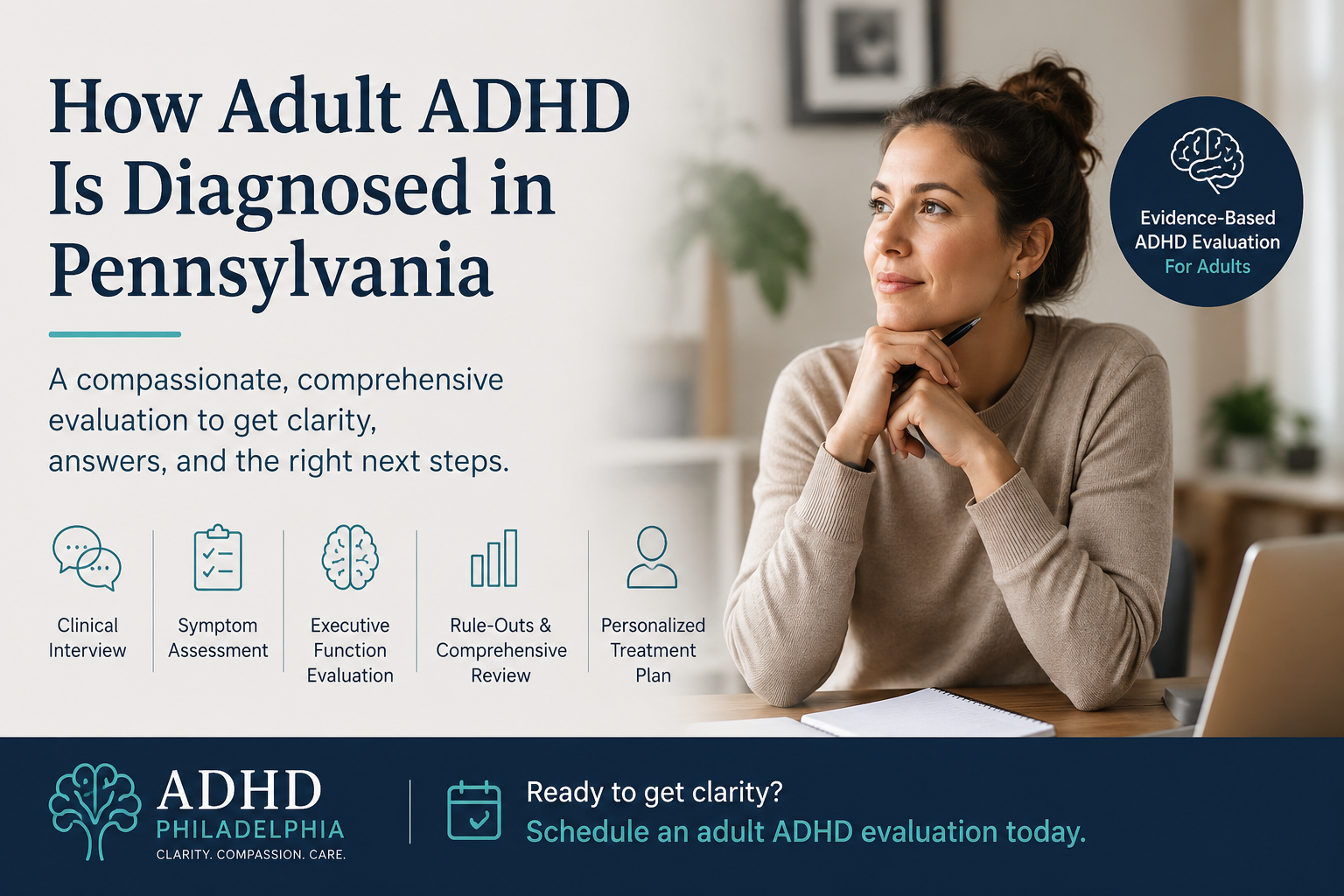
How Adult ADHD Is Diagnosed in Pennsylvania
Adult ADHD diagnosis involves more than a checklist. Learn how ADHD Philadelphia evaluates symptoms, executive function, impairment, testing results, and treatment options for adults in Pennsylvania.
Many adults in Pennsylvania search for ADHD diagnosis after years of struggling with focus, task completion, time management, procrastination, emotional overwhelm, or chronic disorganization. Often, these symptoms are misattributed to stress, anxiety, depression, burnout, or simply “not trying hard enough.”
But for many adults, the issue is not a lack of motivation or intelligence. It may be an untreated attention and executive function disorder that has been present for years.
Adult ADHD diagnosis is a structured clinical process. It is not based on a quick online quiz, a single checklist, or one symptom. A comprehensive ADHD evaluation involves reviewing developmental history, current symptoms, functional impairment, and ruling out other conditions that may mimic ADHD.
For adults in Pennsylvania and Delaware, getting the right evaluation can provide clarity, direction, and a better understanding of why certain patterns keep repeating.
At ADHD Philadelphia, the goal of an adult ADHD evaluation is not simply to label symptoms. The goal is to understand the full clinical picture and determine whether ADHD may be contributing to problems with focus, follow-through, organization, emotional regulation, and daily functioning.
What Is Adult ADHD?
Adult ADHD is a neurodevelopmental condition that affects attention regulation, impulse control, emotional regulation, planning, organization, time management, and follow-through. Many people think ADHD only affects children, but ADHD often continues into adulthood.
Our complete guide to emotional regulation in adults with ADHD explains why reactions may happen quickly, why recovery may take longer, and when further evaluation may be appropriate.
In adults, ADHD may look different than it does in children. A child may appear physically restless or disruptive in a classroom. An adult may appear outwardly successful while privately struggling to keep up with daily responsibilities, deadlines, appointments, bills, household tasks, or work demands.
Some adults with ADHD describe feeling like they are constantly working harder than everyone else just to stay even.
They may know exactly what they need to do but still struggle to start. They may care deeply about their responsibilities but still fall behind. They may create plans, lists, calendars, and reminders, only to find that consistency remains difficult.
That is why a proper diagnosis matters.
What an Adult ADHD Evaluation Includes
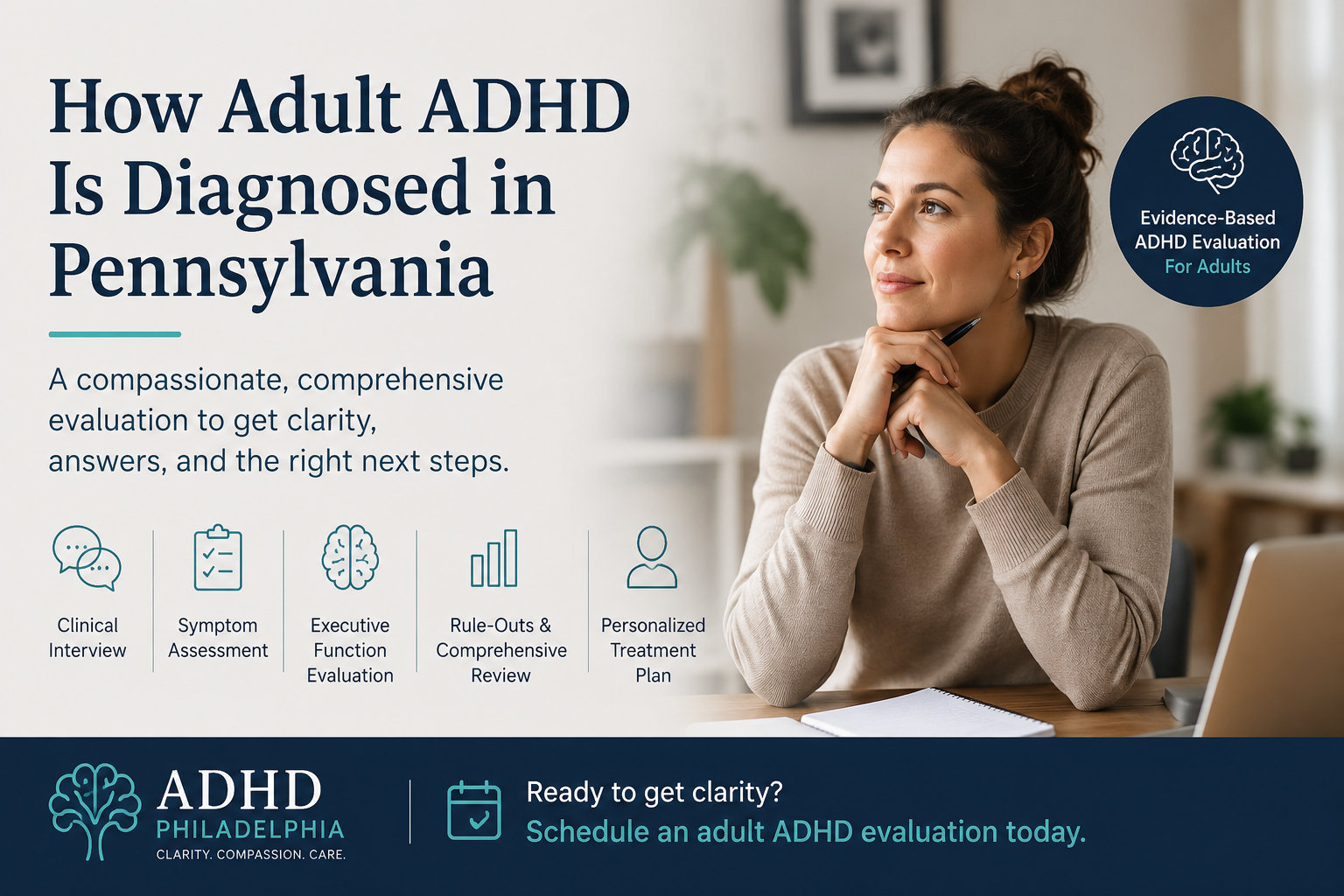
A structured adult ADHD diagnostic evaluation typically includes several important parts.
These may include:
A detailed clinical interview
Review of childhood and adult symptom history
Assessment of executive functioning challenges
Screening for anxiety, depression, sleep disorders, substance use concerns, trauma, and other overlapping conditions
Computerized ADHD testing and behavioral questionnaires when clinically appropriate
Review of functional impairment at work, school, home, and in relationships
The goal is diagnostic clarity — not just symptom labeling.
A structured adult ADHD testing and evaluation process can help clarify whether symptoms such as poor focus, forgetfulness, disorganization, procrastination, and executive dysfunction may be related to ADHD.
Why ADHD Is Often Missed in Adults
ADHD is often missed in adults because symptoms can be misunderstood.
In adulthood, ADHD may not look like the classic stereotype of someone who cannot sit still. Instead, it may show up as internal restlessness, unfinished projects, emotional reactivity, poor time management, chronic lateness, disorganization, difficulty completing tasks, or trouble staying consistent with routines.
Hyperactivity may present as internal restlessness.
Inattention may appear as chronic procrastination, distractibility, forgetfulness, or difficulty starting tasks.
Impulsivity may show up as emotional reactivity, interrupting, overspending, quick decisions, or inconsistent follow-through.
Many adults with ADHD have spent years developing coping strategies. They may rely on pressure, deadlines, urgency, caffeine, anxiety, or last-minute panic to get things done. These strategies can work for a while, but they often become exhausting.
Because symptoms overlap with other mental health conditions, many adults are misdiagnosed or partially treated before receiving a comprehensive ADHD evaluation.
For many adults, understanding ADHD vs anxiety in adults is important because both can affect concentration, restlessness, sleep, motivation, and daily functioning.
ADHD Diagnosis Requires More Than a Checklist
Online ADHD quizzes can be helpful starting points, but they are not the same as a clinical diagnosis.
A checklist may tell you whether your symptoms resemble ADHD, but it cannot fully determine whether ADHD is the primary cause of your difficulties. A proper evaluation considers symptom duration, onset, impairment, developmental history, and other possible explanations.
For example, difficulty concentrating can be caused by ADHD, anxiety, depression, poor sleep, trauma, substance use, grief, burnout, thyroid issues, medication side effects, or other medical and psychiatric concerns.
That is why adult ADHD diagnosis should involve a clinical professional who can look at the whole picture.
At ADHD Philadelphia, the diagnostic process is designed to help adults better understand whether ADHD may be contributing to their symptoms and whether treatment may be appropriate.
Common Reasons Adults Seek ADHD Testing
Adults often seek ADHD testing after years of feeling frustrated, overwhelmed, or confused by patterns they cannot seem to change.
Common reasons include:
Difficulty focusing at work
Trouble finishing tasks
Procrastination even with important responsibilities
Losing things often
Forgetting appointments, deadlines, or conversations
Feeling mentally scattered
Difficulty organizing home, work, or finances
Emotional overwhelm
Difficulty following through even when motivated
Trouble keeping routines consistent
Feeling like daily life requires too much effort
Many adults seeking ADHD testing are not looking for an excuse. They are looking for an explanation.
They want to know why they can perform well in some situations but struggle in others. They want to understand why urgency helps but routine feels impossible. They want to know why they care but still cannot consistently execute.
One reason adults seek evaluation is because adult ADHD can make follow-through difficult even when you care, especially when executive function challenges affect task initiation, planning, and consistency.
Why ADHD Can Be Missed in Women and Mothers
ADHD can be especially easy to miss in women. Many women with ADHD were not disruptive in school, so their symptoms may have been overlooked. Instead of being described as hyperactive, they may have been seen as daydreamy, sensitive, anxious, disorganized, forgetful, or “not living up to their potential.”
Some women become high-functioning maskers. They work harder, overprepare, over-apologize, and hide the amount of effort it takes to keep up.
Motherhood can make these symptoms much harder to ignore. Parenting adds constant demands, interruptions, emotional labor, scheduling, planning, cleaning, meals, school communication, appointments, and daily transitions.
For some women, motherhood is when long-standing ADHD symptoms finally become impossible to explain away.
ADHD can be missed in women for years, and many moms do not realize they have ADHD until motherhoodincreases the mental load and makes symptoms harder to ignore.
What Happens After an ADHD Diagnosis?
If ADHD is diagnosed, treatment may include several options depending on the person’s symptoms, health history, goals, and clinical needs.
Treatment may include:
Behavioral and executive function strategies
Environmental and workflow adjustments
Education about ADHD and symptom management
Medication management when appropriate
Ongoing monitoring of symptoms, side effects, and functioning
For stimulant medications, monthly follow-up appointments are required for safety monitoring, treatment response, and dosage adjustments.
For non-stimulant medications, follow-up appointments are typically scheduled every 30–90 days depending on treatment response, stability, and clinical appropriateness.
All treatment plans are individualized and include structured monitoring.
After diagnosis, adult ADHD treatment may include education, executive function strategies, lifestyle changes, and medication management when clinically appropriate.
Why Ruling Out Other Conditions Matters
A strong ADHD evaluation does not assume that every focus problem is ADHD.
Several conditions can affect attention, memory, motivation, emotional regulation, and follow-through. Anxiety can make it difficult to concentrate. Depression can reduce motivation and energy. Sleep problems can affect memory and executive functioning. Chronic stress can make the brain feel overloaded.
This is why a structured evaluation matters. The purpose is not only to ask, “Could this be ADHD?” The purpose is also to ask, “What else could be contributing to these symptoms?”
A careful diagnostic process can help reduce the risk of misdiagnosis and guide a more appropriate treatment plan.
Telehealth ADHD Diagnosis in Pennsylvania and Delaware
Adult ADHD evaluations at ADHD Philadelphia begin through secure telehealth appointments for adults throughout Pennsylvania and Delaware.
Telehealth can make it easier for busy adults, professionals, students, parents, and remote workers to access care without needing to travel for the first appointment.
In-person visits may be scheduled afterward when clinically appropriate.
There are no walk-in appointments.
This structure allows ADHD Philadelphia to provide organized, professional care while maintaining appropriate clinical monitoring and follow-up.
Frequently Asked Questions About Adult ADHD Diagnosis in Pennsylvania
Can adults be diagnosed with ADHD for the first time?
Yes. Many adults are diagnosed after years of struggling with focus, disorganization, procrastination, emotional reactivity, or difficulty completing tasks. A proper evaluation reviews both current symptoms and earlier life patterns.
Is ADHD testing just a questionnaire?
No. Questionnaires can be helpful, but adult ADHD diagnosis should include a clinical evaluation, symptom history, functional impairment review, and screening for other conditions that may mimic ADHD.
Can anxiety or depression look like ADHD?
Yes. Anxiety, depression, sleep problems, trauma, stress, and other medical or mental health conditions can affect attention and motivation. This is why a comprehensive evaluation is important.
Does ADHD Philadelphia provide evaluations in Pennsylvania and Delaware?
Yes. ADHD Philadelphia provides adult ADHD testing and treatment for patients in Pennsylvania and Delaware. Initial appointments begin through telehealth. In-person appointments may be scheduled after the first online appointment when clinically appropriate. No walk-in appointments are available.
What happens if ADHD is diagnosed?
If ADHD is diagnosed, the next step is an individualized treatment plan. This may include education, behavioral strategies, executive function support, and medication management when clinically appropriate.
Take the First Step
Adults in Pennsylvania who want clarity about ADHD symptoms can schedule an adult ADHD evaluation todaythrough ADHD Philadelphia.
Medical Disclaimer
This article is for educational purposes only and is not a substitute for medical advice, diagnosis, or treatment. If you are experiencing symptoms of ADHD, anxiety, depression, sleep problems, or another mental health concern, consult a qualified healthcare professional.