
How Long Does an Adult ADHD Evaluation Take in Pennsylvania or Delaware?
Wondering how long adult ADHD testing takes? Learn what to expect from ADHD evaluation in Pennsylvania and Delaware, including clinical interview, testing, diagnosis, treatment planning, and follow-up.
Many adults who are thinking about ADHD testing want to know what the process actually looks like.
One of the most common questions is:
“How long does an adult ADHD evaluation take?”
The answer depends on the structure of the evaluation. A proper ADHD evaluation should not feel like a rushed checklist. It should include a careful review of symptoms, history, daily functioning, executive function challenges, overlapping mental health concerns, and treatment options when appropriate.
At ADHD Philadelphia, the adult ADHD evaluation process is designed to be clear, structured, and practical for adults in Pennsylvania and Delaware.
Initial appointments begin through secure telehealth. In-person appointments may be scheduled after the first online appointment when clinically appropriate. There are no walk-in appointments.

Why the ADHD Evaluation Process Should Be Structured
Adult ADHD can affect focus, organization, time management, emotional regulation, procrastination, forgetfulness, task initiation, and follow-through.
But ADHD symptoms can also overlap with other concerns, including anxiety, depression, sleep problems, trauma, substance use, chronic stress, medication side effects, and medical conditions.
That is why an adult ADHD evaluation should involve more than a quick questionnaire.
A structured evaluation helps answer important questions:
Are the symptoms consistent with ADHD?
How long have the symptoms been present?
Did similar patterns exist earlier in life?
Are symptoms affecting work, school, home, relationships, or daily responsibilities?
Could another condition be contributing?
Would treatment be appropriate?
What type of treatment plan makes sense?
The goal is not just to label symptoms. The goal is diagnostic clarity.
A structured adult ADHD testing and evaluation process can help clarify whether poor focus, procrastination, forgetfulness, disorganization, emotional overwhelm, and executive dysfunction are related to ADHD.
How Long Does the First ADHD Appointment Take?
The first appointment is usually focused on understanding the patient’s current concerns, symptom history, daily functioning, and treatment goals.
This appointment may include discussion of:
Focus and concentration
Task completion
Organization
Time management
Procrastination
Forgetfulness
Emotional regulation
Sleep
Work or school performance
Home responsibilities
Relationships
Medical history
Mental health history
Current medications
Substance use concerns
Past treatment experience
The first appointment is important because adult ADHD does not exist in isolation. Symptoms need to be understood in the context of the whole person.
Some adults come in already feeling confident they have ADHD. Others are unsure and simply know that something has felt harder than it should for a long time.
Both situations deserve a careful evaluation.
A careful adult ADHD diagnosis and evaluation starts with understanding how symptoms affect daily functioning, work performance, relationships, emotional regulation, and follow-through.
Why ADHD Diagnosis Usually Takes More Than One Step
Adult ADHD diagnosis often requires more than one step because the clinician needs to understand both symptoms and impairment.
A person may have trouble focusing, but that does not automatically mean ADHD is the cause. Concentration problems can also come from anxiety, depression, poor sleep, grief, trauma, burnout, substance use, medication side effects, or other concerns.
A multi-step process helps reduce the risk of misdiagnosis.
It also gives the provider time to review whether symptoms are consistent, long-standing, impairing, and clinically appropriate for ADHD treatment.
At ADHD Philadelphia, the evaluation process is designed to provide clarity before treatment planning.
For many adults, understanding ADHD vs anxiety in adults is important because both can affect concentration, restlessness, sleep, motivation, emotional regulation, and daily functioning.
What Is Reviewed During an Adult ADHD Evaluation?
A strong adult ADHD evaluation reviews more than attention.
It may include:
Current symptoms
Childhood or earlier life patterns
Functional impairment
Executive function challenges
Mental health history
Medical history
Medication history
Sleep patterns
Substance use concerns
Work or school functioning
Relationship and home functioning
Treatment goals
Safety considerations
Computerized testing when clinically appropriate
This helps create a fuller picture of what is happening.
For example, an adult may say they are distracted at work. But the evaluation may reveal deeper patterns: difficulty starting tasks, losing track of time, emotional overwhelm, chronic procrastination, poor working memory, and inconsistent follow-through.
Those details matter because they help guide the treatment plan.
Adults who want a deeper explanation can learn more about the ADHD evaluation process at ADHD Philadelphia, including clinical interview, symptom review, executive function assessment, testing when appropriate, and treatment planning.
Why Executive Function Matters in ADHD Testing
Many adults do not seek ADHD testing because they are “unable to focus all the time.”
They seek help because they cannot reliably manage daily life.
They may know what to do but struggle to do it consistently. They may care deeply but still miss deadlines, forget tasks, avoid responsibilities, or feel overwhelmed by simple decisions.
This is where executive function becomes important.
Executive function includes brain-based skills such as:
Planning
Prioritizing
Starting tasks
Sustaining attention
Managing time
Organizing information
Regulating emotions
Remembering steps
Controlling impulses
Following through
Completing tasks
Adult ADHD often affects these skills. That is why ADHD evaluation should look at how symptoms show up in real life, not just how someone answers a checklist.
Problems with executive function in adults can affect planning, working memory, organization, emotional regulation, time management, task initiation, and follow-through.
Does ADHD Testing Include Computerized Testing?
Computerized ADHD testing may be used when clinically appropriate.
This type of testing can provide additional information about attention, response consistency, impulsivity, and sustained focus. It can be helpful as one part of the evaluation process.
However, computerized testing should not replace the clinical interview.
A test score alone does not diagnose ADHD. A questionnaire alone does not diagnose ADHD. A strong evaluation considers symptoms, history, impairment, clinical presentation, and other possible explanations.
The goal is to use testing as part of a broader diagnostic process.
When clinically appropriate, adult ADHD testing in Pennsylvania and Delaware may include clinical interview, symptom review, functional impairment assessment, and computerized testing to support diagnostic clarity.
Why Some Evaluations Take Longer Than Others
Not every adult ADHD evaluation is the same.
Some cases are straightforward. Others require more careful review.
An evaluation may take longer when:
Symptoms overlap with anxiety or depression
Sleep problems are present
There is a history of trauma
Substance use concerns need review
The patient has complex medical history
Past medication response needs clarification
Symptoms are inconsistent
There are safety concerns
Records or collateral information are needed
The patient has multiple diagnoses
This does not mean something is wrong. It means the provider is being careful.
A good evaluation should move efficiently, but it should not skip important clinical questions.
Understanding the ADHD Philadelphia patient journey can help adults know what to expect from evaluation, diagnosis, treatment planning, follow-up care, and ongoing monitoring.
What Happens After the Evaluation?
After the evaluation, the next step is reviewing the findings and creating a treatment plan if ADHD is diagnosed.
Treatment may include:
ADHD education
Executive function strategies
Behavioral tools
Lifestyle and sleep review
Medication management when clinically appropriate
Therapy referrals when appropriate
Routine-building support
Ongoing follow-up and monitoring
The treatment plan should be individualized. Adult ADHD affects people differently, and treatment should consider symptoms, goals, medical history, mental health history, safety, functioning, and treatment response.
At ADHD Philadelphia, the goal is not just to diagnose ADHD. The goal is to help adults understand what is happening and what can be done next.
After diagnosis, adult ADHD treatment may include education, executive function strategies, lifestyle changes, and medication management when clinically appropriate.
How Long Until Treatment Starts?
Treatment planning begins after the evaluation supports an ADHD diagnosis and the provider determines that treatment is clinically appropriate.
The exact timing depends on the person’s situation.
For some adults, treatment may begin after the diagnostic process is completed and safety considerations are reviewed. For others, additional information may be needed before medication or other treatment options are started.
This may include review of medical history, current medications, blood pressure, heart history, substance use concerns, psychiatric history, or other safety factors.
Responsible ADHD treatment should not be rushed.
The goal is to choose a treatment plan that is appropriate, safe, and clinically sound.
When clinically appropriate, ADHD medication management for adults may support focus, task initiation, emotional regulation, and daily functioning as part of a monitored treatment plan.
Why Follow-Up Matters After ADHD Diagnosis
ADHD care should not stop after the diagnosis.
Follow-up is important because treatment needs can change. Symptoms may improve, side effects may appear, life stressors may shift, and goals may evolve.
Follow-up appointments may review:
Symptom improvement
Medication response
Side effects
Sleep
Appetite
Mood
Anxiety
Blood pressure or other safety concerns when needed
Daily functioning
Work or school performance
Follow-through
Treatment goals
For stimulant medications, ongoing follow-up is required for safety monitoring, treatment response, and dosage adjustments. ADHD Philadelphia also reviews the prescription drug monitoring program as part of controlled-substance prescribing procedures.
Many adults feel relief when they learn that ADHD treatment can help explain patterns they once blamed on laziness or lack of discipline.
Telehealth ADHD Evaluation in Pennsylvania and Delaware
ADHD Philadelphia provides adult ADHD evaluation and treatment for adults in Pennsylvania and Delaware.
Initial appointments begin through secure telehealth. This can make care more accessible for adults who are busy, overwhelmed, working remotely, parenting, attending school, or struggling to begin the evaluation process.
In-person appointments may be scheduled after the first online appointment when clinically appropriate. There are no walk-in appointments.
Telehealth can reduce barriers while still allowing for structured assessment, education, treatment planning, and follow-up.
Adults searching for ADHD testing in Pennsylvania can begin with a structured telehealth evaluation through ADHD Philadelphia.
Adults searching for ADHD testing in Delaware can also begin with a secure telehealth evaluation through ADHD Philadelphia.
Adults searching for adult ADHD testing in Philadelphia can begin with ADHD Philadelphia’s structured evaluation process.
Adults searching for ADHD testing in Wilmington Delaware, can begin care through ADHD Philadelphia’s Delaware telehealth services.
Frequently Asked Questions About How Long ADHD Evaluation Takes
Can ADHD be diagnosed in one appointment?
Sometimes a clinician may gather significant information in one appointment, but adult ADHD diagnosis should still be based on a structured evaluation. Some cases require more than one step, especially when symptoms overlap with anxiety, depression, sleep problems, trauma, substance use, or other concerns.
Is adult ADHD testing just a questionnaire?
No. Questionnaires can be helpful, but adult ADHD evaluation should include a clinical interview, symptom history, functional impairment review, screening for overlapping conditions, and additional testing when clinically appropriate.
Why does ADHD evaluation take time?
ADHD evaluation takes time because the provider needs to understand symptoms, history, impairment, executive function, medical and mental health factors, and whether another condition may be contributing to the symptoms.
Does ADHD Philadelphia offer telehealth evaluations?
Yes. ADHD Philadelphia provides adult ADHD testing and treatment for adults in Pennsylvania and Delaware. Initial appointments begin through telehealth. In-person appointments may be scheduled after the first online appointment when clinically appropriate. No walk-in appointments are available.
What happens after ADHD is diagnosed?
If ADHD is diagnosed, the next step is an individualized treatment plan. This may include ADHD education, executive function strategies, lifestyle review, medication management when clinically appropriate, and ongoing monitoring.
Take the First Step
If you are wondering how long an adult ADHD evaluation takes, the bigger question may be whether the process is thorough enough to provide real clarity.
A structured ADHD evaluation can help you understand why focus, organization, time management, emotional regulation, and follow-through may feel harder than they should.
If you are an adult in Pennsylvania or Delaware and think ADHD may be affecting your life, ADHD Philadelphia can help you take the next step.
Schedule an adult ADHD evaluation today through ADHD Philadelphia.
Medical Disclaimer
This article is for educational purposes only and is not a substitute for medical advice, diagnosis, or treatment. If you are experiencing symptoms of ADHD, anxiety, depression, sleep problems, substance use concerns, or another mental health concern, consult a qualified healthcare professional.
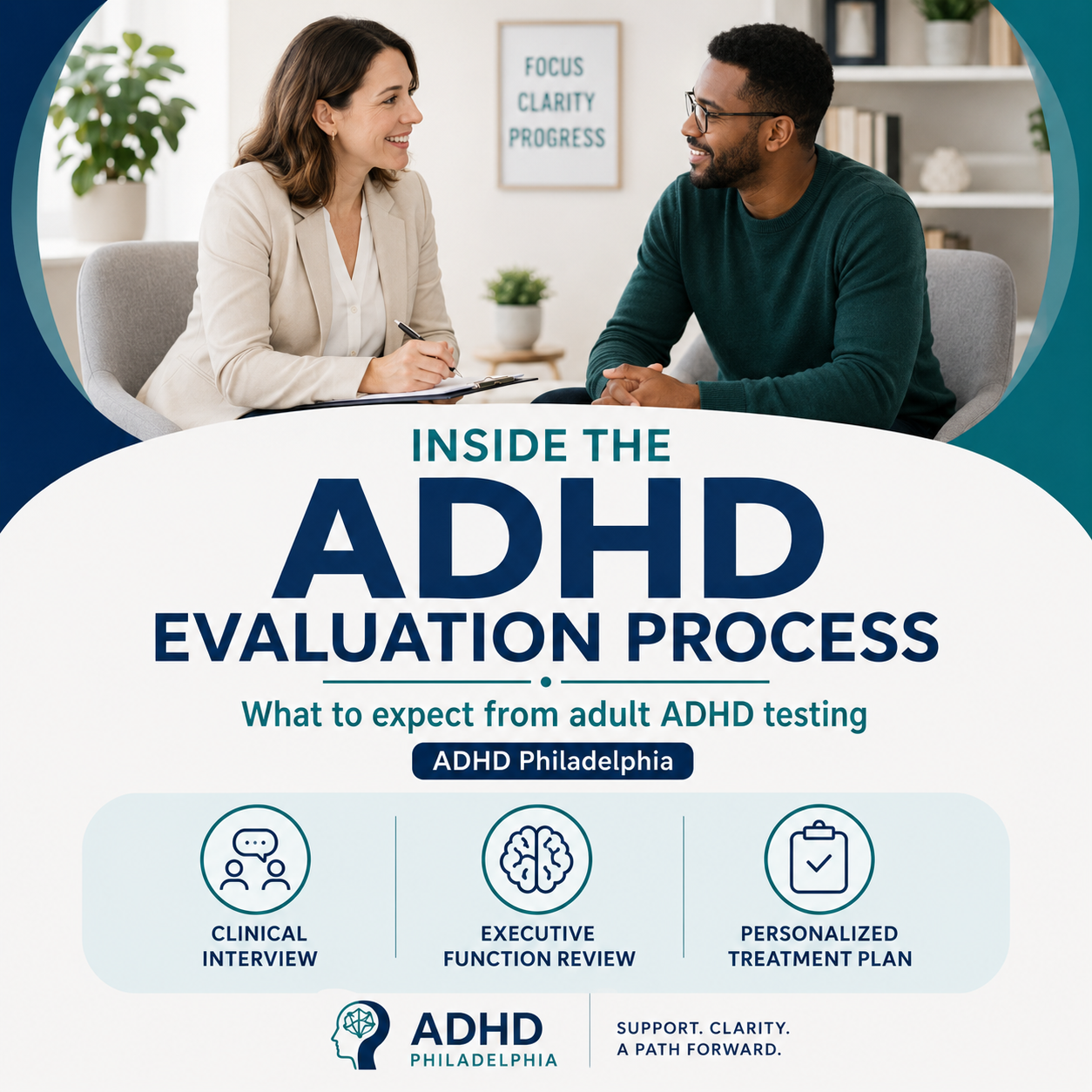
ADHD Evaluation in Philadelphia & Delaware | ADHD Philadelphia
Wondering what happens during adult ADHD testing? Learn how ADHD Philadelphia evaluates symptoms, executive function, impairment, overlapping concerns, results, and treatment options for adults in Pennsylvania and Delaware.

Many adults delay ADHD testing because they do not know what to expect.
They may wonder if the evaluation will feel rushed, judgmental, confusing, or overly clinical. Others worry they will not be taken seriously because they have learned how to “hold it together” in some parts of life while quietly struggling in others.
Some adults are not even sure whether ADHD is the right explanation. They may be asking:
Why is it so hard to focus?
Why do I procrastinate even when something matters?
Why do I feel overwhelmed by simple tasks?
Why do I lose track of time?
Why do I start things but struggle to finish them?
Why do I feel scattered, forgetful, or inconsistent?
Why have anxiety, stress, or burnout treatments not fully explained the problem?
At ADHD Philadelphia, the adult ADHD evaluation process is designed to provide clarity. The goal is not to rush to a label. The goal is to understand your symptoms, history, functioning, and treatment options in a structured and supportive way.
ADHD Philadelphia provides adult ADHD testing, evaluation, and treatment for adults in Pennsylvania and Delaware. Initial appointments begin through secure telehealth. In-person appointments may be scheduled after the first online appointment when clinically appropriate. There are no walk-in appointments.
Why Adults Seek an ADHD Evaluation
Many adults seek ADHD testing after years of feeling frustrated by patterns they cannot seem to change.
They may be successful in some areas but feel disorganized, inconsistent, or overwhelmed behind the scenes. They may perform well under pressure but struggle with routine tasks. They may care deeply about responsibilities but still have trouble following through.
Common reasons adults seek an ADHD evaluation include:
Difficulty focusing at work or school
Trouble completing tasks
Chronic procrastination
Disorganization
Forgetfulness
Poor time management
Emotional overwhelm
Difficulty staying consistent with routines
Interrupting or impulsive decisions
Feeling mentally scattered
Difficulty managing responsibilities at home
Trouble following through even when motivated
Many adults are not looking for an excuse. They are looking for an explanation.
A structured adult ADHD testing and evaluation process can help clarify whether focus problems, procrastination, forgetfulness, disorganization, and executive dysfunction may be related to ADHD.
Step 1: The First Conversation
The evaluation begins with a comprehensive first appointment.
Adults seeking evaluation specifically in Philadelphia can also review Adult ADHD Testing, Diagnosis & Treatment in Philadelphia, PA for Philadelphia-specific information about evaluation options, telehealth, treatment, and nearby in-person care.
This is where we talk about what brought you in, what symptoms you are experiencing, and how those symptoms affect your life. The goal is to understand the full picture, not just complete a quick checklist.
Topics may include:
Focus and concentration
Organization
Task completion
Time management
Sleep
Motivation
Emotional regulation
Work or school performance
Home responsibilities
Relationships
Medical and mental health history
Current medications
Substance use concerns
Past treatment history
This first conversation helps identify whether ADHD may be part of the picture and whether other factors may also be contributing.
At ADHD Philadelphia, the evaluation is designed to be professional, structured, and supportive. Adults should be able to describe their experiences without feeling dismissed or judged.
A careful adult ADHD diagnosis and evaluation starts with understanding how symptoms affect daily functioning, work performance, relationships, emotional regulation, and follow-through.
Step 2: Reviewing Current Symptoms
Adult ADHD symptoms can look different from the way ADHD is often shown in children.
Some adults are not outwardly hyperactive. Instead, they may experience internal restlessness, mental clutter, racing thoughts, difficulty relaxing, or a constant sense of being behind.
Current symptoms may include:
Difficulty sustaining attention
Trouble organizing tasks
Forgetfulness
Avoiding tasks that require sustained effort
Losing items
Distractibility
Restlessness
Impulsivity
Interrupting
Difficulty waiting
Emotional reactivity
Poor follow-through
These symptoms are reviewed in the context of real life. That matters because ADHD is not diagnosed based only on whether someone has symptoms. The symptoms must also cause meaningful impairment in daily functioning.
Recognizing adult ADHD symptoms can help adults understand why problems with focus, procrastination, disorganization, emotional overwhelm, and inconsistent follow-through may have a clinical explanation.
Step 3: Looking at Earlier Life Patterns
Adult ADHD does not suddenly appear out of nowhere.
A strong evaluation looks at whether symptoms have been present over time and whether similar patterns showed up earlier in life. Some adults were never diagnosed as children because they were bright, quiet, anxious, high-achieving, or able to compensate.
Earlier signs may have included:
Daydreaming in class
Losing assignments
Forgetting homework
Procrastinating until the last minute
Difficulty staying organized
Talking too much
Interrupting
Emotional sensitivity
Messy backpack or room
Strong performance in some subjects but not others
Needing pressure to complete work
Being called smart but inconsistent
Reviewing earlier life patterns helps determine whether ADHD symptoms are part of a long-standing pattern or whether they may be better explained by something more recent, such as stress, depression, sleep disruption, trauma, burnout, or substance use.
Many adults begin to recognize ADHD only after learning the signs you might have adult ADHD and not know it, especially when long-standing patterns with focus, organization, time, and follow-through finally make sense.
Step 4: Screening for Overlapping Conditions
A good ADHD evaluation does not assume that every focus problem is ADHD.
Several conditions can affect attention, memory, motivation, emotional regulation, and follow-through. These may include anxiety, depression, bipolar disorder, trauma, sleep problems, substance use, medical conditions, medication side effects, and chronic stress.
Learn more about emotional regulation in adults with ADHD and why a comprehensive evaluation should consider other possible causes of intense or rapidly changing emotions.
This is why ADHD diagnosis should involve clinical judgment, not just an online quiz.
During the evaluation, overlapping concerns may be reviewed so the treatment plan is accurate and safe.
This matters because treating the wrong issue can lead to frustration. For example, anxiety can make it hard to concentrate. Depression can reduce motivation and energy. Poor sleep can affect memory and attention. Trauma can affect emotional regulation. Substance use can interfere with focus and mood.
The goal is diagnostic clarity.
For many adults, understanding ADHD vs anxiety in adults is important because both can affect concentration, restlessness, sleep, motivation, emotional regulation, and daily functioning.
Step 5: Assessing Executive Function
Executive function refers to the brain skills that help people manage daily life.
These skills include planning, prioritizing, organizing, starting tasks, managing time, remembering information, controlling impulses, regulating emotions, and finishing responsibilities.
Many adults with ADHD struggle less with knowing what to do and more with doing it consistently.
They may know the task matters.
They may care about the outcome.
They may understand the consequences.
They may even have the ability to do the task.
But executive dysfunction can make it hard to move from intention into action.
During an ADHD evaluation, executive function patterns are important because they often explain the real-life struggles adults experience at work, at home, in school, and in relationships.
Problems with executive function in adults can affect planning, working memory, organization, emotional regulation, time management, task initiation, and follow-through.
Step 6: Computerized Testing When Clinically Appropriate
ADHD testing may include computerized attention and impulse-control testing when clinically appropriate.
This type of testing can provide additional information about attention patterns, response consistency, impulsivity, and sustained focus. It does not replace the clinical interview, but it can support the evaluation when used as part of a broader assessment.
At ADHD Philadelphia, testing is considered alongside the person’s history, symptoms, impairment, and clinical presentation.
A test score alone does not define a person. A checklist alone does not define a person. The best evaluation uses multiple sources of information to understand what is actually happening.
When clinically appropriate, adult ADHD testing in Pennsylvania and Delaware may include clinical interview, symptom review, functional impairment assessment, and computerized testing to support diagnostic clarity.
Step 7: Understanding Functional Impairment
ADHD diagnosis is not only about symptoms. It is also about impairment.
That means the evaluation looks at how symptoms affect real life.
Adult ADHD may affect:
Work performance
School responsibilities
Relationships
Parenting
Finances
Household tasks
Communication
Driving
Time management
Health routines
Emotional well-being
Self-confidence
For example, someone may struggle with missed deadlines, chronic lateness, unfinished tasks, disorganization, forgotten appointments, emotional overwhelm, or difficulty managing multiple responsibilities.
Understanding impairment helps guide treatment planning. It also helps separate occasional distraction from a clinically meaningful pattern.
Many adults seek evaluation because adult ADHD can make follow-through difficult even when you care, especially when executive function challenges affect task initiation, planning, working memory, and consistency.
Step 8: Reviewing Results in Clear Language
After the evaluation, results should be explained clearly.
Patients should understand what was found, what it means, and what the next steps are. Clinical care should not leave people more confused than when they started.
At ADHD Philadelphia, the goal is to review findings in practical language.
This may include discussing:
Whether ADHD appears to be present
What symptoms are most impairing
Whether other concerns may also be contributing
What treatment options may be appropriate
What medication and non-medication strategies may help
What follow-up care looks like
What safety monitoring may be needed
What the patient can expect next
The goal is understanding, not jargon.
Understanding the ADHD Philadelphia patient journey can help adults know what to expect from evaluation, diagnosis, treatment planning, follow-up care, and ongoing monitoring.
Step 9: Personalized Treatment Planning
If ADHD is diagnosed, the next step is an individualized treatment plan.
Treatment may include:
ADHD education
Executive function strategies
Medication management when clinically appropriate
Behavioral tools
Lifestyle and sleep review
Support for routines and planning
Therapy referrals when appropriate
Ongoing monitoring of treatment response
ADHD treatment should not be one-size-fits-all. A person’s work schedule, health history, symptom pattern, goals, past treatment response, and safety considerations all matter.
For some adults, medication may help improve focus, task initiation, emotional regulation, and daily functioning. For others, structure, behavioral strategies, sleep improvements, or therapy referrals may be central. Many adults benefit from a combination.
After diagnosis, adult ADHD treatment may include education, executive function strategies, lifestyle changes, and medication management when clinically appropriate.
Step 10: Medication Management When Appropriate
Medication may be discussed when clinically appropriate.
This decision should involve education, informed consent, safety review, medical history, medication history, and ongoing follow-up. Stimulant medications are controlled substances and require careful monitoring.
At ADHD Philadelphia, patients are monitored over time. Treatment response, side effects, functioning, safety, and appropriateness are reviewed during follow-up care.
For stimulant medication, follow-up is typically required every 30 days for safety monitoring, treatment response, and dosage adjustments. ADHD Philadelphia also reviews the prescription drug monitoring program as part of controlled-substance prescribing procedures.
Medication is not the only part of ADHD treatment, but for some adults it can be an important part of a structured plan.
When clinically appropriate, ADHD medication management for adults may support focus, task initiation, emotional regulation, and daily functioning as part of a monitored treatment plan.
Step 11: Ongoing Follow-Up and Monitoring
ADHD care should not stop after diagnosis.
Follow-up matters because symptoms, side effects, functioning, and treatment needs can change over time. A plan that works well at one point may need adjustment later.
Ongoing follow-up may include:
Reviewing symptom improvement
Monitoring side effects
Adjusting medication when appropriate
Reviewing sleep, appetite, mood, and functioning
Supporting routines and executive function strategies
Assessing safety concerns
Reviewing treatment goals
Updating the plan as life changes
At ADHD Philadelphia, the goal is not “diagnose and disappear.” The goal is structured care that helps adults understand their symptoms and continue moving toward better functioning.
Many adults feel relief when they learn that ADHD treatment can help explain patterns they once blamed on laziness or lack of discipline.
Telehealth ADHD Evaluation in Pennsylvania and Delaware
ADHD Philadelphia provides adult ADHD evaluation and treatment for adults in Pennsylvania and Delaware.
Initial appointments begin through secure telehealth. This can make care more accessible for busy adults, professionals, students, parents, remote workers, healthcare workers, and people who have struggled to begin the evaluation process.
In-person appointments may be scheduled after the first online appointment when clinically appropriate. There are no walk-in appointments.
Telehealth can reduce barriers while still allowing for structured assessment, education, treatment planning, and follow-up.
Adults searching for ADHD testing in Pennsylvania can begin with a structured telehealth evaluation through ADHD Philadelphia.
Adults searching for ADHD testing in Delaware can also begin with a secure telehealth evaluation through ADHD Philadelphia.
Adults searching for adult ADHD testing in Philadelphia can begin with ADHD Philadelphia’s structured evaluation process.
Adults searching for ADHD testing in Wilmington, Delaware, can begin care through ADHD Philadelphia’s Delaware telehealth services.
What Makes the ADHD Philadelphia Evaluation Different?
The ADHD Philadelphia evaluation process is designed to be clear, structured, and supportive.
The goal is not to rush patients into a diagnosis or treatment plan. The goal is to understand the person’s symptoms, history, functioning, and goals.
Understanding the person can also include cultural context and previous healthcare experiences when they are relevant, without making assumptions based on race or identity. Read our guide to Adult ADHD Care for Black & BIPOC Adults.
The ADHD Philadelphia approach emphasizes:
Diagnostic clarity
A detailed clinical conversation
Screening for overlapping concerns
Attention to executive function
Computerized testing when clinically appropriate
Clear explanation of results
Individualized treatment planning
Responsible medication management when appropriate
Ongoing monitoring
Telehealth access across Pennsylvania and Delaware
Professional, patient-centered care
Adults deserve an evaluation that takes their symptoms seriously and explains what is happening in a way they can understand.
At ADHD Philadelphia, structured adult ADHD care is designed to help patients move from confusion and self-blame toward clarity, treatment planning, and ongoing support.
Frequently Asked Questions About the ADHD Evaluation Process
Is ADHD testing just a questionnaire?
No. Questionnaires can be helpful, but adult ADHD evaluation should include a clinical interview, symptom history, functional impairment review, screening for overlapping conditions, and additional testing when clinically appropriate.
Can adults be diagnosed with ADHD for the first time?
Yes. Many adults are diagnosed later in life after years of struggling with focus, organization, procrastination, emotional regulation, forgetfulness, or follow-through.
What happens during the first ADHD appointment?
The first appointment usually includes a detailed conversation about symptoms, history, functioning, mental health, sleep, medical history, and how attention or executive function problems affect daily life.
Does ADHD Philadelphia offer computerized testing?
Computerized attention and impulse-control testing may be used when clinically appropriate. It is one part of the evaluation and is interpreted along with the clinical interview, symptom history, and functional impairment.
Can anxiety or depression look like ADHD?
Yes. Anxiety, depression, trauma, sleep problems, chronic stress, substance use, and other concerns can affect attention, motivation, memory, and emotional regulation. This is why a comprehensive evaluation is important.
Does ADHD Philadelphia evaluate adults in Pennsylvania and Delaware?
Yes. ADHD Philadelphia provides adult ADHD testing and treatment for adults in Pennsylvania and Delaware. Initial appointments begin through telehealth. In-person appointments may be scheduled after the first online appointment when clinically appropriate. No walk-in appointments are available.
What happens if ADHD is diagnosed?
If ADHD is diagnosed, the next step is an individualized treatment plan. This may include ADHD education, executive function strategies, lifestyle review, medication management when clinically appropriate, and ongoing monitoring.
Take the First Step
Getting evaluated for ADHD does not have to feel confusing or intimidating.
A structured ADHD evaluation can help you understand why focus, organization, time management, emotional regulation, and follow-through have felt harder than they should.
If you are an adult in Pennsylvania or Delaware and think ADHD may be affecting your life, ADHD Philadelphia can help you take the next step.
Schedule an adult ADHD evaluation today through ADHD Philadelphia.
Medical Disclaimer
This article is for educational purposes only and is not a substitute for medical advice, diagnosis, or treatment. If you are experiencing symptoms of ADHD, anxiety, depression, sleep problems, substance use concerns, or another mental health concern, consult a qualified healthcare professional.