
Why Adults With ADHD Feel Overwhelmed (And How Treatment Can Help)
Many adults with ADHD feel constantly overwhelmed by tasks, responsibilities, and mental clutter. Learn why ADHD creates this feeling and how proper diagnosis and treatment can help adults regain focus and control.
Many adults describe ADHD with a single word:
Overwhelmed.
Not just busy.
Not just stressed.
But mentally flooded by tasks, responsibilities, and unfinished thoughts.
For many adults across Pennsylvania and Delaware, this feeling can persist for years before they realize ADHD may be the underlying cause.
Understanding why ADHD creates this sense of overwhelm is the first step toward gaining clarity and regaining control.
One common reason adults with ADHD feel overwhelmed is difficulty initiating tasks, sometimes referred to as ADHD task paralysis, where the brain struggles to begin even simple tasks.
ADHD and the Brain’s Executive Function System
ADHD affects the brain’s executive functioning system — the network responsible for managing tasks, planning, prioritizing, and regulating attention.
Executive functions help the brain answer questions like:
What should I focus on first?
What task is most important?
How do I start this project?
What should I do next?
When this system is working well, people can organize information and take action efficiently.
However, ADHD affects this system in several ways.
Research has shown that ADHD involves differences in dopamine and norepinephrine signaling in the brain’s attention-regulation networks. These neurotransmitters help regulate motivation, reward processing, and sustained focus.
Because of this, adults with ADHD may experience difficulty with:
prioritizing tasks
initiating tasks
sustaining attention
organizing information
managing time
These challenges can create a constant sense of mental overload.
Why ADHD Often Feels Like Mental Overwhelm
Adults with ADHD frequently report that their minds feel like too many browser tabs open at once.
Tasks pile up mentally:
work deadlines
emails to answer
bills to pay
appointments to schedule
responsibilities at home
Instead of processing tasks in sequence, the brain may experience them all at once.
When overwhelm builds, routines are often one of the first things to fall apart, even when those routines were meant to reduce stress in the first place.
This can create several common experiences:
Task Paralysis
When too many tasks compete for attention, it can become difficult to start any of them.
People sometimes interpret this as procrastination or laziness, but in many cases it reflects difficulty with executive functioning.
Decision Fatigue
Adults with ADHD may struggle to prioritize tasks because everything feels equally urgent.
This can lead to:
difficulty choosing what to do first
frequent switching between tasks
unfinished projects
Over time, this creates frustration and mental exhaustion.
If ADHD symptoms are interfering with work, school, or daily responsibilities, adults across Pennsylvania and Delaware can schedule an ADHD evaluation online.
Emotional Overload
ADHD can also affect emotional regulation.
When responsibilities feel unmanageable, many adults experience:
anxiety
irritability
frustration
feelings of failure
These emotions often intensify the sense of overwhelm.
Some adults initially believe their symptoms are anxiety alone, but ADHD and anxiety can overlap. Understanding the difference between ADHD and anxiety in adults can help clarify the underlying cause.
Why Many Adults Do Not Realize ADHD Is the Cause
Many adults with ADHD were never diagnosed during childhood.
Some individuals performed well academically but struggled with organization or time management.
Others developed coping strategies that masked symptoms for years.
However, ADHD symptoms often become more noticeable when life becomes more complex.
Examples include:
demanding careers
graduate school
managing finances
parenting responsibilities
At this stage, the brain’s executive system may become overloaded.
For many adults, overwhelm and poor follow-throughare closely connected, especially when executive functioning demands keep stacking up faster than they can be managed.
Signs That ADHD May Be Contributing to Overwhelm
Adults who recognize these patterns may benefit from learning more about the adult ADHD diagnosis process and how clinicians determine whether ADHD symptoms are present.
Some adults experiencing chronic overwhelm notice patterns such as:
constantly feeling behind on tasks
difficulty starting projects
forgetting important responsibilities
trouble maintaining focus at work
frequent mental fatigue
feeling scattered despite strong effort
When these patterns persist over time, a professional ADHD evaluation for adults can help determine whether ADHD may be contributing to these challenges.
According to the Diagnostic and Statistical Manual of Mental Disorders (DSM-5-TR), ADHD involves persistent patterns of inattention and/or hyperactivity-impulsivity that interfere with functioning across multiple settings.
Understanding these patterns helps clinicians determine whether ADHD is present and whether treatment may be helpful.
How ADHD Treatment Helps Reduce Overwhelm
Effective ADHD treatment for adults often involves a structured approach that may include:
ADHD Evaluation
A comprehensive ADHD evaluation process for adults helps determine whether ADHD symptoms are present and whether other conditions may also be contributing.
Medication Management
For many adults, medication can help improve attention regulation, task initiation, and sustained focus.
When properly monitored, medication may help individuals:
maintain focus on important tasks
reduce mental clutter
improve productivity
Behavioral Strategies
Treatment may also include strategies designed to improve executive functioning, including:
task prioritization systems
time-management techniques
organizational structures
Research on executive functioning suggests that structured environments and external supports can significantly improve performance for individuals with ADHD.
The First Step Toward Clarity
If chronic overwhelm has become part of daily life, it may be helpful to explore whether ADHD could be contributing.
A structured evaluation can provide clarity about symptoms and identify appropriate treatment options.
For many adults, understanding ADHD is the beginning of regaining control over work, responsibilities, and daily life.
Book an ADHD Evaluation
Adults across Pennsylvania and Delaware can schedule an ADHD consultation online.
Learn more and book your ADHD consultation online.
Adult ADHD: A Complete Guide to Symptoms, Diagnosis, and Treatment
Adult ADHD can affect focus, organization, motivation, and emotional regulation. This complete guide explains the symptoms of ADHD in adults, how diagnosis works, and treatment options available for adults in Pennsylvania and Delaware.
Adult attention-deficit/hyperactivity disorder (ADHD) is a neurodevelopmental condition that affects attention regulation, executive functioning, motivation, and emotional regulation.
Many individuals first begin to recognize ADHD symptoms in adults when they notice ongoing difficulties with focus, organization, and follow-through in daily life.
Research suggests that ADHD involves differences in the brain’s attention and reward systems, particularly involving dopamine and norepinephrine pathways in the prefrontal cortex.
For many adults, ADHD can affect work performance, relationships, time management, and overall well-being. The good news is that ADHD is highly treatable when properly diagnosed and managed.
This guide explains the most important things adults should know about ADHD symptoms, diagnosis, testing, and treatment.
Many adults searching for ADHD testing in Pennsylvania or Delaware begin by learning about the symptoms and diagnosis process. If you’ve been struggling with focus, organization, or follow-through, understanding ADHD is the first step toward getting the right support.
What Is Adult ADHD?
Adult ADHD is a neurological condition that affects the brain’s ability to regulate attention, motivation, and executive functions.
Executive functions are mental processes that help people:
• organize tasks
• manage time
• regulate emotions
• start and complete activities
• maintain focus
When these systems do not function efficiently, everyday tasks may feel overwhelming or mentally exhausting.
Many adults with ADHD report lifelong patterns of:
• procrastination
• forgetfulness
• disorganization
• difficulty completing tasks
• emotional reactivity
• inconsistent motivation
Common ADHD Symptoms in Adults
Symptoms of ADHD in adulthood often look different from childhood hyperactivity.
Common symptoms include:
Difficulty Sustaining Attention
Adults may struggle to remain focused during meetings, reading tasks, or detailed work.
Time Blindness
Many individuals experience a distorted perception of time, which can lead to chronic lateness or difficulty estimating how long tasks will take.
Executive Dysfunction
Executive function challenges can make planning, prioritizing, and starting tasks extremely difficult.
Some adults also experience difficulty starting tasks even when they want to complete them, sometimes referred to as ADHD task paralysis.
Emotional Dysregulation
Some adults experience strong emotional responses, frustration intolerance, or rejection sensitivity.
ADHD Burnout
When cognitive demands exceed mental energy for long periods, individuals may experience exhaustion known as ADHD burnout.
Many adults experiencing ADHD symptoms in adults, such as difficulty starting tasks or feeling overwhelmed, may benefit from understanding the root cause. Read more in our article on Why Adults with ADHD Feel Overwhelmed and How to Regain Control.
ADHD vs Anxiety
ADHD and anxiety can look similar because both conditions can cause:
• racing thoughts
• restlessness
• difficulty concentrating
• feeling overwhelmed
However, the underlying causes differ.
ADHD symptoms are related to attention regulation and executive function, while anxiety is driven by excessive worry and threat perception.
If you would like a deeper explanation, read:
👉 Read more: ADHD vs Anxiety: How Adults Can Tell the Difference
How ADHD Is Diagnosed in Adults
Diagnosing ADHD in adults requires a comprehensive clinical evaluation.
A proper adult ADHD diagnosis involves understanding long-standing patterns of attention difficulties, executive dysfunction, and functional impairment across multiple areas of life.
• a detailed clinical interview
• review of current symptoms
• history of symptoms beginning in childhood
• assessment of functioning in multiple areas of life
• screening for other mental health conditions
Because ADHD symptoms overlap with other conditions, a careful diagnostic process is essential.
ADHD Testing and Evaluation
Many adults search for ADHD testing, but it is important to understand what the evaluation process actually involves.
An ADHD evaluation may include:
• clinical assessment tools
• symptom rating scales
• evaluation of executive function difficulties
• assessment for anxiety, depression, or other conditions
You can learn more about this process here:
ADHD Testing & Evaluation for Adults in Pennsylvania & Delaware
ADHD Treatment Options
ADHD treatment often includes a combination of strategies tailored to the individual.
Common treatment approaches include:
Medication Management
Medications can help regulate neurotransmitter systems involved in attention and executive function.
Behavioral Strategies
Structured routines, time-management systems, and environmental modifications can improve functioning.
Therapy and Coaching
Cognitive behavioral therapy and ADHD coaching can help individuals develop practical strategies for managing symptoms.
ADHD Medication Options
ADHD medications generally fall into two categories:
Stimulant Medications
These medications increase dopamine and norepinephrine activity in the brain.
Non-Stimulant Medications
Non-stimulant options can also help regulate attention and impulse control.
More information about medication options can be found here:
ADHD Treatment & Medication Management for Adults in Pennsylvania & Delaware
When Adults Should Seek ADHD Evaluation
Adults should consider an ADHD evaluation if they experience persistent difficulties such as:
• chronic procrastination
• difficulty finishing tasks
• problems with organization
• forgetfulness
• emotional overwhelm
• struggles with time management
If these challenges have been present since childhood and interfere with daily functioning, ADHD may be a possibility.
If you’ve been experiencing persistent ADHD symptoms in adults, seeking a professional evaluation can help determine whether an adult ADHD diagnosis is appropriate.
Adult ADHD Care in Pennsylvania and Delaware
Adults living in Pennsylvania and Delaware who suspect ADHD may benefit from a comprehensive evaluation and individualized treatment plan.
ADHDPhiladelphia.com provides adult ADHD testing, diagnosis, and treatment through a structured telehealth model designed to help individuals understand their symptoms and develop effective strategies for managing ADHD.
Schedule an ADHD Evaluation
If you live in Pennsylvania or Delaware and have been struggling with focus, procrastination, or feeling overwhelmed, ADHD may be playing a role.
A structured ADHD evaluation can help provide clarity and a path forward.
👉 Book your appointment today at ADHDPhiladelphia.com
ADHD Testing by Location
If you are specifically searching for ADHD services in your area:
👉 Adult ADHD Testing in Philadelphia
👉 Adult ADHD Testing in Wilmington
👉 Adult ADHD Testing in Newark
👉 Adult ADHD Testing in Pittsburgh
👉 Adult ADHD Testing in Allentown
👉 Adult ADHD Testing in Harrisburg
👉 Adult ADHD Testing in Lancaster
Frequently Asked Questions About Adult ADHD
Can ADHD be diagnosed in adulthood?
Yes. Many adults are diagnosed later in life after recognizing long-standing patterns of inattention, disorganization, and difficulty with follow-through.
Is ADHD treatable in adults?
Yes. ADHD is highly treatable with the right combination of medication, structure, and behavioral strategies.
What is the difference between ADHD and anxiety?
ADHD affects attention regulation and executive functioning, while anxiety is driven by excessive worry and fear-based thinking.
Related ADHD Topics
• ADHD Task Paralysis: Why Adults Struggle to Start Tasks
• Executive Dysfunction in Adults With ADHD
• ADHD Procrastination vs Laziness
• ADHD Burnout in Adults
• ADHD Time Blindness
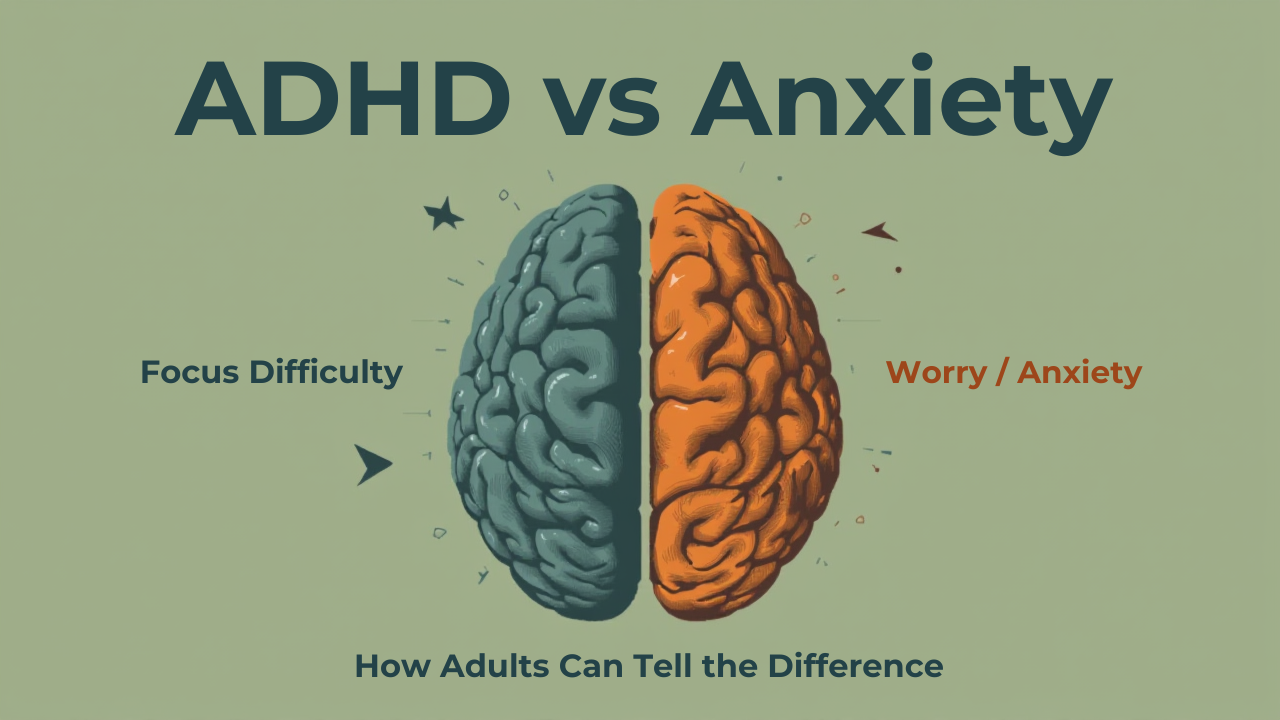
ADHD vs Anxiety: How Adults Can Tell the Difference
Many adults struggle with focus, racing thoughts, and overwhelm and assume anxiety is the cause. However, ADHD and anxiety often overlap. Learn how clinicians distinguish ADHD from anxiety and when adults in Pennsylvania and Delaware may benefit from ADHD testing.
Many adults who struggle with focus, racing thoughts, or difficulty completing tasks assume they may have anxiety.
However, symptoms of ADHD and anxiety often overlap, which can make it difficult to determine the underlying cause.
Understanding the difference can help individuals decide whether an ADHD evaluation for adults may be helpful.
Why ADHD and Anxiety Are Often Confused
Both conditions can involve:
• difficulty concentrating
• restlessness
• racing thoughts
• feeling overwhelmed
• trouble completing tasks
Many adults first begin exploring these questions when they recognize signs of ADHD in adults that have affected them for years.
Key Differences Between ADHD and Anxiety
ADHD
ADHD primarily affects attention regulation and executive functioning.
Common patterns include:
• difficulty starting tasks
• losing items frequently
• procrastination
• time blindness
• impulsive decisions
These symptoms often occur even when a person feels calm.
Anxiety
Anxiety is primarily related to excessive worry or fear about future events.
Common patterns include:
• persistent worry
• physical tension
• difficulty relaxing
• fear of making mistakes
• overthinking decisions
Concentration problems usually occur because the mind is preoccupied with worry.
When ADHD and Anxiety Occur Together
Many adults experience both ADHD and anxiety.
In fact, untreated ADHD can lead to anxiety because individuals may struggle with:
• missed deadlines
• disorganization
• difficulty keeping up with responsibilities
Over time, this stress can increase anxiety symptoms.
When ADHD is identified and treated, many adults experience improvement in both focus and anxiety symptoms, especially when appropriate ADHD medications for adults are considered.
How ADHD Evaluations Help Clarify the Diagnosis
An ADHD evaluation typically includes:
• review of symptom history
• discussion of attention patterns
• evaluation of executive functioning
• screening for anxiety and other conditions
This process helps determine whether ADHD, anxiety, or a combination of factors may be affecting daily functioning.
ADHD Testing and Treatment for Adults
Adults located in Pennsylvania or Delaware who experience persistent focus difficulties may benefit from a professional ADHD evaluation for adults in Pennsylvania and Delaware.
ADHDPhiladelphia.com provides adult ADHD testing and treatment through telehealth and follow-up care.
Understanding the cause of attention challenges can help individuals develop effective strategies for improving focus, productivity, and quality of life.
How ADHD Testing Works for Adults in Pennsylvania and Delaware
Many adults wonder how ADHD testing works and what happens during an ADHD evaluation. This guide explains the ADHD assessment process and how adults in Pennsylvania and Delaware can seek testing and treatment.
Many adults struggle with focus, procrastination, organization, or time management for years before considering whether ADHD may be contributing to these challenges. Learning more about adult ADHD testing and treatment can help individuals understand whether an evaluation may be helpful.
One of the most common questions people ask is:
“How does ADHD testing work for adults?”
Understanding the evaluation process can help individuals decide whether seeking an assessment may be helpful.
Many adults first begin exploring these questions when reading about signs of ADHD in adults.
Many adults pursue an ADHD evaluation after years of believing their difficulties were related to anxiety or stress. Because the symptoms of ADHD and anxiety often overlap, it can be difficult to distinguish between the two without a professional evaluation. Our guide on the difference between ADHD and anxiety in adults explains the key signs clinicians look for.
Why Adults Seek ADHD Testing
Many adults begin exploring ADHD testing after recognizing patterns such as:
difficulty sustaining attention
chronic procrastination
disorganization
losing important items
difficulty finishing tasks
trouble managing time
While these experiences can occur for many reasons, persistent patterns may suggest that an ADHD evaluation for adults could be helpful.
What Happens During an Adult ADHD Evaluation
An ADHD evaluation typically involves several important steps designed to understand how attention and executive functioning affect daily life.
1. Clinical Interview
The evaluation begins with a detailed discussion about symptoms, history, and daily functioning.
Clinicians often review:
attention difficulties
work or academic challenges
organizational patterns
impulsivity or restlessness
The clinician may also explore childhood experiences, since ADHD symptoms typically begin earlier in life even if diagnosis occurs later.
2. Symptom Assessment
Structured screening tools and symptom checklists may be used to evaluate common ADHD patterns such as:
inattention
hyperactivity or restlessness
impulsivity
executive functioning challenges
These tools help clinicians understand how symptoms affect work, school, and daily responsibilities.
3. Review of Daily Functioning
A key part of ADHD diagnosis is determining whether symptoms cause meaningful impairment in daily life.
This may include discussion of:
workplace performance
academic responsibilities
organization and time management
relationships and communication
4. Screening for Other Conditions
Because symptoms like difficulty concentrating can also occur in other conditions, clinicians often evaluate for factors such as:
anxiety
depression
sleep issues
stress
This helps ensure the most accurate understanding of what may be affecting attention and focus.
Because ADHD and anxiety share overlapping symptoms such as difficulty concentrating and feeling overwhelmed, a professional evaluation can help clarify the cause. Learn more about how ADHD and anxiety differ in adults in our detailed guide.
Can ADHD Testing Be Done Through Telehealth?
Many adults now complete ADHD evaluations through telehealth appointments.
Telehealth allows clinicians to conduct detailed interviews, review symptom history, and assess functioning while patients remain in their own environment.
For many adults, this makes the evaluation process more convenient and accessible.
What Happens After an ADHD Diagnosis?
If ADHD is diagnosed, treatment options may include:
medication management
behavioral strategies
executive functioning support
lifestyle adjustments
Treatment plans are individualized based on each person’s needs and goals.
Adults often explore options such as ADHD medication treatment for adults.
ADHD Testing for Adults in Pennsylvania and Delaware
Adults located in Pennsylvania or Delaware who experience persistent focus difficulties may benefit from a professional ADHD evaluation for adults in Pennsylvania and Delaware.
ADHDPhiladelphia.com provides adult ADHD testing and treatment through telehealth and follow-up care.
Understanding how ADHD affects attention and executive functioning can help individuals develop strategies to improve productivity, focus, and overall quality of life.
FAQ
Frequently Asked Questions About Adult ADHD Testing
How long does ADHD testing take for adults?
The evaluation process may involve a clinical interview, symptom assessment, and review of daily functioning.
Can adults be diagnosed with ADHD later in life?
Yes. Many adults receive an ADHD diagnosis after recognizing long-standing patterns of attention and executive functioning challenges.
Do adults need testing to receive ADHD treatment?
A professional evaluation helps clinicians determine whether ADHD or another condition may be affecting attention and focus.

Why Smart Adults Often Miss an ADHD Diagnosis (And What To Do About It)
High-functioning adults often compensate for ADHD symptoms until stress and burnout increase. Learn how intelligence can mask executive dysfunction and why a structured ADHD evaluation in Pennsylvania and Delaware matters.
Many high-achieving adults are surprised to learn they have ADHD.
They finished college.
They built careers.
They manage responsibilities.
So how could ADHD have been missed?
The answer is simple: intelligence can compensate — until it can’t.
For many adults in Pennsylvania and Delaware, ADHD isn’t obvious in childhood. Instead, it becomes more visible when life demands exceed coping strategies.
Why ADHD Is Often Overlooked in Smart Adults
ADHD is not a measure of intelligence.
In fact, many adults with ADHD are:
• Creative
• Verbally strong
• High-performing under pressure
• Capable of last-minute success
Strong cognitive ability can mask executive dysfunction for years.
Deadlines get met — but through stress.
Assignments get completed — but at the last minute.
Work gets done — but at personal cost.
Eventually, the compensatory strategies stop working.
What Changes in Adulthood?
As responsibilities increase, ADHD symptoms become harder to hide.
Adults may begin noticing:
• Chronic procrastination
• Decision fatigue
• Difficulty initiating tasks
• Inconsistent productivity
• Emotional overwhelm
• Burnout despite effort
At this stage, many are misdiagnosed with anxiety, depression, or simple stress.
A structured adult ADHD evaluation helps clarify the difference.
You can learn more about our adult ADHD evaluation process here.
The Hidden Cost of Compensation
When ADHD is undiagnosed, adults often internalize the struggle.
They may think:
“I’m lazy.”
“I’m not disciplined.”
“I should be doing better.”
Over time, chronic stress can impact sleep, emotional regulation, and overall health.
Research suggests untreated ADHD may contribute to long-term risk patterns related to impulsivity and lifestyle instability.
You can read more about how undiagnosed ADHD may impact long-term health here.
Why Proper Diagnosis Matters
A comprehensive ADHD evaluation includes:
• Structured clinical interview
• Functional impairment assessment
• Review of childhood history
• Screening for overlapping conditions
• When appropriate, ADHD testing
Diagnosis is not based on intelligence.
It is based on persistent patterns of executive dysfunction and impairment.
If ADHD is diagnosed, structured treatment options are reviewed.
Learn more about our ADHD treatment and medication management approach.
What To Do If This Sounds Familiar
If you are a high-functioning adult who has always “managed” but never felt stable, it may be worth exploring whether ADHD is part of the picture.
Clarity is not about labeling.
It is about understanding how your brain works — and building sustainable systems around it.
Adult ADHD Care in Pennsylvania & Delaware
At ADHD Philadelphia, we specialize exclusively in adult ADHD diagnosis and structured treatment.
Telehealth appointments are available throughout Pennsylvania and Delaware.
In-person appointments may be scheduled after the initial evaluation when clinically appropriate.
There are no walk-in appointments.
Ready to Take the Next Step?
If you suspect ADHD may have been overlooked, a structured evaluation can provide clarity.

How Do You Know If ADHD Medication Is Working in Adults?
Learn how to tell if ADHD medication is working in adults. Discover what improvement should look like, when adjustments are needed, and how structured monitoring supports safe ADHD treatment in Pennsylvania and Delaware.
One of the most common questions adults ask after starting ADHD medication is:
“Is this actually working?”
For adults diagnosed with ADHD, improvement is not always dramatic. It is often subtle — but clinically meaningful.
Understanding what improvement should look like helps ensure treatment remains safe, appropriate, and effective.
If you are unsure how adult ADHD is diagnosed, you can learn more about our comprehensive evaluation process here.
What Improvement Should Look Like
When medication is properly matched and monitored, adults often notice:
• Improved task initiation
• Reduced procrastination
• Increased sustained attention
• Better organization
• Fewer careless mistakes
• Improved emotional regulation
It may not feel like a “burst of motivation.”
Instead, it often feels like:
“It’s easier to start.”
What Medication Should NOT Do
Medication should not:
• Make you feel euphoric
• Cause severe anxiety
• Dramatically alter personality
• Eliminate normal fatigue
• Replace healthy habits
If side effects outweigh benefits, adjustments are needed.
How Long Does It Take?
Stimulants may begin working the same day.
Non-stimulants may take several weeks.
However, effectiveness must be evaluated over time.
That’s why structured 30-day monitoring is important.
Medication effectiveness should always be evaluated in the context of overall functioning, medical history, and safety considerations.
👉 Learn more about our Medication Management & Stimulant Treatment Policy.
Measuring Functional Improvement
Medication success is measured by:
• Workplace performance
• Academic productivity
• Household task completion
• Time management
• Emotional stability
It is not measured by “feeling different.”
It is measured by functioning better.
When Adjustments Are Needed
You may need adjustment if:
• Benefits are inconsistent
• Focus improves but anxiety worsens
• Sleep becomes disrupted
• Blood pressure increases
• Motivation improves but organization does not
Medication is one tool — not the entire solution.
Comprehensive ADHD treatment often includes behavioral strategies, executive functioning support, and lifestyle optimization alongside medication management.
ADHD Treatment in Pennsylvania & Delaware
At ADHD Philadelphia, medication effectiveness is evaluated through structured follow-up and symptom review.
Treatment decisions are individualized and may include stimulant or non-stimulant options depending on clinical presentation.
You can also read our detailed comparison of stimulant vs non-stimulant ADHD medications here.
Telehealth available throughout Pennsylvania & Delaware.
In-person appointments may be scheduled after the initial visit.
We serve adults in Philadelphia, Montgomery County, Bucks County, Chester County, Wilmington, Newark, Dover, and surrounding communities.
Ready to Begin?
If you are an adult located in Pennsylvania or Delaware and unsure whether ADHD medication may be appropriate, schedule a comprehensive evaluation to review your symptoms, medical history, and treatment options.

Why Adult ADHD Makes Follow-Through So Difficult Even When You Care
Many adults with ADHD care deeply but still struggle to follow through. Learn how executive dysfunction affects task initiation, time management, consistency, and daily responsibilities.
Many adults with ADHD care deeply about their responsibilities.
They care about their work.
They care about their relationships.
They care about their health.
They care about their families.
They care about doing what they said they would do.
But caring does not always make follow-through easier.
This is one of the most painful parts of adult ADHD. Many adults know exactly what needs to be done, but they still struggle to start, stay consistent, finish tasks, or repeat the same helpful behavior over time.
From the outside, this can look like laziness, avoidance, irresponsibility, or lack of discipline. But for many adults with ADHD, the real issue is executive dysfunction.
Adult ADHD affects the brain systems involved in planning, time management, organization, motivation, emotional regulation, working memory, and task completion. That means follow-through is not simply about willpower. It is often about how the brain manages action.
At ADHD Philadelphia, we work with adults in Pennsylvania and Delaware who have spent years asking themselves, “Why can’t I just do what I know I need to do?” For many, ADHD testing and treatment finally help explain the pattern.
Follow-Through Is an Executive Function Skill
Follow-through sounds simple, but it actually requires several executive function skills working together.
To follow through on a task, the brain has to:
Remember what needs to be done
Prioritize the task
Estimate how long it will take
Start the task
Ignore distractions
Manage frustration
Stay with the task long enough to finish
Return to the task if interrupted
Repeat the behavior consistently over time
For adults with ADHD, one or more of these steps may break down.
This is why a person may have strong intentions but poor execution. They may genuinely care and still forget. They may want to finish and still get distracted. They may understand the consequences and still delay until the last minute.
The problem is not always motivation. The problem is often the brain’s ability to organize behavior over time.
A structured evaluation can help determine whether adult ADHD testing and evaluation may explain ongoing struggles with follow-through, procrastination, disorganization, time management, and executive dysfunction.
Why Caring Is Not Always Enough
Many adults with ADHD feel confused because they care so much.
They may say:
“I know it matters.”
“I really meant to do it.”
“I was planning to start.”
“I do not understand why I keep putting it off.”
“I care, but I still cannot seem to follow through.”
This can create shame because the person assumes that if they cared enough, they would do it.
But ADHD often creates a gap between intention and action. The desire is there. The goal is there. The consequences may even be clear. But the brain struggles to activate, organize, and sustain the behavior.
This is especially true when tasks are boring, repetitive, emotionally uncomfortable, unclear, delayed in reward, or not immediately urgent.
Many adults with ADHD can perform well in high-pressure situations because urgency gives the brain stimulation. But routine, maintenance-based tasks can feel much harder. Paying bills, answering emails, cleaning, scheduling appointments, finishing paperwork, or keeping up with daily routines may feel unusually difficult.
This does not mean the person does not care. It means their brain may need more structure, support, and treatment.
For many adults, adult ADHD diagnosis helps explain why caring, trying harder, and making promises may not be enough when executive function challenges interfere with action.
Task Initiation: Why Starting Feels So Hard
One major reason adults with ADHD struggle with follow-through is difficulty starting tasks.
Task initiation is the ability to begin something without needing extreme pressure, panic, or urgency. For adults with ADHD, starting can be one of the hardest parts.
A task may sit on the to-do list for days, weeks, or months. The person may think about it constantly, feel guilty about it, and still not start.
This can happen because the task feels too large, too boring, too emotionally uncomfortable, too unclear, or too disconnected from immediate reward.
The adult with ADHD may not be avoiding the task because they do not care. They may be stuck because their brain cannot easily shift from intention into action.
Common signs of task initiation problems include:
Waiting until the last minute
Needing pressure to start
Feeling frozen by simple tasks
Avoiding tasks that feel unclear
Starting easier tasks instead of important ones
Feeling mentally blocked even when the task matters
Knowing what to do but not being able to begin
Treatment can help adults understand these patterns and build systems that make starting easier.
Many adults seek help because ADHD-related procrastination can make even important tasks feel difficult to start until urgency or stress takes over.
Working Memory: Why Adults With ADHD Forget What They Meant To Do
Another reason follow-through is difficult is working memory.
Working memory is the ability to hold information in mind long enough to use it. Adults with ADHD may fully intend to do something, but the intention disappears once another demand appears.
They may walk into a room and forget why they went there.
They may remember an errand at the wrong time.
They may forget to respond to a message after reading it.
They may miss a deadline because it was not visible enough.
They may start one task and lose track of the original task.
This is not always carelessness. It may be a working memory problem.
Adults with ADHD often need external systems to hold information outside the brain. Reminders, calendars, visible lists, alarms, written plans, and structured routines can help reduce the pressure on working memory.
Treatment can also help by improving attention regulation and helping patients build realistic systems they can actually use.
Problems with executive function in adults can affect working memory, organization, time awareness, planning, and the ability to complete tasks consistently.
Time Blindness: Why Deadlines Sneak Up
Many adults with ADHD struggle with time blindness.
Time blindness means the brain has difficulty sensing, estimating, or managing time. A person may know a deadline exists but not feel it until it becomes urgent.
They may underestimate how long something will take.
They may overestimate how much time they have.
They may lose hours to distractions.
They may run late even when they tried to be on time.
They may feel like time is either “now” or “not now.”
This creates major follow-through problems.
A task that is not urgent may not feel real yet. Then suddenly, the deadline becomes immediate, stress increases, and the person rushes to finish. This pattern may work sometimes, but it often leads to burnout, mistakes, missed opportunities, and emotional exhaustion.
Treatment can help adults develop better planning systems, use external time supports, and reduce dependence on last-minute panic.
Many adults with ADHD struggle because ADHD can make routines hard to maintain, especially when time blindness, distractibility, and inconsistent motivation interfere with daily structure.
Emotional Overwhelm Can Block Follow-Through
Follow-through is not only about attention. It is also about emotion.
Many adults with ADHD avoid tasks because the task triggers discomfort. It may bring up boredom, frustration, shame, fear of failure, uncertainty, guilt, or anxiety.
For example:
An email may feel emotionally loaded.
A bill may bring up shame.
A project may feel too big.
A phone call may feel awkward.
A messy room may feel overwhelming.
A form may feel confusing before it even begins.
When the emotional weight of a task feels too high, the ADHD brain may avoid it. The person may distract themselves, switch tasks, scroll, clean something else, or wait until urgency becomes stronger than discomfort.
This can become a cycle.
Avoidance brings temporary relief.
The task remains unfinished.
Guilt increases.
The task feels even heavier.
Follow-through becomes harder.
ADHD treatment can help patients understand this cycle and develop strategies to lower the emotional barrier to starting.
Many adults with ADHD struggle with follow-through because adult ADHD can cause chronic overwhelm, making everyday responsibilities feel heavier and harder to begin.
Decision Fatigue Makes Follow-Through Harder
Follow-through also becomes harder when every task requires too many decisions.
Adults with ADHD may struggle with questions like:
Where do I start?
What is most important?
How long should this take?
What if I do it wrong?
Should I do this now or later?
What should I handle first?
When the brain has to make too many decisions before beginning, the task can become paralyzing. This is called decision fatigue.
Instead of starting, the person may freeze, delay, or switch to something easier. They may spend more time thinking about the task than doing the task.
This is why simple, clear, structured plans are important for adults with ADHD. The fewer decisions required at the point of action, the easier follow-through becomes.
For many adults, ADHD can make decision-making hard because executive dysfunction affects prioritizing, organizing options, and moving from thought into action.
Why Adults With ADHD Can Follow Through Sometimes
One confusing part of ADHD is inconsistency.
An adult with ADHD may follow through beautifully in one area and struggle deeply in another. They may perform well at work but struggle at home. They may meet deadlines for others but not for themselves. They may manage a crisis effectively but struggle with routine chores.
This inconsistency often causes people to misunderstand ADHD.
They may think, “If I can do it sometimes, why can’t I do it all the time?”
ADHD symptoms often change depending on interest, urgency, novelty, structure, stress level, reward, and accountability.
Tasks that are interesting, urgent, challenging, or externally structured may be easier. Tasks that are boring, repetitive, delayed in reward, or self-directed may be much harder.
This is why adults with ADHD often do not need more shame. They need better systems, better understanding, and appropriate treatment.
Many adults feel relief when they learn that ADHD treatment can help explain patterns they once blamed on laziness or lack of discipline.
Why Remote Work Can Make Follow-Through Worse
Remote and hybrid work can be especially difficult for adults with ADHD.
Working from home often removes external structure. There may be fewer transitions, fewer visual reminders, less accountability, and more distractions. The day can become blurry.
Adults with ADHD may struggle to:
Start work on time
Transition between tasks
Avoid household distractions
Manage emails and messages
Stay organized without external structure
Stop working at a healthy time
Prioritize tasks without immediate feedback
Remote work can be helpful for some people, but for adults with untreated ADHD, it can also expose executive function challenges that were previously hidden by office routines.
Treatment can help adults build structure into the workday and reduce reliance on urgency or panic.
For remote and hybrid workers, adult ADHD treatment may help improve structure, focus, time management, and follow-through during the workday.
ADHD Follow-Through Problems Are Not Moral Failures
Many adults with ADHD carry years of shame.
They may have been called lazy, irresponsible, messy, dramatic, forgetful, careless, or unreliable. Over time, they may begin to believe those labels.
But ADHD-related follow-through problems are not moral failures.
They are often signs of impaired executive functioning, attention regulation, working memory, emotional regulation, and time management.
This does not mean adults with ADHD are not responsible for their actions. It means they may need different tools, clinical support, and treatment strategies to function more consistently.
Understanding ADHD can replace shame with strategy.
Recognizing adult ADHD symptoms can help people understand that problems with follow-through, procrastination, distractibility, emotional overwhelm, and inconsistency may have a clinical explanation.
How ADHD Treatment Can Improve Follow-Through
ADHD treatment can help adults improve follow-through by addressing the underlying symptoms that make consistency difficult.
Treatment may include:
ADHD education
Executive function strategies
Medication management when clinically appropriate
Behavioral tools
Environmental structure
Sleep and lifestyle review
Support for routines and planning
Monitoring of symptoms and treatment response
The goal is not to become perfect. The goal is to reduce friction.
With treatment, adults may find it easier to start tasks, stay focused, remember responsibilities, manage emotions, reduce procrastination, and complete more of what they begin.
For some patients, medication may help improve attention, mental clarity, and task initiation. For others, non-medication strategies and structured systems are central. Many adults benefit from a combination of approaches.
At ADHD Philadelphia, treatment is individualized and monitored over time.
When clinically appropriate, ADHD medication management for adults may support focus, task initiation, emotional regulation, and follow-through as part of a structured treatment plan.
ADHD Evaluation in Pennsylvania and Delaware
Adults in Pennsylvania and Delaware can begin ADHD evaluation through ADHD Philadelphia using secure telehealth appointments.
Telehealth can make it easier for busy professionals, parents, students, entrepreneurs, healthcare workers, and remote employees to access care without unnecessary travel barriers.
In-person appointments may be scheduled after the first telehealth appointment when clinically appropriate. There are no walk-in appointments.
The evaluation process may include a review of symptoms, history, executive functioning, impairment, medical and mental health factors, and overlapping conditions that may affect focus and follow-through.
The goal is diagnostic clarity and a practical treatment plan.
Adults searching for ADHD testing in Pennsylvania can begin with a structured telehealth evaluation through ADHD Philadelphia.
Adults searching for ADHD testing in Delaware can also begin with a secure telehealth evaluation through ADHD Philadelphia.
When to Consider ADHD Testing
You may want to consider ADHD testing if you regularly struggle with:
Starting tasks
Finishing tasks
Following through on promises
Time management
Chronic procrastination
Disorganization
Forgetfulness
Missed deadlines
Emotional overwhelm
Inconsistent routines
Difficulty completing responsibilities
Feeling like you care but cannot execute consistently
If these patterns have affected your work, relationships, school, home life, finances, or self-confidence, an ADHD evaluation may help.
Many adults do not seek help because they think they should be able to fix the problem on their own. But if the same patterns keep repeating despite effort, it may be time to look deeper.
If follow-through problems are affecting daily life, adult ADHD testing may help clarify whether ADHD is contributing to difficulties with focus, procrastination, organization, and consistency.
Frequently Asked Questions About ADHD and Follow-Through
Why do adults with ADHD struggle to follow through?
Adults with ADHD may struggle with follow-through because ADHD affects executive function skills such as task initiation, planning, prioritizing, working memory, time management, emotional regulation, and sustained attention.
Does struggling with follow-through mean I am lazy?
No. Many adults with ADHD care deeply and still struggle to follow through. ADHD can create a gap between intention and action. This does not mean the person is lazy. It may mean their brain needs better support, structure, and treatment.
Why can I follow through sometimes but not all the time?
ADHD symptoms often change depending on interest, urgency, structure, reward, accountability, and emotional stress. This is why adults with ADHD may perform well in some situations but struggle in others.
Can ADHD treatment improve follow-through?
Yes. ADHD treatment may help improve focus, task initiation, planning, time management, emotional regulation, and consistency. Treatment may include education, executive function strategies, behavioral tools, and medication management when clinically appropriate.
Does ADHD Philadelphia treat adults with follow-through problems?
Yes. ADHD Philadelphia provides adult ADHD testing and treatment for patients in Pennsylvania and Delaware. Initial appointments begin through telehealth. In-person appointments may be scheduled after the first online appointment when clinically appropriate. No walk-in appointments are available.
Take the First Step
If you care deeply but still struggle to follow through, you are not alone.
Adult ADHD can make it difficult to start tasks, finish responsibilities, stay consistent, manage time, and keep promises even when your intentions are sincere.
The answer is not more shame. The answer may be better understanding, better systems, and appropriate treatment.
If you are an adult in Pennsylvania or Delaware and think ADHD may be affecting your follow-through, ADHD Philadelphia can help you take the next step.
Schedule an adult ADHD evaluation today through ADHD Philadelphia.
Medical Disclaimer
This article is for educational purposes only and is not a substitute for medical advice, diagnosis, or treatment. If you are experiencing symptoms of ADHD, anxiety, depression, sleep problems, substance use concerns, or another mental health concern, consult a qualified healthcare professional.
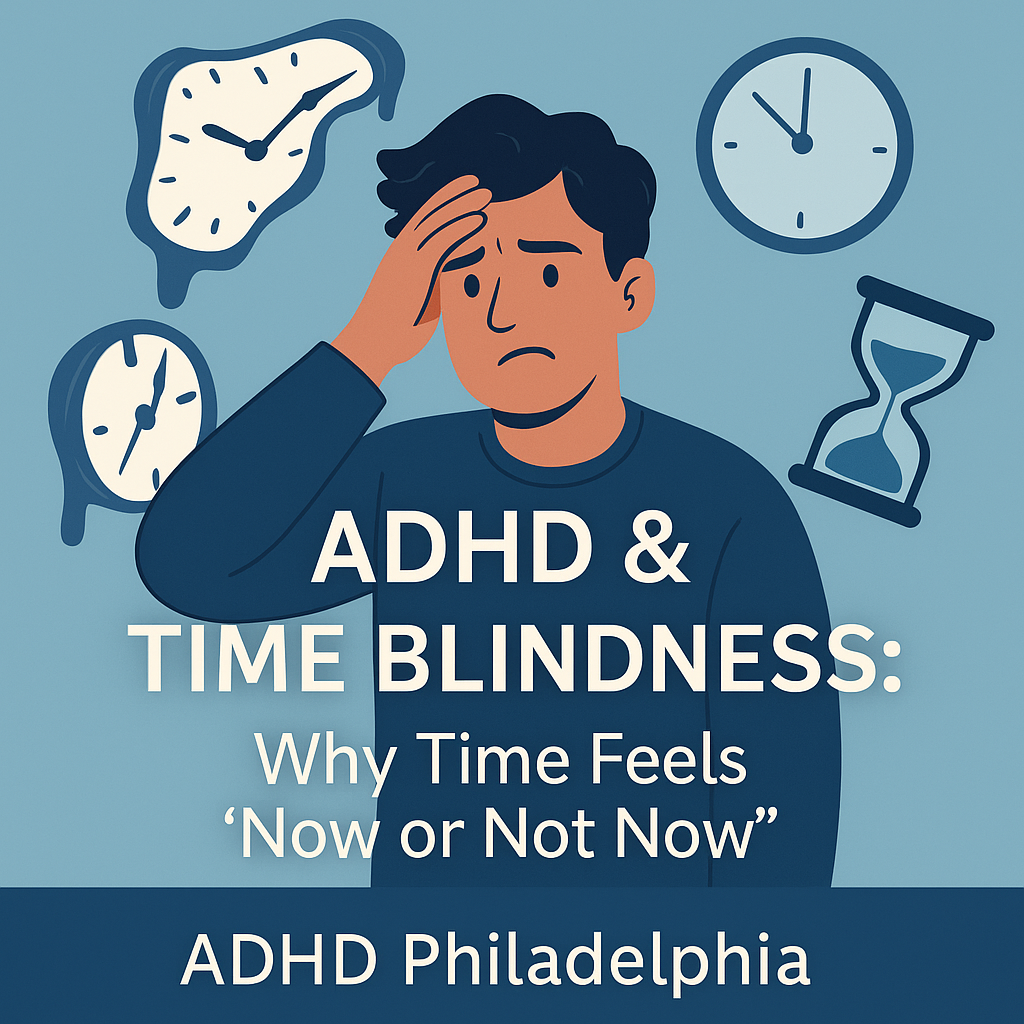
🌪️ ADHD and Time Blindness: Why Time Feels “Now or Not Now”. By Charles Thornton, PMHNP-BC — ADHD Philadelphia
Time blindness is one of the most frustrating symptoms of adult ADHD. Learn why it happens, how it affects daily life, and the evidence-based tools that help adults in PA and DE stay on track.
If you live with ADHD, you’ve probably said something like:
“How did it get so late?”
“I thought I had more time.”
“I’ll start in five minutes…” (one hour later)
“Deadlines sneak up on me even when I know they’re coming.”
This isn’t laziness or irresponsibility.
It’s time blindness, one of the core executive function challenges seen in adults with ADHD.
At ADHD Philadelphia, I help adults across Pennsylvania and Delaware understand why this happens — and how to build systems that finally make time feel manageable.
🧠 What Is Time Blindness?
Time blindness is the difficulty in:
sensing how much time has passed
estimating how long tasks will take
predicting future time demands
transitioning between activities
noticing the “flow” of time at all
Many adults describe time as “now or not now.”
If something isn’t happening right this second, it might as well not exist.
📍 Why ADHD Creates Time Blindness
1️⃣ The ADHD Brain Has Impaired Internal Timekeeping
Executive functions — specifically the prefrontal cortex — help us monitor time.
ADHD disrupts this system, making time feel abstract or unreliable.
This is why adults with ADHD often say:
“I know the deadline is next week… but it doesn’t feel real.”
2️⃣ Dopamine Drives Urgency — Not the Clock
For adults with ADHD, tasks only become “real” when they are:
interesting
rewarding
urgent
or anxiety-producing
This creates the classic ADHD cycle:
No urgency → no action → sudden urgency → hyperfocus → exhaustion.
3️⃣ Working Memory Gaps Disrupt Planning
If something isn’t in front of you, it’s easy to forget it exists.
This fuels procrastination and creates the illusion of “plenty of time.”
4️⃣ Hyperfocus Warps Time Completely
One minute feels like five hours.
Five hours feel like ten minutes.
Hyperfocus is powerful — but also dangerous when time disappears entirely.
🧩 How Time Blindness Affects Daily Life
Adults with ADHD often experience:
chronic lateness
missed deadlines
difficulty switching tasks
forgetting appointments
rushing at the last minute
underestimating task duration
relationship stress (“You’re always late”)
financial issues (late bills, fees)
These challenges feed shame and frustration — but they are neurological, not moral.
🔧 Tools That Help Fix Time Blindness
1️⃣ Externalize All Time (Never Rely on Memory)
Use:
digital timers
time-blocked calendars
visual countdowns
alarms with labels
wall clocks in every room
“time trackers” that show elapsed time
Goal: make invisible time visible.
2️⃣ Break Tasks Into Time-Based Chunks
Instead of:
“Clean the kitchen.”
Try:
“10 minutes: clear counters.”
“10 minutes: wash dishes.”
“5 minutes: sweep.”
Time chunks reduce overwhelm and increase follow-through.
3️⃣ Use “Transition Alarms”
One alarm to end a task.
Another to begin the next one.
Transitions are often the hardest part of ADHD functioning.
4️⃣ Try the “3-to-Start Rule”
Tell yourself:
“I only have to work for 3 minutes.”
This bypasses task initiation paralysis.
Once started, most adults continue naturally.
5️⃣ ADHD Medication Improves Time Awareness
Stimulants and non-stimulants can increase:
working memory
focus
task initiation
ability to sense the passage of time
Medication often reduces procrastination and deadline panic.
🌱 You Can Learn to Work With Time — Not Fight It
Time blindness is a neurological symptom, not a flaw.
With proper tools, structure, and treatment, adults with ADHD can dramatically improve their relationship with time.
👉 Schedule your adult ADHD evaluation today
Serving adults across Pennsylvania and Delaware via convenient telehealth.

🎯 ADHD and Imposter Syndrome: Why High-Achieving Adults Still Feel “Not Good Enough”. By Charles Thornton, PMHNP-BC — ADHD Philadelphia
Imposter syndrome is common in adults with ADHD—even among high achievers. Learn why ADHD creates chronic self-doubt, overcompensation, and fear of being “found out,” and how treatment helps rebuild confidence.
Many adults with ADHD are incredibly capable.
Some are top performers at work.
Some are praised as “brilliant but inconsistent.”
Some people assume they “have it all together.”
And yet… they privately feel like frauds.
This experience is so common that researchers call it ADHD-Imposter Syndrome — a blend of self-doubt, fear of being exposed, and chronic worry that success isn’t deserved.
At ADHD Philadelphia, I help adults across Pennsylvania and Delaware understand why this happens and how to break the cycle.
🧠 Why ADHD Fuels Imposter Syndrome
1️⃣ Years of Masking Create a Hidden Identity Split
Adults with ADHD spend years compensating by:
overworking
pre-planning every detail
double-checking everything
hiding struggles with focus or memory
pretending tasks are easy
Masking leads to the feeling:
“If anyone knew how hard this is for me, they’d think I’m incompetent.”
2️⃣ Inconsistent Performance Feels Like Personal Failure
ADHD causes variability: some days high-output, other days struggling with basics.
This inconsistency feeds the belief:
“My success was luck.”
“I only performed well because I tried 10x harder.”
“If I can’t do it every time, I don’t deserve credit.”
3️⃣ Emotional Intensity Amplifies Self-Doubt
ADHD intensifies emotions — including fear, embarrassment, or criticism.
So even small mistakes feel like proof of inadequacy.
A minor oversight → emotional spiral → “I’m not good enough.”
4️⃣ Rejection Sensitivity (RSD) Makes Criticism Feel Like Threat
RSD can cause adults with ADHD to interpret neutral feedback as catastrophic, reinforcing the narrative of being an imposter.
This leads to avoidance, people-pleasing, or perfectionism.
5️⃣ Working Memory Gaps Get Misinterpreted as Intelligence Gaps
Forgetting something simple? Losing a train of thought mid-conversation?
Non-ADHD adults shrug it off.
Someone with ADHD thinks:
“I must not be capable.”
But it’s neurological — not character-based.
🔧 How to Break ADHD-Imposter Syndrome
1️⃣ Externalize the Struggle (Not the Self-Worth)
Shift the inner narrative from:
❌ “I’m not capable.”
to
✔️ “My executive function creates challenges, but I can still succeed.”
This reduces shame and improves resilience.
2️⃣ Track Success, Not Just Errors
ADHD brains remember failures more vividly.
Create a “Win Log” — a list of accomplishments, even small ones.
Review weekly to rebalance your perspective.
3️⃣ Reduce Masking by Asking for Micro-Accommodations
Such as:
getting agendas before meetings
using written instructions
chunking complex tasks
scheduling focus blocks
These reduce burnout and increase confidence.
4️⃣ Reframe Variability as Part of ADHD, Not a Flaw
Performance fluctuation is expected with ADHD.
Medical treatment and structured tools decrease the swings.
5️⃣ Consider Medication
Medication often provides:
more consistent output
fewer attention lapses
reduced emotional overwhelm
improved task initiation
This directly reduces imposter syndrome triggers.
🌱 You Are Not a Fraud — You’re an Adult With ADHD
Imposter syndrome is not failure — it’s a reflection of how hard you've worked to succeed despite neurological challenges.
With proper treatment and tools, adults with ADHD learn to:
trust their abilities
value their achievements
stop overcompensating
build sustainable confidence
👉 Schedule your ADHD evaluation today
Serving adults across Pennsylvania and Delaware.
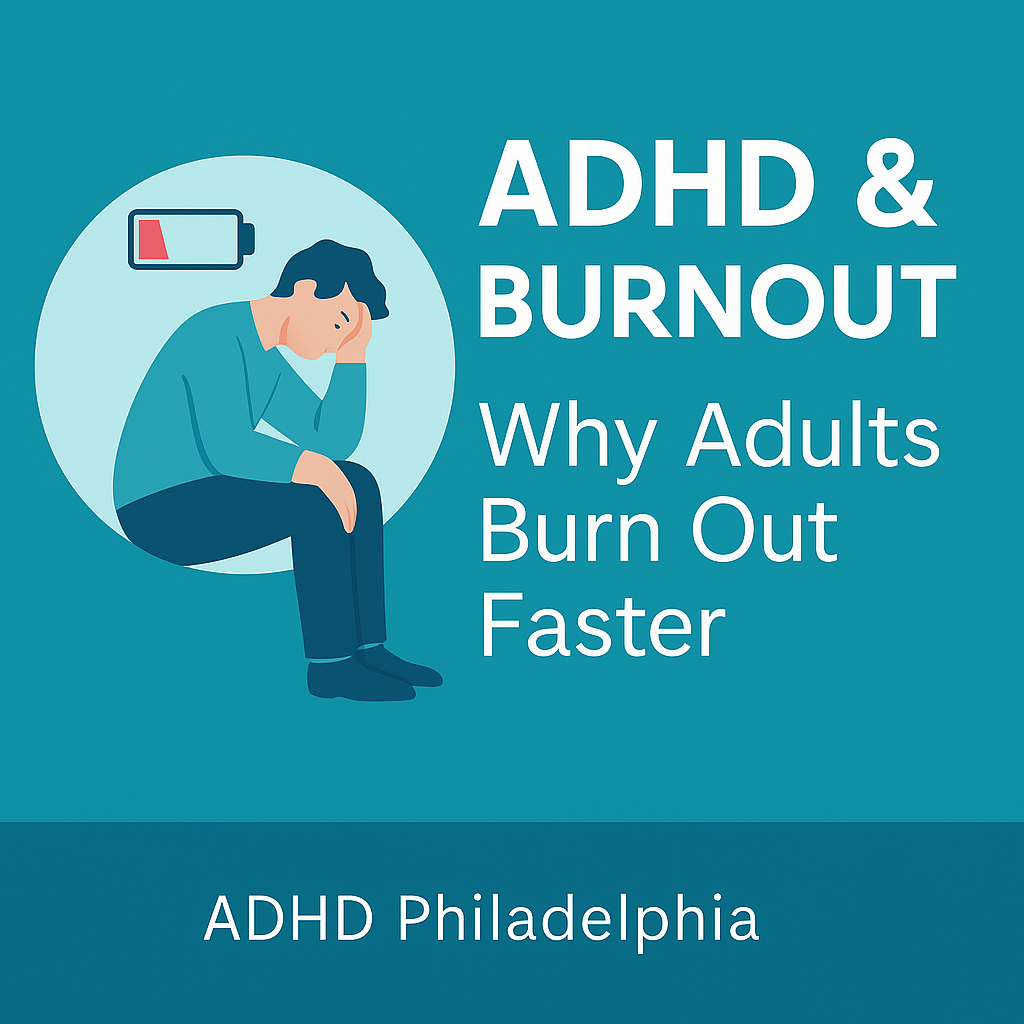
🔥 ADHD and Burnout: Why Adults With ADHD Burn Out Faster — and Recover More Slowly. By Charles Thornton, PMHNP-BC — ADHD Philadelphia
Adults with ADHD burn out more easily because their brains work harder to manage focus, emotion, and daily demands. Learn why ADHD burnout feels different—and the strategies that help you recover without guilt.
Burnout happens to everyone—but ADHD burnout is different.
It hits faster, harder, and lasts longer.
If you’re an adult with ADHD, you may cycle between periods of intense productivity and sudden collapse, where even basic tasks feel impossible. This isn’t a character flaw. It’s a neurological overload.
Research from Barkley, Nowell, Dawson, and the World Federation of ADHD shows that adults with ADHD use more cognitive energy to function in daily life. Over time, this increased effort leads to exhaustion and burnout.
At ADHD Philadelphia, we help adults across Pennsylvania and Delaware understand ADHD burnout, recognize the signs early, and rebuild healthy patterns.
🧠 Why ADHD Burnout Happens
1️⃣ Constant Executive Function Effort Drains the Brain
Adults with ADHD must work harder to:
stay organized
manage time
shift tasks
regulate emotion
maintain focus
This ongoing effort depletes mental energy faster, creating chronic exhaustion even when you appear “high-functioning.”
2️⃣ Emotional Intensity Accelerates Burnout
ADHD amplifies emotions.
Daily stress, rejection sensitivity, and overstimulation place a heavier load on the nervous system.
This leads to:
feeling overwhelmed
difficulty bouncing back
emotional crashes
3️⃣ Hyperfocus → Overwork → Crash
Hyperfocus feels productive… until it isn’t.
Many adults push themselves too hard during high-focus periods, only to crash later when dopamine dips.
This creates the cycle:
Push → Overdo → Burn out → Recover → Repeat
4️⃣ Time Blindness + Overcommitment
Adults with ADHD often say yes to too many responsibilities because they misjudge the time or energy required.
This leads to:
overscheduling
unrealistic expectations
self-blame
exhaustion
5️⃣ Rejection Sensitivity (RSD) Intensifies Stress
Fear of disappointing others can push adults with ADHD to:
overwork
people-please
ignore their limits
feel guilty resting
This emotional strain accelerates burnout.
🔧 3 Ways to Recover From ADHD Burnout
1️⃣ Reduce the Cognitive Load
Your brain needs fewer moving parts.
Try:
simplifying routines
using written reminders
breaking tasks into micro-steps
automating recurring responsibilities (bills, groceries, meds)
This frees working memory and reduces overwhelm.
2️⃣ Use “Energy Mapping”
Track your daily peak and low-energy periods.
Most adults with ADHD have predictable cycles.
Align:
important tasks to high-energy periods
repetitive or low-demand tasks to low-energy periods
This prevents over-exertion.
3️⃣ Normalize Rest as a Treatment Strategy
ADHD recovery requires intentional downtime.
Helpful rest practices include:
quiet sensory breaks
short naps
gentle physical movement
low-stimulation environments
avoiding multitasking
Rest is not earned. It is part of treatment.
💊 How Medication Helps
ADHD medication stabilizes dopamine, smooths out hyperfocus cycles, and reduces the emotional swings that contribute to burnout.
Patients often report:
steadier energy
fewer crashes
improved emotional balance
more predictable daily functioning
Medication does not eliminate stress—but it reduces the neurological load.
If you’re wondering whether your symptoms could be ADHD, read our guide “Do I Have ADHD as an Adult? 12 Signs You Should Not Ignore.”
🌱 You Can Recover From ADHD Burnout
ADHD burnout is real, and it’s treatable.
With the right strategies, support, and treatment, adults learn to pace themselves, restore energy, and rebuild a sustainable life rhythm.
👉 Schedule your ADHD evaluation today
Serving adults across Pennsylvania and Delaware.
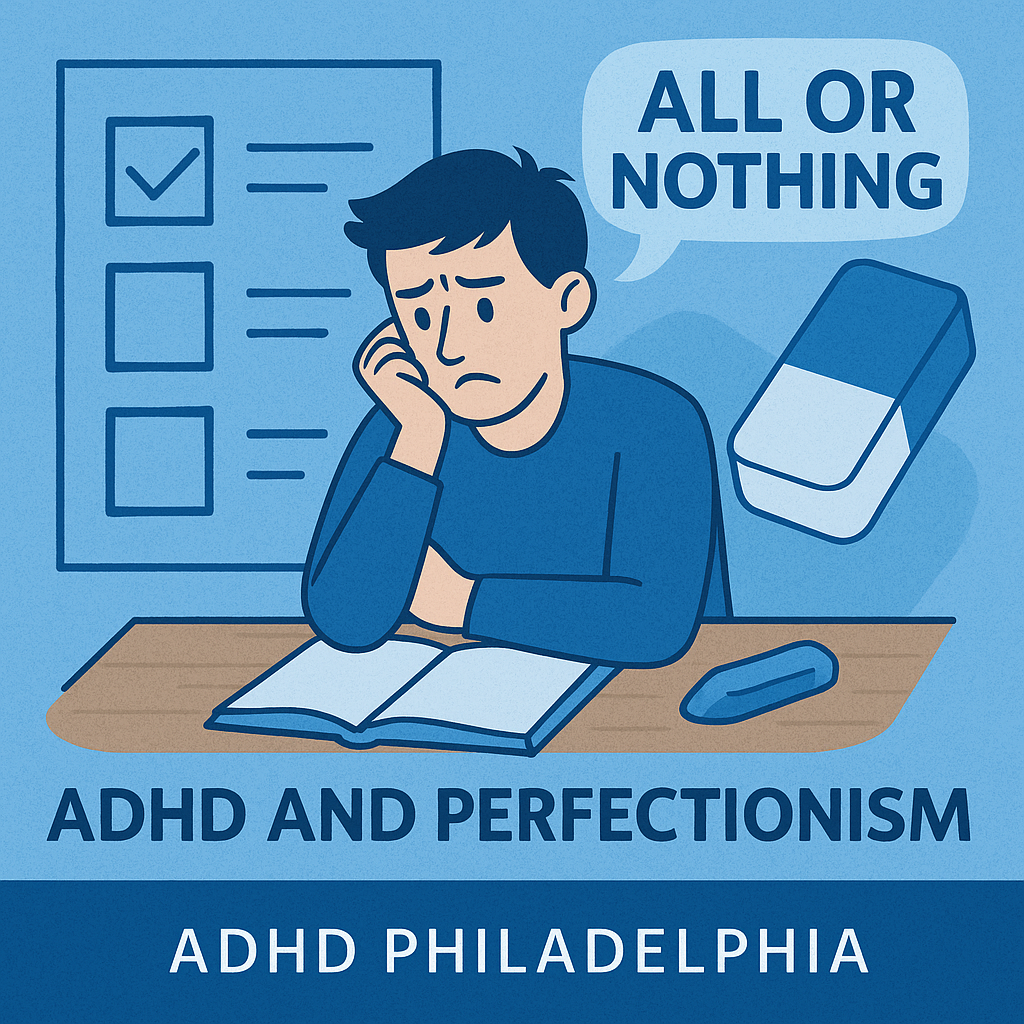
🧩 ADHD and Perfectionism: Why "All or Nothing" Thinking Takes Over. By Charles Thornton, PMHNP-BC — ADHD Philadelphia
Perfectionism is common in adults with ADHD—not because you expect too much, but because your brain fears mistakes, overwhelm, and uncertainty. Learn why ADHD fuels “all-or-nothing” thinking and how to break the cycle.
People often assume ADHD means being careless or distracted.
But for many adults, ADHD actually leads to intense perfectionism.
Not cute or quirky perfectionism —
but paralyzing perfectionism that makes starting, finishing, or sharing anything feel risky.
At ADHD Philadelphia, we help adults across Pennsylvania and Delaware understand why ADHD so often leads to “all-or-nothing” thinking — and how to break free from it using neuroscience-backed strategies.
🧠 Why ADHD Creates Perfectionism
1️⃣ Starting is Hard — So the Task Must Feel Perfect First
Adults with ADHD struggle with task initiation due to low dopamine activation.
When a task feels overwhelming, the brain uses perfectionism to avoid discomfort.
Your brain says:
“If I can’t do it perfectly, I shouldn’t start yet.”
This protects you from feeling:
frustration
confusion
overwhelm
fear of failure
But it also blocks progress.
2️⃣ Emotional Intensity Amplifies Mistakes
Research from Barkley and Wilke-Deaton shows that adults with ADHD experience emotions more intensely, which makes mistakes feel disproportionately painful.
A small error → feels like a big failure.
This causes:
rewriting emails over and over
delaying projects
avoiding criticism at all costs
3️⃣ Working Memory Makes Projects Feel Bigger Than They Are
With limited working memory, tasks feel:
vague
scattered
overwhelming
ADHD brains prefer certainty, so they lean into perfectionism to reduce ambiguity.
“If I plan every detail perfectly, I won’t get overwhelmed.”
Except… planning becomes the trap.
4️⃣ Rejection Sensitivity Makes Feedback Feel Dangerous
Many adults with ADHD experience Rejection Sensitive Dysphoria (RSD).
Perfectionism becomes armor:
“If it’s perfect, no one can criticize me.”
But this creates impossible pressure and burnout.
🔧 3 Ways to Break the ADHD Perfectionism Cycle
1️⃣ The 70% Rule
Aim to complete tasks at 70% quality, not 100%.
This retrains the brain to accept “good enough” instead of “perfect or nothing.”
Your productivity skyrockets because you’re no longer battling paralysis.
2️⃣ The “One Pass” Method
From executive function research:
Do one pass through a task without allowing revisions.
Examples:
Write the email once
Clean the room once
Outline the essay once
Revisions happen after completion, not while you're doing it.
3️⃣ Break Tasks Into "Micro Wins"
Per Nowell and Dawson, dopamine increases with early success.
Micro wins create momentum.
Try:
Write one paragraph
Tidy for 60 seconds
Read one page
Respond to one message
Small wins override perfectionistic shutdown.
💊 How Medication Helps
ADHD medication improves:
task initiation
emotional regulation
fear response
overwhelm during tasks
This reduces the anxiety that fuels perfectionism and helps you move forward without overthinking.
🌱 You Can Escape “All or Nothing” Thinking
Perfectionism isn’t a personality flaw — it’s a survival strategy for an ADHD brain trying to protect itself from discomfort, uncertainty, and emotional pain.
With treatment, tools, and practice, adults learn to work more flexibly and confidently.
👉 Schedule your ADHD evaluation today
Now serving adults across Pennsylvania and Delaware via telehealth and in-person care.
🧭 ADHD and Time Blindness: Why Time Feels “Different” for Adults With ADHD
Time blindness is one of the most frustrating ADHD symptoms for adults. Learn why the ADHD brain struggles to sense time — and the tools that help you stay on track without shame or stress.
If you live with ADHD, you’ve probably asked yourself:
“Where did the time go?”
“Why do I always think I have more time than I do?”
“How can five minutes turn into 45?”
This isn’t irresponsibility — it’s time blindness, a neurological difference deeply connected to ADHD.
Research from Russell Barkley, PhD and Peg Dawson, EdD shows that ADHD affects the brain networks responsible for time perception, time estimation, and time-to-action planning.
At ADHD Philadelphia, we help adults across Pennsylvania and Delaware understand how ADHD shifts their sense of time — and how to build a better relationship with it.
🧠 Why Time Blindness Happens in ADHD
1️⃣ The Brain’s Internal Clock Runs Differently
The prefrontal cortex helps track time and maintain temporal awareness.
In ADHD, this region activates less consistently, making time feel:
Too fast
Too slow
Or completely invisible
This is why adults often say:
“I didn’t realize how much time had passed.”
2️⃣ The Default Mode Network Takes Over
The DMN (daydreaming network) becomes overactive in ADHD.
Once it “steals” attention:
Time slips by
Tasks feel overwhelming
Momentum disappears
This creates the famous ADHD time loop:
“I’ll start soon… wait, how is it already afternoon?”
3️⃣ Working Memory Doesn’t Hold Time Very Well
According to Barkley, working memory is like a mental whiteboard.
In ADHD, that whiteboard erases itself quickly.
So the brain loses track of:
Deadlines
Start times
The order of tasks
Whether something is urgent or not
4️⃣ Dopamine Drives “Now” vs. “Not Now” Thinking
The ADHD brain lives in two time zones:
Now and Not Now.
This leads to:
Overestimating how long tasks will take
Underestimating how long you’ve been scrolling
Feeling like time is either abundant or gone instantly
Dopamine heavily influences this “temporal distortion.”
🔧 3 Tools to Improve Time Awareness
1️⃣ Use External Time Anchors
Because internal time is unreliable, external cues make a huge difference.
Use:
Visual timers
Alarms
Hourly chimes
Smart watches
Color-coded calendars
External time = better time.
2️⃣ Break the Day Into “Time Blocks”
Research from Dawson shows that ADHD brains thrive on structure.
Try:
Morning block
Work block
Recovery block
Evening block
Time becomes easier to feel when broken into meaningful sections.
3️⃣ Use the “5-Minute Landing”
When switching tasks, give yourself 5 minutes to land.
During this time:
Close out the previous task
Prepare the next one
Check the clock deliberately
This protects against time loss during transitions — a major ADHD vulnerability.
🌱 Time Blindness Is Treatable
With awareness, structure, and the right treatment, adults with ADHD can develop a healthier relationship with time — one that feels grounded, predictable, and manageable.
👉 Schedule your ADHD evaluation today
Serving adults across Pennsylvania and Delaware.
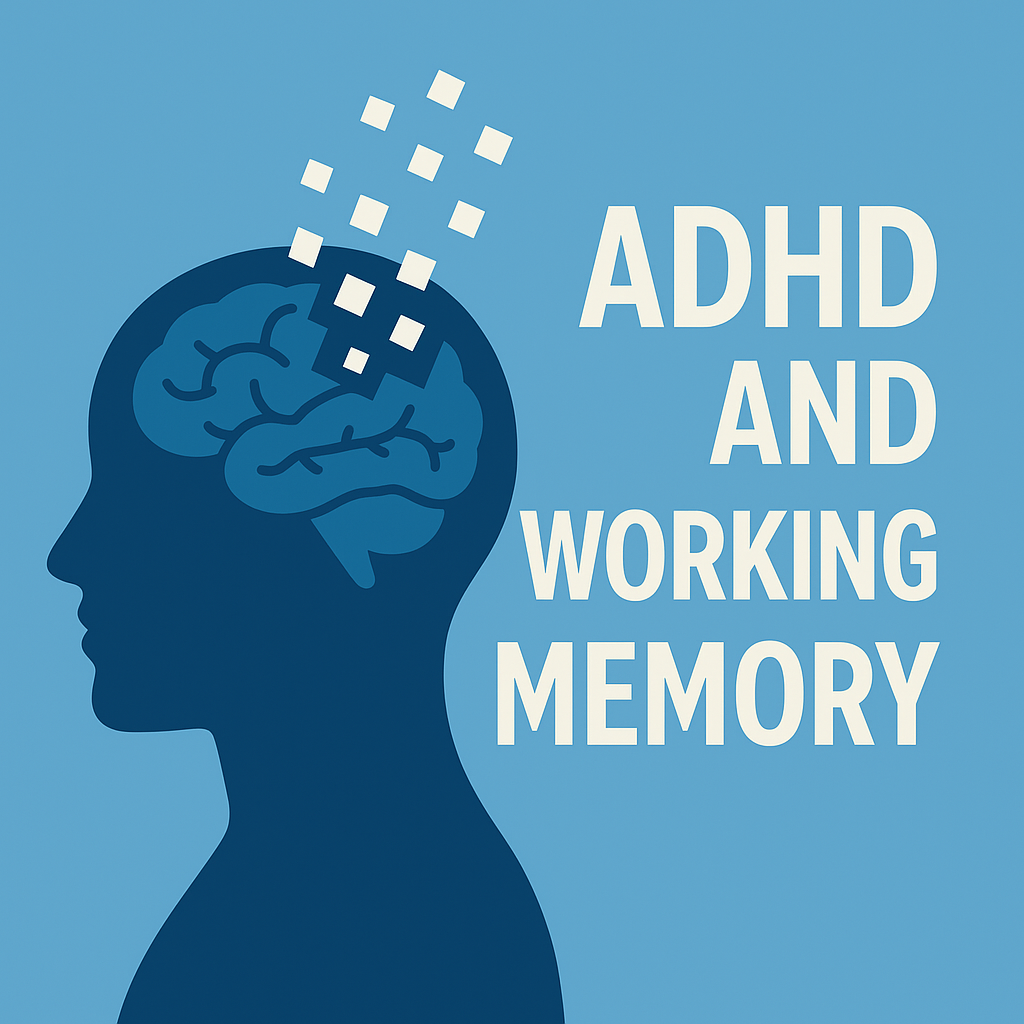
ADHD and Working Memory: Why You Forget Things Even When You Care
Working memory struggles are one of the most common—and misunderstood—symptoms of adult ADHD. Learn why ADHD brains drop information so quickly and how to strengthen your memory using science-backed tools.
By Charles Thornton, PMHNP-BC — ADHD Philadelphia
If you have ADHD, you’ve probably said things like:
“I walked into the room and forgot why.”
“I meant to reply to that message.”
“I know what I need to do… I just can’t hold it in my mind.”
This isn’t carelessness.
It’s a working memory impairment, one of the core executive function challenges in adult ADHD.
According to Russell Barkley, PhD, working memory deficits are as central to ADHD as distractibility or hyperactivity.
At ADHD Philadelphia, we help adults across Pennsylvania and Delaware understand why this happens—and how to rebuild working memory using practical, neuroscience-informed strategies.
🧠 What Is Working Memory?
Working memory is your brain’s ability to hold information in mind long enough to use it.
Examples:
Remembering what someone just said
Holding a task list in your head
Following multi-step directions
Keeping track of time while doing a task
Adults with ADHD often describe working memory as “slippery.” Information slides out before you can act on it.
🔬 Why Working Memory Is Weak in ADHD
1️⃣ The Prefrontal Cortex Processes Information Differently
The PFC is responsible for holding and manipulating short-term information.
In ADHD, the PFC shows reduced activation and connectivity, making it harder to keep information online.
2️⃣ Dopamine Controls the Signal-to-Noise Ratio
Per research from Barkley & Nowell:
When dopamine is low or inconsistent, the brain struggles to filter and store key information.
This causes:
Losing track of tasks
Forgetting instructions
Difficulty recalling conversations
Mental “blanking out” under pressure
3️⃣ The Default Mode Network Interrupts Focus
The DMN (the wandering-mind network) turns on too easily in ADHD.
This pulls you out of the moment and breaks memory encoding.
This is why adults say:
“I heard you… but I didn’t retain it.”
🔧 3 Ways to Strengthen Working Memory
1️⃣ Cognitive Offloading (Dawson & Wilke-Deaton)
Externalizing memory dramatically reduces overwhelm.
Try:
Sticky notes
Planners
Digital reminders
Voice notes
Writing the “next step” before leaving a task
Offloading isn’t cheating—it’s a treatment strategy.
2️⃣ Use Neuroplasticity Through Micro-Repetition
Dr. Nowell notes that repetition builds neural strength.
You can train working memory by:
Reviewing lists out loud
Practicing short recall exercises
Repeating instructions back to people
Daily 2-minute “memory runs”
Small reps → big rewiring.
3️⃣ ADHD Medication Improves Memory Encoding
Stimulants and non-stimulants improve:
Information retention
Recall speed
Task follow-through
Medication doesn’t create memory—it increases the brain’s ability to store and retrieve it.
Many adults describe their experience as:
“It’s like my mind finally has a grip on things.”
🌱 Your Memory Can Improve
Working memory struggles are frustrating but treatable.
With the right tools, routines, and treatment, adults experience more clarity, fewer dropped tasks, and greater confidence.
👉 Schedule your ADHD evaluation today
Serving adults in Pennsylvania and Delaware through telehealth and in-person care.
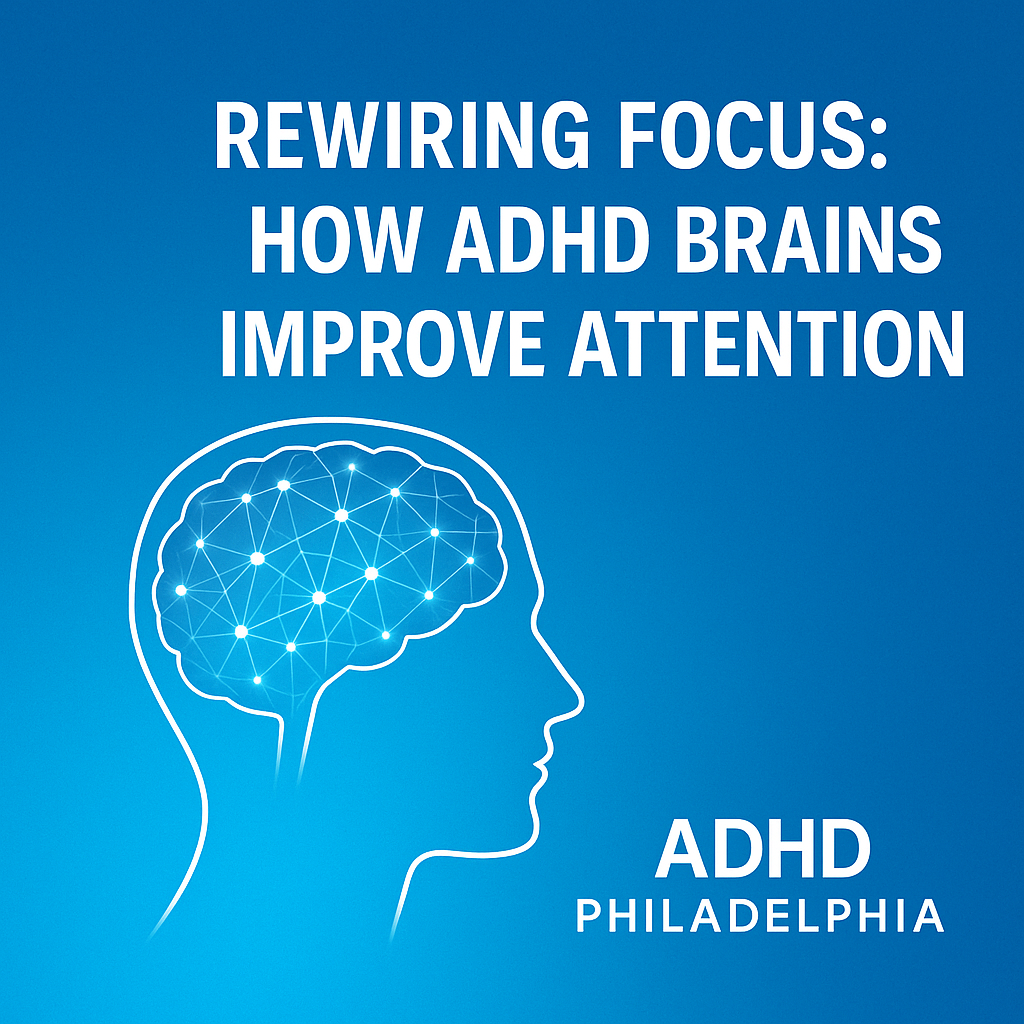
Rewiring Focus: How Adult ADHD Brains Use Neuroplasticity to Improve Attention
Adult ADHD isn't fixed — the brain can change. Learn how neuroplasticity, medication, and daily habits strengthen focus and executive function, based on leading ADHD research.
By Charles Thornton, PMHNP-BC — ADHD Philadelphia
One of the most hopeful discoveries in modern ADHD research is this:
the adult ADHD brain is capable of rewiring.
Thanks to neuroplasticity — the brain’s ability to form new neural pathways — adults can improve focus, emotional regulation, and executive functioning long after childhood.
At ADHD Philadelphia, we help adults across Pennsylvania and Delaware tap into this science to rebuild attention, confidence, and control.
🧠 What Neuroplasticity Means for ADHD
Research from Dr. David Nowell and Dr. Russell Barkley shows that ADHD isn’t just a chemical difference — it’s also a network difference in areas like:
The Anterior Cingulate Cortex (ACC): error-monitoring & emotional regulation
The Prefrontal Cortex: planning, prioritizing, working memory
The Default Mode Network (DMN): wandering mind & intrusive thoughts
Neuroplasticity allows these regions to strengthen, becoming more coordinated with practice, medication, and structured routine.
🔬 Why ADHD Makes Focus Hard
According to Peg Dawson, EdD (“Smart But Scattered Adults”), adults with ADHD struggle primarily in:
Working memory
Response inhibition
Sustained attention
Task initiation
Organization
Time awareness
These are executive functions — and the good news is, executive functions are trainable.
💊 How Medication Supports Brain Rewiring
ADHD medications (per Barkley’s Advances in ADHD Management) increase dopamine and norepinephrine in key pathways, which:
Improves signal-to-noise ratio (clearer thinking)
Strengthens the PFC and ACC
Reduces emotional impulsivity
Enhances learning from feedback
Medication doesn’t just mask symptoms — it improves the brain’s capacity to grow new habits.
People often notice:
Improved mental clarity
Less overwhelm
Better initiation and follow-through
Faster progress when combining meds + skill-building
🧩 3 Neuroplasticity-Based Strategies for Adults with ADHD
1️⃣ The 10-Minute “Activation Loop” (Nowell Method)
The ADHD brain resists starting tasks. Dr. Nowell explains that activation energy improves once the brain begins moving.
Try:
Set a timer for 10 minutes
Start the task with no pressure to finish
Stop when time’s up
This trains circuits responsible for task initiation and reduces avoidance-based wiring.
2️⃣ Build Micro-Routines (“Executive Function Muscle Training”)
From Peg Dawson’s research: small repeated habits strengthen neural pathways. Examples:
Same “start work” ritual each morning
Daily time check-ins (9 AM, 1 PM, 7 PM)
One consistent place for keys, wallet, badge
Repetition = rewiring.
3️⃣ Use Cognitive Offloading (Wilke-Deaton)
ADHD overwhelms working memory. Offload thinking to external tools:
Written lists
Habit trackers
Sticky notes
Calendar alarms
Color-coded folders
This frees brain space so the PFC can focus on decision-making — not memory storage.
🌱 What Progress Looks Like
With ADHD treatment and neuroplasticity-based habits, adults commonly report:
“I can finally stay focused long enough to finish tasks.”
“I don’t feel as overwhelmed when I start my day.”
“My thinking feels clearer and calmer.”
“Managing my schedule feels easier.”
“My emotions don’t spike as fast.”
Healing ADHD is not about perfection — it’s about progressive rewiring.
If you’re wondering whether your symptoms could be ADHD, read our guide “Do I Have ADHD as an Adult? 12 Signs You Should Not Ignore.”
🚀 Ready to Strengthen Your Focus?
If you’re tired of forcing yourself to focus and want a treatment approach grounded in science, we’re here to help.
👉 Schedule your ADHD evaluation today
Proudly serving adults across Pennsylvania and Delaware.

How Treating Undiagnosed Adult ADHD Improves Life in Delaware
Undiagnosed adult ADHD can affect focus, work, relationships, emotional regulation, and confidence. Learn how ADHD treatment can help Delaware adults gain clarity, structure, and better daily functioning.

Many adults in Delaware spend years trying to push through focus problems, procrastination, disorganization, emotional overwhelm, and mental fatigue without realizing that ADHD may be part of the picture.
They may assume they are simply stressed, burned out, lazy, unmotivated, or “bad with time.” But for many adults, the real issue is not a lack of effort. It may be untreated ADHD affecting executive function, attention regulation, motivation, emotional control, and follow-through.
Adult ADHD can affect work, relationships, home responsibilities, finances, school performance, parenting, and self-confidence. In adults, ADHD does not always look like the childhood stereotype of someone who cannot sit still. It may show up as internal restlessness, unfinished tasks, emotional reactivity, chronic lateness, forgetfulness, poor organization, or difficulty completing what you start.
For adults in Delaware, getting properly evaluated and treated for ADHD can be life-changing.
At ADHD Philadelphia, adult ADHD testing, evaluation, and treatment are available through telehealth for patients in Delaware and Pennsylvania. In-person appointments may be scheduled after the first telehealth appointment when clinically appropriate. There are no walk-in appointments.
Why Adult ADHD Often Goes Undiagnosed
Many adults with ADHD were never diagnosed as children. Some performed well enough in school to avoid attention. Others were described as smart but inconsistent, scattered, emotional, forgetful, disorganized, or “not living up to their potential.”
For high-functioning adults, ADHD can be especially easy to miss. They may compensate for years with pressure, perfectionism, urgency, anxiety, overworking, caffeine, or last-minute panic. From the outside, they may seem successful. Internally, they may feel like they are barely keeping everything together.
Undiagnosed adult ADHD may look like:
Difficulty starting important tasks
Trouble finishing projects
Chronic lateness or poor time awareness
Disorganization at home or work
Forgetting appointments, bills, or responsibilities
Feeling overwhelmed by simple decisions
Emotional sensitivity or frustration
Procrastination until urgency creates pressure
Difficulty staying consistent with routines
Mental fatigue from trying to force focus
Low self-esteem after years of feeling behind
These struggles are not character flaws. They may be signs that the brain’s attention and executive function systems need proper support.
Many adults do not realize that adult ADHD diagnosis and evaluation can help explain long-standing patterns with focus, procrastination, disorganization, emotional overwhelm, and inconsistent follow-through.
How Untreated ADHD Affects Daily Life
Untreated ADHD can create a ripple effect across multiple areas of life.
At work, adults may struggle with deadlines, task completion, organization, meetings, emails, documentation, and follow-through. Remote and hybrid work can make symptoms even harder to manage because there is less external structure.
At home, ADHD may affect cleaning, bills, laundry, appointments, meal planning, parenting responsibilities, and daily routines. Many adults know what they need to do but feel unable to consistently do it.
In relationships, ADHD can contribute to missed details, emotional reactions, forgetfulness, interrupting, difficulty listening, or feeling misunderstood. Partners, family members, or coworkers may interpret symptoms as carelessness when the real issue may be attention regulation and executive functioning.
Emotionally, untreated ADHD can lead to guilt, shame, anxiety, irritability, low confidence, and burnout. Many adults blame themselves for symptoms that may be treatable.
Untreated ADHD often affects executive function in adults, including planning, time management, emotional regulation, task initiation, organization, and follow-through.
What Changes After ADHD Is Properly Diagnosed?
A proper ADHD diagnosis can bring clarity. For many adults, the diagnosis helps explain years of patterns that never made sense.
Instead of asking, “Why can’t I just do this?” patients can begin asking, “What support does my brain need to function better?”
That shift matters.
A structured adult ADHD evaluation can help determine whether symptoms are truly related to ADHD or whether another issue may be contributing, such as anxiety, depression, trauma, sleep problems, substance use, medication effects, or chronic stress.
Accurate diagnosis matters because ADHD symptoms can overlap with other conditions. Trouble concentrating, procrastination, emotional overwhelm, restlessness, and low motivation can also appear with anxiety, depression, poor sleep, burnout, trauma, and other mental health or medical concerns.
When ADHD is correctly identified, treatment can be more focused and effective.
A structured evaluation is important because adult ADHD testing in Delaware can help clarify whether symptoms such as poor focus, procrastination, forgetfulness, disorganization, and executive dysfunction are consistent with ADHD or may be better explained by another condition.
How ADHD Treatment Can Improve Life
ADHD treatment is not about changing who you are. It is about helping your brain work with less friction.
Treatment may include medication management, behavioral strategies, education, structure-building, lifestyle changes, executive function tools, therapy referrals when appropriate, or a combination of approaches. The goal is not perfection. The goal is better daily functioning, improved consistency, and less internal chaos.
According to the CDC, adult ADHD treatment may include medication, psychotherapy, education or training, or a combination of treatments. Diagnosis is also a multi-step process because there is no single test for ADHD, and other conditions can produce similar symptoms.
For many adults, treatment may help improve focus, organization, time management, emotional regulation, and follow-through.
After diagnosis, adult ADHD treatment in Delaware may include education, executive function strategies, lifestyle changes, and medication management when clinically appropriate.
Better Focus and Task Completion
Many adults seek ADHD treatment because they are tired of starting things and not finishing them.
They may have notebooks full of ideas, unfinished projects, half-completed tasks, open tabs, unread messages, and important responsibilities that keep getting pushed forward.
This does not always happen because the person does not care. In ADHD, the brain may struggle with task initiation, sustained attention, working memory, prioritization, and motivation. This can make it difficult to begin a task, stay with it, and complete it without getting pulled away by something else.
Treatment can help support sustained attention, reduce distractibility, and improve the ability to stay with a task long enough to complete it.
For Delaware professionals, students, business owners, healthcare workers, parents, and remote employees, this can make a major difference in daily functioning.
One reason adults seek ADHD care is because adult ADHD can make follow-through difficult even when you care, especially when executive function challenges affect task initiation, planning, and consistency.
Improved Time Management
ADHD often affects time awareness. Adults may underestimate how long tasks will take, arrive late despite trying not to, lose track of time, or feel surprised by deadlines even when they knew the deadline was coming.
This can create problems at work, school, home, and in relationships.
Adults with ADHD may say things like:
“I thought I had more time.”
“I was about to do it.”
“I forgot until the last minute.”
“I work better under pressure, but I hate living that way.”
“I know what I need to do. I just cannot seem to start early.”
Treatment can help patients build practical systems for planning, prioritizing, scheduling, and transitioning between tasks. Medication, when clinically appropriate, may also help reduce the mental fog and distractibility that make time management harder.
Better time management can improve work performance, reduce stress, and create more breathing room in daily life.
For many adults, ADHD can make routines hard to maintain because time blindness, distractibility, and task-switching problems interfere with consistency.
Less Overwhelm and Mental Fatigue
Many adults with ADHD feel mentally exhausted because every task requires so much effort.
The brain may struggle to prioritize, filter distractions, remember steps, manage emotions, and organize competing demands. As a result, everyday responsibilities can feel heavier than they should.
Something as simple as answering emails, cleaning a room, paying bills, returning a call, or deciding what to do first can feel overwhelming.
Treatment helps reduce that load by improving support around attention, planning, and emotional regulation.
Patients often describe feeling more clear, more organized, and less mentally scattered once treatment is working. They may still have responsibilities and stress, but they often feel better equipped to manage them.
Many adults seek treatment because adult ADHD can cause chronic overwhelm, especially when the brain has to manage too many tasks, decisions, and responsibilities at once.
Better Emotional Regulation
Adult ADHD does not only affect attention. It can also affect emotional regulation.
Some adults with ADHD experience quick frustration, rejection sensitivity, irritability, mood shifts, impatience, or emotional overwhelm. They may feel embarrassed afterward because their reaction seemed bigger than the situation.
Emotional regulation challenges can affect relationships, parenting, workplace communication, decision-making, and self-confidence.
Treatment can help patients pause, respond more calmly, recognize emotional patterns, and build more effective coping strategies. This can improve communication, reduce conflict, and help adults feel more in control of their responses.
For many adults, understanding ADHD vs anxiety in adults is important because both can affect concentration, restlessness, sleep, emotional regulation, motivation, and daily functioning.
Stronger Relationships
When ADHD is untreated, relationships can suffer.
A partner may feel ignored when the person with ADHD forgets something important. A coworker may feel frustrated by missed details. A family member may mistake distractibility for disinterest. A friend may feel hurt when messages go unanswered.
Over time, these patterns can create shame, defensiveness, resentment, and misunderstanding.
Diagnosis and treatment help create understanding. Once ADHD is recognized, patients can develop systems for follow-through, reminders, communication, routines, and emotional regulation.
This can reduce conflict and help relationships feel less strained.
Treatment does not remove the need for accountability, but it can help adults understand their patterns and build better systems.
Understanding the ADHD Philadelphia patient journey can help adults know what to expect from evaluation, diagnosis, treatment planning, follow-up care, and ongoing monitoring.
More Confidence and Less Shame
One of the biggest changes after ADHD treatment is emotional relief.
Many adults have spent years thinking they were lazy, irresponsible, inconsistent, unreliable, or broken. A diagnosis can help reframe those experiences through a clinical lens.
Treatment helps patients see that ADHD is not a moral failure. It is a treatable condition involving attention regulation, executive functioning, and self-management.
With the right care, adults often begin to rebuild trust in themselves.
They may start finishing more tasks, following through more often, managing emotions more effectively, and understanding their brain with more compassion.
That confidence can affect every part of life.
Many adults feel relief when they realize that ADHD treatment can help explain patterns they once blamed on laziness or lack of discipline.
Why Delaware Adults Benefit From Accessible ADHD Care
Delaware adults need ADHD care that is clear, accessible, and practical.
Whether someone lives in Wilmington, Newark, Dover, Milford, Middletown, Smyrna, Bear, New Castle, Rehoboth Beach, Lewes, or another Delaware community, telehealth can make it easier to begin the process without unnecessary travel barriers.
Telehealth may be especially helpful for adults with ADHD because scheduling, driving, parking, waiting rooms, and travel time can become additional barriers to care.
At ADHD Philadelphia, the first appointment begins through telehealth. In-person appointments may be scheduled afterward when clinically appropriate. There are no walk-in appointments.
This structure allows adults in Delaware to begin ADHD evaluation and treatment in an organized and accessible way.
Adults searching for ADHD testing in Wilmington, Delaware, can begin with a telehealth evaluation through ADHD Philadelphia.
Adults farther south may also benefit from ADHD testing in Dover, Delaware, through ADHD Philadelphia’s Delaware telehealth services.
Adults in New Castle County can also learn more about adult ADHD testing in Newark, Delaware.
What ADHD Philadelphia Does Differently
ADHD Philadelphia focuses on adult ADHD evaluation and treatment in Pennsylvania and Delaware.
The process is designed to provide clarity, not confusion. Patients receive a structured evaluation, a careful review of symptoms, and a treatment plan based on their needs.
Care may include:
Adult ADHD diagnostic evaluation
Review of current and past symptoms
Screening for overlapping mental health concerns
Medication management when clinically appropriate
Education about ADHD and executive functioning
Practical strategies for focus, routines, and follow-through
Ongoing monitoring and follow-up
Transparent treatment expectations
The goal is to help patients understand what is happening, why it matters, and what can be done next.
For stimulant medications, ongoing follow-up is required for safety monitoring, treatment response, and dosage adjustments. ADHD Philadelphia also reviews the prescription drug monitoring program as part of controlled-substance prescribing procedures.
Treatment is individualized and monitored over time.
When clinically appropriate, ADHD medication management for adults may be part of a structured treatment plan that includes monitoring, education, follow-up, and safety review.
When to Consider an ADHD Evaluation
You may want to consider an adult ADHD evaluation if you regularly struggle with:
Focus and concentration
Starting or finishing tasks
Procrastination
Chronic disorganization
Time management
Forgetfulness
Emotional overwhelm
Impulsive decisions
Restlessness
Difficulty staying consistent
Feeling behind despite working hard
Difficulty managing work, school, home, or relationships
Many adults seek ADHD testing after years of feeling frustrated, overwhelmed, or confused by patterns they cannot seem to change.
They are not looking for an excuse. They are looking for an explanation.
They want to understand why they can perform well in some situations but struggle in others. They want to know why urgency helps but routine feels impossible. They want to know why they care but still cannot consistently execute.
If these patterns are affecting daily life, adult ADHD testing and evaluation may help provide clarity and determine whether treatment may be appropriate.
Frequently Asked Questions About Adult ADHD Treatment in Delaware
Can adults be diagnosed with ADHD for the first time?
Yes. Many adults are diagnosed after years of struggling with focus, disorganization, procrastination, emotional reactivity, forgetfulness, or difficulty completing tasks. A proper evaluation reviews current symptoms, earlier life patterns, and functional impairment.
Is ADHD treatment only medication?
No. ADHD treatment may include education, behavioral strategies, executive function support, lifestyle changes, therapy referrals when appropriate, and medication management when clinically appropriate.
Can untreated ADHD affect work performance?
Yes. Untreated ADHD can affect focus, task completion, time management, organization, communication, and follow-through. These challenges can create stress at work, especially for adults in demanding jobs or remote work environments.
Can ADHD affect relationships?
Yes. ADHD can affect listening, emotional regulation, memory, follow-through, and communication. Treatment can help adults better understand these patterns and build strategies that support healthier relationships.
Does ADHD Philadelphia treat adults in Delaware?
Yes. ADHD Philadelphia provides adult ADHD testing and treatment for patients in Delaware and Pennsylvania. Initial appointments begin through telehealth. In-person appointments may be scheduled after the first online appointment when clinically appropriate. No walk-in appointments are available.
What happens after ADHD is diagnosed?
If ADHD is diagnosed, the next step is an individualized treatment plan. This may include education, executive function strategies, behavioral tools, and medication management when clinically appropriate.
Take the First Step
Untreated ADHD can quietly affect almost every part of life. But with the right diagnosis and treatment plan, adults can experience meaningful improvement.
You may become more consistent. You may feel less overwhelmed. You may communicate better. You may finally understand why certain things have always felt harder than they should.
Most importantly, you can stop blaming yourself and start building systems that actually work for your brain.
If you live in Delaware and think ADHD may be affecting your life, ADHD Philadelphia can help you take the next step.
Schedule an adult ADHD evaluation today through ADHD Philadelphia.
Medical Disclaimer
This article is for educational purposes only and is not a substitute for medical advice, diagnosis, or treatment. If you are experiencing symptoms of ADHD, anxiety, depression, sleep problems, substance use concerns, or another mental health concern, consult a qualified healthcare professional.