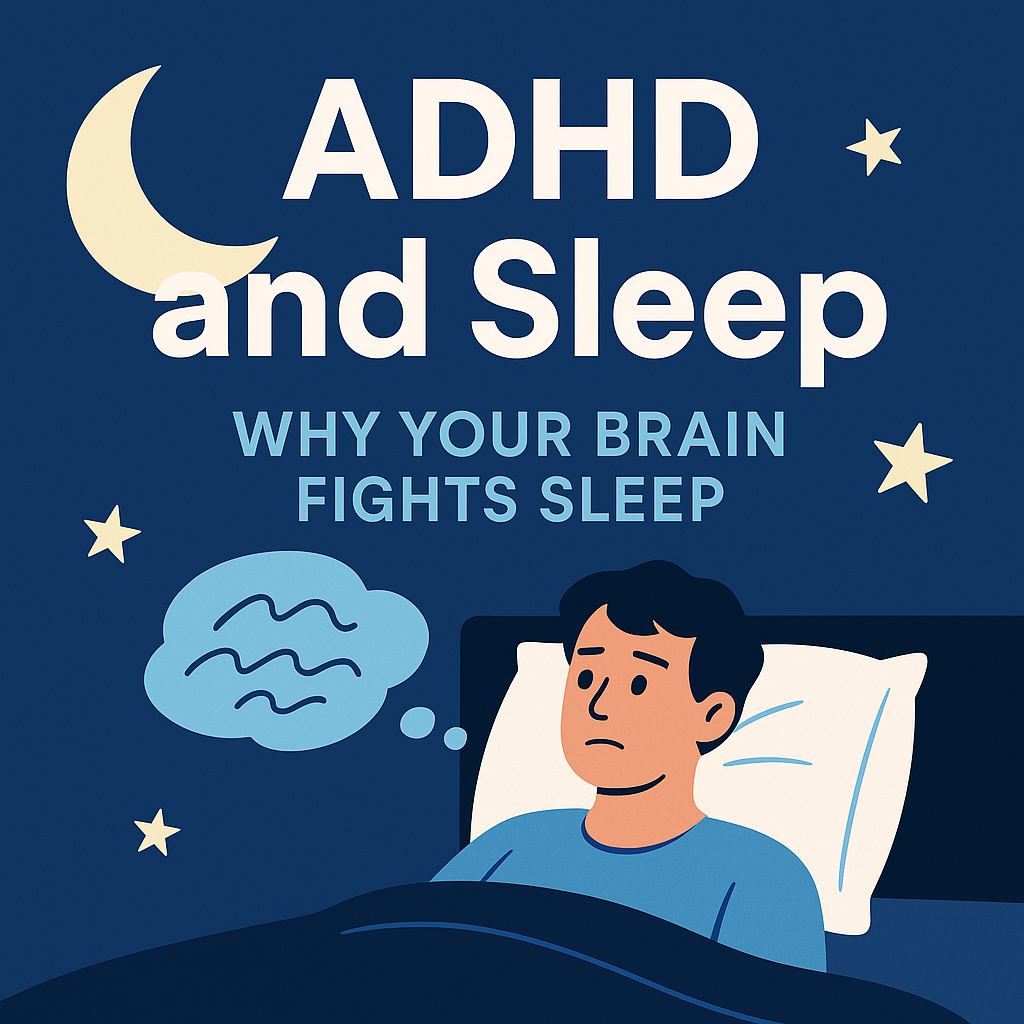
🌙 ADHD and Sleep: Why Your Brain Fights Sleep (and How to Fix It)By Charles Thornton, PMHNP-BC — ADHD Philadelphia
Adults with ADHD often struggle with falling asleep, staying asleep, or waking rested. Learn the neuroscience behind ADHD-related sleep issues and how to finally build a sleep routine that works.
If you have ADHD, sleep can feel like a nightly battle. You’re tired — but your brain refuses to shut off. Or you fall asleep, only to wake up wired at 2 AM. Or you sleep eight hours and still feel exhausted.
This isn’t poor discipline.
It’s ADHD-related sleep dysfunction — and it’s one of the most common challenges adults face.
Research from Barkley, Nowell, Dawson, and the American Academy of Sleep Medicine shows that ADHD disrupts the neural systems that regulate sleep, alertness, and circadian rhythm.
At ADHD Philadelphia, we help adults across Pennsylvania and Delaware understand why this happens — and how to fix it.
🧠 Why ADHD Makes Sleep Difficult
1️⃣ The Brain Struggles to Power Down
Adults with ADHD often feel mentally “revved up” at night.
The Default Mode Network becomes overactive, leading to:
Racing thoughts
Overthinking
Planning tomorrow’s tasks in your head
Emotional replay
This is why many adults say:
“My brain gets loud the moment the room gets quiet.”
2️⃣ Dopamine Drops at Night
Dopamine helps regulate wakefulness and motivation.
In ADHD, dopamine levels fluctuate, causing:
Trouble transitioning from wake → sleep
Feeling “tired but wired”
Delayed sleep onset
Nighttime restlessness
This often shifts sleep several hours later than intended.
3️⃣ Circadian Rhythm Delays
Research shows that ADHD is strongly linked to Delayed Sleep Phase Syndrome (DSPS) — meaning your biological clock runs several hours later.
This is why:
Mornings feel impossible
Your energy peaks at night
You naturally fall asleep later than others
It’s biology, not laziness.
4️⃣ Emotional Intensity Disrupts Sleep
Adults with ADHD experience stronger emotional activation.
This leads to:
Stress spikes at night
Difficulty relaxing
Dream intensity
Waking at 2–3 AM feeling alert
The nervous system takes longer to calm.
🌙 3 Ways to Improve Sleep With ADHD
1️⃣ Create a “Power-Down Hour”
ADHD brains need transition time before bed.
Use 60 minutes for:
Dim lights
Light stretching
Hot shower
Journaling
Gentle music
This helps deactivate the DMN and lowers cortisol.
2️⃣ Use the “Consistent Wake Time” Rule
According to sleep researchers, the wake time — not bedtime — controls your circadian rhythm.
Even if you fall asleep late, a consistent wake time resets your internal clock over 2–3 weeks.
3️⃣ Consider Medication Timing
ADHD medication can improve sleep when dosed correctly because it regulates dopamine.
However, taking stimulants too late in the day can cause sleep delay.
At ADHD Philadelphia, we help you:
Adjust timing
Evaluate medication type
Reduce nighttime rebound crashes
Sleep improves dramatically when dopamine stabilizes.
🌤️ Your Sleep Can Improve
When adults learn how their ADHD affects sleep, everything begins to change:
Mornings feel smoother
Nighttime anxiety decreases
Productivity improves
Emotional balance returns
You deserve rest — and it is absolutely possible.
👉 Schedule your ADHD evaluation today
Serving adults across Pennsylvania and Delaware.
Rewiring Focus: How Adult ADHD Brains Use Neuroplasticity to Improve Attention
Adult ADHD isn't fixed — the brain can change. Learn how neuroplasticity, medication, and daily habits strengthen focus and executive function, based on leading ADHD research.
By Charles Thornton, PMHNP-BC — ADHD Philadelphia
One of the most hopeful discoveries in modern ADHD research is this:
the adult ADHD brain is capable of rewiring.
Thanks to neuroplasticity — the brain’s ability to form new neural pathways — adults can improve focus, emotional regulation, and executive functioning long after childhood.
At ADHD Philadelphia, we help adults across Pennsylvania and Delaware tap into this science to rebuild attention, confidence, and control.
🧠 What Neuroplasticity Means for ADHD
Research from Dr. David Nowell and Dr. Russell Barkley shows that ADHD isn’t just a chemical difference — it’s also a network difference in areas like:
The Anterior Cingulate Cortex (ACC): error-monitoring & emotional regulation
The Prefrontal Cortex: planning, prioritizing, working memory
The Default Mode Network (DMN): wandering mind & intrusive thoughts
Neuroplasticity allows these regions to strengthen, becoming more coordinated with practice, medication, and structured routine.
🔬 Why ADHD Makes Focus Hard
According to Peg Dawson, EdD (“Smart But Scattered Adults”), adults with ADHD struggle primarily in:
Working memory
Response inhibition
Sustained attention
Task initiation
Organization
Time awareness
These are executive functions — and the good news is, executive functions are trainable.
💊 How Medication Supports Brain Rewiring
ADHD medications (per Barkley’s Advances in ADHD Management) increase dopamine and norepinephrine in key pathways, which:
Improves signal-to-noise ratio (clearer thinking)
Strengthens the PFC and ACC
Reduces emotional impulsivity
Enhances learning from feedback
Medication doesn’t just mask symptoms — it improves the brain’s capacity to grow new habits.
People often notice:
Improved mental clarity
Less overwhelm
Better initiation and follow-through
Faster progress when combining meds + skill-building
🧩 3 Neuroplasticity-Based Strategies for Adults with ADHD
1️⃣ The 10-Minute “Activation Loop” (Nowell Method)
The ADHD brain resists starting tasks. Dr. Nowell explains that activation energy improves once the brain begins moving.
Try:
Set a timer for 10 minutes
Start the task with no pressure to finish
Stop when time’s up
This trains circuits responsible for task initiation and reduces avoidance-based wiring.
2️⃣ Build Micro-Routines (“Executive Function Muscle Training”)
From Peg Dawson’s research: small repeated habits strengthen neural pathways. Examples:
Same “start work” ritual each morning
Daily time check-ins (9 AM, 1 PM, 7 PM)
One consistent place for keys, wallet, badge
Repetition = rewiring.
3️⃣ Use Cognitive Offloading (Wilke-Deaton)
ADHD overwhelms working memory. Offload thinking to external tools:
Written lists
Habit trackers
Sticky notes
Calendar alarms
Color-coded folders
This frees brain space so the PFC can focus on decision-making — not memory storage.
🌱 What Progress Looks Like
With ADHD treatment and neuroplasticity-based habits, adults commonly report:
“I can finally stay focused long enough to finish tasks.”
“I don’t feel as overwhelmed when I start my day.”
“My thinking feels clearer and calmer.”
“Managing my schedule feels easier.”
“My emotions don’t spike as fast.”
Healing ADHD is not about perfection — it’s about progressive rewiring.
If you’re wondering whether your symptoms could be ADHD, read our guide “Do I Have ADHD as an Adult? 12 Signs You Should Not Ignore.”
🚀 Ready to Strengthen Your Focus?
If you’re tired of forcing yourself to focus and want a treatment approach grounded in science, we’re here to help.
👉 Schedule your ADHD evaluation today
Proudly serving adults across Pennsylvania and Delaware.