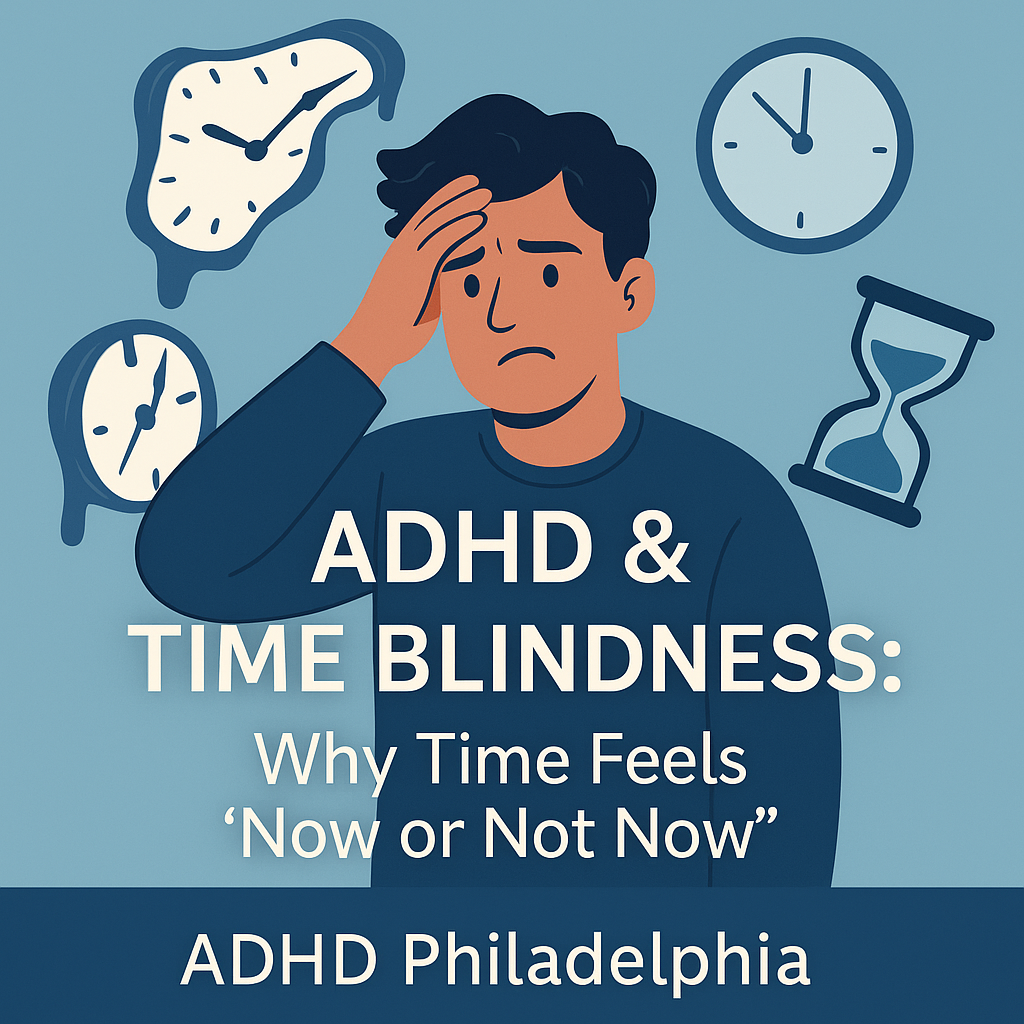
🌪️ ADHD and Time Blindness: Why Time Feels “Now or Not Now”. By Charles Thornton, PMHNP-BC — ADHD Philadelphia
Time blindness is one of the most frustrating symptoms of adult ADHD. Learn why it happens, how it affects daily life, and the evidence-based tools that help adults in PA and DE stay on track.
If you live with ADHD, you’ve probably said something like:
“How did it get so late?”
“I thought I had more time.”
“I’ll start in five minutes…” (one hour later)
“Deadlines sneak up on me even when I know they’re coming.”
This isn’t laziness or irresponsibility.
It’s time blindness, one of the core executive function challenges seen in adults with ADHD.
At ADHD Philadelphia, I help adults across Pennsylvania and Delaware understand why this happens — and how to build systems that finally make time feel manageable.
🧠 What Is Time Blindness?
Time blindness is the difficulty in:
sensing how much time has passed
estimating how long tasks will take
predicting future time demands
transitioning between activities
noticing the “flow” of time at all
Many adults describe time as “now or not now.”
If something isn’t happening right this second, it might as well not exist.
📍 Why ADHD Creates Time Blindness
1️⃣ The ADHD Brain Has Impaired Internal Timekeeping
Executive functions — specifically the prefrontal cortex — help us monitor time.
ADHD disrupts this system, making time feel abstract or unreliable.
This is why adults with ADHD often say:
“I know the deadline is next week… but it doesn’t feel real.”
2️⃣ Dopamine Drives Urgency — Not the Clock
For adults with ADHD, tasks only become “real” when they are:
interesting
rewarding
urgent
or anxiety-producing
This creates the classic ADHD cycle:
No urgency → no action → sudden urgency → hyperfocus → exhaustion.
3️⃣ Working Memory Gaps Disrupt Planning
If something isn’t in front of you, it’s easy to forget it exists.
This fuels procrastination and creates the illusion of “plenty of time.”
4️⃣ Hyperfocus Warps Time Completely
One minute feels like five hours.
Five hours feel like ten minutes.
Hyperfocus is powerful — but also dangerous when time disappears entirely.
🧩 How Time Blindness Affects Daily Life
Adults with ADHD often experience:
chronic lateness
missed deadlines
difficulty switching tasks
forgetting appointments
rushing at the last minute
underestimating task duration
relationship stress (“You’re always late”)
financial issues (late bills, fees)
These challenges feed shame and frustration — but they are neurological, not moral.
🔧 Tools That Help Fix Time Blindness
1️⃣ Externalize All Time (Never Rely on Memory)
Use:
digital timers
time-blocked calendars
visual countdowns
alarms with labels
wall clocks in every room
“time trackers” that show elapsed time
Goal: make invisible time visible.
2️⃣ Break Tasks Into Time-Based Chunks
Instead of:
“Clean the kitchen.”
Try:
“10 minutes: clear counters.”
“10 minutes: wash dishes.”
“5 minutes: sweep.”
Time chunks reduce overwhelm and increase follow-through.
3️⃣ Use “Transition Alarms”
One alarm to end a task.
Another to begin the next one.
Transitions are often the hardest part of ADHD functioning.
4️⃣ Try the “3-to-Start Rule”
Tell yourself:
“I only have to work for 3 minutes.”
This bypasses task initiation paralysis.
Once started, most adults continue naturally.
5️⃣ ADHD Medication Improves Time Awareness
Stimulants and non-stimulants can increase:
working memory
focus
task initiation
ability to sense the passage of time
Medication often reduces procrastination and deadline panic.
🌱 You Can Learn to Work With Time — Not Fight It
Time blindness is a neurological symptom, not a flaw.
With proper tools, structure, and treatment, adults with ADHD can dramatically improve their relationship with time.
👉 Schedule your adult ADHD evaluation today
Serving adults across Pennsylvania and Delaware via convenient telehealth.