
Adult ADHD and Back-to-School Anxiety: Why August Pressure Starts in July
Back-to-school anxiety can start in July for adults with ADHD. Learn why August pressure, college preparation, parenting stress, work routines, avoidance, and executive function challenges can feel overwhelming before the school year begins.

Adult ADHD and Back-to-School Anxiety: Why August Pressure Starts in July
Back-to-school anxiety does not always start in August.
For many adults with ADHD, it starts in July.
The calendar still says summer, but your brain may already feel the pressure coming. Work schedules may be shifting. School calendars may be approaching. College students may be preparing to return to campus. Graduate students may be thinking about classes, clinical work, research, or deadlines. Parents may be looking at supply lists, forms, transportation, appointments, and morning routines.
Even if nothing has officially started yet, your mind may already feel overwhelmed.
You may think:
“I need to get organized.”
“I should schedule that appointment.”
“I need to fix my sleep.”
“I need to prepare for August.”
“I have too much to do.”
“I don’t know where to start.”
At ADHD Philadelphia, we provide ADHD treatment and medication management for adults in Pennsylvania and Delaware. If August pressure starts building in July, adult ADHD may be part of the pattern.
Why Back-to-School Anxiety Starts Early for Adults With ADHD
Back-to-school season is not only stressful for children.
It can affect adults in many roles:
college students
graduate students
working adults
parents
teachers
faculty
healthcare workers
business owners
caregivers
adults returning to training or certification programs
adults managing school-year family routines
For adults with ADHD, the pressure may start early because the brain can sense that a major transition is coming.
August may bring earlier mornings, more traffic, more emails, more deadlines, more paperwork, more planning, more appointments, and less flexibility.
The adult with ADHD may not just be anxious about school. They may be anxious about the executive function demands that come with the school year.
What Back-to-School Anxiety Can Look Like in Adult ADHD
Back-to-school anxiety may not always look like obvious panic.
For adults with ADHD, it may show up as:
avoiding email
putting off forms
feeling irritated when August is mentioned
scrolling instead of planning
feeling tired before the schedule even starts
losing sleep because your brain is planning at night
overbuying planners or supplies but not using them
making lists but not taking action
feeling guilty about not preparing sooner
feeling overwhelmed by small decisions
missing appointment windows
delaying ADHD testing or follow-up care
feeling emotionally flooded by routine changes
You may know that preparation would help, but still feel unable to begin.
That is often where ADHD and anxiety overlap.
ADHD, Anxiety, and Avoidance
ADHD and anxiety can create a difficult cycle.
The ADHD brain may struggle with planning, prioritizing, time awareness, task initiation, emotional regulation, and follow-through.
Then anxiety adds pressure.
The pressure may sound like:
“What if I fall behind again?”
“What if I cannot keep up?”
“What if I forget something important?”
“What if August becomes overwhelming?”
“What if I disappoint people?”
“What if this year is like last year?”
When that pressure becomes too much, the brain may avoid the task. Avoidance provides short-term relief, but it often creates long-term stress.
The task is still there.
The deadline gets closer.
The anxiety grows.
Then the ADHD brain has even more difficulty starting.
Why Planning Can Feel Overwhelming
People often tell adults with ADHD to “just make a plan.”
But planning itself is an executive function task.
Planning requires the brain to:
identify what matters
estimate time
sequence steps
remember details
make decisions
anticipate obstacles
start before urgency arrives
follow through consistently
For adults with ADHD, that can feel like a lot of invisible work.
You may sit down with a planner and suddenly feel stuck. You may not know which task belongs first. You may write down too many things and then avoid the list. You may over-plan because planning feels safer than starting.
This is why back-to-school anxiety is not only about fear. It is also about cognitive load.
The “August Is Coming” Feeling
Some adults with ADHD feel a specific kind of pressure as August approaches.
It may feel like a countdown.
You may look at the calendar and feel your body tense. You may feel behind even though the school year has not started. You may feel like you should already be more prepared.
That “August is coming” feeling can be especially strong for adults near college and school communities such as University City in Philadelphia, West Chester, Bryn Mawr, Newark, Dover, Bethlehem, Lancaster, State College, and surrounding areas.
Even if you are not a student, the school-year rhythm can affect traffic, work schedules, family routines, appointment availability, and emotional pressure.
For adults with ADHD, external changes can create internal stress.
College Students, Graduate Students, and Adult ADHD
College and graduate school can make ADHD symptoms more visible.
Many adults did well in structured environments when someone else created the schedule. But college, graduate school, clinical programs, online classes, and independent work often require more self-management.
Adult students with ADHD may struggle with:
reading assignments
writing papers
long-term projects
discussion boards
clinical documentation
research tasks
email follow-up
financial aid forms
transportation
sleep routines
medication routines
time management
social distractions
planning without daily reminders
A student may be intelligent, motivated, and capable but still struggle when structure is not built in.
This is one reason July can be an important time to consider ADHD testing, diagnosis, or treatment planning before academic pressure increases.
Parents With ADHD and Back-to-School Stress
Parents with ADHD may experience back-to-school season differently.
They may be managing their own symptoms while also managing a child’s schedule.
That can include:
forms
school supplies
medical appointments
transportation
lunch routines
bedtime changes
morning routines
teacher communication
childcare schedules
work responsibilities
emotional transitions
The parent may be helping everyone else get organized while quietly feeling disorganized inside.
This can lead to guilt, irritability, anxiety, and exhaustion.
Adult ADHD care can help parents understand that their struggle is not a character flaw. It may be an executive function issue that needs structure and support.
Teachers, Faculty, and Working Adults With ADHD
Back-to-school season can also affect adults who work in education, healthcare, mental health, administration, and other busy systems.
Teachers and faculty may face lesson planning, emails, meetings, grading, documentation, new schedules, student needs, and administrative tasks.
Working adults may experience increased demands after summer because projects restart, schedules tighten, and workplace expectations increase.
For adults with ADHD, these changes can make symptoms feel louder.
You may notice:
difficulty restarting after summer
more email overwhelm
more procrastination
more difficulty prioritizing
more emotional fatigue
more trouble with sleep
more avoidance of paperwork
more difficulty transitioning between roles
This is why ADHD Philadelphia focuses on real-life functioning, not just “can you pay attention?”
Time Blindness Makes August Feel Far Away Until It Feels Urgent
Time blindness can make back-to-school anxiety worse.
In July, August may feel far away.
Then suddenly it feels too close.
Adults with ADHD may underestimate how long it takes to schedule appointments, complete forms, rebuild sleep routines, prepare work systems, organize supplies, or get treatment started.
This can create the familiar ADHD pattern:
“I have time.”
“I’ll do it next week.”
“I should start soon.”
“Now it’s urgent.”
“Why did I wait?”
If this sounds familiar, you may also want to read Adult ADHD and the August Reset: Why July Is the Time to Prepare for Work, School, and Routine Changes.
Decision Fatigue Before the School Year
Back-to-school season creates many decisions.
What should I schedule first?
Do I need an ADHD evaluation?
Should I restart treatment?
Should I ask about medication management?
What paperwork do I need?
What routine should I build?
What should I buy?
What can wait?
What if I forget something?
For adults with ADHD, too many decisions can create freeze.
This is decision fatigue.
If choosing what to do first feels overwhelming, read Adult ADHD and Decision Fatigue: Why Choosing What to Do First Feels So Overwhelming.
ADHD Testing Before August Pressure Builds
If you have wondered whether adult ADHD is affecting your work, school, home, or emotional life, July can be a good time to begin the process.
At ADHD Philadelphia, adult ADHD testing in Pennsylvania and Delaware may include a clinical consultation, symptom review, rating scales, computerized testing when appropriate, and a careful look at how symptoms affect daily functioning.
Testing can help clarify whether ADHD symptoms are affecting:
time management
task initiation
planning
organization
work performance
school performance
emotional regulation
sleep routines
follow-through
relationships
home responsibilities
A careful adult ADHD diagnosis can also help distinguish ADHD from anxiety, depression, sleep problems, burnout, trauma-related stress, or other concerns that can affect concentration and motivation.
If you are new to the process, you can review the ADHD Patient Journey before scheduling.
Medication Management Before the School Year
If ADHD medication is part of your care, July may also be a good time to review your treatment plan before schedules become more demanding.
Medication management may include discussing:
benefits
side effects
sleep
appetite
timing
duration of effect
work demands
school demands
emotional regulation
follow-up schedule
safety expectations
If you are prescribed ADHD medication, take it only as prescribed and follow your treatment plan. Do not change your dose, restart medication, skip medication, or adjust timing without speaking with your prescriber.
Adults considering stimulant treatment should review ADHD Philadelphia’s Medication Management and Stimulant Treatment Policy.
A Simple Back-to-School Anxiety Reset
When anxiety is high, do not try to solve everything at once.
Try this:
Choose one appointment task.
Choose one schedule task.
Choose one paperwork task.
Choose one routine task.
For example:
Appointment task: schedule ADHD testing or medication follow-up.
Schedule task: review your August calendar.
Paperwork task: gather one form or document.
Routine task: move bedtime earlier by 15 minutes.
This gives the ADHD brain a smaller target.
The goal is not to become perfectly organized. The goal is to reduce pressure before it becomes urgent.
The “One Page” Method
Adults with ADHD can become overwhelmed by too many lists, apps, calendars, sticky notes, emails, and reminders.
Try creating one page for the August transition.
Title it:
August Reset
Then divide it into four sections:
Appointments
Paperwork
Schedule
Routines
Write only three items in each section.
This keeps the transition visible without letting it become too large.
How ADHD Treatment Can Help Back-to-School Anxiety
ADHD treatment is not only about attention.
A strong treatment plan should support real-life functioning, including executive function, emotional regulation, time management, routine changes, task initiation, decision-making, sleep, and follow-through.
Treatment may include:
medication management when appropriate
therapy-informed support
executive function strategies
planning systems
routine support
sleep and lifestyle discussion
follow-up care
education about ADHD patterns
support for school-year transitions
If medication is part of treatment, ongoing follow-up matters. You may also want to read Adult ADHD Medication Follow-Up Care in Pennsylvania and Delaware: Why Monitoring Matters.
ADHD Treatment in Pennsylvania
Adults in Pennsylvania may seek ADHD testing or treatment when back-to-school anxiety, work routines, college preparation, parenting stress, executive function problems, time management, or emotional overwhelm affect daily life.
Whether you live in Philadelphia, University City, West Chester, Bryn Mawr, Bala Cynwyd, King of Prussia, Allentown, Bethlehem, Lancaster, Harrisburg, Pittsburgh, Delaware County, Montgomery County, Chester County, Bucks County, or elsewhere in Pennsylvania, ADHD care should be structured, respectful, and individualized.
ADHD Treatment in Delaware
Adults in Delaware may also benefit from ADHD testing and treatment before school-year routines and work demands increase.
If you live in Wilmington, Newark, Dover, Middletown, Bear, Smyrna, Milford, Seaford, Rehoboth Beach, New Castle County, Kent County, Sussex County, or elsewhere in Delaware, ADHD Philadelphia provides adult ADHD services for Pennsylvania and Delaware residents.
You can review ADHD Philadelphia’s Pennsylvania and Delaware ADHD locations to learn more about service areas.
July Is Not Too Early
July is not too early to prepare.
For adults with ADHD, preparing early can reduce shame, pressure, and last-minute stress. It can also help create more realistic routines before August begins.
You do not have to solve the entire school year today.
You need one next step.
That may be scheduling an evaluation, reviewing treatment, preparing paperwork, rebuilding sleep, or creating one page for your August reset.
Support can help the transition feel less overwhelming.
Book Now: Adult ADHD Testing and Treatment in Pennsylvania and Delaware
ADHD Philadelphia provides adult ADHD testing, diagnosis, treatment, and medication management for adults in Pennsylvania and Delaware.
If back-to-school anxiety, August pressure, work routines, college preparation, parenting stress, or executive function struggles are already on your mind, July may be the right time to get clarity.
Schedule an adult ADHD evaluation or treatment appointment today.
Educational content only. This blog is not medical advice, not a diagnosis, and not a substitute for individualized care. If you are in crisis or feel unsafe, call 988 or go to the nearest emergency room.

Adult ADHD and the August Reset: Why July Is the Time to Prepare for Work, School, and Routine Changes
Returning to work after a long holiday weekend can feel overwhelming for adults with ADHD. Learn why email overload, disrupted sleep, decision fatigue, time blindness, and executive function make the first workday back feel so hard.

Adult ADHD and the August Reset: Why July Is the Time to Prepare for Work, School, and Routine Changes
July may feel like there is still plenty of time.
Summer is still here. The weather is warm. Vacations, cookouts, long weekends, family plans, and lighter routines may still be happening.
But for many adults with ADHD, August can arrive faster than expected.
Suddenly, work schedules become more demanding. School calendars restart. College students prepare to return to campus. Parents manage back-to-school routines. Graduate students try to organize classes, clinical work, research, or employment. Teachers and faculty prepare for another academic year. Working adults try to rebuild structure after a summer that felt scattered.
For adults with ADHD, August is not just another month.
It can be a major routine transition.
At ADHD Philadelphia, we provide ADHD treatment and medication management for adults in Pennsylvania and Delaware. If summer routines have become loose and August feels like it is coming fast, July can be the right time to get ahead of the pattern.
Why July Matters for Adults With ADHD
Adults with ADHD often struggle when a transition is already happening.
By the time August arrives, there may be more pressure, more deadlines, more scheduling demands, and less flexibility. That can make it harder to slow down and ask for help.
July gives adults more room to prepare.
This is especially important if you are dealing with:
difficulty restarting routines
procrastination
time blindness
sleep disruption
decision fatigue
task initiation problems
medication questions
college or graduate school preparation
work performance concerns
paperwork or accommodation needs
emotional overwhelm
unfinished summer tasks
difficulty planning ahead
If you wait until everything feels urgent, ADHD symptoms may feel louder. July gives you a chance to build structure before the pressure increases.
The August Reset Can Be Hard for Adults With ADHD
Many adults think August will automatically create structure.
They may say:
“When school starts, I’ll get organized.”
“When work gets busy again, I’ll focus.”
“When summer ends, I’ll restart my routine.”
“When my schedule is normal, I’ll do better.”
But ADHD does not always respond well to sudden routine changes.
The brain may need time to transition from summer flexibility into work, school, parenting, or academic demands. Without preparation, the August reset can feel overwhelming instead of helpful.
You may know what needs to change, but still struggle to start.
That is why July planning matters.
Summer Can Hide ADHD Symptoms
Summer sometimes hides adult ADHD symptoms because routines may feel looser.
There may be fewer deadlines, fewer school demands, more flexible schedules, vacations, shorter work weeks, or more opportunities to delay tasks.
But the symptoms may not be gone.
They may show up as:
sleeping later than planned
losing track of days
putting off appointments
falling behind on paperwork
missing emails
starting projects but not finishing them
spending too much time scrolling
forgetting medication routines
avoiding planning for August
feeling anxious but not taking action
letting small tasks pile up
When August gets closer, these patterns can become harder to ignore.
Back-to-School Is Not Only for Children
Back-to-school season affects many adults.
It affects college students, graduate students, working adults, parents, teachers, faculty, healthcare workers, business owners, and people managing home and work responsibilities.
For adults with ADHD, back-to-school season may bring:
new schedules
earlier mornings
more traffic
more emails
more appointments
more deadlines
more planning
more paperwork
more executive function demands
more emotional pressure
Even if you are not a student, August may still change the rhythm of your life.
That is why adult ADHD care should focus on real-life functioning, not just attention in one setting.
College Towns and Adult ADHD Support
Many adults in Pennsylvania and Delaware live, work, study, or commute near college and university communities.
Adult ADHD concerns may become more noticeable in places such as Philadelphia, University City, West Chester, Bryn Mawr, Newark, Dover, Bethlehem, Lancaster, State College, and surrounding areas because school-year routines add more structure and more pressure.
A college student may struggle with reading, assignments, deadlines, sleep, and independence.
A graduate student may struggle with research, clinical hours, exams, documentation, or long-term projects.
A working adult may struggle when workplace expectations increase in late summer.
A parent may struggle when their own ADHD symptoms become louder while managing a child’s schedule.
A teacher or faculty member may struggle with planning, grading, meetings, documentation, and emotional fatigue.
The setting may change, but the executive function demands are similar.
Why Adults With ADHD Struggle With Routine Changes
Adult ADHD often affects executive function.
Executive function helps the brain plan, organize, start tasks, manage time, shift attention, regulate emotions, remember steps, and follow through.
When routines change, executive function has to work harder.
You may need to:
rebuild a sleep schedule
organize appointments
prepare forms
create a calendar system
restart medication routines as prescribed
manage transportation
plan meals
answer emails
prepare for classes or work
finish unfinished summer tasks
keep track of deadlines
make decisions quickly
For adults with ADHD, this can feel like too many moving parts at once.
Time Blindness and the “I Still Have Time” Trap
July can create a time blindness trap.
You may think:
“I still have time before August.”
“I’ll schedule that appointment later.”
“I’ll fix my routine next week.”
“I’ll prepare when it gets closer.”
“I’ll be fine once school or work starts.”
Then suddenly August is here.
Time blindness can make future deadlines feel far away until they become urgent. This can lead to last-minute stress, rushed decisions, missed appointments, and difficulty starting the school or work year with confidence.
If time often disappears before you realize where it went, you may also relate to Time Blindness on Weekends: Why Adults With ADHD Lose Track of Saturday and Sunday.
ADHD Testing Before August
If you have been wondering whether adult ADHD is affecting your life, July may be a better time to begin testing than waiting until the school year or work demands are already intense.
At ADHD Philadelphia, adult ADHD testing in Pennsylvania and Delaware may include a clinical consultation, symptom review, rating scales, computerized testing when appropriate, and a careful look at how symptoms affect daily functioning.
Testing can help clarify whether ADHD symptoms are affecting:
work performance
school performance
time management
task initiation
emotional regulation
sleep routines
home responsibilities
relationships
organization
follow-through
decision-making
A careful adult ADHD diagnosis can also help distinguish ADHD from anxiety, depression, sleep problems, burnout, trauma-related stress, or other concerns.
Medication Management Before the School Year
If medication is part of your ADHD treatment plan, July can also be a good time to review how things are going.
Do not wait until the first week of classes, clinical rotations, work deadlines, or parenting routines to realize that your medication plan needs discussion.
Medication management may include reviewing:
benefits
side effects
sleep
appetite
timing
duration of effect
work or school demands
emotional regulation
follow-up schedule
safety expectations
If you are prescribed ADHD medication, take it only as prescribed and follow your treatment plan. Do not change your dose, restart medication, skip medication, or adjust timing without speaking with your prescriber.
Adults considering stimulant treatment should review ADHD Philadelphia’s Medication Management and Stimulant Treatment Policy.
Executive Function Support for August
Adult ADHD treatment should not only ask, “Can you focus?”
It should also ask:
Can you start tasks?
Can you organize your day?
Can you manage time?
Can you follow through?
Can you recover after disruptions?
Can you regulate emotions under pressure?
Can you prepare for transitions?
Can you create routines that actually work?
Executive function support may help adults build systems for planning, prioritizing, task initiation, workday restarts, sleep routines, and follow-through.
If returning to work after the holiday weekend felt hard, you may also want to read Adult ADHD and the Post-Holiday Workday: Why Returning to Work After a Long Weekend Feels So Hard.
A Simple July ADHD Preparation Plan
You do not need to fix your whole life before August.
Start small.
Choose one schedule task.
Choose one health task.
Choose one paperwork task.
Choose one routine task.
For example:
Schedule task: review your August calendar.
Health task: book an ADHD evaluation or follow-up appointment.
Paperwork task: gather forms, insurance information, or school/work documents.
Routine task: move bedtime earlier by 15 minutes.
That is enough to create momentum.
The “Three-Week Runway” Strategy
Adults with ADHD often do better when they have a runway before a major transition.
Instead of waiting until the night before August routines begin, use July as a runway.
Week 1: schedule appointments and review your calendar.
Week 2: rebuild sleep and morning routines.
Week 3: prepare paperwork, workspace, school supplies, or work systems.
Week 4: practice the routine before it becomes urgent.
This gives your brain time to adjust.
ADHD Treatment in Pennsylvania
Adults in Pennsylvania may seek ADHD testing or treatment when work, school, parenting, home responsibilities, routines, time management, and emotional regulation feel harder than they should.
Whether you live in Philadelphia, University City, West Chester, Bryn Mawr, Bala Cynwyd, King of Prussia, Allentown, Bethlehem, Lancaster, Harrisburg, Pittsburgh, Delaware County, Montgomery County, Chester County, Bucks County, or elsewhere in Pennsylvania, ADHD care should be structured, respectful, and individualized.
ADHD Treatment in Delaware
Adults in Delaware may also benefit from ADHD testing and treatment before school-year routines and work demands increase.
If you live in Wilmington, Newark, Dover, Middletown, Bear, Smyrna, Milford, Seaford, Rehoboth Beach, New Castle County, Kent County, Sussex County, or elsewhere in Delaware, ADHD Philadelphia provides adult ADHD services for Pennsylvania and Delaware residents.
You can review ADHD Philadelphia’s Pennsylvania and Delaware ADHD locations to learn more about service areas.
July Is a Chance to Get Ahead
You do not have to wait until August feels overwhelming.
You do not have to wait until deadlines pile up.
You do not have to wait until school, work, parenting, or home routines feel out of control.
July can be a planning month.
For adults with ADHD, preparing early is not overreacting. It is support. It is structure. It is a way to reduce shame and give your brain a better chance to succeed when routines change.
Book Now: Adult ADHD Testing and Treatment in Pennsylvania and Delaware
ADHD Philadelphia provides adult ADHD testing, diagnosis, treatment, and medication management for adults in Pennsylvania and Delaware.
If August routines, school-year demands, college preparation, work responsibilities, or executive function struggles are already on your mind, July may be the right time to get clarity.
Schedule an adult ADHD evaluation or treatment appointment today.
Educational content only. This blog is not medical advice, not a diagnosis, and not a substitute for individualized care. If you are in crisis or feel unsafe, call 988 or go to the nearest emergency room.

Adult ADHD and the Post-Holiday Workday: Why Returning to Work After a Long Weekend Feels So Hard
Returning to work after a long holiday weekend can feel overwhelming for adults with ADHD. Learn why email overload, disrupted sleep, decision fatigue, time blindness, and executive function make the first workday back feel so hard.
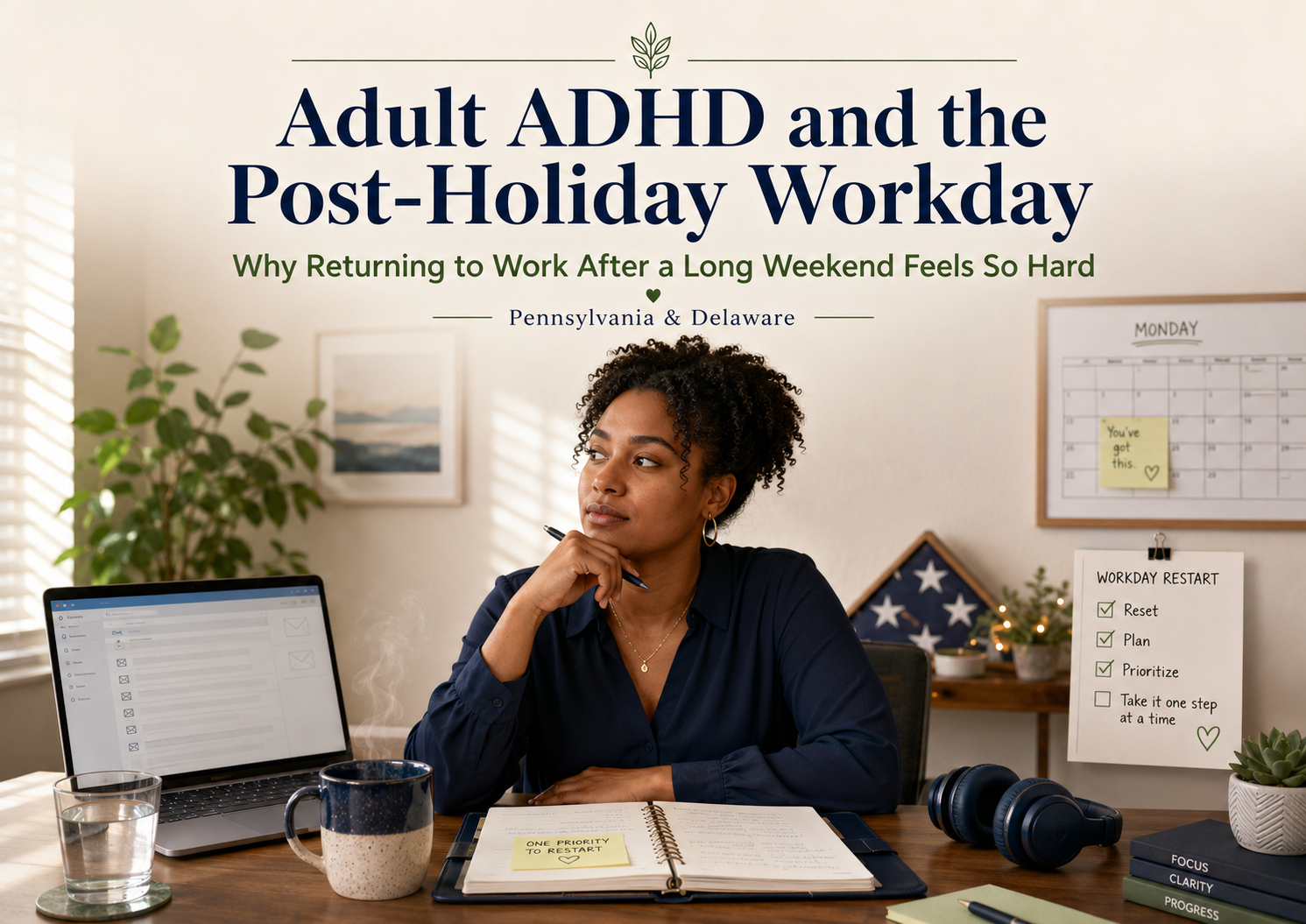
Adult ADHD and the Post-Holiday Workday: Why Returning to Work After a Long Weekend Feels So Hard
The first workday after a long holiday weekend can feel heavy for adults with ADHD.
You may open your email and immediately feel overwhelmed. You may look at your calendar and forget where you left off. You may feel tired from late nights, overstimulated from social plans, behind on home responsibilities, and unsure what to do first.
The weekend is over, but your brain may not feel ready to restart.
For many adults with ADHD, returning to work after a long weekend is not just about motivation. It can involve executive function, time blindness, sleep disruption, task initiation, emotional regulation, and the pressure of getting back into structure after several days of disruption.
At ADHD Philadelphia, we provide ADHD treatment and medication management for adults in Pennsylvania and Delaware. If returning to work after weekends or holidays repeatedly feels harder than it should, adult ADHD may be part of the pattern.
Why the First Workday After a Holiday Can Feel So Hard
A long weekend can interrupt the structure adults with ADHD often depend on.
During a regular workweek, there may be predictable time markers: alarms, meetings, deadlines, commutes, medication routines, meals, and bedtime expectations. A holiday weekend can disrupt many of those anchors at once.
By Monday, you may be dealing with:
Unread emails
Missed messages
A shifted sleep schedule
Unfinished home tasks
Medication routine changes
Travel fatigue
Social exhaustion
Noise or crowd recovery
Unclear priorities
A messy workspace
A calendar that feels too full
Pressure to “catch up” quickly
That combination can make the first workday feel like starting from behind.
Adult ADHD and Transition Difficulty
Adults with ADHD often struggle with transitions.
A transition is not only moving from one place to another. It can also mean shifting from rest to work, from unstructured time to structured time, from social plans to responsibilities, or from a holiday mindset back into professional demands.
The ADHD brain may need more external cues to restart.
You may know the weekend is over, but still feel stuck. You may sit at your desk, open a task, close it, check your phone, open another tab, and then feel frustrated that you are not moving.
This is not laziness. It is often the brain struggling to shift gears.
The Email Wall
For many adults with ADHD, the first major obstacle after a holiday weekend is email.
The inbox may feel like a wall.
You may see unread messages, follow-ups, requests, reminders, and tasks that need decisions. Instead of seeing one message at a time, your brain may feel the pressure of all of them at once.
This can lead to:
Avoiding the inbox
Opening and closing emails without replying
Answering easy emails first
Missing the most important message
Getting stuck deciding where to begin
Feeling ashamed about delayed responses
Spending too long organizing instead of responding
Email overload can quickly become executive function overload.
Why Everything Feels Urgent
After a long weekend, adults with ADHD may struggle to rank what matters most.
Everything can feel urgent:
Work emails
Client or patient messages
Household tasks
Laundry
Bills
Calendar reminders
Follow-up calls
Meal planning
Cleaning
Medication refills
The next deadline
The task you avoided before the weekend
When everything feels urgent, the brain may freeze. This can look like procrastination, but inside it may feel like mental gridlock.
If choosing what to do first often feels overwhelming, you may also want to read Adult ADHD and Decision Fatigue: Why Choosing What to Do First Feels So Overwhelming.
Sleep Disruption Can Make Work Feel Harder
Holiday weekends often include late nights, fireworks, travel, social plans, or extra screen time. Even one disrupted night can affect the next workday.
Poor sleep may make ADHD symptoms feel stronger.
You may notice:
More distractibility
More irritability
More emotional sensitivity
More trouble starting tasks
More difficulty prioritizing
More impulsive scrolling
More trouble remembering details
More difficulty returning to routines
If sleep disruption was part of the holiday weekend, Monday may feel harder because your brain is trying to work with less recovery.
For more on this pattern, read Adult ADHD and Holiday Sleep Disruption: Why One Late Night Can Throw Off the Whole Week.
The Post-Holiday Shame Spiral
Adults with ADHD often carry shame into the first workday after a long weekend.
The thoughts may sound like:
“I should have caught up already.”
“I wasted the weekend.”
“I am already behind.”
“Why can’t I just start?”
“Everyone else seems fine.”
“I always do this.”
Shame can make task initiation harder. The more ashamed you feel, the more you may avoid the task. The more you avoid the task, the more pressure builds.
That cycle can turn one hard morning into a hard day.
The solution is usually not more self-criticism. The solution is a smaller restart plan.
The Workday Restart Problem
Many adults with ADHD try to restart too broadly.
They say:
“I need to get organized.”
“I need to catch up.”
“I need to fix my schedule.”
“I need to get my life together.”
Those goals are too large for a tired ADHD brain.
A better restart is specific:
Open the calendar.
Choose one priority.
Reply to one important email.
Set a 20-minute work block.
Write down the next three steps.
Clear only the desk space you need.
The ADHD brain often needs a visible next step, not a vague demand.
A Simple Post-Holiday Workday Reset
Try this ADHD-friendly reset for the first workday after a long weekend:
Choose one work priority.
Choose one communication task.
Choose one home task.
Choose one stopping point.
For example:
Work priority: finish the report outline.
Communication task: reply to the most important email.
Home task: start one load of laundry.
Stopping point: stop work reset planning after 20 minutes.
This helps prevent the day from becoming an endless catch-up attempt.
Use the “First 15 Minutes” Rule
Instead of trying to plan the whole day perfectly, start with the first 15 minutes.
For the first 15 minutes, do only this:
Open your calendar.
Write down today’s top three tasks.
Circle the one task that matters most.
Start that task for five minutes.
This works because it reduces the decision load. You are not asking your brain to fix the entire day. You are asking it to begin.
Protect Against Fake Productivity
After a holiday weekend, adults with ADHD may fall into fake productivity.
Fake productivity feels useful but avoids the actual priority.
It may look like:
Rewriting the to-do list
Cleaning the desk for too long
Checking low-priority emails
Organizing tabs
Searching for the perfect app
Planning the week for an hour
Starting an easy task while avoiding the important one
These activities are not bad. But they can become avoidance when they replace the task that matters most.
A helpful question is:
“What task would make today feel less heavy if it were done?”
That may be the place to begin.
Long Weekend Recovery and Executive Function
Executive function helps the brain plan, prioritize, manage time, shift attention, regulate emotions, and follow through.
A long weekend can strain executive function because there are more transitions, more decisions, more stimulation, and more routine changes.
By the first workday back, you may be trying to manage both recovery and responsibility at the same time.
That is why Monday can feel harder than expected.
If the July 4th weekend left you foggy, overstimulated, or emotionally drained, you may also want to read Adult ADHD and the July 4th Crash: Why the Day After Celebration Can Feel So Hard.
Medication Routines and Returning to Structure
Long weekends can disrupt medication routines for some adults.
People may sleep later, eat at different times, travel, attend events, use alcohol or cannabis, or forget the usual rhythm of the day. If you are prescribed ADHD medication, take it only as prescribed and follow your treatment plan.
Do not change your dose, restart medication, skip medication, or adjust timing without speaking with your prescriber.
Adults considering stimulant treatment should review ADHD Philadelphia’s Medication Management and Stimulant Treatment Policy.
Responsible medication management includes safety, monitoring, consistency, and follow-up care.
ADHD Testing in Pennsylvania and Delaware
If returning to work after weekends or holidays repeatedly causes overwhelm, avoidance, emotional distress, time blindness, disorganization, or difficulty restarting, ADHD testing may help clarify the pattern.
At ADHD Philadelphia, adult ADHD testing in Pennsylvania and Delaware may include a clinical consultation, symptom review, rating scales, computerized testing when appropriate, and a careful look at how symptoms affect daily functioning.
A careful adult ADHD diagnosis can also help clarify whether ADHD, anxiety, depression, sleep disruption, burnout, trauma-related stress, or another concern may be contributing.
If you are new to the process, you can review the ADHD Patient Journey before scheduling.
How ADHD Treatment Can Help Workday Restarts
ADHD treatment is not only about focus.
A strong treatment plan should support real-life functioning, including workday transitions, task initiation, time management, planning, prioritizing, emotional regulation, medication routines, and follow-through.
Treatment may include:
Medication management when appropriate
Executive function strategies
Therapy-informed support
Time management systems
Workday restart plans
Routine support
Sleep and lifestyle discussion
Follow-up care
Education about ADHD patterns
If medication is part of treatment, ongoing follow-up matters. You may also want to read Adult ADHD Medication Follow-Up Care in Pennsylvania and Delaware: Why Monitoring Matters.
ADHD Treatment in Pennsylvania
Adults in Pennsylvania may seek ADHD testing or treatment when workday restarts, long weekends, disrupted routines, email overload, task initiation, emotional overwhelm, or time management problems affect daily functioning.
Whether you live in Philadelphia, Bala Cynwyd, King of Prussia, West Chester, Allentown, Harrisburg, Lancaster, Pittsburgh, Delaware County, Montgomery County, Chester County, Bucks County, or elsewhere in Pennsylvania, ADHD care should be structured, respectful, and individualized.
ADHD Treatment in Delaware
Adults in Delaware may also benefit from ADHD testing and treatment when returning to work after long weekends feels harder than it should.
If you live in Wilmington, Newark, Dover, Middletown, Bear, Smyrna, Milford, Seaford, Rehoboth Beach, or elsewhere in Delaware, ADHD Philadelphia provides adult ADHD services for Pennsylvania and Delaware residents.
You can review ADHD Philadelphia’s Pennsylvania and Delaware ADHD locations to learn more about service areas.
Monday Does Not Have to Decide the Whole Week
The first workday after a long weekend does not have to be perfect.
You do not need to catch up on everything today.
You need one priority, one visible next step, one communication task, and one stopping point.
Adult ADHD can make returning to structure feel harder, especially after holidays, late nights, overstimulation, and disrupted routines. But with the right support, workday restarts can become more manageable.
Book Now: Adult ADHD Testing and Treatment in Pennsylvania and Delaware
ADHD Philadelphia provides adult ADHD testing, diagnosis, treatment, and medication management for adults in Pennsylvania and Delaware.
If returning to work after weekends or holidays repeatedly leaves you overwhelmed, stuck, scattered, or unable to get back on track, a structured ADHD evaluation can help you get clarity.
Schedule an adult ADHD evaluation or treatment appointment today.
Educational content only. This blog is not medical advice, not a diagnosis, and not a substitute for individualized care. If you are in crisis or feel unsafe, call 988 or go to the nearest emergency room.

Adult ADHD and the July 4th Crash: Why the Day After Celebration Can Feel So Hard
July 4th can be exciting, but adults with ADHD may feel drained afterward. Learn why fireworks, noise, late nights, social plans, sleep disruption, and executive function overload can make the day after celebration feel so hard.

Adult ADHD and the July 4th Crash: Why the Day After Celebration Can Feel So Hard
There may be fireworks, cookouts, family gatherings, traffic, travel, social plans, food, music, alcohol, changed routines, late nights, and more decisions than expected.
For many adults with ADHD, the hardest part is not always the holiday itself.
It is the crash afterward.
The next day, you may feel foggy, drained, irritable, scattered, ashamed, unmotivated, or unable to restart. You may look around at the dishes, laundry, messages, work tasks, errands, and unfinished responsibilities and think, “Why does everything feel so hard now?”
At ADHD Philadelphia, we provide ADHD treatment and medication management for adults in Pennsylvania and Delaware. If holiday weekends often leave you overwhelmed, overstimulated, and struggling to recover, adult ADHD may be part of the pattern.
What Is the July 4th Crash?
The “July 4th crash” is not a formal diagnosis.
It is a way to describe what many adults with ADHD feel after a highly stimulating holiday.
You may have pushed through noise, social expectations, late-night plans, disrupted sleep, fireworks, travel, family dynamics, and changed routines. Your brain and body may have used more energy than people could see.
Then the holiday ends.
The structure disappears. The stimulation drops. The responsibilities return. The mess is still there. The next week is approaching.
For adults with ADHD, that shift can feel like a hard landing.
Why Adults With ADHD May Feel Drained After Celebrations
Adult ADHD is often described as a focus problem, but it can affect much more than attention.
ADHD can affect executive function, emotional regulation, sensory processing, sleep routines, time awareness, impulse control, planning, task initiation, and follow-through.
A holiday like July 4th may challenge several of those areas at once.
You may be dealing with:
Noise from fireworks or music
Crowds and social stimulation
Changed meal times
Later bedtime
Travel or traffic
Family pressure
More decisions
More cleanup
Interrupted medication routines
Alcohol, cannabis, or substance exposure
Less quiet time
Less recovery time
Pressure to “have fun”
When all of that stacks up, the crash afterward makes sense.
Fireworks, Noise, and Overstimulation
Fireworks can be fun for some people and overwhelming for others.
For adults with ADHD who are sensitive to noise, bright lights, movement, or unpredictable stimulation, fireworks can keep the nervous system on alert. Even after the fireworks end, the brain may still feel activated.
You may notice:
Restlessness
Irritability
Trouble winding down
Feeling tense
Difficulty sleeping
Trouble focusing the next day
Feeling emotionally raw
Needing quiet time
Avoiding people after the event
This does not mean you are weak or dramatic. It may mean your brain had too much stimulation and needs recovery.
If this pattern sounds familiar, you may also want to read Adult ADHD and Holiday Weekend Overwhelm: Why Noise, Plans, and Crowds Can Feel Like Too Much.
Sleep Disruption Can Make ADHD Symptoms Louder
July 4th often means later nights.
Fireworks happen after dark. Social plans may run late. Cleanup may happen late. You may stay up scrolling because your brain is still stimulated.
For adults with ADHD, one late night can affect the next day more than expected.
Poor sleep may make it harder to:
Focus
Start tasks
Regulate emotions
Make decisions
Manage time
Follow through
Control impulses
Restart routines
Handle frustration
Recover from social events
If sleep disruption is part of your holiday pattern, read Adult ADHD and Holiday Sleep Disruption: Why One Late Night Can Throw Off the Whole Week.
The Executive Function Problem After the Holiday
The day after July 4th can be full of small responsibilities.
Put food away.
Clean up.
Answer messages.
Do laundry.
Take out trash.
Get back to sleep routine.
Prepare for work.
Check the calendar.
Restart medication routine as prescribed.
Plan the rest of the weekend.
These tasks may look simple from the outside. But for adults with ADHD, the problem is often not knowing what needs to be done. The problem is organizing, prioritizing, starting, and following through when your brain is already tired.
That is executive function overload.
Executive function helps the brain plan, organize, shift attention, regulate emotions, manage time, and complete tasks. When executive function is strained, even small tasks can feel too big.
Why the Mess Feels Bigger Than It Is
After a holiday celebration, the visible mess can feel emotionally heavy.
Dishes, bags, leftovers, laundry, decorations, texts, and unfinished errands may all compete for attention at the same time.
For adults with ADHD, visual clutter can make the brain feel crowded. You may not know where to start, so you avoid the whole thing.
Then avoidance creates shame.
The shame may sound like:
“I should have cleaned this already.”
“Why can’t I handle basic things?”
“Everyone else can recover faster.”
“I wasted the day.”
“I am already behind again.”
That shame can make it even harder to begin.
Time Blindness and the Long Weekend Trap
Holiday weekends can create time blindness.
You may think you have more time than you actually have. You may assume you can recover, clean, rest, socialize, run errands, and prepare for the week later.
Then suddenly the weekend is almost over.
Adults with ADHD may underestimate how long recovery takes. They may also underestimate how long cleanup, planning, errands, and transitions take.
The result is a Sunday-night or Monday-morning scramble.
If time disappears quickly on weekends, you may also relate to Time Blindness on Weekends: Why Adults With ADHD Lose Track of Saturday and Sunday.
Emotional Regulation After a High-Stimulation Day
Emotional regulation does not mean suppressing feelings. It involves noticing the emotion, slowing the reaction when possible, choosing a response, and recovering after the stressful moment. Learn more in the complete guide to emotional regulation in adults with ADHD.
The day after a holiday can feel emotionally strange.
You may feel sad, irritable, anxious, guilty, overstimulated, lonely, or disconnected. You may have enjoyed parts of the holiday but still feel emotionally drained afterward.
Adults with ADHD may have more difficulty regulating emotions when they are tired, hungry, overstimulated, under-slept, or overwhelmed by unfinished tasks.
This may show up as:
Snapping at someone
Avoiding messages
Feeling rejected
Feeling guilty for needing space
Feeling anxious about the week
Feeling ashamed about unfinished tasks
Feeling unable to make decisions
Feeling emotionally “hungover” even without alcohol
The emotional crash is often a signal that the brain needs recovery, not criticism.
Medication Routines, Substances, and Safety
Holiday weekends can disrupt medication routines.
Some adults sleep later, eat later, travel, drink alcohol, use cannabis, attend events, or forget their normal schedule. If you are prescribed ADHD medication, take it only as prescribed and follow your treatment plan.
Do not change your dose, skip medication, restart medication, adjust timing, or combine substances without discussing it with your prescriber.
At ADHD Philadelphia, medication safety and monitoring are part of responsible care. Adults considering stimulant medication should review the Medication Management and Stimulant Treatment Policy.
This is not about judgment. It is about safety, consistency, and protecting your treatment progress.
A Simple July 4th Recovery Reset
After a holiday, adults with ADHD often need a reset that is small enough to actually use.
Try this:
Choose one cleanup task.
Choose one body-care task.
Choose one next-week task.
Choose one stopping point.
For example:
Cleanup task: put leftovers away.
Body-care task: drink water and eat something simple.
Next-week task: check tomorrow’s calendar.
Stopping point: stop cleaning after 20 minutes.
This gives your brain structure without demanding a perfect recovery.
Use the “First 10 Minutes” Rule
The ADHD brain may resist starting because the whole task feels too big.
Instead of saying, “I need to clean everything,” try:
“I will do the first 10 minutes.”
For 10 minutes, you might:
Collect trash
Load the dishwasher
Clear one counter
Put shoes away
Move laundry to the washer
Open the calendar
Write down tomorrow’s first task
After 10 minutes, you can stop or continue. The goal is not to finish everything. The goal is to create movement.
Protect the Next Morning
The morning after July 4th matters.
If the morning becomes completely unstructured, the rest of the day may slip away. One small anchor can help your brain restart.
Try one morning anchor:
Open the blinds.
Drink water.
Take a short walk.
Eat breakfast.
Review the calendar.
Take medication as prescribed.
Start one load of laundry.
Write down the first task.
Avoid starting the day with scrolling.
A small anchor can reduce the feeling that the whole day is already lost.
Make Recovery Part of the Plan
Adults with ADHD often plan the event but forget to plan the recovery.
Recovery is not laziness. Recovery is part of functioning.
Before or after a holiday, ask:
When will I rest?
What is the minimum cleanup?
What can wait?
What needs to be done before work?
What can I remove from the list?
What will help tomorrow feel easier?
This turns recovery from an accident into a strategy.
ADHD Testing in Pennsylvania and Delaware
If holiday crashes are part of a bigger pattern of overstimulation, time blindness, emotional overwhelm, sleep disruption, task initiation problems, or difficulty restarting routines, ADHD testing may help.
At ADHD Philadelphia, adult ADHD testing in Pennsylvania and Delaware may include a clinical consultation, symptom review, rating scales, computerized testing when appropriate, and a careful look at how symptoms affect daily life.
A careful adult ADHD diagnosis can help clarify whether ADHD, anxiety, depression, sleep problems, burnout, trauma-related stress, or another concern may be contributing.
If you are new to the process, you can review the ADHD Patient Journey before scheduling.
How ADHD Treatment Can Help Holiday Recovery
ADHD treatment is not only about sitting still or paying attention.
A strong treatment plan should support real-life functioning, including:
Sleep routines
Emotional regulation
Medication management when appropriate
Executive function strategies
Task initiation
Time management
Planning
Transitions
Follow-through
Realistic routines
Follow-up care
If medication is part of treatment, ongoing monitoring matters. You may also want to read Adult ADHD Medication Follow-Up Care in Pennsylvania and Delaware: Why Monitoring Matters.
ADHD Treatment in Pennsylvania
Adults in Pennsylvania may seek ADHD testing or treatment when holidays, long weekends, work routines, home responsibilities, relationships, sleep, and emotional regulation feel harder than they should.
Whether you live in Philadelphia, Bala Cynwyd, King of Prussia, West Chester, Allentown, Harrisburg, Lancaster, Pittsburgh, Delaware County, Montgomery County, Chester County, Bucks County, or elsewhere in Pennsylvania, ADHD care should be structured, respectful, and individualized.
ADHD Treatment in Delaware
Adults in Delaware may also benefit from ADHD testing and treatment when holiday weekends, disrupted sleep, overstimulation, time blindness, and executive function struggles affect daily life.
If you live in Wilmington, Newark, Dover, Middletown, Bear, Smyrna, Milford, Seaford, Rehoboth Beach, or elsewhere in Delaware, ADHD Philadelphia provides adult ADHD services for Pennsylvania and Delaware residents.
You can review ADHD Philadelphia’s Pennsylvania and Delaware ADHD locations to learn more about service areas.
The Day After Does Not Have to Become a Shame Spiral
The day after July 4th does not have to become proof that you failed.
It can be a recovery day.
Adults with ADHD often need structure after stimulation. They may need quiet after noise. They may need rest after social energy. They may need smaller steps after a big weekend.
You do not have to reset everything at once.
You need one next step, one anchor, and one realistic plan.
With the right evaluation, treatment, and support, holiday recovery can become more manageable.
Book Now: Adult ADHD Testing and Treatment in Pennsylvania and Delaware
ADHD Philadelphia provides adult ADHD testing, diagnosis, treatment, and medication management for adults in Pennsylvania and Delaware.
If holiday weekends leave you overstimulated, emotionally drained, sleep-disrupted, or unable to get back on track, a structured ADHD evaluation can help you get clarity.
Schedule an adult ADHD evaluation or treatment appointment today.
Educational content only. This blog is not medical advice, not a diagnosis, and not a substitute for individualized care. If you are in crisis or feel unsafe, call 988 or go to the nearest emergency room.
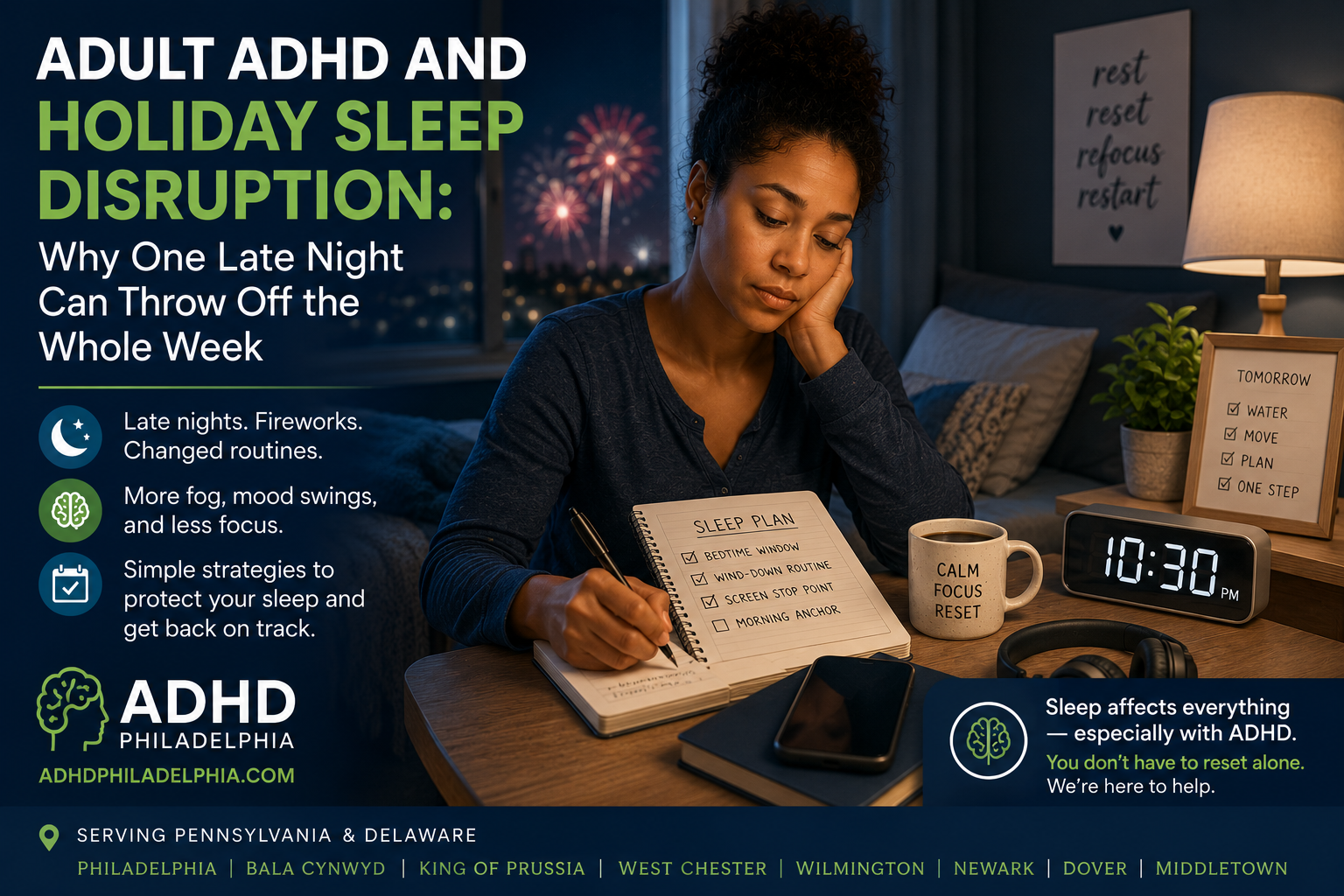
Adult ADHD and Holiday Sleep Disruption: Why One Late Night Can Throw Off the Whole Week
Holiday weekends can disrupt sleep for adults with ADHD. Learn how late nights, fireworks, changed routines, time blindness, and poor sleep can affect focus, mood, executive function, and getting back on track.

One late night during a holiday weekend can make focus, mood, routines, and executive function harder for adults with ADHD.
Holiday weekends can easily throw off sleep.
A cookout runs late. Fireworks continue after dark. Family plans change. Travel takes longer than expected. You stay up scrolling because your brain is still stimulated. You tell yourself, “I’ll get back on track tomorrow.”
But for many adults with ADHD, one late night does not always feel like one late night.
It can affect the next morning, the next day, and sometimes the whole week.
You may feel foggy, irritable, scattered, unmotivated, emotionally sensitive, or unable to restart your routine. You may know what you need to do, but your brain feels slower to begin. The holiday weekend ends, but your sleep schedule, focus, and emotional rhythm still feel off.
At ADHD Philadelphia, we provide ADHD treatment and medication management for adults in Pennsylvania and Delaware. If disrupted sleep makes your ADHD symptoms harder to manage, it may be worth looking at the full pattern.
Why Sleep Matters So Much for Adults With ADHD
Sleep is not just rest.
Sleep affects attention, memory, emotional regulation, impulse control, motivation, planning, time management, and follow-through. These are already areas that can be difficult for adults with ADHD.
When sleep is disrupted, ADHD symptoms may feel louder.
You may notice:
More distractibility
More irritability
More procrastination
More emotional reactivity
More trouble starting tasks
More difficulty making decisions
More time blindness
More impulsive scrolling or spending
More trouble getting back into routines
More difficulty following through
For adults with ADHD, poor sleep can make the brain feel like it has fewer tools available.
Why Holiday Weekends Disrupt Sleep
Holiday weekends often remove normal structure.
A regular weekday may include work, appointments, medication routines, meal times, bedtime routines, and morning expectations. A holiday weekend may involve later nights, looser plans, more noise, more travel, and more stimulation.
Sleep may be disrupted by:
Fireworks
Loud music
Crowds
Travel
Cookouts
Family plans
Late-night cleaning
Extra screen time
Changed medication timing
Alcohol or cannabis exposure
Anxiety about plans
Excitement or overstimulation
Trying to “catch up” on everything at night
Even when the holiday is enjoyable, the brain may have trouble winding down afterward.
If holiday weekends often feel overwhelming because of noise, crowds, plans, and emotional overload, you may also want to read Adult ADHD and Holiday Weekend Overwhelm: Why Noise, Plans, and Crowds Can Feel Like Too Much.
The ADHD Brain May Struggle to Wind Down
Many adults with ADHD describe feeling tired but not sleepy.
The body may be exhausted, but the mind keeps moving.
You may replay conversations, think about unfinished tasks, scroll on your phone, start a late-night project, organize something random, or suddenly feel motivated at the worst possible time.
This can be especially common after a stimulating day.
The brain may need more time to transition from activity to rest. Without a clear wind-down routine, bedtime can keep moving later and later.
A holiday weekend can make this worse because there are fewer external limits. No regular schedule may mean no clear stop point.
Fireworks, Noise, and Sleep Disruption
Fireworks can be exciting for some people and very disruptive for others.
For adults with ADHD who are sensitive to noise or stimulation, fireworks may make it harder to relax, fall asleep, or stay asleep. Even if you are not frightened by the noise, repeated unexpected sounds can keep the nervous system alert.
You may feel:
Startled
Tense
Restless
Irritable
Unable to settle
Mentally alert late at night
Physically tired but wired
This can lead to delayed sleep, poor sleep quality, and a harder morning the next day.
Time Blindness Can Push Bedtime Later
Time blindness can make sleep routines harder.
You may tell yourself:
“I’ll go to bed after one more video.”
“I’ll clean up for just ten minutes.”
“I’ll answer one message.”
“I’ll start getting ready soon.”
“I still have time.”
Then suddenly it is much later than you realized.
Holiday weekends can make time blindness worse because the normal schedule is less visible. Without workday structure, bedtime may become vague. When bedtime is vague, it is easier for the ADHD brain to drift into late-night activity.
If this sounds familiar, read Time Blindness on Weekends: Why Adults With ADHD Lose Track of Saturday and Sunday.
Sleep Loss and Emotional Regulation
Poor sleep can make emotions harder to manage.
Adults with ADHD may already experience strong emotional reactions, especially when overwhelmed, overstimulated, or under pressure. When sleep is disrupted, emotional regulation can become even harder.
You may notice:
Feeling more easily annoyed
Crying more easily
Feeling rejected more intensely
Snapping at people
Feeling more anxious
Feeling more ashamed
Feeling less patient
Feeling overwhelmed by normal tasks
Feeling unable to recover emotionally after stress
This does not mean you are overreacting on purpose. It may mean your brain is trying to regulate emotions with less rest and less executive control.
Sleep Loss and Executive Function
Executive function helps the brain plan, prioritize, start tasks, shift attention, manage time, control impulses, and follow through.
When sleep is disrupted, executive function may feel weaker.
That can make basic tasks feel harder:
Starting laundry
Answering messages
Planning meals
Returning to work
Getting ready on time
Managing appointments
Taking care of bills
Cleaning up after the holiday
Restarting medication routines as prescribed
Preparing for the next week
This is why one late night can create a domino effect.
The late night affects the morning. The hard morning affects the day. The unproductive day creates more stress. The stress can push bedtime later again.
Medication Timing and Sleep Routine Disruption
Holiday weekends may also disrupt medication routines.
Some adults sleep later, eat later, travel, attend events, or forget their normal schedule. If you take ADHD medication, take it only as prescribed and follow your treatment plan. Do not change your dose, skip doses, restart medication, or adjust timing without guidance from your prescriber.
Medication timing, caffeine, alcohol, cannabis, and poor sleep can all affect how you feel. If you are receiving stimulant medication management, safety and monitoring matter.
Adults considering stimulant medication should review ADHD Philadelphia’s Medication Management and Stimulant Treatment Policy.
This is not about shame. It is about making ADHD treatment safer, clearer, and more consistent.
The “I’ll Fix It After the Holiday” Problem
Many adults with ADHD tell themselves they will fix everything after the holiday.
“I’ll clean up Sunday.”
“I’ll restart Monday.”
“I’ll get back to sleep this week.”
“I’ll catch up later.”
“I’ll handle it when things calm down.”
But when sleep is disrupted, the reset may be harder than expected.
You may wake up tired, avoid tasks, feel behind, and then stay up late again trying to recover the time you lost. That can keep the cycle going.
For adults with ADHD, recovery needs to be planned before the crash, not only after the crash.
A Simple ADHD-Friendly Sleep Protection Plan
A holiday sleep plan does not need to be perfect.
Try this:
Choose a realistic bedtime window.
Choose one wind-down activity.
Choose one screen stop point.
Choose one morning anchor.
For example:
Bedtime window: start winding down between 10:30 PM and 11:00 PM.
Wind-down activity: shower, quiet music, or reading.
Screen stop point: phone charges across the room.
Morning anchor: take a short walk, drink water, or review the day’s calendar.
The goal is not perfection. The goal is giving your brain a visible path back to routine.
Protect the Morning After
The morning after a late night matters.
Adults with ADHD may be tempted to let the next day become completely unstructured. But one small morning anchor can help prevent the whole day from slipping.
Try choosing one simple action:
Open the blinds.
Drink water.
Eat something simple.
Take medication as prescribed.
Review the calendar.
Step outside for a few minutes.
Put one load of laundry in.
Clear one surface.
Send one important message.
A small morning anchor tells the brain, “The day has started.” That can help rebuild structure after a disrupted night.
Make the Evening Smaller
After a stimulating holiday event, do not make the evening too complicated.
Instead of trying to clean the whole house, answer every message, plan the week, and reset your life, choose one small closing routine.
For example:
Put food away.
Set out clothes.
Put medication in its usual place if prescribed.
Charge your phone away from the bed.
Write down tomorrow’s first task.
Turn off bright lights.
Use headphones or calming sound if helpful.
The ADHD brain often needs external cues that the day is ending.
ADHD Testing in Pennsylvania and Delaware
If sleep disruption is part of a larger pattern of time blindness, task initiation problems, emotional overwhelm, restlessness, difficulty with routines, disorganization, or follow-through struggles, ADHD testing may help.
At ADHD Philadelphia, adult ADHD testing in Pennsylvania and Delaware may include a clinical consultation, symptom review, rating scales, computerized testing when appropriate, and a careful look at how symptoms affect daily life.
A careful adult ADHD diagnosis can also help clarify whether ADHD, anxiety, depression, sleep problems, burnout, trauma-related stress, or another concern may be contributing.
If you are new to the process, you can review the ADHD Patient Journey before scheduling.
How ADHD Treatment Can Help Sleep-Related Patterns
ADHD treatment is not only about focus.
A strong treatment plan should consider real-life functioning, including sleep routines, emotional regulation, task initiation, time management, planning, transitions, medication timing, and follow-through.
Treatment may include:
Medication management when appropriate
Executive function strategies
Therapy-informed support
Sleep and routine discussion
Planning systems
Follow-up care
Education about ADHD patterns
Support for realistic habit-building
If medication is part of treatment, ongoing follow-up matters. You may also want to read Adult ADHD Medication Follow-Up Care in Pennsylvania and Delaware: Why Monitoring Matters.
ADHD Treatment in Pennsylvania
Adults in Pennsylvania may seek ADHD testing or treatment when sleep disruption, time management problems, emotional overwhelm, and difficulty restarting routines affect work, home life, school, relationships, or daily functioning.
Whether you live in Philadelphia, Bala Cynwyd, King of Prussia, West Chester, Allentown, Harrisburg, Lancaster, Pittsburgh, Delaware County, Montgomery County, Chester County, Bucks County, or elsewhere in Pennsylvania, ADHD care should be structured, respectful, and individualized.
ADHD Treatment in Delaware
Adults in Delaware may also benefit from ADHD testing and treatment when disrupted sleep, holiday routines, emotional overload, and executive function struggles affect daily life.
If you live in Wilmington, Newark, Dover, Middletown, Bear, Smyrna, Milford, Seaford, Rehoboth Beach, or elsewhere in Delaware, ADHD Philadelphia provides adult ADHD services for Pennsylvania and Delaware residents.
You can review ADHD Philadelphia’s Pennsylvania and Delaware ADHD locations to learn more about service areas.
One Late Night Does Not Mean the Week Is Ruined
A disrupted night does not have to become a disrupted week.
Adults with ADHD often benefit from structure, compassion, and small reset points. You do not need to fix your entire routine overnight. You need one next step that helps your brain return to a steady rhythm.
Sleep disruption can make ADHD symptoms feel stronger, but support can help you understand the pattern.
With the right evaluation, treatment plan, and follow-up care, sleep-related ADHD struggles can become more manageable.
Book Now: Adult ADHD Testing and Treatment in Pennsylvania and Delaware
ADHD Philadelphia provides adult ADHD testing, diagnosis, treatment, and medication management for adults in Pennsylvania and Delaware.
If disrupted sleep makes your ADHD symptoms harder to manage, or if holiday weekends often throw off your focus, mood, routines, and follow-through, a structured ADHD evaluation can help you get clarity.
Schedule an adult ADHD evaluation or treatment appointment today.
Educational content only. This blog is not medical advice, not a diagnosis, and not a substitute for individualized care. If you are in crisis or feel unsafe, call 988 or go to the nearest emergency room.

Adult ADHD and Holiday Weekend Overwhelm: Why Noise, Plans, and Crowds Can Feel Like Too Much
Holiday weekends can feel overwhelming for adults with ADHD because of noise, crowds, social plans, disrupted routines, time blindness, emotional overload, and medication routine changes. Learn how ADHD testing and treatment can help adults in Pennsylvania and Delaware.

Adult ADHD and Holiday Weekend Overwhelm: Why Noise, Plans, and Crowds Can Feel Like Too Much
Holiday weekends can look fun from the outside.
Cookouts. Fireworks. Family plans. Travel. Crowds. Food. Music. Noise. Group texts. Last-minute invitations. Changed routines. Later nights. More decisions. More stimulation. More expectations.
But for many adults with ADHD, holiday weekends can feel overwhelming before they even begin.
You may want to enjoy yourself, but still feel overstimulated, scattered, irritated, exhausted, or emotionally flooded. You may struggle with the noise, the planning, the social pressure, the disrupted routine, or the feeling that everyone else seems to handle it better.
At ADHD Philadelphia, we provide ADHD treatment and medication management for adults in Pennsylvania and Delaware. If holiday weekends regularly leave you overwhelmed, overstimulated, or emotionally drained, adult ADHD may be part of the pattern.
Why Holiday Weekends Can Be Hard for Adults With ADHD
Adult ADHD is often described as a focus problem, but it can affect much more than attention.
ADHD can affect executive function, emotional regulation, time awareness, task initiation, planning, transitions, sensory sensitivity, and follow-through. That means a holiday weekend may create stress in several areas at once.
A long weekend may involve:
More noise
More people
More choices
More travel
More disrupted routines
More social expectations
More emotional pressure
More last-minute changes
More food, alcohol, or substance exposure
More difficulty keeping medication and sleep routines consistent
More pressure to “relax” even when your brain feels busy
For adults with ADHD, this combination can make a holiday weekend feel less like a break and more like a full-body overload.
Noise, Fireworks, and Sensory Overload
Some adults with ADHD are more sensitive to noise, crowds, lights, movement, or chaotic environments.
Fireworks, loud music, traffic, crowded events, children running around, multiple conversations, and unpredictable sounds can all become overwhelming.
You may notice:
Irritability
Restlessness
Trouble thinking clearly
A desire to leave suddenly
Feeling tense or on edge
Difficulty following conversations
Headaches or exhaustion
Feeling emotionally drained after social events
Needing quiet time afterward
Not every adult with ADHD has sensory sensitivity. But many adults with ADHD do report feeling easily overstimulated in loud or crowded settings.
This can be especially difficult during holidays because the expectation is often to be social, cheerful, flexible, and available.
When noise, disrupted routines, social expectations, fatigue, and unexpected changes accumulate, emotions may become harder to regulate. Read more about emotional regulation in adults with ADHD.
Social Plans Can Become Executive Function Overload
A holiday weekend may sound simple at first.
“Just come over.”
“Bring something if you want.”
“We’ll figure it out.”
“Come whenever.”
For adults with ADHD, vague plans can create stress.
What time should you arrive? What should you bring? How long should you stay? What do you need to prepare? What if you forget something? What if you are late? What if there are too many people? What if you feel trapped?
Executive function helps the brain organize these details. When executive function is strained, even enjoyable plans can feel complicated.
This is why some adults with ADHD may avoid social plans, cancel at the last minute, arrive late, overprepare, forget important details, or feel exhausted before the event begins.
Why “Fun” Can Still Feel Draining
Many adults with ADHD feel confused when enjoyable events still drain them.
You may like your family and friends. You may want to celebrate. You may want to be present. You may even have a good time for part of the day.
But your brain may still be working hard.
It may be tracking conversations, masking symptoms, managing emotions, adjusting to noise, remembering details, dealing with transitions, making decisions, and trying not to disappoint anyone.
That is a lot of mental work.
So when the event ends, you may feel wiped out, even if nothing “bad” happened.
This does not mean you are antisocial or ungrateful. It may mean your brain had to use more energy than people could see.
Holiday Weekends Can Disrupt Routines
Adults with ADHD often depend on external structure.
A regular workday may provide time markers: wake-up time, commute, meetings, meals, deadlines, and bedtime. A holiday weekend can remove or disrupt those markers.
That disruption can affect:
Sleep
Meals
Medication timing
Exercise
Household routines
Planning for the next workday
Errands
Laundry
Bills
Work preparation
Emotional regulation
When structure disappears, time can become harder to manage. One disrupted day can turn into several days of feeling off track.
If weekend routine disruption is a familiar pattern, you may also want to read Why Weekends Can Disrupt Adult ADHD Routines in Pennsylvania and Delaware.
Time Blindness During Long Weekends
Holiday weekends can make time blindness worse.
A long weekend may feel like “extra time,” but that extra time can disappear quickly. You may think you have plenty of time to rest, clean, shop, answer messages, prepare food, attend events, and get ready for the week.
Then suddenly the weekend is almost over.
Adults with ADHD may underestimate how long travel, errands, social events, cleanup, recovery, and transitions will take. This can create a stressful Sunday or Monday-night scramble after the holiday ends.
If time often disappears before you realize where it went, you may also relate to Time Blindness on Weekends: Why Adults With ADHD Lose Track of Saturday and Sunday.
Emotional Regulation and Holiday Pressure
Holiday weekends can bring emotional pressure.
You may feel pressure to attend events, answer messages, host people, manage family expectations, be cheerful, bring food, spend money, tolerate noise, or stay longer than you want to stay.
For adults with ADHD, emotional regulation can be harder when the brain is tired, overstimulated, under-slept, hungry, or overwhelmed.
This may show up as:
Snapping at someone
Feeling guilty
Feeling rejected
Feeling misunderstood
Crying after an event
Feeling angry over small changes
Feeling anxious before plans
Feeling drained after social interaction
Feeling ashamed for needing space
The emotional reaction may feel bigger than the situation. But the reaction often makes more sense when you consider the full load: noise, decisions, transitions, social masking, time pressure, and disrupted routines.
Alcohol, Cannabis, and Medication Routine Disruption
Holiday weekends can also bring more exposure to alcohol, cannabis, and other substances.
For adults receiving ADHD medication management, this matters.
If you are prescribed medication, take it only as prescribed and follow your treatment plan. Do not change doses, skip medication, restart medication, or combine substances without discussing it with your prescriber.
At ADHD Philadelphia, medication safety and monitoring are part of responsible ADHD care. Adults who are considering stimulant medication should also review the Medication Management and Stimulant Treatment Policy.
This is not about judgment. It is about safety, clarity, and protecting treatment progress.
Signs Holiday Overwhelm May Be Related to Adult ADHD
Not everyone who dislikes crowds or fireworks has ADHD.
But adult ADHD may be worth exploring if holiday weekends repeatedly bring patterns like:
Feeling overwhelmed by noise or crowds
Difficulty planning for events
Forgetting what you need to bring
Arriving late despite trying
Overcommitting to plans
Avoiding plans because they feel too complicated
Feeling emotionally drained after social events
Losing track of time during long weekends
Struggling to restart routines afterward
Feeling irritable when plans change
Needing recovery time after stimulation
Feeling ashamed that holidays feel harder than they “should”
A careful adult ADHD diagnosis can help clarify whether ADHD, anxiety, depression, sleep disruption, trauma-related stress, burnout, or another concern may be contributing.
A Simple ADHD-Friendly Holiday Weekend Plan
A holiday weekend plan does not need to be complicated.
Try this:
Choose one main event.
Choose one recovery block.
Choose one task that protects next week.
Choose one boundary.
For example:
Main event: attend the cookout from 3:00 PM to 6:00 PM.
Recovery block: quiet time Saturday morning.
Next-week task: review calendar Sunday evening.
Boundary: leave before becoming overstimulated.
This gives the weekend structure without making it rigid.
Use Exit Plans Without Shame
Adults with ADHD may benefit from having an exit plan before attending a busy event.
An exit plan may include:
Driving separately when possible
Setting a realistic leaving time
Taking a short walk
Stepping into a quiet room
Using noise-reducing earbuds when appropriate
Having a simple phrase ready, such as “I’m going to head out, but I’m glad I came.”
Planning decompression time afterward
Leaving before you are completely overwhelmed is not failure. It is self-awareness.
Make the Weekend Smaller
Holiday weekends can create pressure to do too much.
Adults with ADHD may benefit from making the weekend smaller on purpose.
Instead of planning five things, choose two.
Instead of staying all day, choose a time window.
Instead of bringing a complicated dish, bring something simple.
Instead of cleaning the whole house, clear one area.
Instead of catching up on everything, pick one task that will make next week easier.
A smaller plan is not a weaker plan. For ADHD, a smaller plan is often a more successful plan.
ADHD Testing in Pennsylvania and Delaware
If holiday overwhelm is part of a larger pattern of overstimulation, time management problems, emotional overwhelm, task initiation struggles, disorganization, or difficulty restarting routines, ADHD testing may help.
At ADHD Philadelphia, adult ADHD testing in Pennsylvania and Delaware may include a clinical consultation, symptom review, rating scales, computerized testing when appropriate, and a careful look at how symptoms affect daily life.
Testing can help clarify whether ADHD symptoms are affecting work, home responsibilities, relationships, routines, and emotional functioning.
If you are new to the process, you can review the ADHD Patient Journey before scheduling.
How ADHD Treatment Can Help Holiday Overwhelm
ADHD treatment is not only about focus at work.
A strong treatment plan should also consider real-life functioning, including emotional regulation, time management, routines, decision-making, sensory overwhelm, transitions, and follow-through.
Treatment may include:
Medication management when appropriate
Executive function strategies
Therapy-informed support
Planning systems
Routine support
Sleep and lifestyle discussion
Follow-up care
Education about ADHD patterns
Support for realistic boundaries
If medication is part of treatment, ongoing monitoring matters. You may also want to read Adult ADHD Medication Follow-Up Care in Pennsylvania and Delaware: Why Monitoring Matters.
ADHD Treatment in Pennsylvania
Adults in Pennsylvania may seek ADHD testing or treatment when holidays, work routines, home responsibilities, relationships, social plans, and emotional regulation feel harder than they should.
Whether you live in Philadelphia, Bala Cynwyd, King of Prussia, West Chester, Allentown, Harrisburg, Lancaster, Pittsburgh, Delaware County, Montgomery County, Chester County, Bucks County, or elsewhere in Pennsylvania, ADHD care should be structured, respectful, and individualized.
ADHD Treatment in Delaware
Adults in Delaware may also benefit from ADHD testing and treatment when disrupted routines, holiday overwhelm, time blindness, and emotional overload affect daily life.
If you live in Wilmington, Newark, Dover, Middletown, Bear, Smyrna, Milford, Seaford, Rehoboth Beach, or elsewhere in Delaware, ADHD Philadelphia provides adult ADHD services for Pennsylvania and Delaware residents.
You can review ADHD Philadelphia’s Pennsylvania and Delaware ADHD locations to learn more about service areas.
You Can Enjoy the Holiday Without Ignoring Your Limits
Adults with ADHD are often told to “just relax,” “just go with the flow,” or “just have fun.”
But sometimes the brain needs structure in order to relax.
You do not have to attend every event. You do not have to stay until you are overwhelmed. You do not have to explain every boundary. You do not have to turn a holiday weekend into another cycle of guilt and exhaustion.
Support can help you understand your patterns and build a plan that fits your life.
Adult ADHD is not a character flaw. It is a brain-based condition that can affect attention, time, emotion, planning, routines, and stimulation.
With the right evaluation and treatment plan, holiday weekends can become more manageable.
Book Now: Adult ADHD Testing and Treatment in Pennsylvania and Delaware
ADHD Philadelphia provides adult ADHD testing, diagnosis, treatment, and medication management for adults in Pennsylvania and Delaware.
If holiday weekends often leave you overstimulated, scattered, emotionally drained, or unable to get back on track afterward, a structured ADHD evaluation can help you get clarity.
Schedule an adult ADHD evaluation or treatment appointment today.
Educational content only. This blog is not medical advice, not a diagnosis, and not a substitute for individualized care. If you are in crisis or feel unsafe, call 988 or go to the nearest emergency room.

Adult ADHD and Decision Fatigue: Why Choosing What to Do First Feels So Overwhelming
Adults with ADHD may feel overwhelmed by choices, priorities, and deciding what to do first. Learn how decision fatigue affects task initiation, routines, work, home responsibilities, and emotional overwhelm.
Adult ADHD and Decision Fatigue: Why Choosing What to Do First Feels So Overwhelming | ADHD Philadelphia
For many adults with ADHD, the hardest part of the day is not always doing the task.
It is deciding what to do first.
You may look at your inbox, your work responsibilities, your laundry, your bills, your calendar, your missed calls, your unfinished projects, and your personal goals — and suddenly everything feels equally urgent.
Your brain freezes.
You know something needs to get done, but choosing the first step feels overwhelming. You may jump between tasks, scroll to avoid deciding, start something random, or spend so much time planning that nothing actually moves forward.
This is often described as decision fatigue.
At ADHD Philadelphia, we provide ADHD treatment and medication management for adults in Pennsylvania and Delaware. If choosing what to do first feels harder than it should, adult ADHD may be part of the pattern.
What Is Decision Fatigue?
Decision fatigue happens when the brain becomes overloaded by too many choices, priorities, or competing demands.
For adults with ADHD, decision fatigue may show up as:
Feeling stuck before starting
Not knowing what matters most
Avoiding tasks because choosing feels stressful
Switching between tasks without finishing
Overthinking small decisions
Feeling mentally exhausted early in the day
Putting off decisions until they become urgent
Asking, “What should I do first?” over and over
Feeling guilty for wasting time deciding
Everyone experiences decision fatigue sometimes. But for adults with ADHD, it can become a daily pattern that affects work, home responsibilities, relationships, finances, school, parenting, and emotional well-being.
Why Adults With ADHD Can Feel Overwhelmed by Choices
Adult ADHD often affects executive function.
Executive functions help the brain organize information, prioritize, start tasks, manage time, regulate emotions, and follow through. When executive function is strained, the brain may struggle to sort tasks by importance.
That can make a normal to-do list feel like a wall of pressure.
You may know that one task is technically more important, but your brain may still react to everything at once:
The email feels urgent.
The bill feels urgent.
The laundry feels urgent.
The work project feels urgent.
The appointment feels urgent.
The text message feels urgent.
The clutter feels urgent.
The unfinished task from last week feels urgent.
When everything feels urgent, nothing feels clear.
That is where many adults with ADHD get stuck.
Decision Fatigue Is Not Laziness
Many adults with ADHD blame themselves for decision fatigue.
They may say:
“I should be able to just pick something.”
“Why can’t I handle basic things?”
“I am wasting time again.”
“Other people do not struggle this much.”
“I know what to do, but I still cannot move.”
But decision fatigue is not laziness. It is often the result of mental overload, poor prioritization signals, time blindness, emotional pressure, and task initiation struggles.
The outside world may only see procrastination.
Inside, the person may be dealing with a crowded mental dashboard where every light is flashing at once.
If you relate to this, you may also want to read why adult ADHD makes follow-through so difficult even when you care.
Why Small Decisions Can Feel So Big
Adults with ADHD may become exhausted by small decisions before the bigger tasks even begin.
What should I answer first?
Should I clean or work?
Should I make the call now or later?
Should I start with the easiest task or the most important one?
Should I organize the list before doing anything?
Should I respond to this message now?
Should I finish yesterday’s task first?
Should I make coffee first?
Should I start over completely?
Each decision may seem small by itself. But when dozens of small choices stack up, the ADHD brain can feel drained.
This can lead to avoidance, irritability, emotional shutdown, or scrolling for relief.
The problem is not that the person does not care. The problem is that the decision process itself becomes exhausting.
The ADHD “Everything Is Important” Problem
One common ADHD pattern is difficulty ranking importance.
A task may feel important because it is urgent, emotional, new, interesting, uncomfortable, overdue, visible, or connected to someone else’s expectations.
That does not mean it is the best task to do first.
For example, an adult with ADHD may start cleaning the kitchen because the clutter is visually loud, even though an important work deadline is due that afternoon.
Or they may answer low-priority emails because the inbox creates pressure, while avoiding the one difficult email that actually matters most.
Or they may spend an hour building a perfect plan, but never begin the first task.
This is why decision fatigue and prioritization problems often travel together.
For a complete step-by-step system for ranking competing demands, read Prioritization Skills in Adults With ADHD.
Decision Fatigue and Time Blindness
Time blindness can make decision fatigue worse.
If your brain struggles to feel time passing accurately, it may be harder to decide what can realistically fit into the day.
You may think:
“I can do all of this.”
“This will only take a few minutes.”
“I still have time.”
“I will start after one more thing.”
“I can catch up later.”
Then suddenly the day is almost over, and the pressure rises.
When time is unclear, priorities become unclear. When priorities are unclear, decisions become harder. When decisions become harder, tasks are delayed.
That cycle can make adults with ADHD feel constantly behind.
Decision Fatigue at Work
At work, adult ADHD decision fatigue may look like:
Opening multiple tabs but not completing the main task
Answering easy emails while avoiding complex work
Feeling stuck when there are multiple deadlines
Spending too long deciding how to start a project
Jumping between tasks after every notification
Avoiding decisions until someone follows up
Feeling mentally exhausted by meetings and messages
Missing important priorities because smaller tasks felt louder
This can be especially frustrating for adults who are intelligent, capable, and deeply motivated but still struggle to create order when demands pile up.
Decision Fatigue at Home
At home, decision fatigue may show up in daily routines:
What should I cook?
Should I clean first or rest first?
Which room should I start with?
What errand should I run first?
Should I pay bills now or later?
What do I need for tomorrow?
Why does the house still feel chaotic?
What should I do with this pile?
Home responsibilities often have fewer external deadlines than work. That means the adult with ADHD may have to create structure internally, which can be difficult when executive function is already strained.
This is why “free time” can still feel stressful.
Decision Fatigue and Emotional Overwhelm
Decision fatigue is not only a planning issue. It can become emotional.
Adults with ADHD may feel anxiety, shame, frustration, irritability, guilt, or defeat when they cannot choose what to do first.
The emotional pressure can make the decision even harder.
The brain may move into a freeze response:
Do nothing.
Avoid everything.
Scroll.
Nap.
Start a random task.
Over-plan.
Ask someone else to decide.
Wait until urgency forces action.
This can create a cycle of shame and avoidance. The more delayed the task becomes, the heavier the decision feels.
A Simple Decision Rule for Adults With ADHD
When everything feels important, try using a simple decision rule.
Ask:
What is the one task that will create the most relief if it is done today?
Not the perfect task.
Not the hardest task.
Not the task you “should” do according to guilt.
The task that creates the most useful relief.
That may be:
Paying one bill
Sending one email
Scheduling one appointment
Putting laundry in the washer
Reviewing tomorrow’s calendar
Submitting one form
Clearing one work bottleneck
Preparing one thing for the morning
The goal is to reduce the decision load and create movement.
Try the “One, One, One” Method
A simple ADHD-friendly decision strategy is the “One, One, One” method.
Choose:
One must-do task
One helpful task
One task to remove or delay
That is it.
For example:
Must-do: respond to the important work email.
Helpful: put clothes in the washer.
Remove or delay: reorganizing the entire closet.
This helps prevent the ADHD brain from treating every task as equal.
It also helps reduce overwhelm by making the day smaller and more realistic.
Make Priorities Visible
Adults with ADHD often benefit from making priorities visible.
Instead of keeping everything in your head, write down only three tasks.
Use a sticky note, small notebook, whiteboard, or planner.
Try this format:
Today’s top 3:
Must do:
Would help:
Can wait:
This creates a visual decision filter.
It also gives your brain permission not to carry everything at once.
ADHD Testing in Pennsylvania and Delaware
If decision fatigue, task initiation, time management, emotional overwhelm, and follow-through problems are affecting daily life, ADHD testing may help clarify the pattern.
At ADHD Philadelphia, adult ADHD testing in Pennsylvania and Delaware may include a clinical consultation, symptom review, rating scales, computerized testing when appropriate, and a careful look at how symptoms affect work, home, routines, relationships, and emotional functioning.
A careful adult ADHD diagnosis can also help distinguish ADHD from anxiety, depression, sleep problems, burnout, trauma-related stress, or other concerns that may affect decision-making.
If you are new to the process, you can review the ADHD Patient Journey before scheduling.
How ADHD Treatment Can Help Decision Fatigue
ADHD treatment is not only about paying attention.
A strong treatment plan should also support real-life functioning, including prioritization, planning, task initiation, time management, emotional regulation, and follow-through.
Treatment may include:
Medication management when appropriate
Executive function strategies
Therapy-informed support
Decision-making systems
Planning tools
Routine support
Sleep and lifestyle discussion
Follow-up care
Education about ADHD patterns
If medication is part of the treatment plan, ongoing monitoring matters. You may also want to read Adult ADHD Medication Follow-Up Care in Pennsylvania and Delaware: Why Monitoring Matters.
ADHD Treatment in Pennsylvania
Adults in Pennsylvania may seek ADHD testing or treatment when decision fatigue affects work performance, home responsibilities, relationships, finances, school, parenting, or emotional well-being.
Whether you live in Philadelphia, Bala Cynwyd, Pittsburgh, Allentown, Reading, Erie, Harrisburg, Lancaster, West Chester, Bryn Mawr, Delaware County, or elsewhere in Pennsylvania, ADHD care should be structured, respectful, and individualized.
ADHD Treatment in Delaware
Adults in Delaware may also benefit from ADHD testing and treatment when daily decisions, routines, task initiation, and prioritizing feel harder than they should.
If you live in Wilmington, Newark, Dover, Middletown, Bear, Smyrna, Milford, Seaford, Rehoboth Beach, or elsewhere in Delaware, ADHD Philadelphia provides adult ADHD services for Pennsylvania and Delaware residents.
You can review ADHD Philadelphia’s Pennsylvania and Delaware ADHD locations to learn more about service areas.
You Do Not Need to Decide Everything at Once
Decision fatigue can make life feel heavier than it has to feel.
But you do not need to solve every problem today.
You need one clear next step.
Adult ADHD can make choices feel crowded, priorities feel confusing, and simple decisions feel exhausting. But with the right evaluation, treatment plan, and support, decision-making can become more manageable.
Book Now: Adult ADHD Testing and Treatment in Pennsylvania and Delaware
ADHD Philadelphia provides adult ADHD testing, diagnosis, treatment, and medication management for adults in Pennsylvania and Delaware.
If choosing what to do first feels overwhelming, or if decision fatigue is affecting your work, routines, relationships, home responsibilities, or emotional well-being, a structured ADHD evaluation can help you get clarity.
Schedule an adult ADHD evaluation or treatment appointment today.
Educational content only. This blog is not medical advice, not a diagnosis, and not a substitute for individualized care. If you are in crisis or feel unsafe, call 988 or go to the nearest emergency room.
Adult ADHD and the Tuesday Reset: Why Getting Back on Track After the Weekend Feels So Hard
Tuesday can feel like the day adults with ADHD realize the week is already getting away from them. Learn why restarting after the weekend can be difficult and how ADHD testing, treatment, and executive function support can help adults in Pennsylvania and Delaware.

Tuesday can feel like the day adults with ADHD realize the week is already getting away from them.
Monday was supposed to be the reset.
You planned to catch up, answer messages, restart routines, handle the tasks you avoided over the weekend, and finally feel organized again. But Monday came with interruptions, work demands, emotional pressure, unread emails, appointments, family responsibilities, and the same old feeling of being behind.
Then Tuesday arrives.
Now the week feels real. The weekend is over. Monday did not fix everything. The to-do list is still there. The pressure is building. And the ADHD brain may feel stuck between guilt about what did not get done and overwhelm about where to start next.
At ADHD Philadelphia, we provide ADHD treatment and medication management for adults in Pennsylvania and Delaware. If getting back on track after the weekend feels harder than it should, adult ADHD may be part of the pattern.
Why Tuesday Can Feel So Hard for Adults With ADHD
For many adults with ADHD, the problem is not simply the weekend.
The problem is the transition back into structure.
Weekends may disrupt routines, sleep, errands, meals, medication timing, chores, planning, and emotional energy. Monday often becomes the day of “I need to fix everything.” But trying to fix everything at once can create more overwhelm.
By Tuesday, many adults with ADHD feel the impact of:
unfinished weekend tasks
Monday tasks that were pushed forward
emails and messages piling up
missed routines
sleep disruption
poor time awareness
difficulty prioritizing
emotional overwhelm
avoidance
task initiation struggles
pressure to catch up quickly
This can make Tuesday feel like a second Monday, but with more guilt attached.
The Tuesday Reset Is Really an Executive Function Problem
Adult ADHD often affects executive function.
Executive functions help the brain plan, organize, start tasks, shift attention, manage time, regulate emotions, and follow through. When those skills are strained, restarting after a disrupted weekend can feel much harder than other people realize.
You may know exactly what needs to be done but still feel unable to begin.
You may open your laptop and stare at the screen.
You may move from task to task without completing anything.
You may start with something easy and avoid what matters most.
You may spend too much time planning and not enough time doing.
You may feel emotionally flooded before you even begin.
This is not laziness. It is often the brain struggling to move from awareness into action.
If this sounds familiar, you may also relate to why adult ADHD makes follow-through so difficult even when you care.
Why Monday Does Not Always Work as a Reset Day
Many adults place too much pressure on Monday.
Monday becomes the day to restart everything:
wake up earlier
eat better
exercise
answer every message
finish overdue tasks
clean up the house
restart medication routines when appropriate
organize the calendar
fix the work backlog
become consistent again
That is a lot of pressure for one day.
For adults with ADHD, this kind of all-or-nothing reset can backfire. If Monday does not go perfectly, the brain may interpret the week as already ruined.
That is why Tuesday matters.
Tuesday can become a more realistic reset point. Instead of trying to repair everything at once, Tuesday can be the day you choose one priority, one next step, and one structure that helps you re-enter the week.
Weekend Disruption Can Carry Into the Week
Weekend routines can strongly affect how the week begins.
If sleep shifted, meals became inconsistent, chores piled up, errands were missed, or Sunday night turned stressful, Monday may begin with low energy and high pressure.
Adults with ADHD often experience this as:
“I already feel behind.”
“I do not know where to start.”
“I need a full day just to catch up.”
“I wasted the weekend.”
“I tried to restart Monday, but I still feel stuck.”
“My week feels off already.”
Saturday and Sunday may be over, but the impact of a disrupted weekend can continue into Tuesday.
For more on this pattern, read Why Weekends Can Disrupt Adult ADHD Routines in Pennsylvania and Delaware.
Time Blindness Can Make Tuesday Feel Urgent
Time blindness can make adults with ADHD underestimate how quickly time is passing.
On the weekend, you may think you have plenty of time. By Monday, you may still believe you can catch up quickly. By Tuesday, the pressure becomes harder to ignore.
This can create a painful shift:
Saturday feels open.
Sunday feels rushed.
Monday feels overwhelming.
Tuesday feels urgent.
Time blindness can make tasks feel either far away or suddenly critical. That makes it harder to pace yourself, plan realistically, and start early enough.
If your weekends often disappear before you realize where the time went, you may want to read Time Blindness on Weekends: Why Adults With ADHD Lose Track of Saturday and Sunday.
The Tuesday Shame Spiral
Many adults with ADHD are not just managing tasks. They are managing shame.
By Tuesday, the inner voice may sound like:
“Why did I not do this already?”
“What is wrong with me?”
“I should be able to handle this.”
“I always do this.”
“I am already behind again.”
“I cannot keep living like this.”
That shame can make it even harder to start.
Shame increases avoidance. Avoidance increases pressure. Pressure increases emotional overwhelm. Emotional overwhelm makes task initiation harder. Then the cycle repeats.
The answer is not more self-criticism. The answer is more structure, more clarity, and more realistic support.
Signs Adult ADHD May Be Affecting Your Weekly Reset
Not every rough Tuesday means ADHD is present.
But adult ADHD testing may be worth considering if the pattern is frequent, long-standing, and affecting your daily functioning.
You may want to consider an evaluation if you often:
feel behind by Tuesday
struggle to restart after weekends
lose track of time during open-ended days
avoid tasks until they become urgent
have difficulty starting even simple responsibilities
feel overwhelmed by prioritizing
miss deadlines despite caring
start tasks but do not finish them
feel ashamed about repeated patterns
struggle with work, home, school, parenting, or relationships because of follow-through problems
need pressure or crisis to begin
A careful adult ADHD diagnosis can help clarify whether ADHD, anxiety, depression, sleep problems, burnout, trauma-related stress, or another concern may be contributing.
A Simple Tuesday Reset for Adults With ADHD
A Tuesday reset should be small enough to actually work.
Try this:
Choose one task that must be done today.
Choose one task that would make tomorrow easier.
Choose one thing to remove from today’s list.
Choose one time to stop and reset.
That is enough.
For example:
Must-do task: pay one bill.
Tomorrow-easier task: pack work bag or review calendar.
Remove: do not reorganize the entire house today.
Stop-and-reset time: 7:30 PM.
This gives your brain a smaller target. Instead of trying to fix the whole week, you create one point of traction.
Make the Next Step Visible
Adults with ADHD often do better when the next step is visible and specific.
Instead of writing:
“Get organized.”
Try:
“Open email and reply to one message.”
Instead of:
“Clean the house.”
Try:
“Clear the kitchen counter for 10 minutes.”
Instead of:
“Catch up on work.”
Try:
“Open the document and write the first three sentences.”
Instead of:
“Fix my week.”
Try:
“Review today’s calendar and choose one priority.”
The ADHD brain can get overwhelmed by vague goals. Specific actions reduce the thinking load and make it easier to start.
ADHD Testing in Pennsylvania and Delaware
If weekly resets feel harder than they should, ADHD testing may help you understand the pattern.
At ADHD Philadelphia, adult ADHD testing in Pennsylvania and Delaware may include a clinical consultation, symptom review, rating scales, computerized testing when appropriate, and a careful look at how symptoms affect daily life.
Testing can help identify whether ADHD symptoms are affecting work, home responsibilities, time management, routines, emotional regulation, and follow-through.
If you are new to the process, you can also review the ADHD Patient Journey before scheduling.
How ADHD Treatment Can Help Weekly Resets
ADHD treatment is not only about focus.
A strong treatment plan should also support real-life functioning, including transitions, task initiation, routines, planning, emotional regulation, and follow-through.
Treatment may include:
medication management when appropriate
therapy-informed support
executive function strategies
time management tools
task initiation systems
sleep and routine discussion
follow-up care
education about ADHD patterns
support for realistic weekly structure
If medication is part of treatment, monitoring matters. Adults may also want to read Adult ADHD Medication Follow-Up Care in Pennsylvania and Delaware: Why Monitoring Matters.
ADHD Treatment in Pennsylvania
Adults in Pennsylvania may seek ADHD testing or treatment when weekly routines, work responsibilities, home tasks, relationships, school, parenting, or emotional well-being are affected by time management and follow-through struggles.
Whether you live in Philadelphia, Bala Cynwyd, Pittsburgh, Allentown, Reading, Erie, Harrisburg, Lancaster, West Chester, Bryn Mawr, Delaware County, or elsewhere in Pennsylvania, ADHD care should be structured, respectful, and individualized.
ADHD Treatment in Delaware
Adults in Delaware may also benefit from ADHD testing and treatment when getting back on track after the weekend feels overwhelming.
If you live in Wilmington, Newark, Dover, Middletown, Bear, Smyrna, Milford, Seaford, Rehoboth Beach, or elsewhere in Delaware, ADHD Philadelphia provides adult ADHD services for Pennsylvania and Delaware residents.
You can review ADHD Philadelphia’s Pennsylvania and Delaware ADHD locations to learn more about service areas.
Tuesday Can Be a Reset, Not a Failure
Tuesday does not have to mean the week is already ruined.
It can be a chance to restart in a smaller, more realistic way.
You do not need to fix the whole week today. You need one clear priority, one visible next step, and one structure that helps you move forward.
Adult ADHD can make transitions harder. It can make time feel slippery. It can make task initiation feel inconsistent. It can make shame feel louder than logic.
But with the right evaluation, treatment plan, and support, weekly resets can become more manageable.
Book Now: Adult ADHD Testing and Treatment in Pennsylvania and Delaware
ADHD Philadelphia provides adult ADHD testing, diagnosis, treatment, and medication management for adults in Pennsylvania and Delaware.
If getting back on track after the weekend feels harder than it should, or if Tuesday often feels like proof that the week is already slipping away, a structured ADHD evaluation can help you get clarity.
Schedule an adult ADHD evaluation or treatment appointment today.
Educational content only. This blog is not medical advice, not a diagnosis, and not a substitute for individualized care. If you are in crisis or feel unsafe, call 988 or go to the nearest emergency room.
Time Blindness on Weekends: Why Adults With ADHD Lose Track of Saturday and Sunday
For adults with ADHD, weekends can disappear before they realize where the time went. Learn how time blindness affects Saturday and Sunday routines, task initiation, follow-through, rest, and Sunday-night overwhelm.
Time Blindness on Weekends: Why Adults With ADHD Lose Track of Saturday and Sunday
Weekends can disappear fast.
You wake up thinking you have plenty of time. You tell yourself you will start the laundry soon, answer that message later, run errands after breakfast, clean the kitchen before dinner, and prepare for Monday at night.
Then suddenly it is Sunday evening.
The laundry is still sitting there. The email was never answered. The groceries were rushed. The house still feels chaotic. Monday is coming, and now the pressure hits all at once.
For many adults with ADHD, this is not simply poor planning. It may be time blindness.
At ADHD Philadelphia, we provide ADHD treatment and medication management for adults in Pennsylvania and Delaware. If your weekends often disappear before you realize where the time went, adult ADHD may be part of the pattern.
What Is Time Blindness?
Time blindness is a common way people describe difficulty sensing, estimating, and managing time.
Adults with ADHD may know that time exists, but still struggle to feel time passing accurately.
You may think:
“I have all day.”
“This will only take 10 minutes.”
“I can start later.”
“I will remember to do it.”
“I just need a few more minutes.”
“I can still fit everything in.”
Then the day slips away.
Time blindness can affect workdays, appointments, bills, relationships, errands, household responsibilities, and rest. But weekends can make it especially obvious because there is often less external structure.
If you missed Saturday’s related post, you may also want to read Why Weekends Can Disrupt Adult ADHD Routines in Pennsylvania and Delaware.
For a more complete explanation of lateness, time estimation, deadlines, transitions, and external time supports, read our guide to time management and time blindness in adults with ADHD
Why Weekends Make Time Blindness Worse
During the week, time is often organized by outside expectations.
Work starts at a certain time. Meetings happen at scheduled times. School pickup, appointments, deadlines, and responsibilities create markers throughout the day.
On weekends, those markers may disappear.
That means the adult ADHD brain may have to create structure from the inside. That can be hard when executive function skills are already strained.
Weekends may bring:
Open-ended time
More choices
Less accountability
Fewer external deadlines
More distractions at home
Unstructured rest
Errands without clear start times
Household tasks without urgency
Social plans that interrupt routines
A long list of unfinished responsibilities
The result can feel confusing. You may have more free time on the weekend but less ability to use it the way you intended.
The “I Have All Day” Problem
One of the biggest weekend traps is believing that more time automatically means more productivity.
For adults with ADHD, more open time can sometimes create less action.
When a day feels wide open, the brain may not feel enough urgency to begin. A task that could have been done in the morning gets pushed to afternoon. Then afternoon gets interrupted. Then evening arrives, and the task suddenly feels urgent, stressful, or impossible.
This can lead to a familiar pattern:
You delay because there is still time.
You avoid because the task feels boring or overwhelming.
You get distracted by something more stimulating.
You underestimate how long the task will take.
You suddenly realize the day is almost over.
You rush, freeze, or give up.
You feel guilty and promise to do better next weekend.
This is not laziness. It is often executive dysfunction combined with poor time awareness.
Time Blindness and Task Initiation
Time blindness is closely connected to task initiation.
If your brain does not feel time passing clearly, it may not generate the internal signal to start.
You may know the task matters. You may care deeply. You may even feel anxious about not doing it. But the “start now” switch does not turn on until the pressure becomes intense.
This is why many adults with ADHD can perform well under deadlines but struggle when there is no immediate consequence.
On weekends, tasks like laundry, groceries, cleaning, meal prep, paperwork, and planning for Monday may not feel urgent until it is almost too late.
If this pattern sounds familiar, you may also relate to why adult ADHD makes follow-through so difficult even when you care.
Why Rest Can Also Get Lost
Time blindness does not only affect productivity. It can also affect rest.
Some adults with ADHD spend the weekend avoiding tasks but never truly resting.
They may scroll for hours but not feel restored.
They may nap too long and feel worse.
They may start random tasks but never finish them.
They may worry about responsibilities while trying to relax.
They may lose time in screens, errands, conversations, or distractions.
Then Sunday night arrives, and they feel both exhausted and unprepared.
This is one of the painful parts of adult ADHD: the weekend may be neither productive nor restful. It becomes a blur of avoidance, pressure, guilt, and emotional overwhelm.
Signs of Weekend Time Blindness in Adults With ADHD
Weekend time blindness can show up in many ways.
You may notice that you:
Lose track of hours easily
Underestimate how long errands take
Overestimate how much you can finish
Wait too long to start important tasks
Feel surprised by how late it is
Miss planned start times
Forget transitions between activities
Get stuck in one activity for too long
Delay chores until Sunday night
Feel like weekends disappear without warning
Struggle to prepare for Monday
Feel guilty even after being busy all weekend
Not every person who struggles with time has ADHD. But if this pattern is frequent, long-standing, and affects work, home, relationships, or emotional well-being, it may be worth exploring.
A careful adult ADHD diagnosis can help clarify whether ADHD, anxiety, depression, sleep problems, burnout, trauma-related stress, or another concern may be contributing.
Why Timers and Calendars May Not Be Enough
Many adults with ADHD have tried timers, calendars, planners, reminders, and apps.
Sometimes they help.
Sometimes they do not.
The issue is not that tools are useless. The issue is that tools only work when they are simple, visible, realistic, and connected to your actual behavior.
A calendar you never check will not help.
A timer you ignore will not help.
A planner that is too complicated will not help.
A to-do list with 27 items may create more overwhelm.
For adults with ADHD, time tools often need to be external, visible, and connected to a very specific action.
Instead of writing “clean house,” try:
10:00 AM — clear kitchen counter for 15 minutes.
Instead of “get ready for Monday,” try:
7:30 PM — choose clothes, check calendar, pack work bag.
Specific is easier than vague.
A Simple Weekend Time Reset
A weekend time reset does not need to be complicated.
Try this:
Pick one anchor time in the morning.
Pick one anchor time in the afternoon.
Pick one anchor time in the evening.
For example:
10:00 AM — start one household task.
2:00 PM — leave for errands or do one outside task.
7:30 PM — prepare for Monday.
Then choose only one task for each anchor.
This gives the day shape without making it rigid.
You can also use visual cues:
Put the laundry basket near the door.
Place the grocery list on the counter.
Keep your planner open.
Set a phone alarm with a specific action.
Use a sticky note that says, “Start the 15-minute version.”
The goal is not perfection. The goal is to make time more visible.
ADHD Testing in Pennsylvania and Delaware
If time blindness affects your weekends, workdays, relationships, bills, home routines, or emotional well-being, ADHD testing may help you understand the pattern.
At ADHD Philadelphia, adult ADHD testing in Pennsylvania and Delaware may include a clinical consultation, symptom review, rating scales, computerized testing when appropriate, and a careful look at how symptoms affect daily life.
The goal is not to diagnose quickly. The goal is to understand what is happening and what kind of support may help.
If you are new to the process, you can also review the ADHD Patient Journey before scheduling.
How ADHD Treatment Can Help Time Blindness
ADHD treatment is not only about focus.
A strong treatment plan should also address time management, task initiation, follow-through, emotional overwhelm, routines, and real-life functioning.
Treatment may include:
Medication management when appropriate
Executive function strategies
Therapy-informed support
Sleep and routine discussion
Follow-up care
Planning tools
Task initiation systems
Education about ADHD patterns
Support for realistic weekend structure
If medication is part of treatment, monitoring matters. You may want to read Adult ADHD Medication Follow-Up Care in Pennsylvania and Delaware: Why Monitoring Matters.
ADHD Treatment in Pennsylvania
Adults in Pennsylvania may seek ADHD testing or treatment when time blindness affects work, home responsibilities, relationships, finances, school, parenting, or emotional well-being.
Whether you live in Philadelphia, Bala Cynwyd, Pittsburgh, Allentown, Reading, Erie, Harrisburg, Lancaster, West Chester, Bryn Mawr, Delaware County, or elsewhere in Pennsylvania, ADHD care should be structured, respectful, and individualized.
ADHD Treatment in Delaware
Adults in Delaware may also benefit from ADHD testing and treatment when weekends disappear, routines collapse, or time management feels harder than it should.
If you live in Wilmington, Newark, Dover, Middletown, Bear, Smyrna, Milford, Seaford, Rehoboth Beach, or elsewhere in Delaware, ADHD Philadelphia provides adult ADHD services for Pennsylvania and Delaware residents.
You can review ADHD Philadelphia’s Pennsylvania and Delaware ADHD locations to learn more about service areas.
Sunday Night Does Not Have to Become a Shame Spiral
Sunday night can feel heavy for adults with ADHD.
It can bring guilt about what did not get done, anxiety about Monday, frustration about lost time, and shame about repeating the same pattern again.
But shame does not build structure.
Support does.
If time blindness keeps affecting your weekends and your life, it may be time to stop blaming yourself and start understanding the pattern.
Adult ADHD is not a failure of character. It is a brain-based condition that can affect time awareness, planning, motivation, task initiation, emotional regulation, and follow-through.
With the right evaluation and treatment plan, weekends can become less chaotic and more manageable.
Book Now: Adult ADHD Testing and Treatment in Pennsylvania and Delaware
ADHD Philadelphia provides adult ADHD testing, diagnosis, treatment, and medication management for adults in Pennsylvania and Delaware.
If your weekends disappear before you realize where the time went, or if time blindness is affecting your work, home routines, relationships, or emotional well-being, a structured ADHD evaluation can help you get clarity.
Schedule an adult ADHD evaluation or treatment appointment today.
Educational content only. This blog is not medical advice, not a diagnosis, and not a substitute for individualized care. If you are in crisis or feel unsafe, call 988 or go to the nearest emergency room.

Why Weekends Can Disrupt Adult ADHD Routines in Pennsylvania and Delaware
Weekends are supposed to feel easier, but adults with ADHD may feel more scattered when weekday structure disappears. Learn why weekend routines can fall apart and how ADHD testing, treatment, and executive function support can help adults in Pennsylvania and Delaware.

Why Weekends Can Disrupt Adult ADHD Routines in Pennsylvania and Delaware
Weekends are supposed to feel easier.
For many adults with ADHD, they do not.
During the week, work schedules, meetings, deadlines, school routines, appointments, and outside expectations may create structure. Even if the week feels stressful, there is often a clear rhythm: wake up, get ready, show up, respond, complete what is urgent, and keep moving.
Then the weekend arrives.
Suddenly, there is less structure, more freedom, more choices, more errands, more household tasks, more social plans, and more pressure to “catch up.” Instead of feeling rested, many adults with ADHD feel scattered, overwhelmed, guilty, or stuck.
At ADHD Philadelphia, we provide ADHD treatment and medication management for adults in Pennsylvania and Delaware. If your weekends often turn into a cycle of procrastination, unfinished tasks, emotional overwhelm, and Sunday-night guilt, adult ADHD may be part of the pattern.
Why Weekends Can Be Harder for Adults With ADHD
Many adults with ADHD do better when the environment provides structure.
During the week, the structure may come from work, school, family routines, scheduled appointments, or external deadlines. On weekends, that structure may disappear.
That can create problems with:
Starting tasks
Choosing what to do first
Estimating how long things will take
Remembering errands or responsibilities
Transitioning between activities
Managing distractions
Balancing rest and productivity
Avoiding all-or-nothing thinking
Stopping one activity and moving to another
Getting back on track after plans change
The problem is not that adults with ADHD do not care. Many care deeply. The problem is that the weekend often requires self-directed executive function skills without the same external structure that helps during the week.
The Weekend “Catch-Up” Trap
Many adults with ADHD enter the weekend with a long list of everything they did not finish during the week.
Laundry.
Email.
Cleaning.
Groceries.
Bills.
Paperwork.
Family responsibilities.
Meal planning.
Exercise.
Appointments.
Home projects.
Messages they forgot to answer.
By Saturday morning, the list may already feel impossible.
Instead of picking one task and starting, the brain may freeze. The adult may scroll, avoid, nap, clean something random, start five tasks at once, or wait until Sunday night when urgency finally kicks in.
This can lead to a painful cycle:
You feel behind.
You make a huge plan.
The plan feels overwhelming.
You avoid starting.
The weekend disappears.
You feel guilty.
You promise next weekend will be different.
If this sounds familiar, you may also relate to why adult ADHD makes follow-through so difficult even when you care.
Time Blindness Can Make Weekends Disappear
Time blindness is a common ADHD-related struggle.
An adult may think:
“I have all day.”
“This will only take 20 minutes.”
“I can do that later.”
“I will start after one more video.”
“I have time before we leave.”
Then suddenly, hours are gone.
Weekends can make time blindness worse because there may be fewer external markers. Without a work schedule or appointment structure, the day can become blurry. Morning turns into afternoon. Afternoon turns into evening. Important tasks are pushed later and later.
This is one reason adults with ADHD may feel like they worked hard all weekend but still did not finish what mattered.
Rest Can Feel Complicated With Adult ADHD
Many adults with ADHD struggle with rest.
Some feel guilty resting because there are unfinished tasks.
Some cannot relax because their mind keeps scanning for what they forgot.
Some only rest by escaping into screens, food, shopping, or distractions.
Some over-plan the weekend and end up exhausted.
Some avoid plans entirely and then feel isolated.
Some sleep too late, lose the day, and feel frustrated.
Healthy rest requires permission, structure, and boundaries. For adults with ADHD, rest may need to be planned just like work tasks. That does not mean the weekend should become rigid. It means the brain may need gentle structure to feel safe enough to slow down.
Weekend Overwhelm Is Not Laziness
Adults with ADHD are often misunderstood.
From the outside, weekend struggles may look like laziness, poor motivation, or lack of discipline. But internally, the experience may feel very different.
The adult may feel:
Mentally overloaded
Unsure where to begin
Frustrated by too many choices
Ashamed about falling behind
Emotionally drained
Frozen by the size of the task list
Distracted by everything in the environment
Unable to shift from thinking to doing
This is executive dysfunction, not a character flaw.
Adult ADHD can affect the brain’s ability to plan, prioritize, start, shift, organize, regulate emotions, and follow through. A person can be intelligent, capable, caring, and still struggle with weekend structure.
Signs Your Weekend Struggles May Be Related to Adult ADHD
Not every difficult weekend means ADHD is present. Everyone has busy, stressful, or unproductive weekends sometimes.
But adult ADHD testing may be worth considering if the pattern is frequent, long-standing, and affecting your functioning.
You may want to consider an evaluation if you often:
Lose track of time on weekends
Avoid errands until they become urgent
Start tasks but do not finish them
Forget plans, messages, bills, or responsibilities
Feel overwhelmed by basic home tasks
Struggle to transition from rest to productivity
Stay busy all day but cannot explain what got done
Have Sunday-night anxiety about unfinished tasks
Need crisis-level urgency to start
Feel ashamed because you care but still cannot stay consistent
A structured adult ADHD diagnosis can help clarify whether ADHD, anxiety, depression, sleep issues, burnout, trauma-related stress, or another concern may be contributing.
ADHD Testing in Pennsylvania and Delaware
If weekend routine disruption is part of a larger life pattern, testing may help.
Adults often seek ADHD evaluation when struggles are affecting work, school, relationships, parenting, home responsibilities, finances, or emotional well-being.
At ADHD Philadelphia, adult ADHD testing in Pennsylvania and Delaware may include a clinical consultation, symptom review, rating scales, computerized testing when appropriate, and a careful look at how symptoms affect daily life.
The goal is not to label someone quickly. The goal is to understand the pattern and identify what kind of support may help.
If you are new to the process, you can also review the ADHD Patient Journey before scheduling.
How ADHD Treatment Can Help Weekend Functioning
ADHD treatment is not only about doing better at work.
A strong treatment plan should also help with daily life: home routines, emotional regulation, planning, follow-through, rest, relationships, and realistic self-management.
Treatment may include:
Medication management when appropriate
Therapy-informed support
Executive function strategies
Task initiation tools
Planning systems
Time-management supports
Sleep and routine discussions
Follow-up care
Education about ADHD patterns
A more realistic weekend structure
If medication is part of treatment, follow-up care matters. Adults may also want to read Adult ADHD Medication Follow-Up Care in Pennsylvania and Delaware: Why Monitoring Matters.
A Simple Weekend Reset Strategy for Adults With ADHD
A weekend plan does not have to be complicated.
In fact, complicated plans often fail.
Try this simple structure:
Choose one must-do task.
Choose one should-do task.
Choose one restorative activity.
Choose one reset task for Monday.
That is it.
For example:
Must-do: grocery shopping.
Should-do: laundry.
Restorative activity: walk outside or meet a friend.
Monday reset: choose clothes, review calendar, and prepare medication or work bag if appropriate.
This gives the ADHD brain a smaller target. Instead of trying to fix your whole life in one weekend, you create enough structure to reduce chaos.
ADHD Treatment in Pennsylvania
Adults in Pennsylvania may seek ADHD support when weekend struggles are part of a larger pattern of procrastination, disorganization, emotional overwhelm, and difficulty following through.
Whether you live in Philadelphia, Bala Cynwyd, Pittsburgh, Allentown, Reading, Erie, Harrisburg, Lancaster, West Chester, Bryn Mawr, Delaware County, or another part of Pennsylvania, ADHD care should be structured, respectful, and individualized.
ADHD Treatment in Delaware
Adults in Delaware may also benefit from ADHD testing and treatment when routines collapse on weekends or during schedule changes.
If you live in Wilmington, Newark, Dover, Middletown, Bear, Smyrna, Milford, Seaford, Rehoboth Beach, or elsewhere in Delaware, ADHD Philadelphia provides adult ADHD services for Pennsylvania and Delaware residents.
You can review ADHD Philadelphia’s Pennsylvania and Delaware ADHD locations to learn more about service areas.
You Deserve More Than Another Weekend of Shame
If your weekends often leave you feeling guilty, overwhelmed, or behind, you are not alone.
The answer is not always to try harder. Sometimes the answer is to understand your brain better, reduce shame, and build a treatment plan that fits how your life actually works.
Adult ADHD can affect workdays, weekends, relationships, home responsibilities, and rest. Getting support can help you move from self-blame to structure.
Book Now: Adult ADHD Testing and Treatment in Pennsylvania and Delaware
ADHD Philadelphia provides adult ADHD testing, diagnosis, treatment, and medication management for adults in Pennsylvania and Delaware.
If weekends have become another reminder that focus, follow-through, routines, and time management feel harder than they should, a structured ADHD evaluation can help you get clarity.
Schedule an adult ADHD evaluation or treatment appointment today.
Educational content only. This blog is not medical advice, not a diagnosis, and not a substitute for individualized care. If you are in crisis or feel unsafe, call 988 or go to the nearest emergency room.

Adult ADHD Medication Side Effects in Pennsylvania and Delaware: What to Track and When to Follow Up
Starting ADHD medication can bring questions about side effects, sleep, appetite, mood, focus, and timing. Learn what adults in Pennsylvania and Delaware should track and when to follow up with an ADHD medication management provider.
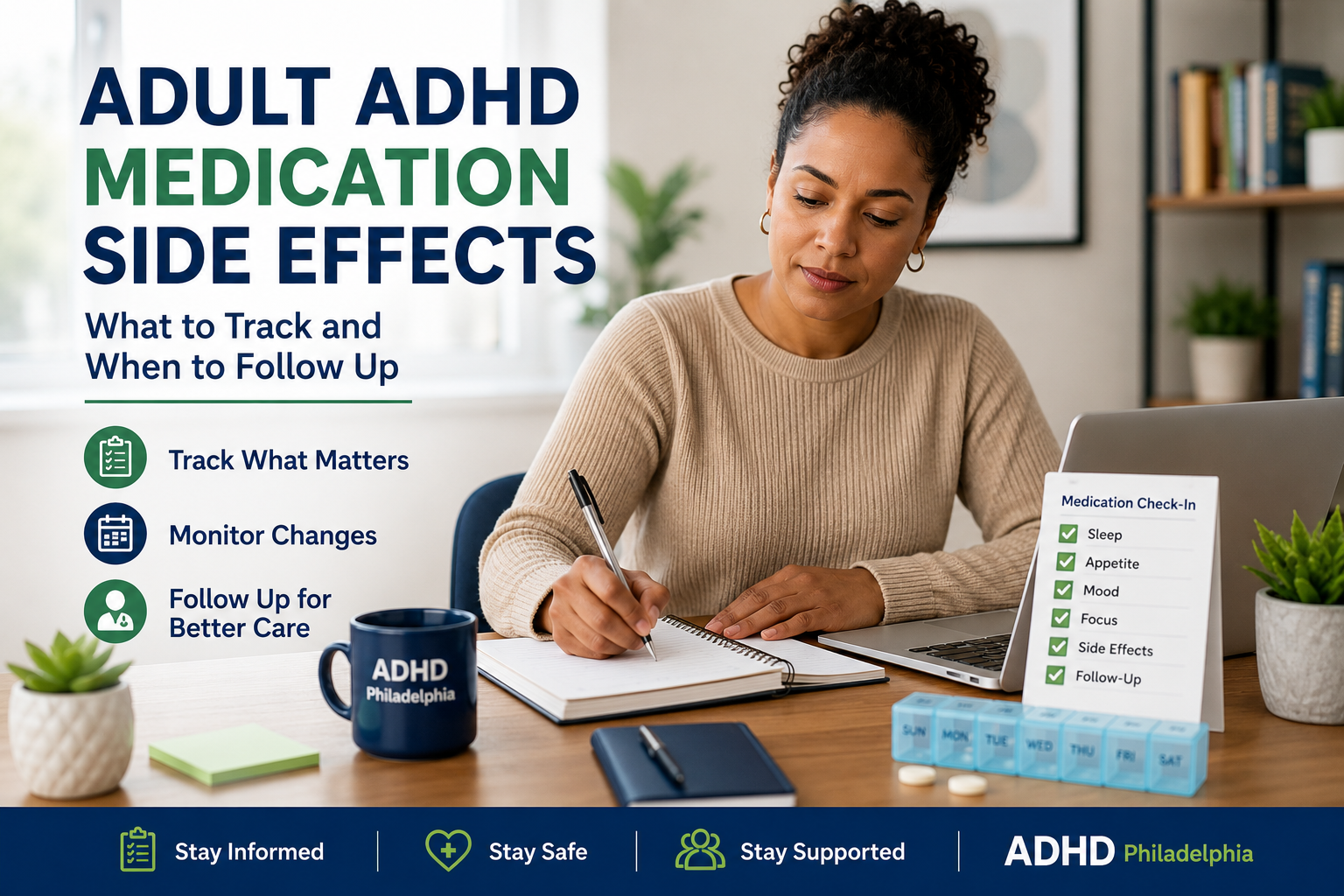
Starting ADHD medication can feel hopeful, but it can also bring questions.
Is this side effect normal?
How long should I wait before saying something?
Is the medication working, or am I just feeling different?
Should I track sleep, appetite, mood, focus, or blood pressure?
Adult ADHD medication management should not be a guessing game. Side effects, benefits, timing, and daily functioning all matter. The more clearly you can describe your experience, the easier it is for your provider to adjust the treatment plan safely and thoughtfully.
At ADHD Philadelphia, we provide ADHD treatment and medication management for adults in Pennsylvania and Delaware. The goal is not just to start medication. The goal is to monitor how treatment affects your real life.
Why Side Effect Tracking Matters
ADHD medication can help some adults improve focus, task initiation, follow-through, and daily functioning. But medication response is not the same for everyone.
Some adults notice improvement quickly.
Some need dose adjustments.
Some need a different medication.
Some experience side effects that need to be addressed.
Some find that medication helps focus but does not fully solve overwhelm, procrastination, routines, or emotional regulation.
Tracking side effects helps your provider understand the difference between a medication that is helping, a dose that needs adjustment, and a treatment plan that may need to change.
If you are just beginning treatment, you may want to first read Adult ADHD Medication Management in Pennsylvania and Delaware: What to Know Before Starting Treatment.
Common ADHD Medication Side Effects Adults May Notice
Side effects can vary depending on the medication, dose, timing, health history, sleep, nutrition, and other medications.
Adults may want to track changes in:
Sleep
Appetite
Headaches
Dry mouth
Stomach discomfort
Nausea
Anxiety
Irritability
Mood changes
Feeling emotionally flat
Feeling overstimulated
Heart rate or blood pressure concerns
Medication wearing off too early
Medication lasting too long
Fatigue or tiredness
Rebound symptoms later in the day
Not every person will experience these concerns. Some adults tolerate medication well. Others need adjustments. The important point is that side effects should be discussed, not ignored.
Side Effects Do Not Always Mean Treatment Has Failed
Many adults worry that reporting side effects means they will lose access to care or that medication will automatically be stopped.
That is not the goal of good follow-up care.
Side effects are clinical information. They help guide the next step.
For example:
If medication works but wears off too early, timing may need to be reviewed.
If medication helps focus but disrupts sleep, the dose or schedule may need adjustment.
If appetite is affected, meal timing and medication timing may need discussion.
If anxiety increases, the provider may need to look at dose, medication type, sleep, caffeine, anxiety history, or other factors.
If focus improves but emotional regulation does not, treatment may need to include therapy-informed strategies or executive function support.
This is why adult ADHD medication follow-up care is so important after medication starts.
What to Track During the First Few Weeks
You do not need a complicated spreadsheet.
A simple note in your phone can be enough.
Try tracking:
What time you take the medication
Whether you ate before taking it
When you first notice benefit
When the benefit seems strongest
When it wears off
Your focus level
Task completion
Mood
Anxiety
Irritability
Sleep quality
Appetite
Headaches or stomach discomfort
Any missed doses
Any unusual symptoms
One useful format is:
“Medication taken at 8 AM. Focus improved from 9 AM to 1 PM. Appetite lower at lunch. Felt irritable around 3 PM. Slept okay.”
That kind of detail can help your provider make better treatment decisions than a general statement like, “I think it works sometimes.”
Sleep Is One of the Most Important Things to Track
Sleep can strongly affect ADHD symptoms.
Poor sleep can worsen attention, memory, irritability, motivation, emotional regulation, and follow-through. It can also make it harder to know whether medication is helping.
When tracking sleep, pay attention to:
What time you fall asleep
How often you wake up
Whether you feel rested
Whether medication seems to interfere with sleep
Whether caffeine, stress, screen time, or schedule changes may be contributing
If sleep gets worse after starting or changing medication, bring that up during follow-up care.
Appetite and Nutrition Matter Too
Some ADHD medications can affect appetite.
Adults may notice they are less hungry during the day, skipping meals, or eating very little until evening. This can lead to headaches, irritability, fatigue, or a medication “crash” later in the day.
Helpful things to track include:
Breakfast before medication
Lunch appetite
Dinner appetite
Hydration
Headaches
Energy dips
Irritability later in the day
You do not have to solve this alone. Bring the pattern to your provider so the treatment plan can be reviewed.
Mood, Anxiety, and Emotional Changes Should Be Discussed
Adult ADHD can overlap with anxiety, depression, trauma-related stress, and burnout. Medication can sometimes improve emotional regulation, but some adults may notice anxiety, irritability, or feeling unlike themselves.
Track changes such as:
Feeling calmer
Feeling more anxious
Feeling emotionally flat
Feeling more irritable
Feeling more impatient
Mood swings
Increased restlessness
Changes in motivation
A thoughtful adult ADHD diagnosis process and ongoing monitoring can help clarify whether symptoms are related to ADHD, medication response, another mental health concern, sleep, stress, or a combination of factors.
Stimulant Medication Side Effect Monitoring
Stimulant medications may be helpful for some adults with ADHD, but they require careful monitoring.
At ADHD Philadelphia, adults are encouraged to review the Medication Management & Stimulant Treatment Policy so expectations are clear before and during treatment.
Monitoring may include discussion of:
Benefits
Side effects
Sleep
Appetite
Mood
Blood pressure or heart rate concerns
Medication timing
Refill expectations
Safe storage
Substance use considerations
Misuse or diversion risk
PDMP review when appropriate
Whether additional medical clearance, EKG, urine drug screening, or in-person care may be needed
This structure helps support safe prescribing and responsible care.
Non-Stimulant Medication Side Effect Monitoring
Non-stimulant ADHD medications may be a good option for some adults, especially when stimulants are not preferred, not tolerated, or not clinically appropriate.
Non-stimulants may work more gradually, so tracking may need to happen over several weeks rather than just a few days.
Adults may want to track:
Focus
Impulsivity
Mood
Sleep
Energy
Fatigue
Drowsiness
Digestive symptoms
Blood pressure or heart rate concerns, depending on medication
Overall functioning
If you are unsure about medication options, you may also want to read about stimulant vs non-stimulant ADHD medications.
When to Contact Your Provider
You should contact your provider if side effects are uncomfortable, persistent, worsening, or interfering with daily functioning.
You should also reach out if:
You feel significantly more anxious or irritable
Sleep becomes difficult
Appetite changes are affecting nutrition
You feel emotionally unlike yourself
Medication seems too strong
Medication does not seem to help
Medication wears off too early
You are unsure whether symptoms are side effects or ADHD symptoms
You accidentally take medication differently than prescribed
You have concerns about safe use
If symptoms feel urgent, severe, or unsafe, seek immediate medical help or emergency care.
ADHD Medication Side Effect Support in Pennsylvania
Adults in Pennsylvania may seek ADHD medication support when they are starting treatment, changing doses, experiencing side effects, or wondering whether medication is helping enough.
Whether you live in Philadelphia, Bala Cynwyd, Pittsburgh, Allentown, Reading, Erie, Harrisburg, Lancaster, West Chester, Bryn Mawr, Delaware County, or elsewhere in Pennsylvania, ADHD medication management should include structured follow-up and clear communication.
If you are still at the beginning of care, you may want to review adult ADHD testing in Pennsylvania and Delaware before starting treatment.
ADHD Medication Side Effect Support in Delaware
Adults in Delaware may also need support with ADHD medication monitoring, side effects, and treatment adjustments.
If you live in Wilmington, Newark, Dover, Middletown, Bear, Smyrna, Milford, Seaford, Rehoboth Beach, or elsewhere in Delaware, follow-up care can help determine whether treatment is improving daily life safely and effectively.
You can review ADHD Philadelphia’s Pennsylvania and Delaware ADHD locations to learn more about service areas.
Treatment Should Be Monitored, Not Rushed
ADHD medication can be helpful, but good care requires more than a prescription.
A strong treatment plan should include education, side effect monitoring, follow-up appointments, safe prescribing practices, and strategies for daily functioning.
If you are building a broader plan, you may also find it helpful to read Adult ADHD Treatment Plans in Pennsylvania and Delaware: Medication, Therapy, and Executive Function Support.
You deserve ADHD care that is thoughtful, structured, and responsive to your actual experience.
Book Now: Adult ADHD Medication Management in Pennsylvania and Delaware
ADHD Philadelphia provides adult ADHD testing, diagnosis, treatment, and medication management for adults in Pennsylvania and Delaware.
If you are starting ADHD medication, experiencing side effects, or wondering whether your current treatment plan is working, the next step is to schedule an appointment.
Schedule an adult ADHD evaluation or treatment appointment today.
Educational content only. This blog is not medical advice, not a diagnosis, and not a substitute for individualized care. If you are in crisis or feel unsafe, call 988 or go to the nearest emergency room.

Adult ADHD Treatment Plans in Pennsylvania and Delaware: Medication, Therapy, and Executive Function Support
Adult ADHD treatment is not one-size-fits-all. Learn how treatment plans for adults in Pennsylvania and Delaware may include medication management, therapy-informed support, executive function strategies, safe prescribing, and structured follow-up care.

Adult ADHD Treatment Plans in Pennsylvania and Delaware: Medication, Therapy, and Executive Function Support
Getting diagnosed with adult ADHD can bring relief, but it can also bring new questions.
What happens next?
Do I need medication?
Would therapy help?
What if I need better routines, structure, or executive function support?
How do I know if treatment is working?
Adult ADHD treatment is not one-size-fits-all. A good treatment plan should look at your symptoms, your life demands, your health history, your goals, and the supports you need to function more consistently.
At ADHD Philadelphia, we provide ADHD treatment and medication management for adults in Pennsylvania and Delaware. The goal is not simply to reduce symptoms on paper. The goal is to help you move through daily life with more clarity, follow-through, and confidence.
Adult ADHD Treatment Should Start With Clarity
Before treatment begins, it is important to understand what is actually causing the difficulty.
Many adults seek help because they struggle with focus, procrastination, time management, organization, forgetfulness, emotional overwhelm, or unfinished tasks. But these symptoms can overlap with anxiety, depression, trauma-related stress, sleep problems, burnout, substance use concerns, or medical issues.
That is why a careful adult ADHD diagnosis matters.
A thoughtful diagnostic process can help answer:
Are the symptoms consistent with ADHD?
Were symptoms present earlier in life?
Are symptoms affecting more than one area of life?
Are anxiety, depression, trauma, sleep, or stress also contributing?
What kind of treatment support would actually help?
If you are still early in the process, you may want to begin with adult ADHD testing in Pennsylvania and Delaware before starting treatment.
Medication Can Be One Part of Adult ADHD Treatment
For some adults, medication can be an important part of ADHD treatment.
Medication may help improve focus, reduce impulsivity, support task initiation, and make daily responsibilities feel more manageable. But medication should not be treated like a magic fix. It works best when it is part of a larger plan that includes monitoring, education, and realistic strategies.
A medication treatment plan should include discussion of:
Potential benefits
Possible side effects
Sleep
Appetite
Mood
Anxiety
Blood pressure or heart rate concerns
Medication duration
Follow-up expectations
Safe use and storage
What to do if the medication is not helping
Adults who are considering medication may find it helpful to review Adult ADHD Medication Management in Pennsylvania and Delaware: What to Know Before Starting Treatment.
Medication Follow-Up Is Part of the Treatment Plan
Starting medication is not the final step. Follow-up care helps determine whether treatment is working safely and effectively.
During follow-up appointments, your provider may ask:
Is your focus improving?
Are you starting tasks more easily?
Are you finishing more of what you begin?
How is your sleep?
How is your appetite?
Are there side effects?
Does the medication last long enough?
Are you more anxious, irritable, or emotionally flat?
Is daily functioning improving?
Do we need to adjust the plan?
If you recently started treatment or are thinking about medication, you may also want to read Adult ADHD Medication Follow-Up Care in Pennsylvania and Delaware: Why Monitoring Matters.
Therapy and Skills Support Can Help ADHD in Daily Life
Medication may help the brain access focus more effectively, but adults still need systems for real life.
Therapy-informed support and skills-based strategies can help adults understand patterns, reduce shame, and build more realistic ways to manage daily responsibilities.
This may include support with:
Task initiation
Planning
Prioritizing
Time awareness
Emotional regulation
Procrastination
Avoidance
Communication
Self-esteem
Stress management
Work routines
Home routines
For many adults, ADHD treatment is not only about paying attention. It is also about learning how to create structure that works with the brain instead of against it.
Executive Function Support Matters
Adult ADHD often affects executive functions. These are the brain-based skills that help with planning, organizing, starting tasks, shifting attention, remembering steps, regulating emotions, and following through.
You may have ADHD-related executive function struggles if you often think:
“I know what I need to do, but I cannot start.”
“I make plans but do not follow them.”
“I lose track of time constantly.”
“I forget things even when they matter.”
“I wait until the last minute even when I care.”
“I feel overwhelmed by simple tasks.”
“I can work under pressure, but I cannot stay consistent.”
This is why adult ADHD treatment should include more than symptom labels. It should help you identify the real-life points where your system breaks down.
If follow-through is one of your biggest struggles, you may also relate to why adult ADHD makes follow-through so difficult even when you care.
Stimulant and Non-Stimulant Medication Options
Some adults benefit from stimulant medications. Others may benefit from non-stimulant medications. Some adults cannot take stimulants, prefer not to take stimulants, or need a different approach because of side effects, medical history, anxiety, sleep problems, or substance use concerns.
The right option depends on the person.
Adults who are unsure about medication options may also want to read about stimulant vs non-stimulant ADHD medications.
A good medication discussion should include benefits, risks, side effects, expectations, alternatives, and follow-up.
Safe Prescribing Requires Structure
Safe ADHD medication management requires clear expectations.
This is especially true when stimulant medications are involved. Stimulants are controlled substances, which means careful monitoring and documentation are part of responsible care.
At ADHD Philadelphia, adults can review the Medication Management & Stimulant Treatment Policy so expectations are clear before starting or continuing medication treatment.
This type of structure may include:
Regular follow-up appointments
Medication response monitoring
Side effect review
PDMP review when appropriate
Substance use discussion
Safe storage discussion
Refill expectations
Urine drug screening when clinically appropriate
EKG or medical clearance when clinically appropriate
This is not about making care harder. It is about making care safer.
ADHD Treatment in Pennsylvania
Adults in Pennsylvania may seek ADHD treatment when symptoms are affecting work, school, parenting, relationships, organization, or daily functioning.
Whether you live in Philadelphia, Bala Cynwyd, Pittsburgh, Allentown, Reading, Erie, Harrisburg, Lancaster, West Chester, Bryn Mawr, Delaware County, or another part of Pennsylvania, ADHD treatment should be structured, respectful, and individualized.
A strong plan may include diagnosis, testing, medication management, therapy-informed support, executive function strategies, and follow-up care.
ADHD Treatment in Delaware
Adults in Delaware may also benefit from structured ADHD treatment when symptoms interfere with work, school, home responsibilities, or emotional stability.
If you live in Wilmington, Newark, Dover, Middletown, Bear, Smyrna, Milford, Seaford, Rehoboth Beach, or elsewhere in Delaware, treatment should focus on your real-life functioning, not just a checklist.
You can review ADHD Philadelphia’s Pennsylvania and Delaware ADHD locations to learn more about service areas.
Your Treatment Plan Should Fit Your Life
A good ADHD treatment plan should not make you feel judged, rushed, or misunderstood.
It should help answer:
What is ADHD affecting in my life?
What symptoms are most impairing?
What treatment options are appropriate?
What side effects or risks should I understand?
What routines or systems would help?
How will we know if treatment is working?
What should we monitor over time?
What is the next step?
You do not need a perfect plan on day one. You need a thoughtful starting point, honest follow-up, and support that can adjust as your needs become clearer.
Book Now: Adult ADHD Treatment in Pennsylvania and Delaware
ADHD Philadelphia provides adult ADHD testing, diagnosis, treatment, and medication management for adults in Pennsylvania and Delaware.
If you are ready to discuss ADHD treatment options, medication management, therapy-informed strategies, or executive function support, the next step is to schedule an appointment.
Schedule an adult ADHD evaluation or treatment appointment today.
Educational content only. This blog is not medical advice, not a diagnosis, and not a substitute for individualized care. If you are in crisis or feel unsafe, call 988 or go to the nearest emergency room.
Adult ADHD Medication Follow-Up Care in Pennsylvania and Delaware: Why Monitoring Matters
Starting ADHD medication is not the finish line. Follow-up care helps adults in Pennsylvania and Delaware monitor benefits, side effects, dose response, sleep, appetite, and daily functioning so ADHD treatment can stay safe, structured, and individualized.

Adult ADHD Medication Follow-Up Care in Pennsylvania and Delaware: Why Monitoring Matters
Starting ADHD medication is not the finish line.
For many adults, it is the beginning of a more structured treatment process. The first prescription is only one part of care. Follow-up appointments help determine whether the medication is working, whether the dose is appropriate, whether side effects are manageable, and whether the treatment plan is actually improving daily life.
At ADHD Philadelphia, we provide ADHD treatment and medication management for adults in Pennsylvania and Delaware. The goal is not just to start medication. The goal is to monitor treatment carefully, adjust when needed, and help adults function with more clarity, consistency, and confidence.
Why Follow-Up Care Matters After Starting ADHD Medication
ADHD treatment should be measured by more than whether you “feel something.”
The real question is whether treatment is helping you function better in your actual life.
Follow-up care gives you and your provider a chance to look at:
Focus
Task initiation
Follow-through
Time management
Emotional regulation
Sleep
Appetite
Anxiety or irritability
Work or school performance
Home responsibilities
Side effects
How long the medication lasts
Whether the medication wears off too early or too late
Whether the treatment plan still fits your goals
This is especially important because adult ADHD affects more than attention. It can affect planning, prioritizing, starting tasks, finishing tasks, remembering responsibilities, managing emotions, and staying consistent when life gets complicated.
If you are still learning about treatment options, you may want to first read Adult ADHD Medication Management in Pennsylvania and Delaware: What to Know Before Starting Treatment.
Medication Response Can Change Over Time
Some adults notice improvement quickly after starting ADHD medication. Others need time, dose adjustments, or a different medication approach.
A medication may help with focus but not task initiation.
It may improve work performance but interfere with sleep.
It may reduce procrastination but increase appetite suppression.
It may work well in the morning but fade too early in the afternoon.
It may help attention but not fully address overwhelm, anxiety, or emotional reactivity.
That does not always mean treatment failed. It may mean the plan needs careful adjustment.
This is why follow-up appointments are so important. ADHD medication management is a process, not a one-time decision.
What Happens During an ADHD Medication Follow-Up Appointment?
A follow-up appointment is usually focused on how treatment is working in daily life.
Your provider may ask questions such as:
What has improved since starting medication?
What has not improved?
Are you starting tasks more easily?
Are you finishing more of what you begin?
Are you less forgetful?
Are you managing time better?
How is your sleep?
How is your appetite?
Are you feeling more anxious, irritable, or emotionally flat?
How long does the medication seem to last?
Are there any side effects?
Are there concerns about misuse, overuse, or taking medication differently than prescribed?
Follow-up care should feel collaborative. You should be able to talk honestly about what is helping, what is not helping, and what feels uncomfortable.
Side Effects Should Be Discussed Early
Many adults worry that if they report side effects, their provider will immediately stop treatment. But side effects are exactly the kind of information that should be discussed during follow-up.
Common medication-related concerns may include:
Appetite changes
Sleep difficulty
Headaches
Dry mouth
Stomach discomfort
Increased anxiety
Irritability
Feeling too activated
Feeling emotionally blunted
Medication wearing off too soon
Medication lasting too long
Changes in blood pressure or heart rate
Not every person experiences side effects, and side effects vary by medication and individual history. The point of follow-up care is to identify concerns early and adjust thoughtfully when needed.
Stimulant Medication Follow-Up Care
Stimulant medications can be helpful for some adults with ADHD, but they require structured monitoring.
At ADHD Philadelphia, adults are encouraged to review the Medication Management & Stimulant Treatment Policy so expectations are clear before and during treatment.
Stimulant follow-up care may include discussion of:
Medication effectiveness
Duration of benefit
Side effects
Sleep and appetite
Blood pressure or heart rate concerns
Refill timing
Safe storage
Controlled-substance expectations
PDMP review when appropriate
Medication misuse or diversion risk
Whether an in-person visit, EKG, urine drug screen, or additional medical clearance may be needed
This kind of structure is not meant to punish patients. It is meant to support safe, responsible prescribing.
Non-Stimulant Medication Follow-Up Care
Non-stimulant ADHD medications may be appropriate for some adults, especially when stimulants are not preferred, not tolerated, or not clinically appropriate.
Non-stimulants may take longer to show full benefit. Because of that, follow-up care often focuses on gradual symptom change, side effects, mood, sleep, energy, and whether the medication is helping enough over time.
Adults who are unsure about medication options may also find it helpful to read about stimulant vs non-stimulant ADHD medications.
The right medication is not always the one that works fastest. The right medication is the one that fits your symptoms, health history, treatment goals, and safety needs.
What to Track Between ADHD Medication Appointments
You do not need a complicated system to track medication response.
A simple note on your phone or planner can be enough.
Try tracking:
What time you take the medication
When it starts helping
When it seems to wear off
Focus level
Task completion
Mood
Anxiety
Sleep
Appetite
Side effects
Missed doses
Work or school functioning
Home responsibilities
This gives your provider more useful information than trying to remember everything during the appointment.
A simple sentence can help:
“Medication helped most with focus from 9 AM to 2 PM, but I felt irritable when it wore off.”
That kind of information can guide treatment more effectively.
Follow-Up Care Helps Separate ADHD From Other Concerns
ADHD rarely exists in isolation.
Some adults also experience anxiety, depression, trauma-related stress, sleep problems, substance use concerns, burnout, or medical conditions that affect energy and attention.
Follow-up care helps your provider understand whether ADHD medication is improving the main symptoms or whether another concern also needs attention.
This matters because difficulty focusing is not always only ADHD. A thoughtful adult ADHD diagnosis process and ongoing follow-up can help clarify the bigger picture.
ADHD Follow-Up Care in Pennsylvania
Adults in Pennsylvania may seek ADHD follow-up care when they have started treatment but still need monitoring, dose adjustment, support with side effects, or help understanding whether medication is working.
Whether you live in Philadelphia, Bala Cynwyd, Pittsburgh, Allentown, Reading, Erie, Harrisburg, Lancaster, West Chester, or another part of Pennsylvania, ADHD care should be structured and individualized.
If you are at the beginning of the process, you may also want to review adult ADHD testing in Pennsylvania and Delaware before starting treatment.
ADHD Follow-Up Care in Delaware
Adults in Delaware also benefit from structured ADHD follow-up care after starting medication.
If you live in Wilmington, Newark, Dover, Middletown, Bear, Milford, Smyrna, or elsewhere in Delaware, follow-up appointments can help determine whether treatment is improving daily functioning and whether any changes are needed.
You can also review ADHD Philadelphia’s Pennsylvania and Delaware ADHD locations to learn more about service areas.
Follow-Up Care Is Part of Taking ADHD Seriously
Many adults wait years before seeking ADHD treatment.
By the time they finally start, they may hope one appointment or one medication will fix everything quickly. But meaningful ADHD care usually works best when it is structured, monitored, and adjusted over time.
Follow-up appointments help turn treatment into a plan.
They help answer:
Is this working?
Is this safe?
Is this dose right?
Are side effects manageable?
Is daily functioning improving?
Do we need to change the approach?
What else would help besides medication?
You deserve care that does more than hand you a prescription. You deserve care that helps you understand your symptoms, monitor your progress, and move forward with support.
Book Now: Adult ADHD Follow-Up Care in Pennsylvania and Delaware
ADHD Philadelphia provides adult ADHD testing, diagnosis, treatment, and medication management for adults in Pennsylvania and Delaware.
If you are starting ADHD treatment, considering medication, or need structured follow-up care, the next step is to schedule an appointment.
Schedule an adult ADHD evaluation or treatment appointment today.
Educational content only. This blog is not medical advice, not a diagnosis, and not a substitute for individualized care. If you are in crisis or feel unsafe, call 988 or go to the nearest emergency room.

Adult ADHD Medication Management in Pennsylvania and Delaware: What to Know Before Starting Treatment
Thinking about ADHD treatment? Learn what adult ADHD medication management in Pennsylvania and Delaware should include, from diagnosis and treatment planning to side effects, follow-up care, and safe prescribing practices.

Starting ADHD treatment can bring a lot of questions. Thoughtful medication management can help adults in Pennsylvania and Delaware move forward with clarity and support.
Starting ADHD treatment can bring up a lot of questions.
Many adults wonder if medication is the right choice, what the evaluation process looks like, whether stimulants are safe, what side effects to expect, and how follow-up care works. Some people feel hopeful. Others feel nervous. Many feel both at the same time.
If you are considering ADHD treatment, it helps to understand what thoughtful medication management should look like.
At ADHD Philadelphia, we provide ADHD treatment and medication management for adults in Pennsylvania and Delaware. The goal is not just to write a prescription. The goal is to understand your symptoms, review your history, discuss risks and benefits, and create a plan that supports your daily functioning.
Why Adults Consider ADHD Medication Management
Adults often seek ADHD treatment because symptoms continue to affect work, school, relationships, home responsibilities, or emotional well-being.
You may be thinking about treatment if you struggle with:
Difficulty starting tasks
Trouble finishing what you begin
Poor time management
Disorganization
Forgetfulness
Emotional overwhelm
Restlessness
Difficulty following through
Chronic procrastination
Trouble managing competing responsibilities
For many adults, medication management is considered after adult ADHD testing in Pennsylvania and Delaware has helped clarify that ADHD may be part of the picture.
Medication Is Only One Part of ADHD Treatment
Medication can be helpful, but it is not the only part of treatment.
Some adults benefit from stimulant medication. Others may do better with non-stimulant options. Some people combine medication with therapy, coaching-style support, better sleep habits, executive function tools, calendar systems, and lifestyle changes.
A good treatment plan should fit the person, not force the person to fit the plan.
That is why a thoughtful adult ADHD diagnosis matters before treatment starts. Difficulty focusing can overlap with anxiety, depression, trauma, poor sleep, burnout, or other concerns, so the right treatment depends on understanding the full picture.
What to Expect Before Starting ADHD Medication
Before starting ADHD medication, a responsible provider should review several important areas with you.
This may include:
Current symptoms
Past mental health history
Medical history
Heart health history
Current medications
Substance use history
Sleep patterns
Anxiety or depression symptoms
Goals for treatment
Past experiences with ADHD medication, if any
A provider should also talk with you about the benefits, possible side effects, follow-up expectations, and safe use of medication.
If you are new to the process, it may help to review the ADHD Patient Journey so you know what to expect from consultation through treatment planning.
Common Questions Adults Ask About ADHD Medication
Adults often ask practical questions before starting treatment.
Will medication change my personality?
ADHD medication should not turn you into a different person. The goal is usually to improve focus, reduce impulsivity, support follow-through, and help daily tasks feel more manageable.
Are stimulants the only option?
No. Some adults use stimulant medications, while others use non-stimulant medications. Treatment depends on your symptoms, medical history, response pattern, and preferences.
What about side effects?
Possible side effects vary by medication and person. A provider should discuss possible appetite changes, sleep changes, anxiety, increased heart rate, headaches, irritability, or other side effects before treatment begins.
How often will I need follow-up?
Follow-up depends on the medication type, how stable symptoms are, and how your body responds. Medication management should include ongoing monitoring rather than a one-time decision.
What Safe ADHD Medication Management Should Include
Good ADHD medication management should be structured and clear.
It should include:
A confirmed or carefully considered diagnosis
Discussion of risks and benefits
Review of side effects
Monitoring for effectiveness
Monitoring for misuse risk when appropriate
Clear follow-up expectations
Thoughtful dose adjustments when needed
Review of sleep, mood, appetite, and functioning
A plan for what to do if medication is not helping
At ADHD Philadelphia, we also encourage adults to review the Medication Management & Stimulant Treatment Policyso expectations are clear before treatment begins.
ADHD Treatment in Pennsylvania
Adults in Pennsylvania may seek medication management when ADHD symptoms continue to interfere with work performance, organization, time management, relationships, or daily functioning.
Whether you live in Philadelphia, Bala Cynwyd, Pittsburgh, Allentown, Harrisburg, Lancaster, West Chester, or elsewhere in Pennsylvania, treatment should feel structured, respectful, and individualized.
Medication is not about “trying harder.” It is about using evidence-based tools to support how your brain functions in real life.
If you are still early in the process, it may also help to understand how ADHD testing works for adults in Pennsylvania and Delaware.
ADHD Treatment in Delaware
Adults in Delaware also seek ADHD treatment when symptoms start interfering with work, school, parenting, organization, or emotional stability.
If you live in Wilmington, Newark, Dover, Middletown, Bear, or elsewhere in Delaware, medication management should include regular follow-up, symptom review, and a treatment plan designed around your needs.
You can also explore ADHD Philadelphia’s Pennsylvania and Delaware ADHD locations to learn more about the areas served.
Starting Treatment Does Not Mean You Failed
Many adults carry shame before starting medication.
They may think they should be able to manage on their own. They may worry treatment means they were not disciplined enough, strong enough, or organized enough.
But starting treatment does not mean you failed.
It means you are taking your symptoms seriously and giving yourself the opportunity to function with more clarity, consistency, and support.
If shame has kept you stuck, you may also relate to why adult ADHD makes follow-through so difficult even when you care.
When to Reach Out
You may want to reach out for ADHD treatment if:
You were recently diagnosed and want to discuss medication options
You were diagnosed in the past but never started treatment
You have been trying to manage symptoms on your own but still feel overwhelmed
You are curious whether medication could help you function more consistently
You want a more structured treatment plan
The right next step is not always medication, but a thoughtful evaluation and treatment discussion can help you make an informed decision.
Book Now: Adult ADHD Treatment in Pennsylvania and Delaware
ADHD Philadelphia provides adult ADHD testing, diagnosis, and treatment for adults in Pennsylvania and Delaware.
If you are thinking about starting ADHD treatment or medication management, the next step is to schedule an appointment and discuss your options.
Schedule an adult ADHD evaluation or treatment appointment today.
Educational content only. This blog is not medical advice, not a diagnosis, and not a substitute for individualized care. If you are in crisis or feel unsafe, call 988 or go to the nearest emergency room.

ADHD Testing for Adults in Pennsylvania and Delaware: Why Summer Can Be the Time to Get Answers
Summer can make adult ADHD harder to ignore. When routines shift, travel increases, kids are home, and work schedules change, adults may notice more procrastination, overwhelm, forgetfulness, and difficulty following through. Learn how adult ADHD testing in Pennsylvania and Delaware can help you get clarity and support.

Summer can make adult ADHD symptoms more noticeable. Adult ADHD testing in Pennsylvania and Delaware can help you get clarity and support.
Summer can make adult ADHD harder to ignore.
For some adults, the structure of the school year, regular work routines, or predictable family schedules helps hold everything together. Then summer arrives. Kids are home. Vacations interrupt routines. Work schedules shift. Social events increase. Holiday weekends throw off sleep. Longer days can bring more stimulation, more decisions, and less structure.
For adults with ADHD, that change can feel like everything is suddenly harder.
You may notice more procrastination, more unfinished tasks, more emotional overwhelm, more missed details, or more difficulty getting back on track after interruptions. You may wonder, “Why can everyone else seem to manage this, but I keep falling behind?”
Sometimes the answer is not laziness. Sometimes it is not poor discipline. Sometimes it is untreated adult ADHD.
At ADHD Philadelphia, we provide adult ADHD testing in Pennsylvania and Delaware, diagnosis, and treatment for adults. If summer has made your symptoms more visible, this may be the right time to finally get answers.
Why Summer Can Make Adult ADHD More Noticeable
Adult ADHD often becomes more obvious when structure disappears.
During the year, you may rely on routines, deadlines, work expectations, school schedules, or outside pressure to stay organized. When summer changes that rhythm, the support system you were depending on may weaken.
You may notice:
You have trouble restarting tasks after interruptions.
You forget appointments, errands, bills, or messages.
You feel overwhelmed by simple planning.
You stay busy all day but do not finish what matters.
You avoid tasks until they become urgent.
You feel emotionally drained by noise, people, travel, or schedule changes.
You struggle to keep up with work while also managing family or social demands.
You feel guilty because you care deeply, but still cannot stay consistent.
This is one reason many adults begin looking for ADHD testing during stressful life transitions. ADHD may have been present for years, but symptoms can become harder to compensate for when life gets less predictable. If this sounds familiar, you may also relate to why adult ADHD makes follow-through so difficult even when you care.
Signs It May Be Time for Adult ADHD Testing
Adult ADHD testing may be helpful when symptoms are affecting your daily life, not just when you are occasionally distracted.
You may want to consider an ADHD evaluation if you often experience:
Difficulty starting tasks, even important ones.
Trouble finishing projects.
Chronic lateness or poor time awareness.
Disorganization at home, work, or school.
Forgetfulness with appointments, emails, texts, or responsibilities.
Difficulty focusing during conversations, meetings, reading, or paperwork.
Restlessness, racing thoughts, or feeling internally “driven.”
Impulsive decisions, spending, interrupting, or emotional reactions.
A long history of being told you are smart but inconsistent.
A pattern of anxiety, burnout, depression, or low self-esteem connected to unfinished responsibilities.
Many adults with ADHD have spent years blaming themselves. They may have been called lazy, careless, scattered, too sensitive, or unmotivated. A structured adult ADHD diagnosis can help separate character from symptoms and clarify whether ADHD may be part of the pattern.
ADHD Testing for Adults in Pennsylvania
If you live in Pennsylvania, adult ADHD testing can help clarify whether ADHD may be contributing to your struggles with attention, organization, follow-through, emotional regulation, or time management.
At ADHD Philadelphia, adult ADHD testing in Pennsylvania and Delaware may include a clinical consultation, symptom review, rating scales, computerized testing when appropriate, and a careful look at how symptoms affect work, school, relationships, home life, and daily functioning.
The goal is not to rush to a label. The goal is to understand what is happening and what type of support may actually help.
For adults in Philadelphia, Bala Cynwyd, Pittsburgh, Harrisburg, Lancaster, Allentown, and other parts of Pennsylvania, telehealth can make the ADHD evaluation process more accessible.
ADHD Testing for Adults in Delaware
Adults in Delaware also seek ADHD testing when symptoms begin interfering with work, relationships, parenting, school, or daily responsibilities.
If you live in Wilmington, Newark, Dover, Milford, or elsewhere in Delaware, adult ADHD evaluation can help determine whether your symptoms fit ADHD, anxiety, depression, trauma-related stress, sleep problems, or another concern.
You can also review ADHD Philadelphia’s Pennsylvania and Delaware ADHD locations to learn more about service areas and location-specific pages.
This matters because ADHD symptoms can overlap with other mental health conditions. Difficulty concentrating can come from ADHD, anxiety, depression, poor sleep, trauma, substance use, or burnout. A thoughtful evaluation helps identify what is most likely driving the pattern.
For many adults, getting tested is not about finding an excuse. It is about finally having language for something they have been fighting alone for years.
Why ADHD Can Be Missed in Adults
Adult ADHD is often missed because many people learn how to hide or compensate for symptoms.
Some adults overwork to keep up.
Some rely on anxiety to create urgency.
Some choose jobs or routines that provide constant stimulation.
Some avoid paperwork, planning, finances, or administrative tasks.
Some appear successful from the outside but feel exhausted inside.
Others were never evaluated as children because they were quiet, bright, high-achieving, anxious, or able to “get by” until adult responsibilities became more demanding.
ADHD can also be missed in women, parents, professionals, Black adults, LGBTQIA+ adults, and adults from communities where mental health symptoms may be misunderstood, minimized, or stigmatized.
If procrastination is one of your biggest concerns, you may also find it helpful to read about why adults with ADHD start tasks at the last minute.
ADHD, Disability Pride, and Asking for Support Without Shame
Many adults with ADHD carry shame.
They may think, “I should be able to do this by now.”
They may compare themselves to coworkers, partners, siblings, classmates, or friends. They may wonder why basic routines feel so much harder for them than for other people.
But ADHD is not a moral failure. It is a neurodevelopmental condition that can affect attention, impulse control, planning, organization, emotional regulation, and follow-through.
Support does not mean you are broken. Support means you are learning how your brain works and creating systems that fit your actual life.
That may include ADHD education, executive function strategies, therapy, coaching-style support, medication management, environmental changes, sleep improvement, or a combination of approaches.
What Happens During an ADHD Evaluation at ADHD Philadelphia?
At ADHD Philadelphia, adult ADHD evaluation is designed to be structured, supportive, and clinically thoughtful.
The process may include:
A clinical ADHD consultation.
Review of current symptoms.
Review of childhood history when available.
Screening for anxiety, depression, trauma, sleep issues, and other possible contributors.
Rating scales.
Computerized testing when clinically appropriate.
Discussion of how symptoms affect work, school, relationships, home life, and daily functioning.
A treatment discussion based on your needs and clinical picture.
The evaluation is not just about whether you can focus during one test. It is about understanding the larger pattern of your life.
To understand the steps from consultation to testing and treatment planning, review the ADHD Patient Journey before your appointment. You can also read more about how ADHD testing works for adults in Pennsylvania and Delaware.
When to Consider ADHD Treatment or Medication Management
If ADHD is diagnosed, treatment may include behavioral strategies, therapy-informed support, lifestyle changes, executive function tools, non-stimulant medication, stimulant medication when appropriate, or a combination of options.
Medication is not the only treatment for ADHD, but for some adults it can be an important part of care. A careful medication management plan should include discussion of benefits, risks, side effects, medical history, mental health history, substance use considerations, follow-up expectations, and safe prescribing practices.
For some adults, ADHD treatment and medication management may be part of a larger plan that includes education, routines, executive function tools, and follow-up care.
At ADHD Philadelphia, treatment decisions are individualized. The goal is not to change who you are. The goal is to help you function with more clarity, consistency, and confidence.
Summer Can Be a Reset Point
You do not have to wait until everything falls apart to seek help.
Summer can be a good time to pause and ask:
Why do routines collapse so easily?
Why do transitions throw me off so much?
Why do I keep starting over?
Why do I feel overwhelmed by planning?
Why do I care so much but still struggle to follow through?
Why have I been blaming myself for symptoms I never fully understood?
If you are an adult in Pennsylvania or Delaware and you are wondering whether ADHD may be part of your story, testing can help you move from confusion to clarity.
Book an Adult ADHD Evaluation in Pennsylvania or Delaware
ADHD Philadelphia provides adult ADHD testing, diagnosis, and treatment for adults in Pennsylvania and Delaware.
If you are struggling with focus, follow-through, time management, procrastination, organization, or emotional overwhelm, a structured ADHD evaluation can help you get clarity.
Schedule an adult ADHD evaluation today.
Educational content only. This blog is not a diagnosis or a substitute for individualized medical care. If you are in crisis or feel unsafe, call 988 or go to the nearest emergency room.

Why So Many Moms Don’t Realize They Have ADHD Until Motherhood
Adults with ADHD often want healthier, more consistent habits but struggle to make them stick. Learn why habits can be hard to build with ADHD and what may help.
Many women live with ADHD for years without realizing it.
They may have spent most of their lives feeling overwhelmed, disorganized, forgetful, emotionally exhausted, or inconsistent, while assuming they were simply not trying hard enough.
Then motherhood changes the picture.
Suddenly, the demands on attention, time management, emotional regulation, planning, memory, routines, and follow-through increase dramatically. The coping strategies that worked before may stop working. Life becomes harder to hold together. What once felt manageable may start to feel impossible.
At ADHD Philadelphia, this is one of the most common stories adult women describe: they did not fully recognize the pattern until motherhood made their symptoms much harder to ignore.
Why ADHD Often Goes Unrecognized in Women
Many women with ADHD were never identified in childhood.
Some did well enough in school to avoid concern. Others were bright, hardworking, anxious, perfectionistic, or constantly compensating. Some were not disruptive, so their struggles were overlooked. Others were misread as careless, emotional, scattered, lazy, or “just stressed.”
ADHD in women often becomes easier to miss when the symptoms show up less as visible hyperactivity and more as:
chronic overwhelm
disorganization
difficulty following through
forgetfulness
emotional exhaustion
inconsistent routines
internal restlessness
mental clutter
That means many women reach adulthood without understanding why everyday life feels harder than it seems to be for other people.
Why Motherhood Can Bring ADHD Symptoms Into Focus
Motherhood increases executive functioning demands in every direction.
A mother may need to:
remember appointments
manage schedules
keep track of forms and deadlines
plan meals
maintain household routines
juggle work and family demands
regulate her own emotions while responding to a child’s needs
handle constant interruptions
switch attention quickly across multiple responsibilities
That level of cognitive and emotional load can make underlying ADHD much more visible.
For many moms, motherhood does not create ADHD. It reveals how much effort it was already taking to keep everything together.
Common Signs ADHD Becomes More Noticeable After Motherhood
1. Overwhelm gets much worse
Many moms describe feeling like they are constantly behind, constantly reacting, or constantly trying to catch up.
This often overlaps with feeling mentally overwhelmed, especially when there is never enough quiet time to reset.
2. Routines keep falling apart
A mother may try planners, schedules, checklists, meal plans, family systems, chore systems, or new daily routines, only to find that they work briefly and then collapse.
That is one reason many adults with ADHD struggle to stay consistent with routines.
3. Follow-through becomes harder
Motherhood often brings more unfinished tasks, more interruptions, and more competing demands.
That can make it even harder to complete what was started, return to tasks later, and stay consistent with responsibilities over time.
This is one reason adults with ADHD often have trouble following through.
4. Task initiation becomes a daily battle
Even when a mom knows exactly what needs to be done, getting started can still feel disproportionately hard.
Laundry, dishes, email, forms, meal prep, scheduling, and simple administrative tasks may all begin to pile up.
That is one reason many adults with ADHD struggle to start tasks.
5. Simple responsibilities feel heavier than they should
A lot of mothers with ADHD say the hardest part is not knowing what to do.
It is how mentally heavy everything feels.
Tasks that look small from the outside may feel cognitively exhausting on the inside.
That is one reason ADHD can make daily life feel so heavy.
6. Consistency becomes painful
Many moms care deeply. They care about their children, their families, their homes, and doing things well.
That is why it hurts so much when they still cannot seem to stay steady, organized, or consistent the way they want to.
This is one reason many adults with ADHD struggle with consistency even when they care.
What This Can Look Like in Real Life
A mother with undiagnosed ADHD might:
constantly lose track of paperwork, forms, or school deadlines
forget things she fully intended to remember
feel like she is always running late
become emotionally overloaded by noise, mess, or interruptions
start organizing systems but not maintain them
struggle to keep routines going for herself or the household
feel embarrassed by clutter or unfinished responsibilities
feel guilty for needing more structure than she can consistently maintain
wonder why everyday parenting feels harder than it seems for other mothers
Sometimes she has already developed a high level of resilience and coping.
Sometimes she has spent years holding everything together through stress, anxiety, last-minute urgency, perfectionism, or overcompensation.
But motherhood often increases the demand enough that the old coping system no longer works.
Why So Many Moms Blame Themselves
This is one of the hardest parts.
Many mothers assume the problem is:
lack of discipline
lack of effort
poor time management
stress
burnout
not being organized enough
“just needing to try harder”
And of course stress and burnout can absolutely be part of the picture.
But in some cases, the deeper issue is untreated or unrecognized ADHD.
When ADHD is not considered, a mother may spend years blaming herself for symptoms that actually reflect executive functioning difficulties, not lack of love or lack of commitment.
It Is Not a Reflection of How Much You Love Your Child
This matters.
A mother can love her child deeply and still struggle with:
organization
follow-through
memory
planning
consistency
mental overload
emotional regulation under pressure
ADHD does not mean a person cares less.
Often, it means she is carrying far more internal strain than other people can see.
Why an ADHD Evaluation Can Matter
For some women, finally understanding the pattern is a major turning point.
An adult ADHD evaluation can help clarify whether long-standing struggles with overwhelm, disorganization, follow-through, routines, and attention regulation may be part of ADHD rather than a personal failure.
That is why some moms decide to seek an ADHD evaluation for adults after years of feeling like they should be coping better than they are.
What Can Help?
The good news is that support can help.
For adults with ADHD, useful treatment may include:
structured evaluation
education about adult ADHD
practical systems that reduce cognitive load
medication when clinically appropriate
behavioral strategies
external reminders and supports
simpler routines that are easier to restart
treatment plans designed around real adult life
For some women, structured ADHD treatment can improve focus, follow-through, emotional regulation, and day-to-day functioning enough that life begins to feel more manageable.
A Mother’s Day Reflection
Mother’s Day can bring gratitude, joy, exhaustion, reflection, and sometimes guilt.
For mothers who may be living with undiagnosed ADHD, it can also bring a quiet recognition:
“Why does this feel so much harder for me than it seems to for other people?”
That question deserves compassion, not shame.
Sometimes the answer is not that a mother is failing.
Sometimes the answer is that she has been carrying ADHD symptoms for years without the language, evaluation, or support to understand them clearly.
Final Thought
If motherhood made your ADHD symptoms more noticeable, that does not mean you became weaker.
It may simply mean the demands increased enough to expose a pattern that had been there all along.
Understanding that can be the beginning of real relief.
If you are ready to explore adult ADHD testing and treatment in Pennsylvania or Delaware, you can book online today.
Why Adults With ADHD Struggle to Stay Consistent With Routines
Adults with ADHD often want better routines but struggle to maintain them over time. Learn why routines can break down with ADHD and what may help.
Many adults with ADHD do not dislike routines because they are lazy or irresponsible.
In many cases, they actually want routines very badly.
They want mornings to feel smoother. They want to keep up with work tasks, remember appointments, stay on top of bills, follow through on responsibilities, and stop feeling like everything is harder than it should be.
But even when routines seem simple from the outside, adults with ADHD often find them difficult to build, maintain, and restart once they fall apart.
At ADHD Philadelphia, many adults describe this frustration in a familiar way: they can get a routine going for a short time, but then something changes, life gets busy, momentum drops, and the whole system starts to unravel.
Summer can test ADHD routines because longer days, travel, social plans, and sleep changes can make consistency harder.Why Routines Can Feel So Hard With ADHD
Routines depend on much more than good intentions.
They require:
consistent task initiation
working memory
time awareness
planning
emotional regulation
sustained attention
flexibility when things change
follow-through over time
Those are all areas that ADHD can affect.
This is one reason many adults with ADHD struggle with consistency even when they care.
Adults With ADHD Often Want Structure — But Struggle to Sustain It
A common misunderstanding is that adults with ADHD just do not like structure.
That is often not true.
Many adults with ADHD actually do better with structure. The difficulty is not always wanting it. The difficulty is maintaining it repeatedly, especially when life becomes repetitive, stressful, emotionally draining, or less stimulating.
A routine may work for:
three days
one week
part of a month
until something unexpected happens
Then once it breaks, it can feel much harder to restart than other people realize.
Why ADHD Routines Often Break Down
1. Starting the routine is hard
A routine still requires action.
Even if the person knows exactly what to do, they may still have trouble getting started.
This is one reason many adults with ADHD struggle to start tasks even when the task is familiar or important.
2. Repetition becomes less stimulating
Routines usually depend on doing the same thing over and over.
But ADHD brains often respond more strongly to novelty, urgency, interest, and immediate reward than to repetition.
That means a routine may feel manageable at first, then harder once the novelty wears off.
3. Small interruptions become bigger than expected
A missed day can turn into a lost week.
A busy morning can disrupt an evening system.
Travel, stress, fatigue, illness, a schedule change, or one emotionally difficult day can interrupt the routine — and then restarting may feel far harder than expected.
4. The routine starts to feel mentally heavy
Adults with ADHD often know that a routine is supposed to make life easier, but parts of the routine can still begin to feel unusually effortful.
That is one reason everyday responsibilities can start to feel so heavy.
5. Follow-through becomes inconsistent
A person may start the morning checklist, begin the work system, or create the calendar plan — but then have trouble following through on it day after day.
This often overlaps with why adults with ADHD have trouble following through.
6. Overwhelm disrupts maintenance
When too many demands pile up, routines often collapse first.
What started as a helpful structure can suddenly feel like one more thing to manage.
This is especially true when adults with ADHD are already feeling mentally overwhelmed.
7. Freeze-and-restart cycles interrupt momentum
Sometimes a person knows exactly what they intended to do, but still freezes.
Then the routine gets delayed, skipped, or avoided. Later, the person tries again, only to repeat the same pattern.
That overlap is common in ADHD task paralysis.
What This Looks Like in Real Life
Adults with ADHD may notice routine problems in areas like:
Morning routines
getting out the door late
forgetting important items
rushing even when trying to plan ahead
knowing what should happen, but not carrying it out smoothly
Work routines
checking email inconsistently
losing track of daily priorities
creating systems but not using them regularly
doing well briefly, then falling off
Home routines
laundry piling up
dishes getting delayed
clutter returning quickly
meal planning or grocery systems failing after a short stretch
Health routines
missing medications
stopping exercise plans
struggling to keep sleep habits consistent
trying self-care systems that do not last
Financial routines
forgetting due dates
intending to budget but not keeping up with it
putting off paperwork, forms, or account management
Why This Feels So Defeating
Routine problems can create a lot of shame.
Adults with ADHD often know what they want their days to look like.
They may buy planners, apps, calendars, notebooks, storage systems, or productivity tools because they are genuinely trying to improve.
Then when the routine breaks down again, they may think:
“Why can’t I keep this going?”
“Why does everything fall apart so fast?”
“Why do I do well for a few days and then lose it?”
“Why can’t I just stay on track?”
That emotional discouragement matters.
When routines fail repeatedly, adults may start blaming themselves instead of recognizing that ADHD may be affecting the executive functioning needed to keep systems going over time.
It Is Not Just About Discipline
This is important.
Routine difficulty is often described as a discipline problem.
But for many adults with ADHD, the issue is not just discipline. It is that the brain systems responsible for activation, persistence, sequencing, time management, and recovery after interruption are working less consistently.
That is why adults with ADHD may sincerely want structure and still have trouble maintaining it.
For some adults, this becomes one of the reasons to seek an ADHD evaluation for adults.
What Actually Helps?
The good news is that routines can improve.
Usually not by expecting perfection, but by making the routine more ADHD-friendly.
Helpful strategies may include:
Make routines smaller
A routine should be as simple as possible before it becomes more ambitious.
Instead of “fix your whole morning,” try:
take medication
check calendar
pack one key item
leave by a set time
Use visible external cues
Do not rely on memory alone.
Use:
alarms
checklists
calendar reminders
whiteboards
sticky notes
visual staging of important items
Build restart plans
Instead of expecting never to fall off, plan for what happens when you do.
A restart plan can reduce shame and make it easier to re-engage quickly.
Reduce all-or-nothing thinking
Missing one day does not mean the whole routine failed.
Flexible consistency is often more realistic than perfection.
Treat the ADHD directly
For many adults, structured ADHD treatment may help improve follow-through, attention regulation, planning, and the ability to stay engaged with routines over time.
When to Consider ADHD Testing
It may be worth considering ADHD testing if you:
want routines but cannot maintain them
repeatedly create systems that fall apart
struggle to restart after interruptions
feel ashamed about inconsistency
notice routine problems affecting work, home life, or relationships
feel like simple structure is harder for you than it seems to be for other adults
At ADHD Philadelphia, adults in Pennsylvania and Delaware can seek structured diagnosis, testing, and treatment for ADHD through a practical and respectful process designed for adult life.
Final Thought
If you struggle to stay consistent with routines, that does not automatically mean you are lazy, careless, or incapable.
For many adults, it may mean ADHD is interfering with the systems that help people begin, repeat, sustain, and restart daily patterns over time.
Understanding that can be the first step toward building routines that actually work for the way your brain functions.
If you are ready to explore adult ADHD testing and treatment in Pennsylvania or Delaware, you can book online today.

Why Adults With ADHD Struggle With Consistency Even When They Care
Adults with ADHD often care a great deal but still struggle to stay consistent with routines, responsibilities, and follow-through. Learn why this happens and what may help.
Many adults with ADHD care deeply.
They care about their work, their families, their goals, their responsibilities, and the promises they make to themselves and other people.
That is what makes ADHD-related inconsistency so frustrating.
The problem is usually not that the person does not care. The problem is that ADHD can interfere with the systems that help people stay steady over time.
At ADHD Philadelphia, many adults describe this experience in almost the same words: “I care a lot, but I still can’t seem to stay consistent.”
Caring and Consistency Are Not the Same Thing
Many adults grow up hearing messages like:
“If it mattered to you, you would keep up with it.”
“You just need more discipline.”
“You’re too inconsistent.”
“You do well for a while, then you fall off.”
Those messages can create a lot of shame.
But caring and consistency are not the same thing.
Consistency requires repeated activation, organization, working memory, sustained attention, emotional regulation, planning, and the ability to return to tasks over time.
Those are all areas that ADHD can affect.
This is one reason adults with ADHD may have trouble following through, even when their intentions are sincere.
What Inconsistency With ADHD Often Looks Like
Adults with ADHD may be consistent for a few days, a week, or even a month — and then suddenly lose momentum.
That inconsistency may show up as:
doing well with a routine and then dropping it
forgetting systems that were working
starting strong and fading out
following through sometimes but not reliably
doing things well under pressure, but not consistently over time
feeling like progress never fully sticks
This pattern can affect:
work
school
finances
relationships
health habits
household tasks
paperwork
communication
long-term goals
Why ADHD Can Make Consistency So Hard
1. ADHD affects self-management over time
Many adults think ADHD is only about being distracted.
But ADHD often affects the ability to regulate behavior across time.
That means the issue is not just paying attention in the moment. It is maintaining effort, returning to tasks, remembering goals, and staying organized long enough to repeat behaviors consistently.
2. Novelty fades
Adults with ADHD often do better when something is:
new
urgent
emotionally charged
highly interesting
immediately rewarding
But consistency usually depends on repetition.
And repetition can feel boring, flat, or mentally draining.
That is why adults with ADHD may do something very well at first, then struggle once the task becomes familiar.
3. Routines are harder to sustain than people realize
A lot of adults are told to “just build a routine.”
But routines require more executive functioning than people think.
To keep a routine going, a person has to:
remember it
begin it
repeat it
recover after interruptions
tolerate boredom
restart after missed days
stay engaged without immediate reward
That can be difficult for adults with ADHD, especially when life gets busy.
For many adults, that inconsistency shows up most clearly in daily routines, where even helpful systems can fall apart once life gets busy, repetitive, or overwhelming.
Link
4. Overwhelm disrupts consistency
Many adults can stay consistent until too many things pile up at once.
Once that happens, the system starts to break down.
Missed steps turn into unfinished tasks. Unfinished tasks turn into stress. Stress turns into avoidance. Avoidance makes it even harder to get back on track.
This is one reason ADHD can leave adults feeling mentally overwhelmed.
5. Starting is only part of the challenge
Some adults think their main problem is procrastination.
Others think it is motivation.
But often the challenge is broader.
Adults with ADHD may struggle to start tasks, then finally begin, then lose consistency in the middle, then have difficulty finishing.
6. The task begins to feel too heavy
Consistency gets harder when tasks begin to feel bigger, heavier, or more mentally effortful than they seem on the outside.
Adults with ADHD may know a task is “simple,” but still experience it as draining or hard to sustain.
That is one reason ADHD can make simple responsibilities feel so heavy.
7. Freeze-and-restart cycles interfere with momentum
Some adults do not just drift away from consistency. They freeze.
They may know what they need to do, want to do it, and still find themselves stuck.
Then, after delay and pressure build up, they restart. Then the cycle happens again.
This often overlaps with ADHD task paralysis.
Why This Hurts So Much Emotionally
Inconsistency can be embarrassing.
Adults with ADHD may start to doubt themselves because they know they are capable.
They may think:
“Why can’t I keep this going?”
“I was doing so well.”
“Why do I keep falling off?”
“Why can’t I be reliable all the time?”
“Why do I care so much but still struggle like this?”
That internal conflict can create shame, self-criticism, frustration, and hopelessness.
The adult may begin to mistake inconsistency for lack of character, when the real issue may be untreated ADHD affecting executive functioning.
Where Adults Often Notice ADHD-Related Inconsistency
Work
An adult may do well for short periods, then struggle to maintain the same level of follow-through, organization, or responsiveness.
Home
Cleaning systems, meal planning, finances, scheduling, paperwork, and daily responsibilities may be managed well for a time, then lost.
Health habits
Adults may start exercise plans, sleep routines, medication schedules, or self-care systems with good intentions, then have trouble maintaining them.
Relationships
People may care deeply about their loved ones but struggle to be consistent with communication, planning, follow-up, and daily tasks.
School
Adults in college, graduate school, or training programs may understand the material but struggle to maintain steady effort across assignments and deadlines.
It Is Not Always a Motivation Problem
This matters because many adults with ADHD are misread.
They may be described as:
careless
lazy
unreliable
inconsistent
not serious enough
good at talking but bad at doing
But often the adult is already trying very hard.
The issue is that ADHD can interfere with the brain-based systems that support repetition, regulation, persistence, and recovery after interruption.
That is why many adults who care deeply may still need a formal ADHD evaluation for adults.
What Can Help?
The good news is that consistency can improve.
Not by blaming yourself more, but by understanding what is actually breaking down and building support around it.
Helpful strategies may include:
Making routines smaller
Instead of trying to become perfectly consistent all at once, reduce routines to smaller, repeatable steps.
Using external reminders
Do not rely only on memory. Use calendars, alarms, checklists, visual cues, and recurring prompts.
Planning for inconsistency
Many adults do better when they assume interruptions will happen and create a restart plan instead of expecting perfect performance.
Lowering perfectionism
Some adults abandon routines because they missed a day and feel like they failed. Flexible consistency is often more realistic than all-or-nothing thinking.
Treating ADHD directly
For some adults, structured ADHD treatment may help improve attention regulation, follow-through, planning, and sustained effort. Treatment may include medication, behavioral strategies, coaching, therapy, or a combination depending on the individual.
When to Consider an ADHD Assessment
It may be worth considering ADHD testing if you:
care a lot but struggle to stay consistent
repeatedly start routines and lose them
do well in bursts but not steadily
feel frustrated by stop-and-start patterns
have trouble maintaining follow-through over time
experience work, school, or relationship problems because of inconsistency
At ADHD Philadelphia, adults in Pennsylvania and Delaware can seek structured diagnosis, testing, and treatment designed around the realities of adult ADHD.
Final Thought
If you care deeply but still struggle with consistency, that does not automatically mean you are lazy, weak, or not serious.
For many adults, it may mean ADHD is making it harder to sustain routines, manage demands, return to tasks, and stay steady over time.
That pattern is frustrating, but it is not random.
And once it is understood more clearly, it can be treated more effectively.
If you are ready to explore adult ADHD testing and treatment in Pennsylvania or Delaware, you can book online today.
Why ADHD Makes Simple Tasks Feel So Heavy
If small everyday responsibilities feel mentally exhausting, ADHD may be part of the reason. Learn why simple tasks can feel so heavy for adults with ADHD.
Many adults with ADHD ask themselves the same frustrating question:
Why does something so simple feel so hard?
It might be answering one email. Starting the laundry. Paying a bill. Returning a call. Making an appointment. Opening the form. Beginning the project. Cleaning one room.
Breaking those invisible steps into a visible sequence is a core part of planning skills in adults with ADHD.
From the outside, these tasks may look small.
But for many adults with ADHD, they do not feel small at all.
They feel heavy.
That heaviness can be difficult to explain to other people. It can also be difficult to explain to yourself. You may know the task is not impossible. You may know it only takes a few minutes. You may even want to get it done. But the mental effort required to begin can feel far bigger than the task itself.
At ADHD Philadelphia, many adults describe this as one of the most discouraging parts of living with undiagnosed or untreated ADHD.
Why “Simple” Tasks Do Not Feel Simple With ADHD
ADHD is not just about being distracted.
In adults, ADHD often affects executive functioning, which includes the ability to organize, prioritize, initiate, sustain effort, regulate emotion, and shift attention effectively.
That means a task is not just a task.
A “simple” task may actually require:
deciding where to begin
holding the steps in mind
tolerating boredom
resisting distractions
managing frustration
switching out of what you are currently doing
following through until the task is complete
For someone with ADHD, all of that can create friction before the task even starts.
This is one reason many adults with ADHD struggle to start tasks even when they know those tasks matter.
What That Heaviness Can Feel Like
Adults describe this experience in different ways.
Some say:
“It feels like my brain is dragging.”
“I know it’s small, but I still cannot make myself do it.”
“It feels bigger in my head than it actually is.”
“I waste so much energy thinking about doing it.”
“The task is easy. Starting it is the hard part.”
Others describe a feeling of pressure building around even minor responsibilities.
The task itself may not be difficult. But the mental activation required to begin it can feel intense.
That is one reason this experience often overlaps with ADHD task paralysis.
Why the Brain Makes Small Tasks Feel So Heavy
There are several common reasons this happens in adults with ADHD.
1. The task is under-stimulating
Tasks that feel repetitive, boring, administrative, or low-reward can be especially hard for the ADHD brain to activate around.
Examples include:
checking email
filling out paperwork
paying routine bills
organizing files
returning routine messages
cleaning and maintenance tasks
When the task offers little novelty, urgency, or emotional payoff, it may feel much harder to enter.
2. The task is not actually one step
A task that looks small from the outside often contains multiple invisible steps.
“Pay the bill” may really mean:
find the bill
log in
remember the password
check the due date
move money
confirm the payment
keep track of what was done
“Clean the kitchen” may really mean:
throw away trash
move dishes
rinse items
load dishwasher
wipe counters
put away leftovers
decide what to do next
For many adults with ADHD, the brain reacts to those hidden layers before they are even consciously named.
3. Emotional resistance builds around unfinished tasks
When adults repeatedly struggle with the same kinds of responsibilities, those tasks often pick up emotional weight.
The task stops being just a task.
It becomes tied to:
guilt
shame
avoidance
self-criticism
fear of falling behind
frustration from past failures
That emotional layer makes the task feel even heavier.
4. Switching attention takes effort
ADHD often makes transitions harder.
The task may be simple, but the shift into it is not.
Moving from rest to effort, from phone use to focus, or from one unfinished task to another can create more friction than other people realize.
5. Overwhelm changes how the task feels
When the brain is already overloaded, even small demands can feel too big.
That is why adults with ADHD often say they are not just procrastinating. They are feeling mentally overwhelmed by everyday life.
Real-Life Examples of This Pattern
This can show up in everyday ways, such as:
avoiding one email for three days
putting off a two-minute phone call
walking past clutter repeatedly without starting
delaying a refill request
not opening a document that needs attention
waiting until the last minute to handle something minor
feeling exhausted before beginning a task that should be easy
This pattern confuses many adults because they may be fully capable of handling large, high-pressure situations.
They may function well during crisis, deadlines, or high-interest work.
But smaller, quieter tasks feel heavier.
That difference is often part of how ADHD shows up in adults.
That heaviness does not just make tasks harder to begin — it can also make it harder for adults with ADHD to follow through once the initial effort wears off.
It Is Not Laziness
This point matters.
If simple tasks always feel heavier than they “should,” many adults start blaming themselves.
They may think:
“I’m lazy.”
“I’m unreliable.”
“I’m making excuses.”
“Other people can do this easily.”
“Why can’t I just do normal things?”
But the problem is often not character.
The problem is that the ADHD brain may experience effort, activation, sequencing, and emotional load differently.
That does not mean the task is impossible. It means the path into the task may require more support than people realize.
This is part of why many adults with ADHD struggle with routines even when the routine itself looks simple on paper.
How This Affects Daily Life
When simple tasks feel unusually heavy, the impact can spread across every part of adult life.
At work
Adults may delay emails, documentation, project setup, follow-up tasks, or administrative responsibilities, even when they are otherwise capable and intelligent.
At home
Bills, chores, scheduling, forms, and errands may pile up, creating visual stress and more overwhelm.
In school
Assignments, reading, online portals, discussion posts, and studying may feel harder to begin than expected.
In relationships
Other people may misread the pattern as a lack of effort, interest, or responsibility.
Emotionally
Repeated difficulty with everyday tasks can lead to shame, burnout, discouragement, and low confidence.
For many adults, these patterns eventually lead them to seek an ADHD evaluation for adults.
What Can Help?
The good news is that this symptom cluster can improve, especially when ADHD treatment is built around how adult ADHD actually works.
Helpful strategies may include:
Making the task smaller than you think it needs to be
Instead of:
“Clean the room.”
Start with:
throw away trash
move one pile
clear one surface
Instead of:
“Do the paperwork.”
Start with:
open the form
fill in your name
answer the first question
Reducing invisible steps
Externalizing the steps can make the task feel lighter.
Write them down. Put them in order. Make the beginning visible.
Lowering the emotional pressure
Sometimes the task feels heavy because it carries too much meaning.
Starting imperfectly is often better than waiting until you feel fully ready.
Using structure outside your head
Calendars, reminders, body doubling, timers, visual cues, and routines can reduce the activation burden.
Treating ADHD directly
For some adults, ADHD medication treatment may improve activation, follow-through, and the ability to get into tasks with less resistance. Others benefit from therapy, coaching, behavioral strategies, or a combined treatment plan.
When to Consider an ADHD Assessment
It may be worth considering an ADHD assessment if:
small tasks regularly feel bigger than they are
you spend excessive mental energy trying to begin routine responsibilities
you often avoid things that should take only a few minutes
unfinished tasks build into overwhelm
you feel ashamed of how hard everyday life feels
this pattern has affected work, school, home life, or confidence
At ADHD Philadelphia, adults in Pennsylvania and Delaware can seek structured evaluation, testing, and treatment through a respectful process designed specifically for adult ADHD care.
Final Thought
If simple tasks feel strangely heavy, you are not imagining it.
And you are not necessarily lazy.
For many adults, that heaviness is part of how ADHD shows up in everyday life.
Once that pattern is recognized clearly, it becomes easier to stop blaming yourself and start getting the right kind of help.
If you are ready to explore adult ADHD testing and treatment in Pennsylvania or Delaware, you can book online today.
ADHD Task Paralysis in Adults: Why You Freeze Even When You Want to Get Things Done
ADHD task paralysis can make adults feel stuck, overwhelmed, and unable to begin even important responsibilities. Learn why it happens and what may help.
Many adults with ADHD do not simply procrastinate.
Instead, they hit a wall.
They may know exactly what needs to be done. They may care about the outcome. They may even feel anxious about putting it off. But instead of moving forward, they feel frozen.
This experience is often described as ADHD task paralysis.
For adults, this can show up at work, at home, in school, or in everyday life. It may affect something as small as answering an email or something as important as finishing a project, paying bills, filling out forms, or making a necessary appointment.
If you have ever felt stuck while telling yourself, “Just do it,” only to still not move, you are not alone.
At ADHD Philadelphia, many adults describe task paralysis as one of the most frustrating and confusing parts of living with untreated or undiagnosed ADHD.
What Is ADHD Task Paralysis?
ADHD task paralysis is the feeling of being mentally unable to start, continue, or switch tasks, even when the task matters.
It is not simply laziness.
It is not always lack of effort.
And it is not necessarily a sign that someone does not care.
Instead, task paralysis often reflects difficulty with executive functioning, especially in areas like task initiation, prioritization, working memory, emotional regulation, and shifting attention.
Some adults describe it like this:
“I want to start, but my brain won’t go.”
“I keep thinking about the task, but I still don’t do it.”
“I feel overwhelmed before I even begin.”
“I freeze when there are too many steps.”
“The more important it is, the harder it can feel to start.”
For many adults, this is closely related to the difficulty many people with ADHD experience when they struggle to start tasks in the first place.
Why Task Paralysis Happens in Adults With ADHD
ADHD affects more than attention.
In adults, it can interfere with the brain’s ability to organize action, manage effort, regulate emotion, and turn intention into movement.
Task paralysis can happen for several reasons.
1. The task feels too big
When a task has too many parts, the brain may not know where to begin.
“Do the taxes.”
“Clean the house.”
“Catch up on work.”
“Fix my life.”
“Get organized.”
These are not really single tasks. They are bundles of smaller steps. For adults with ADHD, the brain may respond to that mental load by freezing instead of acting.
2. The task feels boring or unstimulating
Many adults with ADHD are able to focus when something feels urgent, novel, or emotionally engaging. But if a task feels repetitive, dull, or low-reward, it may be much harder to activate.
This can create an exhausting pattern where adults wait until panic or deadline pressure generates enough stimulation to move.
3. Perfectionism makes the task feel risky
Adults with ADHD often carry years of frustration, criticism, and self-doubt. That emotional history can make even simple tasks feel loaded.
Instead of thinking, “I’ll just start,” the brain may think:
“What if I mess it up?”
“What if I forget something?”
“What if I cannot finish?”
“What if I disappoint myself again?”
That emotional friction can make paralysis worse.
4. Overwhelm shuts down action
Sometimes adults with ADHD do not avoid a task because they do not want to do it. They avoid it because they feel too mentally flooded to begin.
That is one reason task paralysis often overlaps with feeling mentally overwhelmed.
5. Transitions are difficult
Many adults with ADHD struggle to shift from one state into another.
Examples include:
from resting to working
from scrolling to focusing
from one task to another
from thinking to doing
This difficulty with transitions can make starting feel much harder than it looks from the outside.
What ADHD Task Paralysis Looks Like in Real Life
Task paralysis does not always look dramatic.
Often it looks like everyday frustration.
Adults may:
stare at a task without starting
open a document and then close it
think about the task repeatedly all day
reorganize instead of doing the actual work
scroll on their phone while feeling guilty
make lists but not act on them
wait until the pressure becomes unbearable
avoid important responsibilities even when they care deeply
Sometimes the outside world sees procrastination.
But on the inside, the adult may feel stressed, ashamed, frustrated, and confused about why they still cannot move.
Task paralysis can be one part of a larger executive functioning pattern that also includes difficulty finishing, returning to tasks, and maintaining consistency over time.
It Is Not a Character Flaw
This matters.
Many adults with ADHD spend years believing they are lazy, irresponsible, or weak because they cannot consistently do what seems easy for other people.
They may think:
“Why am I like this?”
“Why can I do hard things sometimes but not simple things?”
“Why do I keep freezing?”
“Why can’t I just start?”
But task paralysis in ADHD is often not about character.
It is about how the brain manages activation, effort, sequencing, and emotional load.
That does not make it any less painful, but it does make it more understandable and more treatable.
For some adults, task paralysis does not just affect single projects. It also affects everyday routines that require repeated restarts and consistency over time.
How Task Paralysis Affects Work, School, and Daily Life
Task paralysis can have a major impact on adult functioning.
At work
Adults may struggle to begin reports, send emails, organize projects, or follow through on administrative tasks. This can lead to missed deadlines, underperformance, and chronic stress.
At home
Bills, laundry, dishes, scheduling, paperwork, and cleaning can pile up quickly when starting feels overwhelming.
In school
Reading, writing assignments, studying, and online coursework may become much harder to begin than expected.
In relationships
Partners or family members may misunderstand the pattern and assume the person is avoiding responsibility or not trying hard enough.
Emotionally
Task paralysis can fuel shame, anxiety, burnout, and low self-confidence over time.
For many adults, this becomes one of the reasons they finally seek an ADHD evaluation for adults.
What Can Help With ADHD Task Paralysis?
The good news is that adults with ADHD can improve task paralysis, especially when ADHD treatment is tailored to how the condition actually works.
Helpful strategies may include:
Breaking tasks into first steps
Instead of:
“Clean the kitchen.”
Start with:
put dishes in sink
throw away trash
wipe one counter
Instead of:
“Catch up on work.”
Start with:
open the file
read the first paragraph
reply to one email
Smaller steps reduce mental friction.
Using external structure
Timers, visual reminders, calendars, checklists, and body doubling can make starting easier.
Lowering the pressure to do it perfectly
Adults with ADHD often benefit from starting badly rather than waiting for the perfect moment.
Treating the ADHD directly
For some adults, ADHD medication treatment may improve activation, focus, persistence, and follow-through. Others may benefit from behavioral strategies, therapy, coaching, or a combined approach.
Understanding the pattern
Sometimes one of the most powerful first steps is realizing that task paralysis may be part of ADHD, not a moral failure.
When to Consider an ADHD Assessment
It may be worth considering an ADHD assessment if you regularly experience:
freezing when trying to start important tasks
chronic procrastination
overwhelm with multi-step responsibilities
difficulty organizing and following through
repeated stress from unfinished tasks
guilt, shame, or burnout related to productivity
a long history of “trying harder” without consistent success
This is especially important if these patterns have affected your work, school, relationships, finances, or confidence.
At ADHD Philadelphia, adults in Pennsylvania and Delaware can seek structured diagnosis, testing, and treatment for ADHD through a respectful and practical process designed for adult life.
Final Thought
If you feel frozen when trying to begin something important, that does not automatically mean you are lazy or unmotivated.
You may be dealing with ADHD task paralysis.
For many adults, this is one of the most painful and misunderstood symptoms of ADHD. But once it is recognized clearly, it can be treated more effectively.
Understanding why you freeze is often the beginning of learning how to move again.
If you are ready to explore adult ADHD testing and treatment in Pennsylvania or Delaware, you can book online today.