Adult ADHD and Decision Fatigue: Why Choosing What to Do First Feels So Overwhelming
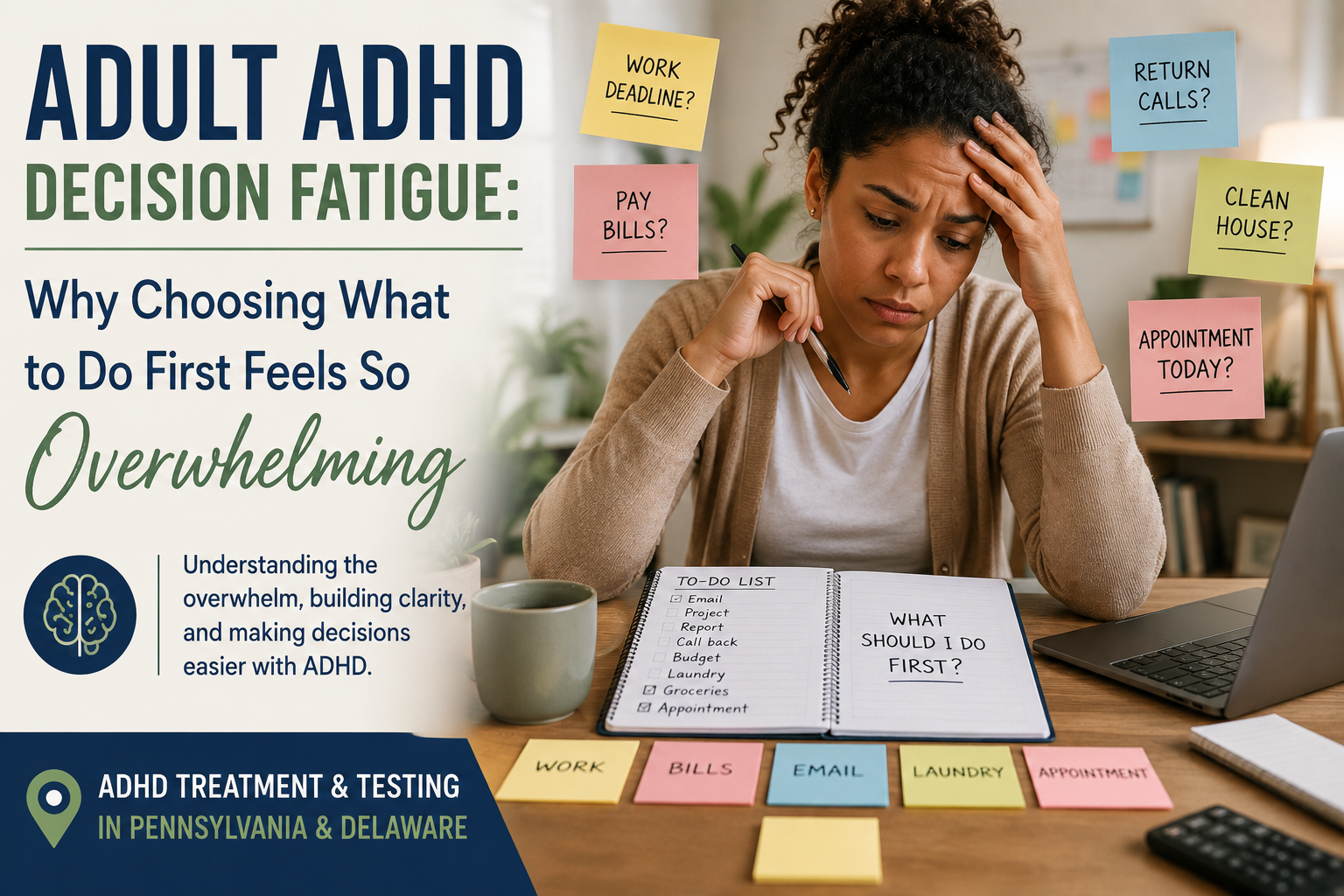
Adult ADHD and Decision Fatigue: Why Choosing What to Do First Feels So Overwhelming | ADHD Philadelphia
For many adults with ADHD, the hardest part of the day is not always doing the task.
It is deciding what to do first.
You may look at your inbox, your work responsibilities, your laundry, your bills, your calendar, your missed calls, your unfinished projects, and your personal goals — and suddenly everything feels equally urgent.
Your brain freezes.
You know something needs to get done, but choosing the first step feels overwhelming. You may jump between tasks, scroll to avoid deciding, start something random, or spend so much time planning that nothing actually moves forward.
This is often described as decision fatigue.
At ADHD Philadelphia, we provide ADHD treatment and medication management for adults in Pennsylvania and Delaware. If choosing what to do first feels harder than it should, adult ADHD may be part of the pattern.
What Is Decision Fatigue?
Decision fatigue happens when the brain becomes overloaded by too many choices, priorities, or competing demands.
For adults with ADHD, decision fatigue may show up as:
Feeling stuck before starting
Not knowing what matters most
Avoiding tasks because choosing feels stressful
Switching between tasks without finishing
Overthinking small decisions
Feeling mentally exhausted early in the day
Putting off decisions until they become urgent
Asking, “What should I do first?” over and over
Feeling guilty for wasting time deciding
Everyone experiences decision fatigue sometimes. But for adults with ADHD, it can become a daily pattern that affects work, home responsibilities, relationships, finances, school, parenting, and emotional well-being.
Why Adults With ADHD Can Feel Overwhelmed by Choices
Adult ADHD often affects executive function.
Executive functions help the brain organize information, prioritize, start tasks, manage time, regulate emotions, and follow through. When executive function is strained, the brain may struggle to sort tasks by importance.
That can make a normal to-do list feel like a wall of pressure.
You may know that one task is technically more important, but your brain may still react to everything at once:
The email feels urgent.
The bill feels urgent.
The laundry feels urgent.
The work project feels urgent.
The appointment feels urgent.
The text message feels urgent.
The clutter feels urgent.
The unfinished task from last week feels urgent.
When everything feels urgent, nothing feels clear.
That is where many adults with ADHD get stuck.
Decision Fatigue Is Not Laziness
Many adults with ADHD blame themselves for decision fatigue.
They may say:
“I should be able to just pick something.”
“Why can’t I handle basic things?”
“I am wasting time again.”
“Other people do not struggle this much.”
“I know what to do, but I still cannot move.”
But decision fatigue is not laziness. It is often the result of mental overload, poor prioritization signals, time blindness, emotional pressure, and task initiation struggles.
The outside world may only see procrastination.
Inside, the person may be dealing with a crowded mental dashboard where every light is flashing at once.
If you relate to this, you may also want to read why adult ADHD makes follow-through so difficult even when you care.
Why Small Decisions Can Feel So Big
Adults with ADHD may become exhausted by small decisions before the bigger tasks even begin.
What should I answer first?
Should I clean or work?
Should I make the call now or later?
Should I start with the easiest task or the most important one?
Should I organize the list before doing anything?
Should I respond to this message now?
Should I finish yesterday’s task first?
Should I make coffee first?
Should I start over completely?
Each decision may seem small by itself. But when dozens of small choices stack up, the ADHD brain can feel drained.
This can lead to avoidance, irritability, emotional shutdown, or scrolling for relief.
The problem is not that the person does not care. The problem is that the decision process itself becomes exhausting.
The ADHD “Everything Is Important” Problem
One common ADHD pattern is difficulty ranking importance.
A task may feel important because it is urgent, emotional, new, interesting, uncomfortable, overdue, visible, or connected to someone else’s expectations.
That does not mean it is the best task to do first.
For example, an adult with ADHD may start cleaning the kitchen because the clutter is visually loud, even though an important work deadline is due that afternoon.
Or they may answer low-priority emails because the inbox creates pressure, while avoiding the one difficult email that actually matters most.
Or they may spend an hour building a perfect plan, but never begin the first task.
This is why decision fatigue and prioritization problems often travel together.
For a complete step-by-step system for ranking competing demands, read Prioritization Skills in Adults With ADHD.
Decision Fatigue and Time Blindness
Time blindness can make decision fatigue worse.
If your brain struggles to feel time passing accurately, it may be harder to decide what can realistically fit into the day.
You may think:
“I can do all of this.”
“This will only take a few minutes.”
“I still have time.”
“I will start after one more thing.”
“I can catch up later.”
Then suddenly the day is almost over, and the pressure rises.
When time is unclear, priorities become unclear. When priorities are unclear, decisions become harder. When decisions become harder, tasks are delayed.
That cycle can make adults with ADHD feel constantly behind.
Decision Fatigue at Work
At work, adult ADHD decision fatigue may look like:
Opening multiple tabs but not completing the main task
Answering easy emails while avoiding complex work
Feeling stuck when there are multiple deadlines
Spending too long deciding how to start a project
Jumping between tasks after every notification
Avoiding decisions until someone follows up
Feeling mentally exhausted by meetings and messages
Missing important priorities because smaller tasks felt louder
This can be especially frustrating for adults who are intelligent, capable, and deeply motivated but still struggle to create order when demands pile up.
Decision Fatigue at Home
At home, decision fatigue may show up in daily routines:
What should I cook?
Should I clean first or rest first?
Which room should I start with?
What errand should I run first?
Should I pay bills now or later?
What do I need for tomorrow?
Why does the house still feel chaotic?
What should I do with this pile?
Home responsibilities often have fewer external deadlines than work. That means the adult with ADHD may have to create structure internally, which can be difficult when executive function is already strained.
This is why “free time” can still feel stressful.
Decision Fatigue and Emotional Overwhelm
Decision fatigue is not only a planning issue. It can become emotional.
Adults with ADHD may feel anxiety, shame, frustration, irritability, guilt, or defeat when they cannot choose what to do first.
The emotional pressure can make the decision even harder.
The brain may move into a freeze response:
Do nothing.
Avoid everything.
Scroll.
Nap.
Start a random task.
Over-plan.
Ask someone else to decide.
Wait until urgency forces action.
This can create a cycle of shame and avoidance. The more delayed the task becomes, the heavier the decision feels.
A Simple Decision Rule for Adults With ADHD
When everything feels important, try using a simple decision rule.
Ask:
What is the one task that will create the most relief if it is done today?
Not the perfect task.
Not the hardest task.
Not the task you “should” do according to guilt.
The task that creates the most useful relief.
That may be:
Paying one bill
Sending one email
Scheduling one appointment
Putting laundry in the washer
Reviewing tomorrow’s calendar
Submitting one form
Clearing one work bottleneck
Preparing one thing for the morning
The goal is to reduce the decision load and create movement.
Try the “One, One, One” Method
A simple ADHD-friendly decision strategy is the “One, One, One” method.
Choose:
One must-do task
One helpful task
One task to remove or delay
That is it.
For example:
Must-do: respond to the important work email.
Helpful: put clothes in the washer.
Remove or delay: reorganizing the entire closet.
This helps prevent the ADHD brain from treating every task as equal.
It also helps reduce overwhelm by making the day smaller and more realistic.
Make Priorities Visible
Adults with ADHD often benefit from making priorities visible.
Instead of keeping everything in your head, write down only three tasks.
Use a sticky note, small notebook, whiteboard, or planner.
Try this format:
Today’s top 3:
Must do:
Would help:
Can wait:
This creates a visual decision filter.
It also gives your brain permission not to carry everything at once.
ADHD Testing in Pennsylvania and Delaware
If decision fatigue, task initiation, time management, emotional overwhelm, and follow-through problems are affecting daily life, ADHD testing may help clarify the pattern.
At ADHD Philadelphia, adult ADHD testing in Pennsylvania and Delaware may include a clinical consultation, symptom review, rating scales, computerized testing when appropriate, and a careful look at how symptoms affect work, home, routines, relationships, and emotional functioning.
A careful adult ADHD diagnosis can also help distinguish ADHD from anxiety, depression, sleep problems, burnout, trauma-related stress, or other concerns that may affect decision-making.
If you are new to the process, you can review the ADHD Patient Journey before scheduling.
How ADHD Treatment Can Help Decision Fatigue
ADHD treatment is not only about paying attention.
A strong treatment plan should also support real-life functioning, including prioritization, planning, task initiation, time management, emotional regulation, and follow-through.
Treatment may include:
Medication management when appropriate
Executive function strategies
Therapy-informed support
Decision-making systems
Planning tools
Routine support
Sleep and lifestyle discussion
Follow-up care
Education about ADHD patterns
If medication is part of the treatment plan, ongoing monitoring matters. You may also want to read Adult ADHD Medication Follow-Up Care in Pennsylvania and Delaware: Why Monitoring Matters.
ADHD Treatment in Pennsylvania
Adults in Pennsylvania may seek ADHD testing or treatment when decision fatigue affects work performance, home responsibilities, relationships, finances, school, parenting, or emotional well-being.
Whether you live in Philadelphia, Bala Cynwyd, Pittsburgh, Allentown, Reading, Erie, Harrisburg, Lancaster, West Chester, Bryn Mawr, Delaware County, or elsewhere in Pennsylvania, ADHD care should be structured, respectful, and individualized.
ADHD Treatment in Delaware
Adults in Delaware may also benefit from ADHD testing and treatment when daily decisions, routines, task initiation, and prioritizing feel harder than they should.
If you live in Wilmington, Newark, Dover, Middletown, Bear, Smyrna, Milford, Seaford, Rehoboth Beach, or elsewhere in Delaware, ADHD Philadelphia provides adult ADHD services for Pennsylvania and Delaware residents.
You can review ADHD Philadelphia’s Pennsylvania and Delaware ADHD locations to learn more about service areas.
You Do Not Need to Decide Everything at Once
Decision fatigue can make life feel heavier than it has to feel.
But you do not need to solve every problem today.
You need one clear next step.
Adult ADHD can make choices feel crowded, priorities feel confusing, and simple decisions feel exhausting. But with the right evaluation, treatment plan, and support, decision-making can become more manageable.
Book Now: Adult ADHD Testing and Treatment in Pennsylvania and Delaware
ADHD Philadelphia provides adult ADHD testing, diagnosis, treatment, and medication management for adults in Pennsylvania and Delaware.
If choosing what to do first feels overwhelming, or if decision fatigue is affecting your work, routines, relationships, home responsibilities, or emotional well-being, a structured ADHD evaluation can help you get clarity.
Schedule an adult ADHD evaluation or treatment appointment today.
Educational content only. This blog is not medical advice, not a diagnosis, and not a substitute for individualized care. If you are in crisis or feel unsafe, call 988 or go to the nearest emergency room.