Why Adults With ADHD Struggle With Summer Routine Changes
Summer can feel like it should be easier.
Longer days.
More sunlight.
Vacations.
Cookouts.
Family events.
Flexible schedules.
More time outside.
A break from the usual pace.
But for many adults with ADHD, summer can also make life feel more scattered.
The routine changes.
Sleep shifts later.
Children may be home from school.
Travel plans interrupt the week.
Work schedules may become less predictable.
Social events increase.
Household responsibilities pile up.
Exercise routines may change.
Medication timing may become less consistent.
The normal structure that helps the brain stay organized can disappear.
By the end of the week, an adult with ADHD may feel confused and frustrated.
“Why am I more overwhelmed when things are supposed to be more relaxed?”
“Why can’t I stay consistent during summer?”
“Why does one schedule change throw off my whole day?”
“Why do I keep falling behind when I have more daylight?”
“Why does summer make my ADHD feel worse?”
This is not always laziness or poor discipline.
Adult ADHD can affect executive functioning, including planning, time management, emotional regulation, task initiation, working memory, routines, sleep consistency, and follow-through. When summer changes the usual structure, those symptoms may become more noticeable.
For adults in Pennsylvania and Delaware, repeated difficulty managing seasonal routine changes may be one reason to consider adult ADHD testing and treatment if focus, procrastination, disorganization, overwhelm, or follow-through are affecting daily functioning.
Why Summer Can Disrupt ADHD Routines
Adults with ADHD often rely on structure more than they realize.
A regular weekday may include a wake-up time, commute, work start time, meal pattern, medication routine, school schedule, exercise time, appointment reminders, and bedtime cues.
Even if the routine is imperfect, it creates anchors.
Summer can weaken those anchors.
Children may be out of school.
Vacations may interrupt workweeks.
Evenings may run later.
Social events may increase.
Weekends may blend into weekdays.
Travel may disrupt sleep.
Heat may affect energy.
Work may feel less structured.
Household tasks may pile up.
For adults with ADHD, structure is not just a preference. It can be part of how the brain organizes the day.
When that structure changes, the brain may have to rebuild the plan repeatedly.
This is why executive dysfunction can become more noticeable during seasonal transitions.
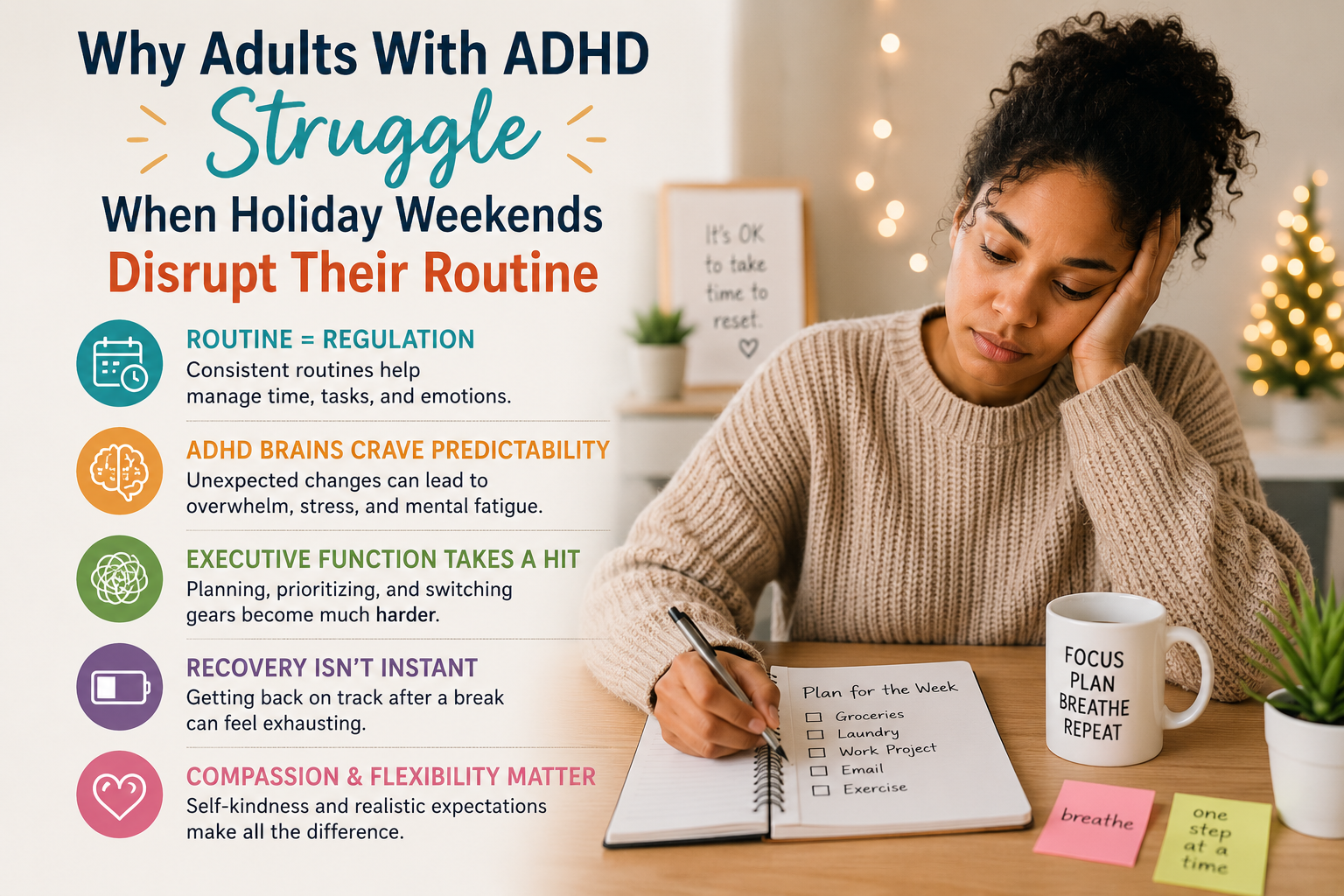
Summer Can Make Time Feel Less Structured
Many adults with ADHD struggle with time blindness.
Time blindness means difficulty sensing, estimating, tracking, or managing time accurately.
Summer can make time feel even more slippery because the days are longer and routines may be looser.
A person may think:
“I’ll do it later.”
“I have plenty of time.”
“I’ll catch up this weekend.”
“I’ll restart after vacation.”
“I’ll get organized once things calm down.”
But later may not have a clear time.
Days pass. Tasks pile up. Sleep shifts. Work becomes rushed. Important responsibilities get delayed.
By the time the adult realizes how much has built up, the task list may feel overwhelming.
This is why ADHD time management often requires more visible structure during summer, not less.
Sleep Changes Can Make ADHD Symptoms Worse
Summer often changes sleep.
Longer daylight, later social events, travel, children’s schedules, heat, screen time, and less predictable routines can all push bedtime later.
For adults with ADHD, sleep disruption can make symptoms worse.
Poor sleep can affect:
Focus
Mood
Memory
Patience
Motivation
Time awareness
Task initiation
Impulse control
Decision-making
Emotional regulation
Follow-through
A few late nights may make the next day feel harder. Then the harder day may lead to more avoidance, more catch-up at night, and another late bedtime.
This can create a cycle.
Summer disrupts sleep.
Poor sleep worsens ADHD symptoms.
ADHD symptoms make routines harder.
Disrupted routines make sleep worse again.
Understanding ADHD and mental exhaustion can help adults recognize why summer may leave them feeling drained even when the season seems more relaxed.
Family and Social Plans Can Increase Overwhelm
Summer often brings more events.
Cookouts.
Graduations.
Vacations.
Family visits.
Beach trips.
Children’s activities.
Weekend plans.
Travel logistics.
Social invitations.
Community events.
These can be enjoyable, but they also require planning, timing, communication, preparation, emotional energy, and follow-through.
Adults with ADHD may feel pulled in several directions at once.
They may want to be present with family but feel distracted by unfinished work.
They may want to enjoy the weekend but feel guilty about chores.
They may want to travel but feel overwhelmed by packing and planning.
They may want to socialize but feel overstimulated afterward.
This does not mean they do not care.
It may mean the mental load is heavier than it looks.
Understanding ADHD and emotional overwhelm can help adults approach summer plans with more compassion and better structure.
Parents With ADHD May Feel Extra Pressure During Summer
Summer can be especially challenging for parents with ADHD.
When children are home from school, the entire household rhythm may change.
There may be camps, childcare, meals, activities, transportation, screen-time negotiations, sleep schedule changes, family trips, and more interruptions throughout the day.
A parent with ADHD may feel like they never get a complete thought.
They may start work and get interrupted.
They may begin cleaning and be pulled into another task.
They may try to plan the week but forget a detail.
They may feel guilty for being overstimulated.
They may feel like everyone needs something at once.
Parenting already requires executive functioning. Summer can increase those demands.
This is why parenting with adult ADHD can feel harder when school-year routines disappear.
Remote Workers With ADHD May Struggle More in Summer
Remote work can already blur the line between work and home.
Summer can blur it even more.
Children may be home.
Family members may interrupt.
Vacation planning may compete with work tasks.
The home may feel louder.
The schedule may shift.
Household responsibilities may become more visible.
Work may happen in the same place as summer distractions.
A remote worker with ADHD may sit down to work and suddenly notice the dishes, laundry, a text message, a child’s question, travel planning, or an unfinished household task.
One interruption becomes several.
The workday disappears.
This is why remote work and adult ADHD are important to understand. Remote work can be helpful, but it often requires strong external structure, especially during summer.
Summer Can Make Procrastination Easier
Summer has a way of making “later” feel believable.
“I’ll do it after the weekend.”
“I’ll handle it after vacation.”
“I’ll restart next week.”
“I’ll organize everything once summer calms down.”
“I’ll get back to my routine in a few days.”
For adults with ADHD, vague future plans can become a trap.
If there is no specific time, place, cue, or next step, the task may keep moving forward without ever getting done.
This is especially common with:
Emails
Bills
Cleaning
Appointments
Medication refills
Work projects
Paperwork
Exercise routines
Meal planning
Sleep routines
Follow-up calls
The adult may not be avoiding because they do not care. They may be avoiding because the task feels vague, boring, emotionally loaded, or too large.
This is why ADHD procrastination often worsens when structure decreases.
Travel Can Break the Systems That Were Working
Summer travel can be wonderful, but it can also disrupt ADHD systems.
Even a short trip may change:
Sleep
Meals
Medication timing
Exercise
Work preparation
Laundry
Childcare
Appointments
Budgeting
Household tasks
Calendar routines
Travel also creates hidden steps:
Packing
Remembering items
Planning transportation
Checking reservations
Managing time
Coordinating with others
Returning home
Unpacking
Restarting work
Resetting the house
For adults with ADHD, those hidden steps can be exhausting.
The trip itself may be enjoyable, but returning afterward may feel overwhelming.
This is why getting back on track after a long weekendor vacation can require a smaller reset plan instead of a harsh self-punishment plan.
Summer Can Make Adults With ADHD Feel Inconsistent
Many adults with ADHD are not incapable.
They are inconsistent.
They may function well when structure is strong but struggle when the structure changes.
They may do well during a normal workweek but fall apart during travel.
They may stay on track during school months but feel scattered in summer.
They may manage tasks when deadlines are clear but struggle when time feels open.
They may do well with routines until one change disrupts the whole system.
This can create shame.
The adult may think, “Why can’t I just be consistent?”
But consistency is often harder when the brain depends on external cues, visible reminders, predictable routines, and clear start points.
For adults with ADHD, the goal is not perfection.
The goal is building routines that are restartable.
Understanding adult ADHD follow-through can help adults recognize that inconsistent performance does not mean they are careless. It may mean they need stronger systems and appropriate treatment support.
A Simple Summer Reset for Adults With ADHD
Summer does not need to be rigid.
But it does need anchors.
Try this simple ADHD-friendly summer reset:
1. Pick one morning anchor
Choose one consistent cue: medication routine, breakfast, shower, walk, calendar review, or opening your planner.
2. Pick one evening anchor
Choose one repeatable closing cue: set clothes out, check calendar, prepare medication, plug in phone, or write tomorrow’s first task.
3. Use three priorities
Do not plan twenty tasks. Choose three that matter most.
4. Make time visible
Use a wall calendar, planner, phone reminders, or visible checklist.
5. Protect sleep when possible
Try to keep wake time and bedtime within a reasonable range, even when summer is flexible.
6. Create a travel reset checklist
Include unpacking, laundry, calendar review, medication routine, and first work task.
7. Plan recovery time
After travel or major events, give yourself a reset block instead of expecting instant productivity.
8. Restart without shame
If summer throws you off, the goal is not self-criticism. The goal is the next clear step.
For adults with ADHD, routines do not need to be perfect to be effective. They need to be easy enough to restart.
When Summer Routine Struggles May Point to ADHD
Everyone gets thrown off sometimes.
But if summer routine changes repeatedly lead to overwhelm, missed responsibilities, procrastination, poor sleep, work problems, emotional distress, or difficulty getting back on track, it may be worth considering an ADHD evaluation.
Adult ADHD testing may be helpful if you often struggle with:
Time management
Task initiation
Procrastination
Disorganization
Forgetfulness
Emotional overwhelm
Sleep routines
Transitions
Follow-through
Task pileups
Work performance
Household routines
Restarting after travel
Feeling capable but inconsistent
A thoughtful evaluation should also consider anxiety, depression, trauma, sleep problems, stress, substance use concerns, medical conditions, and medication effects.
For adults in Pennsylvania and Delaware, adult ADHD evaluation can help clarify whether ADHD may be contributing to repeated problems with routines, transitions, focus, and follow-through.
ADHD Testing and Treatment in Pennsylvania and Delaware
ADHD Philadelphia provides adult ADHD testing and treatment for adults in Pennsylvania and Delaware.
Care is designed to help adults better understand symptoms such as poor focus, procrastination, disorganization, time management problems, emotional overwhelm, difficulty with routines, and trouble following through.
Treatment plans are individualized and may include education, behavioral strategies, structure-building, therapy or coaching strategies, lifestyle review, and medication management when clinically appropriate.
Initial appointments are completed through secure telehealth. In-person appointments may be scheduled after the first online appointment when clinically appropriate. Walk-in appointments are not available.
If summer routine changes repeatedly make it hard to stay focused, consistent, and organized, support may help you move from frustration toward clarity and practical next steps.
To learn more, visit ADHDPhiladelphia.com.
Frequently Asked Questions About Summer and Adult ADHD
Can summer make ADHD symptoms worse?
Summer can make ADHD symptoms more noticeable because routines, sleep, work schedules, family responsibilities, and external structure may change.
Why do adults with ADHD struggle when routines change?
Adults with ADHD may rely on external structure to support planning, time management, task initiation, and follow-through. When routines change, the brain may have to work harder to rebuild structure.
Why does summer make me feel more scattered?
Summer may increase distractions, social plans, travel, sleep disruption, parenting demands, and schedule changes. For adults with ADHD, these changes can increase overwhelm and inconsistency.
How can adults with ADHD stay on track during summer?
Helpful strategies may include visible calendars, morning and evening anchors, three-task priority lists, travel reset checklists, planned recovery time, and realistic routines that are easy to restart.
Does ADHD Philadelphia provide ADHD testing in Pennsylvania and Delaware?
Yes. ADHD Philadelphia provides adult ADHD testing and treatment for adults in Pennsylvania and Delaware. Initial appointments begin through telehealth. In-person appointments may be scheduled after the first online appointment when clinically appropriate. Walk-in appointments are not available.
Take the First Step
If summer routine changes make it harder to focus, stay organized, manage time, and follow through, ADHD Philadelphia can help you better understand what may be happening.
Adult ADHD can affect time management, routines, emotional regulation, transitions, task initiation, and follow-through. A structured evaluation can help clarify whether ADHD may be contributing to these patterns and whether treatment may be appropriate.
Visit ADHDPhiladelphia.com to learn more about adult ADHD testing and treatment.
Medical Disclaimer
This article is for educational purposes only and is not a substitute for medical advice, diagnosis, or treatment. ADHD symptoms can overlap with anxiety, depression, sleep disorders, trauma, substance use concerns, medical conditions, medication effects, stress, and other mental health conditions. If you are experiencing symptoms of ADHD or another mental health concern, consult a qualified healthcare professional.