
Adult ADHD and the July 4th Crash: Why the Day After Celebration Can Feel So Hard
July 4th can be exciting, but adults with ADHD may feel drained afterward. Learn why fireworks, noise, late nights, social plans, sleep disruption, and executive function overload can make the day after celebration feel so hard.

Adult ADHD and the July 4th Crash: Why the Day After Celebration Can Feel So Hard
There may be fireworks, cookouts, family gatherings, traffic, travel, social plans, food, music, alcohol, changed routines, late nights, and more decisions than expected.
For many adults with ADHD, the hardest part is not always the holiday itself.
It is the crash afterward.
The next day, you may feel foggy, drained, irritable, scattered, ashamed, unmotivated, or unable to restart. You may look around at the dishes, laundry, messages, work tasks, errands, and unfinished responsibilities and think, “Why does everything feel so hard now?”
At ADHD Philadelphia, we provide ADHD treatment and medication management for adults in Pennsylvania and Delaware. If holiday weekends often leave you overwhelmed, overstimulated, and struggling to recover, adult ADHD may be part of the pattern.
What Is the July 4th Crash?
The “July 4th crash” is not a formal diagnosis.
It is a way to describe what many adults with ADHD feel after a highly stimulating holiday.
You may have pushed through noise, social expectations, late-night plans, disrupted sleep, fireworks, travel, family dynamics, and changed routines. Your brain and body may have used more energy than people could see.
Then the holiday ends.
The structure disappears. The stimulation drops. The responsibilities return. The mess is still there. The next week is approaching.
For adults with ADHD, that shift can feel like a hard landing.
Why Adults With ADHD May Feel Drained After Celebrations
Adult ADHD is often described as a focus problem, but it can affect much more than attention.
ADHD can affect executive function, emotional regulation, sensory processing, sleep routines, time awareness, impulse control, planning, task initiation, and follow-through.
A holiday like July 4th may challenge several of those areas at once.
You may be dealing with:
Noise from fireworks or music
Crowds and social stimulation
Changed meal times
Later bedtime
Travel or traffic
Family pressure
More decisions
More cleanup
Interrupted medication routines
Alcohol, cannabis, or substance exposure
Less quiet time
Less recovery time
Pressure to “have fun”
When all of that stacks up, the crash afterward makes sense.
Fireworks, Noise, and Overstimulation
Fireworks can be fun for some people and overwhelming for others.
For adults with ADHD who are sensitive to noise, bright lights, movement, or unpredictable stimulation, fireworks can keep the nervous system on alert. Even after the fireworks end, the brain may still feel activated.
You may notice:
Restlessness
Irritability
Trouble winding down
Feeling tense
Difficulty sleeping
Trouble focusing the next day
Feeling emotionally raw
Needing quiet time
Avoiding people after the event
This does not mean you are weak or dramatic. It may mean your brain had too much stimulation and needs recovery.
If this pattern sounds familiar, you may also want to read Adult ADHD and Holiday Weekend Overwhelm: Why Noise, Plans, and Crowds Can Feel Like Too Much.
Sleep Disruption Can Make ADHD Symptoms Louder
July 4th often means later nights.
Fireworks happen after dark. Social plans may run late. Cleanup may happen late. You may stay up scrolling because your brain is still stimulated.
For adults with ADHD, one late night can affect the next day more than expected.
Poor sleep may make it harder to:
Focus
Start tasks
Regulate emotions
Make decisions
Manage time
Follow through
Control impulses
Restart routines
Handle frustration
Recover from social events
If sleep disruption is part of your holiday pattern, read Adult ADHD and Holiday Sleep Disruption: Why One Late Night Can Throw Off the Whole Week.
The Executive Function Problem After the Holiday
The day after July 4th can be full of small responsibilities.
Put food away.
Clean up.
Answer messages.
Do laundry.
Take out trash.
Get back to sleep routine.
Prepare for work.
Check the calendar.
Restart medication routine as prescribed.
Plan the rest of the weekend.
These tasks may look simple from the outside. But for adults with ADHD, the problem is often not knowing what needs to be done. The problem is organizing, prioritizing, starting, and following through when your brain is already tired.
That is executive function overload.
Executive function helps the brain plan, organize, shift attention, regulate emotions, manage time, and complete tasks. When executive function is strained, even small tasks can feel too big.
Why the Mess Feels Bigger Than It Is
After a holiday celebration, the visible mess can feel emotionally heavy.
Dishes, bags, leftovers, laundry, decorations, texts, and unfinished errands may all compete for attention at the same time.
For adults with ADHD, visual clutter can make the brain feel crowded. You may not know where to start, so you avoid the whole thing.
Then avoidance creates shame.
The shame may sound like:
“I should have cleaned this already.”
“Why can’t I handle basic things?”
“Everyone else can recover faster.”
“I wasted the day.”
“I am already behind again.”
That shame can make it even harder to begin.
Time Blindness and the Long Weekend Trap
Holiday weekends can create time blindness.
You may think you have more time than you actually have. You may assume you can recover, clean, rest, socialize, run errands, and prepare for the week later.
Then suddenly the weekend is almost over.
Adults with ADHD may underestimate how long recovery takes. They may also underestimate how long cleanup, planning, errands, and transitions take.
The result is a Sunday-night or Monday-morning scramble.
If time disappears quickly on weekends, you may also relate to Time Blindness on Weekends: Why Adults With ADHD Lose Track of Saturday and Sunday.
Emotional Regulation After a High-Stimulation Day
Emotional regulation does not mean suppressing feelings. It involves noticing the emotion, slowing the reaction when possible, choosing a response, and recovering after the stressful moment. Learn more in the complete guide to emotional regulation in adults with ADHD.
The day after a holiday can feel emotionally strange.
You may feel sad, irritable, anxious, guilty, overstimulated, lonely, or disconnected. You may have enjoyed parts of the holiday but still feel emotionally drained afterward.
Adults with ADHD may have more difficulty regulating emotions when they are tired, hungry, overstimulated, under-slept, or overwhelmed by unfinished tasks.
This may show up as:
Snapping at someone
Avoiding messages
Feeling rejected
Feeling guilty for needing space
Feeling anxious about the week
Feeling ashamed about unfinished tasks
Feeling unable to make decisions
Feeling emotionally “hungover” even without alcohol
The emotional crash is often a signal that the brain needs recovery, not criticism.
Medication Routines, Substances, and Safety
Holiday weekends can disrupt medication routines.
Some adults sleep later, eat later, travel, drink alcohol, use cannabis, attend events, or forget their normal schedule. If you are prescribed ADHD medication, take it only as prescribed and follow your treatment plan.
Do not change your dose, skip medication, restart medication, adjust timing, or combine substances without discussing it with your prescriber.
At ADHD Philadelphia, medication safety and monitoring are part of responsible care. Adults considering stimulant medication should review the Medication Management and Stimulant Treatment Policy.
This is not about judgment. It is about safety, consistency, and protecting your treatment progress.
A Simple July 4th Recovery Reset
After a holiday, adults with ADHD often need a reset that is small enough to actually use.
Try this:
Choose one cleanup task.
Choose one body-care task.
Choose one next-week task.
Choose one stopping point.
For example:
Cleanup task: put leftovers away.
Body-care task: drink water and eat something simple.
Next-week task: check tomorrow’s calendar.
Stopping point: stop cleaning after 20 minutes.
This gives your brain structure without demanding a perfect recovery.
Use the “First 10 Minutes” Rule
The ADHD brain may resist starting because the whole task feels too big.
Instead of saying, “I need to clean everything,” try:
“I will do the first 10 minutes.”
For 10 minutes, you might:
Collect trash
Load the dishwasher
Clear one counter
Put shoes away
Move laundry to the washer
Open the calendar
Write down tomorrow’s first task
After 10 minutes, you can stop or continue. The goal is not to finish everything. The goal is to create movement.
Protect the Next Morning
The morning after July 4th matters.
If the morning becomes completely unstructured, the rest of the day may slip away. One small anchor can help your brain restart.
Try one morning anchor:
Open the blinds.
Drink water.
Take a short walk.
Eat breakfast.
Review the calendar.
Take medication as prescribed.
Start one load of laundry.
Write down the first task.
Avoid starting the day with scrolling.
A small anchor can reduce the feeling that the whole day is already lost.
Make Recovery Part of the Plan
Adults with ADHD often plan the event but forget to plan the recovery.
Recovery is not laziness. Recovery is part of functioning.
Before or after a holiday, ask:
When will I rest?
What is the minimum cleanup?
What can wait?
What needs to be done before work?
What can I remove from the list?
What will help tomorrow feel easier?
This turns recovery from an accident into a strategy.
ADHD Testing in Pennsylvania and Delaware
If holiday crashes are part of a bigger pattern of overstimulation, time blindness, emotional overwhelm, sleep disruption, task initiation problems, or difficulty restarting routines, ADHD testing may help.
At ADHD Philadelphia, adult ADHD testing in Pennsylvania and Delaware may include a clinical consultation, symptom review, rating scales, computerized testing when appropriate, and a careful look at how symptoms affect daily life.
A careful adult ADHD diagnosis can help clarify whether ADHD, anxiety, depression, sleep problems, burnout, trauma-related stress, or another concern may be contributing.
If you are new to the process, you can review the ADHD Patient Journey before scheduling.
How ADHD Treatment Can Help Holiday Recovery
ADHD treatment is not only about sitting still or paying attention.
A strong treatment plan should support real-life functioning, including:
Sleep routines
Emotional regulation
Medication management when appropriate
Executive function strategies
Task initiation
Time management
Planning
Transitions
Follow-through
Realistic routines
Follow-up care
If medication is part of treatment, ongoing monitoring matters. You may also want to read Adult ADHD Medication Follow-Up Care in Pennsylvania and Delaware: Why Monitoring Matters.
ADHD Treatment in Pennsylvania
Adults in Pennsylvania may seek ADHD testing or treatment when holidays, long weekends, work routines, home responsibilities, relationships, sleep, and emotional regulation feel harder than they should.
Whether you live in Philadelphia, Bala Cynwyd, King of Prussia, West Chester, Allentown, Harrisburg, Lancaster, Pittsburgh, Delaware County, Montgomery County, Chester County, Bucks County, or elsewhere in Pennsylvania, ADHD care should be structured, respectful, and individualized.
ADHD Treatment in Delaware
Adults in Delaware may also benefit from ADHD testing and treatment when holiday weekends, disrupted sleep, overstimulation, time blindness, and executive function struggles affect daily life.
If you live in Wilmington, Newark, Dover, Middletown, Bear, Smyrna, Milford, Seaford, Rehoboth Beach, or elsewhere in Delaware, ADHD Philadelphia provides adult ADHD services for Pennsylvania and Delaware residents.
You can review ADHD Philadelphia’s Pennsylvania and Delaware ADHD locations to learn more about service areas.
The Day After Does Not Have to Become a Shame Spiral
The day after July 4th does not have to become proof that you failed.
It can be a recovery day.
Adults with ADHD often need structure after stimulation. They may need quiet after noise. They may need rest after social energy. They may need smaller steps after a big weekend.
You do not have to reset everything at once.
You need one next step, one anchor, and one realistic plan.
With the right evaluation, treatment, and support, holiday recovery can become more manageable.
Book Now: Adult ADHD Testing and Treatment in Pennsylvania and Delaware
ADHD Philadelphia provides adult ADHD testing, diagnosis, treatment, and medication management for adults in Pennsylvania and Delaware.
If holiday weekends leave you overstimulated, emotionally drained, sleep-disrupted, or unable to get back on track, a structured ADHD evaluation can help you get clarity.
Schedule an adult ADHD evaluation or treatment appointment today.
Educational content only. This blog is not medical advice, not a diagnosis, and not a substitute for individualized care. If you are in crisis or feel unsafe, call 988 or go to the nearest emergency room.
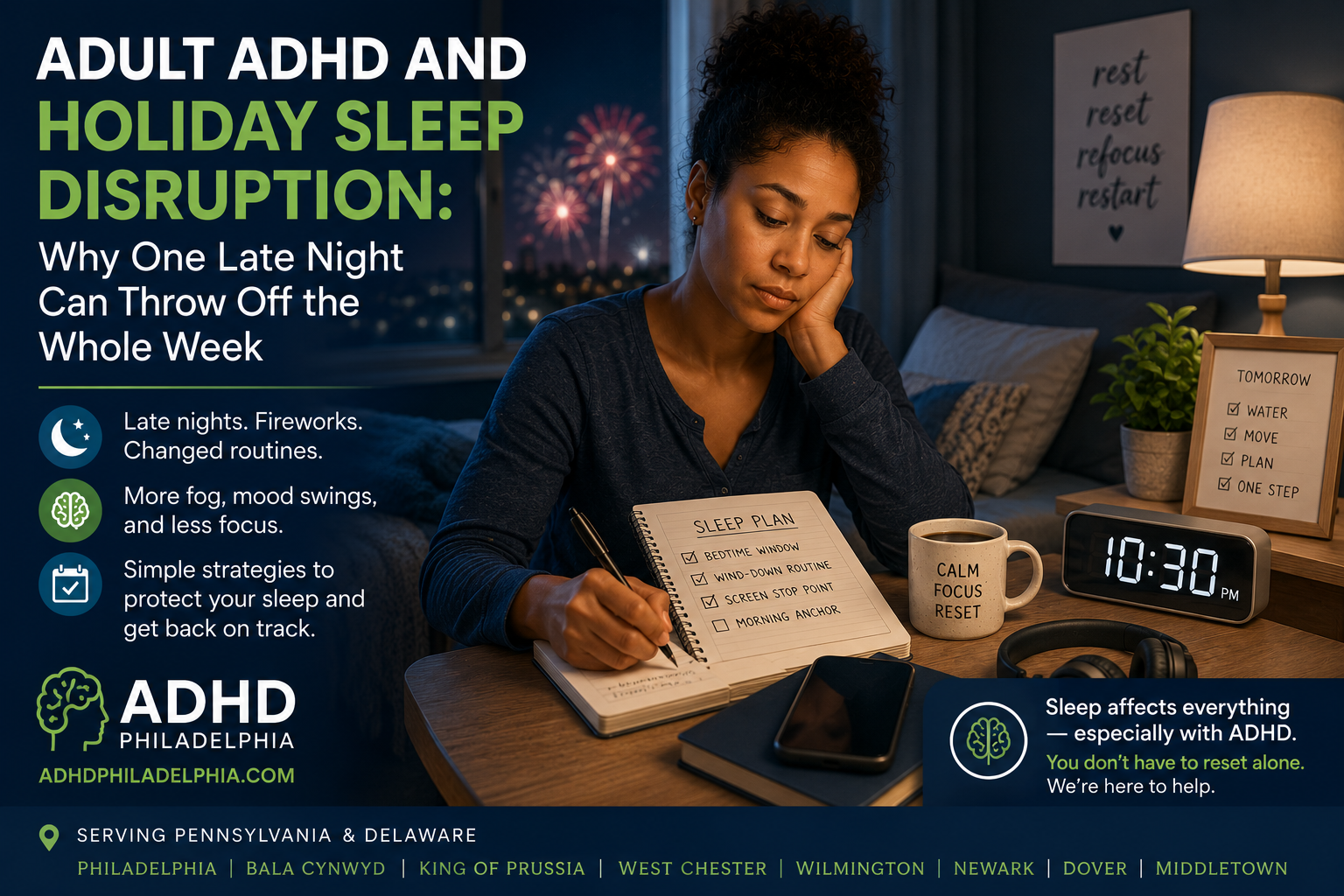
Adult ADHD and Holiday Sleep Disruption: Why One Late Night Can Throw Off the Whole Week
Holiday weekends can disrupt sleep for adults with ADHD. Learn how late nights, fireworks, changed routines, time blindness, and poor sleep can affect focus, mood, executive function, and getting back on track.

One late night during a holiday weekend can make focus, mood, routines, and executive function harder for adults with ADHD.
Holiday weekends can easily throw off sleep.
A cookout runs late. Fireworks continue after dark. Family plans change. Travel takes longer than expected. You stay up scrolling because your brain is still stimulated. You tell yourself, “I’ll get back on track tomorrow.”
But for many adults with ADHD, one late night does not always feel like one late night.
It can affect the next morning, the next day, and sometimes the whole week.
You may feel foggy, irritable, scattered, unmotivated, emotionally sensitive, or unable to restart your routine. You may know what you need to do, but your brain feels slower to begin. The holiday weekend ends, but your sleep schedule, focus, and emotional rhythm still feel off.
At ADHD Philadelphia, we provide ADHD treatment and medication management for adults in Pennsylvania and Delaware. If disrupted sleep makes your ADHD symptoms harder to manage, it may be worth looking at the full pattern.
Why Sleep Matters So Much for Adults With ADHD
Sleep is not just rest.
Sleep affects attention, memory, emotional regulation, impulse control, motivation, planning, time management, and follow-through. These are already areas that can be difficult for adults with ADHD.
When sleep is disrupted, ADHD symptoms may feel louder.
You may notice:
More distractibility
More irritability
More procrastination
More emotional reactivity
More trouble starting tasks
More difficulty making decisions
More time blindness
More impulsive scrolling or spending
More trouble getting back into routines
More difficulty following through
For adults with ADHD, poor sleep can make the brain feel like it has fewer tools available.
Why Holiday Weekends Disrupt Sleep
Holiday weekends often remove normal structure.
A regular weekday may include work, appointments, medication routines, meal times, bedtime routines, and morning expectations. A holiday weekend may involve later nights, looser plans, more noise, more travel, and more stimulation.
Sleep may be disrupted by:
Fireworks
Loud music
Crowds
Travel
Cookouts
Family plans
Late-night cleaning
Extra screen time
Changed medication timing
Alcohol or cannabis exposure
Anxiety about plans
Excitement or overstimulation
Trying to “catch up” on everything at night
Even when the holiday is enjoyable, the brain may have trouble winding down afterward.
If holiday weekends often feel overwhelming because of noise, crowds, plans, and emotional overload, you may also want to read Adult ADHD and Holiday Weekend Overwhelm: Why Noise, Plans, and Crowds Can Feel Like Too Much.
The ADHD Brain May Struggle to Wind Down
Many adults with ADHD describe feeling tired but not sleepy.
The body may be exhausted, but the mind keeps moving.
You may replay conversations, think about unfinished tasks, scroll on your phone, start a late-night project, organize something random, or suddenly feel motivated at the worst possible time.
This can be especially common after a stimulating day.
The brain may need more time to transition from activity to rest. Without a clear wind-down routine, bedtime can keep moving later and later.
A holiday weekend can make this worse because there are fewer external limits. No regular schedule may mean no clear stop point.
Fireworks, Noise, and Sleep Disruption
Fireworks can be exciting for some people and very disruptive for others.
For adults with ADHD who are sensitive to noise or stimulation, fireworks may make it harder to relax, fall asleep, or stay asleep. Even if you are not frightened by the noise, repeated unexpected sounds can keep the nervous system alert.
You may feel:
Startled
Tense
Restless
Irritable
Unable to settle
Mentally alert late at night
Physically tired but wired
This can lead to delayed sleep, poor sleep quality, and a harder morning the next day.
Time Blindness Can Push Bedtime Later
Time blindness can make sleep routines harder.
You may tell yourself:
“I’ll go to bed after one more video.”
“I’ll clean up for just ten minutes.”
“I’ll answer one message.”
“I’ll start getting ready soon.”
“I still have time.”
Then suddenly it is much later than you realized.
Holiday weekends can make time blindness worse because the normal schedule is less visible. Without workday structure, bedtime may become vague. When bedtime is vague, it is easier for the ADHD brain to drift into late-night activity.
If this sounds familiar, read Time Blindness on Weekends: Why Adults With ADHD Lose Track of Saturday and Sunday.
Sleep Loss and Emotional Regulation
Poor sleep can make emotions harder to manage.
Adults with ADHD may already experience strong emotional reactions, especially when overwhelmed, overstimulated, or under pressure. When sleep is disrupted, emotional regulation can become even harder.
You may notice:
Feeling more easily annoyed
Crying more easily
Feeling rejected more intensely
Snapping at people
Feeling more anxious
Feeling more ashamed
Feeling less patient
Feeling overwhelmed by normal tasks
Feeling unable to recover emotionally after stress
This does not mean you are overreacting on purpose. It may mean your brain is trying to regulate emotions with less rest and less executive control.
Sleep Loss and Executive Function
Executive function helps the brain plan, prioritize, start tasks, shift attention, manage time, control impulses, and follow through.
When sleep is disrupted, executive function may feel weaker.
That can make basic tasks feel harder:
Starting laundry
Answering messages
Planning meals
Returning to work
Getting ready on time
Managing appointments
Taking care of bills
Cleaning up after the holiday
Restarting medication routines as prescribed
Preparing for the next week
This is why one late night can create a domino effect.
The late night affects the morning. The hard morning affects the day. The unproductive day creates more stress. The stress can push bedtime later again.
Medication Timing and Sleep Routine Disruption
Holiday weekends may also disrupt medication routines.
Some adults sleep later, eat later, travel, attend events, or forget their normal schedule. If you take ADHD medication, take it only as prescribed and follow your treatment plan. Do not change your dose, skip doses, restart medication, or adjust timing without guidance from your prescriber.
Medication timing, caffeine, alcohol, cannabis, and poor sleep can all affect how you feel. If you are receiving stimulant medication management, safety and monitoring matter.
Adults considering stimulant medication should review ADHD Philadelphia’s Medication Management and Stimulant Treatment Policy.
This is not about shame. It is about making ADHD treatment safer, clearer, and more consistent.
The “I’ll Fix It After the Holiday” Problem
Many adults with ADHD tell themselves they will fix everything after the holiday.
“I’ll clean up Sunday.”
“I’ll restart Monday.”
“I’ll get back to sleep this week.”
“I’ll catch up later.”
“I’ll handle it when things calm down.”
But when sleep is disrupted, the reset may be harder than expected.
You may wake up tired, avoid tasks, feel behind, and then stay up late again trying to recover the time you lost. That can keep the cycle going.
For adults with ADHD, recovery needs to be planned before the crash, not only after the crash.
A Simple ADHD-Friendly Sleep Protection Plan
A holiday sleep plan does not need to be perfect.
Try this:
Choose a realistic bedtime window.
Choose one wind-down activity.
Choose one screen stop point.
Choose one morning anchor.
For example:
Bedtime window: start winding down between 10:30 PM and 11:00 PM.
Wind-down activity: shower, quiet music, or reading.
Screen stop point: phone charges across the room.
Morning anchor: take a short walk, drink water, or review the day’s calendar.
The goal is not perfection. The goal is giving your brain a visible path back to routine.
Protect the Morning After
The morning after a late night matters.
Adults with ADHD may be tempted to let the next day become completely unstructured. But one small morning anchor can help prevent the whole day from slipping.
Try choosing one simple action:
Open the blinds.
Drink water.
Eat something simple.
Take medication as prescribed.
Review the calendar.
Step outside for a few minutes.
Put one load of laundry in.
Clear one surface.
Send one important message.
A small morning anchor tells the brain, “The day has started.” That can help rebuild structure after a disrupted night.
Make the Evening Smaller
After a stimulating holiday event, do not make the evening too complicated.
Instead of trying to clean the whole house, answer every message, plan the week, and reset your life, choose one small closing routine.
For example:
Put food away.
Set out clothes.
Put medication in its usual place if prescribed.
Charge your phone away from the bed.
Write down tomorrow’s first task.
Turn off bright lights.
Use headphones or calming sound if helpful.
The ADHD brain often needs external cues that the day is ending.
ADHD Testing in Pennsylvania and Delaware
If sleep disruption is part of a larger pattern of time blindness, task initiation problems, emotional overwhelm, restlessness, difficulty with routines, disorganization, or follow-through struggles, ADHD testing may help.
At ADHD Philadelphia, adult ADHD testing in Pennsylvania and Delaware may include a clinical consultation, symptom review, rating scales, computerized testing when appropriate, and a careful look at how symptoms affect daily life.
A careful adult ADHD diagnosis can also help clarify whether ADHD, anxiety, depression, sleep problems, burnout, trauma-related stress, or another concern may be contributing.
If you are new to the process, you can review the ADHD Patient Journey before scheduling.
How ADHD Treatment Can Help Sleep-Related Patterns
ADHD treatment is not only about focus.
A strong treatment plan should consider real-life functioning, including sleep routines, emotional regulation, task initiation, time management, planning, transitions, medication timing, and follow-through.
Treatment may include:
Medication management when appropriate
Executive function strategies
Therapy-informed support
Sleep and routine discussion
Planning systems
Follow-up care
Education about ADHD patterns
Support for realistic habit-building
If medication is part of treatment, ongoing follow-up matters. You may also want to read Adult ADHD Medication Follow-Up Care in Pennsylvania and Delaware: Why Monitoring Matters.
ADHD Treatment in Pennsylvania
Adults in Pennsylvania may seek ADHD testing or treatment when sleep disruption, time management problems, emotional overwhelm, and difficulty restarting routines affect work, home life, school, relationships, or daily functioning.
Whether you live in Philadelphia, Bala Cynwyd, King of Prussia, West Chester, Allentown, Harrisburg, Lancaster, Pittsburgh, Delaware County, Montgomery County, Chester County, Bucks County, or elsewhere in Pennsylvania, ADHD care should be structured, respectful, and individualized.
ADHD Treatment in Delaware
Adults in Delaware may also benefit from ADHD testing and treatment when disrupted sleep, holiday routines, emotional overload, and executive function struggles affect daily life.
If you live in Wilmington, Newark, Dover, Middletown, Bear, Smyrna, Milford, Seaford, Rehoboth Beach, or elsewhere in Delaware, ADHD Philadelphia provides adult ADHD services for Pennsylvania and Delaware residents.
You can review ADHD Philadelphia’s Pennsylvania and Delaware ADHD locations to learn more about service areas.
One Late Night Does Not Mean the Week Is Ruined
A disrupted night does not have to become a disrupted week.
Adults with ADHD often benefit from structure, compassion, and small reset points. You do not need to fix your entire routine overnight. You need one next step that helps your brain return to a steady rhythm.
Sleep disruption can make ADHD symptoms feel stronger, but support can help you understand the pattern.
With the right evaluation, treatment plan, and follow-up care, sleep-related ADHD struggles can become more manageable.
Book Now: Adult ADHD Testing and Treatment in Pennsylvania and Delaware
ADHD Philadelphia provides adult ADHD testing, diagnosis, treatment, and medication management for adults in Pennsylvania and Delaware.
If disrupted sleep makes your ADHD symptoms harder to manage, or if holiday weekends often throw off your focus, mood, routines, and follow-through, a structured ADHD evaluation can help you get clarity.
Schedule an adult ADHD evaluation or treatment appointment today.
Educational content only. This blog is not medical advice, not a diagnosis, and not a substitute for individualized care. If you are in crisis or feel unsafe, call 988 or go to the nearest emergency room.

Adult ADHD and Holiday Weekend Overwhelm: Why Noise, Plans, and Crowds Can Feel Like Too Much
Holiday weekends can feel overwhelming for adults with ADHD because of noise, crowds, social plans, disrupted routines, time blindness, emotional overload, and medication routine changes. Learn how ADHD testing and treatment can help adults in Pennsylvania and Delaware.

Adult ADHD and Holiday Weekend Overwhelm: Why Noise, Plans, and Crowds Can Feel Like Too Much
Holiday weekends can look fun from the outside.
Cookouts. Fireworks. Family plans. Travel. Crowds. Food. Music. Noise. Group texts. Last-minute invitations. Changed routines. Later nights. More decisions. More stimulation. More expectations.
But for many adults with ADHD, holiday weekends can feel overwhelming before they even begin.
You may want to enjoy yourself, but still feel overstimulated, scattered, irritated, exhausted, or emotionally flooded. You may struggle with the noise, the planning, the social pressure, the disrupted routine, or the feeling that everyone else seems to handle it better.
At ADHD Philadelphia, we provide ADHD treatment and medication management for adults in Pennsylvania and Delaware. If holiday weekends regularly leave you overwhelmed, overstimulated, or emotionally drained, adult ADHD may be part of the pattern.
Why Holiday Weekends Can Be Hard for Adults With ADHD
Adult ADHD is often described as a focus problem, but it can affect much more than attention.
ADHD can affect executive function, emotional regulation, time awareness, task initiation, planning, transitions, sensory sensitivity, and follow-through. That means a holiday weekend may create stress in several areas at once.
A long weekend may involve:
More noise
More people
More choices
More travel
More disrupted routines
More social expectations
More emotional pressure
More last-minute changes
More food, alcohol, or substance exposure
More difficulty keeping medication and sleep routines consistent
More pressure to “relax” even when your brain feels busy
For adults with ADHD, this combination can make a holiday weekend feel less like a break and more like a full-body overload.
Noise, Fireworks, and Sensory Overload
Some adults with ADHD are more sensitive to noise, crowds, lights, movement, or chaotic environments.
Fireworks, loud music, traffic, crowded events, children running around, multiple conversations, and unpredictable sounds can all become overwhelming.
You may notice:
Irritability
Restlessness
Trouble thinking clearly
A desire to leave suddenly
Feeling tense or on edge
Difficulty following conversations
Headaches or exhaustion
Feeling emotionally drained after social events
Needing quiet time afterward
Not every adult with ADHD has sensory sensitivity. But many adults with ADHD do report feeling easily overstimulated in loud or crowded settings.
This can be especially difficult during holidays because the expectation is often to be social, cheerful, flexible, and available.
When noise, disrupted routines, social expectations, fatigue, and unexpected changes accumulate, emotions may become harder to regulate. Read more about emotional regulation in adults with ADHD.
Social Plans Can Become Executive Function Overload
A holiday weekend may sound simple at first.
“Just come over.”
“Bring something if you want.”
“We’ll figure it out.”
“Come whenever.”
For adults with ADHD, vague plans can create stress.
What time should you arrive? What should you bring? How long should you stay? What do you need to prepare? What if you forget something? What if you are late? What if there are too many people? What if you feel trapped?
Executive function helps the brain organize these details. When executive function is strained, even enjoyable plans can feel complicated.
This is why some adults with ADHD may avoid social plans, cancel at the last minute, arrive late, overprepare, forget important details, or feel exhausted before the event begins.
Why “Fun” Can Still Feel Draining
Many adults with ADHD feel confused when enjoyable events still drain them.
You may like your family and friends. You may want to celebrate. You may want to be present. You may even have a good time for part of the day.
But your brain may still be working hard.
It may be tracking conversations, masking symptoms, managing emotions, adjusting to noise, remembering details, dealing with transitions, making decisions, and trying not to disappoint anyone.
That is a lot of mental work.
So when the event ends, you may feel wiped out, even if nothing “bad” happened.
This does not mean you are antisocial or ungrateful. It may mean your brain had to use more energy than people could see.
Holiday Weekends Can Disrupt Routines
Adults with ADHD often depend on external structure.
A regular workday may provide time markers: wake-up time, commute, meetings, meals, deadlines, and bedtime. A holiday weekend can remove or disrupt those markers.
That disruption can affect:
Sleep
Meals
Medication timing
Exercise
Household routines
Planning for the next workday
Errands
Laundry
Bills
Work preparation
Emotional regulation
When structure disappears, time can become harder to manage. One disrupted day can turn into several days of feeling off track.
If weekend routine disruption is a familiar pattern, you may also want to read Why Weekends Can Disrupt Adult ADHD Routines in Pennsylvania and Delaware.
Time Blindness During Long Weekends
Holiday weekends can make time blindness worse.
A long weekend may feel like “extra time,” but that extra time can disappear quickly. You may think you have plenty of time to rest, clean, shop, answer messages, prepare food, attend events, and get ready for the week.
Then suddenly the weekend is almost over.
Adults with ADHD may underestimate how long travel, errands, social events, cleanup, recovery, and transitions will take. This can create a stressful Sunday or Monday-night scramble after the holiday ends.
If time often disappears before you realize where it went, you may also relate to Time Blindness on Weekends: Why Adults With ADHD Lose Track of Saturday and Sunday.
Emotional Regulation and Holiday Pressure
Holiday weekends can bring emotional pressure.
You may feel pressure to attend events, answer messages, host people, manage family expectations, be cheerful, bring food, spend money, tolerate noise, or stay longer than you want to stay.
For adults with ADHD, emotional regulation can be harder when the brain is tired, overstimulated, under-slept, hungry, or overwhelmed.
This may show up as:
Snapping at someone
Feeling guilty
Feeling rejected
Feeling misunderstood
Crying after an event
Feeling angry over small changes
Feeling anxious before plans
Feeling drained after social interaction
Feeling ashamed for needing space
The emotional reaction may feel bigger than the situation. But the reaction often makes more sense when you consider the full load: noise, decisions, transitions, social masking, time pressure, and disrupted routines.
Alcohol, Cannabis, and Medication Routine Disruption
Holiday weekends can also bring more exposure to alcohol, cannabis, and other substances.
For adults receiving ADHD medication management, this matters.
If you are prescribed medication, take it only as prescribed and follow your treatment plan. Do not change doses, skip medication, restart medication, or combine substances without discussing it with your prescriber.
At ADHD Philadelphia, medication safety and monitoring are part of responsible ADHD care. Adults who are considering stimulant medication should also review the Medication Management and Stimulant Treatment Policy.
This is not about judgment. It is about safety, clarity, and protecting treatment progress.
Signs Holiday Overwhelm May Be Related to Adult ADHD
Not everyone who dislikes crowds or fireworks has ADHD.
But adult ADHD may be worth exploring if holiday weekends repeatedly bring patterns like:
Feeling overwhelmed by noise or crowds
Difficulty planning for events
Forgetting what you need to bring
Arriving late despite trying
Overcommitting to plans
Avoiding plans because they feel too complicated
Feeling emotionally drained after social events
Losing track of time during long weekends
Struggling to restart routines afterward
Feeling irritable when plans change
Needing recovery time after stimulation
Feeling ashamed that holidays feel harder than they “should”
A careful adult ADHD diagnosis can help clarify whether ADHD, anxiety, depression, sleep disruption, trauma-related stress, burnout, or another concern may be contributing.
A Simple ADHD-Friendly Holiday Weekend Plan
A holiday weekend plan does not need to be complicated.
Try this:
Choose one main event.
Choose one recovery block.
Choose one task that protects next week.
Choose one boundary.
For example:
Main event: attend the cookout from 3:00 PM to 6:00 PM.
Recovery block: quiet time Saturday morning.
Next-week task: review calendar Sunday evening.
Boundary: leave before becoming overstimulated.
This gives the weekend structure without making it rigid.
Use Exit Plans Without Shame
Adults with ADHD may benefit from having an exit plan before attending a busy event.
An exit plan may include:
Driving separately when possible
Setting a realistic leaving time
Taking a short walk
Stepping into a quiet room
Using noise-reducing earbuds when appropriate
Having a simple phrase ready, such as “I’m going to head out, but I’m glad I came.”
Planning decompression time afterward
Leaving before you are completely overwhelmed is not failure. It is self-awareness.
Make the Weekend Smaller
Holiday weekends can create pressure to do too much.
Adults with ADHD may benefit from making the weekend smaller on purpose.
Instead of planning five things, choose two.
Instead of staying all day, choose a time window.
Instead of bringing a complicated dish, bring something simple.
Instead of cleaning the whole house, clear one area.
Instead of catching up on everything, pick one task that will make next week easier.
A smaller plan is not a weaker plan. For ADHD, a smaller plan is often a more successful plan.
ADHD Testing in Pennsylvania and Delaware
If holiday overwhelm is part of a larger pattern of overstimulation, time management problems, emotional overwhelm, task initiation struggles, disorganization, or difficulty restarting routines, ADHD testing may help.
At ADHD Philadelphia, adult ADHD testing in Pennsylvania and Delaware may include a clinical consultation, symptom review, rating scales, computerized testing when appropriate, and a careful look at how symptoms affect daily life.
Testing can help clarify whether ADHD symptoms are affecting work, home responsibilities, relationships, routines, and emotional functioning.
If you are new to the process, you can review the ADHD Patient Journey before scheduling.
How ADHD Treatment Can Help Holiday Overwhelm
ADHD treatment is not only about focus at work.
A strong treatment plan should also consider real-life functioning, including emotional regulation, time management, routines, decision-making, sensory overwhelm, transitions, and follow-through.
Treatment may include:
Medication management when appropriate
Executive function strategies
Therapy-informed support
Planning systems
Routine support
Sleep and lifestyle discussion
Follow-up care
Education about ADHD patterns
Support for realistic boundaries
If medication is part of treatment, ongoing monitoring matters. You may also want to read Adult ADHD Medication Follow-Up Care in Pennsylvania and Delaware: Why Monitoring Matters.
ADHD Treatment in Pennsylvania
Adults in Pennsylvania may seek ADHD testing or treatment when holidays, work routines, home responsibilities, relationships, social plans, and emotional regulation feel harder than they should.
Whether you live in Philadelphia, Bala Cynwyd, King of Prussia, West Chester, Allentown, Harrisburg, Lancaster, Pittsburgh, Delaware County, Montgomery County, Chester County, Bucks County, or elsewhere in Pennsylvania, ADHD care should be structured, respectful, and individualized.
ADHD Treatment in Delaware
Adults in Delaware may also benefit from ADHD testing and treatment when disrupted routines, holiday overwhelm, time blindness, and emotional overload affect daily life.
If you live in Wilmington, Newark, Dover, Middletown, Bear, Smyrna, Milford, Seaford, Rehoboth Beach, or elsewhere in Delaware, ADHD Philadelphia provides adult ADHD services for Pennsylvania and Delaware residents.
You can review ADHD Philadelphia’s Pennsylvania and Delaware ADHD locations to learn more about service areas.
You Can Enjoy the Holiday Without Ignoring Your Limits
Adults with ADHD are often told to “just relax,” “just go with the flow,” or “just have fun.”
But sometimes the brain needs structure in order to relax.
You do not have to attend every event. You do not have to stay until you are overwhelmed. You do not have to explain every boundary. You do not have to turn a holiday weekend into another cycle of guilt and exhaustion.
Support can help you understand your patterns and build a plan that fits your life.
Adult ADHD is not a character flaw. It is a brain-based condition that can affect attention, time, emotion, planning, routines, and stimulation.
With the right evaluation and treatment plan, holiday weekends can become more manageable.
Book Now: Adult ADHD Testing and Treatment in Pennsylvania and Delaware
ADHD Philadelphia provides adult ADHD testing, diagnosis, treatment, and medication management for adults in Pennsylvania and Delaware.
If holiday weekends often leave you overstimulated, scattered, emotionally drained, or unable to get back on track afterward, a structured ADHD evaluation can help you get clarity.
Schedule an adult ADHD evaluation or treatment appointment today.
Educational content only. This blog is not medical advice, not a diagnosis, and not a substitute for individualized care. If you are in crisis or feel unsafe, call 988 or go to the nearest emergency room.