
Adult ADHD and Decision Fatigue: Why Choosing What to Do First Feels So Overwhelming
Adults with ADHD may feel overwhelmed by choices, priorities, and deciding what to do first. Learn how decision fatigue affects task initiation, routines, work, home responsibilities, and emotional overwhelm.
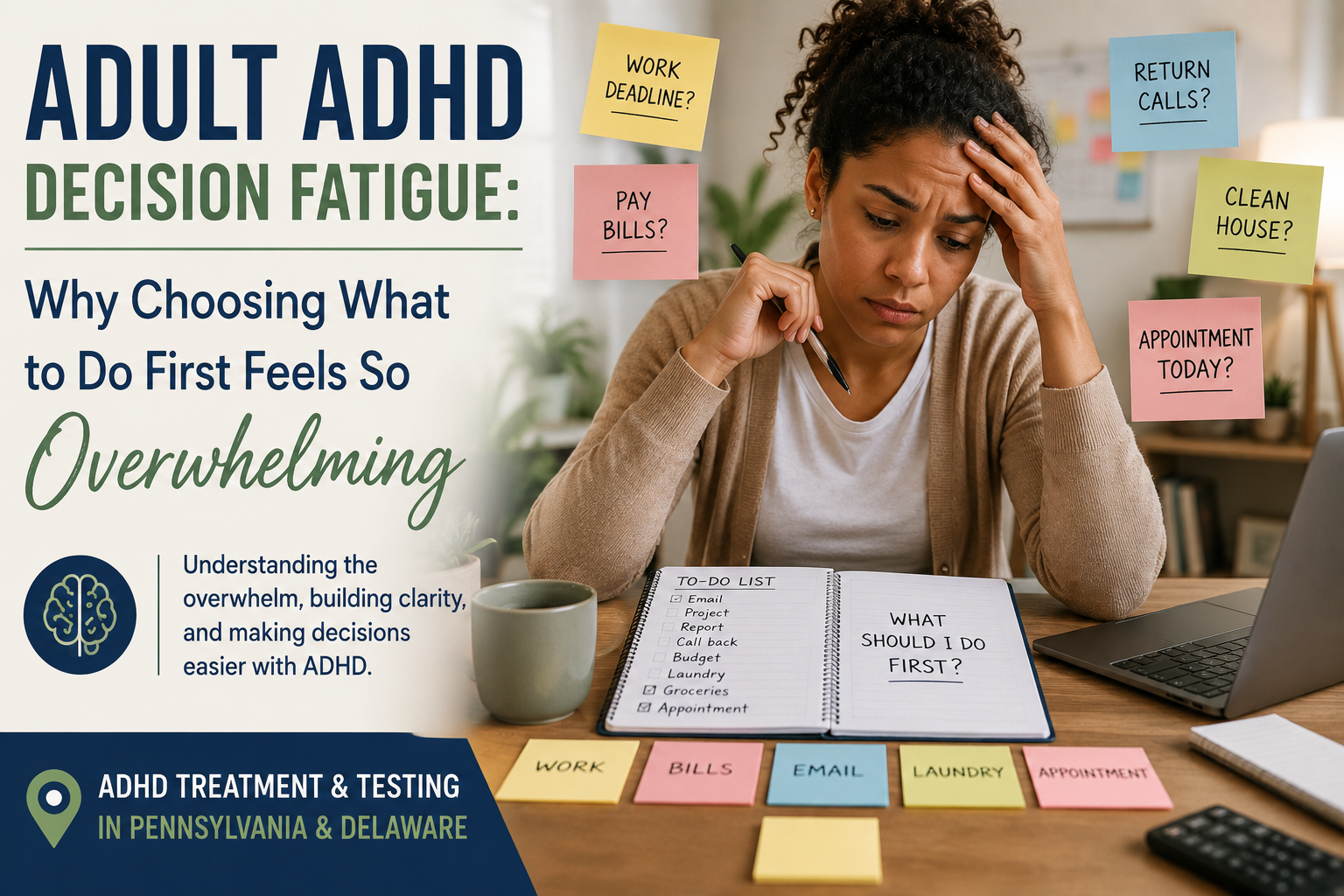
Adult ADHD and Decision Fatigue: Why Choosing What to Do First Feels So Overwhelming | ADHD Philadelphia
For many adults with ADHD, the hardest part of the day is not always doing the task.
It is deciding what to do first.
You may look at your inbox, your work responsibilities, your laundry, your bills, your calendar, your missed calls, your unfinished projects, and your personal goals — and suddenly everything feels equally urgent.
Your brain freezes.
You know something needs to get done, but choosing the first step feels overwhelming. You may jump between tasks, scroll to avoid deciding, start something random, or spend so much time planning that nothing actually moves forward.
This is often described as decision fatigue.
At ADHD Philadelphia, we provide ADHD treatment and medication management for adults in Pennsylvania and Delaware. If choosing what to do first feels harder than it should, adult ADHD may be part of the pattern.
What Is Decision Fatigue?
Decision fatigue happens when the brain becomes overloaded by too many choices, priorities, or competing demands.
For adults with ADHD, decision fatigue may show up as:
Feeling stuck before starting
Not knowing what matters most
Avoiding tasks because choosing feels stressful
Switching between tasks without finishing
Overthinking small decisions
Feeling mentally exhausted early in the day
Putting off decisions until they become urgent
Asking, “What should I do first?” over and over
Feeling guilty for wasting time deciding
Everyone experiences decision fatigue sometimes. But for adults with ADHD, it can become a daily pattern that affects work, home responsibilities, relationships, finances, school, parenting, and emotional well-being.
Why Adults With ADHD Can Feel Overwhelmed by Choices
Adult ADHD often affects executive function.
Executive functions help the brain organize information, prioritize, start tasks, manage time, regulate emotions, and follow through. When executive function is strained, the brain may struggle to sort tasks by importance.
That can make a normal to-do list feel like a wall of pressure.
You may know that one task is technically more important, but your brain may still react to everything at once:
The email feels urgent.
The bill feels urgent.
The laundry feels urgent.
The work project feels urgent.
The appointment feels urgent.
The text message feels urgent.
The clutter feels urgent.
The unfinished task from last week feels urgent.
When everything feels urgent, nothing feels clear.
That is where many adults with ADHD get stuck.
Decision Fatigue Is Not Laziness
Many adults with ADHD blame themselves for decision fatigue.
They may say:
“I should be able to just pick something.”
“Why can’t I handle basic things?”
“I am wasting time again.”
“Other people do not struggle this much.”
“I know what to do, but I still cannot move.”
But decision fatigue is not laziness. It is often the result of mental overload, poor prioritization signals, time blindness, emotional pressure, and task initiation struggles.
The outside world may only see procrastination.
Inside, the person may be dealing with a crowded mental dashboard where every light is flashing at once.
If you relate to this, you may also want to read why adult ADHD makes follow-through so difficult even when you care.
Why Small Decisions Can Feel So Big
Adults with ADHD may become exhausted by small decisions before the bigger tasks even begin.
What should I answer first?
Should I clean or work?
Should I make the call now or later?
Should I start with the easiest task or the most important one?
Should I organize the list before doing anything?
Should I respond to this message now?
Should I finish yesterday’s task first?
Should I make coffee first?
Should I start over completely?
Each decision may seem small by itself. But when dozens of small choices stack up, the ADHD brain can feel drained.
This can lead to avoidance, irritability, emotional shutdown, or scrolling for relief.
The problem is not that the person does not care. The problem is that the decision process itself becomes exhausting.
The ADHD “Everything Is Important” Problem
One common ADHD pattern is difficulty ranking importance.
A task may feel important because it is urgent, emotional, new, interesting, uncomfortable, overdue, visible, or connected to someone else’s expectations.
That does not mean it is the best task to do first.
For example, an adult with ADHD may start cleaning the kitchen because the clutter is visually loud, even though an important work deadline is due that afternoon.
Or they may answer low-priority emails because the inbox creates pressure, while avoiding the one difficult email that actually matters most.
Or they may spend an hour building a perfect plan, but never begin the first task.
This is why decision fatigue and prioritization problems often travel together.
For a complete step-by-step system for ranking competing demands, read Prioritization Skills in Adults With ADHD.
Decision Fatigue and Time Blindness
Time blindness can make decision fatigue worse.
If your brain struggles to feel time passing accurately, it may be harder to decide what can realistically fit into the day.
You may think:
“I can do all of this.”
“This will only take a few minutes.”
“I still have time.”
“I will start after one more thing.”
“I can catch up later.”
Then suddenly the day is almost over, and the pressure rises.
When time is unclear, priorities become unclear. When priorities are unclear, decisions become harder. When decisions become harder, tasks are delayed.
That cycle can make adults with ADHD feel constantly behind.
Decision Fatigue at Work
At work, adult ADHD decision fatigue may look like:
Opening multiple tabs but not completing the main task
Answering easy emails while avoiding complex work
Feeling stuck when there are multiple deadlines
Spending too long deciding how to start a project
Jumping between tasks after every notification
Avoiding decisions until someone follows up
Feeling mentally exhausted by meetings and messages
Missing important priorities because smaller tasks felt louder
This can be especially frustrating for adults who are intelligent, capable, and deeply motivated but still struggle to create order when demands pile up.
Decision Fatigue at Home
At home, decision fatigue may show up in daily routines:
What should I cook?
Should I clean first or rest first?
Which room should I start with?
What errand should I run first?
Should I pay bills now or later?
What do I need for tomorrow?
Why does the house still feel chaotic?
What should I do with this pile?
Home responsibilities often have fewer external deadlines than work. That means the adult with ADHD may have to create structure internally, which can be difficult when executive function is already strained.
This is why “free time” can still feel stressful.
Decision Fatigue and Emotional Overwhelm
Decision fatigue is not only a planning issue. It can become emotional.
Adults with ADHD may feel anxiety, shame, frustration, irritability, guilt, or defeat when they cannot choose what to do first.
The emotional pressure can make the decision even harder.
The brain may move into a freeze response:
Do nothing.
Avoid everything.
Scroll.
Nap.
Start a random task.
Over-plan.
Ask someone else to decide.
Wait until urgency forces action.
This can create a cycle of shame and avoidance. The more delayed the task becomes, the heavier the decision feels.
A Simple Decision Rule for Adults With ADHD
When everything feels important, try using a simple decision rule.
Ask:
What is the one task that will create the most relief if it is done today?
Not the perfect task.
Not the hardest task.
Not the task you “should” do according to guilt.
The task that creates the most useful relief.
That may be:
Paying one bill
Sending one email
Scheduling one appointment
Putting laundry in the washer
Reviewing tomorrow’s calendar
Submitting one form
Clearing one work bottleneck
Preparing one thing for the morning
The goal is to reduce the decision load and create movement.
Try the “One, One, One” Method
A simple ADHD-friendly decision strategy is the “One, One, One” method.
Choose:
One must-do task
One helpful task
One task to remove or delay
That is it.
For example:
Must-do: respond to the important work email.
Helpful: put clothes in the washer.
Remove or delay: reorganizing the entire closet.
This helps prevent the ADHD brain from treating every task as equal.
It also helps reduce overwhelm by making the day smaller and more realistic.
Make Priorities Visible
Adults with ADHD often benefit from making priorities visible.
Instead of keeping everything in your head, write down only three tasks.
Use a sticky note, small notebook, whiteboard, or planner.
Try this format:
Today’s top 3:
Must do:
Would help:
Can wait:
This creates a visual decision filter.
It also gives your brain permission not to carry everything at once.
ADHD Testing in Pennsylvania and Delaware
If decision fatigue, task initiation, time management, emotional overwhelm, and follow-through problems are affecting daily life, ADHD testing may help clarify the pattern.
At ADHD Philadelphia, adult ADHD testing in Pennsylvania and Delaware may include a clinical consultation, symptom review, rating scales, computerized testing when appropriate, and a careful look at how symptoms affect work, home, routines, relationships, and emotional functioning.
A careful adult ADHD diagnosis can also help distinguish ADHD from anxiety, depression, sleep problems, burnout, trauma-related stress, or other concerns that may affect decision-making.
If you are new to the process, you can review the ADHD Patient Journey before scheduling.
How ADHD Treatment Can Help Decision Fatigue
ADHD treatment is not only about paying attention.
A strong treatment plan should also support real-life functioning, including prioritization, planning, task initiation, time management, emotional regulation, and follow-through.
Treatment may include:
Medication management when appropriate
Executive function strategies
Therapy-informed support
Decision-making systems
Planning tools
Routine support
Sleep and lifestyle discussion
Follow-up care
Education about ADHD patterns
If medication is part of the treatment plan, ongoing monitoring matters. You may also want to read Adult ADHD Medication Follow-Up Care in Pennsylvania and Delaware: Why Monitoring Matters.
ADHD Treatment in Pennsylvania
Adults in Pennsylvania may seek ADHD testing or treatment when decision fatigue affects work performance, home responsibilities, relationships, finances, school, parenting, or emotional well-being.
Whether you live in Philadelphia, Bala Cynwyd, Pittsburgh, Allentown, Reading, Erie, Harrisburg, Lancaster, West Chester, Bryn Mawr, Delaware County, or elsewhere in Pennsylvania, ADHD care should be structured, respectful, and individualized.
ADHD Treatment in Delaware
Adults in Delaware may also benefit from ADHD testing and treatment when daily decisions, routines, task initiation, and prioritizing feel harder than they should.
If you live in Wilmington, Newark, Dover, Middletown, Bear, Smyrna, Milford, Seaford, Rehoboth Beach, or elsewhere in Delaware, ADHD Philadelphia provides adult ADHD services for Pennsylvania and Delaware residents.
You can review ADHD Philadelphia’s Pennsylvania and Delaware ADHD locations to learn more about service areas.
You Do Not Need to Decide Everything at Once
Decision fatigue can make life feel heavier than it has to feel.
But you do not need to solve every problem today.
You need one clear next step.
Adult ADHD can make choices feel crowded, priorities feel confusing, and simple decisions feel exhausting. But with the right evaluation, treatment plan, and support, decision-making can become more manageable.
Book Now: Adult ADHD Testing and Treatment in Pennsylvania and Delaware
ADHD Philadelphia provides adult ADHD testing, diagnosis, treatment, and medication management for adults in Pennsylvania and Delaware.
If choosing what to do first feels overwhelming, or if decision fatigue is affecting your work, routines, relationships, home responsibilities, or emotional well-being, a structured ADHD evaluation can help you get clarity.
Schedule an adult ADHD evaluation or treatment appointment today.
Educational content only. This blog is not medical advice, not a diagnosis, and not a substitute for individualized care. If you are in crisis or feel unsafe, call 988 or go to the nearest emergency room.
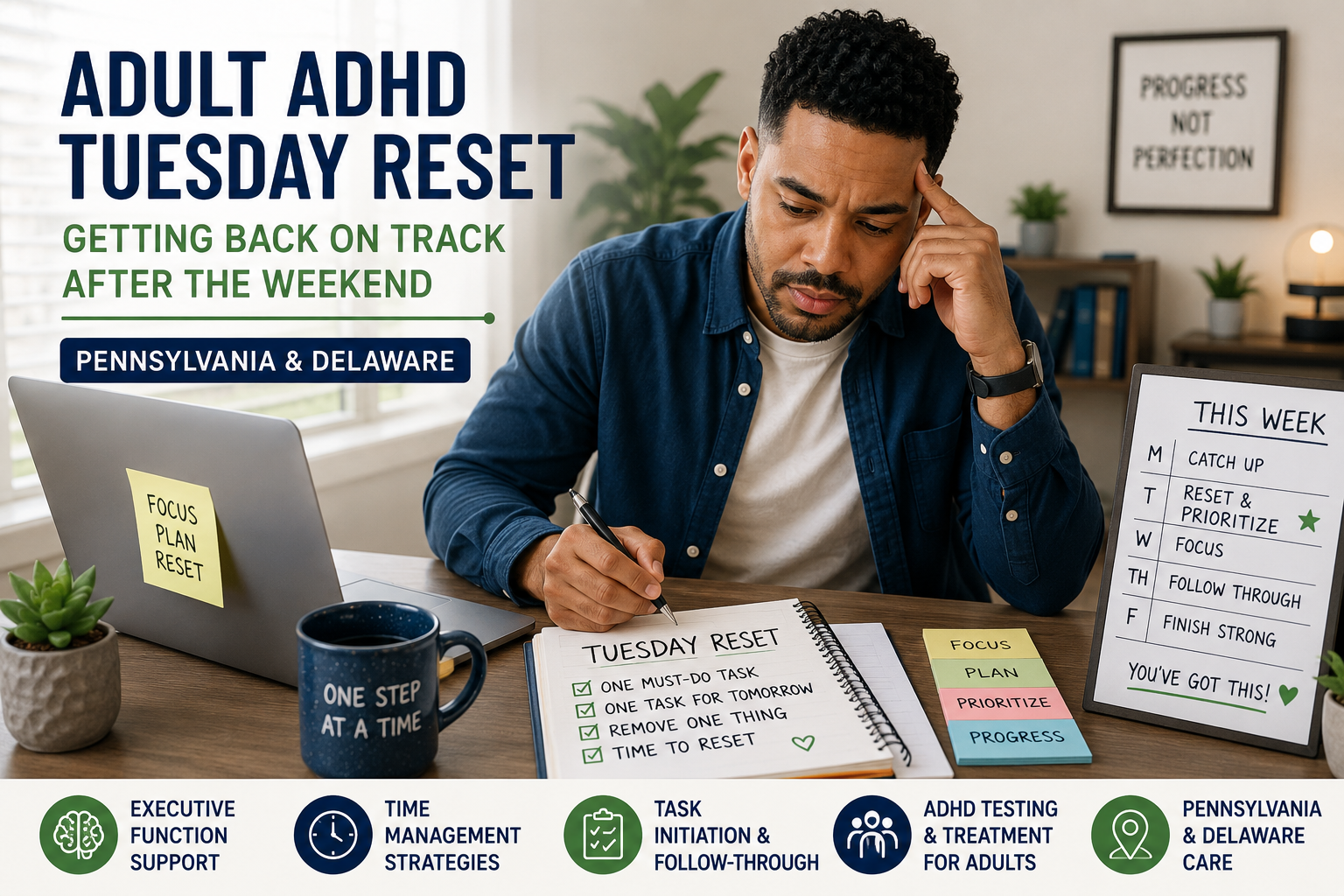
Adult ADHD and the Tuesday Reset: Why Getting Back on Track After the Weekend Feels So Hard
Tuesday can feel like the day adults with ADHD realize the week is already getting away from them. Learn why restarting after the weekend can be difficult and how ADHD testing, treatment, and executive function support can help adults in Pennsylvania and Delaware.

Tuesday can feel like the day adults with ADHD realize the week is already getting away from them.
Monday was supposed to be the reset.
You planned to catch up, answer messages, restart routines, handle the tasks you avoided over the weekend, and finally feel organized again. But Monday came with interruptions, work demands, emotional pressure, unread emails, appointments, family responsibilities, and the same old feeling of being behind.
Then Tuesday arrives.
Now the week feels real. The weekend is over. Monday did not fix everything. The to-do list is still there. The pressure is building. And the ADHD brain may feel stuck between guilt about what did not get done and overwhelm about where to start next.
At ADHD Philadelphia, we provide ADHD treatment and medication management for adults in Pennsylvania and Delaware. If getting back on track after the weekend feels harder than it should, adult ADHD may be part of the pattern.
Why Tuesday Can Feel So Hard for Adults With ADHD
For many adults with ADHD, the problem is not simply the weekend.
The problem is the transition back into structure.
Weekends may disrupt routines, sleep, errands, meals, medication timing, chores, planning, and emotional energy. Monday often becomes the day of “I need to fix everything.” But trying to fix everything at once can create more overwhelm.
By Tuesday, many adults with ADHD feel the impact of:
unfinished weekend tasks
Monday tasks that were pushed forward
emails and messages piling up
missed routines
sleep disruption
poor time awareness
difficulty prioritizing
emotional overwhelm
avoidance
task initiation struggles
pressure to catch up quickly
This can make Tuesday feel like a second Monday, but with more guilt attached.
The Tuesday Reset Is Really an Executive Function Problem
Adult ADHD often affects executive function.
Executive functions help the brain plan, organize, start tasks, shift attention, manage time, regulate emotions, and follow through. When those skills are strained, restarting after a disrupted weekend can feel much harder than other people realize.
You may know exactly what needs to be done but still feel unable to begin.
You may open your laptop and stare at the screen.
You may move from task to task without completing anything.
You may start with something easy and avoid what matters most.
You may spend too much time planning and not enough time doing.
You may feel emotionally flooded before you even begin.
This is not laziness. It is often the brain struggling to move from awareness into action.
If this sounds familiar, you may also relate to why adult ADHD makes follow-through so difficult even when you care.
Why Monday Does Not Always Work as a Reset Day
Many adults place too much pressure on Monday.
Monday becomes the day to restart everything:
wake up earlier
eat better
exercise
answer every message
finish overdue tasks
clean up the house
restart medication routines when appropriate
organize the calendar
fix the work backlog
become consistent again
That is a lot of pressure for one day.
For adults with ADHD, this kind of all-or-nothing reset can backfire. If Monday does not go perfectly, the brain may interpret the week as already ruined.
That is why Tuesday matters.
Tuesday can become a more realistic reset point. Instead of trying to repair everything at once, Tuesday can be the day you choose one priority, one next step, and one structure that helps you re-enter the week.
Weekend Disruption Can Carry Into the Week
Weekend routines can strongly affect how the week begins.
If sleep shifted, meals became inconsistent, chores piled up, errands were missed, or Sunday night turned stressful, Monday may begin with low energy and high pressure.
Adults with ADHD often experience this as:
“I already feel behind.”
“I do not know where to start.”
“I need a full day just to catch up.”
“I wasted the weekend.”
“I tried to restart Monday, but I still feel stuck.”
“My week feels off already.”
Saturday and Sunday may be over, but the impact of a disrupted weekend can continue into Tuesday.
For more on this pattern, read Why Weekends Can Disrupt Adult ADHD Routines in Pennsylvania and Delaware.
Time Blindness Can Make Tuesday Feel Urgent
Time blindness can make adults with ADHD underestimate how quickly time is passing.
On the weekend, you may think you have plenty of time. By Monday, you may still believe you can catch up quickly. By Tuesday, the pressure becomes harder to ignore.
This can create a painful shift:
Saturday feels open.
Sunday feels rushed.
Monday feels overwhelming.
Tuesday feels urgent.
Time blindness can make tasks feel either far away or suddenly critical. That makes it harder to pace yourself, plan realistically, and start early enough.
If your weekends often disappear before you realize where the time went, you may want to read Time Blindness on Weekends: Why Adults With ADHD Lose Track of Saturday and Sunday.
The Tuesday Shame Spiral
Many adults with ADHD are not just managing tasks. They are managing shame.
By Tuesday, the inner voice may sound like:
“Why did I not do this already?”
“What is wrong with me?”
“I should be able to handle this.”
“I always do this.”
“I am already behind again.”
“I cannot keep living like this.”
That shame can make it even harder to start.
Shame increases avoidance. Avoidance increases pressure. Pressure increases emotional overwhelm. Emotional overwhelm makes task initiation harder. Then the cycle repeats.
The answer is not more self-criticism. The answer is more structure, more clarity, and more realistic support.
Signs Adult ADHD May Be Affecting Your Weekly Reset
Not every rough Tuesday means ADHD is present.
But adult ADHD testing may be worth considering if the pattern is frequent, long-standing, and affecting your daily functioning.
You may want to consider an evaluation if you often:
feel behind by Tuesday
struggle to restart after weekends
lose track of time during open-ended days
avoid tasks until they become urgent
have difficulty starting even simple responsibilities
feel overwhelmed by prioritizing
miss deadlines despite caring
start tasks but do not finish them
feel ashamed about repeated patterns
struggle with work, home, school, parenting, or relationships because of follow-through problems
need pressure or crisis to begin
A careful adult ADHD diagnosis can help clarify whether ADHD, anxiety, depression, sleep problems, burnout, trauma-related stress, or another concern may be contributing.
A Simple Tuesday Reset for Adults With ADHD
A Tuesday reset should be small enough to actually work.
Try this:
Choose one task that must be done today.
Choose one task that would make tomorrow easier.
Choose one thing to remove from today’s list.
Choose one time to stop and reset.
That is enough.
For example:
Must-do task: pay one bill.
Tomorrow-easier task: pack work bag or review calendar.
Remove: do not reorganize the entire house today.
Stop-and-reset time: 7:30 PM.
This gives your brain a smaller target. Instead of trying to fix the whole week, you create one point of traction.
Make the Next Step Visible
Adults with ADHD often do better when the next step is visible and specific.
Instead of writing:
“Get organized.”
Try:
“Open email and reply to one message.”
Instead of:
“Clean the house.”
Try:
“Clear the kitchen counter for 10 minutes.”
Instead of:
“Catch up on work.”
Try:
“Open the document and write the first three sentences.”
Instead of:
“Fix my week.”
Try:
“Review today’s calendar and choose one priority.”
The ADHD brain can get overwhelmed by vague goals. Specific actions reduce the thinking load and make it easier to start.
ADHD Testing in Pennsylvania and Delaware
If weekly resets feel harder than they should, ADHD testing may help you understand the pattern.
At ADHD Philadelphia, adult ADHD testing in Pennsylvania and Delaware may include a clinical consultation, symptom review, rating scales, computerized testing when appropriate, and a careful look at how symptoms affect daily life.
Testing can help identify whether ADHD symptoms are affecting work, home responsibilities, time management, routines, emotional regulation, and follow-through.
If you are new to the process, you can also review the ADHD Patient Journey before scheduling.
How ADHD Treatment Can Help Weekly Resets
ADHD treatment is not only about focus.
A strong treatment plan should also support real-life functioning, including transitions, task initiation, routines, planning, emotional regulation, and follow-through.
Treatment may include:
medication management when appropriate
therapy-informed support
executive function strategies
time management tools
task initiation systems
sleep and routine discussion
follow-up care
education about ADHD patterns
support for realistic weekly structure
If medication is part of treatment, monitoring matters. Adults may also want to read Adult ADHD Medication Follow-Up Care in Pennsylvania and Delaware: Why Monitoring Matters.
ADHD Treatment in Pennsylvania
Adults in Pennsylvania may seek ADHD testing or treatment when weekly routines, work responsibilities, home tasks, relationships, school, parenting, or emotional well-being are affected by time management and follow-through struggles.
Whether you live in Philadelphia, Bala Cynwyd, Pittsburgh, Allentown, Reading, Erie, Harrisburg, Lancaster, West Chester, Bryn Mawr, Delaware County, or elsewhere in Pennsylvania, ADHD care should be structured, respectful, and individualized.
ADHD Treatment in Delaware
Adults in Delaware may also benefit from ADHD testing and treatment when getting back on track after the weekend feels overwhelming.
If you live in Wilmington, Newark, Dover, Middletown, Bear, Smyrna, Milford, Seaford, Rehoboth Beach, or elsewhere in Delaware, ADHD Philadelphia provides adult ADHD services for Pennsylvania and Delaware residents.
You can review ADHD Philadelphia’s Pennsylvania and Delaware ADHD locations to learn more about service areas.
Tuesday Can Be a Reset, Not a Failure
Tuesday does not have to mean the week is already ruined.
It can be a chance to restart in a smaller, more realistic way.
You do not need to fix the whole week today. You need one clear priority, one visible next step, and one structure that helps you move forward.
Adult ADHD can make transitions harder. It can make time feel slippery. It can make task initiation feel inconsistent. It can make shame feel louder than logic.
But with the right evaluation, treatment plan, and support, weekly resets can become more manageable.
Book Now: Adult ADHD Testing and Treatment in Pennsylvania and Delaware
ADHD Philadelphia provides adult ADHD testing, diagnosis, treatment, and medication management for adults in Pennsylvania and Delaware.
If getting back on track after the weekend feels harder than it should, or if Tuesday often feels like proof that the week is already slipping away, a structured ADHD evaluation can help you get clarity.
Schedule an adult ADHD evaluation or treatment appointment today.
Educational content only. This blog is not medical advice, not a diagnosis, and not a substitute for individualized care. If you are in crisis or feel unsafe, call 988 or go to the nearest emergency room.
Time Blindness on Weekends: Why Adults With ADHD Lose Track of Saturday and Sunday
For adults with ADHD, weekends can disappear before they realize where the time went. Learn how time blindness affects Saturday and Sunday routines, task initiation, follow-through, rest, and Sunday-night overwhelm.
Time Blindness on Weekends: Why Adults With ADHD Lose Track of Saturday and Sunday
Weekends can disappear fast.
You wake up thinking you have plenty of time. You tell yourself you will start the laundry soon, answer that message later, run errands after breakfast, clean the kitchen before dinner, and prepare for Monday at night.
Then suddenly it is Sunday evening.
The laundry is still sitting there. The email was never answered. The groceries were rushed. The house still feels chaotic. Monday is coming, and now the pressure hits all at once.
For many adults with ADHD, this is not simply poor planning. It may be time blindness.
At ADHD Philadelphia, we provide ADHD treatment and medication management for adults in Pennsylvania and Delaware. If your weekends often disappear before you realize where the time went, adult ADHD may be part of the pattern.
What Is Time Blindness?
Time blindness is a common way people describe difficulty sensing, estimating, and managing time.
Adults with ADHD may know that time exists, but still struggle to feel time passing accurately.
You may think:
“I have all day.”
“This will only take 10 minutes.”
“I can start later.”
“I will remember to do it.”
“I just need a few more minutes.”
“I can still fit everything in.”
Then the day slips away.
Time blindness can affect workdays, appointments, bills, relationships, errands, household responsibilities, and rest. But weekends can make it especially obvious because there is often less external structure.
If you missed Saturday’s related post, you may also want to read Why Weekends Can Disrupt Adult ADHD Routines in Pennsylvania and Delaware.
For a more complete explanation of lateness, time estimation, deadlines, transitions, and external time supports, read our guide to time management and time blindness in adults with ADHD
Why Weekends Make Time Blindness Worse
During the week, time is often organized by outside expectations.
Work starts at a certain time. Meetings happen at scheduled times. School pickup, appointments, deadlines, and responsibilities create markers throughout the day.
On weekends, those markers may disappear.
That means the adult ADHD brain may have to create structure from the inside. That can be hard when executive function skills are already strained.
Weekends may bring:
Open-ended time
More choices
Less accountability
Fewer external deadlines
More distractions at home
Unstructured rest
Errands without clear start times
Household tasks without urgency
Social plans that interrupt routines
A long list of unfinished responsibilities
The result can feel confusing. You may have more free time on the weekend but less ability to use it the way you intended.
The “I Have All Day” Problem
One of the biggest weekend traps is believing that more time automatically means more productivity.
For adults with ADHD, more open time can sometimes create less action.
When a day feels wide open, the brain may not feel enough urgency to begin. A task that could have been done in the morning gets pushed to afternoon. Then afternoon gets interrupted. Then evening arrives, and the task suddenly feels urgent, stressful, or impossible.
This can lead to a familiar pattern:
You delay because there is still time.
You avoid because the task feels boring or overwhelming.
You get distracted by something more stimulating.
You underestimate how long the task will take.
You suddenly realize the day is almost over.
You rush, freeze, or give up.
You feel guilty and promise to do better next weekend.
This is not laziness. It is often executive dysfunction combined with poor time awareness.
Time Blindness and Task Initiation
Time blindness is closely connected to task initiation.
If your brain does not feel time passing clearly, it may not generate the internal signal to start.
You may know the task matters. You may care deeply. You may even feel anxious about not doing it. But the “start now” switch does not turn on until the pressure becomes intense.
This is why many adults with ADHD can perform well under deadlines but struggle when there is no immediate consequence.
On weekends, tasks like laundry, groceries, cleaning, meal prep, paperwork, and planning for Monday may not feel urgent until it is almost too late.
If this pattern sounds familiar, you may also relate to why adult ADHD makes follow-through so difficult even when you care.
Why Rest Can Also Get Lost
Time blindness does not only affect productivity. It can also affect rest.
Some adults with ADHD spend the weekend avoiding tasks but never truly resting.
They may scroll for hours but not feel restored.
They may nap too long and feel worse.
They may start random tasks but never finish them.
They may worry about responsibilities while trying to relax.
They may lose time in screens, errands, conversations, or distractions.
Then Sunday night arrives, and they feel both exhausted and unprepared.
This is one of the painful parts of adult ADHD: the weekend may be neither productive nor restful. It becomes a blur of avoidance, pressure, guilt, and emotional overwhelm.
Signs of Weekend Time Blindness in Adults With ADHD
Weekend time blindness can show up in many ways.
You may notice that you:
Lose track of hours easily
Underestimate how long errands take
Overestimate how much you can finish
Wait too long to start important tasks
Feel surprised by how late it is
Miss planned start times
Forget transitions between activities
Get stuck in one activity for too long
Delay chores until Sunday night
Feel like weekends disappear without warning
Struggle to prepare for Monday
Feel guilty even after being busy all weekend
Not every person who struggles with time has ADHD. But if this pattern is frequent, long-standing, and affects work, home, relationships, or emotional well-being, it may be worth exploring.
A careful adult ADHD diagnosis can help clarify whether ADHD, anxiety, depression, sleep problems, burnout, trauma-related stress, or another concern may be contributing.
Why Timers and Calendars May Not Be Enough
Many adults with ADHD have tried timers, calendars, planners, reminders, and apps.
Sometimes they help.
Sometimes they do not.
The issue is not that tools are useless. The issue is that tools only work when they are simple, visible, realistic, and connected to your actual behavior.
A calendar you never check will not help.
A timer you ignore will not help.
A planner that is too complicated will not help.
A to-do list with 27 items may create more overwhelm.
For adults with ADHD, time tools often need to be external, visible, and connected to a very specific action.
Instead of writing “clean house,” try:
10:00 AM — clear kitchen counter for 15 minutes.
Instead of “get ready for Monday,” try:
7:30 PM — choose clothes, check calendar, pack work bag.
Specific is easier than vague.
A Simple Weekend Time Reset
A weekend time reset does not need to be complicated.
Try this:
Pick one anchor time in the morning.
Pick one anchor time in the afternoon.
Pick one anchor time in the evening.
For example:
10:00 AM — start one household task.
2:00 PM — leave for errands or do one outside task.
7:30 PM — prepare for Monday.
Then choose only one task for each anchor.
This gives the day shape without making it rigid.
You can also use visual cues:
Put the laundry basket near the door.
Place the grocery list on the counter.
Keep your planner open.
Set a phone alarm with a specific action.
Use a sticky note that says, “Start the 15-minute version.”
The goal is not perfection. The goal is to make time more visible.
ADHD Testing in Pennsylvania and Delaware
If time blindness affects your weekends, workdays, relationships, bills, home routines, or emotional well-being, ADHD testing may help you understand the pattern.
At ADHD Philadelphia, adult ADHD testing in Pennsylvania and Delaware may include a clinical consultation, symptom review, rating scales, computerized testing when appropriate, and a careful look at how symptoms affect daily life.
The goal is not to diagnose quickly. The goal is to understand what is happening and what kind of support may help.
If you are new to the process, you can also review the ADHD Patient Journey before scheduling.
How ADHD Treatment Can Help Time Blindness
ADHD treatment is not only about focus.
A strong treatment plan should also address time management, task initiation, follow-through, emotional overwhelm, routines, and real-life functioning.
Treatment may include:
Medication management when appropriate
Executive function strategies
Therapy-informed support
Sleep and routine discussion
Follow-up care
Planning tools
Task initiation systems
Education about ADHD patterns
Support for realistic weekend structure
If medication is part of treatment, monitoring matters. You may want to read Adult ADHD Medication Follow-Up Care in Pennsylvania and Delaware: Why Monitoring Matters.
ADHD Treatment in Pennsylvania
Adults in Pennsylvania may seek ADHD testing or treatment when time blindness affects work, home responsibilities, relationships, finances, school, parenting, or emotional well-being.
Whether you live in Philadelphia, Bala Cynwyd, Pittsburgh, Allentown, Reading, Erie, Harrisburg, Lancaster, West Chester, Bryn Mawr, Delaware County, or elsewhere in Pennsylvania, ADHD care should be structured, respectful, and individualized.
ADHD Treatment in Delaware
Adults in Delaware may also benefit from ADHD testing and treatment when weekends disappear, routines collapse, or time management feels harder than it should.
If you live in Wilmington, Newark, Dover, Middletown, Bear, Smyrna, Milford, Seaford, Rehoboth Beach, or elsewhere in Delaware, ADHD Philadelphia provides adult ADHD services for Pennsylvania and Delaware residents.
You can review ADHD Philadelphia’s Pennsylvania and Delaware ADHD locations to learn more about service areas.
Sunday Night Does Not Have to Become a Shame Spiral
Sunday night can feel heavy for adults with ADHD.
It can bring guilt about what did not get done, anxiety about Monday, frustration about lost time, and shame about repeating the same pattern again.
But shame does not build structure.
Support does.
If time blindness keeps affecting your weekends and your life, it may be time to stop blaming yourself and start understanding the pattern.
Adult ADHD is not a failure of character. It is a brain-based condition that can affect time awareness, planning, motivation, task initiation, emotional regulation, and follow-through.
With the right evaluation and treatment plan, weekends can become less chaotic and more manageable.
Book Now: Adult ADHD Testing and Treatment in Pennsylvania and Delaware
ADHD Philadelphia provides adult ADHD testing, diagnosis, treatment, and medication management for adults in Pennsylvania and Delaware.
If your weekends disappear before you realize where the time went, or if time blindness is affecting your work, home routines, relationships, or emotional well-being, a structured ADHD evaluation can help you get clarity.
Schedule an adult ADHD evaluation or treatment appointment today.
Educational content only. This blog is not medical advice, not a diagnosis, and not a substitute for individualized care. If you are in crisis or feel unsafe, call 988 or go to the nearest emergency room.

Why Weekends Can Disrupt Adult ADHD Routines in Pennsylvania and Delaware
Weekends are supposed to feel easier, but adults with ADHD may feel more scattered when weekday structure disappears. Learn why weekend routines can fall apart and how ADHD testing, treatment, and executive function support can help adults in Pennsylvania and Delaware.

Why Weekends Can Disrupt Adult ADHD Routines in Pennsylvania and Delaware
Weekends are supposed to feel easier.
For many adults with ADHD, they do not.
During the week, work schedules, meetings, deadlines, school routines, appointments, and outside expectations may create structure. Even if the week feels stressful, there is often a clear rhythm: wake up, get ready, show up, respond, complete what is urgent, and keep moving.
Then the weekend arrives.
Suddenly, there is less structure, more freedom, more choices, more errands, more household tasks, more social plans, and more pressure to “catch up.” Instead of feeling rested, many adults with ADHD feel scattered, overwhelmed, guilty, or stuck.
At ADHD Philadelphia, we provide ADHD treatment and medication management for adults in Pennsylvania and Delaware. If your weekends often turn into a cycle of procrastination, unfinished tasks, emotional overwhelm, and Sunday-night guilt, adult ADHD may be part of the pattern.
Why Weekends Can Be Harder for Adults With ADHD
Many adults with ADHD do better when the environment provides structure.
During the week, the structure may come from work, school, family routines, scheduled appointments, or external deadlines. On weekends, that structure may disappear.
That can create problems with:
Starting tasks
Choosing what to do first
Estimating how long things will take
Remembering errands or responsibilities
Transitioning between activities
Managing distractions
Balancing rest and productivity
Avoiding all-or-nothing thinking
Stopping one activity and moving to another
Getting back on track after plans change
The problem is not that adults with ADHD do not care. Many care deeply. The problem is that the weekend often requires self-directed executive function skills without the same external structure that helps during the week.
The Weekend “Catch-Up” Trap
Many adults with ADHD enter the weekend with a long list of everything they did not finish during the week.
Laundry.
Email.
Cleaning.
Groceries.
Bills.
Paperwork.
Family responsibilities.
Meal planning.
Exercise.
Appointments.
Home projects.
Messages they forgot to answer.
By Saturday morning, the list may already feel impossible.
Instead of picking one task and starting, the brain may freeze. The adult may scroll, avoid, nap, clean something random, start five tasks at once, or wait until Sunday night when urgency finally kicks in.
This can lead to a painful cycle:
You feel behind.
You make a huge plan.
The plan feels overwhelming.
You avoid starting.
The weekend disappears.
You feel guilty.
You promise next weekend will be different.
If this sounds familiar, you may also relate to why adult ADHD makes follow-through so difficult even when you care.
Time Blindness Can Make Weekends Disappear
Time blindness is a common ADHD-related struggle.
An adult may think:
“I have all day.”
“This will only take 20 minutes.”
“I can do that later.”
“I will start after one more video.”
“I have time before we leave.”
Then suddenly, hours are gone.
Weekends can make time blindness worse because there may be fewer external markers. Without a work schedule or appointment structure, the day can become blurry. Morning turns into afternoon. Afternoon turns into evening. Important tasks are pushed later and later.
This is one reason adults with ADHD may feel like they worked hard all weekend but still did not finish what mattered.
Rest Can Feel Complicated With Adult ADHD
Many adults with ADHD struggle with rest.
Some feel guilty resting because there are unfinished tasks.
Some cannot relax because their mind keeps scanning for what they forgot.
Some only rest by escaping into screens, food, shopping, or distractions.
Some over-plan the weekend and end up exhausted.
Some avoid plans entirely and then feel isolated.
Some sleep too late, lose the day, and feel frustrated.
Healthy rest requires permission, structure, and boundaries. For adults with ADHD, rest may need to be planned just like work tasks. That does not mean the weekend should become rigid. It means the brain may need gentle structure to feel safe enough to slow down.
Weekend Overwhelm Is Not Laziness
Adults with ADHD are often misunderstood.
From the outside, weekend struggles may look like laziness, poor motivation, or lack of discipline. But internally, the experience may feel very different.
The adult may feel:
Mentally overloaded
Unsure where to begin
Frustrated by too many choices
Ashamed about falling behind
Emotionally drained
Frozen by the size of the task list
Distracted by everything in the environment
Unable to shift from thinking to doing
This is executive dysfunction, not a character flaw.
Adult ADHD can affect the brain’s ability to plan, prioritize, start, shift, organize, regulate emotions, and follow through. A person can be intelligent, capable, caring, and still struggle with weekend structure.
Signs Your Weekend Struggles May Be Related to Adult ADHD
Not every difficult weekend means ADHD is present. Everyone has busy, stressful, or unproductive weekends sometimes.
But adult ADHD testing may be worth considering if the pattern is frequent, long-standing, and affecting your functioning.
You may want to consider an evaluation if you often:
Lose track of time on weekends
Avoid errands until they become urgent
Start tasks but do not finish them
Forget plans, messages, bills, or responsibilities
Feel overwhelmed by basic home tasks
Struggle to transition from rest to productivity
Stay busy all day but cannot explain what got done
Have Sunday-night anxiety about unfinished tasks
Need crisis-level urgency to start
Feel ashamed because you care but still cannot stay consistent
A structured adult ADHD diagnosis can help clarify whether ADHD, anxiety, depression, sleep issues, burnout, trauma-related stress, or another concern may be contributing.
ADHD Testing in Pennsylvania and Delaware
If weekend routine disruption is part of a larger life pattern, testing may help.
Adults often seek ADHD evaluation when struggles are affecting work, school, relationships, parenting, home responsibilities, finances, or emotional well-being.
At ADHD Philadelphia, adult ADHD testing in Pennsylvania and Delaware may include a clinical consultation, symptom review, rating scales, computerized testing when appropriate, and a careful look at how symptoms affect daily life.
The goal is not to label someone quickly. The goal is to understand the pattern and identify what kind of support may help.
If you are new to the process, you can also review the ADHD Patient Journey before scheduling.
How ADHD Treatment Can Help Weekend Functioning
ADHD treatment is not only about doing better at work.
A strong treatment plan should also help with daily life: home routines, emotional regulation, planning, follow-through, rest, relationships, and realistic self-management.
Treatment may include:
Medication management when appropriate
Therapy-informed support
Executive function strategies
Task initiation tools
Planning systems
Time-management supports
Sleep and routine discussions
Follow-up care
Education about ADHD patterns
A more realistic weekend structure
If medication is part of treatment, follow-up care matters. Adults may also want to read Adult ADHD Medication Follow-Up Care in Pennsylvania and Delaware: Why Monitoring Matters.
A Simple Weekend Reset Strategy for Adults With ADHD
A weekend plan does not have to be complicated.
In fact, complicated plans often fail.
Try this simple structure:
Choose one must-do task.
Choose one should-do task.
Choose one restorative activity.
Choose one reset task for Monday.
That is it.
For example:
Must-do: grocery shopping.
Should-do: laundry.
Restorative activity: walk outside or meet a friend.
Monday reset: choose clothes, review calendar, and prepare medication or work bag if appropriate.
This gives the ADHD brain a smaller target. Instead of trying to fix your whole life in one weekend, you create enough structure to reduce chaos.
ADHD Treatment in Pennsylvania
Adults in Pennsylvania may seek ADHD support when weekend struggles are part of a larger pattern of procrastination, disorganization, emotional overwhelm, and difficulty following through.
Whether you live in Philadelphia, Bala Cynwyd, Pittsburgh, Allentown, Reading, Erie, Harrisburg, Lancaster, West Chester, Bryn Mawr, Delaware County, or another part of Pennsylvania, ADHD care should be structured, respectful, and individualized.
ADHD Treatment in Delaware
Adults in Delaware may also benefit from ADHD testing and treatment when routines collapse on weekends or during schedule changes.
If you live in Wilmington, Newark, Dover, Middletown, Bear, Smyrna, Milford, Seaford, Rehoboth Beach, or elsewhere in Delaware, ADHD Philadelphia provides adult ADHD services for Pennsylvania and Delaware residents.
You can review ADHD Philadelphia’s Pennsylvania and Delaware ADHD locations to learn more about service areas.
You Deserve More Than Another Weekend of Shame
If your weekends often leave you feeling guilty, overwhelmed, or behind, you are not alone.
The answer is not always to try harder. Sometimes the answer is to understand your brain better, reduce shame, and build a treatment plan that fits how your life actually works.
Adult ADHD can affect workdays, weekends, relationships, home responsibilities, and rest. Getting support can help you move from self-blame to structure.
Book Now: Adult ADHD Testing and Treatment in Pennsylvania and Delaware
ADHD Philadelphia provides adult ADHD testing, diagnosis, treatment, and medication management for adults in Pennsylvania and Delaware.
If weekends have become another reminder that focus, follow-through, routines, and time management feel harder than they should, a structured ADHD evaluation can help you get clarity.
Schedule an adult ADHD evaluation or treatment appointment today.
Educational content only. This blog is not medical advice, not a diagnosis, and not a substitute for individualized care. If you are in crisis or feel unsafe, call 988 or go to the nearest emergency room.