
Adult ADHD and Decision Fatigue: Why Choosing What to Do First Feels So Overwhelming
Adults with ADHD may feel overwhelmed by choices, priorities, and deciding what to do first. Learn how decision fatigue affects task initiation, routines, work, home responsibilities, and emotional overwhelm.
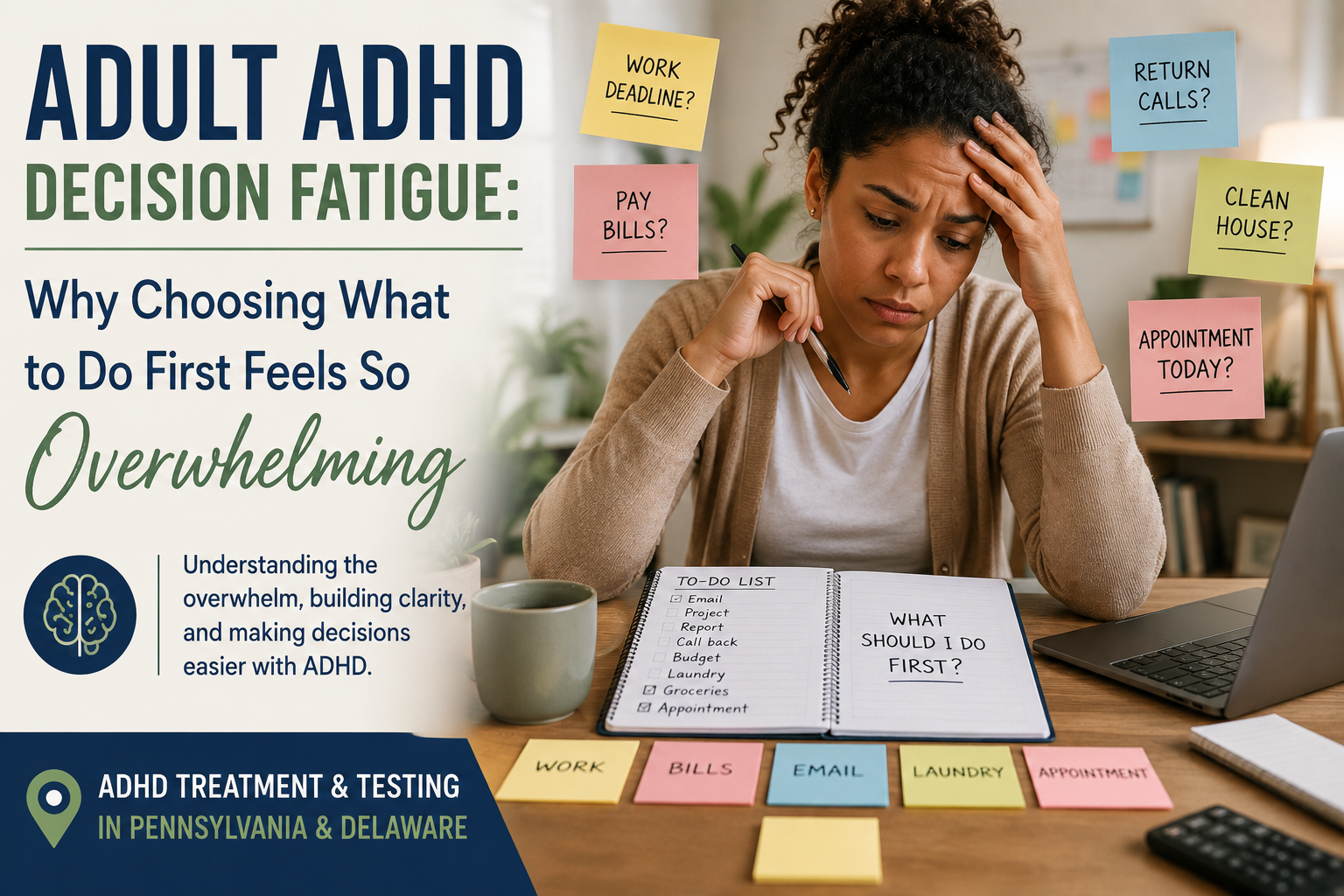
Adult ADHD and Decision Fatigue: Why Choosing What to Do First Feels So Overwhelming | ADHD Philadelphia
For many adults with ADHD, the hardest part of the day is not always doing the task.
It is deciding what to do first.
You may look at your inbox, your work responsibilities, your laundry, your bills, your calendar, your missed calls, your unfinished projects, and your personal goals — and suddenly everything feels equally urgent.
Your brain freezes.
You know something needs to get done, but choosing the first step feels overwhelming. You may jump between tasks, scroll to avoid deciding, start something random, or spend so much time planning that nothing actually moves forward.
This is often described as decision fatigue.
At ADHD Philadelphia, we provide ADHD treatment and medication management for adults in Pennsylvania and Delaware. If choosing what to do first feels harder than it should, adult ADHD may be part of the pattern.
What Is Decision Fatigue?
Decision fatigue happens when the brain becomes overloaded by too many choices, priorities, or competing demands.
For adults with ADHD, decision fatigue may show up as:
Feeling stuck before starting
Not knowing what matters most
Avoiding tasks because choosing feels stressful
Switching between tasks without finishing
Overthinking small decisions
Feeling mentally exhausted early in the day
Putting off decisions until they become urgent
Asking, “What should I do first?” over and over
Feeling guilty for wasting time deciding
Everyone experiences decision fatigue sometimes. But for adults with ADHD, it can become a daily pattern that affects work, home responsibilities, relationships, finances, school, parenting, and emotional well-being.
Why Adults With ADHD Can Feel Overwhelmed by Choices
Adult ADHD often affects executive function.
Executive functions help the brain organize information, prioritize, start tasks, manage time, regulate emotions, and follow through. When executive function is strained, the brain may struggle to sort tasks by importance.
That can make a normal to-do list feel like a wall of pressure.
You may know that one task is technically more important, but your brain may still react to everything at once:
The email feels urgent.
The bill feels urgent.
The laundry feels urgent.
The work project feels urgent.
The appointment feels urgent.
The text message feels urgent.
The clutter feels urgent.
The unfinished task from last week feels urgent.
When everything feels urgent, nothing feels clear.
That is where many adults with ADHD get stuck.
Decision Fatigue Is Not Laziness
Many adults with ADHD blame themselves for decision fatigue.
They may say:
“I should be able to just pick something.”
“Why can’t I handle basic things?”
“I am wasting time again.”
“Other people do not struggle this much.”
“I know what to do, but I still cannot move.”
But decision fatigue is not laziness. It is often the result of mental overload, poor prioritization signals, time blindness, emotional pressure, and task initiation struggles.
The outside world may only see procrastination.
Inside, the person may be dealing with a crowded mental dashboard where every light is flashing at once.
If you relate to this, you may also want to read why adult ADHD makes follow-through so difficult even when you care.
Why Small Decisions Can Feel So Big
Adults with ADHD may become exhausted by small decisions before the bigger tasks even begin.
What should I answer first?
Should I clean or work?
Should I make the call now or later?
Should I start with the easiest task or the most important one?
Should I organize the list before doing anything?
Should I respond to this message now?
Should I finish yesterday’s task first?
Should I make coffee first?
Should I start over completely?
Each decision may seem small by itself. But when dozens of small choices stack up, the ADHD brain can feel drained.
This can lead to avoidance, irritability, emotional shutdown, or scrolling for relief.
The problem is not that the person does not care. The problem is that the decision process itself becomes exhausting.
The ADHD “Everything Is Important” Problem
One common ADHD pattern is difficulty ranking importance.
A task may feel important because it is urgent, emotional, new, interesting, uncomfortable, overdue, visible, or connected to someone else’s expectations.
That does not mean it is the best task to do first.
For example, an adult with ADHD may start cleaning the kitchen because the clutter is visually loud, even though an important work deadline is due that afternoon.
Or they may answer low-priority emails because the inbox creates pressure, while avoiding the one difficult email that actually matters most.
Or they may spend an hour building a perfect plan, but never begin the first task.
This is why decision fatigue and prioritization problems often travel together.
For a complete step-by-step system for ranking competing demands, read Prioritization Skills in Adults With ADHD.
Decision Fatigue and Time Blindness
Time blindness can make decision fatigue worse.
If your brain struggles to feel time passing accurately, it may be harder to decide what can realistically fit into the day.
You may think:
“I can do all of this.”
“This will only take a few minutes.”
“I still have time.”
“I will start after one more thing.”
“I can catch up later.”
Then suddenly the day is almost over, and the pressure rises.
When time is unclear, priorities become unclear. When priorities are unclear, decisions become harder. When decisions become harder, tasks are delayed.
That cycle can make adults with ADHD feel constantly behind.
Decision Fatigue at Work
At work, adult ADHD decision fatigue may look like:
Opening multiple tabs but not completing the main task
Answering easy emails while avoiding complex work
Feeling stuck when there are multiple deadlines
Spending too long deciding how to start a project
Jumping between tasks after every notification
Avoiding decisions until someone follows up
Feeling mentally exhausted by meetings and messages
Missing important priorities because smaller tasks felt louder
This can be especially frustrating for adults who are intelligent, capable, and deeply motivated but still struggle to create order when demands pile up.
Decision Fatigue at Home
At home, decision fatigue may show up in daily routines:
What should I cook?
Should I clean first or rest first?
Which room should I start with?
What errand should I run first?
Should I pay bills now or later?
What do I need for tomorrow?
Why does the house still feel chaotic?
What should I do with this pile?
Home responsibilities often have fewer external deadlines than work. That means the adult with ADHD may have to create structure internally, which can be difficult when executive function is already strained.
This is why “free time” can still feel stressful.
Decision Fatigue and Emotional Overwhelm
Decision fatigue is not only a planning issue. It can become emotional.
Adults with ADHD may feel anxiety, shame, frustration, irritability, guilt, or defeat when they cannot choose what to do first.
The emotional pressure can make the decision even harder.
The brain may move into a freeze response:
Do nothing.
Avoid everything.
Scroll.
Nap.
Start a random task.
Over-plan.
Ask someone else to decide.
Wait until urgency forces action.
This can create a cycle of shame and avoidance. The more delayed the task becomes, the heavier the decision feels.
A Simple Decision Rule for Adults With ADHD
When everything feels important, try using a simple decision rule.
Ask:
What is the one task that will create the most relief if it is done today?
Not the perfect task.
Not the hardest task.
Not the task you “should” do according to guilt.
The task that creates the most useful relief.
That may be:
Paying one bill
Sending one email
Scheduling one appointment
Putting laundry in the washer
Reviewing tomorrow’s calendar
Submitting one form
Clearing one work bottleneck
Preparing one thing for the morning
The goal is to reduce the decision load and create movement.
Try the “One, One, One” Method
A simple ADHD-friendly decision strategy is the “One, One, One” method.
Choose:
One must-do task
One helpful task
One task to remove or delay
That is it.
For example:
Must-do: respond to the important work email.
Helpful: put clothes in the washer.
Remove or delay: reorganizing the entire closet.
This helps prevent the ADHD brain from treating every task as equal.
It also helps reduce overwhelm by making the day smaller and more realistic.
Make Priorities Visible
Adults with ADHD often benefit from making priorities visible.
Instead of keeping everything in your head, write down only three tasks.
Use a sticky note, small notebook, whiteboard, or planner.
Try this format:
Today’s top 3:
Must do:
Would help:
Can wait:
This creates a visual decision filter.
It also gives your brain permission not to carry everything at once.
ADHD Testing in Pennsylvania and Delaware
If decision fatigue, task initiation, time management, emotional overwhelm, and follow-through problems are affecting daily life, ADHD testing may help clarify the pattern.
At ADHD Philadelphia, adult ADHD testing in Pennsylvania and Delaware may include a clinical consultation, symptom review, rating scales, computerized testing when appropriate, and a careful look at how symptoms affect work, home, routines, relationships, and emotional functioning.
A careful adult ADHD diagnosis can also help distinguish ADHD from anxiety, depression, sleep problems, burnout, trauma-related stress, or other concerns that may affect decision-making.
If you are new to the process, you can review the ADHD Patient Journey before scheduling.
How ADHD Treatment Can Help Decision Fatigue
ADHD treatment is not only about paying attention.
A strong treatment plan should also support real-life functioning, including prioritization, planning, task initiation, time management, emotional regulation, and follow-through.
Treatment may include:
Medication management when appropriate
Executive function strategies
Therapy-informed support
Decision-making systems
Planning tools
Routine support
Sleep and lifestyle discussion
Follow-up care
Education about ADHD patterns
If medication is part of the treatment plan, ongoing monitoring matters. You may also want to read Adult ADHD Medication Follow-Up Care in Pennsylvania and Delaware: Why Monitoring Matters.
ADHD Treatment in Pennsylvania
Adults in Pennsylvania may seek ADHD testing or treatment when decision fatigue affects work performance, home responsibilities, relationships, finances, school, parenting, or emotional well-being.
Whether you live in Philadelphia, Bala Cynwyd, Pittsburgh, Allentown, Reading, Erie, Harrisburg, Lancaster, West Chester, Bryn Mawr, Delaware County, or elsewhere in Pennsylvania, ADHD care should be structured, respectful, and individualized.
ADHD Treatment in Delaware
Adults in Delaware may also benefit from ADHD testing and treatment when daily decisions, routines, task initiation, and prioritizing feel harder than they should.
If you live in Wilmington, Newark, Dover, Middletown, Bear, Smyrna, Milford, Seaford, Rehoboth Beach, or elsewhere in Delaware, ADHD Philadelphia provides adult ADHD services for Pennsylvania and Delaware residents.
You can review ADHD Philadelphia’s Pennsylvania and Delaware ADHD locations to learn more about service areas.
You Do Not Need to Decide Everything at Once
Decision fatigue can make life feel heavier than it has to feel.
But you do not need to solve every problem today.
You need one clear next step.
Adult ADHD can make choices feel crowded, priorities feel confusing, and simple decisions feel exhausting. But with the right evaluation, treatment plan, and support, decision-making can become more manageable.
Book Now: Adult ADHD Testing and Treatment in Pennsylvania and Delaware
ADHD Philadelphia provides adult ADHD testing, diagnosis, treatment, and medication management for adults in Pennsylvania and Delaware.
If choosing what to do first feels overwhelming, or if decision fatigue is affecting your work, routines, relationships, home responsibilities, or emotional well-being, a structured ADHD evaluation can help you get clarity.
Schedule an adult ADHD evaluation or treatment appointment today.
Educational content only. This blog is not medical advice, not a diagnosis, and not a substitute for individualized care. If you are in crisis or feel unsafe, call 988 or go to the nearest emergency room.
Why Adult ADHD Gets Worse During Major Life Transitions
Major life changes can make adult ADHD symptoms feel worse. Learn why transitions affect focus, routines, emotional regulation, and follow-through — and how ADHD testing and treatment in Pennsylvania and Delaware may help.
Why Adult ADHD Gets Worse During Major Life Transitions | ADHD Philadelphia
Major life transitions can make adult ADHD symptoms feel much harder to manage.
A new job. A move. A promotion. A breakup. A marriage. Becoming a parent. Returning to school. Starting a business. Losing structure. Working remotely. Graduating from college. Caring for aging parents. Going through grief. Adjusting to a new schedule.
Even positive changes can create stress.
For adults with ADHD, these transitions can disrupt the routines, structure, and coping systems that were helping them function. Many people do not realize how much they were relying on familiar patterns until those patterns suddenly change.
That is often when ADHD symptoms become more noticeable.
An adult may begin asking:
“Why am I suddenly so scattered?”
“Why can’t I keep up anymore?”
“Why am I forgetting everything?”
“Why does my brain feel overwhelmed by normal responsibilities?”
“Why did my ADHD symptoms get worse?”
The truth is that ADHD does not always suddenly become worse overnight. More often, life becomes more demanding, less predictable, and harder to manage. When structure disappears and responsibilities increase, symptoms that were once manageable may become harder to ignore.
For adults in Pennsylvania and Delaware, understanding this pattern can help determine whether adult ADHD testing and treatment may be appropriate.
Adult ADHD Is Often a Problem of Regulation, Not Effort
One of the most misunderstood parts of adult ADHD is that it is not simply a lack of attention.
Many adults with ADHD can focus very well when something is interesting, urgent, emotionally rewarding, new, or highly stimulating. The struggle is often with regulating attention consistently when tasks are boring, repetitive, delayed, complicated, or emotionally draining.
That is why an adult with ADHD may focus for hours on a creative idea, a crisis, a business plan, a favorite project, or a topic they love — but struggle to answer emails, pay bills, return calls, fold laundry, complete paperwork, schedule appointments, or follow through on routine responsibilities.
This can feel confusing and frustrating.
The person may think, “If I can focus sometimes, why can’t I focus when I need to?”
That question is one reason ADHD can feel emotionally painful for adults. They may blame themselves for inconsistency, procrastination, disorganization, or feeling overwhelmed. But ADHD is not a character flaw. It is commonly connected to challenges with executive functioning, including planning, prioritizing, emotional regulation, time management, working memory, organization, and follow-through.
Why Major Life Transitions Make ADHD Symptoms More Noticeable
Major life transitions often remove the structure that was quietly helping a person function.
A college student may have class schedules, deadlines, roommates, campus routines, grades, and external accountability. After graduation, that structure disappears.
A working adult may do well in a familiar role, then receive a promotion that requires more planning, leadership, communication, and time management.
A new parent may have managed ADHD symptoms before motherhood or fatherhood, but sleep disruption, constant interruptions, emotional demands, and household responsibilities make everything harder.
A remote worker may lose the natural structure of commuting, office routines, coworkers, and set work hours.
A person going through divorce, grief, relocation, or financial stress may suddenly have more decisions to make and less emotional energy to manage them.
The transition does not create ADHD. It often exposes the ways ADHD symptoms were already affecting the person’s ability to manage daily life.
Common Life Transitions That Can Make Adult ADHD Feel Worse
Adult ADHD symptoms may become more disruptive during many types of life changes.
Common examples include:
Starting a new job
Changing careers
Getting promoted
Working from home
Returning to school
Graduating from college
Moving to a new home
Getting married
Going through a breakup or divorce
Becoming a parent
Managing motherhood or fatherhood
Starting a business
Taking care of aging parents
Experiencing grief or loss
Recovering from burnout
Adjusting after military service
Changing sleep schedules
Taking on financial responsibilities
Managing health changes
Losing external structure or accountability
These changes increase demands on attention, memory, planning, organization, emotional regulation, and time management.
For someone without ADHD, a major transition may feel stressful but manageable.
If a person has untreated ADHD, the same transition may feel overwhelming, exhausting, and confusing.
The ADHD Brain Has to Rebuild Systems During Transitions
Adults with ADHD often rely on routines, reminders, visual cues, familiar spaces, calendars, deadlines, and external accountability to stay on track.
When life changes, those systems may disappear.
A person may move to a new home and no longer know where anything belongs.
A new job may require different software, meetings, deadlines, and expectations.
A new baby may destroy sleep routines and make basic tasks harder to complete.
A breakup may disrupt eating, sleeping, finances, and emotional stability.
Remote work may make time feel blurry and unstructured.
The ADHD brain often performs better when there is predictability, interest, urgency, reward, and clear structure. Major transitions often bring the opposite: uncertainty, delayed rewards, emotional stress, and too many decisions.
This can lead to:
More procrastination
More forgetfulness
More emotional reactivity
More difficulty starting tasks
More unfinished projects
More missed deadlines
More clutter
More time blindness
More avoidance
More shame
More exhaustion
The person may feel like they are falling apart, but what may actually be happening is that their old coping systems are no longer strong enough for their new life demands.
ADHD and Emotional Stress During Major Life Changes
Major transitions are not just logistical. They are emotional.
Even positive changes can be stressful.
A promotion can bring pride and pressure.
Marriage can bring joy and new responsibilities.
A new baby can bring love and sleep deprivation.
A new home can bring excitement and chaos.
Starting a business can bring purpose and constant decision fatigue.
Adults with ADHD may experience emotional intensity during transitions. They may feel overwhelmed faster, become frustrated more easily, or have difficulty calming their mind when multiple demands happen at once.
This can sometimes look like anxiety, depression, irritability, avoidance, or burnout.
That is one reason adult ADHD can be missed for years. A person may seek help for stress, low mood, racing thoughts, or feeling overwhelmed, while the underlying ADHD remains untreated.
A thorough clinical evaluation can help clarify whether symptoms are related to ADHD, anxiety, depression, sleep problems, trauma, substance use concerns, or another condition that may need attention.
Why ADHD May Become Clearer After College
Many adults first notice ADHD after college or during early adulthood.
This makes sense.
School often provides external structure. There are syllabi, class times, deadlines, grades, reminders, and consequences. Even if a student procrastinates, pulls all-nighters, loses things, or struggles internally, the structure may help them push through.
After graduation, life becomes less predictable.
No one hands out a syllabus for adulthood.
There may be bills, work expectations, taxes, insurance, appointments, relationships, household tasks, career planning, and long-term goals — all without the same external structure.
This is when many adults realize their difficulties are not simply laziness or lack of motivation. They may have been intelligent, capable, and hardworking all along, but still struggling with executive functioning skills that become more important in adulthood.
For many people, ADHD after college becomes more noticeable because adult life requires more independent planning, organization, time management, and follow-through.
Why Parenthood Can Make ADHD Symptoms Harder to Ignore
Parenthood is one of the biggest life transitions that can expose adult ADHD.
Before having children, an adult may be able to compensate with personal routines, late-night catch-up work, flexible schedules, reminders, or last-minute pressure. But children bring constant interruptions, emotional demands, noise, appointments, school forms, meals, laundry, bedtime routines, and unpredictable needs.
For many mothers and fathers, ADHD symptoms become more obvious when they are no longer managing only themselves.
A parent with ADHD may struggle with:
Remembering appointments
Managing school paperwork
Keeping up with household tasks
Staying emotionally regulated during chaos
Following routines consistently
Managing sleep deprivation
Switching between work and parenting
Keeping track of everyone’s needs
Feeling overstimulated
Feeling guilty for not being more organized
This does not mean the parent is failing.
It may mean the parent’s brain is overloaded by constant executive function demands.
A parent with ADHD may need support, structure, treatment, and realistic systems — not more shame.
Remote Work Can Make Adult ADHD Better — or Worse
Remote work can be helpful for some adults with ADHD.
It may reduce commuting stress, office distractions, and rigid workplace demands. But for others, remote work makes ADHD symptoms worse because it removes structure.
Without a commute, office environment, scheduled breaks, coworker visibility, and physical separation between work and home, the day can blur together.
A remote worker with ADHD may sit down at 9:00 AM, answer one message, open five tabs, start three tasks, forget lunch, avoid a difficult project, and then feel panicked at 4:30 PM because the most important work is still unfinished.
Remote work requires self-management.
That includes planning the day, starting tasks without external pressure, resisting distractions, managing time, organizing priorities, and stopping work at a healthy time.
Those are exactly the areas where adult ADHD can create problems.
For a remote worker with ADHD, treatment and structured systems can help create the external support that remote work often removes.
ADHD, Major Life Changes, and Burnout
When adults with ADHD go through major transitions without enough support, they may enter a cycle of overcompensation and burnout.
They try harder.
They stay up later.
They make more lists.
They criticize themselves.
They promise to “get it together.”
They push through exhaustion.
They avoid tasks because they feel too overwhelming.
Then the pressure builds, and they feel even more behind.
This cycle can be especially painful for high-achieving adults.
Many adults with ADHD are intelligent, creative, caring, ambitious, and capable. They may succeed in demanding careers or family roles, but internally feel like they are constantly one step away from dropping the ball.
During major life transitions, the gap between ability and execution can become more obvious.
The person knows what they need to do.
They may even know how to do it.
But starting, sequencing, prioritizing, and completing the task consistently becomes the hard part.
That is one of the reasons ADHD treatment can be life-changing for some adults. Treatment is not about changing someone’s personality. It is about helping the brain function with more clarity, consistency, and support.
When to Consider Adult ADHD Testing
Adult ADHD testing may be helpful if major life transitions have made it harder to function at work, school, home, or in relationships.
Signs that an evaluation may be worth considering include:
You are more forgetful than usual
You constantly feel behind
You avoid tasks that require sustained focus
You start projects but struggle to finish them
You lose track of time easily
You feel overwhelmed by basic responsibilities
You procrastinate until things become urgent
You struggle with routines even when you want them
You have difficulty organizing paperwork, bills, or appointments
You feel emotionally reactive or easily frustrated
You have trouble switching from one task to another
You are successful on the outside but exhausted inside
You have wondered for years whether ADHD may explain your patterns
An ADHD evaluation should not be just a quick checklist. A thoughtful assessment looks at symptoms across life stages, current functioning, impairment, and other possible explanations for attention problems.
Many adults with ADHD also experience anxiety, depression, sleep problems, trauma histories, substance use concerns, or other mental health conditions. These should be considered carefully so the person receives the right diagnosis and treatment plan.
Adult ADHD testing can help clarify whether ADHD may be contributing to problems with focus, follow-through, organization, emotional regulation, and daily functioning.
How Treatment Can Help During Major Transitions
Treatment for adult ADHD may include education, behavioral strategies, medication management when clinically appropriate, lifestyle changes, therapy, coaching strategies, and systems that support executive functioning.
The goal is not perfection.
The goal is better functioning.
For adults going through major transitions, treatment may help with:
Improving focus
Reducing task avoidance
Managing procrastination
Building realistic routines
Improving follow-through
Reducing emotional overwhelm
Creating structure during change
Improving time management
Supporting work performance
Reducing shame
Improving communication
Helping the person understand their brain
For some adults, medication may be part of treatment. For others, non-medication strategies may be the first step. The right plan depends on the person’s symptoms, medical history, mental health history, substance use history, goals, and clinical needs.
At ADHD Philadelphia, care is individualized and monitored over time. Initial appointments are completed through telehealth. In-person appointments may be scheduled after the first online appointment when clinically appropriate. Walk-in appointments are not available.
When clinically appropriate, medication management may be part of an adult ADHD treatment plan.
You Are Not Lazy — Your Life May Have Outgrown Your Coping Systems
One of the most important things to understand is this:
If your ADHD symptoms feel worse during a major life transition, it does not mean you are lazy, broken, or incapable.
It may mean your life demands have increased beyond the coping systems you were using.
That is common.
A person can be bright and still struggle with ADHD.
A person can be motivated and still procrastinate.
A person can love their family and still feel overwhelmed.
A person can be successful and still need treatment.
A person can appear organized in public while privately feeling exhausted.
Adult ADHD often becomes more visible when life requires more self-management than before.
That does not mean there is no hope.
With the right evaluation, treatment plan, and support, many adults begin to understand themselves differently. Instead of seeing their struggles as personal failure, they can begin building systems that match how their brain actually works.
Adult ADHD can affect focus, motivation, emotional regulation, organization, routines, and follow-through — especially during major life transitions.
ADHD Testing and Treatment in Pennsylvania and Delaware
If major life transitions have made your ADHD symptoms harder to manage, it may be time to consider a professional evaluation.
ADHD Philadelphia provides adult ADHD testing and treatment for individuals in Pennsylvania and Delaware. Care is designed to help adults better understand their symptoms, clarify diagnosis, and explore treatment options when appropriate.
Whether you are adjusting to a new job, parenthood, remote work, school, relationship changes, grief, or another major life shift, you do not have to keep trying to figure it out alone.
Support can help you move from survival mode toward a more structured, focused, and sustainable way of functioning.
If you are looking for ADHD testing and treatment in Pennsylvania and Delaware, ADHD Philadelphia can help you take the next step.
Frequently Asked Questions About Adult ADHD and Major Life Transitions
Can adult ADHD get worse during life changes?
Adult ADHD symptoms can become more noticeable during major life transitions because routines, structure, sleep, emotional stability, and external accountability may change. The ADHD itself may not suddenly worsen, but the demands on executive functioning often increase.
Why did my ADHD symptoms get worse after starting a new job?
A new job may require more planning, organization, learning, communication, and time management. If the new role has less structure or more responsibility, ADHD symptoms may become harder to manage.
Can parenthood make ADHD symptoms worse?
Parenthood can make ADHD symptoms more noticeable because it adds constant interruptions, sleep disruption, scheduling demands, emotional labor, and household responsibilities. Many adults first recognize ADHD patterns after becoming parents.
Can remote work make ADHD worse?
Remote work can help some adults with ADHD, but it can make symptoms worse for others by removing structure, accountability, commuting routines, and separation between work and home.
When should I consider ADHD testing?
Consider ADHD testing if problems with focus, procrastination, organization, emotional regulation, time management, or follow-through are affecting work, school, home, or relationships — especially if symptoms have been present for years or became more noticeable during a major life transition.
Take the First Step
If you are an adult in Pennsylvania or Delaware and major life transitions have made ADHD symptoms harder to manage, ADHD Philadelphia can help you better understand what may be happening.
Adult ADHD can affect focus, motivation, emotional regulation, organization, time management, and follow-through. A structured evaluation can provide clarity and help determine whether treatment may be appropriate.
Visit ADHDPhiladelphia.com to schedule an adult ADHD evaluation.
Medical Disclaimer
This article is for educational purposes only and is not a substitute for medical advice, diagnosis, or treatment. ADHD symptoms can overlap with anxiety, depression, sleep disorders, trauma, substance use concerns, medical conditions, and other mental health conditions. If you are experiencing symptoms of ADHD or another mental health concern, consult a qualified healthcare professional.
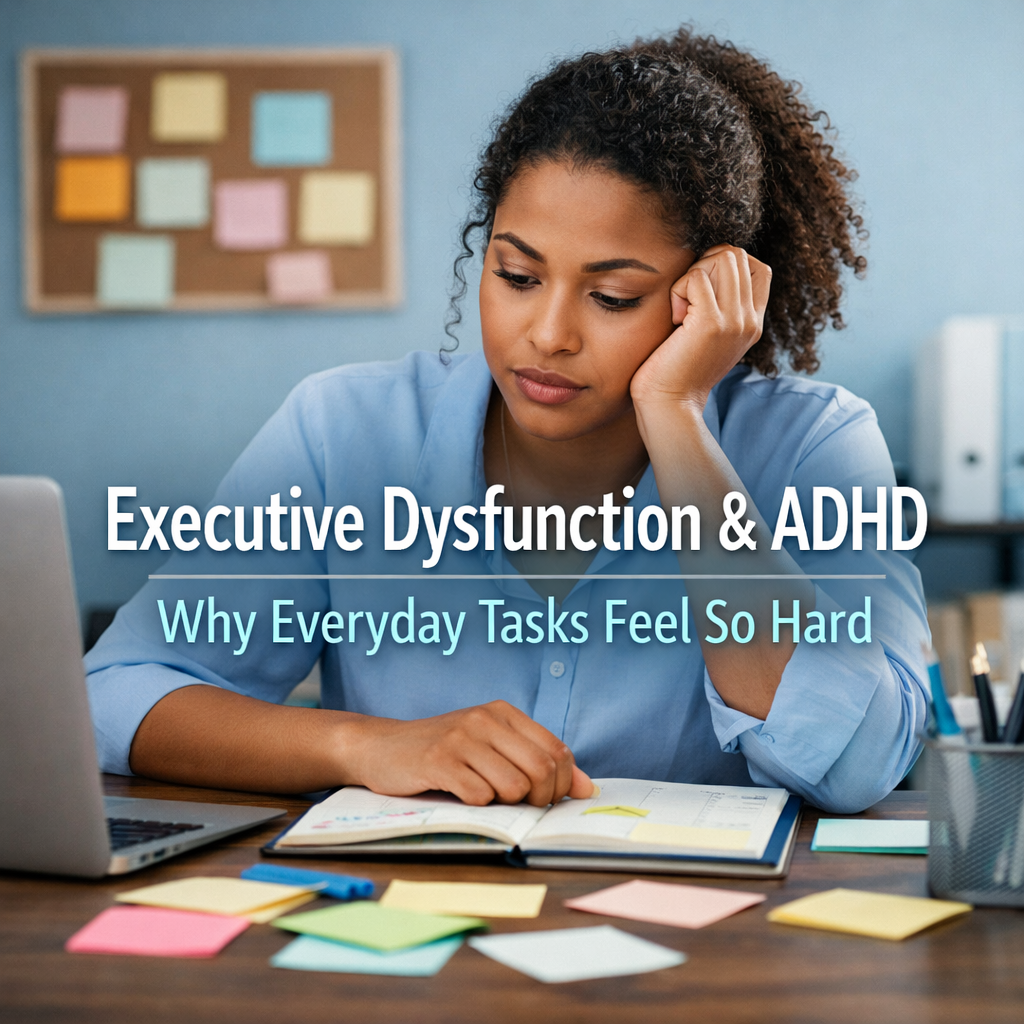
Executive Dysfunction in Adults With ADHD: Why Everyday Tasks Feel So Hard
Executive dysfunction is one of the most common challenges adults with ADHD experience. It affects the brain’s ability to plan, prioritize, start tasks, and manage time. Understanding executive dysfunction can help explain why everyday responsibilities sometimes feel overwhelming and why ADHD evaluation and treatment may help.
Many adults living with attention-deficit/hyperactivity disorder (ADHD) describe a frustrating experience: they know exactly what they need to do, yet starting the task feels nearly impossible.
Bills remain unpaid, emails unanswered, and projects unfinished—not because the person lacks intelligence or motivation, but because the brain struggles with a set of processes known as executive functions.
When these systems are impaired, individuals may experience executive dysfunction, one of the most common and misunderstood challenges associated with adult ADHD.
Understanding executive dysfunction can help adults recognize why everyday tasks sometimes feel overwhelming and why an adult ADHD evaluation may provide valuable answers.
Executive dysfunction is one of the most common challenges adults with ADHD experience.
Many people describe difficulty starting everyday tasks even when they know they are important.
What Is Executive Dysfunction?
Executive functions are mental processes that allow the brain to organize behavior toward a goal. These functions help individuals plan, prioritize, initiate tasks, regulate emotions, and maintain attention.
In simple terms, executive functions act as the brain’s management system.
These cognitive processes help people:
• organize tasks
• manage time
• start and complete projects
• regulate emotions
• maintain focus
• shift attention when necessary
When executive functions are impaired, everyday responsibilities that appear simple to others may become extremely difficult.
This pattern is known as executive dysfunction.
Many adults with ADHD report feeling as though they understand what needs to be done but cannot consistently organize their thoughts and actions to complete those tasks.
Why Executive Dysfunction Occurs in ADHD
Research suggests that ADHD involves differences in brain networks responsible for attention regulation, reward processing, and executive functioning.
These systems are closely linked to activity in the prefrontal cortex, a region of the brain responsible for decision-making, impulse control, and planning.
Neurotransmitters such as dopamine and norepinephrine play an important role in these processes. When these systems are not functioning efficiently, the brain may struggle to regulate attention and motivation.
As a result, tasks that require sustained effort—such as planning a project or organizing paperwork—may feel mentally exhausting.
This is why many adults with ADHD experience difficulty initiating tasks even when they understand their importance.
Common Signs of Executive Dysfunction in Adults With ADHD
Executive dysfunction can appear in many forms. Some individuals experience only mild difficulties, while others may struggle significantly with daily organization and productivity.
Common signs include:
Difficulty Starting Tasks
One of the most frequently reported challenges is task initiation.
Many adults describe staring at a task for long periods without beginning it. Even simple activities such as sending an email or cleaning a room may feel overwhelming.
This experience is often described as ADHD task paralysis, where the brain struggles to transition from intention to action.
You can learn more about this experience in our article on ADHD Task Paralysis: Why Adults With ADHD Struggle to Start Tasks.
Chronic Procrastination
Executive dysfunction often leads to persistent procrastination.
Tasks may be delayed until the last possible moment, even when the individual understands the consequences of waiting.
This pattern is not caused by laziness but rather by difficulty organizing actions and sustaining motivation.
Difficulty Prioritizing Tasks
Adults with executive dysfunction may struggle to determine which tasks are most important.
As a result, individuals may spend time on less urgent activities while more important responsibilities remain unfinished.
Time Management Problems
Many adults with ADHD experience time blindness, which affects their ability to estimate how long tasks will take.
This can lead to chronic lateness, missed deadlines, and difficulty planning daily schedules.
Disorganization
Executive dysfunction may also cause difficulty organizing information, materials, or physical spaces.
Individuals may frequently lose important items, forget appointments, or struggle to maintain structured routines.
For practical systems addressing clutter, lost items, paperwork, and digital information, read Organization Skills in Adults With ADHD.
Emotional Effects of Executive Dysfunction
Executive dysfunction does not only affect productivity—it can also impact emotional well-being.
Many adults with ADHD experience:
• frustration with unfinished tasks
• feelings of guilt or shame
• decreased self-confidence
• chronic stress
Over time, these experiences may lead individuals to believe they are simply “not disciplined enough,” when the underlying issue is neurological rather than motivational.
Recognizing executive dysfunction as a brain-based challenge can help reduce self-criticism and encourage individuals to seek appropriate support.
When Adults Should Consider an ADHD Evaluation
Executive dysfunction can occur in several mental health conditions, including anxiety, depression, and sleep disorders.
However, when these difficulties have been present for many years—especially since childhood—ADHD may be a possible explanation.
Adults should consider seeking an evaluation if they consistently experience:
• chronic procrastination
• difficulty finishing tasks
• problems organizing responsibilities
• forgetfulness
• difficulty prioritizing work
• persistent overwhelm with daily tasks
A structured ADHD testing and evaluation for adults in Pennsylvania and Delaware can help determine whether ADHD may be contributing to these patterns.
How ADHD Testing and Evaluation Works
An adult ADHD evaluation typically involves several steps designed to understand long-standing patterns of attention and executive functioning.
A comprehensive assessment may include:
• a detailed clinical interview
• review of current symptoms
• discussion of childhood history
• evaluation of functioning in work and relationships
• screening for other mental health conditions
Because ADHD symptoms can overlap with anxiety, depression, and other conditions, a careful diagnostic process is essential.
You can learn more about the evaluation process here:
ADHD Testing & Evaluation for Adults in Pennsylvania & Delaware
ADHD Treatment Options for Adults
When ADHD is diagnosed, several treatment strategies may help improve executive functioning and daily productivity.
Treatment plans are individualized and may include a combination of approaches.
Medication Management
ADHD medications can help regulate neurotransmitter systems involved in attention and executive functioning.
For many adults, medication significantly improves focus, organization, and task initiation.
Behavioral Strategies
Structured routines and external organizational systems can help individuals compensate for executive function difficulties.
Examples include:
• task-management tools
• time-blocking schedules
• reminder systems
• simplified workflows
Therapy or Coaching
Cognitive behavioral therapy (CBT) and ADHD coaching can help individuals develop practical strategies for managing daily responsibilities.
You can read more about treatment approaches here:
ADHD Treatment & Medication Management for Adults in Pennsylvania & Delaware
ADHD Care in Pennsylvania and Delaware
Adults living in Pennsylvania and Delaware who suspect ADHD may benefit from a structured evaluation and personalized treatment plan.
ADHDPhiladelphia.com provides adult ADHD testing, diagnosis, and treatment through a telehealth model designed to help individuals understand their symptoms and improve daily functioning.
Our approach focuses on helping adults develop strategies to manage attention, organization, and executive functioning challenges.
Schedule an ADHD Evaluation
If you have been experiencing persistent difficulty with focus, procrastination, organization, or task initiation, ADHD may be a possibility.
A structured evaluation can help determine whether ADHD is present and identify treatment options that may improve productivity and overall well-being.
👉 Book an appointment today at ADHDPhiladelphia.com
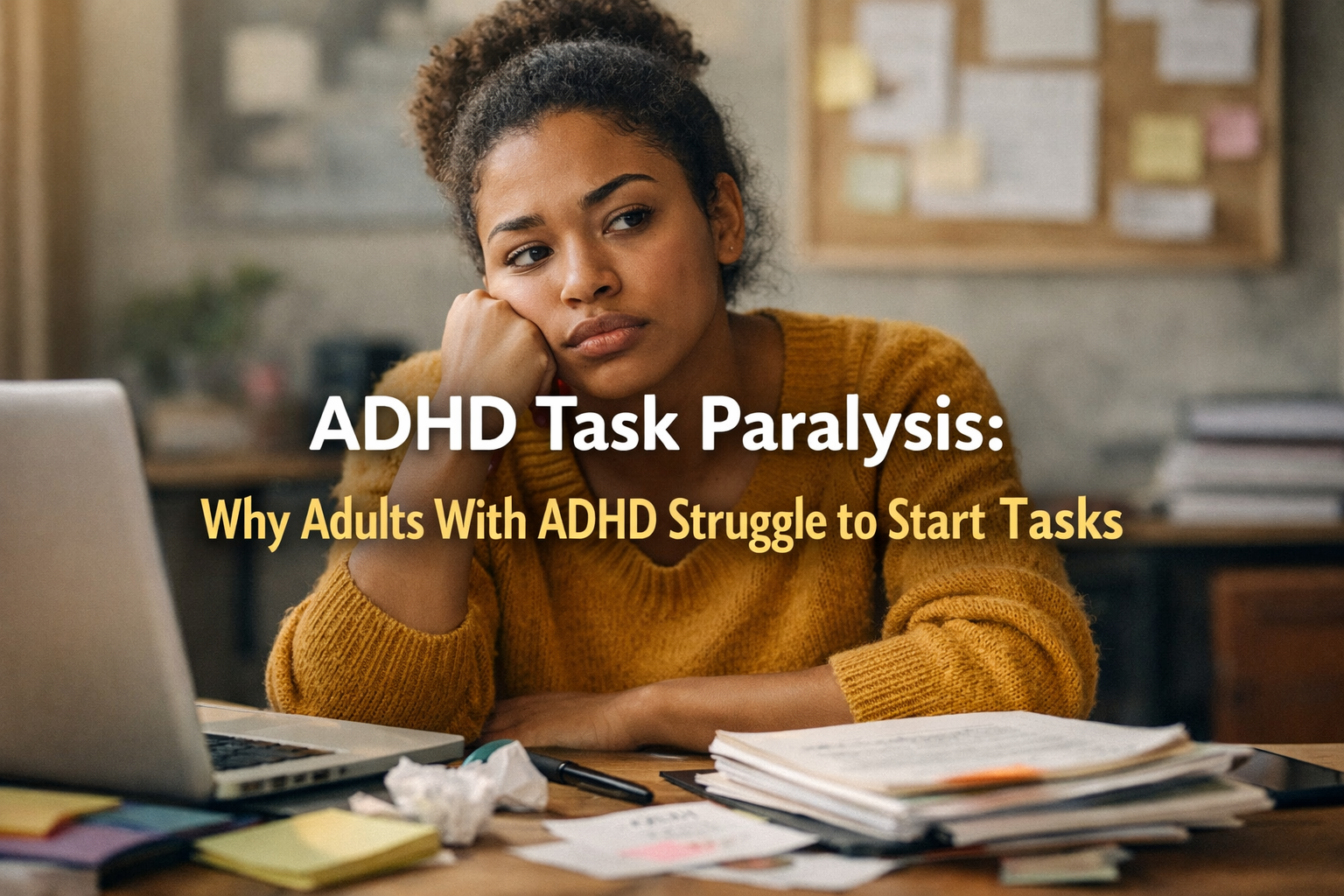
ADHD Task Paralysis: Why Adults With ADHD Struggle to Start Tasks
Adults with ADHD often experience task paralysis — the frustrating feeling of being mentally stuck when trying to start tasks. Understanding why ADHD affects executive functioning can help individuals seek evaluation and treatment.
Many adults with ADHD describe a frustrating experience that others often misunderstand.
They know what needs to be done.
They want to do it.
But somehow, they still cannot start.
This experience is often called ADHD task paralysis.
It is not laziness. It is not lack of motivation. It is a neurological difficulty related to executive functioning, the brain’s system for planning, prioritizing, initiating, and completing tasks.
For many adults, task paralysis becomes one of the most disabling symptoms of undiagnosed ADHD and contributes to the constant feeling of overwhelm many adults describe. You can learn more about this pattern in our guide on why adults with ADHD feel overwhelmed and how treatment can help.
What Is ADHD Task Paralysis?
Task paralysis refers to the inability to initiate tasks despite knowing they are important.
Adults with ADHD often experience:
• difficulty starting work projects
• avoiding emails or paperwork
• delaying simple household tasks
• procrastinating important responsibilities
• feeling mentally frozen when overwhelmed
This occurs because ADHD affects the brain’s self-management system, particularly the executive functions responsible for planning and task initiation.
Executive functioning helps people:
• decide what to do first
• organize steps
• begin tasks
• maintain focus
• finish activities
When these processes are impaired, even simple tasks can feel impossible to start.
If difficulty starting tasks has been a long-standing challenge, a structured ADHD testing and evaluation for adults in Pennsylvania and Delaware can help determine whether ADHD may be contributing to these patterns.
Why ADHD Makes Starting Tasks So Difficult
Several neurological and psychological factors contribute to ADHD task paralysis.
1. Executive Function Impairment
ADHD affects the brain’s executive function system, which controls planning, working memory, and task initiation.
Without strong executive functioning, the brain struggles to move from intention to action.
2. Overwhelm From Too Many Steps
Adults with ADHD often see the entire project at once rather than breaking it into steps.
For example:
Instead of thinking:
“Send one email”
the brain sees:
• open laptop
• find email
• write message
• respond to questions
• deal with consequences
This cognitive overload leads to mental shutdown.
3. Dopamine and Motivation Differences
ADHD brains process dopamine differently, affecting motivation and reward systems.
Tasks that are:
• repetitive
• boring
• unclear
• long-term
may not generate enough stimulation for the brain to begin.
4. Fear of Failure or Mistakes
Many adults with ADHD have experienced years of criticism about productivity or organization.
This can lead to:
• perfectionism
• avoidance
• anxiety about starting
The result is often procrastination that feels involuntary.
Common Signs of ADHD Task Paralysis
Adults may notice patterns such as:
• staring at a task for long periods without starting
• waiting until the last minute to complete work
• avoiding emails, calls, or paperwork
• feeling overwhelmed by simple responsibilities
• spending hours thinking about tasks but not beginning them
Many adults assume these problems are personal failures, when in reality they are often symptoms of untreated ADHD.
Because ADHD symptoms can overlap with anxiety and stress, it can also be helpful to understand the difference between ADHD and anxiety in adults.
How ADHD Treatment Can Help
The good news is that task paralysis can improve significantly with proper treatment.
Treatment for adult ADHD often includes:
ADHD Evaluation
A structured assessment can determine whether symptoms meet criteria for ADHD according to modern diagnostic guidelines.
Medication Treatment
Research consistently shows that stimulant medications and certain non-stimulant medications are among the most effective treatments for ADHD symptoms, including attention regulation and task initiation.
Executive Function Strategies
Adults often benefit from learning practical strategies for:
• breaking tasks into smaller steps
• creating external structure
• improving time awareness
• reducing overwhelm
When to Consider ADHD Testing
Adults should consider an ADHD evaluation if they experience:
• chronic procrastination
• difficulty starting tasks
• frequent overwhelm
• problems finishing projects
• workplace or academic struggles
These symptoms may have been present since childhood but become more noticeable in adulthood when responsibilities increase.
If you are unsure what the evaluation process involves, you can read more about how adults get tested for ADHD and what a structured assessment typically includes.
ADHD Testing and Treatment in Pennsylvania and Delaware
If you believe ADHD task paralysis may be affecting your work, school, or daily life, professional evaluation can help provide clarity.
ADHD Philadelphia offers adult ADHD testing and treatment for individuals located in Pennsylvania and Delaware through structured telehealth appointments.
If ADHD symptoms such as task paralysis, overwhelm, or chronic procrastination are affecting your daily life, you can book an ADHD evaluation online at ADHDPhiladelphia.com.