
Stimulant vs Non-Stimulant ADHD Medication for Adults in Pennsylvania & Delaware
Compare stimulant and non-stimulant ADHD medication options for adults in Pennsylvania and Delaware. Learn how structured diagnosis, $150 per visit medication management, and consistent follow-up support safe and effective treatment.
If you are searching for ADHD medication for adults, you may be wondering:
Should I take a stimulant?
Is a non-stimulant safer?
What is the difference?
The answer depends on your clinical history, symptom pattern, and treatment goals.
At ADHD Philadelphia, medication decisions are made only after a structured diagnostic evaluation has been completed. If you are unsure whether you meet criteria for ADHD, learn more about our Adult ADHD Diagnosis process before considering medication options.
Two Main Categories of ADHD Medication
There are two primary categories used in adult ADHD treatment:
• Stimulant medications
• Non-stimulant medications
Both can be effective. The right choice depends on individual factors.
Stimulant Medications
Stimulants are the most commonly prescribed medications for ADHD.
They work by increasing levels of dopamine and norepinephrine in areas of the brain responsible for attention regulation and executive functioning.
Common Benefits:
• Faster onset of symptom improvement
• Strong effect on focus and task completion
• Improved productivity and mental clarity
Important Considerations:
• Require careful monitoring
• May affect sleep or appetite
• Require monthly follow-up appointments
At ADHD Philadelphia, stimulant medications require monthly monitoring visits to ensure safety, symptom response, and dosage accuracy.
All medication management visits are $150 per appointment.
Structured monitoring supports responsible, evidence-based care.
Non-Stimulant Medications
Non-stimulants may be recommended when:
• Stimulants are not tolerated
• There is a history of side effects
• Anxiety is a significant concern
• A slower, steadier response is preferred
Non-stimulants typically take longer to show full benefit but may provide stable symptom improvement without stimulant-related side effects.
Monitoring Structure:
Follow-up appointments are typically scheduled every 30–90 days, depending on response and stability.
All visits remain $150 per appointment.
Which Is Better?
There is no universal “better” medication.
Treatment decisions are based on:
• Symptom severity
• Medical history
• Co-occurring conditions
• Lifestyle factors
• Functional impairment
• Patient preference
Medication is never prescribed casually.
Diagnosis requires structured clinical evaluation, functional assessment, and screening for overlapping conditions. If you have not yet completed evaluation, visit our ADHD Testing & Evaluation page to understand how diagnosis is established.
What Happens After Starting Medication?
Once medication begins:
• Follow-up schedule is clearly outlined
• Symptom response is reviewed
• Side effects are monitored
• Functional improvement is tracked
• Adjustments are made when clinically appropriate
The goal is not just symptom reduction — it is improved daily functioning.
Telehealth ADHD Medication Management in Pennsylvania & Delaware
Adult ADHD treatment at ADHD Philadelphia begins via secure telehealth consultation for adults residing in Pennsylvania and Delaware.
In-person appointments may be scheduled afterward when clinically appropriate.
There are no walk-in appointments.
Care is structured.
Monitoring is consistent.
Treatment decisions are evidence-based.
The Bottom Line
Stimulant and non-stimulant medications both have a role in adult ADHD treatment.
The key is not choosing a category at random.
The key is accurate diagnosis and structured follow-up.
If you are searching for:
• ADHD medication for adults
• ADHD doctor Pennsylvania
• ADHD psychiatrist Delaware
• ADHD treatment near me
Clarity begins with structured evaluation.

Do I Need ADHD Testing as an Adult in Pennsylvania or Delaware?
Not every adult needs computerized ADHD testing. Learn when ADHD testing is helpful, how structured evaluations work, and what to expect during adult ADHD diagnosis in Pennsylvania and Delaware.
If you are searching for “ADHD test for adults” or wondering whether you need ADHD testing before treatment, it is important to understand how adult ADHD is properly diagnosed.
ADHD testing can be helpful — but not every adult requires computerized testing to receive an accurate diagnosis.
At ADHD Philadelphia, diagnosis begins with a structured clinical evaluation conducted through secure telehealth appointments for adults residing in Pennsylvania and Delaware.
What Is ADHD Testing?
ADHD testing refers to structured tools used to measure:
• Attention regulation
• Impulse control
• Executive functioning performance
Testing may include:
• Computerized attention assessments
• Behavioral rating scales
• Symptom questionnaires
• Functional performance measures
Testing provides objective data. However, testing alone does not determine diagnosis.
For a full overview of structured diagnostic criteria, visit our Adult ADHD Diagnosis page.
Do All Adults Need ADHD Testing?
Not always.
Some adults present with a clear clinical history that supports diagnosis through structured interview and impairment review alone.
In other cases, testing strengthens diagnostic confidence — especially when symptoms overlap with anxiety, depression, trauma, or sleep concerns.
Testing decisions are made during your initial evaluation.
For a detailed breakdown of how testing fits into the full assessment process, visit our ADHD Testing & Evaluation page.
Why Online ADHD Quizzes Are Not Enough
Online ADHD quizzes can raise awareness, but they are not diagnostic tools.
A complete adult ADHD evaluation requires:
• Structured clinical interview
• Childhood symptom review
• Functional impairment assessment
• Screening for overlapping conditions
• Professional medical judgment
Diagnosis requires evidence of persistent symptoms and measurable functional impairment.
What Happens After Testing?
If ADHD is diagnosed:
• Treatment options are discussed
• Behavioral strategies may be recommended
• Medication may be considered when appropriate
Stimulant medications require monthly follow-up appointments.
Non-stimulant medications typically require follow-up every 30–90 days depending on stability.
All appointments are $150 per visit.
Structured monitoring supports safe, responsible care.
Telehealth ADHD Evaluation in Pennsylvania & Delaware
Adult ADHD evaluations begin via secure telehealth appointments.
In-person visits may be scheduled afterward when clinically appropriate.
There are no walk-in appointments.
The Bottom Line
ADHD testing is a tool — not a shortcut.
Accurate diagnosis requires structure, clinical judgment, and functional assessment.
If you are searching for:
• ADHD testing near me
• ADHD test for adults
• ADHD evaluation Pennsylvania
• ADHD assessment Delaware
Clarity begins with structured evaluation.
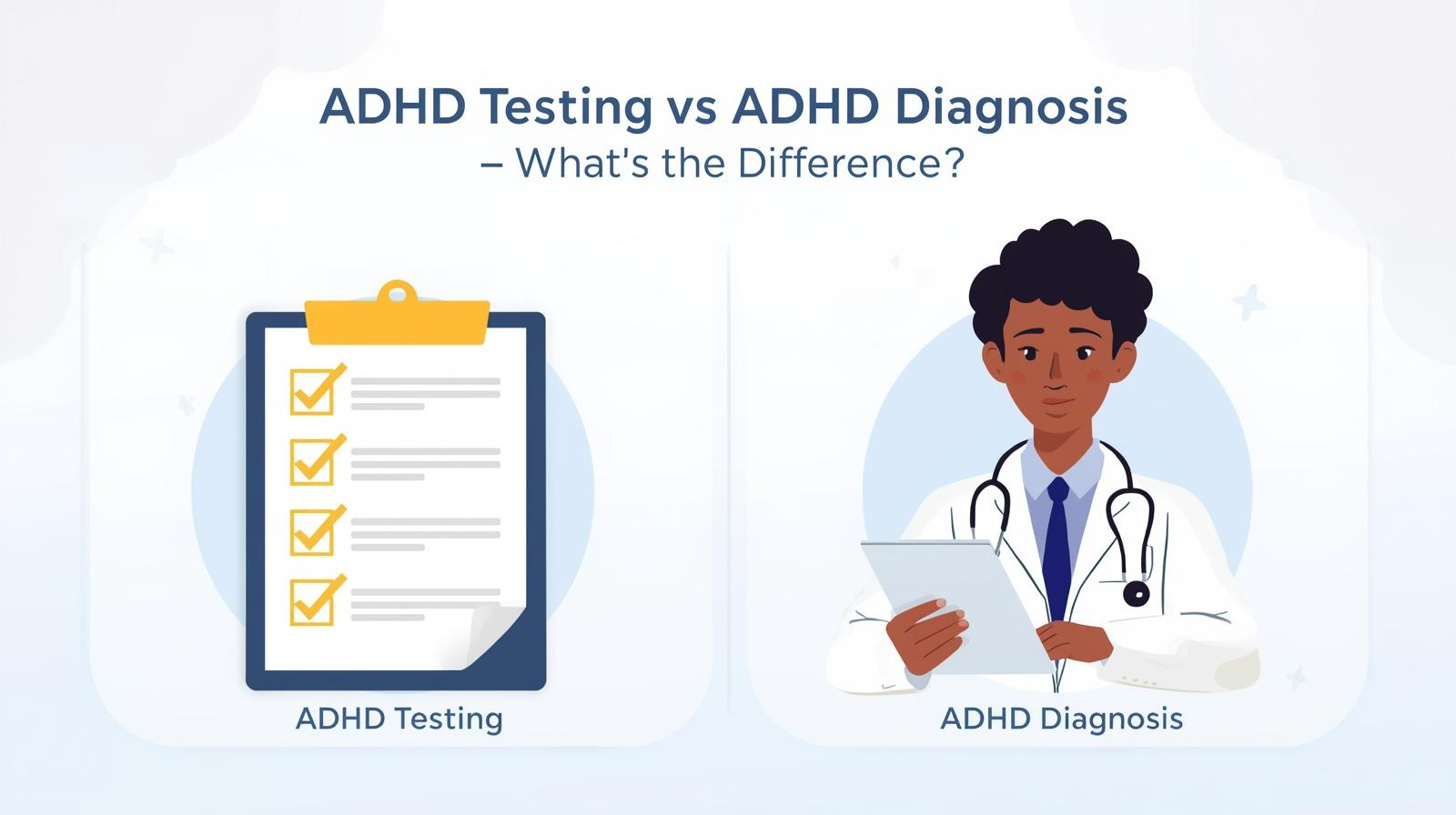
ADHD Testing vs ADHD Diagnosis — What’s the Difference?
ADHD testing and ADHD diagnosis are not the same. Learn how adult ADHD is evaluated in Pennsylvania and Delaware and why structured clinical assessment matters more than online quizzes.
If you are searching for “ADHD testing near me” or “ADHD diagnosis in Philadelphia,” you may not realize that ADHD testing and ADHD diagnosis are not the same thing.
Understanding the difference can prevent confusion — and ensure you receive the right evaluation.
At ADHD Philadelphia, we provide structured adult ADHD evaluations across Pennsylvania and Delaware, beginning with telehealth appointments and moving to in-person visits when clinically appropriate.
What Is ADHD Testing?
ADHD testing refers to objective tools used to measure attention, impulsivity, and executive functioning.
Testing may include:
Computerized attention assessments
Behavioral questionnaires
Symptom rating scales
Collateral reports when appropriate
Testing provides objective data. It measures performance patterns.
However, testing alone does not equal a diagnosis.
What Is ADHD Diagnosis?
ADHD diagnosis is a clinical decision made after reviewing:
Childhood history
Current symptoms
Functional impairment
Work and academic impact
Emotional regulation patterns
Rule-outs for overlapping conditions
Diagnosis requires clinical judgment.
Testing supports diagnosis — but does not replace a structured evaluation.
Why Testing Alone Is Not Enough
Some individuals complete online ADHD tests and assume the results confirm ADHD.
Online quizzes are not diagnostic tools.
A formal ADHD diagnosis requires:
Persistent symptoms
Functional impairment
Clinical interview
Medical and psychiatric review
Testing provides information.
Diagnosis provides clarity.
Do Adults Need ADHD Testing?
Not every adult requires computerized testing.
In some cases, a structured clinical interview is sufficient.
In other cases, testing strengthens diagnostic confidence.
The decision depends on:
Symptom presentation
History clarity
Functional impairment
Differential diagnosis considerations
A professional evaluation determines what is appropriate.
ADHD Evaluation in Pennsylvania & Delaware
Adult ADHD evaluations at ADHD Philadelphia begin with secure telehealth consultation.
After the initial appointment:
ADHD testing may be recommended
In-person visits may be scheduled when clinically appropriate
Treatment planning is discussed
There are no walk-in appointments.
The Bottom Line
ADHD testing measures performance.
ADHD diagnosis requires structured clinical evaluation.
If you are searching for ADHD testing in Philadelphia or ADHD evaluation in Delaware, make sure you are receiving a complete diagnostic process — not just a test.
Clarity begins with structured evaluation.
ADHD Testing vs ADHD Screening: What’s the Difference for Adults?
ADHD screening quizzes are not the same as comprehensive ADHD testing. Learn how adult ADHD evaluations work in Pennsylvania and Delaware and why structured diagnosis provides greater clarity.
Many adults searching for “ADHD test for adults” are unsure whether they need a quick screening or a full diagnostic evaluation.
While the terms are often used interchangeably online, ADHD screening and ADHD testing are not the same thing.
Understanding the difference helps ensure accurate diagnosis and appropriate treatment.
What Is ADHD Screening?
An ADHD screening is typically:
A short questionnaire
A self-report checklist
An online symptom quiz
Screening tools can identify whether ADHD symptoms may be present. However, they do not confirm a diagnosis.
Screenings are helpful starting points — not diagnostic decisions.
What Is ADHD Testing?
ADHD testing is part of a comprehensive diagnostic evaluation and may include:
Computerized attention testing
Behavioral questionnaires
Executive functioning measures
Testing provides objective data that supports the clinical interview.
However, ADHD diagnosis is never based on a single score.
Testing supports — but does not replace — a structured clinical evaluation.
Why a Comprehensive Evaluation Matters
Many conditions can mimic ADHD symptoms, including:
Anxiety disorders
Depression
Sleep disorders
Trauma-related conditions
A thorough adult ADHD evaluation includes:
Clinical interview
Symptom history review
Functional impairment assessment
Differential diagnosis screening
ADHD testing when appropriate
This structured process reduces misdiagnosis and improves treatment outcomes.
After Diagnosis: What Happens Next?
If ADHD is diagnosed, treatment may include:
Executive function strategies
Environmental and workflow adjustments
Medication management when appropriate
Stimulant medications require monthly follow-up appointments for monitoring and dosage adjustment.
Non-stimulant medications are typically monitored every 30–90 days depending on treatment response.
All treatment plans include structured follow-up.
Telehealth ADHD Testing in Pennsylvania & Delaware
Adult ADHD evaluations begin via secure telehealth appointments across Pennsylvania and Delaware.
In-person visits are scheduled afterward when clinically appropriate.
There are no walk-in appointments.
Take the Next Step
If you are searching for ADHD testing, ADHD assessment for adults, or ADHD diagnosis in Pennsylvania or Delaware, a comprehensive evaluation provides clarity beyond a screening quiz.
Schedule your adult ADHD evaluation today.
What Happens During an Adult ADHD Evaluation?
An adult ADHD evaluation includes a structured clinical interview, ADHD testing when appropriate, and differential diagnosis. Learn what to expect from a comprehensive ADHD assessment in Pennsylvania and Delaware.
Many adults searching for ADHD evaluation or ADHD testing near them feel unsure about what the process actually involves.
A comprehensive adult ADHD evaluation is structured, detailed, and designed to provide diagnostic clarity — not just a symptom checklist.
Step 1: Clinical Interview
The evaluation begins with a structured clinical interview reviewing:
Childhood symptom history
Current attention and executive functioning challenges
Academic and occupational functioning
Emotional regulation patterns
Sleep, anxiety, and mood history
Adult ADHD diagnosis requires evidence that symptoms are persistent and cause measurable functional impairment.
Step 2: ADHD Testing & Behavioral Measures
Depending on clinical presentation, evaluation may include:
Computerized ADHD testing
Self-report and observer questionnaires
Executive function screening tools
Testing supports the clinical interview but does not replace it.
ADHD is diagnosed through a comprehensive review — not a single score.
Step 3: Differential Diagnosis
Many conditions can mimic ADHD symptoms, including:
Anxiety disorders
Depression
Sleep disorders
Trauma-related conditions
A thorough evaluation helps rule out overlapping causes before confirming an ADHD diagnosis.
Step 4: Treatment Planning
If ADHD is diagnosed, next steps may include:
Behavioral strategy development
Executive function supports
Medication management when appropriate
Stimulant medications require monthly follow-up appointments for monitoring and safety.
Non-stimulant medications are typically monitored every 30–90 days depending on response and stability.
Telehealth ADHD Evaluations in Pennsylvania & Delaware
Adult ADHD evaluations begin via secure telehealth appointments for residents across Pennsylvania and Delaware. In-person visits are scheduled afterward when clinically appropriate.
There are no walk-in appointments.
Schedule Your ADHD Evaluation
If you are searching for ADHD evaluation, ADHD testing, or ADHD assessment for adults in Pennsylvania or Delaware, structured care can provide clarity.
Book your adult ADHD evaluation today.
How Adult ADHD Is Diagnosed in Pennsylvania
Adult ADHD diagnosis in Pennsylvania involves a structured clinical evaluation — not just a quick quiz. Learn what ADHD testing includes, how evaluations work, and what to expect from telehealth ADHD care.
Many adults in Pennsylvania search for ADHD diagnosis after years of struggling with focus, task completion, time management, or chronic overwhelm. Often, symptoms are misattributed to stress, anxiety, depression, or burnout.
Adult ADHD diagnosis is a structured clinical process. It is not based on a quick online quiz or a single symptom checklist. A comprehensive ADHD evaluation involves reviewing developmental history, current symptoms, functional impairment, and ruling out other conditions that may mimic ADHD.
What an Adult ADHD Evaluation Includes
A structured adult ADHD diagnostic evaluation typically includes:
A detailed clinical interview
Review of childhood and adult symptom history
Assessment of executive functioning challenges
Screening for anxiety, depression, sleep disorders, and other overlapping conditions
Computerized ADHD testing and behavioral questionnaires when appropriate
The goal is diagnostic clarity — not just symptom labeling.
Why ADHD Is Often Missed in Adults
In adulthood, ADHD may look different than it did in childhood.
Hyperactivity may present as internal restlessness.
Inattention may appear as chronic procrastination or difficulty starting tasks.
Impulsivity may show up as emotional reactivity or inconsistent follow-through.
Because these symptoms overlap with other mental health conditions, many adults are misdiagnosed before receiving a comprehensive ADHD evaluation.
What Happens After Diagnosis
If ADHD is diagnosed, treatment may include:
Behavioral and executive function strategies
Environmental and workflow adjustments
Medication management when appropriate
For stimulant medications, monthly follow-up appointments are required for safety monitoring and dosage adjustments.
For non-stimulant medications, follow-up appointments are typically scheduled every 30–90 days depending on treatment response and stability.
All treatment plans are individualized and include structured monitoring.
Telehealth ADHD Diagnosis in Pennsylvania & Delaware
Adult ADHD evaluations begin via secure telehealth appointments for adults throughout Pennsylvania and Delaware. In-person visits are scheduled afterward when clinically appropriate.
There are no walk-in appointments.
Take the First Step
If you are searching for ADHD diagnosis, ADHD testing, or ADHD evaluation in Pennsylvania or Delaware, structured care can provide clarity.
Schedule your adult ADHD evaluation today and begin the process toward improved focus and direction.
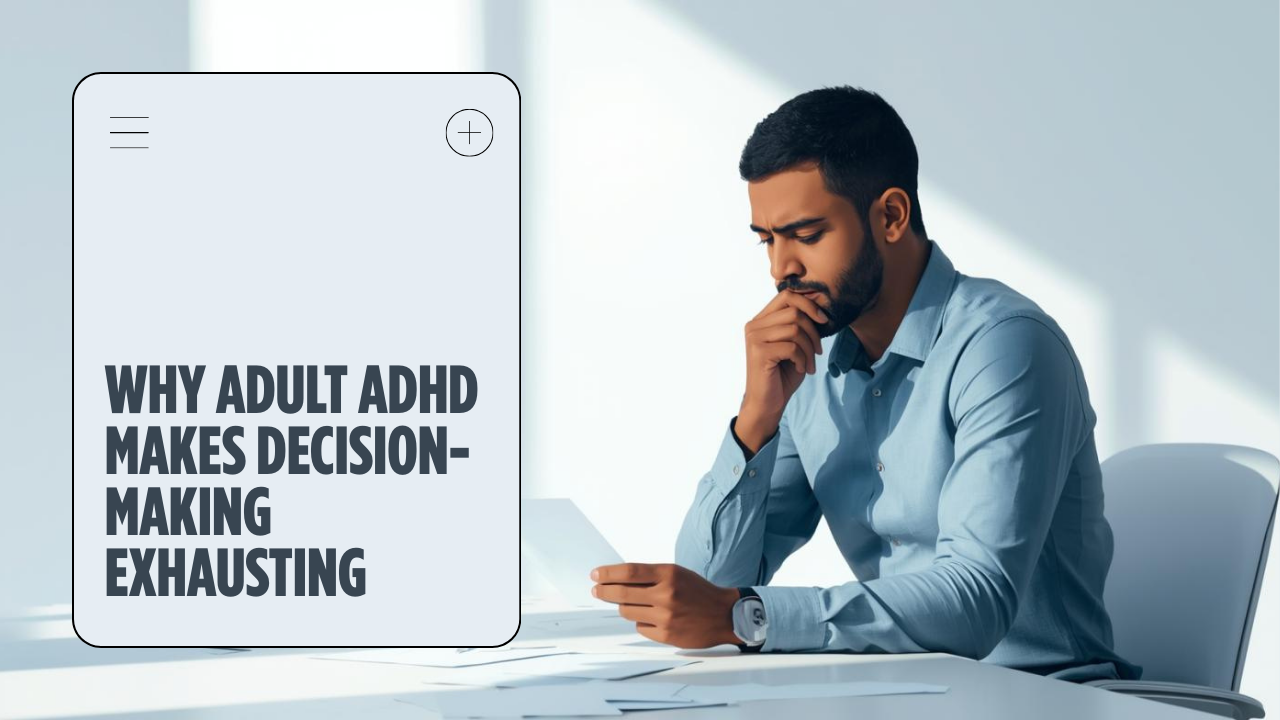
Why Adult ADHD Makes Decision-Making So Mentally Exhausting
Adults with ADHD often feel mentally drained by everyday decisions. Learn how executive dysfunction and working memory overload contribute to decision fatigue—and how proper ADHD testing and treatment can help.
Many adults with ADHD end the day feeling mentally depleted — even when they didn’t complete anything extraordinary.
The exhaustion isn’t always physical.
It’s cognitive.
Small decisions accumulate:
What to prioritize
When to respond
How to structure the day
What to say in a conversation
What to ignore
For an ADHD brain, every one of those choices carries extra weight.
Executive Dysfunction and Decision Load
Decision-making depends heavily on executive function. The brain must:
Hold multiple variables in working memory
Weigh consequences
Inhibit distractions
Filter irrelevant input
Choose and commit
In adult ADHD, working memory and inhibitory control require more effort. That means each decision consumes more mental energy than it would for someone without ADHD.
Why Even Simple Choices Feel Draining
When executive systems fatigue quickly, the brain has fewer resources left for sustained effort.
This can look like:
Avoiding decisions
Overthinking minor details
Delaying responses
Feeling paralyzed by options
Snapping after a long day
Over time, adults may internalize the belief that they are indecisive or inefficient — when in reality, their cognitive load is simply higher.
The Link Between Decision Fatigue and Burnout
When decision fatigue accumulates daily, it contributes to burnout.
Mental exhaustion increases emotional reactivity, reduces task initiation, and weakens follow-through — reinforcing the very patterns we discussed earlier in the week.
It’s not laziness.
It’s overload.
How ADHD Treatment Reduces Mental Exhaustion
When adult ADHD is properly identified, treatment aims to:
Improve executive efficiency
Reduce working memory strain
Support structured decision-making
Decrease cognitive overload
Many adults report clearer thinking and reduced mental fatigue once ADHD is addressed directly.
At ADHD Philadelphia, evaluation begins with structured telehealth appointments. In-person visits are scheduled after the initial online evaluation when appropriate. There are no walk-ins, allowing care to remain focused and individualized.
If decision-making feels disproportionately exhausting, ADHD may be part of the explanation.
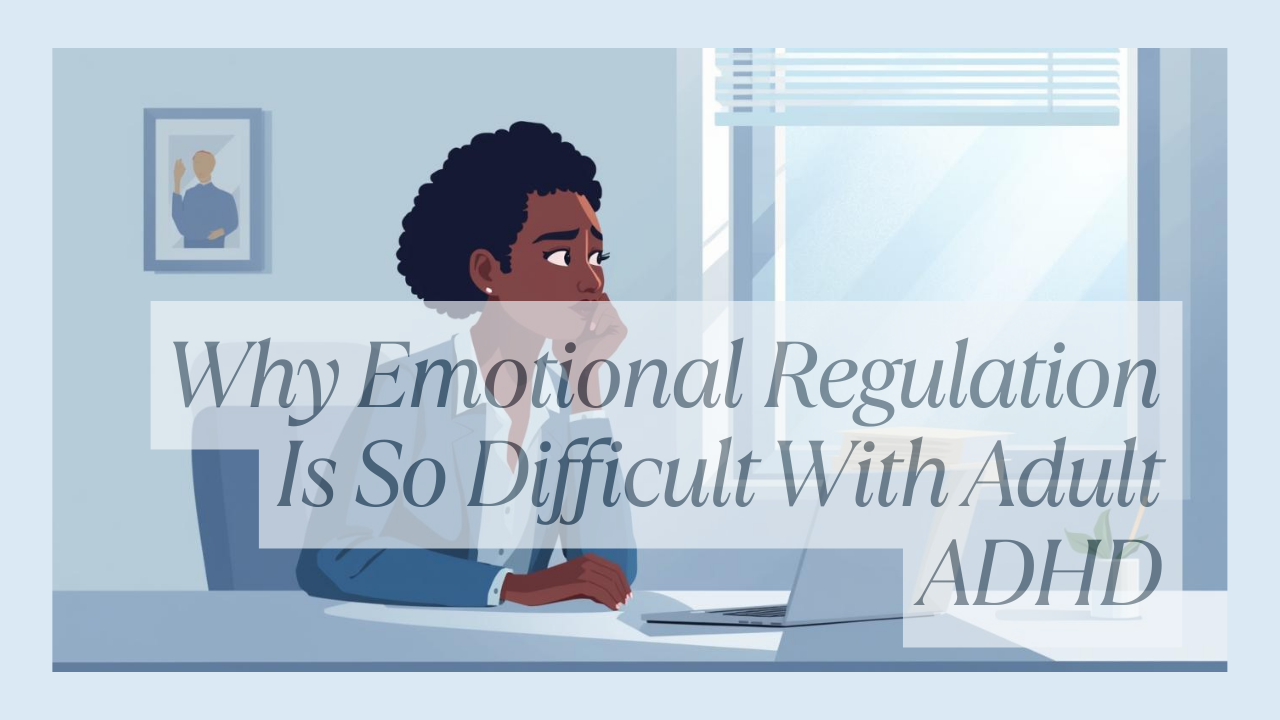
Why Emotional Regulation Is So Difficult With Adult ADHD
Emotional regulation challenges are a core part of adult ADHD. Learn why frustration escalates quickly, how executive dysfunction affects emotional control, and how proper ADHD testing and treatment can help.
When people think of ADHD, they often think about attention.
But for many adults, the most disruptive symptom isn’t focus — it’s emotion.
Frustration rises quickly.
Disappointment feels sharper.
Stress escalates faster than expected.
This isn’t about personality.
It’s about regulation.
ADHD and Emotional Control
Emotional regulation depends on executive function systems that help the brain:
Pause before reacting
Shift perspective
Moderate intensity
Recover after stress
In adult ADHD, those systems can be less efficient. Emotions don’t necessarily last longer — but they often feel stronger and harder to contain.
Why Reactions Feel Immediate
ADHD affects inhibitory control — the ability to slow down a reaction.
That split-second pause that allows someone to think, “Let me respond differently,” can be weaker. The result may look like:
Irritability
Impatience
Overwhelm
Emotional shutdown
This can create tension at work and in relationships, especially when others don’t understand what’s happening.
Stress Makes Emotional Regulation Harder
When the nervous system is already overloaded, emotional responses intensify.
Deadlines, multitasking, and decision fatigue drain executive resources. With fewer internal buffers, reactions feel bigger and faster.
Over time, adults may internalize shame about being “too sensitive” or “too reactive.”
But emotional dysregulation is a recognized component of adult ADHD.
How Treatment Supports Emotional Stability
Effective ADHD treatment doesn’t just improve attention — it helps regulate emotional intensity.
Care may focus on:
Strengthening executive function
Reducing nervous system overload
Improving pause-and-reflect capacity
Supporting consistent routines
Many adults experience more stability once their ADHD is properly addressed.
At ADHD Philadelphia, evaluation begins with structured telehealth appointments, with in-person visits scheduled afterward when appropriate. There are no walk-ins, allowing care to remain individualized and intentional.
If emotional reactions feel bigger than they should, ADHD may be part of the explanation.

Why Adult ADHD Makes Follow-Through So Difficult (Even When You Care)
Many adults with ADHD start tasks with good intentions but struggle to follow through. Learn how executive dysfunction affects consistency, why this isn’t a motivation issue, and how proper ADHD testing and treatment can help.
Many adults with ADHD don’t struggle with starting.
They struggle with finishing.
Tasks begin with intention and urgency, but somewhere along the way, momentum drops. What started clearly becomes harder to sustain. This pattern often leads to frustration, guilt, and self-doubt — especially when the task truly matters.
This isn’t a willpower issue.
It’s a follow-through problem rooted in executive function.
What Follow-Through Actually Requires
Follow-through depends on several executive skills working together, including:
Sustained attention
Working memory
Emotional regulation
Mental flexibility
In adult ADHD, these systems fatigue more quickly. The brain may lose track of steps, struggle to hold priorities in mind, or become overwhelmed as demands stack up.
The result is not a lack of care — it’s a loss of cognitive support.
Why Consistency Is Especially Hard
Consistency requires the brain to re-engage repeatedly without novelty or urgency. For ADHD brains, that’s one of the hardest things to do.
When interest fades or distractions appear, follow-through weakens. Over time, this can create a pattern of unfinished projects and internalized shame, even in high-functioning adults.
Emotional Load Makes It Worse
Tasks that carry emotional weight — responsibilities tied to work, relationships, or self-worth — drain executive resources faster.
As pressure builds, the nervous system shifts into protection mode. Avoidance may show up, not because someone doesn’t care, but because the brain is overloaded.
How Proper ADHD Care Helps
When adult ADHD is correctly identified, treatment focuses on:
Supporting sustained attention
Reducing cognitive overload
Improving emotional regulation
Creating structures that support consistency
Many adults experience improved follow-through once their brain is supported instead of pushed.
At ADHD Philadelphia, care begins with structured telehealth evaluation, with in-person appointments scheduled afterward when appropriate. There are no walk-ins, allowing care to remain focused and individualized.
If follow-through has always been harder than it should be, ADHD may be the missing explanation.
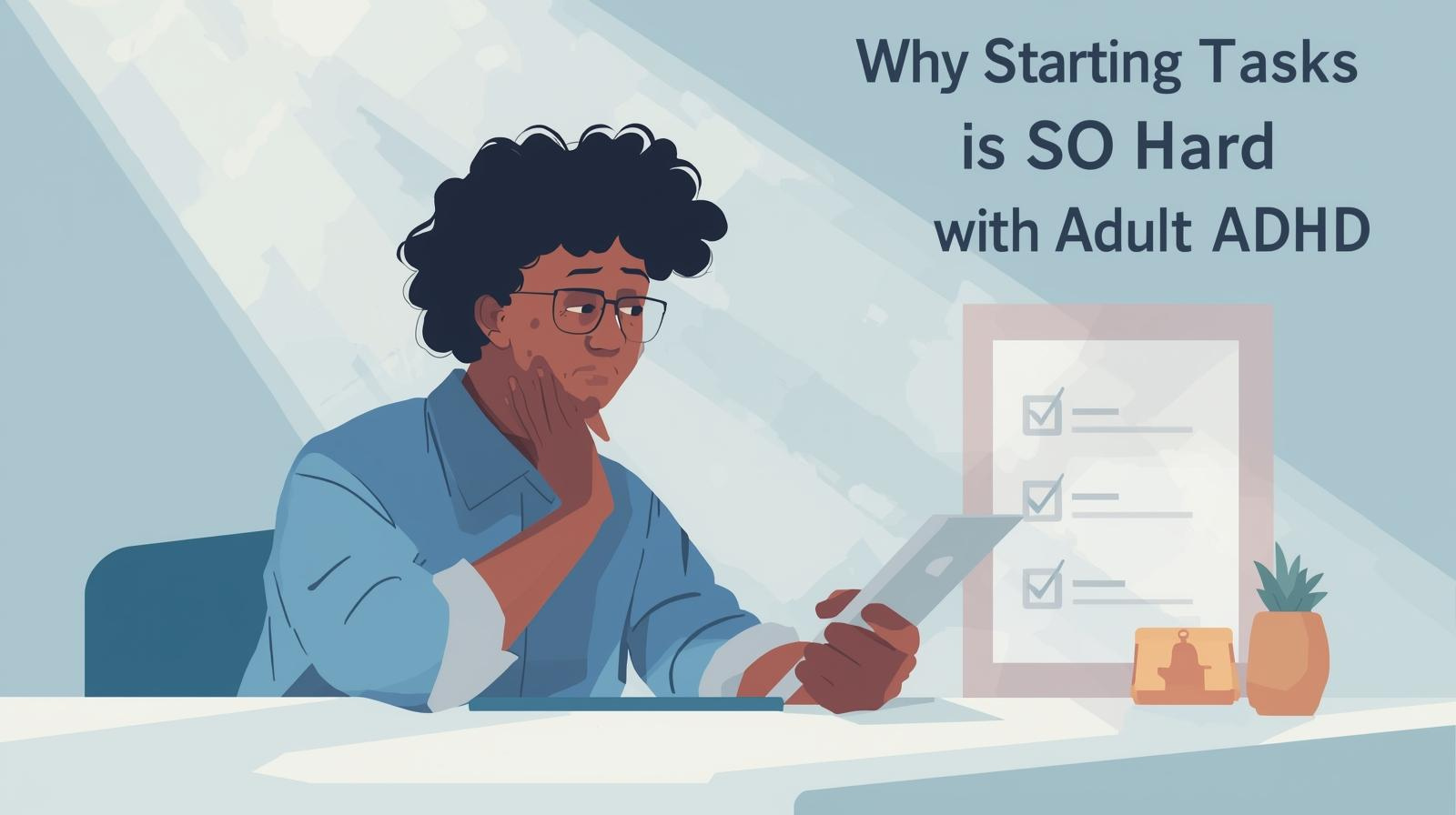
Why Starting Tasks Is So Hard With Adult ADHD
Adults with ADHD often struggle most with starting tasks, not finishing them. Learn how executive dysfunction affects task initiation, why motivation isn’t the solution, and how proper ADHD testing and treatment can help.
For many adults with ADHD, the hardest part of a task isn’t doing it —
it’s starting it.
This is one of the most misunderstood aspects of adult ADHD. From the outside, it can look like procrastination or avoidance. Internally, it feels like being stuck in place, even when you know exactly what needs to be done.
That disconnect is not a motivation problem.
It’s a task initiation problem.
What Task Initiation Really Is
Task initiation is an executive function skill. It allows the brain to:
Shift from intention to action
Activate attention at the right moment
Transition between tasks smoothly
In adults with ADHD, this system doesn’t reliably “turn on” when it should. Knowing what to do doesn’t automatically create the neurological momentum needed to begin.
This is why adults with ADHD often describe feeling “frozen” or “paralyzed” at the start of tasks — even important ones.
Why Motivation Isn’t the Fix
Many people are told they just need more motivation, better discipline, or stronger routines. But motivation is unreliable in ADHD because it’s not the primary driver of action.
ADHD brains rely more heavily on:
Interest
Urgency
External structure
Emotional engagement
When those elements are missing, starting feels nearly impossible — no matter how much someone wants to begin.
The Role of Emotional Load
Task initiation becomes even harder when a task carries emotional weight.
If a task feels:
Overwhelming
Unclear
Tied to past failures
High-stakes
The nervous system may interpret it as a threat rather than a neutral activity. That triggers avoidance — not because of fear or laziness, but because the brain is trying to protect itself from overload.
What Actually Helps With Starting
Effective ADHD treatment focuses on reducing the friction at the starting line.
This often includes:
Supporting executive function directly
Lowering cognitive and emotional load
Creating external structure instead of relying on willpower
Addressing nervous system regulation
When ADHD is properly identified and treated, many adults report that starting tasks becomes more manageable — not effortless, but possible.
Care is not about forcing productivity.
It’s about helping the brain engage when it needs to.
At ADHD Philadelphia, care begins with structured telehealth evaluation, with in-person appointments scheduled afterward when appropriate. There are no walk-ins, allowing treatment to remain intentional and individualized.
If starting tasks feels harder than it should, ADHD may be the missing explanation.

Why Adult ADHD Makes Simple Tasks Feel Overwhelming
Adult ADHD can make everyday tasks feel exhausting and overwhelming due to executive dysfunction and nervous system overload. Learn why this isn’t laziness, how stress worsens symptoms, and how proper ADHD testing and treatment can help adults regain focus and control.
Many adults with ADHD don’t struggle because tasks are hard.
They struggle because tasks are hard to start, organize, and sustain.
This distinction matters — because it explains why intelligent, capable adults can feel overwhelmed by things that look “simple” from the outside.
Answering an email.
Starting the laundry.
Making a phone call.
Following through on a plan.
When adult ADHD is involved, these tasks don’t register as small. They register as cognitively heavy.
The Role of Executive Dysfunction
Adult ADHD is fundamentally a condition of executive function — the brain systems responsible for:
Task initiation
Prioritization
Working memory
Emotional regulation
Sustaining attention
When executive function is underpowered or overloaded, the brain struggles to break tasks into manageable steps. Instead of seeing “one small thing,” the brain perceives everything at once.
This creates a feeling of overwhelm that has nothing to do with effort or motivation.
Why Overwhelm Isn’t Laziness
Many adults with ADHD grow up internalizing the belief that they are lazy, disorganized, or not trying hard enough. Over time, this self-blame can be more disabling than the symptoms themselves.
But overwhelm in ADHD is not a character flaw.
It’s a regulation issue.
When the nervous system is already taxed — by work demands, emotional stress, or constant decision-making — even minor tasks can feel impossible to start.
This is why “just push through it” rarely works.
Stress Makes ADHD Feel Worse
Stress doesn’t just coexist with ADHD — it amplifies it.
Under stress:
Focus narrows or disappears
Emotional reactions intensify
Mental fatigue increases
Task initiation becomes harder
This creates a feedback loop where overwhelm leads to avoidance, avoidance leads to guilt, and guilt increases stress.
Without proper identification and support, adults often cycle through burnout without understanding why.
Why Proper Diagnosis Changes Everything
When adult ADHD is accurately identified, the narrative changes.
Instead of asking:
“Why can’t I do this?”
People begin asking:
“What support does my brain actually need?”
Evidence-based ADHD treatment focuses on improving executive function, regulating the nervous system, and reducing unnecessary cognitive load — not forcing productivity through shame.
Many adults experience:
Reduced overwhelm
Improved task follow-through
Better emotional regulation
Increased self-compassion
Care begins with understanding — not pressure.
At ADHD Philadelphia, evaluation and treatment begin through structured telehealth care, with in-person appointments scheduled afterward when appropriate. There are no walk-ins, allowing care to remain intentional and individualized.
If simple tasks feel overwhelming, it may not be a personal failing — it may be untreated ADHD.

ADHD Burnout Isn’t a Personal Failure — It’s a Nervous System Issue
ADHD burnout is often mistaken for a lack of motivation or resilience. Learn why chronic exhaustion in adults with ADHD is a nervous system issue—and how proper support can help restore balance.
Burnout has a way of turning into self-blame.
Many adults with ADHD don’t just feel tired — they feel ashamed. Ashamed that tasks feel harder. Ashamed that motivation comes and goes. Ashamed that rest doesn’t seem to reset them the way it does for others.
But ADHD burnout isn’t a personal failure. It’s a nervous system issue.
ADHD affects executive functioning — the brain’s ability to regulate attention, emotions, energy, and task initiation. When this system is under constant demand, the result is often chronic stress, emotional exhaustion, and shutdown.
This is why telling yourself to “try harder” doesn’t work. The issue isn’t effort. It’s regulation.
When adult ADHD is properly identified and treated, many people experience:
Less emotional exhaustion
Improved self-compassion
Better pacing of energy
More sustainable focus
Care doesn’t mean pushing harder. It means supporting how your brain actually works.
At ADHD Philadelphia, care begins with a structured telehealth evaluation, followed by in-person appointments when appropriate. There are no walk-ins — care is intentional and individualized.
If you’ve been carrying burnout as a personal flaw, it may be time to look at it differently.
👉 Read more and explore next steps:
https://www.adhdphiladelphia.com/book-a-same-day-appointment
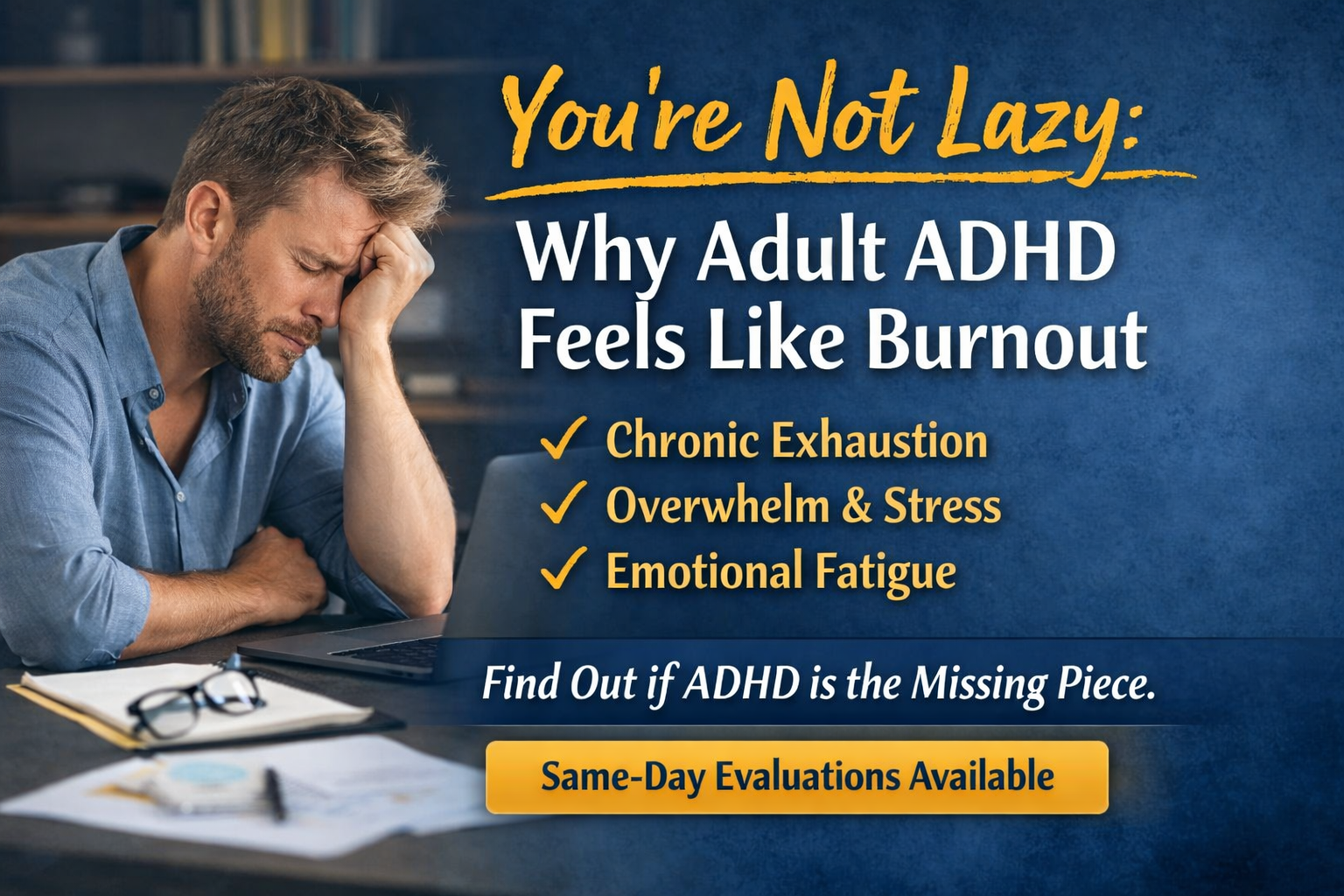
You’re Not Lazy: Why Adult ADHD Feels Like Burnout
Adult ADHD often feels like chronic burnout rather than hyperactivity. Learn why untreated ADHD leads to exhaustion and how proper treatment can restore focus, energy, and emotional balance.
Many adults with ADHD don’t feel hyper — they feel exhausted.
By the time people reach adulthood, ADHD often looks less like excess energy and more like burnout, overwhelm, and emotional fatigue. Tasks feel harder than they should. Motivation comes in short bursts. And no matter how much effort you put in, it never seems consistent.
That’s not a character flaw. It’s executive dysfunction.
Executive function controls planning, task initiation, emotional regulation, and follow-through. When ADHD goes untreated, adults often compensate by overworking, masking symptoms, or pushing themselves until burnout sets in.
This is why so many adults with ADHD are first diagnosed with anxiety or depression. The emotional toll is real — but the root cause is often neurological, not motivational.
When adult ADHD is properly identified and treated, many people report:
Less mental exhaustion
Improved task initiation
Better emotional regulation
A greater sense of control over daily life
At ADHD Philadelphia, care begins with a structured telehealth evaluation, followed by in-person appointments when appropriate. There are no walk-ins — care is intentional and personalized.
If burnout feels like your baseline, ADHD may be the missing piece.
👉 Schedule a same-day ADHD evaluation:
https://www.adhdphiladelphia.com/book-a-same-day-appointment

Why Adult ADHD Is So Often Missed — and How Proper Treatment Changes Everything
Adult ADHD is frequently overlooked or misdiagnosed as anxiety, depression, or burnout. Learn why ADHD is often missed in adults and how evidence-based treatment can help restore focus, emotional regulation, and daily functioning.
Many adults live for years believing they’re “bad at life,” unmotivated, or simply overwhelmed — without realizing the real issue is undiagnosed ADHD.
Adult ADHD doesn’t usually look like hyperactivity. It shows up as:
Chronic overwhelm
Difficulty starting or finishing tasks
Emotional dysregulation
Inconsistent performance at work
Burnout despite effort
Because these symptoms overlap with anxiety and depression, ADHD is often missed or misattributed, delaying effective treatment for years.
Why ADHD Is Commonly Missed in Adults
Symptoms evolve with age
High-functioning adults mask struggles
ADHD is mistaken for stress or personality traits
Many were never evaluated as children
ADHD is a neurodevelopmental condition, not a character flaw. When untreated, it impacts executive functioning — the brain’s ability to plan, regulate emotion, manage time, and sustain effort.
What Proper ADHD Treatment Looks Like
Effective treatment is structured, personalized, and evidence-based, often including:
Comprehensive ADHD evaluation
Medication when appropriate
Education about executive functioning
Ongoing follow-up and adjustments
When treated correctly, many adults report:
Improved focus and task completion
Reduced emotional reactivity
Better work performance
Less burnout and self-blame
Care That Fits Real Adult Life
At ADHD Philadelphia, care is designed for adults with real schedules — remote workers, parents, professionals, and students — across Pennsylvania and Delaware.
📍 Appointments start via telehealth
📍 In-person visits are scheduled after the initial online appointment
📍 No walk-ins — care is intentional and structured
Call to Action
If you’ve tried therapy, productivity hacks, or antidepressants — and still feel stuck — ADHD may be the missing piece.
👉 Book a same-day ADHD evaluation:
https://www.adhdphiladelphia.com/book-a-same-day-appointment
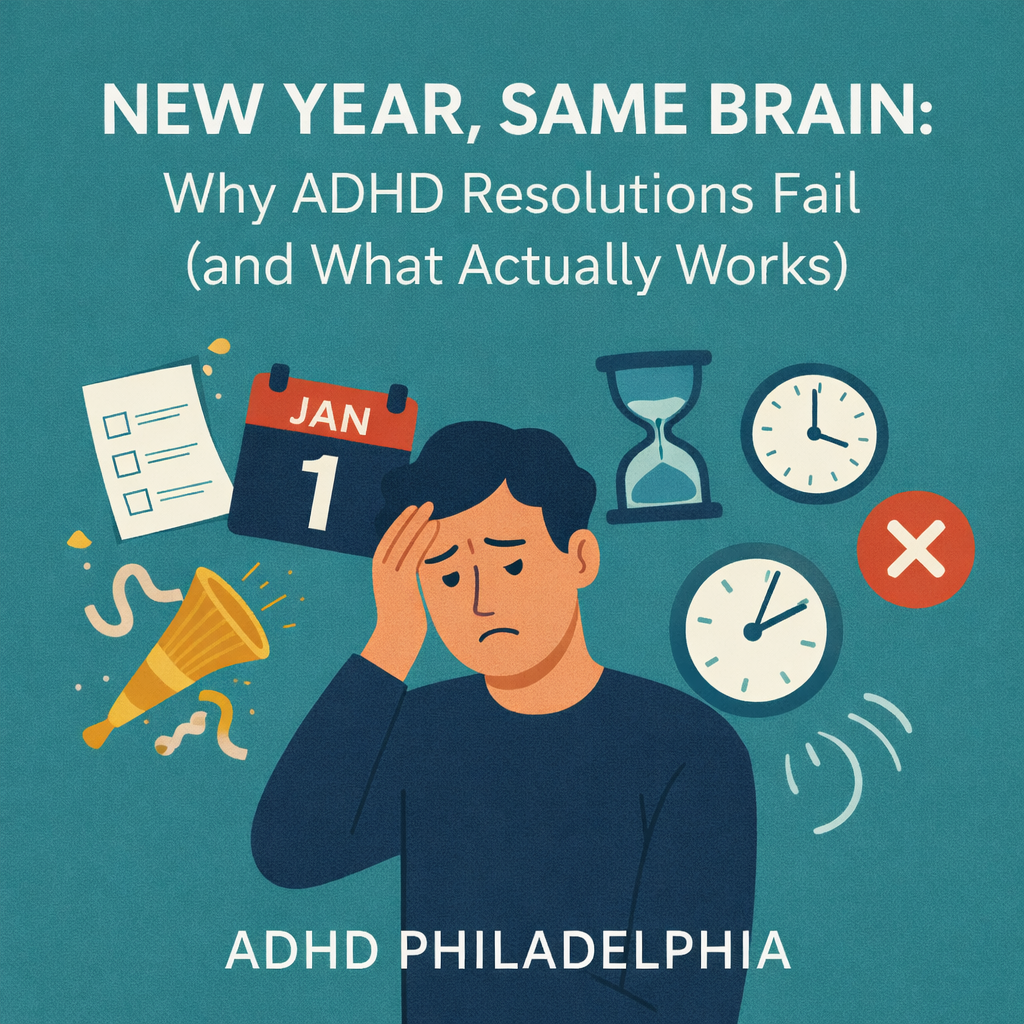
🎆 New Year, Same Brain: Why ADHD Resolutions Fail (and What Actually Works). By Charles Thornton, PMHNP-BC — ADHD Philadelphia
New Year’s resolutions often fail for adults with ADHD—not due to lack of effort, but because traditional goal-setting doesn’t match how the ADHD brain works. Learn why resolutions collapse and what actually leads to lasting change.
Every January, adults with ADHD make the same promises:
“This is the year I finally get organized.”
“I’m going to stick to routines.”
“I’ll stop procrastinating.”
“I’ll follow through this time.”
And by mid-January… the guilt sets in.
If this sounds familiar, you’re not failing — the system is failing you.
Traditional New Year’s resolutions are built for brains that thrive on long-term planning, delayed rewards, and consistent self-motivation.
The ADHD brain works differently.
At ADHD Philadelphia, I help adults across Pennsylvania and Delaware build change strategies that actually fit how their brains function — without shame.
🧠 Why Resolutions Fail in ADHD (It’s Not Willpower)
1️⃣ Resolutions Rely on Future Motivation
ADHD brains struggle to connect future rewards to present effort.
If the benefit isn’t immediate, the brain disengages.
That’s why goals like “get healthier this year” collapse quickly — there’s no dopamine today.
2️⃣ Goals Are Too Big and Too Abstract
“Be more organized.”
“Get in shape.”
“Be more productive.”
These goals overwhelm executive function.
The ADHD brain shuts down when tasks feel vague, large, or undefined.
3️⃣ Dopamine Drops After January 1st
The excitement of a “fresh start” provides a temporary dopamine boost — but it fades fast.
When dopamine drops, motivation disappears, and the brain interprets this as failure.
4️⃣ Shame Becomes the Primary Driver
Many adults with ADHD try to motivate themselves through guilt:
“I should be better by now.”
Shame does not produce consistency — it produces avoidance.
5️⃣ Time Blindness Sabotages Consistency
ADHD brains struggle with routine repetition over time.
Miss one day → feels like you’ve failed completely → the habit collapses.
🔧 What Actually Works for ADHD (Instead of Resolutions)
1️⃣ Replace Resolutions With “Systems”
ADHD thrives on external structure, not internal discipline.
Examples:
alarms instead of memory
calendars instead of intention
checklists instead of motivation
routines instead of goals
Systems reduce cognitive load and make follow-through easier.
2️⃣ Shrink Goals Until They Feel Almost Too Easy
Instead of:
❌ “Go to the gym 5 days a week”
Try:
✔️ “Put on workout clothes once a day”
Small actions trigger dopamine and build momentum.
3️⃣ Anchor Habits to Existing Routines
Don’t create new habits from scratch.
Attach them to things you already do.
Examples:
meds after brushing teeth
planning after coffee
stretching before bed
This reduces executive demand.
4️⃣ Track Effort, Not Perfection
ADHD brains are inconsistent by nature.
Progress comes from returning, not maintaining perfection.
Miss a day?
You didn’t fail — you paused.
5️⃣ Consider ADHD Treatment
When ADHD is untreated, behavior change requires enormous effort.
Medication and ADHD-informed strategies improve:
task initiation
emotional regulation
consistency
follow-through
Many adults say:
“Change finally feels possible.”
🌱 This Can Be the Year Things Actually Stick
You don’t need more motivation.
You need strategies designed for your brain.
With ADHD-aware tools and treatment, adults learn to:
stop restarting every January
build sustainable routines
let go of shame
make progress that lasts
👉 Schedule your adult ADHD evaluation today
Serving adults throughout Pennsylvania and Delaware.
🧠 ADHD and Emotional Dysregulation: Why Your Reactions Feel Bigger Than the Situation. By Charles Thornton, PMHNP-BC — ADHD Philadelphia
Emotional dysregulation is a core but often overlooked symptom of adult ADHD. Learn why emotions feel intense, fast, and overwhelming—and how treatment helps adults regain emotional balance.
Do your emotions ever feel like they arrive at full volume—without warning?
Do small frustrations turn into big reactions before you can stop them?
Do you calm down later and think, “Why did I react like that?”
This isn’t immaturity or lack of self-control.
It’s emotional dysregulation, a core feature of adult ADHD that often goes unrecognized.
At ADHD Philadelphia, I help adults across Pennsylvania and Delaware understand why ADHD affects emotional regulation—and how treatment can dramatically reduce emotional overwhelm.
🧠 What Is Emotional Dysregulation?
Emotional dysregulation refers to difficulty with:
controlling emotional intensity
slowing emotional reactions
shifting from one emotional state to another
calming the nervous system after activation
Adults with ADHD don’t just feel emotions — they feel them faster, stronger, and longer.
🔬 Why ADHD Makes Emotions Feel Bigger
1️⃣ The Prefrontal Cortex Has Less “Brake Power”
The prefrontal cortex helps regulate emotions.
In ADHD, this system activates less efficiently, making it harder to pause, reflect, or modulate reactions in the moment.
Emotion arrives before logic can catch up.
2️⃣ The Amygdala Reacts More Strongly
The amygdala (the brain’s alarm center) fires more quickly in ADHD, interpreting situations as more urgent or threatening than they are.
This leads to:
quick frustration
sudden anger
intense sadness
emotional shutdown
3️⃣ Emotions Shift Faster Than Recovery Time
ADHD brains move quickly from one emotion to another—but recovery lags behind.
This causes:
emotional whiplash
lingering reactions
feeling “stuck” emotionally
4️⃣ Rejection Sensitivity Amplifies Emotional Pain
Many adults with ADHD experience Rejection Sensitive Dysphoria (RSD).
Neutral feedback can feel deeply personal or rejecting, triggering outsized emotional responses.
🧩 How Emotional Dysregulation Shows Up in Daily Life
Adults with ADHD may experience:
snapping during minor stress
crying unexpectedly
shutting down during conflict
regret after emotional reactions
difficulty letting things go
relationship tension
workplace misunderstandings
These patterns often create shame—but they are neurological, not character flaws.
🔧 Tools That Help Regulate Emotions in ADHD
1️⃣ Slow the Nervous System First
Emotion regulation starts in the body, not the mind.
Helpful tools include:
paced breathing
grounding exercises
cold water on the face
brief movement or stretching
These calm the amygdala so thinking can return.
2️⃣ Create a “Pause Buffer”
Build in a pause before responding:
count to 10
take one deep breath
step away briefly
This gives the prefrontal cortex time to engage.
3️⃣ Name the Emotion
Labeling emotions (“I’m frustrated,” “I feel overwhelmed”) reduces intensity by activating regulatory brain networks.
4️⃣ Reduce Baseline Overload
Emotional regulation worsens when you’re:
tired
hungry
overstimulated
overwhelmed
Managing sleep, nutrition, and workload improves emotional control.
5️⃣ Medication Can Help Stabilize Emotions
ADHD medication improves:
emotional regulation
impulse control
reaction time
recovery after emotional spikes
Many adults report fewer emotional “blow-ups” and faster calming.
🌱 Emotional Balance Is Possible
Emotional dysregulation is one of the most validating symptoms to treat.
When adults understand what’s happening in their brain, shame decreases—and emotional control improves.
👉 Schedule your adult ADHD evaluation today
Serving adults throughout Pennsylvania and Delaware via telehealth.
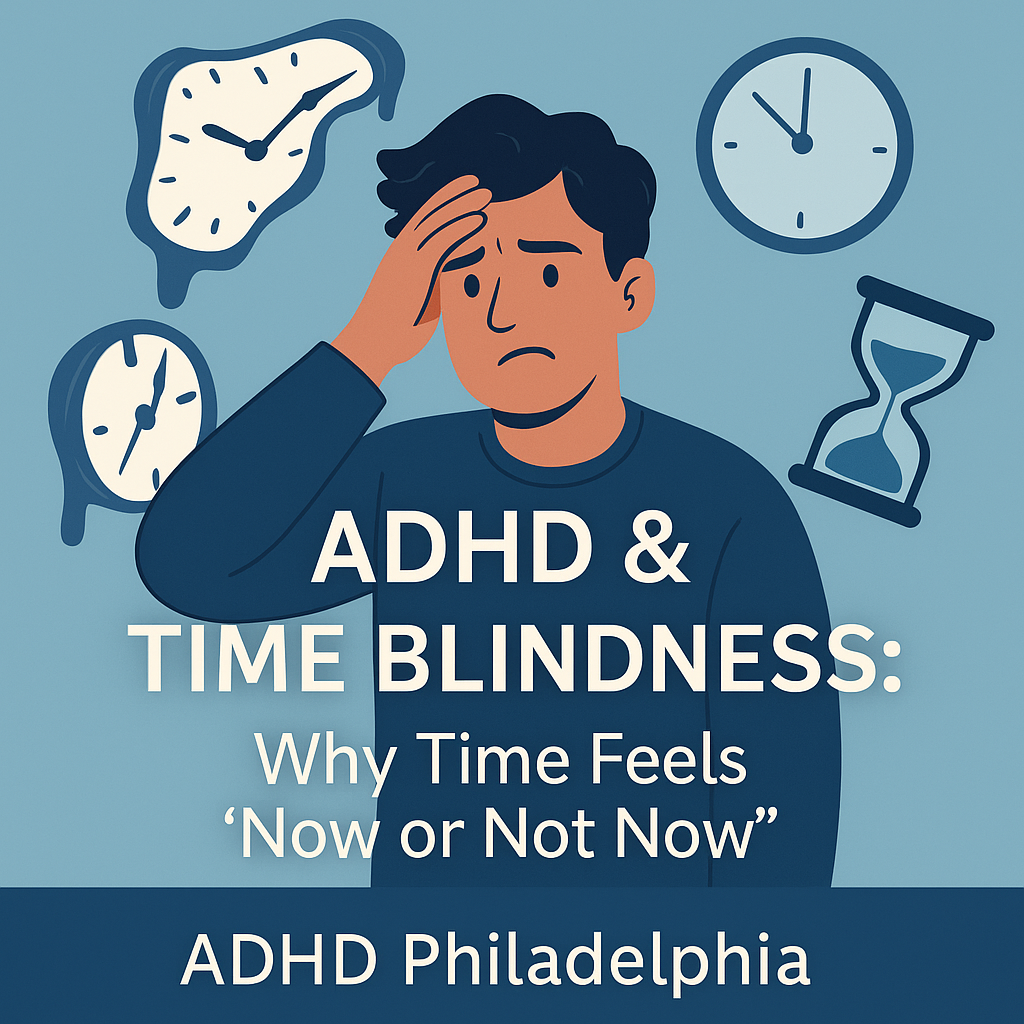
🌪️ ADHD and Time Blindness: Why Time Feels “Now or Not Now”. By Charles Thornton, PMHNP-BC — ADHD Philadelphia
Time blindness is one of the most frustrating symptoms of adult ADHD. Learn why it happens, how it affects daily life, and the evidence-based tools that help adults in PA and DE stay on track.
If you live with ADHD, you’ve probably said something like:
“How did it get so late?”
“I thought I had more time.”
“I’ll start in five minutes…” (one hour later)
“Deadlines sneak up on me even when I know they’re coming.”
This isn’t laziness or irresponsibility.
It’s time blindness, one of the core executive function challenges seen in adults with ADHD.
At ADHD Philadelphia, I help adults across Pennsylvania and Delaware understand why this happens — and how to build systems that finally make time feel manageable.
🧠 What Is Time Blindness?
Time blindness is the difficulty in:
sensing how much time has passed
estimating how long tasks will take
predicting future time demands
transitioning between activities
noticing the “flow” of time at all
Many adults describe time as “now or not now.”
If something isn’t happening right this second, it might as well not exist.
📍 Why ADHD Creates Time Blindness
1️⃣ The ADHD Brain Has Impaired Internal Timekeeping
Executive functions — specifically the prefrontal cortex — help us monitor time.
ADHD disrupts this system, making time feel abstract or unreliable.
This is why adults with ADHD often say:
“I know the deadline is next week… but it doesn’t feel real.”
2️⃣ Dopamine Drives Urgency — Not the Clock
For adults with ADHD, tasks only become “real” when they are:
interesting
rewarding
urgent
or anxiety-producing
This creates the classic ADHD cycle:
No urgency → no action → sudden urgency → hyperfocus → exhaustion.
3️⃣ Working Memory Gaps Disrupt Planning
If something isn’t in front of you, it’s easy to forget it exists.
This fuels procrastination and creates the illusion of “plenty of time.”
4️⃣ Hyperfocus Warps Time Completely
One minute feels like five hours.
Five hours feel like ten minutes.
Hyperfocus is powerful — but also dangerous when time disappears entirely.
🧩 How Time Blindness Affects Daily Life
Adults with ADHD often experience:
chronic lateness
missed deadlines
difficulty switching tasks
forgetting appointments
rushing at the last minute
underestimating task duration
relationship stress (“You’re always late”)
financial issues (late bills, fees)
These challenges feed shame and frustration — but they are neurological, not moral.
🔧 Tools That Help Fix Time Blindness
1️⃣ Externalize All Time (Never Rely on Memory)
Use:
digital timers
time-blocked calendars
visual countdowns
alarms with labels
wall clocks in every room
“time trackers” that show elapsed time
Goal: make invisible time visible.
2️⃣ Break Tasks Into Time-Based Chunks
Instead of:
“Clean the kitchen.”
Try:
“10 minutes: clear counters.”
“10 minutes: wash dishes.”
“5 minutes: sweep.”
Time chunks reduce overwhelm and increase follow-through.
3️⃣ Use “Transition Alarms”
One alarm to end a task.
Another to begin the next one.
Transitions are often the hardest part of ADHD functioning.
4️⃣ Try the “3-to-Start Rule”
Tell yourself:
“I only have to work for 3 minutes.”
This bypasses task initiation paralysis.
Once started, most adults continue naturally.
5️⃣ ADHD Medication Improves Time Awareness
Stimulants and non-stimulants can increase:
working memory
focus
task initiation
ability to sense the passage of time
Medication often reduces procrastination and deadline panic.
🌱 You Can Learn to Work With Time — Not Fight It
Time blindness is a neurological symptom, not a flaw.
With proper tools, structure, and treatment, adults with ADHD can dramatically improve their relationship with time.
👉 Schedule your adult ADHD evaluation today
Serving adults across Pennsylvania and Delaware via convenient telehealth.

🎯 ADHD and Imposter Syndrome: Why High-Achieving Adults Still Feel “Not Good Enough”. By Charles Thornton, PMHNP-BC — ADHD Philadelphia
Imposter syndrome is common in adults with ADHD—even among high achievers. Learn why ADHD creates chronic self-doubt, overcompensation, and fear of being “found out,” and how treatment helps rebuild confidence.
Many adults with ADHD are incredibly capable.
Some are top performers at work.
Some are praised as “brilliant but inconsistent.”
Some people assume they “have it all together.”
And yet… they privately feel like frauds.
This experience is so common that researchers call it ADHD-Imposter Syndrome — a blend of self-doubt, fear of being exposed, and chronic worry that success isn’t deserved.
At ADHD Philadelphia, I help adults across Pennsylvania and Delaware understand why this happens and how to break the cycle.
🧠 Why ADHD Fuels Imposter Syndrome
1️⃣ Years of Masking Create a Hidden Identity Split
Adults with ADHD spend years compensating by:
overworking
pre-planning every detail
double-checking everything
hiding struggles with focus or memory
pretending tasks are easy
Masking leads to the feeling:
“If anyone knew how hard this is for me, they’d think I’m incompetent.”
2️⃣ Inconsistent Performance Feels Like Personal Failure
ADHD causes variability: some days high-output, other days struggling with basics.
This inconsistency feeds the belief:
“My success was luck.”
“I only performed well because I tried 10x harder.”
“If I can’t do it every time, I don’t deserve credit.”
3️⃣ Emotional Intensity Amplifies Self-Doubt
ADHD intensifies emotions — including fear, embarrassment, or criticism.
So even small mistakes feel like proof of inadequacy.
A minor oversight → emotional spiral → “I’m not good enough.”
4️⃣ Rejection Sensitivity (RSD) Makes Criticism Feel Like Threat
RSD can cause adults with ADHD to interpret neutral feedback as catastrophic, reinforcing the narrative of being an imposter.
This leads to avoidance, people-pleasing, or perfectionism.
5️⃣ Working Memory Gaps Get Misinterpreted as Intelligence Gaps
Forgetting something simple? Losing a train of thought mid-conversation?
Non-ADHD adults shrug it off.
Someone with ADHD thinks:
“I must not be capable.”
But it’s neurological — not character-based.
🔧 How to Break ADHD-Imposter Syndrome
1️⃣ Externalize the Struggle (Not the Self-Worth)
Shift the inner narrative from:
❌ “I’m not capable.”
to
✔️ “My executive function creates challenges, but I can still succeed.”
This reduces shame and improves resilience.
2️⃣ Track Success, Not Just Errors
ADHD brains remember failures more vividly.
Create a “Win Log” — a list of accomplishments, even small ones.
Review weekly to rebalance your perspective.
3️⃣ Reduce Masking by Asking for Micro-Accommodations
Such as:
getting agendas before meetings
using written instructions
chunking complex tasks
scheduling focus blocks
These reduce burnout and increase confidence.
4️⃣ Reframe Variability as Part of ADHD, Not a Flaw
Performance fluctuation is expected with ADHD.
Medical treatment and structured tools decrease the swings.
5️⃣ Consider Medication
Medication often provides:
more consistent output
fewer attention lapses
reduced emotional overwhelm
improved task initiation
This directly reduces imposter syndrome triggers.
🌱 You Are Not a Fraud — You’re an Adult With ADHD
Imposter syndrome is not failure — it’s a reflection of how hard you've worked to succeed despite neurological challenges.
With proper treatment and tools, adults with ADHD learn to:
trust their abilities
value their achievements
stop overcompensating
build sustainable confidence
👉 Schedule your ADHD evaluation today
Serving adults across Pennsylvania and Delaware.
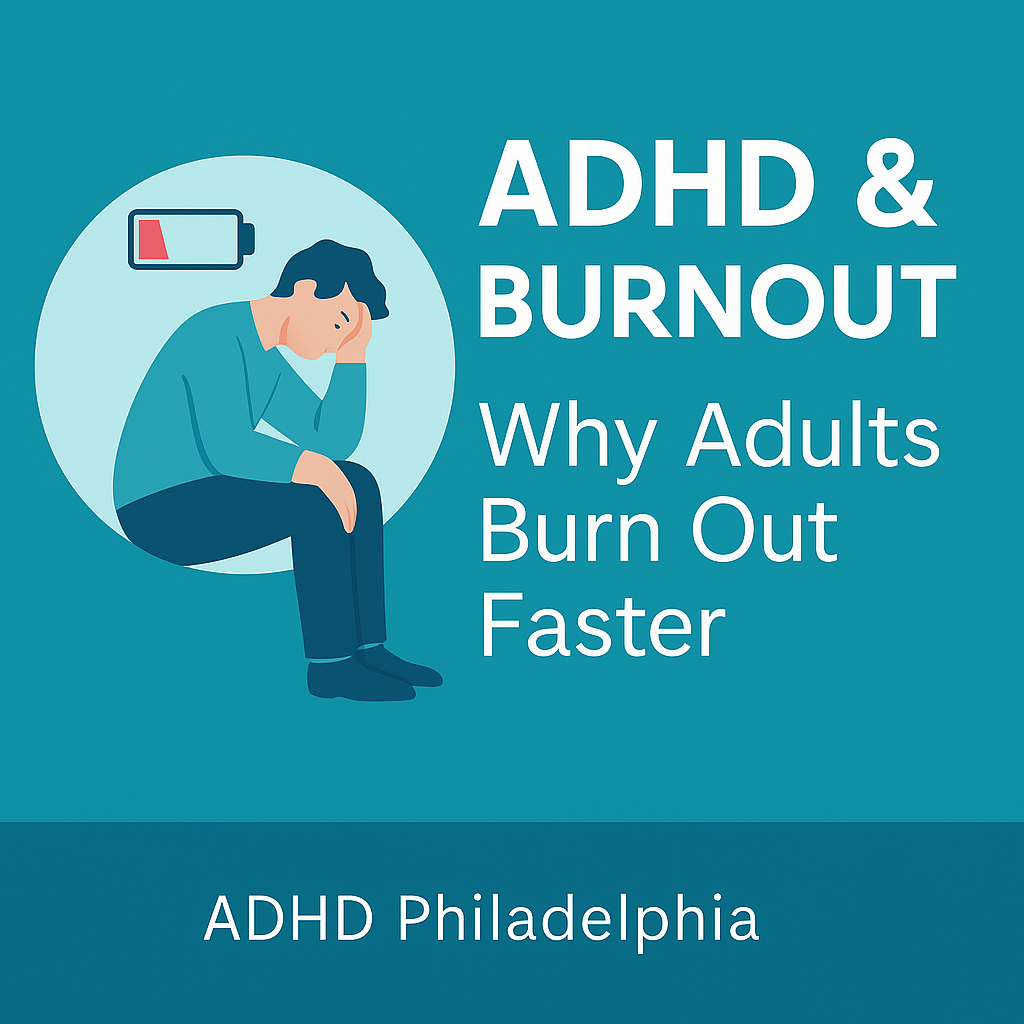
🔥 ADHD and Burnout: Why Adults With ADHD Burn Out Faster — and Recover More Slowly. By Charles Thornton, PMHNP-BC — ADHD Philadelphia
Adults with ADHD burn out more easily because their brains work harder to manage focus, emotion, and daily demands. Learn why ADHD burnout feels different—and the strategies that help you recover without guilt.
Burnout happens to everyone—but ADHD burnout is different.
It hits faster, harder, and lasts longer.
If you’re an adult with ADHD, you may cycle between periods of intense productivity and sudden collapse, where even basic tasks feel impossible. This isn’t a character flaw. It’s a neurological overload.
Research from Barkley, Nowell, Dawson, and the World Federation of ADHD shows that adults with ADHD use more cognitive energy to function in daily life. Over time, this increased effort leads to exhaustion and burnout.
At ADHD Philadelphia, we help adults across Pennsylvania and Delaware understand ADHD burnout, recognize the signs early, and rebuild healthy patterns.
🧠 Why ADHD Burnout Happens
1️⃣ Constant Executive Function Effort Drains the Brain
Adults with ADHD must work harder to:
stay organized
manage time
shift tasks
regulate emotion
maintain focus
This ongoing effort depletes mental energy faster, creating chronic exhaustion even when you appear “high-functioning.”
2️⃣ Emotional Intensity Accelerates Burnout
ADHD amplifies emotions.
Daily stress, rejection sensitivity, and overstimulation place a heavier load on the nervous system.
This leads to:
feeling overwhelmed
difficulty bouncing back
emotional crashes
3️⃣ Hyperfocus → Overwork → Crash
Hyperfocus feels productive… until it isn’t.
Many adults push themselves too hard during high-focus periods, only to crash later when dopamine dips.
This creates the cycle:
Push → Overdo → Burn out → Recover → Repeat
4️⃣ Time Blindness + Overcommitment
Adults with ADHD often say yes to too many responsibilities because they misjudge the time or energy required.
This leads to:
overscheduling
unrealistic expectations
self-blame
exhaustion
5️⃣ Rejection Sensitivity (RSD) Intensifies Stress
Fear of disappointing others can push adults with ADHD to:
overwork
people-please
ignore their limits
feel guilty resting
This emotional strain accelerates burnout.
🔧 3 Ways to Recover From ADHD Burnout
1️⃣ Reduce the Cognitive Load
Your brain needs fewer moving parts.
Try:
simplifying routines
using written reminders
breaking tasks into micro-steps
automating recurring responsibilities (bills, groceries, meds)
This frees working memory and reduces overwhelm.
2️⃣ Use “Energy Mapping”
Track your daily peak and low-energy periods.
Most adults with ADHD have predictable cycles.
Align:
important tasks to high-energy periods
repetitive or low-demand tasks to low-energy periods
This prevents over-exertion.
3️⃣ Normalize Rest as a Treatment Strategy
ADHD recovery requires intentional downtime.
Helpful rest practices include:
quiet sensory breaks
short naps
gentle physical movement
low-stimulation environments
avoiding multitasking
Rest is not earned. It is part of treatment.
💊 How Medication Helps
ADHD medication stabilizes dopamine, smooths out hyperfocus cycles, and reduces the emotional swings that contribute to burnout.
Patients often report:
steadier energy
fewer crashes
improved emotional balance
more predictable daily functioning
Medication does not eliminate stress—but it reduces the neurological load.
If you’re wondering whether your symptoms could be ADHD, read our guide “Do I Have ADHD as an Adult? 12 Signs You Should Not Ignore.”
🌱 You Can Recover From ADHD Burnout
ADHD burnout is real, and it’s treatable.
With the right strategies, support, and treatment, adults learn to pace themselves, restore energy, and rebuild a sustainable life rhythm.
👉 Schedule your ADHD evaluation today
Serving adults across Pennsylvania and Delaware.
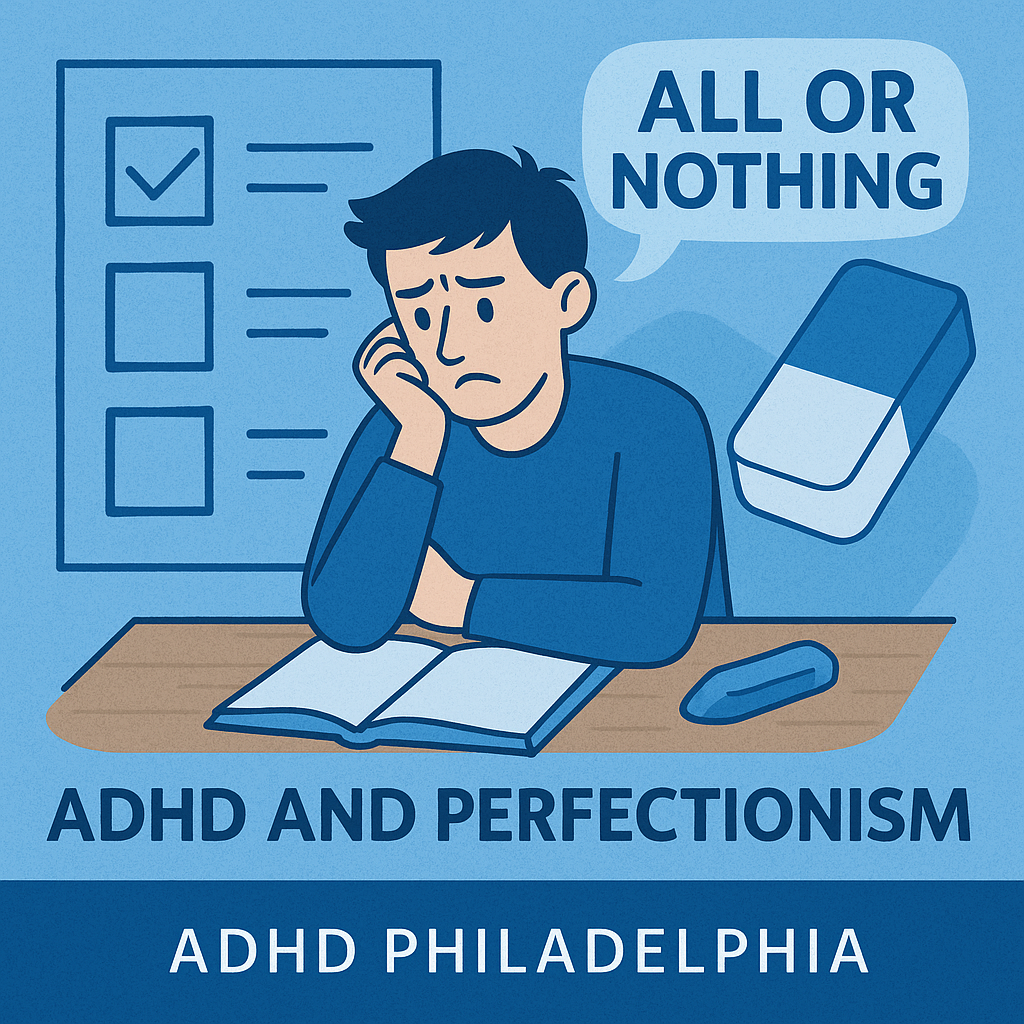
🧩 ADHD and Perfectionism: Why "All or Nothing" Thinking Takes Over. By Charles Thornton, PMHNP-BC — ADHD Philadelphia
Perfectionism is common in adults with ADHD—not because you expect too much, but because your brain fears mistakes, overwhelm, and uncertainty. Learn why ADHD fuels “all-or-nothing” thinking and how to break the cycle.
People often assume ADHD means being careless or distracted.
But for many adults, ADHD actually leads to intense perfectionism.
Not cute or quirky perfectionism —
but paralyzing perfectionism that makes starting, finishing, or sharing anything feel risky.
At ADHD Philadelphia, we help adults across Pennsylvania and Delaware understand why ADHD so often leads to “all-or-nothing” thinking — and how to break free from it using neuroscience-backed strategies.
🧠 Why ADHD Creates Perfectionism
1️⃣ Starting is Hard — So the Task Must Feel Perfect First
Adults with ADHD struggle with task initiation due to low dopamine activation.
When a task feels overwhelming, the brain uses perfectionism to avoid discomfort.
Your brain says:
“If I can’t do it perfectly, I shouldn’t start yet.”
This protects you from feeling:
frustration
confusion
overwhelm
fear of failure
But it also blocks progress.
2️⃣ Emotional Intensity Amplifies Mistakes
Research from Barkley and Wilke-Deaton shows that adults with ADHD experience emotions more intensely, which makes mistakes feel disproportionately painful.
A small error → feels like a big failure.
This causes:
rewriting emails over and over
delaying projects
avoiding criticism at all costs
3️⃣ Working Memory Makes Projects Feel Bigger Than They Are
With limited working memory, tasks feel:
vague
scattered
overwhelming
ADHD brains prefer certainty, so they lean into perfectionism to reduce ambiguity.
“If I plan every detail perfectly, I won’t get overwhelmed.”
Except… planning becomes the trap.
4️⃣ Rejection Sensitivity Makes Feedback Feel Dangerous
Many adults with ADHD experience Rejection Sensitive Dysphoria (RSD).
Perfectionism becomes armor:
“If it’s perfect, no one can criticize me.”
But this creates impossible pressure and burnout.
🔧 3 Ways to Break the ADHD Perfectionism Cycle
1️⃣ The 70% Rule
Aim to complete tasks at 70% quality, not 100%.
This retrains the brain to accept “good enough” instead of “perfect or nothing.”
Your productivity skyrockets because you’re no longer battling paralysis.
2️⃣ The “One Pass” Method
From executive function research:
Do one pass through a task without allowing revisions.
Examples:
Write the email once
Clean the room once
Outline the essay once
Revisions happen after completion, not while you're doing it.
3️⃣ Break Tasks Into "Micro Wins"
Per Nowell and Dawson, dopamine increases with early success.
Micro wins create momentum.
Try:
Write one paragraph
Tidy for 60 seconds
Read one page
Respond to one message
Small wins override perfectionistic shutdown.
💊 How Medication Helps
ADHD medication improves:
task initiation
emotional regulation
fear response
overwhelm during tasks
This reduces the anxiety that fuels perfectionism and helps you move forward without overthinking.
🌱 You Can Escape “All or Nothing” Thinking
Perfectionism isn’t a personality flaw — it’s a survival strategy for an ADHD brain trying to protect itself from discomfort, uncertainty, and emotional pain.
With treatment, tools, and practice, adults learn to work more flexibly and confidently.
👉 Schedule your ADHD evaluation today
Now serving adults across Pennsylvania and Delaware via telehealth and in-person care.