
Why So Many Moms Don’t Realize They Have ADHD Until Motherhood
Adults with ADHD often want healthier, more consistent habits but struggle to make them stick. Learn why habits can be hard to build with ADHD and what may help.
Many women live with ADHD for years without realizing it.
They may have spent most of their lives feeling overwhelmed, disorganized, forgetful, emotionally exhausted, or inconsistent, while assuming they were simply not trying hard enough.
Then motherhood changes the picture.
Suddenly, the demands on attention, time management, emotional regulation, planning, memory, routines, and follow-through increase dramatically. The coping strategies that worked before may stop working. Life becomes harder to hold together. What once felt manageable may start to feel impossible.
At ADHD Philadelphia, this is one of the most common stories adult women describe: they did not fully recognize the pattern until motherhood made their symptoms much harder to ignore.
Why ADHD Often Goes Unrecognized in Women
Many women with ADHD were never identified in childhood.
Some did well enough in school to avoid concern. Others were bright, hardworking, anxious, perfectionistic, or constantly compensating. Some were not disruptive, so their struggles were overlooked. Others were misread as careless, emotional, scattered, lazy, or “just stressed.”
ADHD in women often becomes easier to miss when the symptoms show up less as visible hyperactivity and more as:
chronic overwhelm
disorganization
difficulty following through
forgetfulness
emotional exhaustion
inconsistent routines
internal restlessness
mental clutter
That means many women reach adulthood without understanding why everyday life feels harder than it seems to be for other people.
Why Motherhood Can Bring ADHD Symptoms Into Focus
Motherhood increases executive functioning demands in every direction.
A mother may need to:
remember appointments
manage schedules
keep track of forms and deadlines
plan meals
maintain household routines
juggle work and family demands
regulate her own emotions while responding to a child’s needs
handle constant interruptions
switch attention quickly across multiple responsibilities
That level of cognitive and emotional load can make underlying ADHD much more visible.
For many moms, motherhood does not create ADHD. It reveals how much effort it was already taking to keep everything together.
Common Signs ADHD Becomes More Noticeable After Motherhood
1. Overwhelm gets much worse
Many moms describe feeling like they are constantly behind, constantly reacting, or constantly trying to catch up.
This often overlaps with feeling mentally overwhelmed, especially when there is never enough quiet time to reset.
2. Routines keep falling apart
A mother may try planners, schedules, checklists, meal plans, family systems, chore systems, or new daily routines, only to find that they work briefly and then collapse.
That is one reason many adults with ADHD struggle to stay consistent with routines.
3. Follow-through becomes harder
Motherhood often brings more unfinished tasks, more interruptions, and more competing demands.
That can make it even harder to complete what was started, return to tasks later, and stay consistent with responsibilities over time.
This is one reason adults with ADHD often have trouble following through.
4. Task initiation becomes a daily battle
Even when a mom knows exactly what needs to be done, getting started can still feel disproportionately hard.
Laundry, dishes, email, forms, meal prep, scheduling, and simple administrative tasks may all begin to pile up.
That is one reason many adults with ADHD struggle to start tasks.
5. Simple responsibilities feel heavier than they should
A lot of mothers with ADHD say the hardest part is not knowing what to do.
It is how mentally heavy everything feels.
Tasks that look small from the outside may feel cognitively exhausting on the inside.
That is one reason ADHD can make daily life feel so heavy.
6. Consistency becomes painful
Many moms care deeply. They care about their children, their families, their homes, and doing things well.
That is why it hurts so much when they still cannot seem to stay steady, organized, or consistent the way they want to.
This is one reason many adults with ADHD struggle with consistency even when they care.
What This Can Look Like in Real Life
A mother with undiagnosed ADHD might:
constantly lose track of paperwork, forms, or school deadlines
forget things she fully intended to remember
feel like she is always running late
become emotionally overloaded by noise, mess, or interruptions
start organizing systems but not maintain them
struggle to keep routines going for herself or the household
feel embarrassed by clutter or unfinished responsibilities
feel guilty for needing more structure than she can consistently maintain
wonder why everyday parenting feels harder than it seems for other mothers
Sometimes she has already developed a high level of resilience and coping.
Sometimes she has spent years holding everything together through stress, anxiety, last-minute urgency, perfectionism, or overcompensation.
But motherhood often increases the demand enough that the old coping system no longer works.
Why So Many Moms Blame Themselves
This is one of the hardest parts.
Many mothers assume the problem is:
lack of discipline
lack of effort
poor time management
stress
burnout
not being organized enough
“just needing to try harder”
And of course stress and burnout can absolutely be part of the picture.
But in some cases, the deeper issue is untreated or unrecognized ADHD.
When ADHD is not considered, a mother may spend years blaming herself for symptoms that actually reflect executive functioning difficulties, not lack of love or lack of commitment.
It Is Not a Reflection of How Much You Love Your Child
This matters.
A mother can love her child deeply and still struggle with:
organization
follow-through
memory
planning
consistency
mental overload
emotional regulation under pressure
ADHD does not mean a person cares less.
Often, it means she is carrying far more internal strain than other people can see.
Why an ADHD Evaluation Can Matter
For some women, finally understanding the pattern is a major turning point.
An adult ADHD evaluation can help clarify whether long-standing struggles with overwhelm, disorganization, follow-through, routines, and attention regulation may be part of ADHD rather than a personal failure.
That is why some moms decide to seek an ADHD evaluation for adults after years of feeling like they should be coping better than they are.
What Can Help?
The good news is that support can help.
For adults with ADHD, useful treatment may include:
structured evaluation
education about adult ADHD
practical systems that reduce cognitive load
medication when clinically appropriate
behavioral strategies
external reminders and supports
simpler routines that are easier to restart
treatment plans designed around real adult life
For some women, structured ADHD treatment can improve focus, follow-through, emotional regulation, and day-to-day functioning enough that life begins to feel more manageable.
A Mother’s Day Reflection
Mother’s Day can bring gratitude, joy, exhaustion, reflection, and sometimes guilt.
For mothers who may be living with undiagnosed ADHD, it can also bring a quiet recognition:
“Why does this feel so much harder for me than it seems to for other people?”
That question deserves compassion, not shame.
Sometimes the answer is not that a mother is failing.
Sometimes the answer is that she has been carrying ADHD symptoms for years without the language, evaluation, or support to understand them clearly.
Final Thought
If motherhood made your ADHD symptoms more noticeable, that does not mean you became weaker.
It may simply mean the demands increased enough to expose a pattern that had been there all along.
Understanding that can be the beginning of real relief.
If you are ready to explore adult ADHD testing and treatment in Pennsylvania or Delaware, you can book online today.

Why Adults With ADHD Struggle With Consistency Even When They Care
Adults with ADHD often care a great deal but still struggle to stay consistent with routines, responsibilities, and follow-through. Learn why this happens and what may help.
Many adults with ADHD care deeply.
They care about their work, their families, their goals, their responsibilities, and the promises they make to themselves and other people.
That is what makes ADHD-related inconsistency so frustrating.
The problem is usually not that the person does not care. The problem is that ADHD can interfere with the systems that help people stay steady over time.
At ADHD Philadelphia, many adults describe this experience in almost the same words: “I care a lot, but I still can’t seem to stay consistent.”
Caring and Consistency Are Not the Same Thing
Many adults grow up hearing messages like:
“If it mattered to you, you would keep up with it.”
“You just need more discipline.”
“You’re too inconsistent.”
“You do well for a while, then you fall off.”
Those messages can create a lot of shame.
But caring and consistency are not the same thing.
Consistency requires repeated activation, organization, working memory, sustained attention, emotional regulation, planning, and the ability to return to tasks over time.
Those are all areas that ADHD can affect.
This is one reason adults with ADHD may have trouble following through, even when their intentions are sincere.
What Inconsistency With ADHD Often Looks Like
Adults with ADHD may be consistent for a few days, a week, or even a month — and then suddenly lose momentum.
That inconsistency may show up as:
doing well with a routine and then dropping it
forgetting systems that were working
starting strong and fading out
following through sometimes but not reliably
doing things well under pressure, but not consistently over time
feeling like progress never fully sticks
This pattern can affect:
work
school
finances
relationships
health habits
household tasks
paperwork
communication
long-term goals
Why ADHD Can Make Consistency So Hard
1. ADHD affects self-management over time
Many adults think ADHD is only about being distracted.
But ADHD often affects the ability to regulate behavior across time.
That means the issue is not just paying attention in the moment. It is maintaining effort, returning to tasks, remembering goals, and staying organized long enough to repeat behaviors consistently.
2. Novelty fades
Adults with ADHD often do better when something is:
new
urgent
emotionally charged
highly interesting
immediately rewarding
But consistency usually depends on repetition.
And repetition can feel boring, flat, or mentally draining.
That is why adults with ADHD may do something very well at first, then struggle once the task becomes familiar.
3. Routines are harder to sustain than people realize
A lot of adults are told to “just build a routine.”
But routines require more executive functioning than people think.
To keep a routine going, a person has to:
remember it
begin it
repeat it
recover after interruptions
tolerate boredom
restart after missed days
stay engaged without immediate reward
That can be difficult for adults with ADHD, especially when life gets busy.
For many adults, that inconsistency shows up most clearly in daily routines, where even helpful systems can fall apart once life gets busy, repetitive, or overwhelming.
Link
4. Overwhelm disrupts consistency
Many adults can stay consistent until too many things pile up at once.
Once that happens, the system starts to break down.
Missed steps turn into unfinished tasks. Unfinished tasks turn into stress. Stress turns into avoidance. Avoidance makes it even harder to get back on track.
This is one reason ADHD can leave adults feeling mentally overwhelmed.
5. Starting is only part of the challenge
Some adults think their main problem is procrastination.
Others think it is motivation.
But often the challenge is broader.
Adults with ADHD may struggle to start tasks, then finally begin, then lose consistency in the middle, then have difficulty finishing.
6. The task begins to feel too heavy
Consistency gets harder when tasks begin to feel bigger, heavier, or more mentally effortful than they seem on the outside.
Adults with ADHD may know a task is “simple,” but still experience it as draining or hard to sustain.
That is one reason ADHD can make simple responsibilities feel so heavy.
7. Freeze-and-restart cycles interfere with momentum
Some adults do not just drift away from consistency. They freeze.
They may know what they need to do, want to do it, and still find themselves stuck.
Then, after delay and pressure build up, they restart. Then the cycle happens again.
This often overlaps with ADHD task paralysis.
Why This Hurts So Much Emotionally
Inconsistency can be embarrassing.
Adults with ADHD may start to doubt themselves because they know they are capable.
They may think:
“Why can’t I keep this going?”
“I was doing so well.”
“Why do I keep falling off?”
“Why can’t I be reliable all the time?”
“Why do I care so much but still struggle like this?”
That internal conflict can create shame, self-criticism, frustration, and hopelessness.
The adult may begin to mistake inconsistency for lack of character, when the real issue may be untreated ADHD affecting executive functioning.
Where Adults Often Notice ADHD-Related Inconsistency
Work
An adult may do well for short periods, then struggle to maintain the same level of follow-through, organization, or responsiveness.
Home
Cleaning systems, meal planning, finances, scheduling, paperwork, and daily responsibilities may be managed well for a time, then lost.
Health habits
Adults may start exercise plans, sleep routines, medication schedules, or self-care systems with good intentions, then have trouble maintaining them.
Relationships
People may care deeply about their loved ones but struggle to be consistent with communication, planning, follow-up, and daily tasks.
School
Adults in college, graduate school, or training programs may understand the material but struggle to maintain steady effort across assignments and deadlines.
It Is Not Always a Motivation Problem
This matters because many adults with ADHD are misread.
They may be described as:
careless
lazy
unreliable
inconsistent
not serious enough
good at talking but bad at doing
But often the adult is already trying very hard.
The issue is that ADHD can interfere with the brain-based systems that support repetition, regulation, persistence, and recovery after interruption.
That is why many adults who care deeply may still need a formal ADHD evaluation for adults.
What Can Help?
The good news is that consistency can improve.
Not by blaming yourself more, but by understanding what is actually breaking down and building support around it.
Helpful strategies may include:
Making routines smaller
Instead of trying to become perfectly consistent all at once, reduce routines to smaller, repeatable steps.
Using external reminders
Do not rely only on memory. Use calendars, alarms, checklists, visual cues, and recurring prompts.
Planning for inconsistency
Many adults do better when they assume interruptions will happen and create a restart plan instead of expecting perfect performance.
Lowering perfectionism
Some adults abandon routines because they missed a day and feel like they failed. Flexible consistency is often more realistic than all-or-nothing thinking.
Treating ADHD directly
For some adults, structured ADHD treatment may help improve attention regulation, follow-through, planning, and sustained effort. Treatment may include medication, behavioral strategies, coaching, therapy, or a combination depending on the individual.
When to Consider an ADHD Assessment
It may be worth considering ADHD testing if you:
care a lot but struggle to stay consistent
repeatedly start routines and lose them
do well in bursts but not steadily
feel frustrated by stop-and-start patterns
have trouble maintaining follow-through over time
experience work, school, or relationship problems because of inconsistency
At ADHD Philadelphia, adults in Pennsylvania and Delaware can seek structured diagnosis, testing, and treatment designed around the realities of adult ADHD.
Final Thought
If you care deeply but still struggle with consistency, that does not automatically mean you are lazy, weak, or not serious.
For many adults, it may mean ADHD is making it harder to sustain routines, manage demands, return to tasks, and stay steady over time.
That pattern is frustrating, but it is not random.
And once it is understood more clearly, it can be treated more effectively.
If you are ready to explore adult ADHD testing and treatment in Pennsylvania or Delaware, you can book online today.

Why Adults With ADHD Have Trouble Following Through
Many adults with ADHD care deeply but still struggle to follow through. Learn how task initiation, executive dysfunction, working memory, overwhelm, and time blindness can affect daily consistency.
Many adults with ADHD do not struggle because they do not care.
They struggle because following through requires more than good intentions.
It requires planning, activation, working memory, emotional regulation, organization, sustained attention, and the ability to keep going when something becomes boring, frustrating, repetitive, or mentally demanding.
A structured adult ADHD testing and evaluation process can help clarify whether difficulty following through, procrastination, forgetfulness, disorganization, and task initiation problems may be related to ADHD.
For many adults, this is also why ADHD can make it hard to stay consistent over time, even when they care deeply and genuinely want to do well.
That is why many adults with ADHD can genuinely want to do something, fully intend to do it, and still not follow through consistently.
They may start strong, lose momentum, get distracted, forget part of the process, feel overwhelmed halfway through, or stall when the task becomes less interesting than it was at the beginning.
At ADHD Philadelphia, many adults describe follow-through problems as one of the most frustrating parts of living with untreated or undiagnosed ADHD.
Good Intentions Are Not Always the Problem
Adults with ADHD are often misunderstood.
Other people may assume:
“If it mattered, you would do it.”
“You just need to be more disciplined.”
“You start things but never finish.”
“You need to try harder.”
But many adults with ADHD are already trying very hard.
The issue is not always motivation in the usual sense. The issue is often executive functioning.
Follow-through depends on being able to:
remember what needs to be done
keep the goal active in your mind
resist distractions
manage competing demands
tolerate frustration
persist without immediate reward
stay organized long enough to complete the task
When those systems are inconsistent, follow-through becomes inconsistent too.
That inconsistency is often painful for adults with ADHD because they may care a great deal and still struggle to maintain routines, momentum, and reliability over time.
Why Follow-Through Can Be So Hard With ADHD
ADHD affects more than attention.
In adults, it often affects self-management over time.
That means the challenge is not just starting. It is continuing, returning, remembering, sequencing, and finishing.
This is one reason many adults with ADHD struggle to start tasks, then later find that they also struggle to complete them.
Common Reasons Adults With ADHD Struggle to Follow Through
1. The task loses stimulation
A task may feel interesting at first, but once novelty fades, the brain may stop engaging with it in the same way.
Adults with ADHD often do well when something feels urgent, new, emotionally charged, or highly interesting. But when a task becomes repetitive or delayed, persistence can drop.
This can look like:
starting projects and leaving them unfinished
doing the exciting part but not the boring part
getting stuck in the middle
abandoning things that once felt important
2. Working memory gets overloaded
Follow-through depends on remembering what step comes next, keeping track of details, and holding goals in mind over time.
When working memory is inconsistent, adults may:
forget what they were doing
lose track of deadlines
leave tasks unfinished
miss small but important next steps
feel like they constantly have to restart
Explore our comprehensive guide to working memory in adults with ADHD for practical ways to protect instructions, next steps, deadlines, and unfinished intentions.
3. The task becomes mentally heavy
Many adults with ADHD say that even simple responsibilities can begin to feel unusually difficult once they require multiple steps or sustained effort.
That is one reason ADHD can make everyday tasks feel mentally heavy.
4. Overwhelm interrupts momentum
Adults with ADHD may begin with good intentions, but once too many demands pile up, follow-through can collapse.
The task may not seem impossible at first. But once it connects to other unfinished tasks, emotional pressure, or time stress, it can start to feel unmanageable.
This often overlaps with feeling mentally overwhelmed.
5. Perfectionism interferes with completion
Adults with ADHD do not only struggle with inattention. Many also struggle with fear of doing something poorly.
That can lead to:
overthinking instead of finishing
avoiding the final step
delaying submission
waiting until it feels “good enough”
abandoning tasks that feel imperfect
6. Transitions disrupt consistency
Following through often means returning to a task multiple times.
Adults with ADHD may struggle not only with beginning, but also with re-entering a task after interruptions, time away, or distractions.
That can create a stop-and-start cycle that makes completion much harder than it looks from the outside.
What This Looks Like in Real Life
Trouble following through may show up as:
starting projects but not finishing them
forgetting important forms, emails, or deadlines
leaving tasks half-done around the house
making plans but not carrying them out
returning to the same to-do list over and over
losing momentum after an enthusiastic beginning
letting bills, paperwork, or errands pile up
feeling embarrassed about inconsistency
Sometimes the adult knows exactly what is happening and feels frustrated.
Other times they only know that life feels harder than it should.
For many adults, follow-through problems are especially noticeable in daily routines like mornings, work organization, medication habits, and household tasks.
It Is Not a Character Flaw
This matters.
Many adults with ADHD spend years blaming themselves for inconsistency.
They may call themselves:
lazy
unreliable
careless
weak
immature
unmotivated
But trouble following through is often not about character.
It is often about how ADHD affects the systems needed to manage behavior over time.
That does not remove responsibility, but it does change the framework.
When the real problem is understood more accurately, the solution becomes more practical.
How Follow-Through Problems Affect Adult Life
At work
Adults may struggle to finish projects, respond to emails, maintain paperwork, follow through on administrative tasks, or close out important details after a strong start.
At home
Cleaning, scheduling, bills, forms, laundry, errands, and household routines may be started but not completed consistently.
In school
Assignments, studying, papers, online coursework, and deadlines may become harder to maintain over time, especially when the work is not immediately stimulating.
In relationships
Partners, family members, or friends may interpret inconsistency as a lack of care, even when the adult truly means well.
Emotionally
Repeated difficulty following through can contribute to shame, self-doubt, frustration, anxiety, and burnout.
For many adults, this becomes one of the reasons they eventually seek an ADHD evaluation for adults.
What Can Help Adults With ADHD Follow Through Better?
The good news is that follow-through can improve, especially when ADHD treatment is tailored to how ADHD actually works.
Helpful strategies may include:
Breaking tasks into visible next steps
Do not rely on “finish the project” as a usable instruction.
Instead:
open the file
write the first sentence
reply to one message
make one phone call
pay one bill
clear one surface
Smaller steps make it easier to re-engage.
Using external structure
Calendars, reminders, alarms, checklists, recurring routines, and visual cues reduce the burden on working memory.
Reducing perfection pressure
Sometimes “done enough” is more helpful than waiting for ideal conditions.
Building in accountability
Body doubling, scheduled check-ins, or external deadlines can make consistency easier.
Treating ADHD directly
For some adults, ADHD medication treatment may improve consistency, focus, activation, and persistence. Others may benefit from behavioral strategies, therapy, coaching, or a combined treatment approach.
When to Consider an ADHD Assessment
It may be worth considering an ADHD assessment if you regularly:
start things but do not finish them
forget important follow-up steps
lose momentum after good intentions
struggle to stay consistent even with things that matter
feel ashamed about repeated incompletion
experience work, school, or relationship strain because of inconsistency
At ADHD Philadelphia, adults in Pennsylvania and Delaware can seek structured diagnosis, testing, and treatment for ADHD through a respectful and practical process designed for adult life.
If follow-through problems are affecting your work, home life, routines, or confidence, you can schedule an adult ADHD evaluation today through ADHD Philadelphia.
Final Thought
If you have trouble following through, it does not automatically mean you are lazy, careless, or not serious.
For many adults, it may mean ADHD is interfering with the systems that help people stay organized, persistent, and consistent over time.
Understanding that pattern can be the first step toward changing it.
If you are ready to explore adult ADHD testing and treatment in Pennsylvania or Delaware, you can book online today.

Why ADHD Makes Simple Tasks Feel So Heavy
If small everyday responsibilities feel mentally exhausting, ADHD may be part of the reason. Learn why simple tasks can feel so heavy for adults with ADHD.
Many adults with ADHD ask themselves the same frustrating question:
Why does something so simple feel so hard?
It might be answering one email. Starting the laundry. Paying a bill. Returning a call. Making an appointment. Opening the form. Beginning the project. Cleaning one room.
Breaking those invisible steps into a visible sequence is a core part of planning skills in adults with ADHD.
From the outside, these tasks may look small.
But for many adults with ADHD, they do not feel small at all.
They feel heavy.
That heaviness can be difficult to explain to other people. It can also be difficult to explain to yourself. You may know the task is not impossible. You may know it only takes a few minutes. You may even want to get it done. But the mental effort required to begin can feel far bigger than the task itself.
At ADHD Philadelphia, many adults describe this as one of the most discouraging parts of living with undiagnosed or untreated ADHD.
Why “Simple” Tasks Do Not Feel Simple With ADHD
ADHD is not just about being distracted.
In adults, ADHD often affects executive functioning, which includes the ability to organize, prioritize, initiate, sustain effort, regulate emotion, and shift attention effectively.
That means a task is not just a task.
A “simple” task may actually require:
deciding where to begin
holding the steps in mind
tolerating boredom
resisting distractions
managing frustration
switching out of what you are currently doing
following through until the task is complete
For someone with ADHD, all of that can create friction before the task even starts.
This is one reason many adults with ADHD struggle to start tasks even when they know those tasks matter.
What That Heaviness Can Feel Like
Adults describe this experience in different ways.
Some say:
“It feels like my brain is dragging.”
“I know it’s small, but I still cannot make myself do it.”
“It feels bigger in my head than it actually is.”
“I waste so much energy thinking about doing it.”
“The task is easy. Starting it is the hard part.”
Others describe a feeling of pressure building around even minor responsibilities.
The task itself may not be difficult. But the mental activation required to begin it can feel intense.
That is one reason this experience often overlaps with ADHD task paralysis.
Why the Brain Makes Small Tasks Feel So Heavy
There are several common reasons this happens in adults with ADHD.
1. The task is under-stimulating
Tasks that feel repetitive, boring, administrative, or low-reward can be especially hard for the ADHD brain to activate around.
Examples include:
checking email
filling out paperwork
paying routine bills
organizing files
returning routine messages
cleaning and maintenance tasks
When the task offers little novelty, urgency, or emotional payoff, it may feel much harder to enter.
2. The task is not actually one step
A task that looks small from the outside often contains multiple invisible steps.
“Pay the bill” may really mean:
find the bill
log in
remember the password
check the due date
move money
confirm the payment
keep track of what was done
“Clean the kitchen” may really mean:
throw away trash
move dishes
rinse items
load dishwasher
wipe counters
put away leftovers
decide what to do next
For many adults with ADHD, the brain reacts to those hidden layers before they are even consciously named.
3. Emotional resistance builds around unfinished tasks
When adults repeatedly struggle with the same kinds of responsibilities, those tasks often pick up emotional weight.
The task stops being just a task.
It becomes tied to:
guilt
shame
avoidance
self-criticism
fear of falling behind
frustration from past failures
That emotional layer makes the task feel even heavier.
4. Switching attention takes effort
ADHD often makes transitions harder.
The task may be simple, but the shift into it is not.
Moving from rest to effort, from phone use to focus, or from one unfinished task to another can create more friction than other people realize.
5. Overwhelm changes how the task feels
When the brain is already overloaded, even small demands can feel too big.
That is why adults with ADHD often say they are not just procrastinating. They are feeling mentally overwhelmed by everyday life.
Real-Life Examples of This Pattern
This can show up in everyday ways, such as:
avoiding one email for three days
putting off a two-minute phone call
walking past clutter repeatedly without starting
delaying a refill request
not opening a document that needs attention
waiting until the last minute to handle something minor
feeling exhausted before beginning a task that should be easy
This pattern confuses many adults because they may be fully capable of handling large, high-pressure situations.
They may function well during crisis, deadlines, or high-interest work.
But smaller, quieter tasks feel heavier.
That difference is often part of how ADHD shows up in adults.
That heaviness does not just make tasks harder to begin — it can also make it harder for adults with ADHD to follow through once the initial effort wears off.
It Is Not Laziness
This point matters.
If simple tasks always feel heavier than they “should,” many adults start blaming themselves.
They may think:
“I’m lazy.”
“I’m unreliable.”
“I’m making excuses.”
“Other people can do this easily.”
“Why can’t I just do normal things?”
But the problem is often not character.
The problem is that the ADHD brain may experience effort, activation, sequencing, and emotional load differently.
That does not mean the task is impossible. It means the path into the task may require more support than people realize.
This is part of why many adults with ADHD struggle with routines even when the routine itself looks simple on paper.
How This Affects Daily Life
When simple tasks feel unusually heavy, the impact can spread across every part of adult life.
At work
Adults may delay emails, documentation, project setup, follow-up tasks, or administrative responsibilities, even when they are otherwise capable and intelligent.
At home
Bills, chores, scheduling, forms, and errands may pile up, creating visual stress and more overwhelm.
In school
Assignments, reading, online portals, discussion posts, and studying may feel harder to begin than expected.
In relationships
Other people may misread the pattern as a lack of effort, interest, or responsibility.
Emotionally
Repeated difficulty with everyday tasks can lead to shame, burnout, discouragement, and low confidence.
For many adults, these patterns eventually lead them to seek an ADHD evaluation for adults.
What Can Help?
The good news is that this symptom cluster can improve, especially when ADHD treatment is built around how adult ADHD actually works.
Helpful strategies may include:
Making the task smaller than you think it needs to be
Instead of:
“Clean the room.”
Start with:
throw away trash
move one pile
clear one surface
Instead of:
“Do the paperwork.”
Start with:
open the form
fill in your name
answer the first question
Reducing invisible steps
Externalizing the steps can make the task feel lighter.
Write them down. Put them in order. Make the beginning visible.
Lowering the emotional pressure
Sometimes the task feels heavy because it carries too much meaning.
Starting imperfectly is often better than waiting until you feel fully ready.
Using structure outside your head
Calendars, reminders, body doubling, timers, visual cues, and routines can reduce the activation burden.
Treating ADHD directly
For some adults, ADHD medication treatment may improve activation, follow-through, and the ability to get into tasks with less resistance. Others benefit from therapy, coaching, behavioral strategies, or a combined treatment plan.
When to Consider an ADHD Assessment
It may be worth considering an ADHD assessment if:
small tasks regularly feel bigger than they are
you spend excessive mental energy trying to begin routine responsibilities
you often avoid things that should take only a few minutes
unfinished tasks build into overwhelm
you feel ashamed of how hard everyday life feels
this pattern has affected work, school, home life, or confidence
At ADHD Philadelphia, adults in Pennsylvania and Delaware can seek structured evaluation, testing, and treatment through a respectful process designed specifically for adult ADHD care.
Final Thought
If simple tasks feel strangely heavy, you are not imagining it.
And you are not necessarily lazy.
For many adults, that heaviness is part of how ADHD shows up in everyday life.
Once that pattern is recognized clearly, it becomes easier to stop blaming yourself and start getting the right kind of help.
If you are ready to explore adult ADHD testing and treatment in Pennsylvania or Delaware, you can book online today.

ADHD Task Paralysis in Adults: Why You Freeze Even When You Want to Get Things Done
ADHD task paralysis can make adults feel stuck, overwhelmed, and unable to begin even important responsibilities. Learn why it happens and what may help.
Many adults with ADHD do not simply procrastinate.
Instead, they hit a wall.
They may know exactly what needs to be done. They may care about the outcome. They may even feel anxious about putting it off. But instead of moving forward, they feel frozen.
This experience is often described as ADHD task paralysis.
For adults, this can show up at work, at home, in school, or in everyday life. It may affect something as small as answering an email or something as important as finishing a project, paying bills, filling out forms, or making a necessary appointment.
If you have ever felt stuck while telling yourself, “Just do it,” only to still not move, you are not alone.
At ADHD Philadelphia, many adults describe task paralysis as one of the most frustrating and confusing parts of living with untreated or undiagnosed ADHD.
What Is ADHD Task Paralysis?
ADHD task paralysis is the feeling of being mentally unable to start, continue, or switch tasks, even when the task matters.
It is not simply laziness.
It is not always lack of effort.
And it is not necessarily a sign that someone does not care.
Instead, task paralysis often reflects difficulty with executive functioning, especially in areas like task initiation, prioritization, working memory, emotional regulation, and shifting attention.
Some adults describe it like this:
“I want to start, but my brain won’t go.”
“I keep thinking about the task, but I still don’t do it.”
“I feel overwhelmed before I even begin.”
“I freeze when there are too many steps.”
“The more important it is, the harder it can feel to start.”
For many adults, this is closely related to the difficulty many people with ADHD experience when they struggle to start tasks in the first place.
Why Task Paralysis Happens in Adults With ADHD
ADHD affects more than attention.
In adults, it can interfere with the brain’s ability to organize action, manage effort, regulate emotion, and turn intention into movement.
Task paralysis can happen for several reasons.
1. The task feels too big
When a task has too many parts, the brain may not know where to begin.
“Do the taxes.”
“Clean the house.”
“Catch up on work.”
“Fix my life.”
“Get organized.”
These are not really single tasks. They are bundles of smaller steps. For adults with ADHD, the brain may respond to that mental load by freezing instead of acting.
2. The task feels boring or unstimulating
Many adults with ADHD are able to focus when something feels urgent, novel, or emotionally engaging. But if a task feels repetitive, dull, or low-reward, it may be much harder to activate.
This can create an exhausting pattern where adults wait until panic or deadline pressure generates enough stimulation to move.
3. Perfectionism makes the task feel risky
Adults with ADHD often carry years of frustration, criticism, and self-doubt. That emotional history can make even simple tasks feel loaded.
Instead of thinking, “I’ll just start,” the brain may think:
“What if I mess it up?”
“What if I forget something?”
“What if I cannot finish?”
“What if I disappoint myself again?”
That emotional friction can make paralysis worse.
4. Overwhelm shuts down action
Sometimes adults with ADHD do not avoid a task because they do not want to do it. They avoid it because they feel too mentally flooded to begin.
That is one reason task paralysis often overlaps with feeling mentally overwhelmed.
5. Transitions are difficult
Many adults with ADHD struggle to shift from one state into another.
Examples include:
from resting to working
from scrolling to focusing
from one task to another
from thinking to doing
This difficulty with transitions can make starting feel much harder than it looks from the outside.
What ADHD Task Paralysis Looks Like in Real Life
Task paralysis does not always look dramatic.
Often it looks like everyday frustration.
Adults may:
stare at a task without starting
open a document and then close it
think about the task repeatedly all day
reorganize instead of doing the actual work
scroll on their phone while feeling guilty
make lists but not act on them
wait until the pressure becomes unbearable
avoid important responsibilities even when they care deeply
Sometimes the outside world sees procrastination.
But on the inside, the adult may feel stressed, ashamed, frustrated, and confused about why they still cannot move.
Task paralysis can be one part of a larger executive functioning pattern that also includes difficulty finishing, returning to tasks, and maintaining consistency over time.
It Is Not a Character Flaw
This matters.
Many adults with ADHD spend years believing they are lazy, irresponsible, or weak because they cannot consistently do what seems easy for other people.
They may think:
“Why am I like this?”
“Why can I do hard things sometimes but not simple things?”
“Why do I keep freezing?”
“Why can’t I just start?”
But task paralysis in ADHD is often not about character.
It is about how the brain manages activation, effort, sequencing, and emotional load.
That does not make it any less painful, but it does make it more understandable and more treatable.
For some adults, task paralysis does not just affect single projects. It also affects everyday routines that require repeated restarts and consistency over time.
How Task Paralysis Affects Work, School, and Daily Life
Task paralysis can have a major impact on adult functioning.
At work
Adults may struggle to begin reports, send emails, organize projects, or follow through on administrative tasks. This can lead to missed deadlines, underperformance, and chronic stress.
At home
Bills, laundry, dishes, scheduling, paperwork, and cleaning can pile up quickly when starting feels overwhelming.
In school
Reading, writing assignments, studying, and online coursework may become much harder to begin than expected.
In relationships
Partners or family members may misunderstand the pattern and assume the person is avoiding responsibility or not trying hard enough.
Emotionally
Task paralysis can fuel shame, anxiety, burnout, and low self-confidence over time.
For many adults, this becomes one of the reasons they finally seek an ADHD evaluation for adults.
What Can Help With ADHD Task Paralysis?
The good news is that adults with ADHD can improve task paralysis, especially when ADHD treatment is tailored to how the condition actually works.
Helpful strategies may include:
Breaking tasks into first steps
Instead of:
“Clean the kitchen.”
Start with:
put dishes in sink
throw away trash
wipe one counter
Instead of:
“Catch up on work.”
Start with:
open the file
read the first paragraph
reply to one email
Smaller steps reduce mental friction.
Using external structure
Timers, visual reminders, calendars, checklists, and body doubling can make starting easier.
Lowering the pressure to do it perfectly
Adults with ADHD often benefit from starting badly rather than waiting for the perfect moment.
Treating the ADHD directly
For some adults, ADHD medication treatment may improve activation, focus, persistence, and follow-through. Others may benefit from behavioral strategies, therapy, coaching, or a combined approach.
Understanding the pattern
Sometimes one of the most powerful first steps is realizing that task paralysis may be part of ADHD, not a moral failure.
When to Consider an ADHD Assessment
It may be worth considering an ADHD assessment if you regularly experience:
freezing when trying to start important tasks
chronic procrastination
overwhelm with multi-step responsibilities
difficulty organizing and following through
repeated stress from unfinished tasks
guilt, shame, or burnout related to productivity
a long history of “trying harder” without consistent success
This is especially important if these patterns have affected your work, school, relationships, finances, or confidence.
At ADHD Philadelphia, adults in Pennsylvania and Delaware can seek structured diagnosis, testing, and treatment for ADHD through a respectful and practical process designed for adult life.
Final Thought
If you feel frozen when trying to begin something important, that does not automatically mean you are lazy or unmotivated.
You may be dealing with ADHD task paralysis.
For many adults, this is one of the most painful and misunderstood symptoms of ADHD. But once it is recognized clearly, it can be treated more effectively.
Understanding why you freeze is often the beginning of learning how to move again.
If you are ready to explore adult ADHD testing and treatment in Pennsylvania or Delaware, you can book online today.

Why So Many Adults With ADHD Struggle to Start Tasks
Task initiation problems are one of the most frustrating symptoms of adult ADHD. Learn why starting tasks feels so hard and how treatment may help adults in Pennsylvania and Delaware.
A lot of adults with ADHD do not have a problem understanding what needs to be done.
They know the task.
They know the deadline.
They may even care deeply about getting it done.
But somehow, getting started feels much harder than it “should.”
This is one of the most misunderstood parts of adult ADHD. From the outside, it can look like procrastination, laziness, poor discipline, or lack of motivation. But for many adults, the real issue is difficulty with task initiation, which is part of executive functioning.
At ADHD Philadelphia, many adults describe this experience in similar ways:
“I keep thinking about it, but I still can’t start.”
“Once I get going, I’m often okay.”
“The hardest part is beginning.”
“I waste so much energy trying to make myself do simple things.”
If that sounds familiar, you are not alone.
That is one reason routines can feel so frustrating with ADHD — even when the steps are familiar, starting them each day can still feel harder than expected.
What Is Task Initiation?
Task initiation is the ability to begin a task without excessive delay.
That sounds simple, but it involves a lot more than just deciding to act. It requires the brain to organize, activate, prioritize, tolerate discomfort, and shift into action.
For adults with ADHD, that process can feel blocked.
You may want to:
answer an email
start a work assignment
clean one room
make an appointment
pay a bill
fill out a form
begin studying
respond to messages
Yet even small tasks can start to feel strangely heavy.
That disconnect can be frustrating, especially for adults who are intelligent, capable, and trying very hard.
Why Starting Tasks Feels So Hard With ADHD
ADHD is not simply a problem with paying attention. In adults, it often affects the brain’s ability to regulate effort, motivation, planning, and follow-through.
Task initiation can become difficult for several reasons.
1. The task does not create enough immediate stimulation
Many adults with ADHD do better with urgency, novelty, pressure, or intense interest.
If a task feels boring, repetitive, vague, or emotionally flat, the brain may not “activate” easily. This does not mean the person does not care. It often means the task is not creating enough internal traction to get movement started.
2. The task feels too big or undefined
Sometimes the problem is not the whole task. It is that the brain does not know what the first step is.
“Clean the apartment.”
“Work on taxes.”
“Fix my schedule.”
“Get caught up.”
These sound like single tasks, but they are really clusters of many tasks. Adults with ADHD often freeze when a task is too broad, too layered, or too mentally cluttered.
3. Perfectionism makes the starting point feel risky
Many adults with ADHD have years of frustration behind them. They may worry about doing something wrong, forgetting a step, losing momentum, or not finishing once they begin.
That can lead to avoidance.
It may not look like anxiety at first glance, but sometimes task paralysis is made worse by fear of failure, shame, or overwhelm.
4. Transitions are harder than people realize
ADHD often makes it harder to shift from one state to another.
For example:
from resting to working
from thinking to doing
from one task to another
from phone use to focused attention
This is why some adults can spend a long time circling a task mentally before finally beginning it.
5. Mental energy gets wasted in the “pre-start” phase
Adults with ADHD often use a lot of invisible effort before they even begin.
They may:
think about the task repeatedly
criticize themselves for not starting
open and close tabs
make lists without acting
prepare too long
wait to “feel ready”
This can be exhausting. By the time they finally try to start, they may already feel defeated.
It Is Not Laziness
This matters.
When adults with ADHD struggle to start tasks, they are often judged harshly by others and by themselves.
Over time, they may start believing things like:
“I’m unreliable.”
“I’m lazy.”
“I waste time.”
“I should be able to do this.”
“Something is wrong with me.”
But many adults with ADHD are not avoiding tasks because they do not care.
They are struggling because the brain systems involved in activation and self-management are not working efficiently.
That is very different from laziness.
Common Signs ADHD May Be Affecting Task Initiation
Adults often notice patterns like:
putting off simple tasks for days or weeks
feeling stuck even when the task is important
starting only when the deadline becomes urgent
needing pressure or panic to get moving
feeling overwhelmed by unclear tasks
procrastinating even on things they want to do
spending more time preparing than actually doing
feeling guilty about unfinished tasks almost every day
Many adults with undiagnosed ADHD have lived with these patterns for years without realizing they may be clinically meaningful.
How This Affects Daily Life
Task initiation problems can affect nearly every part of adult life.
At work
Adults may struggle to start reports, return emails, organize projects, complete paperwork, or begin important tasks until stress builds.
At home
Laundry, dishes, bills, errands, cleaning, scheduling, and follow-up tasks can pile up quickly.
In school or training
Reading assignments, studying, writing papers, and completing forms can become overwhelming.
In relationships
Partners or family members may misunderstand the problem and assume the person is avoiding responsibility.
Emotionally
Repeated difficulty starting tasks can lead to frustration, shame, low confidence, and burnout.
This is one reason many adults eventually seek an ADHD evaluation for adults. They are tired of knowing what to do but feeling unable to consistently begin.
What Can Help
The good news is that adults with ADHD can improve task initiation, especially when ADHD treatment is tailored to how ADHD actually works.
Helpful strategies may include:
Breaking the task into visible first steps
Instead of “clean the kitchen,” the first step becomes:
put dishes in sink
throw away trash
wipe one counter
Instead of “work on taxes,” the first step becomes:
open tax folder
log into account
find one document
The smaller and more specific the starting point, the easier it often becomes to begin.
External structure
Timers, reminders, calendars, checklists, body doubling, routines, and visual cues can help reduce the friction involved in starting.
Lowering the emotional load
Sometimes people wait until they feel motivated. But with ADHD, action often comes before motivation.
Starting badly is usually better than waiting for the perfect mental state.
Medication treatment when appropriate
For some adults, ADHD medication treatment may improve activation, focus, persistence, and follow-through. Treatment is individualized, and not every patient needs the same approach, but for many adults this can be an important part of care.
Better understanding of the diagnosis
Sometimes one of the most helpful steps is realizing there is a reason this has been so hard.
That understanding can reduce shame and make room for more effective strategies.
When to Consider an ADHD Evaluation
It may be worth considering an ADHD assessment if you have longstanding problems with:
starting tasks
finishing tasks
organization
follow-through
procrastination
distractibility
time management
overwhelm with everyday responsibilities
This is especially important if these issues have affected work, school, relationships, or self-esteem.
At ADHD Philadelphia, adults in Pennsylvania and Delaware can seek structured evaluation and treatment for ADHD through a respectful, professional process focused on clarity and practical next steps.
Starting tasks is only one part of the challenge. Many adults with ADHD also struggle with follow-through, unfinished tasks, and staying on track over time.
Final Thought
If you keep telling yourself, “Why can’t I just start?” you may not be dealing with a character flaw.
You may be dealing with ADHD.
For many adults, task initiation is one of the most painful and misunderstood parts of the condition. The struggle is real, but it is also treatable.
Understanding the reason behind the pattern is often the beginning of real change.
Book online at ADHDPhiladelphia.com if you are ready to explore adult ADHD testing and treatment in Pennsylvania or Delaware.

Why ADHD Is Often Mistaken for Anxiety in Adults
ADHD and anxiety share many overlapping symptoms, which often leads adults to be misdiagnosed. Learn why ADHD is frequently mistaken for anxiety and how a structured ADHD evaluation can help adults across Pennsylvania and Delaware find clarity.
Many adults spend years struggling with focus, procrastination, mental overwhelm, or difficulty completing tasks without realizing that ADHD may be contributing to their challenges. Instead, they are often told their symptoms are related to anxiety.
While anxiety and ADHD can share several overlapping symptoms, they are fundamentally different conditions that require different approaches to evaluation and treatment.
Understanding the differences between ADHD and anxiety is an important step toward receiving the right diagnosis and support.
Overlapping Symptoms Between ADHD and Anxiety
Adults with ADHD and adults with anxiety may experience many similar difficulties, including:
• difficulty concentrating
• racing thoughts
• feeling overwhelmed by responsibilities
• trouble completing tasks
• restlessness or mental agitation
Because these symptoms overlap, many adults initially receive treatment for anxiety before ADHD is considered.
However, the underlying causes of these symptoms are often very different.
A structured adult ADHD evaluation can help determine whether symptoms are related to ADHD, anxiety, or both.
How ADHD Affects Attention and Executive Function
ADHD primarily affects attention regulation and executive functioning. Executive functions are mental processes that help individuals plan, organize, prioritize tasks, and regulate focus.
Adults with ADHD may experience:
• chronic procrastination
• difficulty starting tasks
• disorganization
• difficulty completing projects
• losing track of responsibilities
• difficulty sustaining attention
These challenges often occur even when a person is highly motivated to succeed.
When executive functioning is impaired, everyday tasks can begin to feel overwhelming, which can sometimes create secondary anxiety.
How Anxiety Affects Thinking and Focus
Anxiety disorders typically involve excessive worry, fear, or anticipation of negative outcomes.
Adults experiencing anxiety may notice:
• persistent worry
• physical tension or restlessness
• difficulty relaxing
• racing thoughts related to stress or fear
• sleep disturbance
When someone is experiencing intense worry, concentration can also become difficult.
In these cases, attention problems are often secondary to anxiety rather than caused by ADHD.
Why ADHD Is Often Misdiagnosed as Anxiety
There are several reasons ADHD is frequently mistaken for anxiety in adults.
First, many adults with ADHD were never evaluated during childhood. As a result, symptoms may go unrecognized for years.
Second, ADHD symptoms often become more noticeable when responsibilities increase during adulthood, such as managing work deadlines, finances, or family responsibilities.
Third, chronic difficulty staying organized or completing tasks can create feelings of stress and overwhelm that resemble anxiety.
Because of these factors, adults may receive treatment for anxiety without realizing that ADHD may also be contributing to their symptoms.
When ADHD and Anxiety Occur Together
It is also important to recognize that ADHD and anxiety can occur at the same time.
Some adults experience both conditions, which can make symptoms more complex.
In these situations, careful clinical evaluation is important to understand how each condition may be contributing to a person’s experiences.
A structured ADHD evaluation helps clarify whether ADHD symptoms are present and whether additional conditions should be considered.
How ADHD Evaluation Works
Adults seeking clarity about their symptoms typically begin with a structured evaluation process.
At ADHD Philadelphia, adult ADHD evaluation includes:
Step 1: ADHD Consultation
A clinical consultation reviews developmental history, current symptoms, executive functioning challenges, and differential diagnosis considerations.
Step 2: ADHD Testing
Structured computerized ADHD testing may be used when clinically appropriate to provide additional objective information about attention and cognitive functioning.
This two-step process helps determine whether ADHD may be present and guides treatment recommendations.
Learn more about adult ADHD diagnosis and how structured evaluation can provide clarity.
Treatment Options for Adult ADHD
When ADHD is diagnosed, treatment may include approaches designed to improve focus, organization, and daily functioning.
Treatment options may include:
• stimulant medication management
• non-stimulant ADHD treatment options
• structured follow-up monitoring
• individualized treatment planning
Treatment decisions are based on clinical evaluation and individual needs.
Learn more about ADHD treatment options for adults and how structured care can support long-term functioning.
When to Consider an ADHD Evaluation
Adults may consider ADHD evaluation if they experience:
• persistent difficulty focusing
• chronic procrastination
• difficulty organizing responsibilities
• feeling mentally overwhelmed by everyday tasks
• difficulty completing projects despite strong effort
For many adults, understanding whether ADHD may be contributing to these experiences can provide important clarity.
ADHD Evaluation for Adults in Pennsylvania & Delaware
Adults located anywhere in Pennsylvania or Delaware can schedule an ADHD evaluation through secure telehealth appointments.
Initial evaluations are conducted through video visits, with in-person appointments available when clinically appropriate after the first appointment.

Why Adults With ADHD Procrastinate — Even When Tasks Are Important
Procrastination is one of the most frustrating symptoms of adult ADHD. Learn why task initiation is difficult for many adults with ADHD and how proper diagnosis and treatment can help.
Why Adults With ADHD Procrastinate — Even When Tasks Are Important
Many adults with ADHD describe a frustrating pattern: they know something needs to be done, they want to do it, and they understand the consequences of not doing it — yet getting started feels almost impossible.
This experience is often misunderstood as laziness or lack of motivation. In reality, procrastination in adults with ADHD is usually connected to differences in executive functioning, the brain processes responsible for planning, prioritizing, and initiating tasks.
Understanding why procrastination happens can help adults recognize that these challenges are not personal failures, but symptoms of a treatable condition.
ADHD Is a Disorder of Task Initiation
One of the core challenges in ADHD is difficulty with task initiation — the ability to start an activity without excessive delay.
Even small tasks can feel mentally overwhelming, such as:
• answering emails
• starting a work project
• paying bills
• cleaning or organizing
• completing paperwork
Adults with ADHD often describe feeling “stuck”, even when they know exactly what needs to be done.
For many people, learning more about adult ADHD diagnosis can provide clarity about why these patterns occur and how they can be addressed.
The ADHD Brain and Motivation
The ADHD brain processes motivation differently.
Research shows that individuals with ADHD may have differences in dopamine regulation in brain networks responsible for attention, reward, and motivation. Because of this, tasks that feel routine or boring can be especially difficult to start.
Instead, the ADHD brain often responds more strongly to:
• urgency
• deadlines
• novelty
• high interest
• immediate rewards
This is why many adults with ADHD notice they can work intensely under pressure but struggle with tasks that require slow, consistent progress.
Why Procrastination Creates Stress
Over time, procrastination can create significant stress in daily life.
Adults with ADHD may experience:
• missed deadlines
• unfinished projects
• financial disorganization
• workplace difficulties
• relationship conflicts
These challenges can lead to feelings of frustration, guilt, and low self-confidence.
When these patterns persist, structured ADHD testing for adults can help determine whether ADHD may be contributing to these difficulties.
What an ADHD Evaluation Looks Like
Many adults worry that the evaluation process will be complicated or time-consuming.
In reality, an ADHD evaluation is typically a structured clinical process that reviews symptoms, history, and functioning across multiple areas of life.
Learning what to expect during an ADHD evaluation can help adults feel more comfortable seeking answers about their symptoms.
The goal of the evaluation is to determine whether ADHD or another condition may be affecting attention, organization, and task initiation.
ADHD Treatment Can Improve Productivity
The good news is that effective treatment can dramatically improve many ADHD symptoms, including procrastination.
Common treatment approaches may include:
• medication management
• behavioral strategies
• executive functioning skills
• lifestyle adjustments
With appropriate ADHD treatment and medication management, many adults report improvements in focus, motivation, and the ability to start and complete tasks.
When to Consider an ADHD Evaluation
Adults may benefit from evaluation if they regularly experience:
• chronic procrastination
• difficulty starting tasks
• poor time management
• disorganization
• mental exhaustion from everyday responsibilities
These symptoms are often present for many years before someone considers ADHD as a possible explanation.
If these challenges sound familiar, you can schedule an ADHD evaluation online to determine whether ADHD may be contributing to these difficulties.
Early identification and treatment can make a meaningful difference in productivity, confidence, and overall quality of life.

Executive Dysfunction in Adults With ADHD: Why Everyday Tasks Feel So Hard
Executive dysfunction is one of the most common challenges adults with ADHD experience. It affects the brain’s ability to plan, prioritize, start tasks, and manage time. Understanding executive dysfunction can help explain why everyday responsibilities sometimes feel overwhelming and why ADHD evaluation and treatment may help.
Many adults living with attention-deficit/hyperactivity disorder (ADHD) describe a frustrating experience: they know exactly what they need to do, yet starting the task feels nearly impossible.
Bills remain unpaid, emails unanswered, and projects unfinished—not because the person lacks intelligence or motivation, but because the brain struggles with a set of processes known as executive functions.
When these systems are impaired, individuals may experience executive dysfunction, one of the most common and misunderstood challenges associated with adult ADHD.
Understanding executive dysfunction can help adults recognize why everyday tasks sometimes feel overwhelming and why an adult ADHD evaluation may provide valuable answers.
Executive dysfunction is one of the most common challenges adults with ADHD experience.
Many people describe difficulty starting everyday tasks even when they know they are important.
What Is Executive Dysfunction?
Executive functions are mental processes that allow the brain to organize behavior toward a goal. These functions help individuals plan, prioritize, initiate tasks, regulate emotions, and maintain attention.
In simple terms, executive functions act as the brain’s management system.
These cognitive processes help people:
• organize tasks
• manage time
• start and complete projects
• regulate emotions
• maintain focus
• shift attention when necessary
When executive functions are impaired, everyday responsibilities that appear simple to others may become extremely difficult.
This pattern is known as executive dysfunction.
Many adults with ADHD report feeling as though they understand what needs to be done but cannot consistently organize their thoughts and actions to complete those tasks.
Why Executive Dysfunction Occurs in ADHD
Research suggests that ADHD involves differences in brain networks responsible for attention regulation, reward processing, and executive functioning.
These systems are closely linked to activity in the prefrontal cortex, a region of the brain responsible for decision-making, impulse control, and planning.
Neurotransmitters such as dopamine and norepinephrine play an important role in these processes. When these systems are not functioning efficiently, the brain may struggle to regulate attention and motivation.
As a result, tasks that require sustained effort—such as planning a project or organizing paperwork—may feel mentally exhausting.
This is why many adults with ADHD experience difficulty initiating tasks even when they understand their importance.
Common Signs of Executive Dysfunction in Adults With ADHD
Executive dysfunction can appear in many forms. Some individuals experience only mild difficulties, while others may struggle significantly with daily organization and productivity.
Common signs include:
Difficulty Starting Tasks
One of the most frequently reported challenges is task initiation.
Many adults describe staring at a task for long periods without beginning it. Even simple activities such as sending an email or cleaning a room may feel overwhelming.
This experience is often described as ADHD task paralysis, where the brain struggles to transition from intention to action.
You can learn more about this experience in our article on ADHD Task Paralysis: Why Adults With ADHD Struggle to Start Tasks.
Chronic Procrastination
Executive dysfunction often leads to persistent procrastination.
Tasks may be delayed until the last possible moment, even when the individual understands the consequences of waiting.
This pattern is not caused by laziness but rather by difficulty organizing actions and sustaining motivation.
Difficulty Prioritizing Tasks
Adults with executive dysfunction may struggle to determine which tasks are most important.
As a result, individuals may spend time on less urgent activities while more important responsibilities remain unfinished.
Time Management Problems
Many adults with ADHD experience time blindness, which affects their ability to estimate how long tasks will take.
This can lead to chronic lateness, missed deadlines, and difficulty planning daily schedules.
Disorganization
Executive dysfunction may also cause difficulty organizing information, materials, or physical spaces.
Individuals may frequently lose important items, forget appointments, or struggle to maintain structured routines.
For practical systems addressing clutter, lost items, paperwork, and digital information, read Organization Skills in Adults With ADHD.
Emotional Effects of Executive Dysfunction
Executive dysfunction does not only affect productivity—it can also impact emotional well-being.
Many adults with ADHD experience:
• frustration with unfinished tasks
• feelings of guilt or shame
• decreased self-confidence
• chronic stress
Over time, these experiences may lead individuals to believe they are simply “not disciplined enough,” when the underlying issue is neurological rather than motivational.
Recognizing executive dysfunction as a brain-based challenge can help reduce self-criticism and encourage individuals to seek appropriate support.
When Adults Should Consider an ADHD Evaluation
Executive dysfunction can occur in several mental health conditions, including anxiety, depression, and sleep disorders.
However, when these difficulties have been present for many years—especially since childhood—ADHD may be a possible explanation.
Adults should consider seeking an evaluation if they consistently experience:
• chronic procrastination
• difficulty finishing tasks
• problems organizing responsibilities
• forgetfulness
• difficulty prioritizing work
• persistent overwhelm with daily tasks
A structured ADHD testing and evaluation for adults in Pennsylvania and Delaware can help determine whether ADHD may be contributing to these patterns.
How ADHD Testing and Evaluation Works
An adult ADHD evaluation typically involves several steps designed to understand long-standing patterns of attention and executive functioning.
A comprehensive assessment may include:
• a detailed clinical interview
• review of current symptoms
• discussion of childhood history
• evaluation of functioning in work and relationships
• screening for other mental health conditions
Because ADHD symptoms can overlap with anxiety, depression, and other conditions, a careful diagnostic process is essential.
You can learn more about the evaluation process here:
ADHD Testing & Evaluation for Adults in Pennsylvania & Delaware
ADHD Treatment Options for Adults
When ADHD is diagnosed, several treatment strategies may help improve executive functioning and daily productivity.
Treatment plans are individualized and may include a combination of approaches.
Medication Management
ADHD medications can help regulate neurotransmitter systems involved in attention and executive functioning.
For many adults, medication significantly improves focus, organization, and task initiation.
Behavioral Strategies
Structured routines and external organizational systems can help individuals compensate for executive function difficulties.
Examples include:
• task-management tools
• time-blocking schedules
• reminder systems
• simplified workflows
Therapy or Coaching
Cognitive behavioral therapy (CBT) and ADHD coaching can help individuals develop practical strategies for managing daily responsibilities.
You can read more about treatment approaches here:
ADHD Treatment & Medication Management for Adults in Pennsylvania & Delaware
ADHD Care in Pennsylvania and Delaware
Adults living in Pennsylvania and Delaware who suspect ADHD may benefit from a structured evaluation and personalized treatment plan.
ADHDPhiladelphia.com provides adult ADHD testing, diagnosis, and treatment through a telehealth model designed to help individuals understand their symptoms and improve daily functioning.
Our approach focuses on helping adults develop strategies to manage attention, organization, and executive functioning challenges.
Schedule an ADHD Evaluation
If you have been experiencing persistent difficulty with focus, procrastination, organization, or task initiation, ADHD may be a possibility.
A structured evaluation can help determine whether ADHD is present and identify treatment options that may improve productivity and overall well-being.
👉 Book an appointment today at ADHDPhiladelphia.com

Stimulant vs Non-Stimulant ADHD Medications: What Adults Should Know
Stimulant and non-stimulant ADHD medications work differently in the brain. Learn how each option helps adults improve focus and executive function.
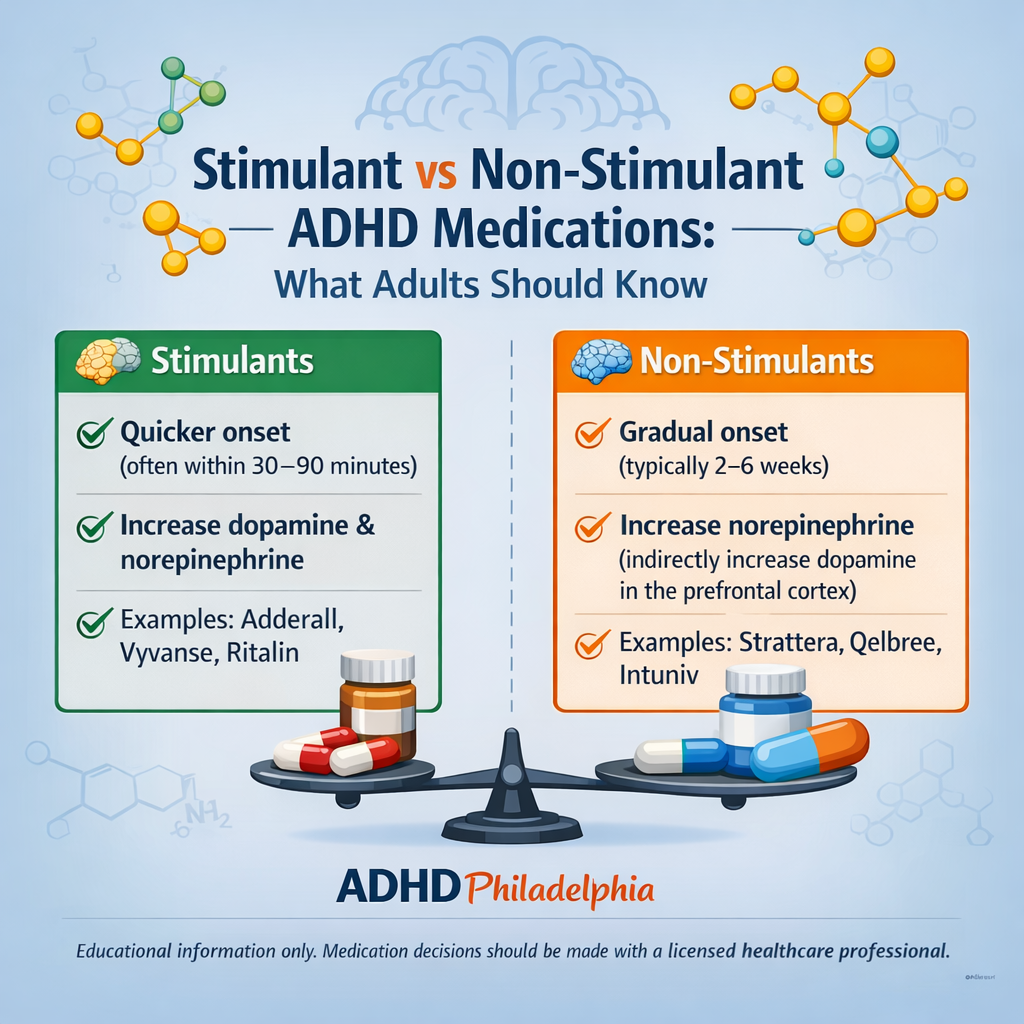
Many adults living with ADHD eventually ask the same question:
“What medication is best for ADHD — stimulants or non-stimulants?”
Understanding the difference can help patients feel more informed and confident about treatment decisions.
At ADHDPhiladelphia.com, we work with adults across Pennsylvania and Delaware who are seeking clear information about ADHD medications and how they affect the brain.
The goal is always the same: help the brain regulate focus, motivation, and executive function more effectively.
Some adults seek treatment for anxiety before realizing their symptoms may actually be related to ADHD. Because the two conditions can overlap, it’s important to understand the difference. Our article on ADHD vs anxiety in adults explains how clinicians distinguish between these conditions.
How ADHD Affects the Brain
ADHD is a neurodevelopmental condition that affects how the brain regulates attention, organization, and impulse control.
The brain regions most involved include:
• Prefrontal cortex
• Anterior cingulate cortex
• Dopamine reward pathways
• Norepinephrine attention systems
These systems help regulate:
• focus
• motivation
• working memory
• task completion
• emotional regulation
When these systems are underactive or dysregulated, everyday tasks can feel significantly harder than they should.
Medication is one of the tools that can help restore more balanced signaling in these networks.
What Are Stimulant ADHD Medications?
Stimulant medications are the most commonly prescribed treatment for ADHD.
They work by increasing the availability of dopamine and norepinephrine, two neurotransmitters that help regulate attention and motivation.
Common stimulant medications include:
• Adderall (amphetamine salts)
• Vyvanse (lisdexamfetamine)
• Ritalin (methylphenidate)
• Concerta (extended-release methylphenidate)
These medications help improve:
• sustained focus
• mental clarity
• task initiation
• impulse control
For many adults, stimulants work quickly and effectively and are often considered first-line treatment.
What Are Non-Stimulant ADHD Medications?
Non-stimulant medications are another option for treating ADHD.
They typically work more gradually by affecting norepinephrine signaling or other regulatory systems in the brain.
Examples include:
• Atomoxetine (Strattera)
• Guanfacine (Intuniv)
• Clonidine
• Certain antidepressants used off-label
Non-stimulants may be recommended when:
• stimulants cause side effects
• there is a medical reason stimulants are not appropriate
• patients prefer a non-stimulant option
• there is concern about misuse or dependence
These medications often take several weeks to reach full effectiveness.
How Doctors Decide Which Medication Is Best
Choosing the right ADHD medication is a personalized process.
Clinicians typically consider:
• symptom severity
• previous medication history
• sleep patterns
• anxiety or mood symptoms
• work demands
• medical history
The goal is to find a treatment plan that helps the brain function better while minimizing side effects.
ADHD Treatment Is More Than Medication
Medication can be a powerful tool, but it works best alongside other strategies:
• structured routines
• sleep optimization
• exercise
• ADHD coaching
• therapy when needed
Many adults experience meaningful improvement when treatment is individualized and monitored carefully.
ADHD Testing and Treatment in Pennsylvania and Delaware
If you’re an adult struggling with focus, procrastination, or mental overload, an ADHD evaluation may help provide answers.
At ADHDPhiladelphia.com, we provide:
✔ Adult ADHD evaluations
✔ Medication management
✔ Telehealth appointments across Pennsylvania and Delaware
✔ Ongoing treatment monitoring
Many adults discover that ADHD has been affecting their work, education, and daily life for years without realizing it.
The good news is that effective treatments are available.
Schedule an ADHD Evaluation
Learn more or schedule an appointment at:
https://www.ADHDPhiladelphia.com
—
Charles T
Psychiatric Nurse Practitioner
Adult ADHD Specialist

Why Adults With ADHD Struggle With Focus — and How Treatment Helps the Brain Work Better
Adults with ADHD often struggle with focus, organization, and motivation. Learn how ADHD affects the brain and how professional testing and treatment in Philadelphia and Delaware can help improve attention and daily functioning.
Why Adults With ADHD Struggle With Focus — and How Treatment Helps the Brain Work Better
Many adults believe their difficulty focusing is simply a matter of discipline or motivation. They may blame themselves for procrastination, unfinished projects, or feeling overwhelmed by tasks that seem easy for others.
However, for millions of adults, these struggles are not a character flaw. They are often symptoms of Attention-Deficit/Hyperactivity Disorder (ADHD) — a neurodevelopmental condition that affects how the brain regulates attention, motivation, and executive functioning.
Understanding what is happening in the brain can help people realize that effective treatment is available and that improvement is possible.
ADHD Is a Brain Regulation Condition
ADHD affects the brain systems responsible for executive functioning, which includes:
Sustaining attention
Organizing tasks
Managing time
Prioritizing responsibilities
Regulating impulses
Maintaining motivation
These skills rely heavily on activity in the prefrontal cortex, a region of the brain responsible for planning, decision-making, and attention regulation.
Research shows that people with ADHD often experience differences in dopamine and norepinephrine signaling within these brain networks, which can make it more difficult to maintain consistent attention and motivation.
This means a person with ADHD can focus, but often struggles to do so when they need to, for as long as they need to, or on tasks that are not immediately rewarding. manual-executive-function-adhd-…
Common Signs of Undiagnosed Adult ADHD
Many adults do not realize their symptoms may be related to ADHD. Some of the most common experiences include:
• Difficulty finishing projects
• Losing focus during conversations
• Forgetting appointments or deadlines
• Feeling overwhelmed by organization tasks
• Procrastinating even on important responsibilities
• Struggling with time management
• Frequently switching between tasks without completing them
Because ADHD often persists from childhood into adulthood, many people have lived with these challenges for years without realizing there may be an underlying explanation.
Why ADHD Often Goes Undiagnosed in Adults
Adult ADHD is commonly overlooked for several reasons:
1️⃣ Symptoms may have been misunderstood during childhood
2️⃣ Adults develop coping strategies that mask symptoms
3️⃣ Many people assume ADHD only affects children
4️⃣ Symptoms overlap with stress, anxiety, or depression
As a result, adults may struggle silently while assuming their challenges are simply part of their personality.
The Good News: ADHD Is Treatable
The encouraging reality is that ADHD is one of the most treatable conditions in mental health.
Treatment may include:
Evidence-based medication options
Behavioral strategies
Executive function skill development
Structured routines and planning systems
Stimulant and non-stimulant medications are among the most researched and effective treatments available for ADHD when prescribed and monitored appropriately. manual-advances-management-adhd
Many adults experience significant improvement in focus, productivity, and overall quality of life once treatment begins.
ADHD Testing and Treatment in Pennsylvania and Delaware
At ADHDPhiladelphia.com, we specialize in evaluating and treating adult ADHD through a structured, professional process designed to help individuals better understand their symptoms and develop an effective treatment plan.
Services include:
Adult ADHD evaluation
Medication management when appropriate
Ongoing monitoring and follow-up care
Personalized treatment planning
Appointments begin through secure telehealth, allowing patients to receive care from the comfort of home.
When appropriate, in-person appointments may be scheduled after the initial telehealth visit.
When to Consider ADHD Testing
You may want to consider an evaluation if you regularly experience:
• Persistent difficulty focusing
• Chronic procrastination
• Trouble organizing tasks
• Problems finishing projects
• Frequent mental overwhelm
• Difficulty managing responsibilities
Seeking professional evaluation can provide clarity and help determine whether ADHD may be contributing to these challenges.
Moving Forward
If you believe ADHD may be affecting your focus or daily functioning, professional evaluation can provide answers and help guide effective treatment options.
You can learn more about testing and treatment options at: