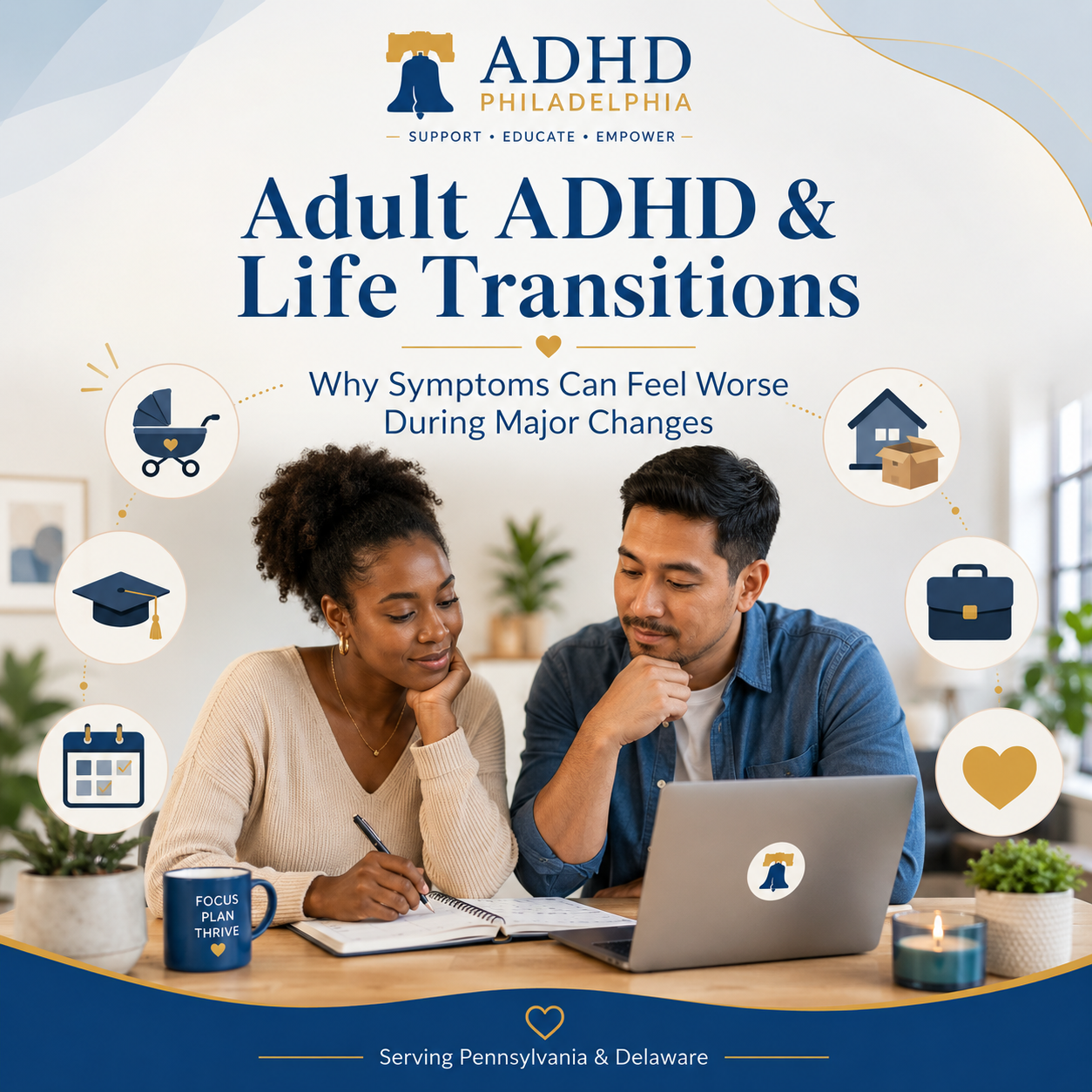
Why Adult ADHD Gets Worse During Major Life Transitions
Major life changes can make adult ADHD symptoms feel worse. Learn why transitions affect focus, routines, emotional regulation, and follow-through — and how ADHD testing and treatment in Pennsylvania and Delaware may help.
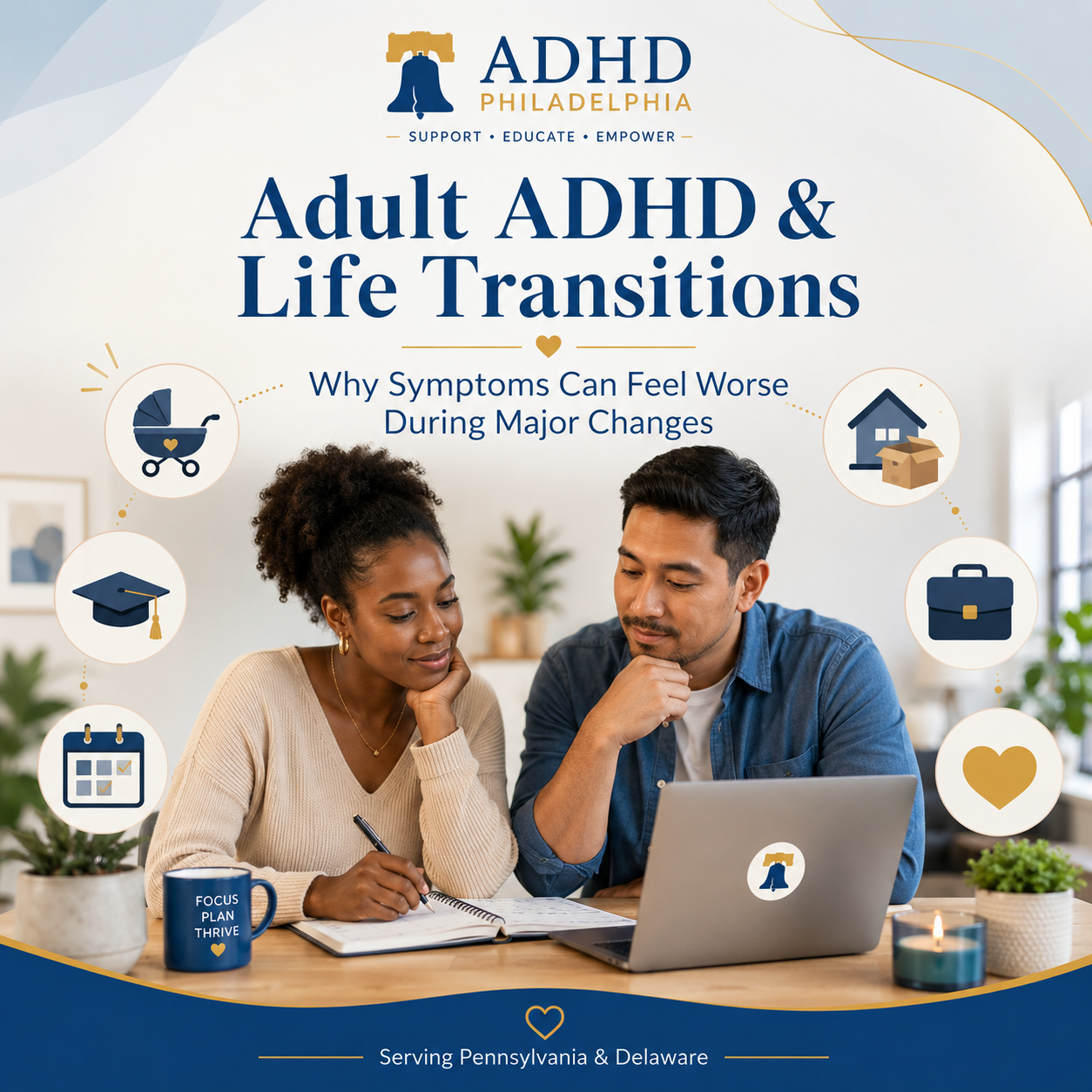
Why Adult ADHD Gets Worse During Major Life Transitions | ADHD Philadelphia
Major life transitions can make adult ADHD symptoms feel much harder to manage.
A new job. A move. A promotion. A breakup. A marriage. Becoming a parent. Returning to school. Starting a business. Losing structure. Working remotely. Graduating from college. Caring for aging parents. Going through grief. Adjusting to a new schedule.
Even positive changes can create stress.
For adults with ADHD, these transitions can disrupt the routines, structure, and coping systems that were helping them function. Many people do not realize how much they were relying on familiar patterns until those patterns suddenly change.
That is often when ADHD symptoms become more noticeable.
An adult may begin asking:
“Why am I suddenly so scattered?”
“Why can’t I keep up anymore?”
“Why am I forgetting everything?”
“Why does my brain feel overwhelmed by normal responsibilities?”
“Why did my ADHD symptoms get worse?”
The truth is that ADHD does not always suddenly become worse overnight. More often, life becomes more demanding, less predictable, and harder to manage. When structure disappears and responsibilities increase, symptoms that were once manageable may become harder to ignore.
For adults in Pennsylvania and Delaware, understanding this pattern can help determine whether adult ADHD testing and treatment may be appropriate.
Adult ADHD Is Often a Problem of Regulation, Not Effort
One of the most misunderstood parts of adult ADHD is that it is not simply a lack of attention.
Many adults with ADHD can focus very well when something is interesting, urgent, emotionally rewarding, new, or highly stimulating. The struggle is often with regulating attention consistently when tasks are boring, repetitive, delayed, complicated, or emotionally draining.
That is why an adult with ADHD may focus for hours on a creative idea, a crisis, a business plan, a favorite project, or a topic they love — but struggle to answer emails, pay bills, return calls, fold laundry, complete paperwork, schedule appointments, or follow through on routine responsibilities.
This can feel confusing and frustrating.
The person may think, “If I can focus sometimes, why can’t I focus when I need to?”
That question is one reason ADHD can feel emotionally painful for adults. They may blame themselves for inconsistency, procrastination, disorganization, or feeling overwhelmed. But ADHD is not a character flaw. It is commonly connected to challenges with executive functioning, including planning, prioritizing, emotional regulation, time management, working memory, organization, and follow-through.
Why Major Life Transitions Make ADHD Symptoms More Noticeable
Major life transitions often remove the structure that was quietly helping a person function.
A college student may have class schedules, deadlines, roommates, campus routines, grades, and external accountability. After graduation, that structure disappears.
A working adult may do well in a familiar role, then receive a promotion that requires more planning, leadership, communication, and time management.
A new parent may have managed ADHD symptoms before motherhood or fatherhood, but sleep disruption, constant interruptions, emotional demands, and household responsibilities make everything harder.
A remote worker may lose the natural structure of commuting, office routines, coworkers, and set work hours.
A person going through divorce, grief, relocation, or financial stress may suddenly have more decisions to make and less emotional energy to manage them.
The transition does not create ADHD. It often exposes the ways ADHD symptoms were already affecting the person’s ability to manage daily life.
Common Life Transitions That Can Make Adult ADHD Feel Worse
Adult ADHD symptoms may become more disruptive during many types of life changes.
Common examples include:
Starting a new job
Changing careers
Getting promoted
Working from home
Returning to school
Graduating from college
Moving to a new home
Getting married
Going through a breakup or divorce
Becoming a parent
Managing motherhood or fatherhood
Starting a business
Taking care of aging parents
Experiencing grief or loss
Recovering from burnout
Adjusting after military service
Changing sleep schedules
Taking on financial responsibilities
Managing health changes
Losing external structure or accountability
These changes increase demands on attention, memory, planning, organization, emotional regulation, and time management.
For someone without ADHD, a major transition may feel stressful but manageable.
If a person has untreated ADHD, the same transition may feel overwhelming, exhausting, and confusing.
The ADHD Brain Has to Rebuild Systems During Transitions
Adults with ADHD often rely on routines, reminders, visual cues, familiar spaces, calendars, deadlines, and external accountability to stay on track.
When life changes, those systems may disappear.
A person may move to a new home and no longer know where anything belongs.
A new job may require different software, meetings, deadlines, and expectations.
A new baby may destroy sleep routines and make basic tasks harder to complete.
A breakup may disrupt eating, sleeping, finances, and emotional stability.
Remote work may make time feel blurry and unstructured.
The ADHD brain often performs better when there is predictability, interest, urgency, reward, and clear structure. Major transitions often bring the opposite: uncertainty, delayed rewards, emotional stress, and too many decisions.
This can lead to:
More procrastination
More forgetfulness
More emotional reactivity
More difficulty starting tasks
More unfinished projects
More missed deadlines
More clutter
More time blindness
More avoidance
More shame
More exhaustion
The person may feel like they are falling apart, but what may actually be happening is that their old coping systems are no longer strong enough for their new life demands.
ADHD and Emotional Stress During Major Life Changes
Major transitions are not just logistical. They are emotional.
Even positive changes can be stressful.
A promotion can bring pride and pressure.
Marriage can bring joy and new responsibilities.
A new baby can bring love and sleep deprivation.
A new home can bring excitement and chaos.
Starting a business can bring purpose and constant decision fatigue.
Adults with ADHD may experience emotional intensity during transitions. They may feel overwhelmed faster, become frustrated more easily, or have difficulty calming their mind when multiple demands happen at once.
This can sometimes look like anxiety, depression, irritability, avoidance, or burnout.
That is one reason adult ADHD can be missed for years. A person may seek help for stress, low mood, racing thoughts, or feeling overwhelmed, while the underlying ADHD remains untreated.
A thorough clinical evaluation can help clarify whether symptoms are related to ADHD, anxiety, depression, sleep problems, trauma, substance use concerns, or another condition that may need attention.
Why ADHD May Become Clearer After College
Many adults first notice ADHD after college or during early adulthood.
This makes sense.
School often provides external structure. There are syllabi, class times, deadlines, grades, reminders, and consequences. Even if a student procrastinates, pulls all-nighters, loses things, or struggles internally, the structure may help them push through.
After graduation, life becomes less predictable.
No one hands out a syllabus for adulthood.
There may be bills, work expectations, taxes, insurance, appointments, relationships, household tasks, career planning, and long-term goals — all without the same external structure.
This is when many adults realize their difficulties are not simply laziness or lack of motivation. They may have been intelligent, capable, and hardworking all along, but still struggling with executive functioning skills that become more important in adulthood.
For many people, ADHD after college becomes more noticeable because adult life requires more independent planning, organization, time management, and follow-through.
Why Parenthood Can Make ADHD Symptoms Harder to Ignore
Parenthood is one of the biggest life transitions that can expose adult ADHD.
Before having children, an adult may be able to compensate with personal routines, late-night catch-up work, flexible schedules, reminders, or last-minute pressure. But children bring constant interruptions, emotional demands, noise, appointments, school forms, meals, laundry, bedtime routines, and unpredictable needs.
For many mothers and fathers, ADHD symptoms become more obvious when they are no longer managing only themselves.
A parent with ADHD may struggle with:
Remembering appointments
Managing school paperwork
Keeping up with household tasks
Staying emotionally regulated during chaos
Following routines consistently
Managing sleep deprivation
Switching between work and parenting
Keeping track of everyone’s needs
Feeling overstimulated
Feeling guilty for not being more organized
This does not mean the parent is failing.
It may mean the parent’s brain is overloaded by constant executive function demands.
A parent with ADHD may need support, structure, treatment, and realistic systems — not more shame.
Remote Work Can Make Adult ADHD Better — or Worse
Remote work can be helpful for some adults with ADHD.
It may reduce commuting stress, office distractions, and rigid workplace demands. But for others, remote work makes ADHD symptoms worse because it removes structure.
Without a commute, office environment, scheduled breaks, coworker visibility, and physical separation between work and home, the day can blur together.
A remote worker with ADHD may sit down at 9:00 AM, answer one message, open five tabs, start three tasks, forget lunch, avoid a difficult project, and then feel panicked at 4:30 PM because the most important work is still unfinished.
Remote work requires self-management.
That includes planning the day, starting tasks without external pressure, resisting distractions, managing time, organizing priorities, and stopping work at a healthy time.
Those are exactly the areas where adult ADHD can create problems.
For a remote worker with ADHD, treatment and structured systems can help create the external support that remote work often removes.
ADHD, Major Life Changes, and Burnout
When adults with ADHD go through major transitions without enough support, they may enter a cycle of overcompensation and burnout.
They try harder.
They stay up later.
They make more lists.
They criticize themselves.
They promise to “get it together.”
They push through exhaustion.
They avoid tasks because they feel too overwhelming.
Then the pressure builds, and they feel even more behind.
This cycle can be especially painful for high-achieving adults.
Many adults with ADHD are intelligent, creative, caring, ambitious, and capable. They may succeed in demanding careers or family roles, but internally feel like they are constantly one step away from dropping the ball.
During major life transitions, the gap between ability and execution can become more obvious.
The person knows what they need to do.
They may even know how to do it.
But starting, sequencing, prioritizing, and completing the task consistently becomes the hard part.
That is one of the reasons ADHD treatment can be life-changing for some adults. Treatment is not about changing someone’s personality. It is about helping the brain function with more clarity, consistency, and support.
When to Consider Adult ADHD Testing
Adult ADHD testing may be helpful if major life transitions have made it harder to function at work, school, home, or in relationships.
Signs that an evaluation may be worth considering include:
You are more forgetful than usual
You constantly feel behind
You avoid tasks that require sustained focus
You start projects but struggle to finish them
You lose track of time easily
You feel overwhelmed by basic responsibilities
You procrastinate until things become urgent
You struggle with routines even when you want them
You have difficulty organizing paperwork, bills, or appointments
You feel emotionally reactive or easily frustrated
You have trouble switching from one task to another
You are successful on the outside but exhausted inside
You have wondered for years whether ADHD may explain your patterns
An ADHD evaluation should not be just a quick checklist. A thoughtful assessment looks at symptoms across life stages, current functioning, impairment, and other possible explanations for attention problems.
Many adults with ADHD also experience anxiety, depression, sleep problems, trauma histories, substance use concerns, or other mental health conditions. These should be considered carefully so the person receives the right diagnosis and treatment plan.
Adult ADHD testing can help clarify whether ADHD may be contributing to problems with focus, follow-through, organization, emotional regulation, and daily functioning.
How Treatment Can Help During Major Transitions
Treatment for adult ADHD may include education, behavioral strategies, medication management when clinically appropriate, lifestyle changes, therapy, coaching strategies, and systems that support executive functioning.
The goal is not perfection.
The goal is better functioning.
For adults going through major transitions, treatment may help with:
Improving focus
Reducing task avoidance
Managing procrastination
Building realistic routines
Improving follow-through
Reducing emotional overwhelm
Creating structure during change
Improving time management
Supporting work performance
Reducing shame
Improving communication
Helping the person understand their brain
For some adults, medication may be part of treatment. For others, non-medication strategies may be the first step. The right plan depends on the person’s symptoms, medical history, mental health history, substance use history, goals, and clinical needs.
At ADHD Philadelphia, care is individualized and monitored over time. Initial appointments are completed through telehealth. In-person appointments may be scheduled after the first online appointment when clinically appropriate. Walk-in appointments are not available.
When clinically appropriate, medication management may be part of an adult ADHD treatment plan.
You Are Not Lazy — Your Life May Have Outgrown Your Coping Systems
One of the most important things to understand is this:
If your ADHD symptoms feel worse during a major life transition, it does not mean you are lazy, broken, or incapable.
It may mean your life demands have increased beyond the coping systems you were using.
That is common.
A person can be bright and still struggle with ADHD.
A person can be motivated and still procrastinate.
A person can love their family and still feel overwhelmed.
A person can be successful and still need treatment.
A person can appear organized in public while privately feeling exhausted.
Adult ADHD often becomes more visible when life requires more self-management than before.
That does not mean there is no hope.
With the right evaluation, treatment plan, and support, many adults begin to understand themselves differently. Instead of seeing their struggles as personal failure, they can begin building systems that match how their brain actually works.
Adult ADHD can affect focus, motivation, emotional regulation, organization, routines, and follow-through — especially during major life transitions.
ADHD Testing and Treatment in Pennsylvania and Delaware
If major life transitions have made your ADHD symptoms harder to manage, it may be time to consider a professional evaluation.
ADHD Philadelphia provides adult ADHD testing and treatment for individuals in Pennsylvania and Delaware. Care is designed to help adults better understand their symptoms, clarify diagnosis, and explore treatment options when appropriate.
Whether you are adjusting to a new job, parenthood, remote work, school, relationship changes, grief, or another major life shift, you do not have to keep trying to figure it out alone.
Support can help you move from survival mode toward a more structured, focused, and sustainable way of functioning.
If you are looking for ADHD testing and treatment in Pennsylvania and Delaware, ADHD Philadelphia can help you take the next step.
Frequently Asked Questions About Adult ADHD and Major Life Transitions
Can adult ADHD get worse during life changes?
Adult ADHD symptoms can become more noticeable during major life transitions because routines, structure, sleep, emotional stability, and external accountability may change. The ADHD itself may not suddenly worsen, but the demands on executive functioning often increase.
Why did my ADHD symptoms get worse after starting a new job?
A new job may require more planning, organization, learning, communication, and time management. If the new role has less structure or more responsibility, ADHD symptoms may become harder to manage.
Can parenthood make ADHD symptoms worse?
Parenthood can make ADHD symptoms more noticeable because it adds constant interruptions, sleep disruption, scheduling demands, emotional labor, and household responsibilities. Many adults first recognize ADHD patterns after becoming parents.
Can remote work make ADHD worse?
Remote work can help some adults with ADHD, but it can make symptoms worse for others by removing structure, accountability, commuting routines, and separation between work and home.
When should I consider ADHD testing?
Consider ADHD testing if problems with focus, procrastination, organization, emotional regulation, time management, or follow-through are affecting work, school, home, or relationships — especially if symptoms have been present for years or became more noticeable during a major life transition.
Take the First Step
If you are an adult in Pennsylvania or Delaware and major life transitions have made ADHD symptoms harder to manage, ADHD Philadelphia can help you better understand what may be happening.
Adult ADHD can affect focus, motivation, emotional regulation, organization, time management, and follow-through. A structured evaluation can provide clarity and help determine whether treatment may be appropriate.
Visit ADHDPhiladelphia.com to schedule an adult ADHD evaluation.
Medical Disclaimer
This article is for educational purposes only and is not a substitute for medical advice, diagnosis, or treatment. ADHD symptoms can overlap with anxiety, depression, sleep disorders, trauma, substance use concerns, medical conditions, and other mental health conditions. If you are experiencing symptoms of ADHD or another mental health concern, consult a qualified healthcare professional.

Why Adults With ADHD Start Tasks at the Last Minute (And How Treatment Can Help)
Many adults with ADHD find themselves starting important tasks at the last minute. This pattern is often related to executive function differences in the ADHD brain. Learn why it happens and how ADHD testing and treatment can help.
Many adults with ADHD notice a pattern in their work and personal life: important tasks often get started at the last possible moment.
Bills are paid the night before they are due.
Projects begin only hours before a deadline.
Emails sit unanswered until urgency builds.
This pattern can feel frustrating or confusing, especially when the person truly wants to complete the task earlier.
For many adults, this pattern is not about laziness or lack of motivation. Instead, it is often related to how ADHD affects the brain’s executive function system, which regulates attention, planning, motivation, and task initiation.
Difficulty beginning before a deadline becomes urgent may reflect problems with task initiation in adults with ADHD.
Understanding why this happens can help adults recognize ADHD symptoms and explore solutions that improve daily functioning.
ADHD and Executive Function
ADHD is considered a neurodevelopmental condition that affects the brain systems responsible for self-management and attention regulation.
Executive functions include abilities such as:
• starting tasks
• organizing information
• maintaining attention
• managing time
• regulating effort and motivation
When these systems are less efficient, tasks that seem simple for others may require much greater mental effort.
This can lead to a pattern where the brain delays action until urgency creates enough stimulation to begin the task.
Research has shown that ADHD involves differences in brain systems that regulate attention and motivation, particularly those involving dopamine and norepinephrine.
The “Deadline Effect” in ADHD
Many adults with ADHD report that they work best when a deadline is very close.
This phenomenon is sometimes called the deadline effect.
When a task suddenly becomes urgent, the brain experiences increased stimulation and pressure. This can temporarily boost focus and motivation.
As a result, many adults with ADHD find themselves completing work in short bursts of intense productivity right before deadlines.
While this strategy can occasionally produce results, it often comes with downsides:
• high stress
• inconsistent productivity
• sleep disruption
• reduced quality of work
• chronic mental exhaustion
Over time, relying on urgency as a primary motivator can create significant stress in work, school, and personal life.
Why the ADHD Brain Delays Tasks
Several ADHD-related factors can contribute to procrastination and last-minute productivity.
Task Initiation Difficulty
One of the most common ADHD symptoms is difficulty starting tasks, especially those that feel boring, repetitive, or overwhelming.
Even when someone knows a task is important, their brain may struggle to activate the mental energy required to begin.
Motivation and Reward Processing
The ADHD brain often responds strongly to interest, novelty, urgency, or reward.
Tasks that lack these elements may feel harder to engage with, which can lead to delays.
Time Perception Differences
Many adults with ADHD experience differences in how they perceive time.
This can make it difficult to estimate how long tasks will take or recognize when action needs to begin.
As a result, deadlines can arrive sooner than expected.
Difficulty feeling a future deadline until it becomes urgent may be connected to time blindness in adults with ADHD.
Emotional Impact of ADHD Procrastination
Repeated procrastination can have emotional consequences.
Adults may begin to feel:
• frustrated with themselves
• anxious about deadlines
• overwhelmed by unfinished tasks
• worried about work performance
Many people spend years believing these patterns reflect personal shortcomings.
However, for many adults, these experiences are actually consistent with undiagnosed ADHD.
How ADHD Evaluation Can Help
If procrastination, focus problems, and mental exhaustion have been persistent patterns, a professional ADHD evaluation may help clarify what is happening.
An ADHD evaluation typically includes:
• clinical history and symptom review
• discussion of attention and executive function patterns
• assessment of how symptoms affect work and daily life
For many adults, receiving an accurate diagnosis can help them understand long-standing challenges and begin exploring strategies that improve productivity and well-being.
You can learn more about the evaluation process here:
Adult ADHD Diagnosis in Pennsylvania and Delaware
ADHD Treatment Options
ADHD treatment for adults may include a combination of approaches depending on individual needs.
Common options include:
• medication management
• behavioral strategies
• executive function coaching
• lifestyle adjustments that support focus and organization
Evidence-based treatments, including stimulant medications and atomoxetine, have strong research support for improving ADHD symptoms and functioning in many patients.
Treatment decisions are individualized and made collaboratively between the patient and clinician.
When to Consider ADHD Testing
Adults may consider ADHD testing if they notice patterns such as:
• chronic procrastination
• difficulty starting tasks
• problems with focus or organization
• mental exhaustion from routine tasks
• struggling with deadlines despite strong effort
For many people, understanding the underlying cause of these patterns can be an important step toward improvement.
*adult ADHD testing in Pennsylvania and Delaware
ADHD Testing and Treatment in Pennsylvania and Delaware
At ADHDPhiladelphia.com, adults can receive professional ADHD evaluations and treatment focused specifically on adult ADHD.
Appointments are available for adults located in:
• Pennsylvania
• Delaware
Initial evaluations are conducted through telehealth, with in-person visits scheduled when clinically appropriate.
If you have struggled with focus, procrastination, or mental exhaustion for years, learning more about ADHD testing may be a helpful step.
You can schedule an appointment here: