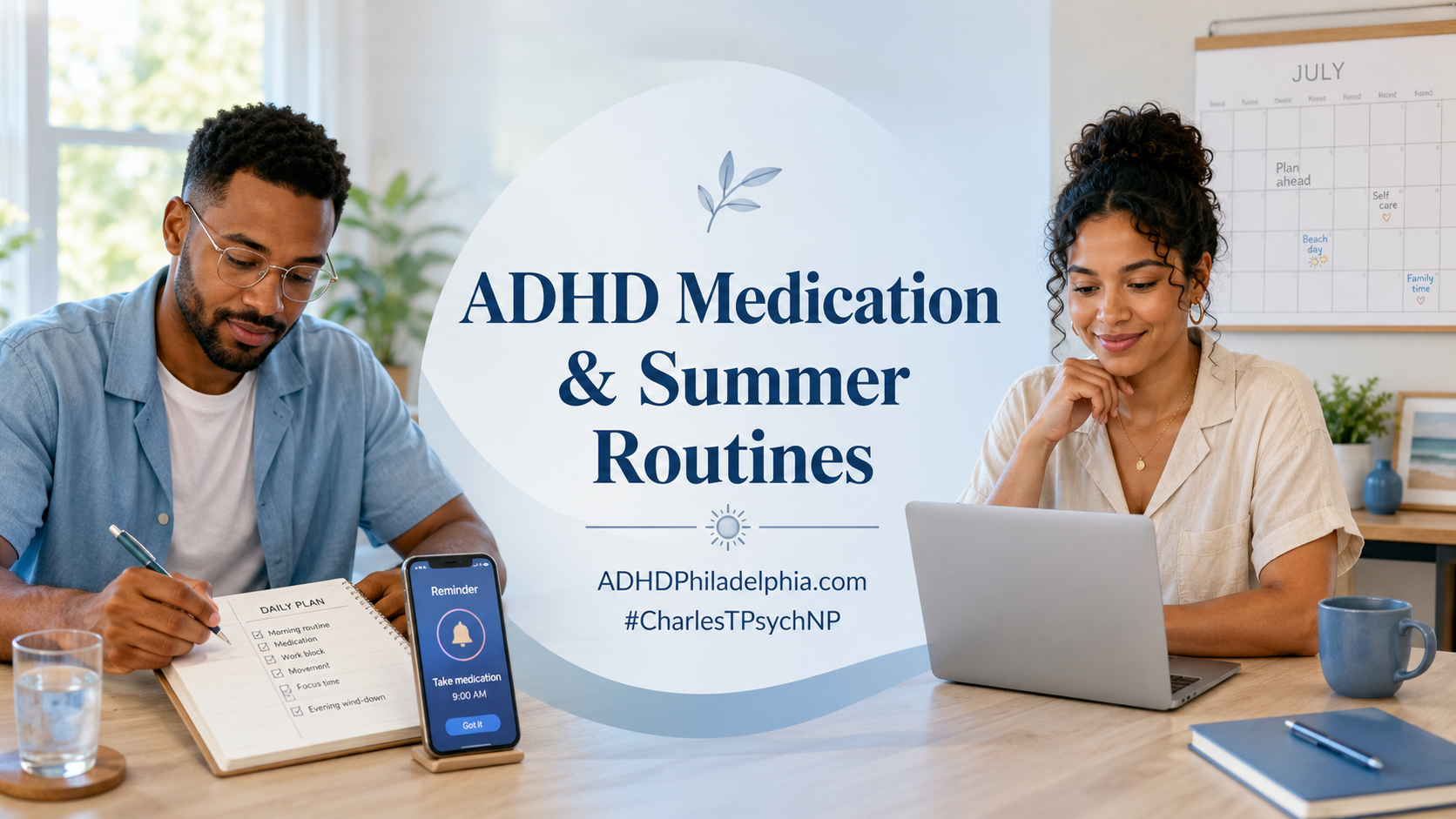
Why Adults With ADHD Struggle to Stay Consistent With Medication and Routines During Summer
Summer can disrupt medication timing, sleep, routines, and follow-through for adults with ADHD. Learn why consistency gets harder and when ADHD treatment support may help.
Summer can change everything.
Wake-up times shift.
Bedtimes drift later.
Travel plans interrupt the week.
Children may be home from school.
Work schedules may become less predictable.
Meals may happen at different times.
Weekends may feel longer.
Vacations may disrupt the calendar.
Family events may crowd the schedule.
For adults with ADHD, these changes can make consistency harder.
This can include consistency with routines, sleep, appointments, daily responsibilities, and medication timing.
An adult may start the summer with good intentions:
“I’m going to stay organized.”
“I’m going to keep my routine.”
“I’m going to stay on top of appointments.”
“I’m going to take my medication exactly as prescribed.”
“I’m going to keep my sleep schedule steady.”
“I’m going to reset after every trip.”
Then summer happens.
The morning routine changes.
The medication reminder gets missed.
The refill date sneaks up.
The appointment is forgotten.
Sleep gets pushed later.
The calendar feels scattered.
The adult feels frustrated and ashamed.
This is not always carelessness.
Adult ADHD can affect executive functioning, including working memory, planning, time awareness, task initiation, organization, emotional regulation, routines, and follow-through. When summer disrupts the structure that supports consistency, medication and daily routines may become harder to manage.
For adults in Pennsylvania and Delaware, repeated difficulty with routines, follow-through, medication consistency, focus, and time management may be one reason to consider adult ADHD testing and treatment.
Why Summer Can Disrupt ADHD Medication Routines
Medication routines often depend on daily structure.
A person may take medication after waking up, before work, with breakfast, after brushing teeth, or before starting the day.
That routine may work well when the schedule is predictable.
But summer can disrupt those cues.
A person may wake up later.
Breakfast may be skipped.
Travel may change the morning routine.
A family event may start early.
Children may interrupt the usual sequence.
Work may begin at a different time.
A person may sleep in after a late night.
The medication may be in a travel bag, not the usual place.
For adults with ADHD, habits often depend on visible cues and repeated patterns. When the cue disappears, the action may disappear too.
This is why ADHD routines need to be simple, visible, and restartable during summer.

Consistency Is an Executive Function Skill
Many people think consistency is just discipline.
For adults with ADHD, consistency is often an executive function challenge.
To stay consistent with medication and routines, the brain has to:
Remember the task
Track time
Notice the cue
Pause distractions
Start the action
Follow the sequence
Plan ahead
Refill medication on time
Attend appointments
Adjust around schedule changes
Return to routine after disruption
That is a lot of executive functioning.
When summer adds travel, family demands, sleep changes, work interruptions, social plans, and less predictable mornings, consistency can become harder.
This is why executive dysfunction can affect medication routines, not just work tasks or household chores.
Medication Should Be Taken Only as Prescribed
If you are prescribed ADHD medication, it is important to take it exactly as directed by your clinician.
Do not change the dose, timing, frequency, or schedule without speaking with your prescriber.
This is especially important for stimulant medications, which are controlled substances and require careful monitoring.
At ADHD Philadelphia, stimulant treatment is monitored closely. Patients receiving stimulant medication are assessed and monitored on a structured basis. Prescription Drug Monitoring Program checks are completed prior to prescribing controlled substances. Additional safety steps may be required when clinically appropriate.
These may include medication follow-up visits, side effect monitoring, urine drug screening, EKGs, in-person appointments, and review of substance use concerns.
Treatment decisions are individualized and based on safety, symptoms, functioning, response, and clinical appropriateness.
Understanding ADHD medication management can help adults approach treatment with more structure and less confusion.
Summer Travel Can Make Medication Planning More Complicated
Travel can be one of the biggest routine disruptors.
A person may pack quickly, leave early, stay in a hotel, visit family, change time zones, or keep medication in a different bag than usual.
This can create problems.
Medication may be forgotten at home.
The morning cue may be missing.
The schedule may shift.
The refill date may happen during travel.
The adult may not have a clear plan for appointments.
Sleep and meals may become inconsistent.
Travel stress may increase emotional overwhelm.
For adults taking prescribed ADHD medication, summer travel requires planning.
This may include checking refill timing, keeping medication secure, following prescribing instructions, and asking the prescriber about travel-related questions before leaving.
For controlled substances, travel planning matters. Medication laws and rules may vary when crossing state or international borders. Patients should speak with their prescriber and review destination-specific requirements when needed.
This is why ADHD after summer travel can involve more than unpacking. It can also involve safely returning to treatment routines.
Sleep Changes Can Affect ADHD Symptoms and Routine Consistency
Summer often changes sleep.
Longer daylight, social events, children’s schedules, travel, heat, screen time, and later nights can all push bedtime later.
For adults with ADHD, sleep disruption can make routines harder to maintain.
Poor sleep can affect:
Focus
Mood
Memory
Patience
Motivation
Time awareness
Task initiation
Emotional regulation
Decision-making
Follow-through
If sleep shifts, the morning routine may shift too.
A person may wake up late, rush, skip breakfast, forget medication, miss planning time, or start the day already behind.
Then the day becomes reactive instead of structured.
Understanding ADHD and mental exhaustion can help adults recognize why summer sleep changes can affect medication routines, work routines, parenting routines, and follow-through.
Refill Timing Can Sneak Up During Summer
Adults with ADHD may struggle with time blindness.
Time blindness can make it difficult to sense how much time has passed, how soon something is due, or how quickly a deadline is approaching.
This can affect medication refills and appointments.
A person may think:
“I still have time.”
“I’ll request it tomorrow.”
“I’ll call after work.”
“I’ll schedule the appointment later.”
“I didn’t realize I was almost out.”
“I forgot the office needed time to process it.”
Then suddenly, the refill date is here.
For ADHD treatment, waiting until the last minute can create stress. This is especially true for controlled substances, which require careful prescribing, monitoring, and pharmacy processing.
The goal is not panic.
The goal is planning.
Adults with ADHD often benefit from visible refill reminders, appointment reminders, and calendar alerts.
This is why ADHD time management is part of treatment success.
Parenting and Family Demands Can Interrupt Treatment Routines
Parents and caregivers with ADHD may have an even harder time staying consistent during summer.
Children may be home.
Camp schedules may change.
Meals may shift.
Family members may need more support.
Noise and interruptions may increase.
Appointments may compete with childcare.
Work and home responsibilities may overlap.
A parent may be focused on everyone else’s needs and forget their own medication routine, sleep routine, meals, appointments, or refill planning.
This can create a painful pattern.
The adult works hard to care for the family but loses the structure needed to care for themselves.
This is why parenting with adult ADHD can make summer treatment routines harder to maintain.
Remote Work Can Blur Medication and Routine Cues
Remote work can be helpful for some adults with ADHD, but it can also blur routine cues.
There may be no commute.
No clear work start.
No office environment.
No external transition.
No consistent morning sequence.
No separation between home tasks and work tasks.
During summer, this can become even more difficult.
Children may be home.
Family plans may interrupt the day.
Household tasks may compete with work.
Travel planning may distract the adult.
The workday may begin later or become scattered.
For some adults, the commute or office routine used to act as a cue for medication, breakfast, planning, or starting work.
Without that cue, the routine may become less consistent.
This is why remote work and adult ADHD can affect treatment routines as well as productivity.
Shame Can Make Routine Problems Worse
Many adults with ADHD feel ashamed when they miss routines.
They may think:
“I should know better.”
“I’m a provider, parent, professional, or adult — why can’t I remember?”
“I was doing well, and now I messed it up.”
“I’m inconsistent again.”
“I can’t trust myself.”
Shame can make the problem worse.
When shame increases, the adult may avoid checking the calendar, avoid calling the office, avoid opening the portal, avoid looking at the medication bottle, or avoid admitting they need help.
Avoidance can then create more missed steps.
This is why ADHD care should be structured, professional, and nonjudgmental.
A missed routine is not a moral failure.
It is information.
It may mean the system needs to be more visible, more realistic, and easier to restart.
Understanding adult ADHD follow-through can help adults separate character from symptoms.
A Simple Summer Medication and Routine Reset
This section is for general education. Always follow your prescriber’s instructions for medication use.
Here are practical ways adults with ADHD can support consistency during summer:
1. Use one visible medication cue
Keep the cue connected to something stable, such as brushing teeth, breakfast, or checking the morning calendar.
2. Use phone reminders
Set recurring reminders for medication, appointments, and refill planning.
3. Keep appointments on one calendar
Use one primary calendar for treatment appointments, work, family plans, and travel.
4. Plan refills early
Do not wait until the last minute. Add a reminder several days before you expect to need a refill.
5. Create a travel medication checklist
Include medication, prescriber instructions, pharmacy information, appointment dates, and travel-related questions to ask before leaving.
6. Protect sleep where possible
A consistent wake time can help stabilize the rest of the day.
7. Use a “restart note”
If the routine gets disrupted, write: “Tomorrow, start with ______.”
8. Ask for help before the system breaks
If you are struggling with consistency, speak with your clinician. Treatment works best when concerns are addressed early.
The goal is not perfection.
The goal is safe, consistent, supported care.
When Routine Problems May Mean ADHD Treatment Support Could Help
Everyone forgets things sometimes.
But if medication routines, appointments, refills, sleep, work, parenting, or daily responsibilities repeatedly become difficult to manage, ADHD may be worth exploring or reassessing.
Adult ADHD testing or treatment support may be helpful if you often struggle with:
Forgetfulness
Medication routines
Appointment follow-through
Refill planning
Time management
Task initiation
Disorganization
Sleep routines
Emotional overwhelm
Work productivity
Parenting demands
Travel disruption
Feeling capable but inconsistent
A thoughtful ADHD evaluation should also consider anxiety, depression, trauma, sleep problems, stress, substance use concerns, medical conditions, medication effects, and other possible explanations.
For adults in Pennsylvania and Delaware, adult ADHD evaluation can help clarify whether ADHD may be contributing to repeated problems with routines, follow-through, and daily functioning.
ADHD Treatment and Medication Management in Pennsylvania and Delaware
ADHD Philadelphia provides adult ADHD testing and treatment for adults in Pennsylvania and Delaware.
Care is designed to help adults better understand symptoms such as poor focus, procrastination, disorganization, time management problems, emotional overwhelm, difficulty with routines, and trouble following through.
Treatment plans are individualized and may include education, behavioral strategies, structure-building, therapy or coaching strategies, lifestyle review, and medication management when clinically appropriate.
For stimulant medication treatment, structured monitoring is required because stimulants are controlled substances. Safety monitoring may include regular follow-up visits, Prescription Drug Monitoring Program review, side effect monitoring, urine drug screening when clinically appropriate, EKG when clinically appropriate, and in-person appointments when needed.
Initial appointments are completed through secure telehealth. In-person appointments may be scheduled after the first online appointment when clinically appropriate. Walk-in appointments are not available.
If summer routines make it harder to stay consistent with treatment, appointments, refills, and daily structure, support may help you move from frustration toward clarity and practical next steps.
To learn more, visit ADHDPhiladelphia.com.
Frequently Asked Questions About ADHD Medication Routines and Summer
Why do adults with ADHD struggle with medication routines during summer?
Adults with ADHD may struggle with medication routines during summer because wake times, sleep schedules, meals, travel, family plans, and daily cues may change.
Should I change how I take my ADHD medication during summer?
Do not change your ADHD medication dose, timing, or schedule without speaking with your prescribing clinician. Medication should be taken exactly as prescribed.
Why do I forget refills and appointments?
ADHD can affect working memory, time awareness, planning, and follow-through. Refill and appointment reminders may need to be visible and set earlier than expected.
Can travel disrupt ADHD treatment routines?
Yes. Travel can change sleep, medication timing, meals, appointment access, refill planning, and daily routines. Speak with your prescriber before travel if you have questions.
Does ADHD Philadelphia provide ADHD treatment in Pennsylvania and Delaware?
Yes. ADHD Philadelphia provides adult ADHD testing and treatment for adults in Pennsylvania and Delaware. Initial appointments begin through telehealth. In-person appointments may be scheduled after the first online appointment when clinically appropriate. Walk-in appointments are not available.
Take the First Step
If summer schedule changes make it harder to stay consistent with routines, treatment appointments, medication planning, and follow-through, ADHD Philadelphia can help you better understand what may be happening.
Adult ADHD can affect routines, emotional regulation, time management, working memory, task initiation, and follow-through. A structured evaluation can help clarify whether ADHD may be contributing to these patterns and whether treatment may be appropriate.
Visit ADHDPhiladelphia.com to learn more about adult ADHD testing and treatment.
Medical Disclaimer
This article is for educational purposes only and is not a substitute for medical advice, diagnosis, or treatment. Do not start, stop, or change medication without consulting your prescribing clinician. ADHD symptoms can overlap with anxiety, depression, sleep disorders, trauma, substance use concerns, medical conditions, medication effects, stress, and other mental health conditions. If you are experiencing symptoms of ADHD or another mental health concern, consult a qualified healthcare professional.

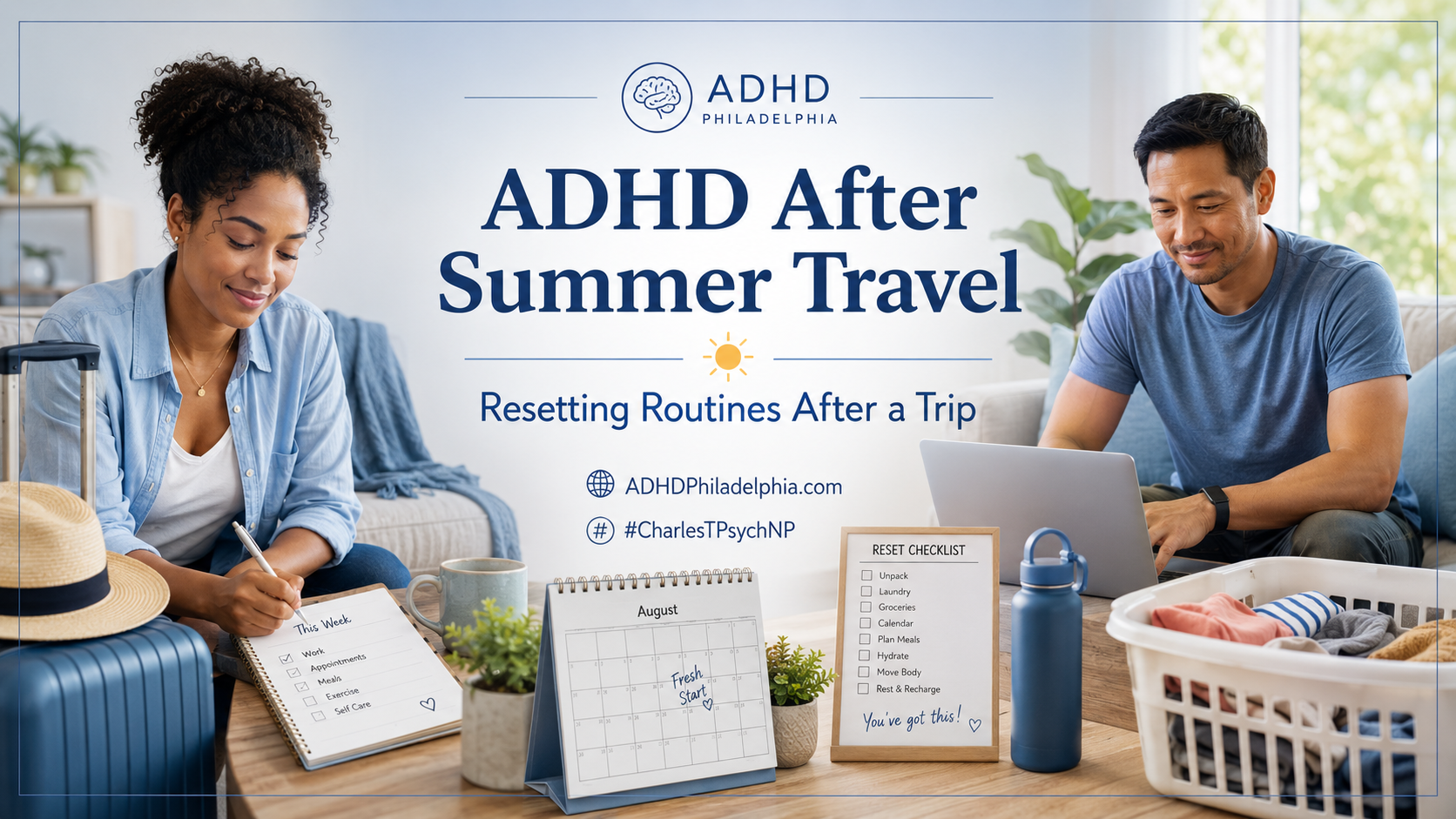
Why Adults With ADHD Struggle to Reset After Summer Travel
Summer travel can disrupt routines for adults with ADHD. Learn why returning home, unpacking, restarting work, and getting back on track can feel harder than expected.
Summer travel can be exciting.
A beach trip.
A family visit.
A weekend getaway.
A graduation trip.
A wedding.
A road trip.
A long weekend.
A vacation that has been planned for months.
Travel can give adults a needed break from work, routines, responsibilities, and the usual stress of daily life.
But for many adults with ADHD, returning from summer travel can feel surprisingly difficult.
The suitcase stays unpacked.
Laundry piles up.
Sleep feels off.
Work emails feel overwhelming.
The refrigerator is empty.
The calendar feels unclear.
Medication timing may have shifted.
Bills and messages may have accumulated.
The house feels disorganized.
The brain feels like it is still somewhere else.
Then the adult with ADHD may think:
“Why can’t I just get back to normal?”
“Why is unpacking so hard?”
“Why do I feel behind after a vacation?”
“Why does returning home feel more stressful than leaving?”
“Why does one trip throw off my whole week?”
This is not always laziness.
Adult ADHD can affect executive functioning, including planning, time management, task initiation, working memory, emotional regulation, organization, routines, and follow-through. When travel disrupts the systems that help the brain stay on track, resetting can feel much harder than expected.
For adults in Pennsylvania and Delaware, repeated difficulty getting back on track after travel, schedule changes, or disrupted routines may be one reason to consider adult ADHD testing and treatment.
Why Travel Disrupts ADHD Routines
Adults with ADHD often rely on routines more than they realize.
A normal week may include:
A wake-up time
Medication routine
Work start time
Meal pattern
Exercise schedule
Sleep routine
Household rhythm
Calendar reminders
Daily task cues
Work and home boundaries
Even if the routine is not perfect, it gives the brain structure.
Travel changes that structure.
Sleep may shift.
Meals may happen at different times.
Medication timing may become less consistent.
Exercise may pause.
Work routines may stop.
Household tasks may wait.
The calendar may be ignored.
The environment changes.
The usual cues disappear.
Then, when the adult returns home, the brain has to rebuild the routine.
That rebuilding process requires executive functioning. If executive functioning is already strained, the reset can feel overwhelming.
This is why executive dysfunction can become more noticeable after summer travel.
The Return Home Creates a Task Pileup
Travel can delay tasks, but it does not erase them.
While the adult is away, responsibilities may continue building.
Emails arrive.
Bills wait.
Laundry accumulates.
Messages go unanswered.
Work projects continue.
Appointments need attention.
Groceries need restocking.
The house may need cleaning.
Mail may pile up.
Children’s schedules may need restarting.
When the adult returns, everything may feel urgent at once.
For ADHD, this can create shutdown.
The adult may not know where to begin. They may start unpacking, then notice the laundry. They may begin laundry, then remember groceries. They may open email, then become overwhelmed. They may start making a list, then get distracted by another task.
The problem is not that nothing is happening.
The problem is that everything is competing for attention.
This is why ADHD and task pileups can make returning from travel feel so difficult.
Unpacking Is Often Harder Than Packing
Many adults with ADHD find packing stressful.
But unpacking can be even harder.
Packing has urgency.
There is a deadline.
The trip is coming.
There is pressure to prepare.
There may be excitement or fear driving action.
Unpacking has less urgency.
The trip is over.
The reward is gone.
The task feels boring.
The suitcase can be ignored.
The clothes can wait.
The toiletries can sit in the bag.
The mess can become part of the room.
For adults with ADHD, low-interest tasks are often harder to start. Unpacking may feel simple from the outside, but it can require sorting, decision-making, laundry, putting items away, remembering where things go, and restarting normal routines.
That is a lot of executive functioning for a task with little immediate reward.
This is why ADHD task initiation can become a major barrier after travel.
Sleep Disruption Can Make the Reset Harder
Travel often changes sleep.
A person may stay up later, wake up earlier, sleep in a different bed, share a room, change time zones, drink more caffeine, eat later, nap during the day, or spend more time on screens.
Even enjoyable travel can disrupt recovery.
For adults with ADHD, sleep changes can make symptoms worse.
Poor sleep can affect:
Focus
Mood
Memory
Patience
Motivation
Task initiation
Time awareness
Emotional regulation
Decision-making
Follow-through
So when the adult returns home, they may not only be facing a task pileup. They may also be trying to reset with a tired brain.
This can make everything feel harder.
The suitcase feels heavier.
The email inbox feels bigger.
The calendar feels confusing.
The body wants rest.
The mind feels foggy.
The person feels guilty for not bouncing back.
Understanding ADHD and mental exhaustion can help adults recognize why post-travel recovery can take more than one night.
Travel Can Disrupt Medication and Health Routines
Travel may also interrupt health routines.
Medication timing may change.
Meals may be inconsistent.
Hydration may be lower.
Sleep may shift.
Exercise may stop.
Caffeine intake may increase.
Alcohol may be present at social events.
Stress may increase during planning or travel.
For adults receiving ADHD treatment, routine consistency matters.
Medication should always be taken as prescribed. If someone has questions about travel, timing, missed doses, side effects, or interactions, they should speak with their prescribing clinician.
For adults treated at ADHD Philadelphia, treatment plans are individualized and monitored carefully. Stimulant medications are controlled substances and require structured follow-up and safety monitoring.
Travel can be part of life, but it is important to plan ahead when medication, sleep, schedule, and health routines may be affected.
Understanding ADHD medication management can help adults approach travel with more planning and less confusion.
Returning to Work Can Feel Like a Shock
After travel, work can feel especially difficult.
The adult may open the laptop and feel flooded.
Emails.
Deadlines.
Meetings.
Messages.
Missed updates.
Unclear priorities.
Tasks that were paused before leaving.
New tasks that arrived while away.
For adults with ADHD, returning to work after travel can be difficult because the brain has to switch from travel mode back into task mode.
That transition requires:
Planning
Prioritizing
Task initiation
Emotional regulation
Memory
Focus
Time management
Follow-through
If the adult works remotely, the transition may be even harder because there is no commute or physical workplace to signal that the work routine has restarted.
This is why remote work and adult ADHD can be especially challenging after summer travel.
Family Travel Can Add Another Layer
Travel with family can be meaningful, but it can also be demanding.
Parents and caregivers may manage:
Packing
Snacks
Medications
Clothing
Sunscreen
Transportation
Children’s sleep
Activities
Behavior
Meals
Schedules
Budgeting
Family expectations
Safety
Communication
Returning home
By the time the trip ends, the parent may feel like they need a vacation from the vacation.
For adults with ADHD, family travel can create extra executive load. The parent may be managing their own ADHD symptoms while also managing everyone else’s needs.
Then the family returns home and the parent is expected to restart work, unpack, clean, handle laundry, prepare meals, manage children’s schedules, and return to normal.
That is a lot.
This is why parenting with adult ADHD can feel harder during summer travel season.
The Emotional Crash After Travel Is Real
Many adults with ADHD feel an emotional drop after travel.
The trip may have provided novelty, stimulation, social connection, sunlight, movement, or a break from normal demands.
Then the person returns home.
The excitement ends.
The routine returns.
The bills are still there.
The work is still waiting.
The house needs attention.
The calendar feels heavy.
The body feels tired.
For ADHD, novelty can be energizing. When the novelty ends, returning to ordinary tasks can feel emotionally difficult.
This may show up as sadness, irritability, avoidance, restlessness, boredom, guilt, or overwhelm.
The adult may think something is wrong with them because they feel worse after a vacation.
But sometimes the crash is the result of stimulation ending, sleep disruption, task pileups, and emotional overload all happening at once.
Understanding ADHD and emotional overwhelm can help adults approach the post-travel period with compassion and structure instead of shame.
Time Blindness Can Make Reentry Feel Sudden
Travel can distort time.
Before the trip, the adult may think:
“I’ll deal with that after I get back.”
“I’ll answer that later.”
“I’ll reset on Monday.”
“I’ll unpack right away.”
“I’ll get caught up quickly.”
Then the trip ends.
Suddenly, Monday arrives. The inbox is full. The suitcase is still packed. The calendar has appointments. Work starts again. The house needs attention.
The adult may feel shocked by how quickly normal life returned.
This can be connected to ADHD time blindness.
Time blindness can make it hard to sense how long tasks will take, how much recovery time is needed, or how quickly responsibilities will resume.
This is why ADHD time management often requires a reentry plan before the trip ends.
A Simple Travel Reset Plan for Adults With ADHD
The goal after travel is not to catch up on everything immediately.
The goal is to restart.
Try this ADHD-friendly travel reset:
1. Create a reentry buffer
Avoid scheduling your hardest work task immediately after returning if possible. Give yourself a reset window.
2. Unpack one category first
Do not start with “unpack everything.” Try “remove toiletries,” “start laundry,” or “empty dirty clothes.”
3. Choose three priorities
Pick three tasks that would make the biggest difference today or tomorrow.
4. Use a visible checklist
Post-travel tasks are easy to forget. Make them visible.
5. Restart sleep gently
Choose a realistic bedtime and wake time for the next two nights.
6. Do a calendar review
Look at the next seven days before jumping into tasks.
7. Restock basics
Food, medication routines, laundry, and work supplies can help the week feel less chaotic.
8. Write a restart note
Before stopping for the day, write: “Tomorrow, start with ______.”
9. Reduce shame
A slow reset is still a reset.
For adults with ADHD, post-travel routines work best when they are simple, visible, and restartable.
When Post-Travel Struggles May Point to ADHD
Everyone can feel tired after travel.
But if returning from trips repeatedly leads to major problems with work, home responsibilities, emotional overwhelm, sleep, organization, time management, or follow-through, ADHD may be worth exploring.
Adult ADHD testing may be helpful if you often struggle with:
Unpacking
Task initiation
Time management
Disorganization
Forgetfulness
Emotional overwhelm
Sleep routines
Travel recovery
Returning to work
Task pileups
Procrastination
Following through
Restarting after breaks
Feeling capable but inconsistent
A thoughtful evaluation should also consider anxiety, depression, trauma, sleep problems, stress, substance use concerns, medical conditions, and medication effects.
For adults in Pennsylvania and Delaware, adult ADHD evaluation can help clarify whether ADHD may be contributing to repeated problems with routines, transitions, travel recovery, and follow-through.
ADHD Testing and Treatment in Pennsylvania and Delaware
ADHD Philadelphia provides adult ADHD testing and treatment for adults in Pennsylvania and Delaware.
Care is designed to help adults better understand symptoms such as poor focus, procrastination, disorganization, time management problems, emotional overwhelm, difficulty with routines, and trouble following through.
Treatment plans are individualized and may include education, behavioral strategies, structure-building, therapy or coaching strategies, lifestyle review, and medication management when clinically appropriate.
Initial appointments are completed through secure telehealth. In-person appointments may be scheduled after the first online appointment when clinically appropriate. Walk-in appointments are not available.
If summer travel repeatedly makes it hard to reset, restart routines, manage work, and follow through, support may help you move from frustration toward clarity and practical next steps.
To learn more, visit ADHDPhiladelphia.com.
Frequently Asked Questions About Adult ADHD and Summer Travel
Why do adults with ADHD struggle after travel?
Adults with ADHD may struggle after travel because routines, sleep, medication timing, work structure, household tasks, and emotional regulation may all be disrupted at the same time.
Why is unpacking so hard with ADHD?
Unpacking may be hard because it requires task initiation, sorting, decision-making, laundry, organization, and follow-through. It also has less urgency than packing.
Can vacation make ADHD symptoms worse?
Vacation itself does not cause ADHD, but disrupted routines, poor sleep, task pileups, travel stress, and returning to responsibilities can make ADHD symptoms more noticeable.
How can adults with ADHD reset after summer travel?
Helpful strategies include using a travel reset checklist, unpacking one category first, choosing three priorities, reviewing the calendar, restarting sleep gently, and writing a restart note for the next day.
Does ADHD Philadelphia provide ADHD testing in Pennsylvania and Delaware?
Yes. ADHD Philadelphia provides adult ADHD testing and treatment for adults in Pennsylvania and Delaware. Initial appointments begin through telehealth. In-person appointments may be scheduled after the first online appointment when clinically appropriate. Walk-in appointments are not available.
Take the First Step
If summer travel, vacations, and schedule changes make it harder to reset, focus, organize, and follow through, ADHD Philadelphia can help you better understand what may be happening.
Adult ADHD can affect routines, emotional regulation, time management, transitions, task initiation, and follow-through. A structured evaluation can help clarify whether ADHD may be contributing to these patterns and whether treatment may be appropriate.
Visit ADHDPhiladelphia.com to learn more about adult ADHD testing and treatment.
Medical Disclaimer
This article is for educational purposes only and is not a substitute for medical advice, diagnosis, or treatment. ADHD symptoms can overlap with anxiety, depression, sleep disorders, trauma, substance use concerns, medical conditions, medication effects, stress, and other mental health conditions. If you are experiencing symptoms of ADHD or another mental health concern, consult a qualified healthcare professional.Summer travel can be exciting.

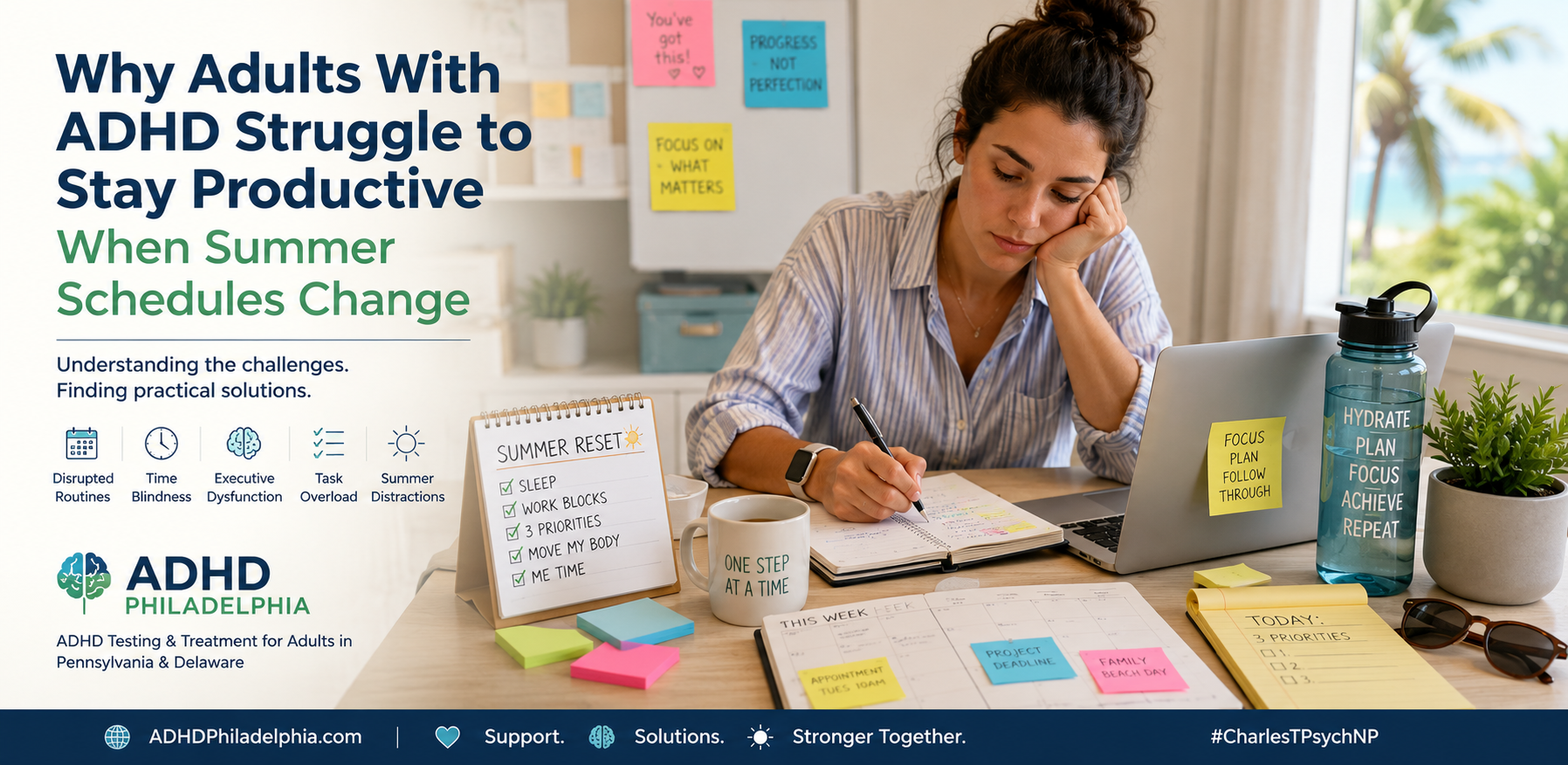
Why Adults With ADHD Struggle to Stay Productive When Summer Schedules Change
Summer schedule changes can make adult ADHD productivity harder. Learn why disrupted routines, time blindness, procrastination, sleep changes, and reduced structure affect focus.
Summer can make productivity feel unpredictable.
The days are longer.
The weather is warmer.
Schedules become more flexible.
Travel increases.
Children may be home from school.
Weekends feel fuller.
Work routines may shift.
Social plans become more frequent.
For some adults, this feels refreshing.
For many adults with ADHD, it can feel destabilizing.
The same person who was starting to build a steady routine in March or April may suddenly feel scattered by late May or June. Work gets delayed. Sleep shifts. Email piles up. Household tasks fall behind. Appointments are forgotten. The calendar feels crowded. Focus becomes harder to access.
Then the adult with ADHD may wonder:
“Why am I less productive when summer is supposed to feel easier?”
“Why does one schedule change throw off my whole week?”
“Why do I keep saying I’ll do it later?”
“Why am I working hard but still falling behind?”
“Why can’t I stay consistent when my routine changes?”
This is not always laziness.
Adult ADHD can affect executive functioning, including planning, prioritizing, time awareness, task initiation, emotional regulation, working memory, routines, and follow-through. When summer changes the usual structure, productivity can become harder to maintain.
For adults in Pennsylvania and Delaware, repeated problems with productivity, focus, procrastination, and follow-through may be one reason to consider adult ADHD testing and treatment.
Why Summer Schedules Can Make Productivity Harder
Adults with ADHD often rely on structure more than they realize.
A regular weekday may include a wake-up time, work start time, commute, medication routine, meal schedule, school schedule, meetings, deadlines, and bedtime cues.
Even if the routine is imperfect, it still creates rhythm.
Summer can disrupt that rhythm.
Children may be home.
Travel may interrupt the week.
Evenings may run later.
Sleep may shift.
Family events may increase.
Work may feel less structured.
Household tasks may pile up.
Remote work may become more distracting.
The usual start-and-stop points may disappear.
For adults with ADHD, productivity is often easier when there are clear external cues. When those cues disappear, the brain may have to create structure on its own.
That can be exhausting.
This is why executive dysfunction can become more noticeable when summer schedules change.
Summer Can Make “Later” Feel Too Easy
One of the biggest productivity traps for adults with ADHD is the word “later.”
During summer, “later” feels especially believable.
“I’ll do it after the weekend.”
“I’ll get back on track after the trip.”
“I’ll answer that email tonight.”
“I’ll restart Monday.”
“I’ll organize everything once things calm down.”
“I’ll be more productive once summer settles down.”
But for ADHD, “later” often needs a specific time, place, cue, and starting step.
Without that, later becomes vague.
The task moves forward on the calendar, but it never becomes clear enough to start.
This can happen with work projects, bills, medication refills, scheduling appointments, cleaning, paperwork, exercise, meal planning, and follow-up messages.
The adult may care deeply about the task. They may even feel stressed about it every day. But stress alone does not always create action.
This is why ADHD procrastination can increase when schedules become less structured.
Longer Days Can Create a False Sense of Time
Summer gives the feeling of more time.
More daylight can make the day feel bigger than it actually is. An adult with ADHD may think, “I have all day,” or “I can still get this done tonight.”
Then the day disappears.
A quick errand takes longer than expected.
A family plan shifts the afternoon.
A text turns into a long conversation.
One household task becomes five.
A work task is delayed until evening.
Evening becomes late night.
The task moves to tomorrow.
This is where ADHD time blindness can become a major issue.
Time blindness means difficulty sensing, estimating, tracking, or managing time accurately. It can make tasks feel either immediate or invisible, with very little middle ground.
Summer can intensify this because routines are looser and transitions are less predictable.
This is why ADHD time management often requires visible structure during summer.
Remote Workers With ADHD May Struggle More During Summer
Remote work can already make ADHD symptoms harder to manage.
Summer can add another layer.
Children may be home.
Family members may interrupt more often.
Travel plans may compete with work.
The house may feel louder.
Laundry, dishes, and errands may become more visible.
Outdoor plans may become tempting.
Work and home boundaries may blur even more.
A remote worker with ADHD may sit down to work and then notice everything except the task they planned to do.
They may check one message.
Then answer a household question.
Then remember an errand.
Then open another tab.
Then respond to an email.
Then realize an hour has passed.
This does not mean remote work is bad.
It means remote work often requires more intentional structure for adults with ADHD.
This is why remote work and adult ADHD should be taken seriously when summer schedules change.
Summer Sleep Changes Can Hurt Productivity
Productivity is not only about motivation.
It is also about sleep.
Summer often changes sleep patterns. Longer daylight, later events, travel, heat, screen time, children’s schedules, and flexible evenings can all push bedtime later.
For adults with ADHD, sleep disruption can make productivity harder.
Poor sleep can affect:
Focus
Mood
Memory
Patience
Motivation
Task initiation
Time awareness
Decision-making
Impulse control
Emotional regulation
Follow-through
An adult may wake up tired, start slowly, avoid hard tasks, feel guilty, work late to catch up, and then sleep poorly again.
This cycle can repeat for weeks.
Summer sleep disruption can quietly reduce productivity before the person realizes what is happening.
Understanding ADHD and mental exhaustion can help adults see why the problem is not always effort. Sometimes the brain is trying to work with low fuel.
More Plans Can Mean More Transitions
Summer can bring more movement.
Work.
Home.
Travel.
Family gatherings.
Cookouts.
Beach trips.
Children’s activities.
Social plans.
Appointments.
Errands.
Weekend events.
Each activity may seem simple on its own. But every activity requires transitions.
Adults with ADHD may struggle with transitions because shifting from one mode to another requires executive functioning.
The brain has to stop one task, remember the next task, organize materials, estimate time, regulate emotions, and begin again.
That is a lot.
This is why summer can feel more tiring than expected. The adult may not only be doing more. They may be switching more.
And every switch can create an opportunity to lose momentum.
This is why ADHD and interruptions are especially important during summer productivity struggles.
Productivity May Drop When Routines Are Not Visible
Adults with ADHD often do better when routines are visible.
A mental routine is easy to lose.
A visible routine gives the brain something to return to.
That might include:
A wall calendar
A whiteboard
A planner
A phone reminder
A sticky note
A written morning routine
A visible task list
A weekly reset checklist
A medication routine reminder
A workday start checklist
During summer, routines need to be easier to see because there are more schedule changes.
The goal is not to create a perfect system.
The goal is to reduce the number of decisions the brain has to make from scratch.
This is why ADHD routines should be simple, visible, and restartable.
Family Responsibilities Can Compete With Work Productivity
Summer can increase the invisible workload at home.
This may include childcare, transportation, camps, meals, groceries, family visits, vacation planning, cleaning, laundry, social events, and managing everyone’s schedule.
For parents and caregivers with ADHD, this can become overwhelming quickly.
The adult may start the day planning to work, but the household keeps pulling attention away.
A child needs help.
A family member asks a question.
A camp form is due.
A meal needs planning.
A ride needs coordinating.
A schedule changes.
A work task gets delayed.
This can create guilt in both directions.
The adult may feel guilty while working because family needs are waiting.
Then they may feel guilty while handling family needs because work is falling behind.
This does not mean they are failing.
It may mean the demands have outgrown the structure currently supporting them.
This is why parenting with adult ADHD can become harder during summer.
ADHD Productivity Problems Can Look Like Laziness From the Outside
One of the most painful parts of adult ADHD is being misunderstood.
From the outside, productivity struggles may look like laziness, poor discipline, lack of motivation, or not caring.
But many adults with ADHD are working extremely hard internally.
They may be trying to hold the schedule in their head.
Trying to remember what they forgot.
Trying to force motivation.
Trying to recover from a late night.
Trying to manage shame.
Trying to answer messages.
Trying to start the hard task.
Trying to not disappoint anyone.
The effort is real.
But effort without structure can still lead to inconsistent results.
Adult ADHD often creates a gap between intention and action. The person may know what needs to be done and still struggle to begin, organize, prioritize, or complete it.
This is why adult ADHD follow-through is such an important topic for productivity.
A Simple Summer Productivity Reset for Adults With ADHD
Summer productivity does not require a perfect routine.
It requires a realistic reset.
Try this:
1. Pick one daily anchor
Choose one non-negotiable cue: checking your calendar, taking medication as prescribed, opening your planner, eating breakfast, or reviewing your first task.
2. Choose three priorities
Do not write a twenty-item list. Pick three tasks that would make the biggest difference today.
3. Make the first step physical
Instead of “work on project,” write “open document.”
Instead of “clean house,” write “clear counter.”
Instead of “get organized,” write “write task list.”
4. Use time blocks
Create visible work blocks, even if they are short.
5. Plan for interruptions
Assume interruptions will happen. Keep a restart note that says, “When I come back, start here.”
6. Protect sleep where possible
Productivity depends on recovery.
7. Create a travel reset checklist
Use the same checklist after trips: unpack, laundry, calendar, medication routine, first work task.
8. Restart without shame
Shame does not improve executive function. Structure helps more.
For adults with ADHD, productivity often improves when the system is simple enough to restart after disruption.
When Summer Productivity Struggles May Point to ADHD
Everyone has unproductive days.
But if summer schedule changes repeatedly lead to missed deadlines, procrastination, emotional overwhelm, work problems, sleep disruption, disorganization, task pileups, or difficulty following through, it may be worth considering an ADHD evaluation.
Adult ADHD testing may be helpful if you often struggle with:
Focus
Task initiation
Time management
Procrastination
Disorganization
Forgetfulness
Emotional overwhelm
Work productivity
Remote work structure
Sleep routines
Transitions
Follow-through
Feeling capable but inconsistent
A thoughtful evaluation should also consider other possible explanations, including anxiety, depression, trauma, sleep problems, stress, substance use concerns, medical conditions, and medication effects.
For adults in Pennsylvania and Delaware, adult ADHD evaluation can help clarify whether ADHD may be contributing to repeated productivity problems.
ADHD Testing and Treatment in Pennsylvania and Delaware
ADHD Philadelphia provides adult ADHD testing and treatment for adults in Pennsylvania and Delaware.
Care is designed to help adults better understand symptoms such as poor focus, procrastination, disorganization, time management problems, emotional overwhelm, difficulty with routines, and trouble following through.
Treatment plans are individualized and may include education, behavioral strategies, structure-building, therapy or coaching strategies, lifestyle review, and medication management when clinically appropriate.
Initial appointments are completed through secure telehealth. In-person appointments may be scheduled after the first online appointment when clinically appropriate. Walk-in appointments are not available.
If summer schedule changes repeatedly make it hard to stay productive, focused, and organized, support may help you move from frustration toward clarity and practical next steps.
To learn more, visit ADHDPhiladelphia.com.
Frequently Asked Questions About Adult ADHD and Summer Productivity
Can summer make adult ADHD symptoms worse?
Summer can make ADHD symptoms more noticeable because routines, sleep schedules, work patterns, family responsibilities, and external structure may change.
Why do adults with ADHD lose productivity when schedules change?
Adults with ADHD may rely on external cues and predictable routines to support planning, focus, task initiation, and follow-through. When schedules change, productivity may become harder to maintain.
Why do I procrastinate more during summer?
Summer can make “later” feel easier because schedules are looser and days feel longer. For adults with ADHD, vague plans often need clear times, cues, and first steps.
How can adults with ADHD stay productive during summer?
Helpful strategies include using visible calendars, three-priority task lists, morning anchors, time blocks, restart notes, travel reset checklists, and realistic routines that are easy to restart.
Does ADHD Philadelphia provide ADHD testing in Pennsylvania and Delaware?
Yes. ADHD Philadelphia provides adult ADHD testing and treatment for adults in Pennsylvania and Delaware. Initial appointments begin through telehealth. In-person appointments may be scheduled after the first online appointment when clinically appropriate. Walk-in appointments are not available.
Take the First Step
If summer schedule changes make it harder to stay productive, focused, organized, and consistent, ADHD Philadelphia can help you better understand what may be happening.
Adult ADHD can affect productivity, time management, routines, emotional regulation, transitions, task initiation, and follow-through. A structured evaluation can help clarify whether ADHD may be contributing to these patterns and whether treatment may be appropriate.
Visit ADHDPhiladelphia.com to learn more about adult ADHD testing and treatment.
Medical Disclaimer
This article is for educational purposes only and is not a substitute for medical advice, diagnosis, or treatment. ADHD symptoms can overlap with anxiety, depression, sleep disorders, trauma, substance use concerns, medical conditions, medication effects, stress, and other mental health conditions. If you are experiencing symptoms of ADHD or another mental health concern, consult a qualified healthcare professional.
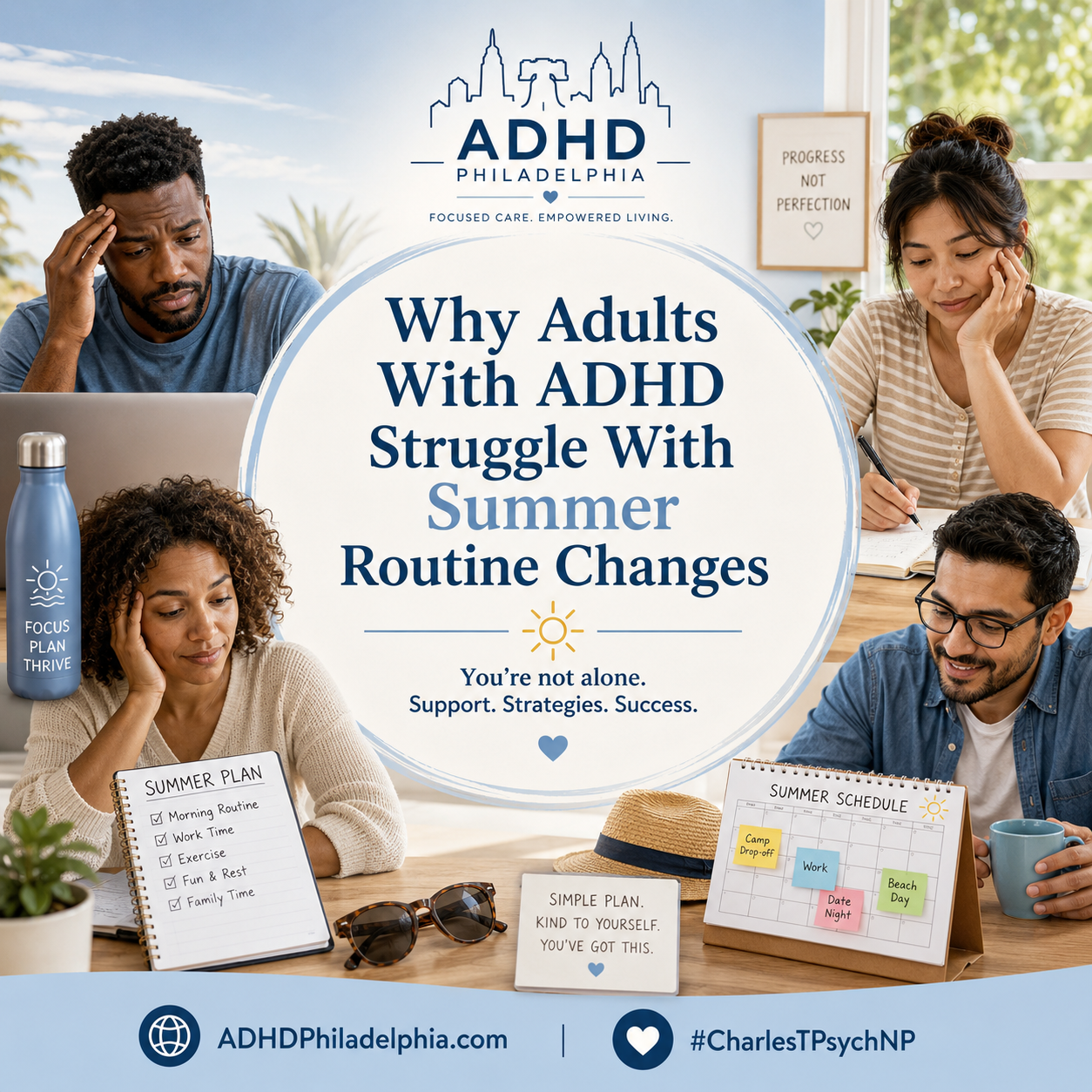
Why Adults With ADHD Struggle With Summer Routine Changes
Summer can disrupt routines for adults with ADHD. Learn why changing schedules, sleep shifts, travel, family plans, and reduced structure can make focus and follow-through harder.
Summer can feel like it should be easier.
Longer days.
More sunlight.
Vacations.
Cookouts.
Family events.
Flexible schedules.
More time outside.
A break from the usual pace.
But for many adults with ADHD, summer can also make life feel more scattered.
The routine changes.
Sleep shifts later.
Children may be home from school.
Travel plans interrupt the week.
Work schedules may become less predictable.
Social events increase.
Household responsibilities pile up.
Exercise routines may change.
Medication timing may become less consistent.
The normal structure that helps the brain stay organized can disappear.
By the end of the week, an adult with ADHD may feel confused and frustrated.
“Why am I more overwhelmed when things are supposed to be more relaxed?”
“Why can’t I stay consistent during summer?”
“Why does one schedule change throw off my whole day?”
“Why do I keep falling behind when I have more daylight?”
“Why does summer make my ADHD feel worse?”
This is not always laziness or poor discipline.
Adult ADHD can affect executive functioning, including planning, time management, emotional regulation, task initiation, working memory, routines, sleep consistency, and follow-through. When summer changes the usual structure, those symptoms may become more noticeable.
For adults in Pennsylvania and Delaware, repeated difficulty managing seasonal routine changes may be one reason to consider adult ADHD testing and treatment if focus, procrastination, disorganization, overwhelm, or follow-through are affecting daily functioning.
Why Summer Can Disrupt ADHD Routines
Adults with ADHD often rely on structure more than they realize.
A regular weekday may include a wake-up time, commute, work start time, meal pattern, medication routine, school schedule, exercise time, appointment reminders, and bedtime cues.
Even if the routine is imperfect, it creates anchors.
Summer can weaken those anchors.
Children may be out of school.
Vacations may interrupt workweeks.
Evenings may run later.
Social events may increase.
Weekends may blend into weekdays.
Travel may disrupt sleep.
Heat may affect energy.
Work may feel less structured.
Household tasks may pile up.
For adults with ADHD, structure is not just a preference. It can be part of how the brain organizes the day.
When that structure changes, the brain may have to rebuild the plan repeatedly.
This is why executive dysfunction can become more noticeable during seasonal transitions.
Summer Can Make Time Feel Less Structured
Many adults with ADHD struggle with time blindness.
Time blindness means difficulty sensing, estimating, tracking, or managing time accurately.
Summer can make time feel even more slippery because the days are longer and routines may be looser.
A person may think:
“I’ll do it later.”
“I have plenty of time.”
“I’ll catch up this weekend.”
“I’ll restart after vacation.”
“I’ll get organized once things calm down.”
But later may not have a clear time.
Days pass. Tasks pile up. Sleep shifts. Work becomes rushed. Important responsibilities get delayed.
By the time the adult realizes how much has built up, the task list may feel overwhelming.
This is why ADHD time management often requires more visible structure during summer, not less.
Sleep Changes Can Make ADHD Symptoms Worse
Summer often changes sleep.
Longer daylight, later social events, travel, children’s schedules, heat, screen time, and less predictable routines can all push bedtime later.
For adults with ADHD, sleep disruption can make symptoms worse.
Poor sleep can affect:
Focus
Mood
Memory
Patience
Motivation
Time awareness
Task initiation
Impulse control
Decision-making
Emotional regulation
Follow-through
A few late nights may make the next day feel harder. Then the harder day may lead to more avoidance, more catch-up at night, and another late bedtime.
This can create a cycle.
Summer disrupts sleep.
Poor sleep worsens ADHD symptoms.
ADHD symptoms make routines harder.
Disrupted routines make sleep worse again.
Understanding ADHD and mental exhaustion can help adults recognize why summer may leave them feeling drained even when the season seems more relaxed.
Family and Social Plans Can Increase Overwhelm
Summer often brings more events.
Cookouts.
Graduations.
Vacations.
Family visits.
Beach trips.
Children’s activities.
Weekend plans.
Travel logistics.
Social invitations.
Community events.
These can be enjoyable, but they also require planning, timing, communication, preparation, emotional energy, and follow-through.
Adults with ADHD may feel pulled in several directions at once.
They may want to be present with family but feel distracted by unfinished work.
They may want to enjoy the weekend but feel guilty about chores.
They may want to travel but feel overwhelmed by packing and planning.
They may want to socialize but feel overstimulated afterward.
This does not mean they do not care.
It may mean the mental load is heavier than it looks.
Understanding ADHD and emotional overwhelm can help adults approach summer plans with more compassion and better structure.
Parents With ADHD May Feel Extra Pressure During Summer
Summer can be especially challenging for parents with ADHD.
When children are home from school, the entire household rhythm may change.
There may be camps, childcare, meals, activities, transportation, screen-time negotiations, sleep schedule changes, family trips, and more interruptions throughout the day.
A parent with ADHD may feel like they never get a complete thought.
They may start work and get interrupted.
They may begin cleaning and be pulled into another task.
They may try to plan the week but forget a detail.
They may feel guilty for being overstimulated.
They may feel like everyone needs something at once.
Parenting already requires executive functioning. Summer can increase those demands.
This is why parenting with adult ADHD can feel harder when school-year routines disappear.
Remote Workers With ADHD May Struggle More in Summer
Remote work can already blur the line between work and home.
Summer can blur it even more.
Children may be home.
Family members may interrupt.
Vacation planning may compete with work tasks.
The home may feel louder.
The schedule may shift.
Household responsibilities may become more visible.
Work may happen in the same place as summer distractions.
A remote worker with ADHD may sit down to work and suddenly notice the dishes, laundry, a text message, a child’s question, travel planning, or an unfinished household task.
One interruption becomes several.
The workday disappears.
This is why remote work and adult ADHD are important to understand. Remote work can be helpful, but it often requires strong external structure, especially during summer.
Summer Can Make Procrastination Easier
Summer has a way of making “later” feel believable.
“I’ll do it after the weekend.”
“I’ll handle it after vacation.”
“I’ll restart next week.”
“I’ll organize everything once summer calms down.”
“I’ll get back to my routine in a few days.”
For adults with ADHD, vague future plans can become a trap.
If there is no specific time, place, cue, or next step, the task may keep moving forward without ever getting done.
This is especially common with:
Emails
Bills
Cleaning
Appointments
Medication refills
Work projects
Paperwork
Exercise routines
Meal planning
Sleep routines
Follow-up calls
The adult may not be avoiding because they do not care. They may be avoiding because the task feels vague, boring, emotionally loaded, or too large.
This is why ADHD procrastination often worsens when structure decreases.
Travel Can Break the Systems That Were Working
Summer travel can be wonderful, but it can also disrupt ADHD systems.
Even a short trip may change:
Sleep
Meals
Medication timing
Exercise
Work preparation
Laundry
Childcare
Appointments
Budgeting
Household tasks
Calendar routines
Travel also creates hidden steps:
Packing
Remembering items
Planning transportation
Checking reservations
Managing time
Coordinating with others
Returning home
Unpacking
Restarting work
Resetting the house
For adults with ADHD, those hidden steps can be exhausting.
The trip itself may be enjoyable, but returning afterward may feel overwhelming.
This is why getting back on track after a long weekendor vacation can require a smaller reset plan instead of a harsh self-punishment plan.
Summer Can Make Adults With ADHD Feel Inconsistent
Many adults with ADHD are not incapable.
They are inconsistent.
They may function well when structure is strong but struggle when the structure changes.
They may do well during a normal workweek but fall apart during travel.
They may stay on track during school months but feel scattered in summer.
They may manage tasks when deadlines are clear but struggle when time feels open.
They may do well with routines until one change disrupts the whole system.
This can create shame.
The adult may think, “Why can’t I just be consistent?”
But consistency is often harder when the brain depends on external cues, visible reminders, predictable routines, and clear start points.
For adults with ADHD, the goal is not perfection.
The goal is building routines that are restartable.
Understanding adult ADHD follow-through can help adults recognize that inconsistent performance does not mean they are careless. It may mean they need stronger systems and appropriate treatment support.
A Simple Summer Reset for Adults With ADHD
Summer does not need to be rigid.
But it does need anchors.
Try this simple ADHD-friendly summer reset:
1. Pick one morning anchor
Choose one consistent cue: medication routine, breakfast, shower, walk, calendar review, or opening your planner.
2. Pick one evening anchor
Choose one repeatable closing cue: set clothes out, check calendar, prepare medication, plug in phone, or write tomorrow’s first task.
3. Use three priorities
Do not plan twenty tasks. Choose three that matter most.
4. Make time visible
Use a wall calendar, planner, phone reminders, or visible checklist.
5. Protect sleep when possible
Try to keep wake time and bedtime within a reasonable range, even when summer is flexible.
6. Create a travel reset checklist
Include unpacking, laundry, calendar review, medication routine, and first work task.
7. Plan recovery time
After travel or major events, give yourself a reset block instead of expecting instant productivity.
8. Restart without shame
If summer throws you off, the goal is not self-criticism. The goal is the next clear step.
For adults with ADHD, routines do not need to be perfect to be effective. They need to be easy enough to restart.
When Summer Routine Struggles May Point to ADHD
Everyone gets thrown off sometimes.
But if summer routine changes repeatedly lead to overwhelm, missed responsibilities, procrastination, poor sleep, work problems, emotional distress, or difficulty getting back on track, it may be worth considering an ADHD evaluation.
Adult ADHD testing may be helpful if you often struggle with:
Time management
Task initiation
Procrastination
Disorganization
Forgetfulness
Emotional overwhelm
Sleep routines
Transitions
Follow-through
Task pileups
Work performance
Household routines
Restarting after travel
Feeling capable but inconsistent
A thoughtful evaluation should also consider anxiety, depression, trauma, sleep problems, stress, substance use concerns, medical conditions, and medication effects.
For adults in Pennsylvania and Delaware, adult ADHD evaluation can help clarify whether ADHD may be contributing to repeated problems with routines, transitions, focus, and follow-through.
ADHD Testing and Treatment in Pennsylvania and Delaware
ADHD Philadelphia provides adult ADHD testing and treatment for adults in Pennsylvania and Delaware.
Care is designed to help adults better understand symptoms such as poor focus, procrastination, disorganization, time management problems, emotional overwhelm, difficulty with routines, and trouble following through.
Treatment plans are individualized and may include education, behavioral strategies, structure-building, therapy or coaching strategies, lifestyle review, and medication management when clinically appropriate.
Initial appointments are completed through secure telehealth. In-person appointments may be scheduled after the first online appointment when clinically appropriate. Walk-in appointments are not available.
If summer routine changes repeatedly make it hard to stay focused, consistent, and organized, support may help you move from frustration toward clarity and practical next steps.
To learn more, visit ADHDPhiladelphia.com.
Frequently Asked Questions About Summer and Adult ADHD
Can summer make ADHD symptoms worse?
Summer can make ADHD symptoms more noticeable because routines, sleep, work schedules, family responsibilities, and external structure may change.
Why do adults with ADHD struggle when routines change?
Adults with ADHD may rely on external structure to support planning, time management, task initiation, and follow-through. When routines change, the brain may have to work harder to rebuild structure.
Why does summer make me feel more scattered?
Summer may increase distractions, social plans, travel, sleep disruption, parenting demands, and schedule changes. For adults with ADHD, these changes can increase overwhelm and inconsistency.
How can adults with ADHD stay on track during summer?
Helpful strategies may include visible calendars, morning and evening anchors, three-task priority lists, travel reset checklists, planned recovery time, and realistic routines that are easy to restart.
Does ADHD Philadelphia provide ADHD testing in Pennsylvania and Delaware?
Yes. ADHD Philadelphia provides adult ADHD testing and treatment for adults in Pennsylvania and Delaware. Initial appointments begin through telehealth. In-person appointments may be scheduled after the first online appointment when clinically appropriate. Walk-in appointments are not available.
Take the First Step
If summer routine changes make it harder to focus, stay organized, manage time, and follow through, ADHD Philadelphia can help you better understand what may be happening.
Adult ADHD can affect time management, routines, emotional regulation, transitions, task initiation, and follow-through. A structured evaluation can help clarify whether ADHD may be contributing to these patterns and whether treatment may be appropriate.
Visit ADHDPhiladelphia.com to learn more about adult ADHD testing and treatment.
Medical Disclaimer
This article is for educational purposes only and is not a substitute for medical advice, diagnosis, or treatment. ADHD symptoms can overlap with anxiety, depression, sleep disorders, trauma, substance use concerns, medical conditions, medication effects, stress, and other mental health conditions. If you are experiencing symptoms of ADHD or another mental health concern, consult a qualified healthcare professional.

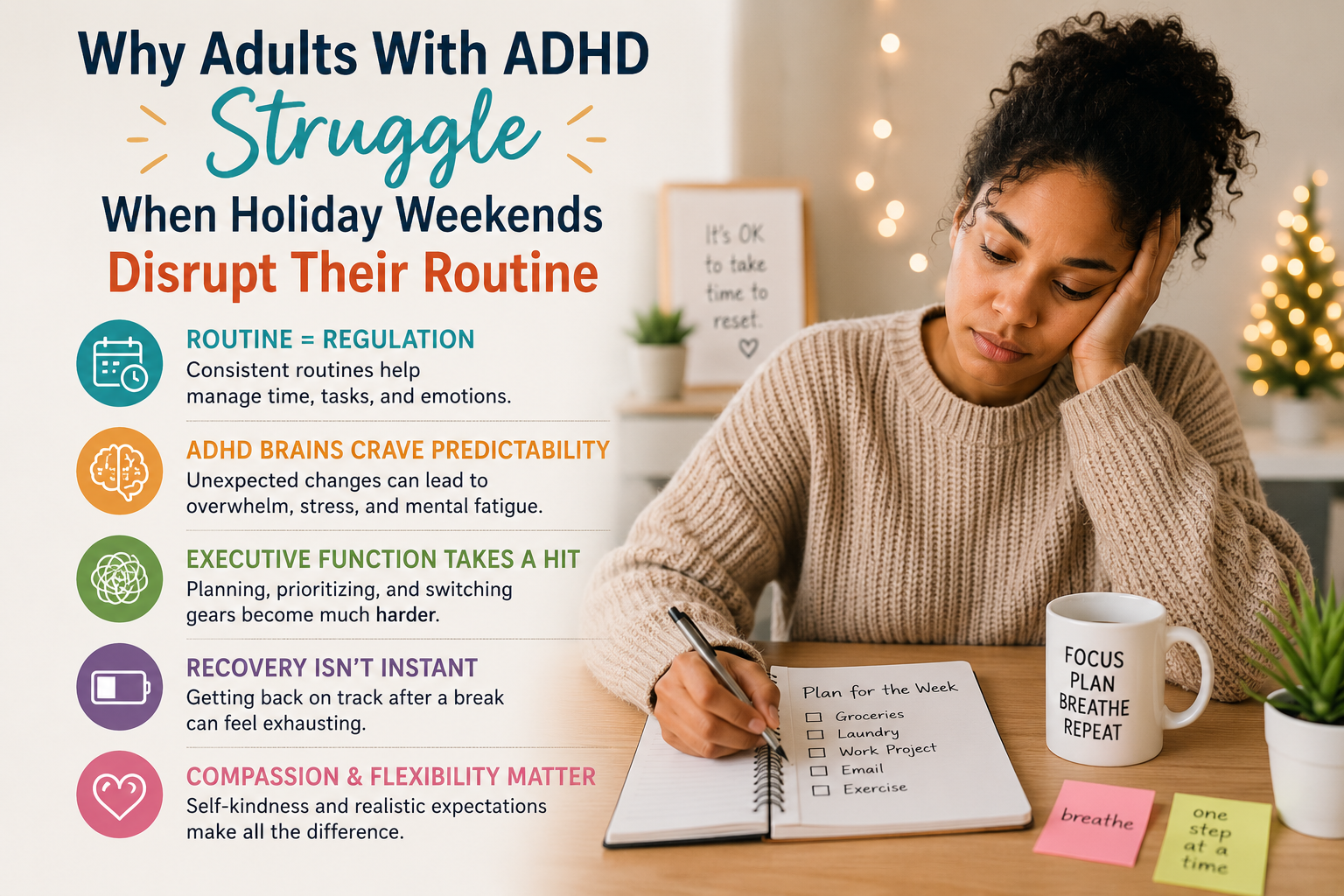
Why Adults With ADHD Struggle When Holiday Weekends Disrupt Their Routine
Long weekends can feel relaxing, but for adults with ADHD, disrupted routines may lead to overwhelm, poor sleep, procrastination, task pileups, and difficulty restarting.
Holiday weekends can be meaningful.
They can bring rest, family, travel, cookouts, reflection, community events, and a break from the usual workweek.
But for adults with ADHD, long weekends can also create a hidden challenge: routine disruption.
A three-day weekend may sound relaxing, but the sudden change in schedule can affect sleep, meals, chores, medication timing, work preparation, emotional regulation, time management, and follow-through.
The person may start the weekend with good intentions.
They may plan to rest, clean, catch up, spend time with family, prepare for the week, answer emails, grocery shop, organize the house, or finally handle tasks that were pushed aside.
Then the weekend disappears.
Sleep shifts.
Meals happen at random times.
Plans change.
Travel takes longer than expected.
Family events run late.
Household tasks pile up.
Work reminders get ignored.
The return to normal life feels harder than expected.
By Monday night or Tuesday morning, the adult with ADHD may feel behind, overwhelmed, guilty, and unprepared.
This is not always a lack of discipline.
Adult ADHD can affect executive functioning, including planning, prioritizing, time awareness, emotional regulation, task initiation, routines, and follow-through. When a routine changes, the brain may have to work harder to rebuild structure.
For adults in Pennsylvania and Delaware, repeated difficulty with disrupted routines may be one reason to consider adult ADHD testing and treatment if focus, time management, procrastination, and daily functioning are being affected

Why Adults With ADHD Struggle When Holiday Weekends Disrupt Their Routine
Why Routine Changes Can Be So Hard With ADHD
Many adults with ADHD rely on structure more than they realize.
A regular weekday may not be perfect, but it often provides anchors:
A wake-up time
A work start time
Medication routines
School or family schedules
Meal patterns
Commute or transition cues
Appointment reminders
Work deadlines
A predictable bedtime
Even if the person struggles, those repeated cues help organize the day.
Holiday weekends can remove or weaken those anchors.
The adult may sleep later, stay up later, eat differently, skip usual planning, delay chores, or lose track of what day it is. The normal rhythm disappears.
For some people, this feels freeing.
For adults with ADHD, it can feel disorienting.
Without structure, the brain may struggle to decide what to do first, what matters most, how much time has passed, and how to restart after the weekend.
This is why executive dysfunction can become more noticeable when routines change.
Long Weekends Can Make Time Feel Blurry
Adults with ADHD often struggle with time blindness.
Time blindness means difficulty sensing, estimating, tracking, or managing time accurately.
During a holiday weekend, time can become even blurrier.
Friday night may feel like there is plenty of time.
Saturday may disappear into errands, family, travel, or rest.
Sunday may become a recovery day.
Monday may feel like “extra time,” until suddenly the weekend is almost over.
Then Tuesday arrives with work, responsibilities, appointments, emails, bills, and unfinished tasks.
The adult may feel surprised by how quickly time passed.
They may think:
“I had three days. Why didn’t I get more done?”
“I thought I had more time.”
“I forgot Tuesday was coming.”
“I never got ready for the week.”
“Now I’m already behind.”
This is why ADHD time management often requires visible structure, especially when the usual routine is interrupted.
Summer can create similar challenges for adults with ADHD because seasonal schedule changes can disrupt sleep, routines, and follow-through.
Sleep Changes Can Make ADHD Symptoms Worse
Holiday weekends often disrupt sleep.
A person may stay up later, wake up later, travel, attend gatherings, nap unexpectedly, drink more caffeine, eat later, or spend more time on screens.
For adults with ADHD, sleep disruption can make symptoms worse.
Poor sleep can affect:
Focus
Mood
Memory
Motivation
Emotional regulation
Task initiation
Decision-making
Irritability
Follow-through
Impulse control
A disrupted sleep schedule can make it harder to restart the week.
The adult may wake up Tuesday feeling groggy, mentally foggy, and emotionally unprepared. Tasks that were already difficult may feel even harder.
This can create a cycle:
The weekend disrupts sleep.
Poor sleep worsens ADHD symptoms.
Worse symptoms make Tuesday harder.
Tuesday stress leads to more avoidance.
Avoidance creates task pileups.
Task pileups create more overwhelm.
Understanding ADHD and mental exhaustion can help adults recognize why a long weekend may leave them feeling drained instead of refreshed.
Family Events Can Increase Emotional Overwhelm
Holiday weekends often include family gatherings, social events, travel, parenting responsibilities, or emotionally meaningful moments.
These events can be positive, but they can also be overstimulating.
Adults with ADHD may have to manage:
Noise
Crowds
Multiple conversations
Planning details
Travel timing
Food preparation
Family expectations
Children’s needs
Social pressure
Financial stress
Unfinished tasks waiting at home
Emotional memories connected to the holiday
Even enjoyable events can take energy.
Some adults with ADHD may feel overstimulated during the event and depleted afterward. Others may feel guilty because they wanted to be present but struggled with distraction, irritability, restlessness, or mental fatigue.
This does not mean they do not care.
It may mean their nervous system and executive function system are working hard.
Understanding ADHD and emotional overwhelm can help adults approach holidays with more compassion and better planning.
Travel Can Break ADHD Systems
Travel can be especially disruptive for adults with ADHD.
Even a short trip can interrupt routines around sleep, meals, medication, work preparation, exercise, chores, and planning.
A person may forget something important.
They may underestimate travel time.
They may pack at the last minute.
They may return home too late.
They may avoid unpacking.
They may forget to prepare for work.
They may come back to a messy house and a full inbox.
Travel also adds hidden executive function demands:
Planning the route
Packing
Remembering items
Managing time
Adjusting to delays
Coordinating with others
Tracking belongings
Handling transitions
Returning home and resetting
For adults with ADHD, these hidden steps can be exhausting.
This is why ADHD task initiation can become harder after a holiday weekend. The person may know they need to unpack, check the calendar, prep for work, or clean up, but starting feels difficult.
The Return-to-Work Transition Can Feel Harsh
The hardest part of a holiday weekend is often not the weekend itself.
It is the return.
Adults with ADHD may struggle with transitions, especially when moving from unstructured time back into work demands.
Tuesday morning may bring:
Unread emails
Missed messages
Work deadlines
Laundry
Dishes
Appointments
Bills
School schedules
Medication refills
Calendar reminders
Grocery needs
A messy house
A brain that still feels off-rhythm
The person may feel like they are starting the week already behind.
This can quickly trigger shame, avoidance, or shutdown.
They may open the laptop and feel overwhelmed.
They may delay checking email.
They may scroll instead of starting.
They may jump between tasks.
They may work late trying to catch up.
They may feel frustrated that a “restful” weekend made life feel harder.
This is why resetting after falling behind with ADHD matters so much. After a disrupted weekend, the goal is not to punish yourself into productivity. The goal is to rebuild structure one step at a time.
Holiday Weekends Can Disrupt Medication and Self-Care Routines
Some adults with ADHD may notice that holiday weekends disrupt medication timing, meals, hydration, sleep, exercise, and other self-care routines.
This can matter.
Medication routines are often tied to weekday patterns. A person may take medication at a certain time because they wake up for work. But when the wake-up time changes, the routine may shift.
They may forget a dose, take it later than usual, skip meals, drink more caffeine, or change sleep patterns.
This can affect how the day feels.
Medication decisions should always be discussed with a qualified prescriber. But from a routine standpoint, holiday weekends can make consistency harder.
At ADHD Philadelphia, treatment is individualized and monitored over time. For adults receiving medication management, follow-up and safety monitoring are important parts of care.
When appropriate, ADHD medication management may be one part of a broader treatment plan for adults who struggle with focus, consistency, and daily functioning.
Summer can create similar challenges for adults with ADHD because seasonal schedule changes can disrupt sleep, routines, and follow-through.
Why Adults With ADHD May Overplan the Weekend
Some adults with ADHD try to compensate for routine disruption by making an ambitious plan.
They may tell themselves:
“I’ll clean the whole house this weekend.”
“I’ll catch up on all my emails.”
“I’ll meal prep for the week.”
“I’ll finally organize everything.”
“I’ll rest and still get everything done.”
“I’ll use the extra day to reset my entire life.”
The plan may be unrealistic, but it feels motivating at first.
Then the weekend happens.
Plans change. Energy drops. Sleep shifts. Family needs increase. Tasks take longer than expected. The person gets overwhelmed and avoids the plan altogether.
By the end of the weekend, they may feel disappointed in themselves.
This is a common ADHD pattern: using big plans to create hope, then feeling shame when the plan is too large to execute.
A better approach is to choose a smaller reset.
Not twenty tasks.
Three.
Not the whole house.
One surface.
Not the whole inbox.
Ten minutes.
Not “fix my life.”
Prepare for Tuesday.
This is why adult ADHD follow-through often improves when the plan is realistic, visible, and small enough to start.
Long Weekends Can Be Hard for Remote Workers With ADHD
Remote workers may be especially affected by holiday weekends.
When work and home already happen in the same space, a long weekend can blur boundaries even more.
A remote worker with ADHD may think:
“I’ll catch up later.”
“I’ll answer that email Monday night.”
“I’ll clean first, then work.”
“I’ll just check one thing.”
“I’ll start fresh Tuesday.”
But when Tuesday comes, the home environment may still be full of distractions: dishes, laundry, family needs, phone notifications, unfinished chores, and work tasks all competing for attention.
Without a commute or office transition, it may be harder to shift back into work mode.
This is why remote work and adult ADHD are so connected. Remote work can be helpful, but it often requires stronger self-generated structure.
A Simple Holiday Weekend Reset for Adults With ADHD
The goal is not to make holiday weekends rigid.
The goal is to create enough structure that the return to normal life does not feel like a crash.
Try this simple reset:
1. Choose one anchor each day
Pick one consistent cue: wake-up time, medication routine, morning walk, breakfast, or bedtime.
2. Keep Tuesday visible
Before the weekend begins, write down the first three things you need for Tuesday.
3. Use a “return home” checklist
Include simple items like unpack bag, check calendar, prepare clothes, review email, and set alarm.
4. Plan one reset block
Set aside 20–30 minutes near the end of the weekend to prepare for the next day.
5. Lower the task count
Choose three important tasks, not twenty.
6. Protect sleep when possible
Even one late night can affect focus, mood, and motivation.
7. Restart without shame
If the weekend went off track, the goal is not self-punishment. The goal is the next step.
For adults with ADHD, routines do not need to be perfect to be helpful. They just need to be restartable.
When Holiday Weekend Struggles May Point to ADHD
Everyone can feel off after a long weekend.
But if routine disruption repeatedly leads to major overwhelm, procrastination, emotional distress, missed responsibilities, work problems, or difficulty restarting, it may be worth considering an ADHD evaluation.
Adult ADHD testing may be helpful if you often struggle with:
Starting tasks
Restarting after breaks
Managing time
Following routines
Preparing for work
Handling transitions
Sleep consistency
Task pileups
Emotional overwhelm
Forgetfulness
Disorganization
Procrastination
Follow-through
A thoughtful evaluation should also consider other possible explanations, including anxiety, depression, trauma, sleep problems, stress, substance use concerns, medical conditions, and medication effects.
For adults in Pennsylvania and Delaware, adult ADHD evaluation can help clarify whether ADHD may be contributing to repeated problems with routines, transitions, and follow-through.
ADHD Testing and Treatment in Pennsylvania and Delaware
ADHD Philadelphia provides adult ADHD testing and treatment for adults in Pennsylvania and Delaware.
Care is designed to help adults better understand symptoms such as poor focus, procrastination, disorganization, time management problems, emotional overwhelm, difficulty with routines, and trouble following through.
Treatment plans are individualized and may include education, behavioral strategies, structure-building, therapy or coaching strategies, lifestyle review, and medication management when clinically appropriate.
Initial appointments are completed through secure telehealth. In-person appointments may be scheduled after the first online appointment when clinically appropriate. Walk-in appointments are not available.
If long weekends, schedule changes, or disrupted routines repeatedly make it hard to restart, support may help you move from frustration toward clarity and practical next steps.
To learn more, visit ADHDPhiladelphia.com.
Frequently Asked Questions About ADHD and Holiday Weekends
Why do holiday weekends make ADHD symptoms worse?
Holiday weekends can disrupt sleep, routines, medication timing, work structure, meals, chores, and planning. For adults with ADHD, losing structure can make focus, time management, and follow-through harder.
Why do I feel worse after a long weekend?
Adults with ADHD may feel worse after a long weekend because disrupted routines can lead to poor sleep, task pileups, emotional overwhelm, and difficulty transitioning back into work or daily responsibilities.
Can ADHD make transitions harder?
Yes. ADHD can affect executive functioning, which includes planning, task initiation, time management, emotional regulation, and shifting from one mode to another. This can make transitions after holidays or weekends more difficult.
How can adults with ADHD reset after a holiday weekend?
A simple reset may include choosing three priority tasks, checking the calendar, preparing for the next day, setting alarms, protecting sleep, and restarting with one small action instead of trying to fix everything at once.
Does ADHD Philadelphia provide ADHD testing in Pennsylvania and Delaware?
Yes. ADHD Philadelphia provides adult ADHD testing and treatment for adults in Pennsylvania and Delaware. Initial appointments begin through telehealth. In-person appointments may be scheduled after the first online appointment when clinically appropriate. Walk-in appointments are not available.
Take the First Step
If holiday weekends, schedule changes, or disrupted routines make it hard to focus, restart, and follow through, ADHD Philadelphia can help you better understand what may be happening.
Adult ADHD can affect time management, routines, emotional regulation, transitions, task initiation, and follow-through. A structured evaluation can help clarify whether ADHD may be contributing to these patterns and whether treatment may be appropriate.
Visit ADHDPhiladelphia.com to learn more about adult ADHD testing and treatment.
Medical Disclaimer
This article is for educational purposes only and is not a substitute for medical advice, diagnosis, or treatment. ADHD symptoms can overlap with anxiety, depression, sleep disorders, trauma, substance use concerns, medical conditions, medication effects, stress, and other mental health conditions. If you are experiencing symptoms of ADHD or another mental health concern, consult a qualified healthcare professional.

Why Remote Work Can Make Undiagnosed Adult ADHD Harder to Ignore
Remote work can expose undiagnosed adult ADHD by removing structure, routines, accountability, and separation between work and home. Learn why focus, time management, and follow-through may become harder.

Why Remote Work Can Make Undiagnosed Adult ADHD Harder to Ignore
Remote work can be a blessing.
No commute.
More flexibility.
More control over the environment.
Less office noise.
More time at home.
More room to work in a way that fits your life.
But for many adults with undiagnosed ADHD, remote work can also make symptoms much harder to ignore.
A person may have managed fairly well in an office, classroom, job site, or structured work environment. There may have been a commute, a set start time, coworkers nearby, meetings that shaped the day, visible expectations, and a clear separation between work and home.
Then remote work removes much of that structure.
Suddenly, the day may feel wide open.
The laptop is there.
The tasks are there.
The emails are there.
The deadlines are there.
But focus still feels hard.
The adult may sit down to work and quickly get pulled into laundry, dishes, phone notifications, personal messages, online browsing, household tasks, food, pets, family interruptions, or another work task that feels easier to start.
By the end of the day, they may feel frustrated and confused.
“I was home all day. Why didn’t I get more done?”
“Why did time disappear?”
“Why do I work better under pressure?”
“Why can’t I start until everything is urgent?”
“Why does working from home feel harder than it should?”
For adults in Pennsylvania and Delaware, remote work struggles may be one reason to consider adult ADHD testing and treatment if focus, time management, procrastination, disorganization, and follow-through are affecting work performance or daily functioning.
Remote work may become even harder during summer when household routines, family schedules, and distractions change.
Remote Work Removes External Structure
Many adults with ADHD rely on external structure more than they realize.
A traditional workplace may provide:
A commute
A start time
A desk or office
Coworkers nearby
Scheduled meetings
Lunch breaks
Visible accountability
Environmental cues
A clear end to the workday
Even if the person still struggled internally, the work environment may have helped organize the day.
Remote work often removes those cues.
There may be no commute to signal the start of work.
No coworker nearby to create accountability.
No physical separation between work and home.
No clear transition between personal responsibilities and job responsibilities.
No natural stopping point.
For adults with ADHD, this can create a problem.
The brain may know work needs to begin, but without external cues, it may struggle to activate. The person may intend to start at 9:00 AM, but one small distraction becomes twenty minutes, then an hour, then half the day.
This is not always a discipline problem.
It may be executive dysfunction showing up in a remote-work environment.
Why Working From Home Can Make Time Disappear
Many adults with ADHD struggle with time blindness.
Time blindness means difficulty sensing, estimating, tracking, or managing time accurately.
Remote work can make time blindness worse because the day may have fewer natural markers.
In an office, there may be a commute, morning arrival, lunch break, coworker conversations, meetings, and leaving the building. At home, the day may blend together.
A person may think, “I’ll start in a few minutes.”
Then they check one message.
They make coffee.
They answer a text.
They open another tab.
They remember the laundry.
They scroll for a moment.
They check email.
They look up and it is already noon.
This can create panic and shame.
The adult may then rush through work late in the day, stay up too late, or push tasks into tomorrow. Over time, this creates a cycle of delay, pressure, exhaustion, and falling behind.
Understanding ADHD time blindness can help adults recognize why working from home may require more visible structure, not more self-criticism.
Remote Work Can Increase Distractions
Remote work creates a unique kind of distraction.
At home, distractions are not only digital. They are physical, emotional, and environmental.
The dishes are visible.
The laundry is nearby.
The phone is always available.
The bed may be a few steps away.
The refrigerator is close.
Pets may interrupt.
Children may need attention.
Family members may ask questions.
Personal tasks may compete with work tasks.
For someone without ADHD, these distractions may be annoying.
For someone with ADHD, they can completely derail the day.
The brain may jump from one cue to another. One notification leads to another task. One household reminder leads to a cleaning project. One work email leads to a different work task. One thought creates a chain reaction.
The adult may end the day exhausted but unsure what actually got done.
This is why ADHD and interruptions can be especially important for remote workers.
The Problem Is Not Always Focus — Sometimes It Is Task Initiation
Many remote workers with ADHD do not only struggle to focus.
They struggle to start.
Task initiation is the ability to begin a task without needing extreme urgency, panic, pressure, or emotional intensity.
Remote work can make task initiation harder because there may be less external pressure to begin. No one sees whether the person started at 9:00 AM. No one notices if they are stuck staring at the screen. No one can easily tell if they are avoiding the hardest task.
The adult may know exactly what needs to be done.
They may have a list.
They may have deadlines.
They may have reminders.
They may have a calendar.
They may have good intentions.
But starting still feels hard.
This can be one of the most frustrating parts of undiagnosed ADHD. The person may be bright, capable, and motivated — but still unable to consistently move from intention to action.
Understanding ADHD task initiation can help adults stop viewing the problem as laziness and start recognizing it as a possible executive-function challenge.
Remote Work Can Make Procrastination Easier to Hide
In a traditional workplace, procrastination may be more visible.
At home, it can be easier to hide.
A remote worker may look active online but avoid the most important task. They may answer easy emails while avoiding the difficult report. They may attend meetings but delay follow-up. They may work late to compensate for losing time earlier in the day.
This can create a painful pattern.
The person may technically get work done, but only through stress, last-minute pressure, late nights, or constant catch-up.
They may seem functional from the outside while privately feeling overwhelmed.
This is especially common for high-achieving adults with ADHD. They may be smart enough, creative enough, or hardworking enough to compensate for a long time — until the cost becomes too high.
Over time, procrastination can become emotionally exhausting.
The person may feel like they are always behind, always rushing, always apologizing, or always trying to recover.
This is why ADHD procrastination should not automatically be dismissed as poor motivation.
Remote Workers With ADHD May Overwork to Compensate
Some adults with ADHD do not look unproductive.
They look overworked.
Because focus is inconsistent during the day, they may compensate by working at night, answering messages after hours, catching up on weekends, or using anxiety to push through deadlines.
This can create a cycle:
The day starts slowly.
Focus is scattered.
Important tasks are delayed.
Pressure builds.
The person works late.
Sleep gets worse.
The next day starts with less energy.
Focus becomes harder again.
Over time, this can lead to burnout.
Remote work may look flexible, but without boundaries, it can blur the line between working and recovering. Adults with ADHD may feel like they are never fully on and never fully off.
They may be physically home but mentally stuck in unfinished tasks all evening.
Understanding ADHD burnout can help remote workers recognize when compensation is becoming unsustainable.
Remote Work Can Make Emotional Overwhelm Worse
Remote work can be isolating.
If a person falls behind, there may be fewer opportunities for quick clarification, reassurance, or support. A confusing task may sit untouched for days. An uncomfortable email may become emotionally heavier each time it is avoided. A missed message may create guilt.
A critical email, confusing assignment, missed deadline, or abrupt change can create an emotional reaction that interferes with focus long after the original event. Learn how ADHD may affect emotional regulation and recovery after stress.
Adults with ADHD may experience strong emotional reactions to work stress.
A delayed task can feel like failure.
A confusing project can create shame.
A messy workspace can make the whole day feel impossible.
The person may not only be managing tasks.
They may be managing feelings about the tasks.
This matters because emotional regulation is part of executive functioning. When emotions become intense, focus and follow-through often become harder.
Understanding ADHD and emotional overwhelm can help adults recognize that remote work struggles are not always about poor work ethic. Sometimes the emotional load is part of the problem.
Remote Work Can Affect Household Routines
Working from home can blur work tasks and home tasks.
A person may start the day planning to work, then notice the trash, dishes, mail, laundry, pet needs, grocery list, or household clutter. Each home cue competes with job responsibilities.
For adults with ADHD, this can create constant task switching.
Work tasks interrupt home tasks.
Home tasks interrupt work tasks.
Messages interrupt both.
The person starts several things and finishes few.
This can be especially difficult for parents, caregivers, entrepreneurs, students, and adults managing multiple responsibilities at once.
Instead of feeling flexible, remote work may feel like living inside one giant unfinished to-do list.
This is why ADHD routines can become harder to maintain when home and work happen in the same space.
Why Undiagnosed ADHD May Show Up More Clearly in Remote Work
Some adults do not realize they may have ADHD until remote work exposes the pattern.
They may notice:
Difficulty starting work without pressure
Trouble staying focused during independent tasks
Losing time during the day
Working better at night or under deadline pressure
Avoiding tasks that feel boring or unclear
Starting many tasks but finishing few
Forgetting meetings or messages
Difficulty switching between tasks
Feeling overwhelmed by email
Feeling exhausted from self-management
Struggling to create routines
Overworking to catch up
Feeling capable but inconsistent
The key word is pattern.
Everyone gets distracted sometimes. Everyone has unproductive days. Everyone struggles with motivation occasionally.
But when these patterns are frequent, long-standing, and affecting work, home, relationships, health responsibilities, or emotional well-being, it may be worth considering an evaluation.
A structured adult ADHD evaluation can help clarify whether ADHD may be contributing to remote work struggles.
Remote Work Strategies That May Help Adults With ADHD
Remote work may require intentional structure.
Here are a few ADHD-friendly strategies that may help:
1. Create a fake commute
Take a short walk, drive around the block, or create a morning transition ritual before starting work.
2. Use visible time blocks
Instead of keeping the schedule only in your head, write down clear work blocks.
3. Start with one physical action
Do not write “work.” Write “open laptop,” “open document,” or “reply to one message.”
4. Reduce notifications
Turn off nonessential alerts during focus blocks.
5. Keep a restart note
Before switching tasks, write down: “When I return, start here.”
6. Separate work and home cues
Even if you do not have a separate office, use a specific chair, desk area, lamp, playlist, or notebook to signal work mode.
7. Plan breaks on purpose
Unplanned breaks can become long distractions. Planned breaks can help the brain reset.
8. End the day with a shutdown routine
Write down what was completed, what is next, and what can wait until tomorrow.
For adults with ADHD, remote work success often depends less on willpower and more on building external structure.
Treatment Can Help Remote Workers With ADHD
ADHD treatment is not about making someone perfect.
It is about reducing impairment and improving daily functioning.
For remote workers, ADHD treatment may help with:
Focus
Task initiation
Time management
Procrastination
Emotional regulation
Follow-through
Workday structure
Sleep routines
Task completion
Interruptions
Restarting after distractions
Reducing shame
Creating realistic systems
Treatment may include education, behavioral strategies, executive function support, therapy or coaching strategies, lifestyle review, and medication management when clinically appropriate.
At ADHD Philadelphia, care is individualized and monitored over time. Initial appointments are completed through secure telehealth for adults in Pennsylvania and Delaware. In-person appointments may be scheduled after the first online appointment when clinically appropriate. Walk-in appointments are not available.
For some adults, ADHD treatment for adults can help remote work feel less chaotic and more manageable.
Remote Work Did Not Cause ADHD — It May Have Revealed It
Remote work does not cause ADHD.
But it can reveal ADHD symptoms that were previously hidden by structure, pressure, routine, or external accountability.
If you have struggled more since working from home, that does not mean you are lazy, unprofessional, or incapable.
It may mean your brain needs more structure than your current environment provides.
Adult ADHD can affect focus, motivation, time awareness, task initiation, organization, emotional regulation, working memory, and follow-through. When those symptoms interfere with work or daily life, evaluation and treatment may help.
If you are an adult in Pennsylvania or Delaware and remote work has made focus, procrastination, time management, or follow-through harder to manage, ADHD Philadelphia can help you explore whether ADHD may be part of the picture.
Visit ADHDPhiladelphia.com to learn more about adult ADHD testing and treatment.
Frequently Asked Questions About Remote Work and Adult ADHD
Can remote work make ADHD symptoms worse?
Remote work can make ADHD symptoms more noticeable by removing structure, routine, accountability, and separation between work and home. It can also increase distractions and make time management harder.
Why do I focus better in an office than at home?
An office may provide external structure, environmental cues, coworker visibility, and clearer work boundaries. Adults with ADHD may function better when those supports are present.
Does struggling with remote work mean I have ADHD?
Not necessarily. Many people struggle with remote work. However, repeated problems with focus, procrastination, time blindness, disorganization, and follow-through may be reasons to consider an ADHD evaluation.
Can ADHD treatment help remote workers?
ADHD treatment may help remote workers improve focus, structure, task initiation, emotional regulation, time management, and follow-through. Treatment may include behavioral strategies, therapy or coaching strategies, lifestyle changes, and medication management when appropriate.
Does ADHD Philadelphia provide telehealth ADHD treatment?
Yes. ADHD Philadelphia provides adult ADHD testing and treatment for adults in Pennsylvania and Delaware. Initial appointments are completed through telehealth. In-person appointments may be scheduled after the first online appointment when clinically appropriate. Walk-in appointments are not available.
Take the First Step
If remote work has made your ADHD symptoms harder to ignore, you do not have to keep blaming yourself.
Adult ADHD can affect focus, task initiation, time management, emotional regulation, routines, and follow-through. A structured evaluation can help clarify whether ADHD may be contributing to these patterns and whether treatment may be appropriate.
ADHD Philadelphia provides adult ADHD testing and treatment for adults in Pennsylvania and Delaware.
Visit ADHDPhiladelphia.com to learn more.
Medical Disclaimer
This article is for educational purposes only and is not a substitute for medical advice, diagnosis, or treatment. ADHD symptoms can overlap with anxiety, depression, sleep disorders, trauma, substance use concerns, medical conditions, medication effects, stress, and other mental health conditions. If you are experiencing symptoms of ADHD or another mental health concern, consult a qualified healthcare professional.