Why Adults With ADHD Struggle to Reset After Summer Travel
Summer travel can be exciting.
A beach trip.
A family visit.
A weekend getaway.
A graduation trip.
A wedding.
A road trip.
A long weekend.
A vacation that has been planned for months.
Travel can give adults a needed break from work, routines, responsibilities, and the usual stress of daily life.
But for many adults with ADHD, returning from summer travel can feel surprisingly difficult.
The suitcase stays unpacked.
Laundry piles up.
Sleep feels off.
Work emails feel overwhelming.
The refrigerator is empty.
The calendar feels unclear.
Medication timing may have shifted.
Bills and messages may have accumulated.
The house feels disorganized.
The brain feels like it is still somewhere else.
Then the adult with ADHD may think:
“Why can’t I just get back to normal?”
“Why is unpacking so hard?”
“Why do I feel behind after a vacation?”
“Why does returning home feel more stressful than leaving?”
“Why does one trip throw off my whole week?”
This is not always laziness.
Adult ADHD can affect executive functioning, including planning, time management, task initiation, working memory, emotional regulation, organization, routines, and follow-through. When travel disrupts the systems that help the brain stay on track, resetting can feel much harder than expected.
For adults in Pennsylvania and Delaware, repeated difficulty getting back on track after travel, schedule changes, or disrupted routines may be one reason to consider adult ADHD testing and treatment.
Why Travel Disrupts ADHD Routines
Adults with ADHD often rely on routines more than they realize.
A normal week may include:
A wake-up time
Medication routine
Work start time
Meal pattern
Exercise schedule
Sleep routine
Household rhythm
Calendar reminders
Daily task cues
Work and home boundaries
Even if the routine is not perfect, it gives the brain structure.
Travel changes that structure.
Sleep may shift.
Meals may happen at different times.
Medication timing may become less consistent.
Exercise may pause.
Work routines may stop.
Household tasks may wait.
The calendar may be ignored.
The environment changes.
The usual cues disappear.
Then, when the adult returns home, the brain has to rebuild the routine.
That rebuilding process requires executive functioning. If executive functioning is already strained, the reset can feel overwhelming.
This is why executive dysfunction can become more noticeable after summer travel.
The Return Home Creates a Task Pileup
Travel can delay tasks, but it does not erase them.
While the adult is away, responsibilities may continue building.
Emails arrive.
Bills wait.
Laundry accumulates.
Messages go unanswered.
Work projects continue.
Appointments need attention.
Groceries need restocking.
The house may need cleaning.
Mail may pile up.
Children’s schedules may need restarting.
When the adult returns, everything may feel urgent at once.
For ADHD, this can create shutdown.
The adult may not know where to begin. They may start unpacking, then notice the laundry. They may begin laundry, then remember groceries. They may open email, then become overwhelmed. They may start making a list, then get distracted by another task.
The problem is not that nothing is happening.
The problem is that everything is competing for attention.
This is why ADHD and task pileups can make returning from travel feel so difficult.
Unpacking Is Often Harder Than Packing
Many adults with ADHD find packing stressful.
But unpacking can be even harder.
Packing has urgency.
There is a deadline.
The trip is coming.
There is pressure to prepare.
There may be excitement or fear driving action.
Unpacking has less urgency.
The trip is over.
The reward is gone.
The task feels boring.
The suitcase can be ignored.
The clothes can wait.
The toiletries can sit in the bag.
The mess can become part of the room.
For adults with ADHD, low-interest tasks are often harder to start. Unpacking may feel simple from the outside, but it can require sorting, decision-making, laundry, putting items away, remembering where things go, and restarting normal routines.
That is a lot of executive functioning for a task with little immediate reward.
This is why ADHD task initiation can become a major barrier after travel.
Sleep Disruption Can Make the Reset Harder
Travel often changes sleep.
A person may stay up later, wake up earlier, sleep in a different bed, share a room, change time zones, drink more caffeine, eat later, nap during the day, or spend more time on screens.
Even enjoyable travel can disrupt recovery.
For adults with ADHD, sleep changes can make symptoms worse.
Poor sleep can affect:
Focus
Mood
Memory
Patience
Motivation
Task initiation
Time awareness
Emotional regulation
Decision-making
Follow-through
So when the adult returns home, they may not only be facing a task pileup. They may also be trying to reset with a tired brain.
This can make everything feel harder.
The suitcase feels heavier.
The email inbox feels bigger.
The calendar feels confusing.
The body wants rest.
The mind feels foggy.
The person feels guilty for not bouncing back.
Understanding ADHD and mental exhaustion can help adults recognize why post-travel recovery can take more than one night.
Travel Can Disrupt Medication and Health Routines
Travel may also interrupt health routines.
Medication timing may change.
Meals may be inconsistent.
Hydration may be lower.
Sleep may shift.
Exercise may stop.
Caffeine intake may increase.
Alcohol may be present at social events.
Stress may increase during planning or travel.
For adults receiving ADHD treatment, routine consistency matters.
Medication should always be taken as prescribed. If someone has questions about travel, timing, missed doses, side effects, or interactions, they should speak with their prescribing clinician.
For adults treated at ADHD Philadelphia, treatment plans are individualized and monitored carefully. Stimulant medications are controlled substances and require structured follow-up and safety monitoring.
Travel can be part of life, but it is important to plan ahead when medication, sleep, schedule, and health routines may be affected.
Understanding ADHD medication management can help adults approach travel with more planning and less confusion.
Returning to Work Can Feel Like a Shock
After travel, work can feel especially difficult.
The adult may open the laptop and feel flooded.
Emails.
Deadlines.
Meetings.
Messages.
Missed updates.
Unclear priorities.
Tasks that were paused before leaving.
New tasks that arrived while away.
For adults with ADHD, returning to work after travel can be difficult because the brain has to switch from travel mode back into task mode.
That transition requires:
Planning
Prioritizing
Task initiation
Emotional regulation
Memory
Focus
Time management
Follow-through
If the adult works remotely, the transition may be even harder because there is no commute or physical workplace to signal that the work routine has restarted.
This is why remote work and adult ADHD can be especially challenging after summer travel.
Family Travel Can Add Another Layer
Travel with family can be meaningful, but it can also be demanding.
Parents and caregivers may manage:
Packing
Snacks
Medications
Clothing
Sunscreen
Transportation
Children’s sleep
Activities
Behavior
Meals
Schedules
Budgeting
Family expectations
Safety
Communication
Returning home
By the time the trip ends, the parent may feel like they need a vacation from the vacation.
For adults with ADHD, family travel can create extra executive load. The parent may be managing their own ADHD symptoms while also managing everyone else’s needs.
Then the family returns home and the parent is expected to restart work, unpack, clean, handle laundry, prepare meals, manage children’s schedules, and return to normal.
That is a lot.
This is why parenting with adult ADHD can feel harder during summer travel season.
The Emotional Crash After Travel Is Real
Many adults with ADHD feel an emotional drop after travel.
The trip may have provided novelty, stimulation, social connection, sunlight, movement, or a break from normal demands.
Then the person returns home.
The excitement ends.
The routine returns.
The bills are still there.
The work is still waiting.
The house needs attention.
The calendar feels heavy.
The body feels tired.
For ADHD, novelty can be energizing. When the novelty ends, returning to ordinary tasks can feel emotionally difficult.
This may show up as sadness, irritability, avoidance, restlessness, boredom, guilt, or overwhelm.
The adult may think something is wrong with them because they feel worse after a vacation.
But sometimes the crash is the result of stimulation ending, sleep disruption, task pileups, and emotional overload all happening at once.
Understanding ADHD and emotional overwhelm can help adults approach the post-travel period with compassion and structure instead of shame.
Time Blindness Can Make Reentry Feel Sudden
Travel can distort time.
Before the trip, the adult may think:
“I’ll deal with that after I get back.”
“I’ll answer that later.”
“I’ll reset on Monday.”
“I’ll unpack right away.”
“I’ll get caught up quickly.”
Then the trip ends.
Suddenly, Monday arrives. The inbox is full. The suitcase is still packed. The calendar has appointments. Work starts again. The house needs attention.
The adult may feel shocked by how quickly normal life returned.
This can be connected to ADHD time blindness.
Time blindness can make it hard to sense how long tasks will take, how much recovery time is needed, or how quickly responsibilities will resume.
This is why ADHD time management often requires a reentry plan before the trip ends.
A Simple Travel Reset Plan for Adults With ADHD
The goal after travel is not to catch up on everything immediately.
The goal is to restart.
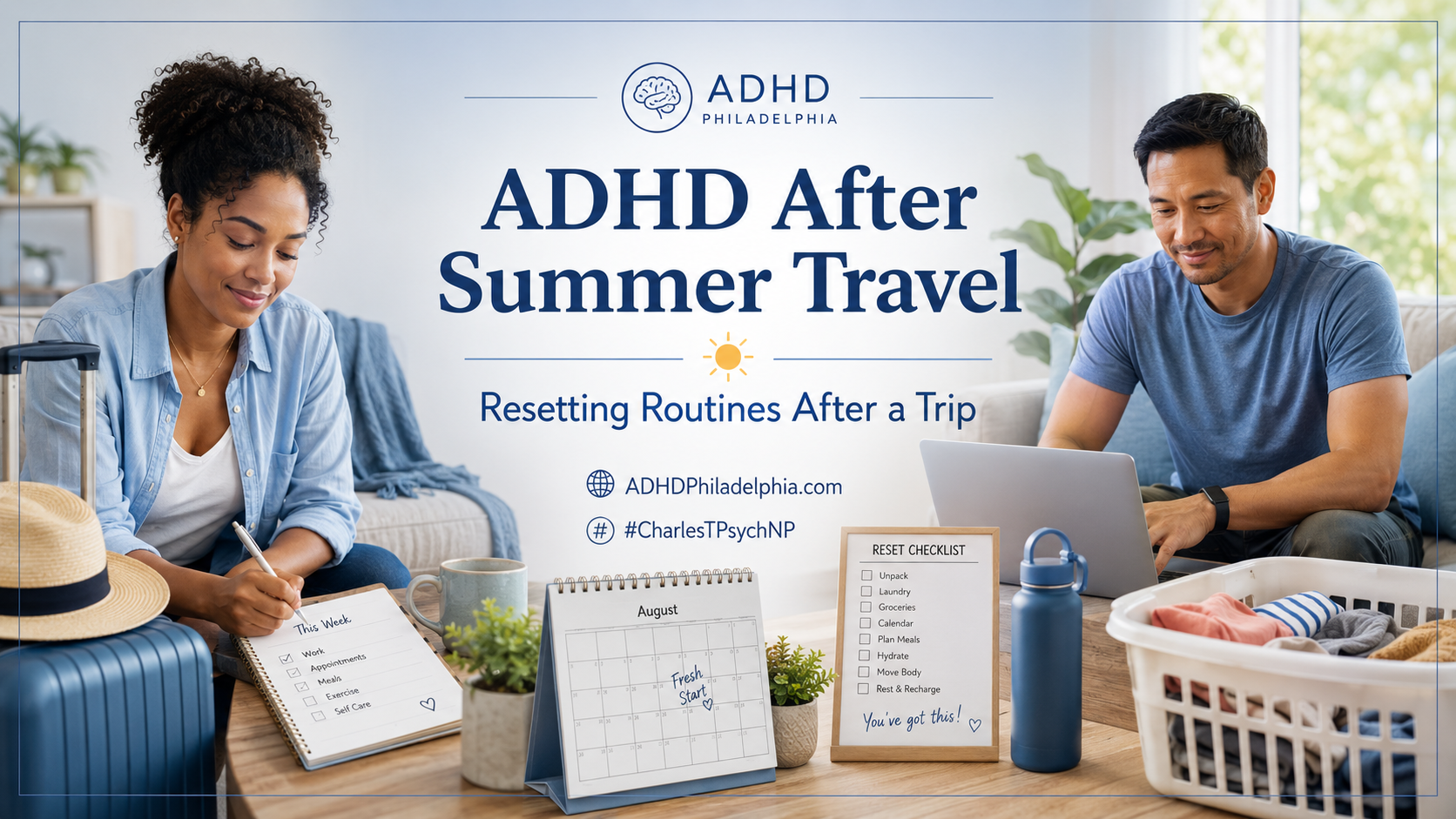
Try this ADHD-friendly travel reset:
1. Create a reentry buffer
Avoid scheduling your hardest work task immediately after returning if possible. Give yourself a reset window.
2. Unpack one category first
Do not start with “unpack everything.” Try “remove toiletries,” “start laundry,” or “empty dirty clothes.”
3. Choose three priorities
Pick three tasks that would make the biggest difference today or tomorrow.
4. Use a visible checklist
Post-travel tasks are easy to forget. Make them visible.
5. Restart sleep gently
Choose a realistic bedtime and wake time for the next two nights.
6. Do a calendar review
Look at the next seven days before jumping into tasks.
7. Restock basics
Food, medication routines, laundry, and work supplies can help the week feel less chaotic.
8. Write a restart note
Before stopping for the day, write: “Tomorrow, start with ______.”
9. Reduce shame
A slow reset is still a reset.
For adults with ADHD, post-travel routines work best when they are simple, visible, and restartable.
When Post-Travel Struggles May Point to ADHD
Everyone can feel tired after travel.
But if returning from trips repeatedly leads to major problems with work, home responsibilities, emotional overwhelm, sleep, organization, time management, or follow-through, ADHD may be worth exploring.
Adult ADHD testing may be helpful if you often struggle with:
Unpacking
Task initiation
Time management
Disorganization
Forgetfulness
Emotional overwhelm
Sleep routines
Travel recovery
Returning to work
Task pileups
Procrastination
Following through
Restarting after breaks
Feeling capable but inconsistent
A thoughtful evaluation should also consider anxiety, depression, trauma, sleep problems, stress, substance use concerns, medical conditions, and medication effects.
For adults in Pennsylvania and Delaware, adult ADHD evaluation can help clarify whether ADHD may be contributing to repeated problems with routines, transitions, travel recovery, and follow-through.
ADHD Testing and Treatment in Pennsylvania and Delaware
ADHD Philadelphia provides adult ADHD testing and treatment for adults in Pennsylvania and Delaware.
Care is designed to help adults better understand symptoms such as poor focus, procrastination, disorganization, time management problems, emotional overwhelm, difficulty with routines, and trouble following through.
Treatment plans are individualized and may include education, behavioral strategies, structure-building, therapy or coaching strategies, lifestyle review, and medication management when clinically appropriate.
Initial appointments are completed through secure telehealth. In-person appointments may be scheduled after the first online appointment when clinically appropriate. Walk-in appointments are not available.
If summer travel repeatedly makes it hard to reset, restart routines, manage work, and follow through, support may help you move from frustration toward clarity and practical next steps.
To learn more, visit ADHDPhiladelphia.com.
Frequently Asked Questions About Adult ADHD and Summer Travel
Why do adults with ADHD struggle after travel?
Adults with ADHD may struggle after travel because routines, sleep, medication timing, work structure, household tasks, and emotional regulation may all be disrupted at the same time.
Why is unpacking so hard with ADHD?
Unpacking may be hard because it requires task initiation, sorting, decision-making, laundry, organization, and follow-through. It also has less urgency than packing.
Can vacation make ADHD symptoms worse?
Vacation itself does not cause ADHD, but disrupted routines, poor sleep, task pileups, travel stress, and returning to responsibilities can make ADHD symptoms more noticeable.
How can adults with ADHD reset after summer travel?
Helpful strategies include using a travel reset checklist, unpacking one category first, choosing three priorities, reviewing the calendar, restarting sleep gently, and writing a restart note for the next day.
Does ADHD Philadelphia provide ADHD testing in Pennsylvania and Delaware?
Yes. ADHD Philadelphia provides adult ADHD testing and treatment for adults in Pennsylvania and Delaware. Initial appointments begin through telehealth. In-person appointments may be scheduled after the first online appointment when clinically appropriate. Walk-in appointments are not available.
Take the First Step
If summer travel, vacations, and schedule changes make it harder to reset, focus, organize, and follow through, ADHD Philadelphia can help you better understand what may be happening.
Adult ADHD can affect routines, emotional regulation, time management, transitions, task initiation, and follow-through. A structured evaluation can help clarify whether ADHD may be contributing to these patterns and whether treatment may be appropriate.
Visit ADHDPhiladelphia.com to learn more about adult ADHD testing and treatment.
Medical Disclaimer
This article is for educational purposes only and is not a substitute for medical advice, diagnosis, or treatment. ADHD symptoms can overlap with anxiety, depression, sleep disorders, trauma, substance use concerns, medical conditions, medication effects, stress, and other mental health conditions. If you are experiencing symptoms of ADHD or another mental health concern, consult a qualified healthcare professional.Summer travel can be exciting.