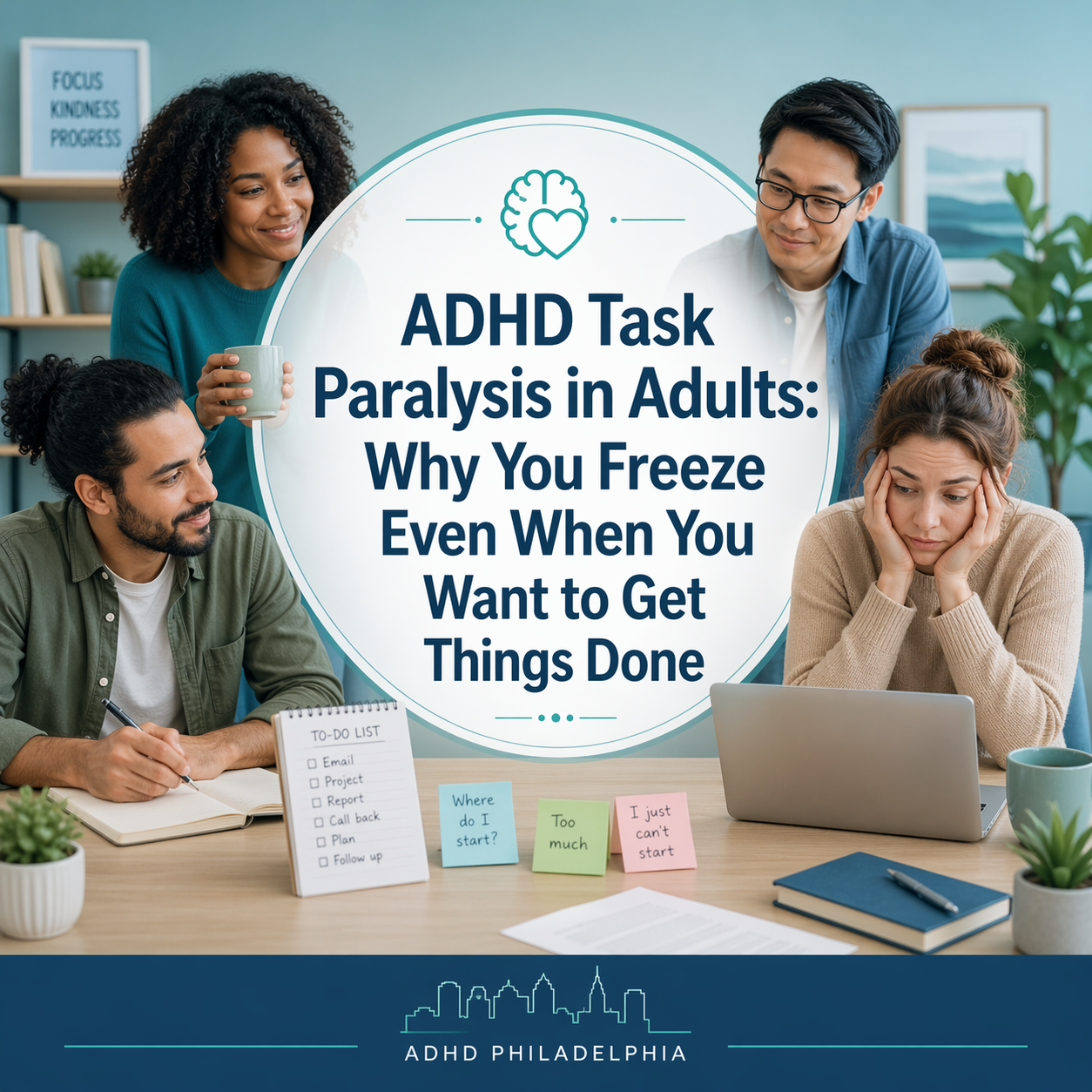
ADHD Task Paralysis in Adults: Why You Freeze Even When You Want to Get Things Done
ADHD task paralysis can make adults feel stuck, overwhelmed, and unable to begin even important responsibilities. Learn why it happens and what may help.
Many adults with ADHD do not simply procrastinate.
Instead, they hit a wall.
They may know exactly what needs to be done. They may care about the outcome. They may even feel anxious about putting it off. But instead of moving forward, they feel frozen.
This experience is often described as ADHD task paralysis.
For adults, this can show up at work, at home, in school, or in everyday life. It may affect something as small as answering an email or something as important as finishing a project, paying bills, filling out forms, or making a necessary appointment.
If you have ever felt stuck while telling yourself, “Just do it,” only to still not move, you are not alone.
At ADHD Philadelphia, many adults describe task paralysis as one of the most frustrating and confusing parts of living with untreated or undiagnosed ADHD.
What Is ADHD Task Paralysis?
ADHD task paralysis is the feeling of being mentally unable to start, continue, or switch tasks, even when the task matters.
It is not simply laziness.
It is not always lack of effort.
And it is not necessarily a sign that someone does not care.
Instead, task paralysis often reflects difficulty with executive functioning, especially in areas like task initiation, prioritization, working memory, emotional regulation, and shifting attention.
Some adults describe it like this:
“I want to start, but my brain won’t go.”
“I keep thinking about the task, but I still don’t do it.”
“I feel overwhelmed before I even begin.”
“I freeze when there are too many steps.”
“The more important it is, the harder it can feel to start.”
For many adults, this is closely related to the difficulty many people with ADHD experience when they struggle to start tasks in the first place.
Why Task Paralysis Happens in Adults With ADHD
ADHD affects more than attention.
In adults, it can interfere with the brain’s ability to organize action, manage effort, regulate emotion, and turn intention into movement.
Task paralysis can happen for several reasons.
1. The task feels too big
When a task has too many parts, the brain may not know where to begin.
“Do the taxes.”
“Clean the house.”
“Catch up on work.”
“Fix my life.”
“Get organized.”
These are not really single tasks. They are bundles of smaller steps. For adults with ADHD, the brain may respond to that mental load by freezing instead of acting.
2. The task feels boring or unstimulating
Many adults with ADHD are able to focus when something feels urgent, novel, or emotionally engaging. But if a task feels repetitive, dull, or low-reward, it may be much harder to activate.
This can create an exhausting pattern where adults wait until panic or deadline pressure generates enough stimulation to move.
3. Perfectionism makes the task feel risky
Adults with ADHD often carry years of frustration, criticism, and self-doubt. That emotional history can make even simple tasks feel loaded.
Instead of thinking, “I’ll just start,” the brain may think:
“What if I mess it up?”
“What if I forget something?”
“What if I cannot finish?”
“What if I disappoint myself again?”
That emotional friction can make paralysis worse.
4. Overwhelm shuts down action
Sometimes adults with ADHD do not avoid a task because they do not want to do it. They avoid it because they feel too mentally flooded to begin.
That is one reason task paralysis often overlaps with feeling mentally overwhelmed.
5. Transitions are difficult
Many adults with ADHD struggle to shift from one state into another.
Examples include:
from resting to working
from scrolling to focusing
from one task to another
from thinking to doing
This difficulty with transitions can make starting feel much harder than it looks from the outside.
What ADHD Task Paralysis Looks Like in Real Life
Task paralysis does not always look dramatic.
Often it looks like everyday frustration.
Adults may:
stare at a task without starting
open a document and then close it
think about the task repeatedly all day
reorganize instead of doing the actual work
scroll on their phone while feeling guilty
make lists but not act on them
wait until the pressure becomes unbearable
avoid important responsibilities even when they care deeply
Sometimes the outside world sees procrastination.
But on the inside, the adult may feel stressed, ashamed, frustrated, and confused about why they still cannot move.
Task paralysis can be one part of a larger executive functioning pattern that also includes difficulty finishing, returning to tasks, and maintaining consistency over time.
It Is Not a Character Flaw
This matters.
Many adults with ADHD spend years believing they are lazy, irresponsible, or weak because they cannot consistently do what seems easy for other people.
They may think:
“Why am I like this?”
“Why can I do hard things sometimes but not simple things?”
“Why do I keep freezing?”
“Why can’t I just start?”
But task paralysis in ADHD is often not about character.
It is about how the brain manages activation, effort, sequencing, and emotional load.
That does not make it any less painful, but it does make it more understandable and more treatable.
For some adults, task paralysis does not just affect single projects. It also affects everyday routines that require repeated restarts and consistency over time.
How Task Paralysis Affects Work, School, and Daily Life
Task paralysis can have a major impact on adult functioning.
At work
Adults may struggle to begin reports, send emails, organize projects, or follow through on administrative tasks. This can lead to missed deadlines, underperformance, and chronic stress.
At home
Bills, laundry, dishes, scheduling, paperwork, and cleaning can pile up quickly when starting feels overwhelming.
In school
Reading, writing assignments, studying, and online coursework may become much harder to begin than expected.
In relationships
Partners or family members may misunderstand the pattern and assume the person is avoiding responsibility or not trying hard enough.
Emotionally
Task paralysis can fuel shame, anxiety, burnout, and low self-confidence over time.
For many adults, this becomes one of the reasons they finally seek an ADHD evaluation for adults.
What Can Help With ADHD Task Paralysis?
The good news is that adults with ADHD can improve task paralysis, especially when ADHD treatment is tailored to how the condition actually works.
Helpful strategies may include:
Breaking tasks into first steps
Instead of:
“Clean the kitchen.”
Start with:
put dishes in sink
throw away trash
wipe one counter
Instead of:
“Catch up on work.”
Start with:
open the file
read the first paragraph
reply to one email
Smaller steps reduce mental friction.
Using external structure
Timers, visual reminders, calendars, checklists, and body doubling can make starting easier.
Lowering the pressure to do it perfectly
Adults with ADHD often benefit from starting badly rather than waiting for the perfect moment.
Treating the ADHD directly
For some adults, ADHD medication treatment may improve activation, focus, persistence, and follow-through. Others may benefit from behavioral strategies, therapy, coaching, or a combined approach.
Understanding the pattern
Sometimes one of the most powerful first steps is realizing that task paralysis may be part of ADHD, not a moral failure.
When to Consider an ADHD Assessment
It may be worth considering an ADHD assessment if you regularly experience:
freezing when trying to start important tasks
chronic procrastination
overwhelm with multi-step responsibilities
difficulty organizing and following through
repeated stress from unfinished tasks
guilt, shame, or burnout related to productivity
a long history of “trying harder” without consistent success
This is especially important if these patterns have affected your work, school, relationships, finances, or confidence.
At ADHD Philadelphia, adults in Pennsylvania and Delaware can seek structured diagnosis, testing, and treatment for ADHD through a respectful and practical process designed for adult life.
Final Thought
If you feel frozen when trying to begin something important, that does not automatically mean you are lazy or unmotivated.
You may be dealing with ADHD task paralysis.
For many adults, this is one of the most painful and misunderstood symptoms of ADHD. But once it is recognized clearly, it can be treated more effectively.
Understanding why you freeze is often the beginning of learning how to move again.
If you are ready to explore adult ADHD testing and treatment in Pennsylvania or Delaware, you can book online today.

Why So Many Adults With ADHD Struggle to Start Tasks
Task initiation problems are one of the most frustrating symptoms of adult ADHD. Learn why starting tasks feels so hard and how treatment may help adults in Pennsylvania and Delaware.
A lot of adults with ADHD do not have a problem understanding what needs to be done.
They know the task.
They know the deadline.
They may even care deeply about getting it done.
But somehow, getting started feels much harder than it “should.”
This is one of the most misunderstood parts of adult ADHD. From the outside, it can look like procrastination, laziness, poor discipline, or lack of motivation. But for many adults, the real issue is difficulty with task initiation, which is part of executive functioning.
At ADHD Philadelphia, many adults describe this experience in similar ways:
“I keep thinking about it, but I still can’t start.”
“Once I get going, I’m often okay.”
“The hardest part is beginning.”
“I waste so much energy trying to make myself do simple things.”
If that sounds familiar, you are not alone.
That is one reason routines can feel so frustrating with ADHD — even when the steps are familiar, starting them each day can still feel harder than expected.
What Is Task Initiation?
Task initiation is the ability to begin a task without excessive delay.
That sounds simple, but it involves a lot more than just deciding to act. It requires the brain to organize, activate, prioritize, tolerate discomfort, and shift into action.
For adults with ADHD, that process can feel blocked.
You may want to:
answer an email
start a work assignment
clean one room
make an appointment
pay a bill
fill out a form
begin studying
respond to messages
Yet even small tasks can start to feel strangely heavy.
That disconnect can be frustrating, especially for adults who are intelligent, capable, and trying very hard.
Why Starting Tasks Feels So Hard With ADHD
ADHD is not simply a problem with paying attention. In adults, it often affects the brain’s ability to regulate effort, motivation, planning, and follow-through.
Task initiation can become difficult for several reasons.
1. The task does not create enough immediate stimulation
Many adults with ADHD do better with urgency, novelty, pressure, or intense interest.
If a task feels boring, repetitive, vague, or emotionally flat, the brain may not “activate” easily. This does not mean the person does not care. It often means the task is not creating enough internal traction to get movement started.
2. The task feels too big or undefined
Sometimes the problem is not the whole task. It is that the brain does not know what the first step is.
“Clean the apartment.”
“Work on taxes.”
“Fix my schedule.”
“Get caught up.”
These sound like single tasks, but they are really clusters of many tasks. Adults with ADHD often freeze when a task is too broad, too layered, or too mentally cluttered.
3. Perfectionism makes the starting point feel risky
Many adults with ADHD have years of frustration behind them. They may worry about doing something wrong, forgetting a step, losing momentum, or not finishing once they begin.
That can lead to avoidance.
It may not look like anxiety at first glance, but sometimes task paralysis is made worse by fear of failure, shame, or overwhelm.
4. Transitions are harder than people realize
ADHD often makes it harder to shift from one state to another.
For example:
from resting to working
from thinking to doing
from one task to another
from phone use to focused attention
This is why some adults can spend a long time circling a task mentally before finally beginning it.
5. Mental energy gets wasted in the “pre-start” phase
Adults with ADHD often use a lot of invisible effort before they even begin.
They may:
think about the task repeatedly
criticize themselves for not starting
open and close tabs
make lists without acting
prepare too long
wait to “feel ready”
This can be exhausting. By the time they finally try to start, they may already feel defeated.
It Is Not Laziness
This matters.
When adults with ADHD struggle to start tasks, they are often judged harshly by others and by themselves.
Over time, they may start believing things like:
“I’m unreliable.”
“I’m lazy.”
“I waste time.”
“I should be able to do this.”
“Something is wrong with me.”
But many adults with ADHD are not avoiding tasks because they do not care.
They are struggling because the brain systems involved in activation and self-management are not working efficiently.
That is very different from laziness.
Common Signs ADHD May Be Affecting Task Initiation
Adults often notice patterns like:
putting off simple tasks for days or weeks
feeling stuck even when the task is important
starting only when the deadline becomes urgent
needing pressure or panic to get moving
feeling overwhelmed by unclear tasks
procrastinating even on things they want to do
spending more time preparing than actually doing
feeling guilty about unfinished tasks almost every day
Many adults with undiagnosed ADHD have lived with these patterns for years without realizing they may be clinically meaningful.
How This Affects Daily Life
Task initiation problems can affect nearly every part of adult life.
At work
Adults may struggle to start reports, return emails, organize projects, complete paperwork, or begin important tasks until stress builds.
At home
Laundry, dishes, bills, errands, cleaning, scheduling, and follow-up tasks can pile up quickly.
In school or training
Reading assignments, studying, writing papers, and completing forms can become overwhelming.
In relationships
Partners or family members may misunderstand the problem and assume the person is avoiding responsibility.
Emotionally
Repeated difficulty starting tasks can lead to frustration, shame, low confidence, and burnout.
This is one reason many adults eventually seek an ADHD evaluation for adults. They are tired of knowing what to do but feeling unable to consistently begin.
What Can Help
The good news is that adults with ADHD can improve task initiation, especially when ADHD treatment is tailored to how ADHD actually works.
Helpful strategies may include:
Breaking the task into visible first steps
Instead of “clean the kitchen,” the first step becomes:
put dishes in sink
throw away trash
wipe one counter
Instead of “work on taxes,” the first step becomes:
open tax folder
log into account
find one document
The smaller and more specific the starting point, the easier it often becomes to begin.
External structure
Timers, reminders, calendars, checklists, body doubling, routines, and visual cues can help reduce the friction involved in starting.
Lowering the emotional load
Sometimes people wait until they feel motivated. But with ADHD, action often comes before motivation.
Starting badly is usually better than waiting for the perfect mental state.
Medication treatment when appropriate
For some adults, ADHD medication treatment may improve activation, focus, persistence, and follow-through. Treatment is individualized, and not every patient needs the same approach, but for many adults this can be an important part of care.
Better understanding of the diagnosis
Sometimes one of the most helpful steps is realizing there is a reason this has been so hard.
That understanding can reduce shame and make room for more effective strategies.
When to Consider an ADHD Evaluation
It may be worth considering an ADHD assessment if you have longstanding problems with:
starting tasks
finishing tasks
organization
follow-through
procrastination
distractibility
time management
overwhelm with everyday responsibilities
This is especially important if these issues have affected work, school, relationships, or self-esteem.
At ADHD Philadelphia, adults in Pennsylvania and Delaware can seek structured evaluation and treatment for ADHD through a respectful, professional process focused on clarity and practical next steps.
Starting tasks is only one part of the challenge. Many adults with ADHD also struggle with follow-through, unfinished tasks, and staying on track over time.
Final Thought
If you keep telling yourself, “Why can’t I just start?” you may not be dealing with a character flaw.
You may be dealing with ADHD.
For many adults, task initiation is one of the most painful and misunderstood parts of the condition. The struggle is real, but it is also treatable.
Understanding the reason behind the pattern is often the beginning of real change.
Book online at ADHDPhiladelphia.com if you are ready to explore adult ADHD testing and treatment in Pennsylvania or Delaware.

Why Adults With ADHD Feel Overwhelmed (And How to Regain Control)
Many adults with ADHD feel overwhelmed by everyday responsibilities. Learn how executive dysfunction, task paralysis, decision fatigue, emotional overload, and treatment options may help.
Many adults with ADHD describe the same feeling:
“I know what I need to do, but everything feels like too much.”
The inbox is full.
The laundry is sitting there.
The bills need attention.
The work project is overdue.
The appointment needs to be scheduled.
The house feels cluttered.
The to-do list keeps growing.
The brain feels crowded, tired, and stuck.
For many adults, this is not laziness. It may be ADHD-related overwhelm.
Adult ADHD can affect attention, working memory, task initiation, planning, prioritizing, emotional regulation, and follow-through. When these executive function skills are strained, even ordinary responsibilities can feel heavier than they should.
At ADHD Philadelphia, we work with adults in Pennsylvania and Delaware who feel overwhelmed by daily life and want to understand whether ADHD may be part of the picture. ADHD testing and treatment can help provide clarity and create a more structured path forward.
Initial appointments begin through secure telehealth. In-person appointments may be scheduled after the first online appointment when clinically appropriate. Walk-in appointments are not available.
Why ADHD Can Make Daily Life Feel Overwhelming
ADHD does not only affect focus.
It can affect the brain’s ability to organize information, prioritize tasks, begin responsibilities, manage emotions, and complete steps in the right order.
That means an adult with ADHD may know what needs to be done but still feel unable to start.
A simple task may not feel simple because the brain sees every hidden step at once.
For example, “clean the kitchen” may actually feel like:
Clear the counter
Load the dishwasher
Wash the pans
Take out the trash
Put away groceries
Wipe the sink
Sweep the floor
Decide what to do with the mail
Remember the thing you forgot yesterday
When the brain sees too many steps at once, it may shut down instead of starting.
This is one reason adults with ADHD often feel overwhelmed before they even begin.
A structured adult ADHD testing and evaluation process can help clarify whether chronic overwhelm, poor focus, procrastination, forgetfulness, disorganization, and executive dysfunction may be related to ADHD.
Overwhelm Is Often an Executive Function Problem
Executive function refers to the brain skills that help people manage daily life.
These skills include:
Planning
Prioritizing
Starting tasks
Organizing information
Managing time
Holding steps in working memory
Regulating emotions
Switching between tasks
Completing responsibilities
Following through over time
When executive function is strained, daily life can feel chaotic.
The adult may not lack intelligence, ambition, or effort. In fact, many adults with ADHD are working extremely hard. But they may be using too much energy just trying to organize the basics.
This can lead to the feeling of being constantly behind.
Problems with executive function in adults can affect planning, working memory, organization, emotional regulation, time management, task initiation, and follow-through.
Task Paralysis: When You Feel Stuck
One common reason adults with ADHD feel overwhelmed is task paralysis.
Task paralysis happens when the brain struggles to begin, even when the person knows the task matters.
This may look like:
Staring at the task but not starting
Avoiding the task for hours or days
Scrolling instead of beginning
Cleaning something else instead of the priority task
Waiting until urgency creates pressure
Feeling guilty but still unable to move
Feeling mentally frozen
Task paralysis is often misunderstood as laziness. But many adults with ADHD are not avoiding tasks because they do not care. They may be overwhelmed by the number of steps, the emotional weight of the task, uncertainty about where to start, or fear of doing it wrong.
Many adults feel frustrated because adult ADHD can make follow-through difficult even when you care, especially when task initiation, planning, working memory, and consistency are affected.
Why Simple Tasks Can Feel So Heavy
Many adults with ADHD ask:
“Why does something so simple feel so hard?”
It might be answering one email.
Paying one bill.
Returning one call.
Starting one form.
Putting away one basket of laundry.
Scheduling one appointment.
From the outside, these tasks look small. Internally, they may feel huge.
This happens because simple tasks often require multiple executive function steps. The brain must notice the task, remember why it matters, decide when to do it, find the needed information, start the task, stay focused, manage frustration, complete the final step, and follow up if needed.
When the brain is already overloaded, even small tasks can feel mentally exhausting.
Many adults with ADHD struggle because ADHD can make simple tasks feel overwhelming, especially when the brain sees too many steps at once.
Decision Fatigue Adds to the Overwhelm
Overwhelm often gets worse when every task requires a decision.
Adults with ADHD may get stuck asking:
What should I do first?
Is this urgent?
Should I answer this now?
Where do I start?
What if I choose the wrong thing?
Should I clean, work, rest, or respond?
What did I forget?
When the brain has to make too many decisions, it can become exhausted. This is decision fatigue.
Decision fatigue can lead to avoidance, procrastination, irritability, impulsive choices, or shutting down completely.
The more overwhelmed the brain becomes, the harder it is to make clear decisions. The harder decisions become, the more overwhelmed the person feels.
For many adults, ADHD can make decision-making hard because executive dysfunction affects prioritizing, organizing options, managing uncertainty, and moving from thought into action.
Emotional Overload Makes Everything Feel Bigger
ADHD can also affect emotional regulation.
This means emotions may rise quickly, feel intense, and make it harder to think clearly.
A task may trigger frustration, shame, guilt, fear, embarrassment, or anxiety.
For example:
A bill may trigger shame.
An email may trigger dread.
A messy room may trigger defeat.
A work deadline may trigger panic.
A missed appointment may trigger self-criticism.
When emotion becomes intense, the brain may avoid the task to escape the feeling.
That avoidance brings short-term relief, but the task remains unfinished. Then guilt grows. The task feels heavier. The cycle repeats.
This is one reason ADHD-related overwhelm can feel so difficult to escape.
For many adults, understanding ADHD vs anxiety in adults is important because both can affect concentration, restlessness, sleep, motivation, emotional regulation, and daily functioning.
LGBTQ+ adults with ADHD may experience emotional overwhelm differently when masking, stress, identity concerns, and executive dysfunction all interact.
Time Blindness Can Make Overwhelm Worse
Many adults with ADHD struggle with time blindness.
Time blindness means difficulty sensing, estimating, or managing time.
An adult may know a deadline exists but not feel it until it becomes urgent. They may underestimate how long a task will take. They may lose track of time while doing something else. They may feel like time is either “now” or “not now.”
This can create overwhelm because tasks pile up before the brain fully registers how much time has passed.
The adult may feel shocked by how quickly the day disappeared.
They may think:
“How is it already afternoon?”
“How did I not start yet?”
“Why do I always wait until the last minute?”
“Why does time keep getting away from me?”
When time management becomes difficult, life can feel like a constant race to catch up.
Many adults struggle because ADHD can make routines hard to maintain, especially when time blindness, distractibility, and task-switching problems interfere with daily structure.
Overwhelm Can Affect Work, Home, and Relationships
ADHD-related overwhelm can affect every major area of adult life.
At work, it may show up as missed deadlines, difficulty organizing projects, trouble responding to messages, procrastination, poor prioritization, and mental fatigue.
At home, it may show up as clutter, unpaid bills, unfinished chores, missed appointments, laundry piles, unopened mail, and difficulty keeping routines.
In relationships, overwhelm may lead to emotional reactivity, forgetfulness, poor follow-through, shutdown, irritability, or feeling misunderstood.
The adult may care deeply but feel unable to keep up consistently.
This can create shame and self-blame.
Many adults feel relief when they learn that ADHD treatment can help explain patterns they once blamed on laziness or lack of discipline.
Why Adults With ADHD Often Feel Behind
Many adults with ADHD feel like they are always catching up.
They may wake up already thinking about yesterday’s unfinished tasks. They may carry mental lists all day. They may feel guilty for resting because there is always something else to do.
This creates a constant sense of pressure.
Even when they are not actively working, the brain may feel busy.
This can lead to burnout, irritability, poor sleep, reduced motivation, and emotional exhaustion.
Adults with ADHD often need systems that reduce mental load. The goal is not to remember everything perfectly. The goal is to build external structure so the brain is not carrying every task at once.
Recognizing adult ADHD symptoms can help explain why overwhelm, mental exhaustion, time blindness, emotional reactivity, procrastination, and inconsistent follow-through may affect daily life.
How to Regain Control When ADHD Feels Overwhelming
Regaining control does not mean becoming perfect.
It means reducing friction.
Adults with ADHD often benefit from strategies that make tasks smaller, more visible, more structured, and less emotionally loaded.
Here are several practical steps.
1. Start With One Visible Task
When everything feels urgent, choose one visible task.
Not the perfect task.
Not the biggest task.
Not the task that fixes your whole life.
Just one task that creates movement.
Examples:
Clear one counter
Answer one email
Put one bill in front of you
Set one appointment reminder
Place laundry in the washer
Open the document
Write the first sentence
Starting with one visible action helps break the frozen feeling.
When overwhelm makes it hard to begin, adult ADHD can make follow-through difficult even when you care because the brain may struggle to move from intention into action.
2. Reduce the Number of Decisions
Decision-making drains energy.
When overwhelmed, reduce choices.
Instead of asking:
“What should I do today?”
Ask:
“What are the next two options?”
Instead of asking:
“How do I fix this whole mess?”
Ask:
“What is the next 10-minute step?”
Instead of choosing from 20 tasks, choose from 2.
This helps the brain stop scanning endless possibilities and start moving.
Reducing choices can help because ADHD can make decision-making hard when the brain is overwhelmed by too many options, priorities, and possible outcomes.
3. Use External Systems
Adults with ADHD often need external supports.
These may include:
Calendars
Alarms
Visible lists
Whiteboards
Sticky notes
Phone reminders
Automatic bill pay
Checklists
Timers
Simple routines
Shared calendars
Task management tools
The goal is not to force the brain to remember everything. The goal is to move important information outside the brain where it can be seen and used.
Support for executive function in adults may include external systems that reduce memory load, improve organization, and make follow-through easier.
4. Make the First Step Smaller
If a task feels overwhelming, the first step may be too big.
“Clean the house” is too big.
“Fix my finances” is too big.
“Catch up on work” is too big.
“Get my life together” is too big.
Try shrinking the first step.
Open the bill.
Write one line.
Clear one surface.
Set one timer.
Create one folder.
Send one message.
Start for five minutes.
Smaller steps reduce emotional resistance.
Many adults need smaller starting points because ADHD can make simple tasks feel overwhelming when the brain sees the entire task all at once.
5. Consider Whether ADHD Evaluation May Help
If overwhelm has been a long-standing pattern, an ADHD evaluation may help.
This is especially true if overwhelm comes with:
Poor focus
Chronic procrastination
Disorganization
Time blindness
Task paralysis
Forgetfulness
Emotional reactivity
Difficulty finishing tasks
Trouble keeping routines
Feeling behind despite working hard
Difficulty managing responsibilities at work or home
A structured ADHD evaluation can help determine whether ADHD may be contributing or whether another condition may be involved.
A careful adult ADHD diagnosis and evaluation reviews symptoms, history, impairment, executive functioning, and other possible explanations before treatment planning begins.
ADHD Testing and Treatment in Pennsylvania and Delaware
ADHD Philadelphia provides adult ADHD testing and treatment for adults in Pennsylvania and Delaware.
Care is designed to help adults better understand symptoms such as chronic overwhelm, poor focus, procrastination, disorganization, forgetfulness, task paralysis, emotional reactivity, and difficulty following through.
A structured evaluation may include a clinical interview, symptom review, earlier life patterns, functional impairment review, executive function assessment, and screening for overlapping concerns.
Treatment may include ADHD education, executive function strategies, behavioral tools, lifestyle review, and medication management when clinically appropriate.
Adults searching for ADHD testing in Pennsylvania and Delaware can begin with a structured telehealth evaluation through ADHD Philadelphia.
After diagnosis, adult ADHD treatment may include education, executive function strategies, lifestyle changes, and medication management when clinically appropriate.
Medication Management When Clinically Appropriate
Medication may be discussed if ADHD is diagnosed and treatment is clinically appropriate.
This conversation should include education, informed consent, medical history, psychiatric history, medication history, safety considerations, and follow-up expectations.
Stimulant medications are controlled substances and require responsible monitoring.
At ADHD Philadelphia, treatment response, side effects, functioning, safety, and appropriateness are reviewed during follow-up care. For stimulant medication, follow-up is typically required every 30 days for safety monitoring, treatment response, and dosage adjustments.
ADHD Philadelphia also reviews the prescription drug monitoring program as part of controlled-substance prescribing procedures.
Patients can review the Medication Management & Stimulant Treatment Policy to better understand ADHD Philadelphia’s expectations for stimulant medication monitoring, controlled-substance safety, follow-up visits, and treatment requirements.
When clinically appropriate, ADHD medication management for adults may support focus, task initiation, emotional regulation, and daily functioning as part of a monitored treatment plan.
Telehealth ADHD Care in Pennsylvania and Delaware
ADHD Philadelphia provides adult ADHD evaluation and treatment for adults in Pennsylvania and Delaware.
Initial appointments begin through secure telehealth. This can make care more accessible for busy adults, professionals, students, parents, remote workers, healthcare workers, and people who have struggled to begin the evaluation process.
In-person appointments may be scheduled after the first online appointment when clinically appropriate. Walk-in appointments are not available.
In this section, link the bolded phrase below to your Pennsylvania ADHD testing page or main ADHD testing page.
Adults searching for ADHD testing in Pennsylvania can begin with a structured telehealth evaluation through ADHD Philadelphia.
Adults searching for ADHD testing in Delaware can also begin with a secure telehealth evaluation through ADHD Philadelphia.
Adults searching for adult ADHD testing in Philadelphia can begin with ADHD Philadelphia’s structured evaluation process.
Adults searching for ADHD testing in Wilmington, Delaware can begin care through ADHD Philadelphia’s Delaware telehealth services.
Frequently Asked Questions About ADHD and Overwhelm
Why do adults with ADHD feel overwhelmed so easily?
Adults with ADHD may feel overwhelmed because ADHD affects executive function skills such as planning, prioritizing, working memory, task initiation, emotional regulation, time management, and follow-through.
Is ADHD overwhelm the same as anxiety?
Not always. ADHD and anxiety can overlap, but they are not the same. ADHD overwhelm often comes from executive dysfunction, task overload, time blindness, and difficulty organizing action. Anxiety may involve excessive worry, fear, or nervous system activation. Some adults have both.
Why do simple tasks feel so hard with ADHD?
Simple tasks can feel hard because they may involve many hidden steps. Adults with ADHD may struggle to organize those steps, start the task, manage frustration, and finish without getting distracted.
Can ADHD treatment help with overwhelm?
Yes. ADHD treatment may help adults improve focus, task initiation, executive functioning, emotional regulation, routines, and follow-through. Treatment may include education, behavioral strategies, lifestyle changes, and medication management when clinically appropriate.
Does ADHD Philadelphia treat adults in Pennsylvania and Delaware?
Yes. ADHD Philadelphia provides adult ADHD testing and treatment for adults in Pennsylvania and Delaware. Initial appointments begin through telehealth. In-person appointments may be scheduled after the first online appointment when clinically appropriate. Walk-in appointments are not available.
Take the First Step
If you feel overwhelmed by tasks that seem simple for everyone else, you are not alone.
Adult ADHD can affect focus, time management, emotional regulation, organization, decision-making, and follow-through. A structured evaluation can help clarify whether ADHD may be contributing to these patterns and whether treatment may be appropriate.
ADHD Philadelphia provides adult ADHD testing and treatment for adults in Pennsylvania and Delaware.
Schedule an adult ADHD evaluation today through ADHD Philadelphia.
Medical Disclaimer
This article is for educational purposes only and is not a substitute for medical advice, diagnosis, or treatment. If you are experiencing symptoms of ADHD, anxiety, depression, sleep problems, substance use concerns, or another mental health concern, consult a qualified healthcare professional.

Why Adult ADHD Makes Follow-Through So Difficult Even When You Care
Many adults with ADHD care deeply but still struggle to follow through. Learn how executive dysfunction affects task initiation, time management, consistency, and daily responsibilities.
Many adults with ADHD care deeply about their responsibilities.
They care about their work.
They care about their relationships.
They care about their health.
They care about their families.
They care about doing what they said they would do.
But caring does not always make follow-through easier.
This is one of the most painful parts of adult ADHD. Many adults know exactly what needs to be done, but they still struggle to start, stay consistent, finish tasks, or repeat the same helpful behavior over time.
From the outside, this can look like laziness, avoidance, irresponsibility, or lack of discipline. But for many adults with ADHD, the real issue is executive dysfunction.
Adult ADHD affects the brain systems involved in planning, time management, organization, motivation, emotional regulation, working memory, and task completion. That means follow-through is not simply about willpower. It is often about how the brain manages action.
At ADHD Philadelphia, we work with adults in Pennsylvania and Delaware who have spent years asking themselves, “Why can’t I just do what I know I need to do?” For many, ADHD testing and treatment finally help explain the pattern.
Follow-Through Is an Executive Function Skill
Follow-through sounds simple, but it actually requires several executive function skills working together.
To follow through on a task, the brain has to:
Remember what needs to be done
Prioritize the task
Estimate how long it will take
Start the task
Ignore distractions
Manage frustration
Stay with the task long enough to finish
Return to the task if interrupted
Repeat the behavior consistently over time
For adults with ADHD, one or more of these steps may break down.
This is why a person may have strong intentions but poor execution. They may genuinely care and still forget. They may want to finish and still get distracted. They may understand the consequences and still delay until the last minute.
The problem is not always motivation. The problem is often the brain’s ability to organize behavior over time.
A structured evaluation can help determine whether adult ADHD testing and evaluation may explain ongoing struggles with follow-through, procrastination, disorganization, time management, and executive dysfunction.
Why Caring Is Not Always Enough
Many adults with ADHD feel confused because they care so much.
They may say:
“I know it matters.”
“I really meant to do it.”
“I was planning to start.”
“I do not understand why I keep putting it off.”
“I care, but I still cannot seem to follow through.”
This can create shame because the person assumes that if they cared enough, they would do it.
But ADHD often creates a gap between intention and action. The desire is there. The goal is there. The consequences may even be clear. But the brain struggles to activate, organize, and sustain the behavior.
This is especially true when tasks are boring, repetitive, emotionally uncomfortable, unclear, delayed in reward, or not immediately urgent.
Many adults with ADHD can perform well in high-pressure situations because urgency gives the brain stimulation. But routine, maintenance-based tasks can feel much harder. Paying bills, answering emails, cleaning, scheduling appointments, finishing paperwork, or keeping up with daily routines may feel unusually difficult.
This does not mean the person does not care. It means their brain may need more structure, support, and treatment.
For many adults, adult ADHD diagnosis helps explain why caring, trying harder, and making promises may not be enough when executive function challenges interfere with action.
Task Initiation: Why Starting Feels So Hard
One major reason adults with ADHD struggle with follow-through is difficulty starting tasks.
Task initiation is the ability to begin something without needing extreme pressure, panic, or urgency. For adults with ADHD, starting can be one of the hardest parts.
A task may sit on the to-do list for days, weeks, or months. The person may think about it constantly, feel guilty about it, and still not start.
This can happen because the task feels too large, too boring, too emotionally uncomfortable, too unclear, or too disconnected from immediate reward.
The adult with ADHD may not be avoiding the task because they do not care. They may be stuck because their brain cannot easily shift from intention into action.
Common signs of task initiation problems include:
Waiting until the last minute
Needing pressure to start
Feeling frozen by simple tasks
Avoiding tasks that feel unclear
Starting easier tasks instead of important ones
Feeling mentally blocked even when the task matters
Knowing what to do but not being able to begin
Treatment can help adults understand these patterns and build systems that make starting easier.
Many adults seek help because ADHD-related procrastination can make even important tasks feel difficult to start until urgency or stress takes over.
Working Memory: Why Adults With ADHD Forget What They Meant To Do
Another reason follow-through is difficult is working memory.
Working memory is the ability to hold information in mind long enough to use it. Adults with ADHD may fully intend to do something, but the intention disappears once another demand appears.
They may walk into a room and forget why they went there.
They may remember an errand at the wrong time.
They may forget to respond to a message after reading it.
They may miss a deadline because it was not visible enough.
They may start one task and lose track of the original task.
This is not always carelessness. It may be a working memory problem.
Adults with ADHD often need external systems to hold information outside the brain. Reminders, calendars, visible lists, alarms, written plans, and structured routines can help reduce the pressure on working memory.
Treatment can also help by improving attention regulation and helping patients build realistic systems they can actually use.
Problems with executive function in adults can affect working memory, organization, time awareness, planning, and the ability to complete tasks consistently.
Time Blindness: Why Deadlines Sneak Up
Many adults with ADHD struggle with time blindness.
Time blindness means the brain has difficulty sensing, estimating, or managing time. A person may know a deadline exists but not feel it until it becomes urgent.
They may underestimate how long something will take.
They may overestimate how much time they have.
They may lose hours to distractions.
They may run late even when they tried to be on time.
They may feel like time is either “now” or “not now.”
This creates major follow-through problems.
A task that is not urgent may not feel real yet. Then suddenly, the deadline becomes immediate, stress increases, and the person rushes to finish. This pattern may work sometimes, but it often leads to burnout, mistakes, missed opportunities, and emotional exhaustion.
Treatment can help adults develop better planning systems, use external time supports, and reduce dependence on last-minute panic.
Many adults with ADHD struggle because ADHD can make routines hard to maintain, especially when time blindness, distractibility, and inconsistent motivation interfere with daily structure.
Emotional Overwhelm Can Block Follow-Through
Follow-through is not only about attention. It is also about emotion.
Many adults with ADHD avoid tasks because the task triggers discomfort. It may bring up boredom, frustration, shame, fear of failure, uncertainty, guilt, or anxiety.
For example:
An email may feel emotionally loaded.
A bill may bring up shame.
A project may feel too big.
A phone call may feel awkward.
A messy room may feel overwhelming.
A form may feel confusing before it even begins.
When the emotional weight of a task feels too high, the ADHD brain may avoid it. The person may distract themselves, switch tasks, scroll, clean something else, or wait until urgency becomes stronger than discomfort.
This can become a cycle.
Avoidance brings temporary relief.
The task remains unfinished.
Guilt increases.
The task feels even heavier.
Follow-through becomes harder.
ADHD treatment can help patients understand this cycle and develop strategies to lower the emotional barrier to starting.
Many adults with ADHD struggle with follow-through because adult ADHD can cause chronic overwhelm, making everyday responsibilities feel heavier and harder to begin.
Decision Fatigue Makes Follow-Through Harder
Follow-through also becomes harder when every task requires too many decisions.
Adults with ADHD may struggle with questions like:
Where do I start?
What is most important?
How long should this take?
What if I do it wrong?
Should I do this now or later?
What should I handle first?
When the brain has to make too many decisions before beginning, the task can become paralyzing. This is called decision fatigue.
Instead of starting, the person may freeze, delay, or switch to something easier. They may spend more time thinking about the task than doing the task.
This is why simple, clear, structured plans are important for adults with ADHD. The fewer decisions required at the point of action, the easier follow-through becomes.
For many adults, ADHD can make decision-making hard because executive dysfunction affects prioritizing, organizing options, and moving from thought into action.
Why Adults With ADHD Can Follow Through Sometimes
One confusing part of ADHD is inconsistency.
An adult with ADHD may follow through beautifully in one area and struggle deeply in another. They may perform well at work but struggle at home. They may meet deadlines for others but not for themselves. They may manage a crisis effectively but struggle with routine chores.
This inconsistency often causes people to misunderstand ADHD.
They may think, “If I can do it sometimes, why can’t I do it all the time?”
ADHD symptoms often change depending on interest, urgency, novelty, structure, stress level, reward, and accountability.
Tasks that are interesting, urgent, challenging, or externally structured may be easier. Tasks that are boring, repetitive, delayed in reward, or self-directed may be much harder.
This is why adults with ADHD often do not need more shame. They need better systems, better understanding, and appropriate treatment.
Many adults feel relief when they learn that ADHD treatment can help explain patterns they once blamed on laziness or lack of discipline.
Why Remote Work Can Make Follow-Through Worse
Remote and hybrid work can be especially difficult for adults with ADHD.
Working from home often removes external structure. There may be fewer transitions, fewer visual reminders, less accountability, and more distractions. The day can become blurry.
Adults with ADHD may struggle to:
Start work on time
Transition between tasks
Avoid household distractions
Manage emails and messages
Stay organized without external structure
Stop working at a healthy time
Prioritize tasks without immediate feedback
Remote work can be helpful for some people, but for adults with untreated ADHD, it can also expose executive function challenges that were previously hidden by office routines.
Treatment can help adults build structure into the workday and reduce reliance on urgency or panic.
For remote and hybrid workers, adult ADHD treatment may help improve structure, focus, time management, and follow-through during the workday.
ADHD Follow-Through Problems Are Not Moral Failures
Many adults with ADHD carry years of shame.
They may have been called lazy, irresponsible, messy, dramatic, forgetful, careless, or unreliable. Over time, they may begin to believe those labels.
But ADHD-related follow-through problems are not moral failures.
They are often signs of impaired executive functioning, attention regulation, working memory, emotional regulation, and time management.
This does not mean adults with ADHD are not responsible for their actions. It means they may need different tools, clinical support, and treatment strategies to function more consistently.
Understanding ADHD can replace shame with strategy.
Recognizing adult ADHD symptoms can help people understand that problems with follow-through, procrastination, distractibility, emotional overwhelm, and inconsistency may have a clinical explanation.
How ADHD Treatment Can Improve Follow-Through
ADHD treatment can help adults improve follow-through by addressing the underlying symptoms that make consistency difficult.
Treatment may include:
ADHD education
Executive function strategies
Medication management when clinically appropriate
Behavioral tools
Environmental structure
Sleep and lifestyle review
Support for routines and planning
Monitoring of symptoms and treatment response
The goal is not to become perfect. The goal is to reduce friction.
With treatment, adults may find it easier to start tasks, stay focused, remember responsibilities, manage emotions, reduce procrastination, and complete more of what they begin.
For some patients, medication may help improve attention, mental clarity, and task initiation. For others, non-medication strategies and structured systems are central. Many adults benefit from a combination of approaches.
At ADHD Philadelphia, treatment is individualized and monitored over time.
When clinically appropriate, ADHD medication management for adults may support focus, task initiation, emotional regulation, and follow-through as part of a structured treatment plan.
ADHD Evaluation in Pennsylvania and Delaware
Adults in Pennsylvania and Delaware can begin ADHD evaluation through ADHD Philadelphia using secure telehealth appointments.
Telehealth can make it easier for busy professionals, parents, students, entrepreneurs, healthcare workers, and remote employees to access care without unnecessary travel barriers.
In-person appointments may be scheduled after the first telehealth appointment when clinically appropriate. There are no walk-in appointments.
The evaluation process may include a review of symptoms, history, executive functioning, impairment, medical and mental health factors, and overlapping conditions that may affect focus and follow-through.
The goal is diagnostic clarity and a practical treatment plan.
Adults searching for ADHD testing in Pennsylvania can begin with a structured telehealth evaluation through ADHD Philadelphia.
Adults searching for ADHD testing in Delaware can also begin with a secure telehealth evaluation through ADHD Philadelphia.
When to Consider ADHD Testing
You may want to consider ADHD testing if you regularly struggle with:
Starting tasks
Finishing tasks
Following through on promises
Time management
Chronic procrastination
Disorganization
Forgetfulness
Missed deadlines
Emotional overwhelm
Inconsistent routines
Difficulty completing responsibilities
Feeling like you care but cannot execute consistently
If these patterns have affected your work, relationships, school, home life, finances, or self-confidence, an ADHD evaluation may help.
Many adults do not seek help because they think they should be able to fix the problem on their own. But if the same patterns keep repeating despite effort, it may be time to look deeper.
If follow-through problems are affecting daily life, adult ADHD testing may help clarify whether ADHD is contributing to difficulties with focus, procrastination, organization, and consistency.
Frequently Asked Questions About ADHD and Follow-Through
Why do adults with ADHD struggle to follow through?
Adults with ADHD may struggle with follow-through because ADHD affects executive function skills such as task initiation, planning, prioritizing, working memory, time management, emotional regulation, and sustained attention.
Does struggling with follow-through mean I am lazy?
No. Many adults with ADHD care deeply and still struggle to follow through. ADHD can create a gap between intention and action. This does not mean the person is lazy. It may mean their brain needs better support, structure, and treatment.
Why can I follow through sometimes but not all the time?
ADHD symptoms often change depending on interest, urgency, structure, reward, accountability, and emotional stress. This is why adults with ADHD may perform well in some situations but struggle in others.
Can ADHD treatment improve follow-through?
Yes. ADHD treatment may help improve focus, task initiation, planning, time management, emotional regulation, and consistency. Treatment may include education, executive function strategies, behavioral tools, and medication management when clinically appropriate.
Does ADHD Philadelphia treat adults with follow-through problems?
Yes. ADHD Philadelphia provides adult ADHD testing and treatment for patients in Pennsylvania and Delaware. Initial appointments begin through telehealth. In-person appointments may be scheduled after the first online appointment when clinically appropriate. No walk-in appointments are available.
Take the First Step
If you care deeply but still struggle to follow through, you are not alone.
Adult ADHD can make it difficult to start tasks, finish responsibilities, stay consistent, manage time, and keep promises even when your intentions are sincere.
The answer is not more shame. The answer may be better understanding, better systems, and appropriate treatment.
If you are an adult in Pennsylvania or Delaware and think ADHD may be affecting your follow-through, ADHD Philadelphia can help you take the next step.
Schedule an adult ADHD evaluation today through ADHD Philadelphia.
Medical Disclaimer
This article is for educational purposes only and is not a substitute for medical advice, diagnosis, or treatment. If you are experiencing symptoms of ADHD, anxiety, depression, sleep problems, substance use concerns, or another mental health concern, consult a qualified healthcare professional.
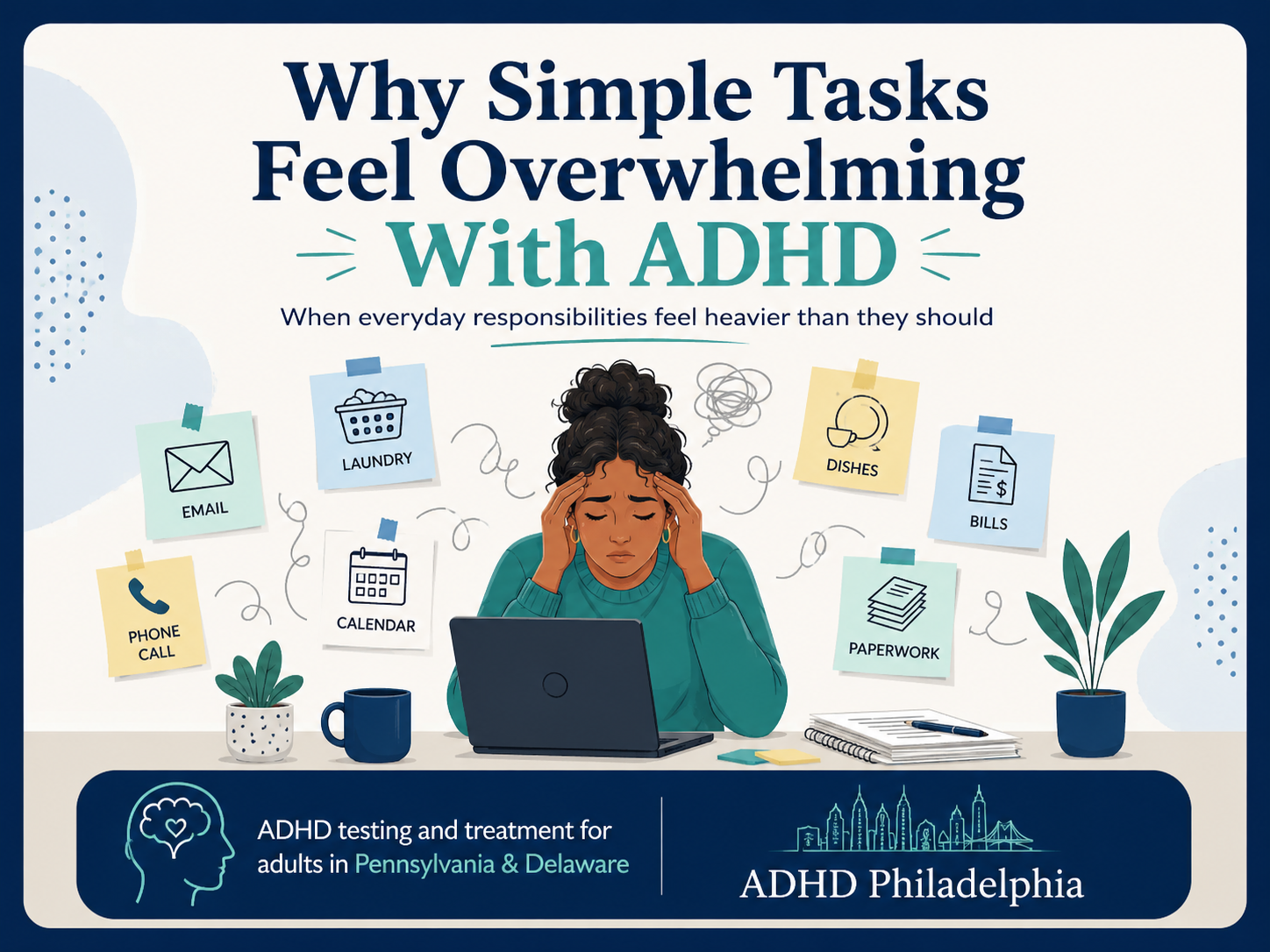
Why Adult ADHD Makes Simple Tasks Feel Overwhelming
Simple tasks can feel overwhelming for adults with ADHD. Learn how executive dysfunction, task initiation, working memory, emotional overload, and decision fatigue can make everyday responsibilities feel harder.
For many adults with ADHD, the hardest tasks are not always the biggest ones.
Sometimes the most frustrating tasks are the small ones.
Answering an email.
Starting laundry.
Returning a phone call.
Scheduling an appointment.
Paying a bill.
Cleaning one room.
Opening a form.
Putting groceries away.
Starting a work project.
From the outside, these tasks may look simple. But for adults with ADHD, simple tasks can feel strangely heavy, frustrating, or emotionally exhausting.
This can lead to shame.
Many adults think, “Why can’t I just do this?”
They may know the task matters.
They may want to finish it.
They may understand the consequences.
They may even have time.
But the task still feels hard to begin.
Adult ADHD can affect executive function, task initiation, working memory, emotional regulation, time awareness, planning, and follow-through. When these brain-based skills are strained, even ordinary responsibilities can feel bigger than they should.
At ADHD Philadelphia, we work with adults in Pennsylvania and Delaware who struggle with focus, procrastination, disorganization, emotional overwhelm, task initiation, and daily follow-through. A structured ADHD evaluation can help clarify whether ADHD may be contributing to these patterns.
Initial appointments begin through secure telehealth. In-person appointments may be scheduled after the first online appointment when clinically appropriate. Walk-in appointments are not available.
Why Simple Tasks Are Not Always Simple With ADHD
A task may look simple from the outside, but internally it may involve many hidden steps.
For example, “pay the bill” may actually require:
Finding the bill
Opening the account
Remembering the password
Checking the due date
Reviewing the balance
Deciding which account to use
Making the payment
Saving confirmation
Remembering whether autopay is set up
Following up if something looks wrong
That is not one step. That is a sequence.
For adults with ADHD, sequencing can be difficult when executive function is overloaded. The brain may see the entire task at once and feel flooded before the first step begins.
That is why a task that “should only take five minutes” can sit unfinished for days.
A structured adult ADHD testing and evaluation process can help clarify whether difficulty starting simple tasks, procrastination, forgetfulness, disorganization, and executive dysfunction may be related to ADHD.
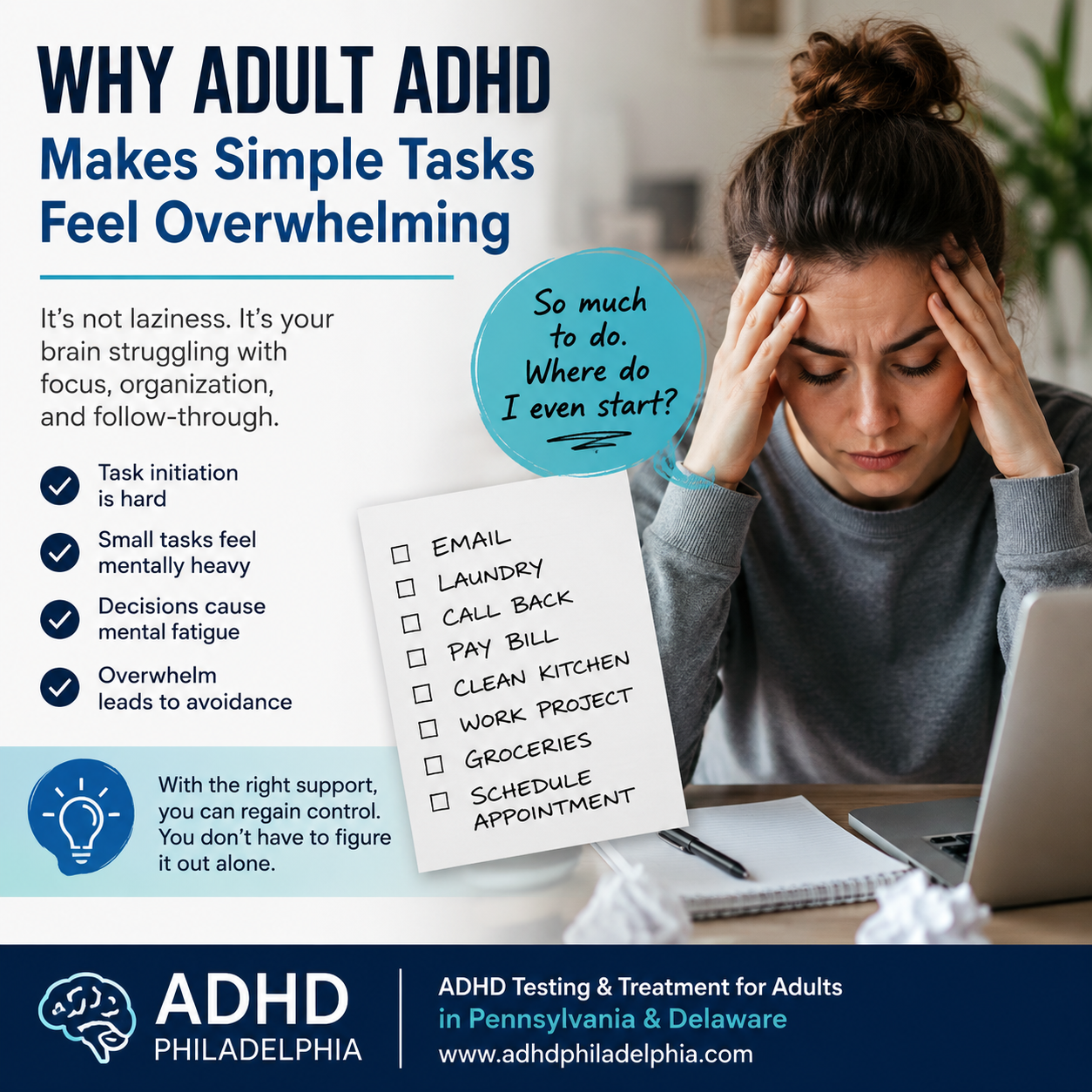
ADHD and Executive Function
Executive function refers to the brain skills that help people manage daily life.
These skills include:
Planning
Prioritizing
Starting tasks
Remembering steps
Managing time
Organizing information
Regulating emotions
Switching between tasks
Finishing responsibilities
Following through over time
When executive function is strained, even small tasks can feel mentally complicated.
The adult may know what needs to be done but struggle to organize the steps, begin the task, stay focused, and finish completely.
This is not about intelligence. Many adults with ADHD are bright, capable, creative, and hardworking. The problem is often not knowing what to do. The problem is activating the brain to do it consistently.
Problems with executive function in adults can affect planning, working memory, organization, emotional regulation, time management, task initiation, and follow-through.
Task Initiation: The Hardest Part Is Starting
One of the most common ADHD-related struggles is task initiation.
Task initiation is the ability to begin a task without needing extreme urgency, pressure, panic, or outside prompting.
Many adults with ADHD say:
“Once I start, I’m usually okay.”
“The hardest part is getting going.”
“I keep thinking about it, but I still don’t do it.”
“I know what to do, but I feel stuck.”
Simple tasks often become overwhelming because the brain struggles to start.
The person may delay, scroll, clean something else, overthink, avoid, or wait until the task becomes urgent. Then they may rush under pressure and feel guilty afterward.
This cycle can repeat for years before the person realizes ADHD may be involved.
Many adults feel stuck because adult ADHD can make follow-through difficult even when you care, especially when task initiation, planning, working memory, and consistency are affected.
Working Memory Can Make Small Tasks Harder
Working memory is the ability to hold information in mind while using it.
For adults with ADHD, working memory can be inconsistent.
This may look like:
Walking into a room and forgetting why
Opening a laptop and forgetting the original task
Starting one chore and getting pulled into another
Losing track of steps
Forgetting what was just read
Forgetting to return to an unfinished task
Misplacing important items needed to complete the task
A simple task may fall apart because the brain loses the thread.
The adult may start with good intentions but get interrupted, distracted, or mentally overloaded. Then the task disappears from awareness until later, when guilt returns.
Many adults with ADHD struggle because ADHD can make it hard to regain momentum after interruptions, especially when working memory and task switching are affected.
Emotional Overwhelm Can Attach to Small Tasks
Simple tasks can become emotionally loaded.
An email may trigger dread.
A bill may trigger shame.
Laundry may trigger defeat.
A form may trigger frustration.
A voicemail may trigger anxiety.
A cluttered room may trigger embarrassment.
Once emotion attaches to the task, the task feels heavier.
The adult may avoid the task not because they do not care, but because the task creates an uncomfortable emotional reaction.
Avoidance brings temporary relief. But the task remains unfinished, which increases guilt and stress. Over time, the task becomes even harder to face.
This is one reason adults with ADHD often feel trapped in cycles of avoidance and self-criticism.
Many adults struggle because adult ADHD can cause chronic overwhelm, especially when emotions, decisions, unfinished tasks, and executive function demands pile up.
Stress Makes ADHD Feel Worse
Stress can make ADHD symptoms harder to manage.
Under stress, adults with ADHD may experience:
Worse focus
More emotional reactivity
More avoidance
More procrastination
Poorer time awareness
Reduced patience
More mental fatigue
More difficulty starting tasks
More difficulty finishing tasks
Stress does not just sit beside ADHD. It can amplify ADHD symptoms.
This creates a loop.
The task feels overwhelming.
The adult avoids it.
Avoidance creates guilt.
Guilt increases stress.
Stress makes the task feel harder.
The task remains unfinished.
Breaking that loop often requires structure, support, and a better understanding of what is happening.
For many adults, understanding ADHD vs anxiety in adults is important because both can affect concentration, restlessness, sleep, motivation, emotional regulation, and daily functioning.
Why Simple Tasks Pile Up
Adults with ADHD may delay small tasks because each one feels slightly uncomfortable, boring, unclear, or mentally demanding.
But small tasks do not stay small forever.
One email becomes twenty.
One bill becomes a late fee.
One basket of laundry becomes several.
One missed call becomes an awkward follow-up.
One cluttered counter becomes a room that feels impossible to clean.
Once tasks pile up, the brain has even more difficulty deciding where to begin.
This creates a stuck feeling.
The adult may look around and feel overwhelmed by everything at once.
Recognizing adult ADHD symptoms can help explain why small tasks pile up when focus, planning, time awareness, emotional regulation, and follow-through are affected.
Decision Fatigue Makes Small Tasks Feel Bigger
Small tasks often require decisions.
Should I answer this email now?
What should I say?
Where should this paper go?
Do I need to call or can I do it online?
Should I clean first or work first?
Do I have enough time?
What if I do it wrong?
For adults with ADHD, decision-making can become exhausting.
The brain may overthink, compare too many options, or search for the perfect starting point. This can make even a basic task feel mentally heavy.
When every task requires a decision, the day becomes draining.
For many adults, ADHD can make decision-making hard because executive dysfunction affects prioritizing, organizing options, managing uncertainty, and moving from thought into action.
Why Adults With ADHD Often Blame Themselves
Many adults with ADHD have spent years being told they should “just try harder.”
They may have heard:
“You’re smart, but you don’t apply yourself.”
“You just need discipline.”
“You’re overthinking it.”
“It only takes five minutes.”
“Why didn’t you just do it?”
After hearing this enough, many adults begin to believe the problem is character.
But untreated ADHD is not a character flaw.
When task initiation, working memory, time awareness, emotional regulation, and executive function are impaired, daily responsibilities can require more effort than others realize.
Understanding ADHD can reduce shame and help adults approach the problem with better tools instead of more self-criticism.
Many adults feel relief when they learn that ADHD treatment can help explain patterns they once blamed on laziness or lack of discipline.
How to Make Simple Tasks Easier
The goal is not to force your brain to work like everyone else’s.
The goal is to reduce friction.
Here are practical ways to make simple tasks easier when ADHD is involved.
1. Shrink the Task
If a task feels too big, make the first step smaller.
Instead of “clean the kitchen,” try:
Clear one counter
Put away five items
Load five dishes
Throw away visible trash
Wipe one surface
Instead of “catch up on email,” try:
Open the inbox
Answer one message
Delete five emails
Flag three important messages
The smaller the first step, the easier it may be to begin.
Many adults with ADHD need smaller starting points because ADHD can make adults feel stuck even when they know what to do.
2. Make the Task Visible
Out of sight can quickly become out of mind.
Adults with ADHD often benefit from making tasks visible.
This may include:
Whiteboards
Sticky notes
Open checklists
Calendar reminders
Phone alarms
Visible bins
Paper trays
Task cards
Timers
A task that is visible is easier to return to.
The goal is not to remember everything. The goal is to build a system that remembers for you.
After diagnosis, adult ADHD treatment may include education, executive function strategies, lifestyle changes, and medication management when clinically appropriate.
3. Use a Timer to Start
A timer can reduce the emotional weight of a task.
Instead of committing to finishing everything, commit to starting for a short period.
Try:
Five minutes
Ten minutes
One song
One small section
One visible step
This helps the brain stop treating the task like an all-or-nothing demand.
Sometimes momentum appears after starting. Sometimes it does not. Either way, beginning for a short time is still progress.
Starting small can help because adult ADHD can make follow-through difficult even when you care, especially when the brain struggles to activate without urgency.
4. Remove Unnecessary Decisions
If a task requires too many choices, simplify it.
Choose the same bill-paying day each week.
Use one laundry basket system.
Keep one place for keys.
Use one calendar.
Create one morning checklist.
Use one folder for forms.
Decide on one “first task” for each workday.
Reducing decisions lowers mental load.
Adults with ADHD often need fewer decisions, not more pressure.
This is why ADHD can make routines hard to maintain, but simple external systems can reduce decision fatigue and make daily tasks easier to repeat.
5. Consider ADHD Evaluation if This Pattern Is Long-Standing
Everyone avoids tasks sometimes.
But if simple tasks have felt overwhelming for years, and the pattern affects work, school, home, relationships, finances, or daily functioning, ADHD evaluation may be helpful.
This is especially true if the task overwhelm comes with:
Poor focus
Procrastination
Disorganization
Time blindness
Forgetfulness
Emotional reactivity
Difficulty starting
Difficulty finishing
Trouble keeping routines
Feeling behind despite trying hard
A structured evaluation can help determine whether ADHD may be contributing and whether treatment may help.
A careful adult ADHD diagnosis and evaluation reviews symptoms, history, impairment, executive functioning, and other possible explanations before treatment planning begins.
ADHD Testing and Treatment in Pennsylvania and Delaware
ADHD Philadelphia provides adult ADHD testing and treatment for adults in Pennsylvania and Delaware.
Care is designed to help adults better understand symptoms such as procrastination, poor focus, forgetfulness, disorganization, emotional overwhelm, task initiation problems, and difficulty following through.
A structured evaluation may include a clinical interview, symptom review, earlier life patterns, functional impairment review, executive function assessment, and screening for overlapping concerns.
Treatment may include ADHD education, executive function strategies, behavioral tools, lifestyle review, and medication management when clinically appropriate.
Adults searching for ADHD testing in Pennsylvania and Delawarecan begin with a structured telehealth evaluation through ADHD Philadelphia.
After diagnosis, adult ADHD treatment may include education, executive function strategies, lifestyle changes, and medication management when clinically appropriate.
Medication Management When Clinically Appropriate
Medication may be discussed if ADHD is diagnosed and treatment is clinically appropriate.
This conversation should include education, informed consent, medical history, psychiatric history, medication history, safety considerations, and follow-up expectations.
Stimulant medications are controlled substances and require responsible monitoring.
At ADHD Philadelphia, treatment response, side effects, functioning, safety, and appropriateness are reviewed during follow-up care. For stimulant medication, follow-up is typically required every 30 days for safety monitoring, treatment response, and dosage adjustments.
ADHD Philadelphia also reviews the prescription drug monitoring program as part of controlled-substance prescribing procedures.
Patients can review the Medication Management & Stimulant Treatment Policy to better understand ADHD Philadelphia’s expectations for stimulant medication monitoring, controlled-substance safety, follow-up visits, and treatment requirements.
When clinically appropriate, ADHD medication management for adults may support focus, task initiation, emotional regulation, and daily functioning as part of a monitored treatment plan.
Telehealth ADHD Care in Pennsylvania and Delaware
ADHD Philadelphia provides adult ADHD evaluation and treatment for adults in Pennsylvania and Delaware.
Initial appointments begin through secure telehealth. This can make care more accessible for busy adults, professionals, students, parents, remote workers, healthcare workers, and people who have struggled to begin the evaluation process.
In-person appointments may be scheduled after the first online appointment when clinically appropriate. Walk-in appointments are not available.
Adults searching for ADHD testing in Pennsylvania can begin with a structured telehealth evaluation through ADHD Philadelphia.
Adults searching for ADHD testing in Delaware can also begin with a secure telehealth evaluation through ADHD Philadelphia.
Adults searching for adult ADHD testing in Philadelphia can begin with ADHD Philadelphia’s structured evaluation process.
Adults searching for ADHD testing in Wilmington, Delaware can begin care through ADHD Philadelphia’s Delaware telehealth services.
Frequently Asked Questions About ADHD and Simple Tasks
Why do simple tasks feel overwhelming with ADHD?
Simple tasks can feel overwhelming because ADHD affects executive function skills such as planning, task initiation, working memory, time management, emotional regulation, and follow-through.
Is this laziness or ADHD?
It is not possible to diagnose based on one symptom, but many adults with ADHD struggle to start and finish simple tasks despite caring deeply. If this pattern is long-standing and affects daily functioning, ADHD evaluation may help.
Why do I avoid tasks that only take a few minutes?
Small tasks may trigger emotional discomfort, decision fatigue, uncertainty, boredom, or executive function overload. Avoidance may bring temporary relief but usually increases stress later.
Can ADHD treatment help with task initiation?
Yes. ADHD treatment may help improve focus, task initiation, planning, emotional regulation, routines, and follow-through. Treatment may include education, behavioral strategies, executive function tools, and medication management when clinically appropriate.
Does ADHD Philadelphia treat adults in Pennsylvania and Delaware?
Yes. ADHD Philadelphia provides adult ADHD testing and treatment for adults in Pennsylvania and Delaware. Initial appointments begin through telehealth. In-person appointments may be scheduled after the first online appointment when clinically appropriate. Walk-in appointments are not available.
Take the First Step
If simple tasks feel heavier than they should, you are not alone.
Adult ADHD can affect focus, task initiation, working memory, emotional regulation, organization, time management, and follow-through. A structured evaluation can help clarify whether ADHD may be contributing and whether treatment may be appropriate.
ADHD Philadelphia provides adult ADHD testing and treatment for adults in Pennsylvania and Delaware.
Schedule an adult ADHD evaluation today through ADHD Philadelphia.
Medical Disclaimer
This article is for educational purposes only and is not a substitute for medical advice, diagnosis, or treatment. If you are experiencing symptoms of ADHD, anxiety, depression, sleep problems, substance use concerns, or another mental health concern, consult a qualified healthcare professional.
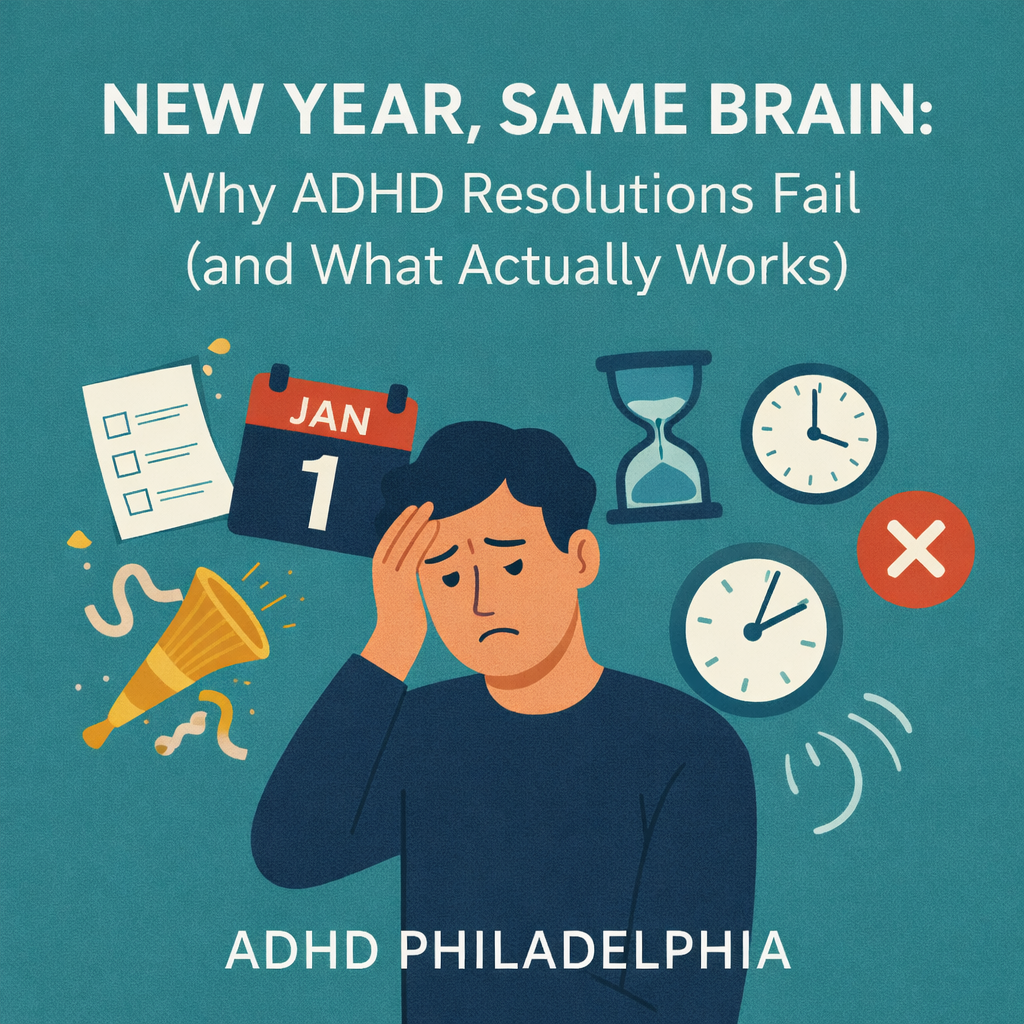
🎆 New Year, Same Brain: Why ADHD Resolutions Fail (and What Actually Works). By Charles Thornton, PMHNP-BC — ADHD Philadelphia
New Year’s resolutions often fail for adults with ADHD—not due to lack of effort, but because traditional goal-setting doesn’t match how the ADHD brain works. Learn why resolutions collapse and what actually leads to lasting change.
Every January, adults with ADHD make the same promises:
“This is the year I finally get organized.”
“I’m going to stick to routines.”
“I’ll stop procrastinating.”
“I’ll follow through this time.”
And by mid-January… the guilt sets in.
If this sounds familiar, you’re not failing — the system is failing you.
Traditional New Year’s resolutions are built for brains that thrive on long-term planning, delayed rewards, and consistent self-motivation.
The ADHD brain works differently.
At ADHD Philadelphia, I help adults across Pennsylvania and Delaware build change strategies that actually fit how their brains function — without shame.
🧠 Why Resolutions Fail in ADHD (It’s Not Willpower)
1️⃣ Resolutions Rely on Future Motivation
ADHD brains struggle to connect future rewards to present effort.
If the benefit isn’t immediate, the brain disengages.
That’s why goals like “get healthier this year” collapse quickly — there’s no dopamine today.
2️⃣ Goals Are Too Big and Too Abstract
“Be more organized.”
“Get in shape.”
“Be more productive.”
These goals overwhelm executive function.
The ADHD brain shuts down when tasks feel vague, large, or undefined.
3️⃣ Dopamine Drops After January 1st
The excitement of a “fresh start” provides a temporary dopamine boost — but it fades fast.
When dopamine drops, motivation disappears, and the brain interprets this as failure.
4️⃣ Shame Becomes the Primary Driver
Many adults with ADHD try to motivate themselves through guilt:
“I should be better by now.”
Shame does not produce consistency — it produces avoidance.
5️⃣ Time Blindness Sabotages Consistency
ADHD brains struggle with routine repetition over time.
Miss one day → feels like you’ve failed completely → the habit collapses.
🔧 What Actually Works for ADHD (Instead of Resolutions)
1️⃣ Replace Resolutions With “Systems”
ADHD thrives on external structure, not internal discipline.
Examples:
alarms instead of memory
calendars instead of intention
checklists instead of motivation
routines instead of goals
Systems reduce cognitive load and make follow-through easier.
2️⃣ Shrink Goals Until They Feel Almost Too Easy
Instead of:
❌ “Go to the gym 5 days a week”
Try:
✔️ “Put on workout clothes once a day”
Small actions trigger dopamine and build momentum.
3️⃣ Anchor Habits to Existing Routines
Don’t create new habits from scratch.
Attach them to things you already do.
Examples:
meds after brushing teeth
planning after coffee
stretching before bed
This reduces executive demand.
4️⃣ Track Effort, Not Perfection
ADHD brains are inconsistent by nature.
Progress comes from returning, not maintaining perfection.
Miss a day?
You didn’t fail — you paused.
5️⃣ Consider ADHD Treatment
When ADHD is untreated, behavior change requires enormous effort.
Medication and ADHD-informed strategies improve:
task initiation
emotional regulation
consistency
follow-through
Many adults say:
“Change finally feels possible.”
🌱 This Can Be the Year Things Actually Stick
You don’t need more motivation.
You need strategies designed for your brain.
With ADHD-aware tools and treatment, adults learn to:
stop restarting every January
build sustainable routines
let go of shame
make progress that lasts
👉 Schedule your adult ADHD evaluation today
Serving adults throughout Pennsylvania and Delaware.
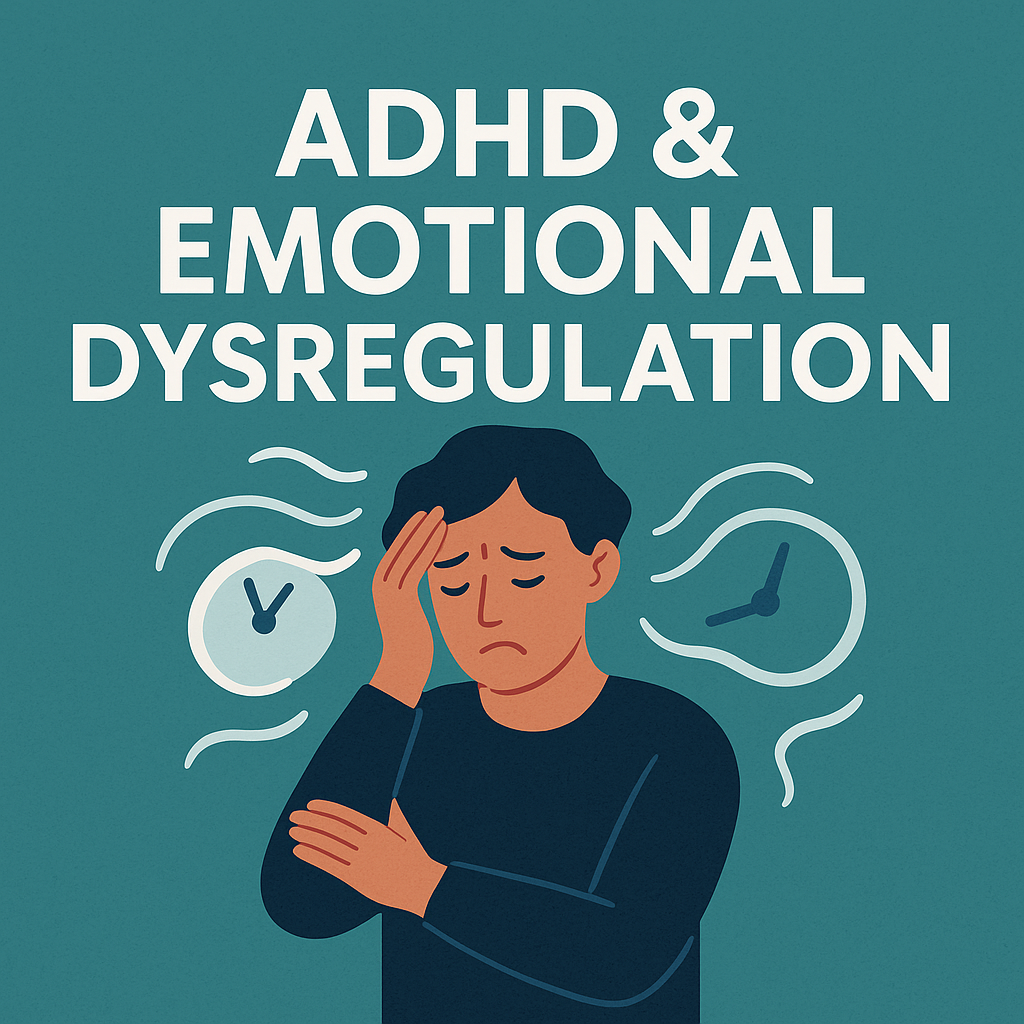
🧠 ADHD and Emotional Dysregulation: Why Your Reactions Feel Bigger Than the Situation. By Charles Thornton, PMHNP-BC — ADHD Philadelphia
Emotional dysregulation is a core but often overlooked symptom of adult ADHD. Learn why emotions feel intense, fast, and overwhelming—and how treatment helps adults regain emotional balance.
Do your emotions ever feel like they arrive at full volume—without warning?
Do small frustrations turn into big reactions before you can stop them?
Do you calm down later and think, “Why did I react like that?”
This isn’t immaturity or lack of self-control.
It’s emotional dysregulation, a core feature of adult ADHD that often goes unrecognized.
At ADHD Philadelphia, I help adults across Pennsylvania and Delaware understand why ADHD affects emotional regulation—and how treatment can dramatically reduce emotional overwhelm.
🧠 What Is Emotional Dysregulation?
Emotional dysregulation refers to difficulty with:
controlling emotional intensity
slowing emotional reactions
shifting from one emotional state to another
calming the nervous system after activation
Adults with ADHD don’t just feel emotions — they feel them faster, stronger, and longer.
🔬 Why ADHD Makes Emotions Feel Bigger
1️⃣ The Prefrontal Cortex Has Less “Brake Power”
The prefrontal cortex helps regulate emotions.
In ADHD, this system activates less efficiently, making it harder to pause, reflect, or modulate reactions in the moment.
Emotion arrives before logic can catch up.
2️⃣ The Amygdala Reacts More Strongly
The amygdala (the brain’s alarm center) fires more quickly in ADHD, interpreting situations as more urgent or threatening than they are.
This leads to:
quick frustration
sudden anger
intense sadness
emotional shutdown
3️⃣ Emotions Shift Faster Than Recovery Time
ADHD brains move quickly from one emotion to another—but recovery lags behind.
This causes:
emotional whiplash
lingering reactions
feeling “stuck” emotionally
4️⃣ Rejection Sensitivity Amplifies Emotional Pain
Many adults with ADHD experience Rejection Sensitive Dysphoria (RSD).
Neutral feedback can feel deeply personal or rejecting, triggering outsized emotional responses.
🧩 How Emotional Dysregulation Shows Up in Daily Life
Adults with ADHD may experience:
snapping during minor stress
crying unexpectedly
shutting down during conflict
regret after emotional reactions
difficulty letting things go
relationship tension
workplace misunderstandings
These patterns often create shame—but they are neurological, not character flaws.
🔧 Tools That Help Regulate Emotions in ADHD
1️⃣ Slow the Nervous System First
Emotion regulation starts in the body, not the mind.
Helpful tools include:
paced breathing
grounding exercises
cold water on the face
brief movement or stretching
These calm the amygdala so thinking can return.
2️⃣ Create a “Pause Buffer”
Build in a pause before responding:
count to 10
take one deep breath
step away briefly
This gives the prefrontal cortex time to engage.
3️⃣ Name the Emotion
Labeling emotions (“I’m frustrated,” “I feel overwhelmed”) reduces intensity by activating regulatory brain networks.
4️⃣ Reduce Baseline Overload
Emotional regulation worsens when you’re:
tired
hungry
overstimulated
overwhelmed
Managing sleep, nutrition, and workload improves emotional control.
5️⃣ Medication Can Help Stabilize Emotions
ADHD medication improves:
emotional regulation
impulse control
reaction time
recovery after emotional spikes
Many adults report fewer emotional “blow-ups” and faster calming.
🌱 Emotional Balance Is Possible
Emotional dysregulation is one of the most validating symptoms to treat.
When adults understand what’s happening in their brain, shame decreases—and emotional control improves.
👉 Schedule your adult ADHD evaluation today
Serving adults throughout Pennsylvania and Delaware via telehealth.
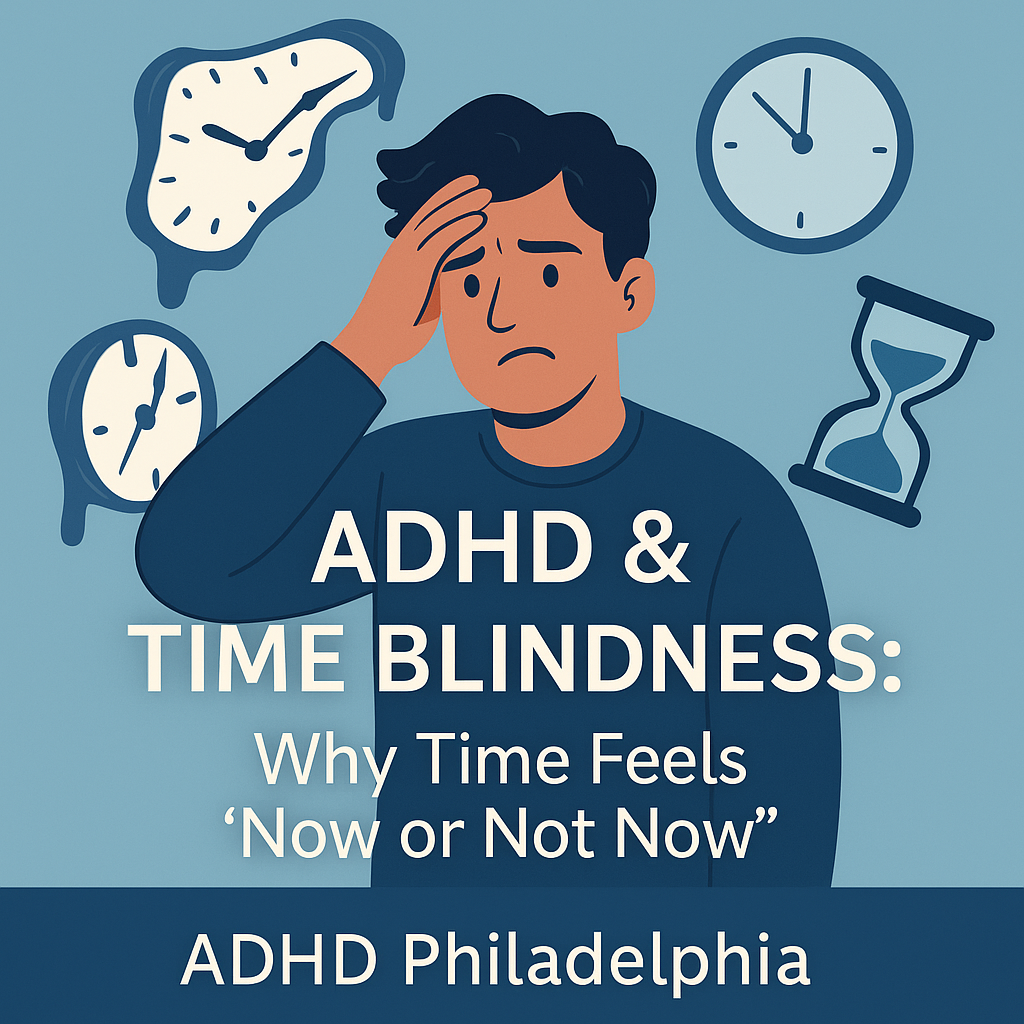
🌪️ ADHD and Time Blindness: Why Time Feels “Now or Not Now”. By Charles Thornton, PMHNP-BC — ADHD Philadelphia
Time blindness is one of the most frustrating symptoms of adult ADHD. Learn why it happens, how it affects daily life, and the evidence-based tools that help adults in PA and DE stay on track.
If you live with ADHD, you’ve probably said something like:
“How did it get so late?”
“I thought I had more time.”
“I’ll start in five minutes…” (one hour later)
“Deadlines sneak up on me even when I know they’re coming.”
This isn’t laziness or irresponsibility.
It’s time blindness, one of the core executive function challenges seen in adults with ADHD.
At ADHD Philadelphia, I help adults across Pennsylvania and Delaware understand why this happens — and how to build systems that finally make time feel manageable.
🧠 What Is Time Blindness?
Time blindness is the difficulty in:
sensing how much time has passed
estimating how long tasks will take
predicting future time demands
transitioning between activities
noticing the “flow” of time at all
Many adults describe time as “now or not now.”
If something isn’t happening right this second, it might as well not exist.
📍 Why ADHD Creates Time Blindness
1️⃣ The ADHD Brain Has Impaired Internal Timekeeping
Executive functions — specifically the prefrontal cortex — help us monitor time.
ADHD disrupts this system, making time feel abstract or unreliable.
This is why adults with ADHD often say:
“I know the deadline is next week… but it doesn’t feel real.”
2️⃣ Dopamine Drives Urgency — Not the Clock
For adults with ADHD, tasks only become “real” when they are:
interesting
rewarding
urgent
or anxiety-producing
This creates the classic ADHD cycle:
No urgency → no action → sudden urgency → hyperfocus → exhaustion.
3️⃣ Working Memory Gaps Disrupt Planning
If something isn’t in front of you, it’s easy to forget it exists.
This fuels procrastination and creates the illusion of “plenty of time.”
4️⃣ Hyperfocus Warps Time Completely
One minute feels like five hours.
Five hours feel like ten minutes.
Hyperfocus is powerful — but also dangerous when time disappears entirely.
🧩 How Time Blindness Affects Daily Life
Adults with ADHD often experience:
chronic lateness
missed deadlines
difficulty switching tasks
forgetting appointments
rushing at the last minute
underestimating task duration
relationship stress (“You’re always late”)
financial issues (late bills, fees)
These challenges feed shame and frustration — but they are neurological, not moral.
🔧 Tools That Help Fix Time Blindness
1️⃣ Externalize All Time (Never Rely on Memory)
Use:
digital timers
time-blocked calendars
visual countdowns
alarms with labels
wall clocks in every room
“time trackers” that show elapsed time
Goal: make invisible time visible.
2️⃣ Break Tasks Into Time-Based Chunks
Instead of:
“Clean the kitchen.”
Try:
“10 minutes: clear counters.”
“10 minutes: wash dishes.”
“5 minutes: sweep.”
Time chunks reduce overwhelm and increase follow-through.
3️⃣ Use “Transition Alarms”
One alarm to end a task.
Another to begin the next one.
Transitions are often the hardest part of ADHD functioning.
4️⃣ Try the “3-to-Start Rule”
Tell yourself:
“I only have to work for 3 minutes.”
This bypasses task initiation paralysis.
Once started, most adults continue naturally.
5️⃣ ADHD Medication Improves Time Awareness
Stimulants and non-stimulants can increase:
working memory
focus
task initiation
ability to sense the passage of time
Medication often reduces procrastination and deadline panic.
🌱 You Can Learn to Work With Time — Not Fight It
Time blindness is a neurological symptom, not a flaw.
With proper tools, structure, and treatment, adults with ADHD can dramatically improve their relationship with time.
👉 Schedule your adult ADHD evaluation today
Serving adults across Pennsylvania and Delaware via convenient telehealth.
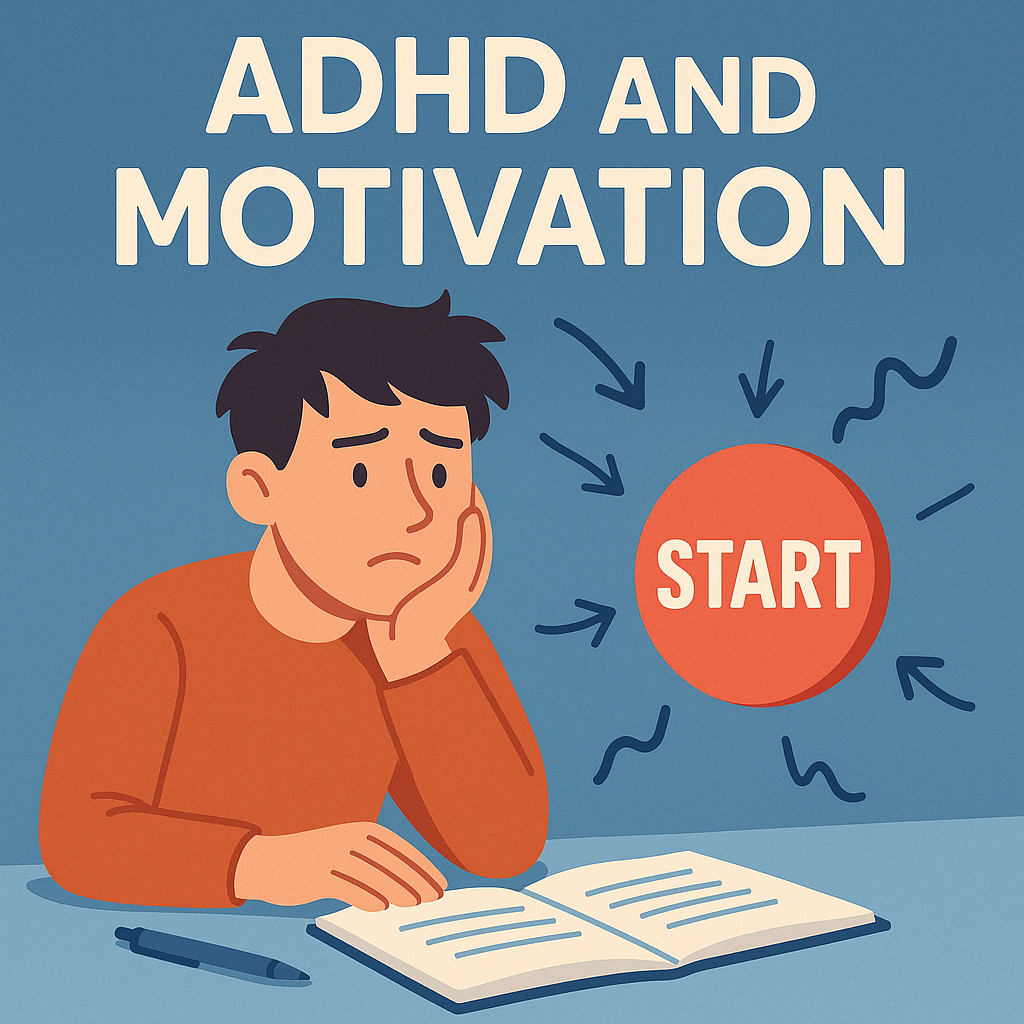
ADHD and Motivation: Why You “Can’t Make Yourself Start” (Even When You Want To)By Charles Thornton, PMHNP-BC — ADHD Philadelphia
ADHD makes motivation unpredictable because the brain struggles with activation, dopamine regulation, and task initiation. Learn why starting tasks feels so hard—and the strategies that make motivation easier for adults with ADHD.
Introduction
If you have ADHD, you’ve probably said something like:
“I want to start… but I just can’t.”
“I know what to do. Why can’t I make myself do it?”
“It feels like my brain is resisting.”
This isn’t laziness or poor discipline.
It’s ADHD motivational dysregulation — a neurological challenge deeply rooted in dopamine pathways and executive functioning.
Research from Russell Barkley, David Nowell, and Peg Dawson shows that adults with ADHD have unique barriers to starting tasks, even when they truly want to succeed.
At ADHD Philadelphia, we help adults across Pennsylvania and Delaware understand how ADHD disrupts motivation—and how to rebuild it using neuroscience-based strategies.
🧠 Why Motivation Works Differently in ADHD
1️⃣ Low Dopamine = Low Activation Energy
Dopamine fuels interest, drive, and goal-directed behavior.
In ADHD, dopamine levels are inconsistent, causing the brain to struggle with:
Task initiation
Follow-through
Shifting into “action mode”
That invisible wall you feel before starting a task?
That’s the dopamine barrier.
2️⃣ The Task Must Feel “Real” to Activate the Brain
ADHD brains don’t respond to should.
They respond to:
urgency
novelty
competition
emotional importance
immediate reward
This is why last-minute deadlines can activate you instantly, while routine tasks feel impossible.
3️⃣ Executive Function “Lag” Makes Starting Slow
According to Peg Dawson, adults with ADHD often experience a delay between intention and action.
Your brain knows what to do…
but can’t activate the motor plan to begin.
This leads to paralysis, guilt, and frustration.
Problems with executive function in adults can affect planning, working memory, time management, task initiation, organization, emotional regulation, and follow-through.
4️⃣ Overwhelm Blocks the Start Button
When a task feels large, vague, or emotionally loaded, the ADHD brain shuts down.
The prefrontal cortex becomes overloaded, causing the nervous system to freeze instead of act.
This is why adults say:
“I get overwhelmed before I begin.”
🔧 3 Science-Based Strategies to Boost Motivation
1️⃣ Use the “5% Start Rule”
Instead of starting Task A…
Start 5% of Task A.
Examples:
Open the document
Write one sentence
Wash two dishes
Sort one email
Put on gym clothes
Starting tiny wakes up dopamine circuits and builds momentum.
2️⃣ Add “Instant Rewards” to Trigger Motivation
ADHD brains move toward pleasure, not pressure.
Use small rewards to activate the dopamine system:
Work with a favorite drink
Use a focus playlist
Do a task in a new environment
Pair a boring task with something enjoyable
Nowell calls this “dopamine stacking.”
3️⃣ Try the “Activation Loop”
Set a timer for 10 minutes and begin.
You don’t have to finish.
You just have to start.
After 10 minutes, motivation is significantly more likely to appear.
If you’re wondering whether your symptoms could be ADHD, read our guide “Do I Have ADHD as an Adult? 12 Signs You Should Not Ignore.”
💊 How Medication Helps Motivation
ADHD medication improves the brain’s ability to:
initiate tasks
maintain momentum
avoid shutdown
transition between steps
Patients often describe it as:
“I can finally get going without wrestling myself.”
Medication doesn’t create motivation—it removes the neurological barriers to allowing it.
🌱 You Can Build Reliable Motivation
Adults with ADHD can absolutely learn to activate more easily.
With the right strategies and treatment, starting becomes:
less painful
more predictable
more consistent
even effortless over time
👉 Schedule your ADHD evaluation today
Serving adults across Pennsylvania and Delaware.
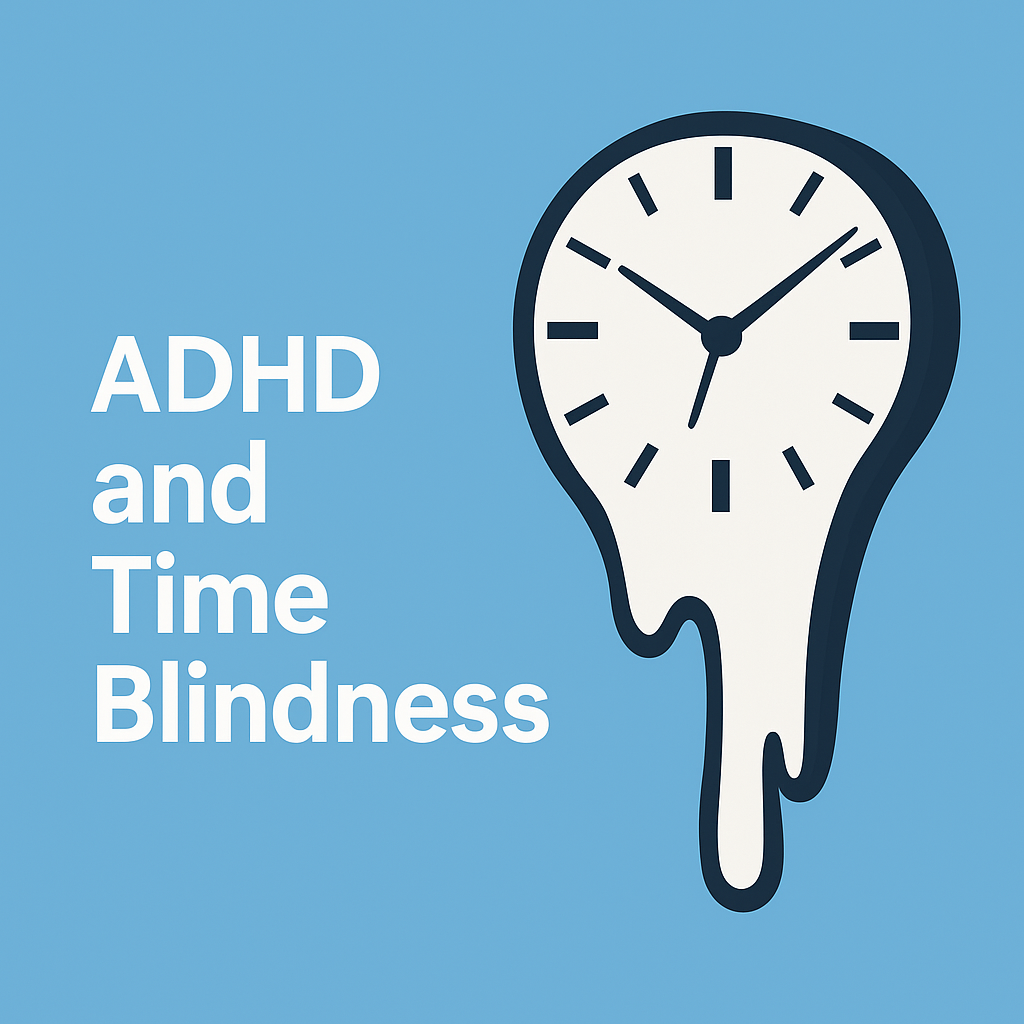
🧭 ADHD and Time Blindness: Why Time Feels “Different” for Adults With ADHD
Time blindness is one of the most frustrating ADHD symptoms for adults. Learn why the ADHD brain struggles to sense time — and the tools that help you stay on track without shame or stress.
If you live with ADHD, you’ve probably asked yourself:
“Where did the time go?”
“Why do I always think I have more time than I do?”
“How can five minutes turn into 45?”
This isn’t irresponsibility — it’s time blindness, a neurological difference deeply connected to ADHD.
Research from Russell Barkley, PhD and Peg Dawson, EdD shows that ADHD affects the brain networks responsible for time perception, time estimation, and time-to-action planning.
At ADHD Philadelphia, we help adults across Pennsylvania and Delaware understand how ADHD shifts their sense of time — and how to build a better relationship with it.
🧠 Why Time Blindness Happens in ADHD
1️⃣ The Brain’s Internal Clock Runs Differently
The prefrontal cortex helps track time and maintain temporal awareness.
In ADHD, this region activates less consistently, making time feel:
Too fast
Too slow
Or completely invisible
This is why adults often say:
“I didn’t realize how much time had passed.”
2️⃣ The Default Mode Network Takes Over
The DMN (daydreaming network) becomes overactive in ADHD.
Once it “steals” attention:
Time slips by
Tasks feel overwhelming
Momentum disappears
This creates the famous ADHD time loop:
“I’ll start soon… wait, how is it already afternoon?”
3️⃣ Working Memory Doesn’t Hold Time Very Well
According to Barkley, working memory is like a mental whiteboard.
In ADHD, that whiteboard erases itself quickly.
So the brain loses track of:
Deadlines
Start times
The order of tasks
Whether something is urgent or not
4️⃣ Dopamine Drives “Now” vs. “Not Now” Thinking
The ADHD brain lives in two time zones:
Now and Not Now.
This leads to:
Overestimating how long tasks will take
Underestimating how long you’ve been scrolling
Feeling like time is either abundant or gone instantly
Dopamine heavily influences this “temporal distortion.”
🔧 3 Tools to Improve Time Awareness
1️⃣ Use External Time Anchors
Because internal time is unreliable, external cues make a huge difference.
Use:
Visual timers
Alarms
Hourly chimes
Smart watches
Color-coded calendars
External time = better time.
2️⃣ Break the Day Into “Time Blocks”
Research from Dawson shows that ADHD brains thrive on structure.
Try:
Morning block
Work block
Recovery block
Evening block
Time becomes easier to feel when broken into meaningful sections.
3️⃣ Use the “5-Minute Landing”
When switching tasks, give yourself 5 minutes to land.
During this time:
Close out the previous task
Prepare the next one
Check the clock deliberately
This protects against time loss during transitions — a major ADHD vulnerability.
🌱 Time Blindness Is Treatable
With awareness, structure, and the right treatment, adults with ADHD can develop a healthier relationship with time — one that feels grounded, predictable, and manageable.
👉 Schedule your ADHD evaluation today
Serving adults across Pennsylvania and Delaware.

Why ADHD Makes Decision-Making Hard and 3 Ways to Make It Easier
Adult ADHD can make even simple decisions feel exhausting. Learn why decision fatigue, executive dysfunction, overwhelm, and task initiation problems make choices harder — and how treatment can help.
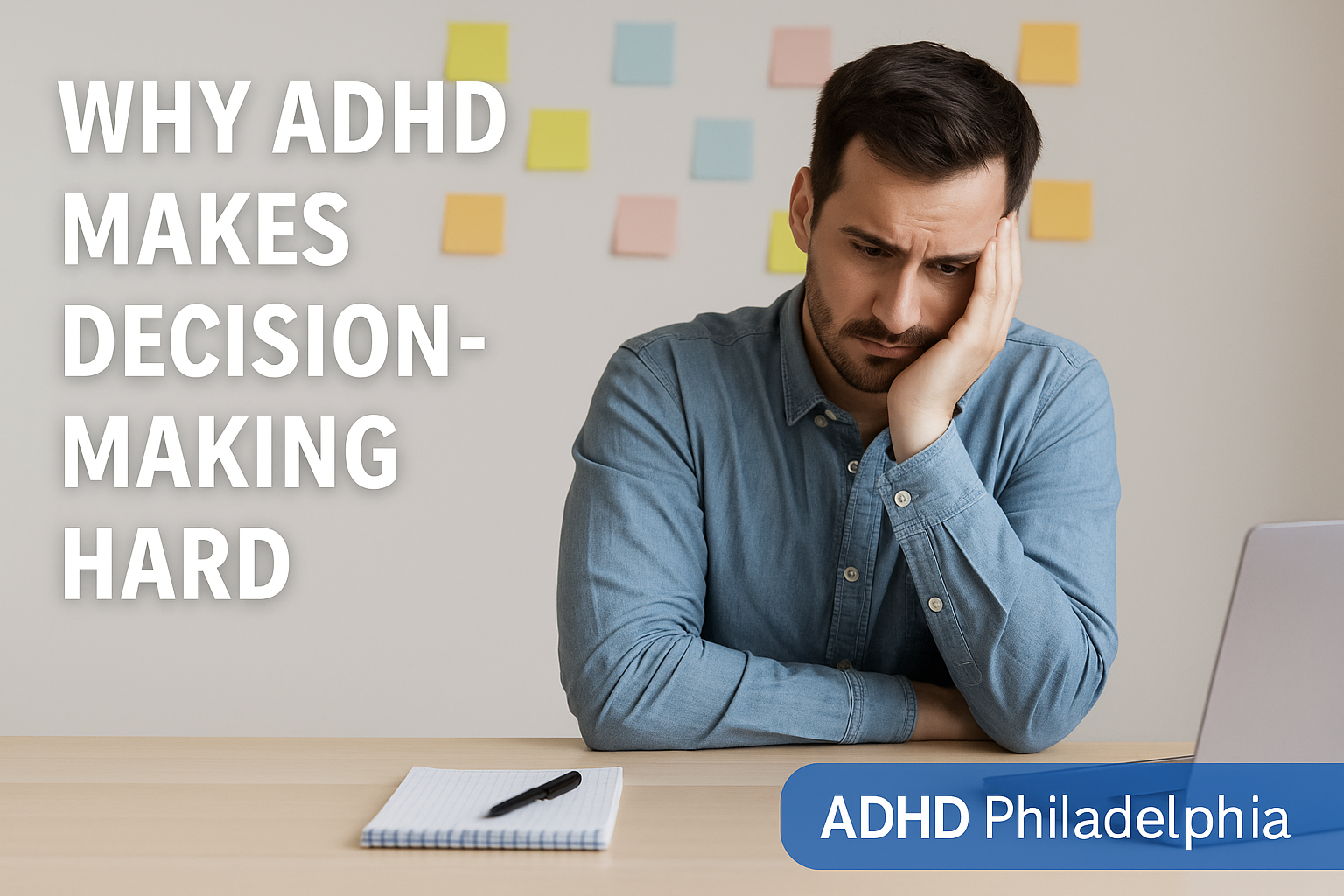
If you have adult ADHD, even simple decisions can feel exhausting.
You may spend too much time deciding what task to start, what message to answer, what to eat, what to buy, what to clean first, or whether to do something now or later. You may overthink, second-guess yourself, avoid the decision completely, or feel mentally drained before you even begin.
This is not laziness.
For many adults with ADHD, difficulty making decisions is connected to executive dysfunction, decision fatigue, emotional overwhelm, and difficulty prioritizing. The brain may know that a choice needs to be made, but it struggles to sort options, compare consequences, manage uncertainty, and move into action.
At ADHD Philadelphia, we help adults in Pennsylvania and Delaware understand how ADHD affects focus, motivation, executive function, and daily decision-making. With proper evaluation and treatment, many adults can learn to make decisions with more clarity and less mental exhaustion.
Why ADHD Makes Decision-Making Hard
Decision-making requires several executive function skills working together.
To make a decision, the brain has to:
Recognize that a choice needs to be made
Identify the options
Compare possible outcomes
Prioritize what matters most
Manage uncertainty
Control emotional reactions
Choose a direction
Move into action
For adults with ADHD, this process can become overwhelming. The brain may get stuck comparing too many options, worrying about the wrong choice, or searching for the “perfect” answer.
Even small decisions can feel heavy because the ADHD brain may struggle with prioritizing, working memory, emotional regulation, and time awareness.
This is why adults with ADHD may spend more energy thinking about a decision than actually making it.
Difficulty making decisions is often connected to executive dysfunction in adults with ADHD, especially when the brain struggles with planning, prioritizing, working memory, and task initiation.
ADHD and Decision Fatigue
Decision fatigue happens when the brain becomes tired from making too many choices.
For adults with ADHD, decision fatigue can happen quickly because the brain may already be working harder to manage attention, filter distractions, regulate emotions, and organize tasks.
A simple day can become packed with decisions:
What should I do first?
Should I answer this email now?
What should I eat?
Should I start work or clean up first?
Which task matters most?
Did I forget something?
What if I make the wrong choice?
By the time an adult with ADHD reaches an important decision, the brain may already feel overloaded.
This can lead to avoidance, procrastination, irritability, impulsive decisions, or shutting down completely.
Many adults with ADHD struggle with decision fatigue because adult ADHD can cause chronic overwhelm, making everyday choices feel heavier and more mentally exhausting.
Why Small Decisions Can Feel So Big
One of the confusing parts of adult ADHD is that small decisions can sometimes feel as difficult as major ones.
Choosing what to eat may feel draining.
Picking which task to start may feel impossible.
Deciding what to wear may take too long.
Choosing how to respond to a message may become stressful.
Trying to organize a messy room may feel paralyzing.
This happens because the ADHD brain may have trouble filtering what matters from what does not.
Instead of quickly identifying the next best step, the brain may treat every option as equally important. That can create mental gridlock.
The person may think:
“What if I pick the wrong thing?”
“What if I start with the wrong task?”
“What if this takes too long?”
“What if I forget something more important?”
This can make the decision feel emotionally bigger than it is.
When decision-making problems affect daily life, adult ADHD testing and evaluation can help determine whether executive function challenges may be contributing to the pattern.
The ADHD Brain Wants Urgency, Interest, or Reward
Adults with ADHD often make decisions more easily when something feels urgent, interesting, or rewarding.
That is why a person may struggle to plan ahead but suddenly make decisions quickly when a deadline is hours away. Urgency gives the brain stimulation. Pressure can temporarily sharpen focus.
But this creates a difficult cycle.
The person may delay decisions until the last minute. Then stress rises, urgency kicks in, and the decision finally gets made. This may work sometimes, but it often leads to burnout, rushed choices, missed details, and emotional exhaustion.
Without urgency, decisions can feel unclear or unmotivating.
This is why adults with ADHD often benefit from external structure, simplified choices, routines, deadlines, reminders, and treatment strategies that reduce reliance on last-minute panic.
For many adults, adult ADHD can make follow-through difficult even when you care, especially when motivation depends on urgency, pressure, or immediate reward.
Decision Paralysis and ADHD
Decision paralysis happens when a person becomes so overwhelmed by options that they cannot choose.
Adults with ADHD may experience decision paralysis when:
There are too many options
The task feels too vague
The outcome feels uncertain
The decision feels emotionally loaded
There is fear of making the wrong choice
The task has no immediate reward
The person does not know where to start
Decision paralysis can look like doing nothing, but internally the brain may be working very hard.
The adult may be thinking, comparing, worrying, planning, and second-guessing without moving forward.
This is mentally exhausting.
Over time, decision paralysis can affect work, home responsibilities, relationships, finances, school, health routines, and self-confidence.
Decision paralysis is often connected to task initiation problems, which is one reason starting tasks can be so hard with adult ADHD.
ADHD, Perfectionism, and Fear of the Wrong Choice
Many adults with ADHD also struggle with perfectionism.
They may feel like they cannot move forward until they know the best option, the right order, the perfect plan, or the safest choice.
This can make decisions take much longer than necessary.
Perfectionism may sound like high standards, but in adult ADHD, it can become a form of avoidance. If the person is afraid of making the wrong choice, they may delay choosing at all.
They may keep researching.
They may keep comparing.
They may ask multiple people for reassurance.
They may restart the plan repeatedly.
They may avoid the decision until someone else decides or the deadline passes.
Treatment can help adults recognize when perfectionism is creating paralysis and learn how to choose a “good enough” next step.
Many adults feel stuck because ADHD and motivation problems can make it difficult to move from thinking into action, especially when a decision feels uncertain or emotionally uncomfortable.
ADHD and Emotional Overload During Decisions
Decision-making is not only logical. It is emotional.
Adults with ADHD may experience strong emotional reactions during decisions. They may feel pressure, guilt, shame, fear, frustration, or anxiety.
A simple decision may trigger thoughts like:
“I should already know what to do.”
“Why is this so hard for me?”
“What if I disappoint someone?”
“What if I mess this up again?”
“Why can everyone else handle this?”
When emotions become intense, the brain may have an even harder time choosing clearly.
This can lead to avoidance, impulsive decisions, emotional shutdown, or overexplaining.
Adults with ADHD often need strategies that reduce emotional pressure before making decisions.
For some adults, ADHD and emotional intensity can make decisions feel more stressful because feelings may rise quickly and interfere with clear thinking.
3 Ways to Make Decisions Easier With ADHD
The goal is not to make perfect decisions.
The goal is to reduce friction, lower mental overload, and make it easier to move forward.
Here are three practical ways to make decision-making easier with adult ADHD.
1. Use Default Options
Default options reduce the number of choices your brain has to make.
Instead of deciding from scratch every time, you create a pre-decided option that becomes your standard.
Examples include:
Eating the same breakfast on workdays
Having a default work outfit
Using the same morning routine
Keeping the same grocery list basics
Having a set bill-paying day
Using one main calendar
Choosing a default workspace
Creating a standard bedtime routine
Adults with ADHD often do better when fewer decisions are required at the moment of action.
Defaults are not boring. They are supportive.
They free up mental energy for the decisions that actually matter.
Using default options can help because ADHD can make routines hard to maintain when every step requires a new decision.
2. Limit the Number of Choices
Too many options can overwhelm the ADHD brain.
Instead of asking, “What should I do today?” narrow the choice.
Ask:
“Which of these two tasks should I start first?”
“Do I want option A or option B?”
“What is the next smallest step?”
“What would help me move forward for 10 minutes?”
Reducing choices helps the brain stop scanning endless possibilities.
For example, instead of choosing from 20 tasks, pick the top three. Then choose one.
Instead of deciding what to clean in the whole house, choose one room. Then choose one surface.
Instead of deciding what to do with your entire day, choose the next 15-minute action.
Smaller choices reduce overwhelm and make movement easier.
Breaking choices into smaller steps can help because adult ADHD can make simple tasks feel overwhelming when the brain sees too many steps at once.
3. Choose “Good Enough” and Move Forward
Adults with ADHD often wait for the best choice, but waiting for the perfect choice can keep them stuck.
A helpful question is:
“What is good enough to keep me moving?”
This does not mean being careless. It means choosing progress over paralysis.
For many daily decisions, the perfect answer is not necessary. You only need the next workable step.
Instead of asking:
“What is the best possible option?”
Try asking:
“What is the next reasonable option?”
Instead of asking:
“What if this is wrong?”
Try asking:
“Can I adjust later if needed?”
Action often creates clarity. Once you begin, the next step becomes easier to see.
With the right support, adult ADHD treatment can help patients reduce decision paralysis, improve follow-through, and build practical systems for daily life.
When Decision-Making Problems Affect Daily Life
Everyone struggles with decisions sometimes.
But if decision-making problems are interfering with your work, relationships, finances, health, home responsibilities, or emotional well-being, it may be time to consider whether ADHD is part of the picture.
You may want to consider an ADHD evaluation if you often:
Overthink simple choices
Avoid decisions until the last minute
Feel mentally drained by routine decisions
Freeze when tasks have too many steps
Regret decisions often
Need urgency to make progress
Feel overwhelmed by options
Procrastinate because you do not know where to start
Make impulsive choices to escape the stress of deciding
Feel ashamed about how hard decisions feel
These patterns can be frustrating, but they are also understandable when viewed through the lens of executive function.
Recognizing adult ADHD symptoms can help explain why decision-making, prioritizing, procrastination, emotional regulation, and follow-through may feel harder than they should.
How ADHD Treatment Can Help With Decision-Making
ADHD treatment can help adults make decisions with less mental strain.
Treatment may include:
ADHD education
Executive function strategies
Medication management when clinically appropriate
Behavioral tools
Routine building
Environmental structure
Sleep and lifestyle review
Support for planning and prioritizing
Ongoing monitoring of symptoms and treatment response
For some adults, medication may improve attention, mental clarity, and task initiation. For others, behavioral strategies and structure are the most important tools. Many adults benefit from a combination.
The goal is to make decisions easier by reducing overload and improving the systems that support daily functioning.
At ADHD Philadelphia, care is individualized and monitored over time.
When clinically appropriate, ADHD medication management for adults may support focus, task initiation, planning, and decision-making as part of a structured treatment plan.
ADHD Evaluation in Pennsylvania and Delaware
Adults in Pennsylvania and Delaware can begin ADHD evaluation through ADHD Philadelphia using secure telehealth appointments.
Telehealth can make care more accessible for busy professionals, students, parents, entrepreneurs, healthcare workers, remote employees, and adults who have struggled to begin the evaluation process.
In-person appointments may be scheduled after the first telehealth appointment when clinically appropriate. There are no walk-in appointments.
A structured evaluation can help determine whether ADHD is contributing to decision fatigue, procrastination, poor focus, task initiation problems, emotional overwhelm, or inconsistent follow-through.
Adults searching for ADHD testing in Pennsylvania can begin with a structured telehealth evaluation through ADHD Philadelphia.
Adults searching for ADHD testing in Delaware can also begin with a secure telehealth evaluation through ADHD Philadelphia.
Frequently Asked Questions About ADHD and Decision-Making
Why does ADHD make decisions so hard?
ADHD can affect executive function skills such as planning, prioritizing, emotional regulation, working memory, and task initiation. These skills are important for making decisions and moving into action.
Is decision paralysis a symptom of ADHD?
Decision paralysis can be common in adults with ADHD, especially when there are too many options, unclear priorities, emotional pressure, or fear of making the wrong choice.
Why do small decisions feel exhausting with ADHD?
Small decisions can feel exhausting because the ADHD brain may struggle to filter what matters, compare options efficiently, and move forward without overthinking.
Can ADHD treatment help with decision-making?
Yes. ADHD treatment may help improve focus, task initiation, planning, prioritizing, emotional regulation, and follow-through. Treatment may include education, executive function strategies, behavioral tools, and medication management when clinically appropriate.
Does ADHD Philadelphia evaluate adults for ADHD in Pennsylvania and Delaware?
Yes. ADHD Philadelphia provides adult ADHD testing and treatment for patients in Pennsylvania and Delaware. Initial appointments begin through telehealth. In-person appointments may be scheduled after the first online appointment when clinically appropriate. No walk-in appointments are available.
Take the First Step
If simple decisions feel harder than they should, you are not alone.
Adult ADHD can make decision-making feel exhausting because the brain may struggle with prioritizing, emotional regulation, working memory, task initiation, and executive function.
The answer is not more shame. The answer may be better understanding, better systems, and appropriate treatment.
If you are an adult in Pennsylvania or Delaware and think ADHD may be affecting your decision-making, ADHD Philadelphia can help you take the next step.
Schedule an adult ADHD evaluation today through ADHD Philadelphia.
Medical Disclaimer
This article is for educational purposes only and is not a substitute for medical advice, diagnosis, or treatment. If you are experiencing symptoms of ADHD, anxiety, depression, sleep problems, substance use concerns, or another mental health concern, consult a qualified healthcare professional.