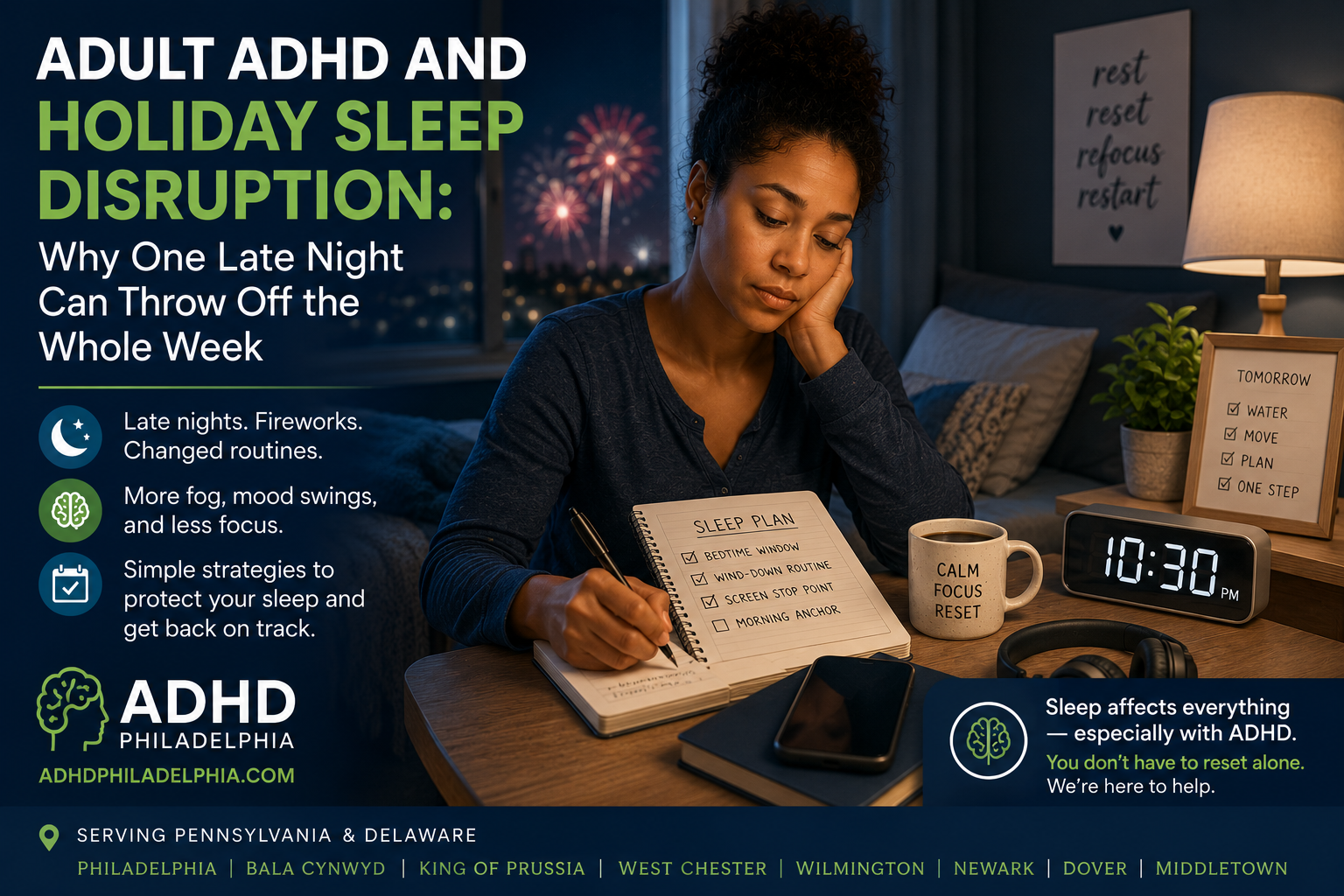
Adult ADHD and Holiday Sleep Disruption: Why One Late Night Can Throw Off the Whole Week
Holiday weekends can disrupt sleep for adults with ADHD. Learn how late nights, fireworks, changed routines, time blindness, and poor sleep can affect focus, mood, executive function, and getting back on track.

One late night during a holiday weekend can make focus, mood, routines, and executive function harder for adults with ADHD.
Holiday weekends can easily throw off sleep.
A cookout runs late. Fireworks continue after dark. Family plans change. Travel takes longer than expected. You stay up scrolling because your brain is still stimulated. You tell yourself, “I’ll get back on track tomorrow.”
But for many adults with ADHD, one late night does not always feel like one late night.
It can affect the next morning, the next day, and sometimes the whole week.
You may feel foggy, irritable, scattered, unmotivated, emotionally sensitive, or unable to restart your routine. You may know what you need to do, but your brain feels slower to begin. The holiday weekend ends, but your sleep schedule, focus, and emotional rhythm still feel off.
At ADHD Philadelphia, we provide ADHD treatment and medication management for adults in Pennsylvania and Delaware. If disrupted sleep makes your ADHD symptoms harder to manage, it may be worth looking at the full pattern.
Why Sleep Matters So Much for Adults With ADHD
Sleep is not just rest.
Sleep affects attention, memory, emotional regulation, impulse control, motivation, planning, time management, and follow-through. These are already areas that can be difficult for adults with ADHD.
When sleep is disrupted, ADHD symptoms may feel louder.
You may notice:
More distractibility
More irritability
More procrastination
More emotional reactivity
More trouble starting tasks
More difficulty making decisions
More time blindness
More impulsive scrolling or spending
More trouble getting back into routines
More difficulty following through
For adults with ADHD, poor sleep can make the brain feel like it has fewer tools available.
Why Holiday Weekends Disrupt Sleep
Holiday weekends often remove normal structure.
A regular weekday may include work, appointments, medication routines, meal times, bedtime routines, and morning expectations. A holiday weekend may involve later nights, looser plans, more noise, more travel, and more stimulation.
Sleep may be disrupted by:
Fireworks
Loud music
Crowds
Travel
Cookouts
Family plans
Late-night cleaning
Extra screen time
Changed medication timing
Alcohol or cannabis exposure
Anxiety about plans
Excitement or overstimulation
Trying to “catch up” on everything at night
Even when the holiday is enjoyable, the brain may have trouble winding down afterward.
If holiday weekends often feel overwhelming because of noise, crowds, plans, and emotional overload, you may also want to read Adult ADHD and Holiday Weekend Overwhelm: Why Noise, Plans, and Crowds Can Feel Like Too Much.
The ADHD Brain May Struggle to Wind Down
Many adults with ADHD describe feeling tired but not sleepy.
The body may be exhausted, but the mind keeps moving.
You may replay conversations, think about unfinished tasks, scroll on your phone, start a late-night project, organize something random, or suddenly feel motivated at the worst possible time.
This can be especially common after a stimulating day.
The brain may need more time to transition from activity to rest. Without a clear wind-down routine, bedtime can keep moving later and later.
A holiday weekend can make this worse because there are fewer external limits. No regular schedule may mean no clear stop point.
Fireworks, Noise, and Sleep Disruption
Fireworks can be exciting for some people and very disruptive for others.
For adults with ADHD who are sensitive to noise or stimulation, fireworks may make it harder to relax, fall asleep, or stay asleep. Even if you are not frightened by the noise, repeated unexpected sounds can keep the nervous system alert.
You may feel:
Startled
Tense
Restless
Irritable
Unable to settle
Mentally alert late at night
Physically tired but wired
This can lead to delayed sleep, poor sleep quality, and a harder morning the next day.
Time Blindness Can Push Bedtime Later
Time blindness can make sleep routines harder.
You may tell yourself:
“I’ll go to bed after one more video.”
“I’ll clean up for just ten minutes.”
“I’ll answer one message.”
“I’ll start getting ready soon.”
“I still have time.”
Then suddenly it is much later than you realized.
Holiday weekends can make time blindness worse because the normal schedule is less visible. Without workday structure, bedtime may become vague. When bedtime is vague, it is easier for the ADHD brain to drift into late-night activity.
If this sounds familiar, read Time Blindness on Weekends: Why Adults With ADHD Lose Track of Saturday and Sunday.
Sleep Loss and Emotional Regulation
Poor sleep can make emotions harder to manage.
Adults with ADHD may already experience strong emotional reactions, especially when overwhelmed, overstimulated, or under pressure. When sleep is disrupted, emotional regulation can become even harder.
You may notice:
Feeling more easily annoyed
Crying more easily
Feeling rejected more intensely
Snapping at people
Feeling more anxious
Feeling more ashamed
Feeling less patient
Feeling overwhelmed by normal tasks
Feeling unable to recover emotionally after stress
This does not mean you are overreacting on purpose. It may mean your brain is trying to regulate emotions with less rest and less executive control.
Sleep Loss and Executive Function
Executive function helps the brain plan, prioritize, start tasks, shift attention, manage time, control impulses, and follow through.
When sleep is disrupted, executive function may feel weaker.
That can make basic tasks feel harder:
Starting laundry
Answering messages
Planning meals
Returning to work
Getting ready on time
Managing appointments
Taking care of bills
Cleaning up after the holiday
Restarting medication routines as prescribed
Preparing for the next week
This is why one late night can create a domino effect.
The late night affects the morning. The hard morning affects the day. The unproductive day creates more stress. The stress can push bedtime later again.
Medication Timing and Sleep Routine Disruption
Holiday weekends may also disrupt medication routines.
Some adults sleep later, eat later, travel, attend events, or forget their normal schedule. If you take ADHD medication, take it only as prescribed and follow your treatment plan. Do not change your dose, skip doses, restart medication, or adjust timing without guidance from your prescriber.
Medication timing, caffeine, alcohol, cannabis, and poor sleep can all affect how you feel. If you are receiving stimulant medication management, safety and monitoring matter.
Adults considering stimulant medication should review ADHD Philadelphia’s Medication Management and Stimulant Treatment Policy.
This is not about shame. It is about making ADHD treatment safer, clearer, and more consistent.
The “I’ll Fix It After the Holiday” Problem
Many adults with ADHD tell themselves they will fix everything after the holiday.
“I’ll clean up Sunday.”
“I’ll restart Monday.”
“I’ll get back to sleep this week.”
“I’ll catch up later.”
“I’ll handle it when things calm down.”
But when sleep is disrupted, the reset may be harder than expected.
You may wake up tired, avoid tasks, feel behind, and then stay up late again trying to recover the time you lost. That can keep the cycle going.
For adults with ADHD, recovery needs to be planned before the crash, not only after the crash.
A Simple ADHD-Friendly Sleep Protection Plan
A holiday sleep plan does not need to be perfect.
Try this:
Choose a realistic bedtime window.
Choose one wind-down activity.
Choose one screen stop point.
Choose one morning anchor.
For example:
Bedtime window: start winding down between 10:30 PM and 11:00 PM.
Wind-down activity: shower, quiet music, or reading.
Screen stop point: phone charges across the room.
Morning anchor: take a short walk, drink water, or review the day’s calendar.
The goal is not perfection. The goal is giving your brain a visible path back to routine.
Protect the Morning After
The morning after a late night matters.
Adults with ADHD may be tempted to let the next day become completely unstructured. But one small morning anchor can help prevent the whole day from slipping.
Try choosing one simple action:
Open the blinds.
Drink water.
Eat something simple.
Take medication as prescribed.
Review the calendar.
Step outside for a few minutes.
Put one load of laundry in.
Clear one surface.
Send one important message.
A small morning anchor tells the brain, “The day has started.” That can help rebuild structure after a disrupted night.
Make the Evening Smaller
After a stimulating holiday event, do not make the evening too complicated.
Instead of trying to clean the whole house, answer every message, plan the week, and reset your life, choose one small closing routine.
For example:
Put food away.
Set out clothes.
Put medication in its usual place if prescribed.
Charge your phone away from the bed.
Write down tomorrow’s first task.
Turn off bright lights.
Use headphones or calming sound if helpful.
The ADHD brain often needs external cues that the day is ending.
ADHD Testing in Pennsylvania and Delaware
If sleep disruption is part of a larger pattern of time blindness, task initiation problems, emotional overwhelm, restlessness, difficulty with routines, disorganization, or follow-through struggles, ADHD testing may help.
At ADHD Philadelphia, adult ADHD testing in Pennsylvania and Delaware may include a clinical consultation, symptom review, rating scales, computerized testing when appropriate, and a careful look at how symptoms affect daily life.
A careful adult ADHD diagnosis can also help clarify whether ADHD, anxiety, depression, sleep problems, burnout, trauma-related stress, or another concern may be contributing.
If you are new to the process, you can review the ADHD Patient Journey before scheduling.
How ADHD Treatment Can Help Sleep-Related Patterns
ADHD treatment is not only about focus.
A strong treatment plan should consider real-life functioning, including sleep routines, emotional regulation, task initiation, time management, planning, transitions, medication timing, and follow-through.
Treatment may include:
Medication management when appropriate
Executive function strategies
Therapy-informed support
Sleep and routine discussion
Planning systems
Follow-up care
Education about ADHD patterns
Support for realistic habit-building
If medication is part of treatment, ongoing follow-up matters. You may also want to read Adult ADHD Medication Follow-Up Care in Pennsylvania and Delaware: Why Monitoring Matters.
ADHD Treatment in Pennsylvania
Adults in Pennsylvania may seek ADHD testing or treatment when sleep disruption, time management problems, emotional overwhelm, and difficulty restarting routines affect work, home life, school, relationships, or daily functioning.
Whether you live in Philadelphia, Bala Cynwyd, King of Prussia, West Chester, Allentown, Harrisburg, Lancaster, Pittsburgh, Delaware County, Montgomery County, Chester County, Bucks County, or elsewhere in Pennsylvania, ADHD care should be structured, respectful, and individualized.
ADHD Treatment in Delaware
Adults in Delaware may also benefit from ADHD testing and treatment when disrupted sleep, holiday routines, emotional overload, and executive function struggles affect daily life.
If you live in Wilmington, Newark, Dover, Middletown, Bear, Smyrna, Milford, Seaford, Rehoboth Beach, or elsewhere in Delaware, ADHD Philadelphia provides adult ADHD services for Pennsylvania and Delaware residents.
You can review ADHD Philadelphia’s Pennsylvania and Delaware ADHD locations to learn more about service areas.
One Late Night Does Not Mean the Week Is Ruined
A disrupted night does not have to become a disrupted week.
Adults with ADHD often benefit from structure, compassion, and small reset points. You do not need to fix your entire routine overnight. You need one next step that helps your brain return to a steady rhythm.
Sleep disruption can make ADHD symptoms feel stronger, but support can help you understand the pattern.
With the right evaluation, treatment plan, and follow-up care, sleep-related ADHD struggles can become more manageable.
Book Now: Adult ADHD Testing and Treatment in Pennsylvania and Delaware
ADHD Philadelphia provides adult ADHD testing, diagnosis, treatment, and medication management for adults in Pennsylvania and Delaware.
If disrupted sleep makes your ADHD symptoms harder to manage, or if holiday weekends often throw off your focus, mood, routines, and follow-through, a structured ADHD evaluation can help you get clarity.
Schedule an adult ADHD evaluation or treatment appointment today.
Educational content only. This blog is not medical advice, not a diagnosis, and not a substitute for individualized care. If you are in crisis or feel unsafe, call 988 or go to the nearest emergency room.