
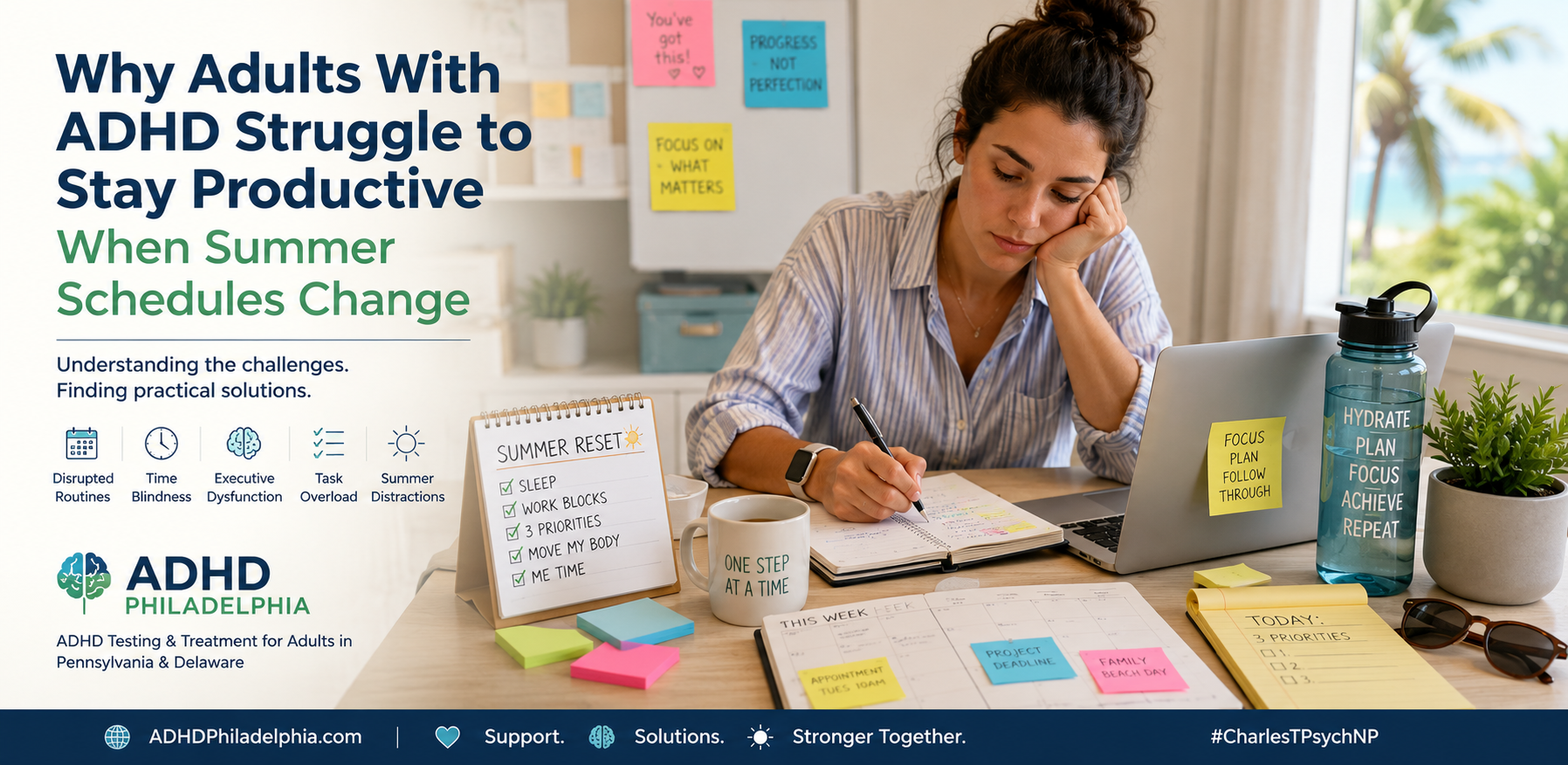
Why Adults With ADHD Struggle to Stay Productive When Summer Schedules Change
Summer schedule changes can make adult ADHD productivity harder. Learn why disrupted routines, time blindness, procrastination, sleep changes, and reduced structure affect focus.
Summer can make productivity feel unpredictable.
The days are longer.
The weather is warmer.
Schedules become more flexible.
Travel increases.
Children may be home from school.
Weekends feel fuller.
Work routines may shift.
Social plans become more frequent.
For some adults, this feels refreshing.
For many adults with ADHD, it can feel destabilizing.
The same person who was starting to build a steady routine in March or April may suddenly feel scattered by late May or June. Work gets delayed. Sleep shifts. Email piles up. Household tasks fall behind. Appointments are forgotten. The calendar feels crowded. Focus becomes harder to access.
Then the adult with ADHD may wonder:
“Why am I less productive when summer is supposed to feel easier?”
“Why does one schedule change throw off my whole week?”
“Why do I keep saying I’ll do it later?”
“Why am I working hard but still falling behind?”
“Why can’t I stay consistent when my routine changes?”
This is not always laziness.
Adult ADHD can affect executive functioning, including planning, prioritizing, time awareness, task initiation, emotional regulation, working memory, routines, and follow-through. When summer changes the usual structure, productivity can become harder to maintain.
For adults in Pennsylvania and Delaware, repeated problems with productivity, focus, procrastination, and follow-through may be one reason to consider adult ADHD testing and treatment.
Why Summer Schedules Can Make Productivity Harder
Adults with ADHD often rely on structure more than they realize.
A regular weekday may include a wake-up time, work start time, commute, medication routine, meal schedule, school schedule, meetings, deadlines, and bedtime cues.
Even if the routine is imperfect, it still creates rhythm.
Summer can disrupt that rhythm.
Children may be home.
Travel may interrupt the week.
Evenings may run later.
Sleep may shift.
Family events may increase.
Work may feel less structured.
Household tasks may pile up.
Remote work may become more distracting.
The usual start-and-stop points may disappear.
For adults with ADHD, productivity is often easier when there are clear external cues. When those cues disappear, the brain may have to create structure on its own.
That can be exhausting.
This is why executive dysfunction can become more noticeable when summer schedules change.
Summer Can Make “Later” Feel Too Easy
One of the biggest productivity traps for adults with ADHD is the word “later.”
During summer, “later” feels especially believable.
“I’ll do it after the weekend.”
“I’ll get back on track after the trip.”
“I’ll answer that email tonight.”
“I’ll restart Monday.”
“I’ll organize everything once things calm down.”
“I’ll be more productive once summer settles down.”
But for ADHD, “later” often needs a specific time, place, cue, and starting step.
Without that, later becomes vague.
The task moves forward on the calendar, but it never becomes clear enough to start.
This can happen with work projects, bills, medication refills, scheduling appointments, cleaning, paperwork, exercise, meal planning, and follow-up messages.
The adult may care deeply about the task. They may even feel stressed about it every day. But stress alone does not always create action.
This is why ADHD procrastination can increase when schedules become less structured.
Longer Days Can Create a False Sense of Time
Summer gives the feeling of more time.
More daylight can make the day feel bigger than it actually is. An adult with ADHD may think, “I have all day,” or “I can still get this done tonight.”
Then the day disappears.
A quick errand takes longer than expected.
A family plan shifts the afternoon.
A text turns into a long conversation.
One household task becomes five.
A work task is delayed until evening.
Evening becomes late night.
The task moves to tomorrow.
This is where ADHD time blindness can become a major issue.
Time blindness means difficulty sensing, estimating, tracking, or managing time accurately. It can make tasks feel either immediate or invisible, with very little middle ground.
Summer can intensify this because routines are looser and transitions are less predictable.
This is why ADHD time management often requires visible structure during summer.
Remote Workers With ADHD May Struggle More During Summer
Remote work can already make ADHD symptoms harder to manage.
Summer can add another layer.
Children may be home.
Family members may interrupt more often.
Travel plans may compete with work.
The house may feel louder.
Laundry, dishes, and errands may become more visible.
Outdoor plans may become tempting.
Work and home boundaries may blur even more.
A remote worker with ADHD may sit down to work and then notice everything except the task they planned to do.
They may check one message.
Then answer a household question.
Then remember an errand.
Then open another tab.
Then respond to an email.
Then realize an hour has passed.
This does not mean remote work is bad.
It means remote work often requires more intentional structure for adults with ADHD.
This is why remote work and adult ADHD should be taken seriously when summer schedules change.
Summer Sleep Changes Can Hurt Productivity
Productivity is not only about motivation.
It is also about sleep.
Summer often changes sleep patterns. Longer daylight, later events, travel, heat, screen time, children’s schedules, and flexible evenings can all push bedtime later.
For adults with ADHD, sleep disruption can make productivity harder.
Poor sleep can affect:
Focus
Mood
Memory
Patience
Motivation
Task initiation
Time awareness
Decision-making
Impulse control
Emotional regulation
Follow-through
An adult may wake up tired, start slowly, avoid hard tasks, feel guilty, work late to catch up, and then sleep poorly again.
This cycle can repeat for weeks.
Summer sleep disruption can quietly reduce productivity before the person realizes what is happening.
Understanding ADHD and mental exhaustion can help adults see why the problem is not always effort. Sometimes the brain is trying to work with low fuel.
More Plans Can Mean More Transitions
Summer can bring more movement.
Work.
Home.
Travel.
Family gatherings.
Cookouts.
Beach trips.
Children’s activities.
Social plans.
Appointments.
Errands.
Weekend events.
Each activity may seem simple on its own. But every activity requires transitions.
Adults with ADHD may struggle with transitions because shifting from one mode to another requires executive functioning.
The brain has to stop one task, remember the next task, organize materials, estimate time, regulate emotions, and begin again.
That is a lot.
This is why summer can feel more tiring than expected. The adult may not only be doing more. They may be switching more.
And every switch can create an opportunity to lose momentum.
This is why ADHD and interruptions are especially important during summer productivity struggles.
Productivity May Drop When Routines Are Not Visible
Adults with ADHD often do better when routines are visible.
A mental routine is easy to lose.
A visible routine gives the brain something to return to.
That might include:
A wall calendar
A whiteboard
A planner
A phone reminder
A sticky note
A written morning routine
A visible task list
A weekly reset checklist
A medication routine reminder
A workday start checklist
During summer, routines need to be easier to see because there are more schedule changes.
The goal is not to create a perfect system.
The goal is to reduce the number of decisions the brain has to make from scratch.
This is why ADHD routines should be simple, visible, and restartable.
Family Responsibilities Can Compete With Work Productivity
Summer can increase the invisible workload at home.
This may include childcare, transportation, camps, meals, groceries, family visits, vacation planning, cleaning, laundry, social events, and managing everyone’s schedule.
For parents and caregivers with ADHD, this can become overwhelming quickly.
The adult may start the day planning to work, but the household keeps pulling attention away.
A child needs help.
A family member asks a question.
A camp form is due.
A meal needs planning.
A ride needs coordinating.
A schedule changes.
A work task gets delayed.
This can create guilt in both directions.
The adult may feel guilty while working because family needs are waiting.
Then they may feel guilty while handling family needs because work is falling behind.
This does not mean they are failing.
It may mean the demands have outgrown the structure currently supporting them.
This is why parenting with adult ADHD can become harder during summer.
ADHD Productivity Problems Can Look Like Laziness From the Outside
One of the most painful parts of adult ADHD is being misunderstood.
From the outside, productivity struggles may look like laziness, poor discipline, lack of motivation, or not caring.
But many adults with ADHD are working extremely hard internally.
They may be trying to hold the schedule in their head.
Trying to remember what they forgot.
Trying to force motivation.
Trying to recover from a late night.
Trying to manage shame.
Trying to answer messages.
Trying to start the hard task.
Trying to not disappoint anyone.
The effort is real.
But effort without structure can still lead to inconsistent results.
Adult ADHD often creates a gap between intention and action. The person may know what needs to be done and still struggle to begin, organize, prioritize, or complete it.
This is why adult ADHD follow-through is such an important topic for productivity.
A Simple Summer Productivity Reset for Adults With ADHD
Summer productivity does not require a perfect routine.
It requires a realistic reset.
Try this:
1. Pick one daily anchor
Choose one non-negotiable cue: checking your calendar, taking medication as prescribed, opening your planner, eating breakfast, or reviewing your first task.
2. Choose three priorities
Do not write a twenty-item list. Pick three tasks that would make the biggest difference today.
3. Make the first step physical
Instead of “work on project,” write “open document.”
Instead of “clean house,” write “clear counter.”
Instead of “get organized,” write “write task list.”
4. Use time blocks
Create visible work blocks, even if they are short.
5. Plan for interruptions
Assume interruptions will happen. Keep a restart note that says, “When I come back, start here.”
6. Protect sleep where possible
Productivity depends on recovery.
7. Create a travel reset checklist
Use the same checklist after trips: unpack, laundry, calendar, medication routine, first work task.
8. Restart without shame
Shame does not improve executive function. Structure helps more.
For adults with ADHD, productivity often improves when the system is simple enough to restart after disruption.
When Summer Productivity Struggles May Point to ADHD
Everyone has unproductive days.
But if summer schedule changes repeatedly lead to missed deadlines, procrastination, emotional overwhelm, work problems, sleep disruption, disorganization, task pileups, or difficulty following through, it may be worth considering an ADHD evaluation.
Adult ADHD testing may be helpful if you often struggle with:
Focus
Task initiation
Time management
Procrastination
Disorganization
Forgetfulness
Emotional overwhelm
Work productivity
Remote work structure
Sleep routines
Transitions
Follow-through
Feeling capable but inconsistent
A thoughtful evaluation should also consider other possible explanations, including anxiety, depression, trauma, sleep problems, stress, substance use concerns, medical conditions, and medication effects.
For adults in Pennsylvania and Delaware, adult ADHD evaluation can help clarify whether ADHD may be contributing to repeated productivity problems.
ADHD Testing and Treatment in Pennsylvania and Delaware
ADHD Philadelphia provides adult ADHD testing and treatment for adults in Pennsylvania and Delaware.
Care is designed to help adults better understand symptoms such as poor focus, procrastination, disorganization, time management problems, emotional overwhelm, difficulty with routines, and trouble following through.
Treatment plans are individualized and may include education, behavioral strategies, structure-building, therapy or coaching strategies, lifestyle review, and medication management when clinically appropriate.
Initial appointments are completed through secure telehealth. In-person appointments may be scheduled after the first online appointment when clinically appropriate. Walk-in appointments are not available.
If summer schedule changes repeatedly make it hard to stay productive, focused, and organized, support may help you move from frustration toward clarity and practical next steps.
To learn more, visit ADHDPhiladelphia.com.
Frequently Asked Questions About Adult ADHD and Summer Productivity
Can summer make adult ADHD symptoms worse?
Summer can make ADHD symptoms more noticeable because routines, sleep schedules, work patterns, family responsibilities, and external structure may change.
Why do adults with ADHD lose productivity when schedules change?
Adults with ADHD may rely on external cues and predictable routines to support planning, focus, task initiation, and follow-through. When schedules change, productivity may become harder to maintain.
Why do I procrastinate more during summer?
Summer can make “later” feel easier because schedules are looser and days feel longer. For adults with ADHD, vague plans often need clear times, cues, and first steps.
How can adults with ADHD stay productive during summer?
Helpful strategies include using visible calendars, three-priority task lists, morning anchors, time blocks, restart notes, travel reset checklists, and realistic routines that are easy to restart.
Does ADHD Philadelphia provide ADHD testing in Pennsylvania and Delaware?
Yes. ADHD Philadelphia provides adult ADHD testing and treatment for adults in Pennsylvania and Delaware. Initial appointments begin through telehealth. In-person appointments may be scheduled after the first online appointment when clinically appropriate. Walk-in appointments are not available.
Take the First Step
If summer schedule changes make it harder to stay productive, focused, organized, and consistent, ADHD Philadelphia can help you better understand what may be happening.
Adult ADHD can affect productivity, time management, routines, emotional regulation, transitions, task initiation, and follow-through. A structured evaluation can help clarify whether ADHD may be contributing to these patterns and whether treatment may be appropriate.
Visit ADHDPhiladelphia.com to learn more about adult ADHD testing and treatment.
Medical Disclaimer
This article is for educational purposes only and is not a substitute for medical advice, diagnosis, or treatment. ADHD symptoms can overlap with anxiety, depression, sleep disorders, trauma, substance use concerns, medical conditions, medication effects, stress, and other mental health conditions. If you are experiencing symptoms of ADHD or another mental health concern, consult a qualified healthcare professional.