
Why Smart Adults Often Miss an ADHD Diagnosis (And What To Do About It)
High-functioning adults often compensate for ADHD symptoms until stress and burnout increase. Learn how intelligence can mask executive dysfunction and why a structured ADHD evaluation in Pennsylvania and Delaware matters.
Many high-achieving adults are surprised to learn they have ADHD.
They finished college.
They built careers.
They manage responsibilities.
So how could ADHD have been missed?
The answer is simple: intelligence can compensate — until it can’t.
For many adults in Pennsylvania and Delaware, ADHD isn’t obvious in childhood. Instead, it becomes more visible when life demands exceed coping strategies.
Why ADHD Is Often Overlooked in Smart Adults
ADHD is not a measure of intelligence.
In fact, many adults with ADHD are:
• Creative
• Verbally strong
• High-performing under pressure
• Capable of last-minute success
Strong cognitive ability can mask executive dysfunction for years.
Deadlines get met — but through stress.
Assignments get completed — but at the last minute.
Work gets done — but at personal cost.
Eventually, the compensatory strategies stop working.
This pattern is particularly common among high-achieving adults whose professional success may hide significant executive-function strain. Learn more in our guide to Adult ADHD Care for Professionals.
What Changes in Adulthood?
As responsibilities increase, ADHD symptoms become harder to hide.
Adults may begin noticing:
• Chronic procrastination
• Decision fatigue
• Difficulty initiating tasks
• Inconsistent productivity
• Emotional overwhelm
• Burnout despite effort
At this stage, many are misdiagnosed with anxiety, depression, or simple stress.
A structured adult ADHD evaluation helps clarify the difference.
You can learn more about our adult ADHD evaluation process here.
The Hidden Cost of Compensation
When ADHD is undiagnosed, adults often internalize the struggle.
They may think:
“I’m lazy.”
“I’m not disciplined.”
“I should be doing better.”
Over time, chronic stress can impact sleep, emotional regulation, and overall health.
Research suggests untreated ADHD may contribute to long-term risk patterns related to impulsivity and lifestyle instability.
You can read more about how undiagnosed ADHD may impact long-term health here.
Why Proper Diagnosis Matters
A comprehensive ADHD evaluation includes:
• Structured clinical interview
• Functional impairment assessment
• Review of childhood history
• Screening for overlapping conditions
• When appropriate, ADHD testing
Diagnosis is not based on intelligence.
It is based on persistent patterns of executive dysfunction and impairment.
If ADHD is diagnosed, structured treatment options are reviewed.
Learn more about our ADHD treatment and medication management approach.
What To Do If This Sounds Familiar
If you are a high-functioning adult who has always “managed” but never felt stable, it may be worth exploring whether ADHD is part of the picture.
Clarity is not about labeling.
It is about understanding how your brain works — and building sustainable systems around it.
Adult ADHD Care in Pennsylvania & Delaware
At ADHD Philadelphia, we specialize exclusively in adult ADHD diagnosis and structured treatment.
Telehealth appointments are available throughout Pennsylvania and Delaware.
In-person appointments may be scheduled after the initial evaluation when clinically appropriate.
There are no walk-in appointments.
Ready to Take the Next Step?
If you suspect ADHD may have been overlooked, a structured evaluation can provide clarity.

How Do You Know If ADHD Medication Is Working in Adults?
Learn how to tell if ADHD medication is working in adults. Discover what improvement should look like, when adjustments are needed, and how structured monitoring supports safe ADHD treatment in Pennsylvania and Delaware.
One of the most common questions adults ask after starting ADHD medication is:
“Is this actually working?”
For adults diagnosed with ADHD, improvement is not always dramatic. It is often subtle — but clinically meaningful.
Understanding what improvement should look like helps ensure treatment remains safe, appropriate, and effective.
If you are unsure how adult ADHD is diagnosed, you can learn more about our comprehensive evaluation process here.
What Improvement Should Look Like
When medication is properly matched and monitored, adults often notice:
• Improved task initiation
• Reduced procrastination
• Increased sustained attention
• Better organization
• Fewer careless mistakes
• Improved emotional regulation
It may not feel like a “burst of motivation.”
Instead, it often feels like:
“It’s easier to start.”
What Medication Should NOT Do
Medication should not:
• Make you feel euphoric
• Cause severe anxiety
• Dramatically alter personality
• Eliminate normal fatigue
• Replace healthy habits
If side effects outweigh benefits, adjustments are needed.
How Long Does It Take?
Stimulants may begin working the same day.
Non-stimulants may take several weeks.
However, effectiveness must be evaluated over time.
That’s why structured 30-day monitoring is important.
Medication effectiveness should always be evaluated in the context of overall functioning, medical history, and safety considerations.
👉 Learn more about our Medication Management & Stimulant Treatment Policy.
Measuring Functional Improvement
Medication success is measured by:
• Workplace performance
• Academic productivity
• Household task completion
• Time management
• Emotional stability
It is not measured by “feeling different.”
It is measured by functioning better.
When Adjustments Are Needed
You may need adjustment if:
• Benefits are inconsistent
• Focus improves but anxiety worsens
• Sleep becomes disrupted
• Blood pressure increases
• Motivation improves but organization does not
Medication is one tool — not the entire solution.
Comprehensive ADHD treatment often includes behavioral strategies, executive functioning support, and lifestyle optimization alongside medication management.
ADHD Treatment in Pennsylvania & Delaware
At ADHD Philadelphia, medication effectiveness is evaluated through structured follow-up and symptom review.
Treatment decisions are individualized and may include stimulant or non-stimulant options depending on clinical presentation.
You can also read our detailed comparison of stimulant vs non-stimulant ADHD medications here.
Telehealth available throughout Pennsylvania & Delaware.
In-person appointments may be scheduled after the initial visit.
We serve adults in Philadelphia, Montgomery County, Bucks County, Chester County, Wilmington, Newark, Dover, and surrounding communities.
Ready to Begin?
If you are an adult located in Pennsylvania or Delaware and unsure whether ADHD medication may be appropriate, schedule a comprehensive evaluation to review your symptoms, medical history, and treatment options.
ADHD Testing vs ADHD Screening: What’s the Difference for Adults?
ADHD screening quizzes are not the same as comprehensive ADHD testing. Learn how adult ADHD evaluations work in Pennsylvania and Delaware and why structured diagnosis provides greater clarity.
Many adults searching for “ADHD test for adults” are unsure whether they need a quick screening or a full diagnostic evaluation.
While the terms are often used interchangeably online, ADHD screening and ADHD testing are not the same thing.
Understanding the difference helps ensure accurate diagnosis and appropriate treatment.
What Is ADHD Screening?
An ADHD screening is typically:
A short questionnaire
A self-report checklist
An online symptom quiz
Screening tools can identify whether ADHD symptoms may be present. However, they do not confirm a diagnosis.
Screenings are helpful starting points — not diagnostic decisions.
What Is ADHD Testing?
ADHD testing is part of a comprehensive diagnostic evaluation and may include:
Computerized attention testing
Behavioral questionnaires
Executive functioning measures
Testing provides objective data that supports the clinical interview.
However, ADHD diagnosis is never based on a single score.
Testing supports — but does not replace — a structured clinical evaluation.
Why a Comprehensive Evaluation Matters
Many conditions can mimic ADHD symptoms, including:
Anxiety disorders
Depression
Sleep disorders
Trauma-related conditions
A thorough adult ADHD evaluation includes:
Clinical interview
Symptom history review
Functional impairment assessment
Differential diagnosis screening
ADHD testing when appropriate
This structured process reduces misdiagnosis and improves treatment outcomes.
After Diagnosis: What Happens Next?
If ADHD is diagnosed, treatment may include:
Executive function strategies
Environmental and workflow adjustments
Medication management when appropriate
Stimulant medications require monthly follow-up appointments for monitoring and dosage adjustment.
Non-stimulant medications are typically monitored every 30–90 days depending on treatment response.
All treatment plans include structured follow-up.
Telehealth ADHD Testing in Pennsylvania & Delaware
Adult ADHD evaluations begin via secure telehealth appointments across Pennsylvania and Delaware.
In-person visits are scheduled afterward when clinically appropriate.
There are no walk-in appointments.
Take the Next Step
If you are searching for ADHD testing, ADHD assessment for adults, or ADHD diagnosis in Pennsylvania or Delaware, a comprehensive evaluation provides clarity beyond a screening quiz.
Schedule your adult ADHD evaluation today.
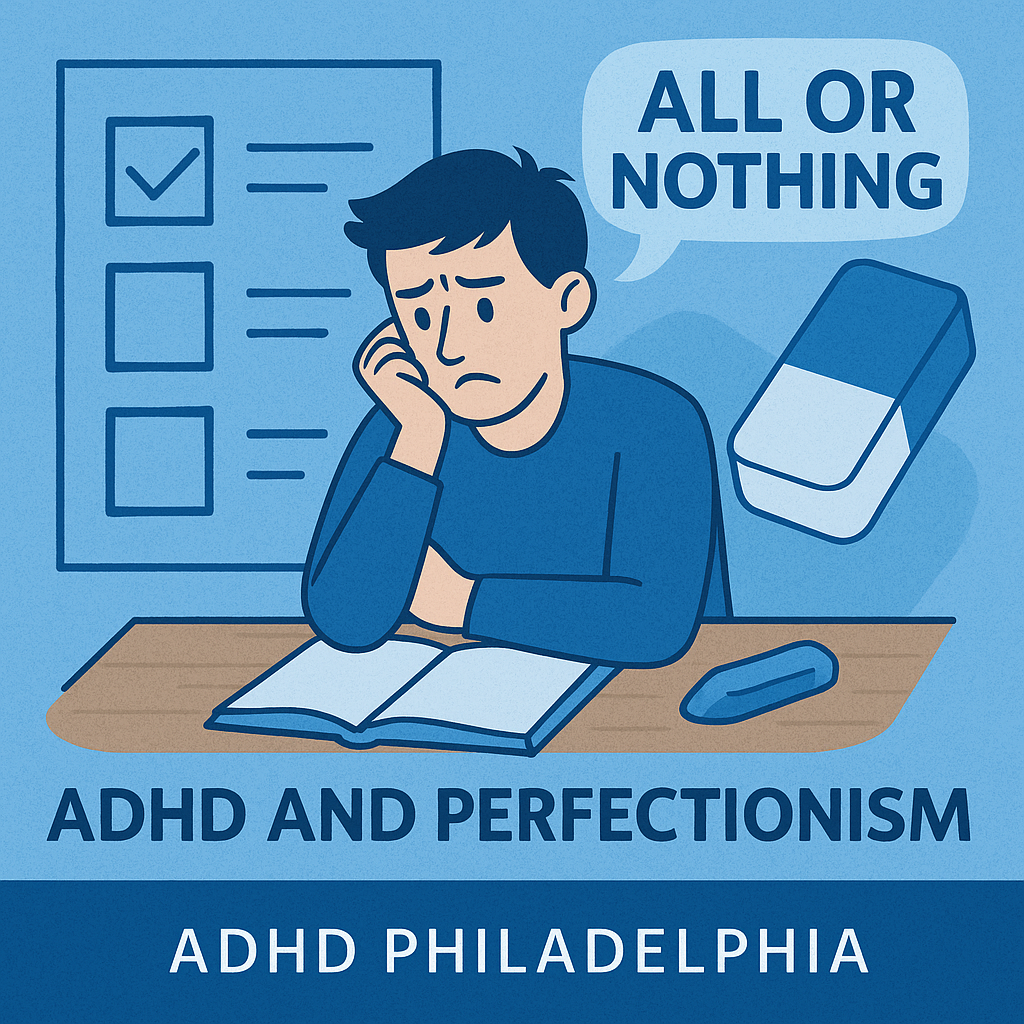
🧩 ADHD and Perfectionism: Why "All or Nothing" Thinking Takes Over. By Charles Thornton, PMHNP-BC — ADHD Philadelphia
Perfectionism is common in adults with ADHD—not because you expect too much, but because your brain fears mistakes, overwhelm, and uncertainty. Learn why ADHD fuels “all-or-nothing” thinking and how to break the cycle.
People often assume ADHD means being careless or distracted.
But for many adults, ADHD actually leads to intense perfectionism.
Not cute or quirky perfectionism —
but paralyzing perfectionism that makes starting, finishing, or sharing anything feel risky.
At ADHD Philadelphia, we help adults across Pennsylvania and Delaware understand why ADHD so often leads to “all-or-nothing” thinking — and how to break free from it using neuroscience-backed strategies.
🧠 Why ADHD Creates Perfectionism
1️⃣ Starting is Hard — So the Task Must Feel Perfect First
Adults with ADHD struggle with task initiation due to low dopamine activation.
When a task feels overwhelming, the brain uses perfectionism to avoid discomfort.
Your brain says:
“If I can’t do it perfectly, I shouldn’t start yet.”
This protects you from feeling:
frustration
confusion
overwhelm
fear of failure
But it also blocks progress.
2️⃣ Emotional Intensity Amplifies Mistakes
Research from Barkley and Wilke-Deaton shows that adults with ADHD experience emotions more intensely, which makes mistakes feel disproportionately painful.
A small error → feels like a big failure.
This causes:
rewriting emails over and over
delaying projects
avoiding criticism at all costs
3️⃣ Working Memory Makes Projects Feel Bigger Than They Are
With limited working memory, tasks feel:
vague
scattered
overwhelming
ADHD brains prefer certainty, so they lean into perfectionism to reduce ambiguity.
“If I plan every detail perfectly, I won’t get overwhelmed.”
Except… planning becomes the trap.
4️⃣ Rejection Sensitivity Makes Feedback Feel Dangerous
Many adults with ADHD experience Rejection Sensitive Dysphoria (RSD).
Perfectionism becomes armor:
“If it’s perfect, no one can criticize me.”
But this creates impossible pressure and burnout.
🔧 3 Ways to Break the ADHD Perfectionism Cycle
1️⃣ The 70% Rule
Aim to complete tasks at 70% quality, not 100%.
This retrains the brain to accept “good enough” instead of “perfect or nothing.”
Your productivity skyrockets because you’re no longer battling paralysis.
2️⃣ The “One Pass” Method
From executive function research:
Do one pass through a task without allowing revisions.
Examples:
Write the email once
Clean the room once
Outline the essay once
Revisions happen after completion, not while you're doing it.
3️⃣ Break Tasks Into "Micro Wins"
Per Nowell and Dawson, dopamine increases with early success.
Micro wins create momentum.
Try:
Write one paragraph
Tidy for 60 seconds
Read one page
Respond to one message
Small wins override perfectionistic shutdown.
💊 How Medication Helps
ADHD medication improves:
task initiation
emotional regulation
fear response
overwhelm during tasks
This reduces the anxiety that fuels perfectionism and helps you move forward without overthinking.
🌱 You Can Escape “All or Nothing” Thinking
Perfectionism isn’t a personality flaw — it’s a survival strategy for an ADHD brain trying to protect itself from discomfort, uncertainty, and emotional pain.
With treatment, tools, and practice, adults learn to work more flexibly and confidently.
👉 Schedule your ADHD evaluation today
Now serving adults across Pennsylvania and Delaware via telehealth and in-person care.

🔄 ADHD and Rumination: Why Your Brain Replays Everything (and How to Stop It)By Charles Thornton, PMHNP-BC — ADHD Philadelphia
Rumination is common in adults with ADHD—your brain replays conversations, mistakes, and worries on a loop. Learn why ADHD increases rumination and how to break the cycle using neuroscience-backed techniques.
Do you ever replay a conversation from three days ago?
Or obsessively think, “I should’ve said this differently”?
Or lie awake at night replaying moments you wish you could edit?
This is rumination, and it is extremely common in adults with ADHD.
It isn’t overthinking in the traditional anxiety sense — it’s a neurobiological loop tied to executive function, emotional regulation, and dopamine imbalance.
Research from Barkley, Nowell, and Wilke-Deaton shows that ADHD brains struggle to shift thoughts once activated — which makes rumination sticky and persistent.
At ADHD Philadelphia, we help adults across Pennsylvania and Delaware understand why rumination happens and how to quiet the mental noise.
🧠 Why Rumination Happens More With ADHD
1️⃣ The Brain Can’t “Let Go” Easily
The ADHD brain has difficulty with cognitive shifting — moving from one thought to another.
Once a thought activates, the prefrontal cortex struggles to disengage.
You don’t stay stuck because you want to…
Your brain gets locked in.
2️⃣ Emotional Intensity Fuels the Loop
Adults with ADHD feel emotions more intensely, which makes certain moments emotionally charged.
Strong emotion → More mental replay
More replay → Stronger emotional memory
And the loop continues.
Difficulty recovering after emotionally charged experiences may be connected to emotional regulation in adults with ADHD, although anxiety, depression, trauma, and other factors should also be considered.
3️⃣ The Default Mode Network (DMN) Hijacks Your Mind
The DMN — the mind-wandering network — becomes overactive in ADHD.
When this network takes over, the brain:
Replays conversations
Analyzes past mistakes
Imagines negative future outcomes
This is why rumination often hits at night or during downtime.
4️⃣ Low Dopamine Creates “Mental Static”
Rumination increases when dopamine is low because the brain struggles to shift into goal-oriented thinking.
This leads to:
Mental replay
Over-analysis
Getting stuck in “why did I do that?” loops
Rumination is often worst when you’re tired, bored, or overwhelmed.
🔧 3 Research-Based Ways to Reduce Rumination
1️⃣ The 90-Second Reset
Emotions last 90 seconds unless we feed them with thoughts.
When rumination begins:
Pause → Breathe → Redirect
This allows the emotional surge to pass before the loop takes over.
2️⃣ Use “Cognitive Offloading” to Break the Loop
Write the thought down.
Rumination loses power once it’s moved out of your head and onto:
A notes app
A journal
A sticky note
A voice memo
This technique is recommended by both Nowell and Wilke-Deaton.
3️⃣ Use Pattern Interrupts
Rumination is a mental loop — so break the loop physically.
Try:
Standing up
Splashing cold water
Changing rooms
A 20-second stretch
Starting a simple task
This sends a “reset signal” to the nervous system.
💊 How Medication Helps
Medication improves dopamine stabilization and reduces DMN overactivation, making it easier to:
Shift thoughts
Control emotional loops
Stop replaying conversations
Transition into sleep at night
Many adults say medication makes rumination feel like “background noise” instead of the main soundtrack.
🌱 You Can Quiet the Mental Replay
Rumination doesn’t mean something is wrong with you — it’s a brain pattern that can be changed.
With the right tools and treatment, adults with ADHD can finally:
Let go of past moments
Stop replaying conversations
Reduce nighttime overthinking
Feel mentally lighter
👉 Schedule your ADHD evaluation today
Serving adults across Pennsylvania and Delaware.
ADHD Testing Near Me: Why Local Adult Evaluations Matter in Pennsylvania and Delaware
What happens during adult ADHD testing in Philadelphia? Learn how a comprehensive ADHD evaluation works, what testing can and cannot diagnose, current costs, telehealth options, and what happens after an ADHD diagnosis.

If you’ve ever searched “ADHD testing near me” and felt overwhelmed by endless results, you’re not alone. Many adults know something’s off — constant distraction, missed deadlines, or emotional burnout — but they aren’t sure where to start.
At ADHDPhiladelphia.com, we help adults across Pennsylvania and Delaware find clarity fast through affordable, compassionate ADHD testing and treatment that’s local, accessible, and professional.
Why Local ADHD Testing Matters
Getting evaluated close to home isn’t just convenient — it’s powerful.
Here’s why local testing leads to better results:
1️⃣ Personalized Understanding
Providers who serve your region understand your lifestyle, work demands, and environmental stressors.
We know what it’s like to manage deadlines in Philadelphia or balance hybrid work in Wilmington — and tailor care accordingly.
2️⃣ Faster Results and Follow-Up
Large hospital systems often have months-long waitlists. ADHD Philadelphia offers same-week evaluations and telehealth options, so you can move from confusion to clarity in days, not months.
3️⃣ Real-World Support and Connection
We’re not just an evaluation center — we’re a continuing care team.
That means ongoing treatment, medication management, and behavioral support built around your needs, not a one-size-fits-all approach.
How Our Process Works
Our ADHD testing includes:
✅ A thorough intake and clinical interview
✅ Evidence-based ADHD questionnaires
✅ Screening for anxiety, depression, or trauma
✅ A personalized discussion of results and next steps
You’ll leave understanding your brain, your options, and your path forward.
Serving Adults Across Pennsylvania & Delaware
Whether you’re in Philadelphia, Bala Cynwyd, West Chester, Newark, or Dover, our telehealth platform and in-person options make testing simple.
We proudly serve professionals, students, and adults balancing work, family, and focus challenges.
Affordable, Compassionate ADHD Testing
ADHD Philadelphia is built on accessibility —
Transparent pricing
Insurance-friendly superbills
Low-cost assessments
No surprise fees
Because getting help should never depend on guesswork or gatekeeping.
Ready to Take the Next Step?
You don’t have to keep guessing why focus feels so hard.
👉 Schedule your ADHD evaluation today and see how local, personalized ADHD testing can change your life.
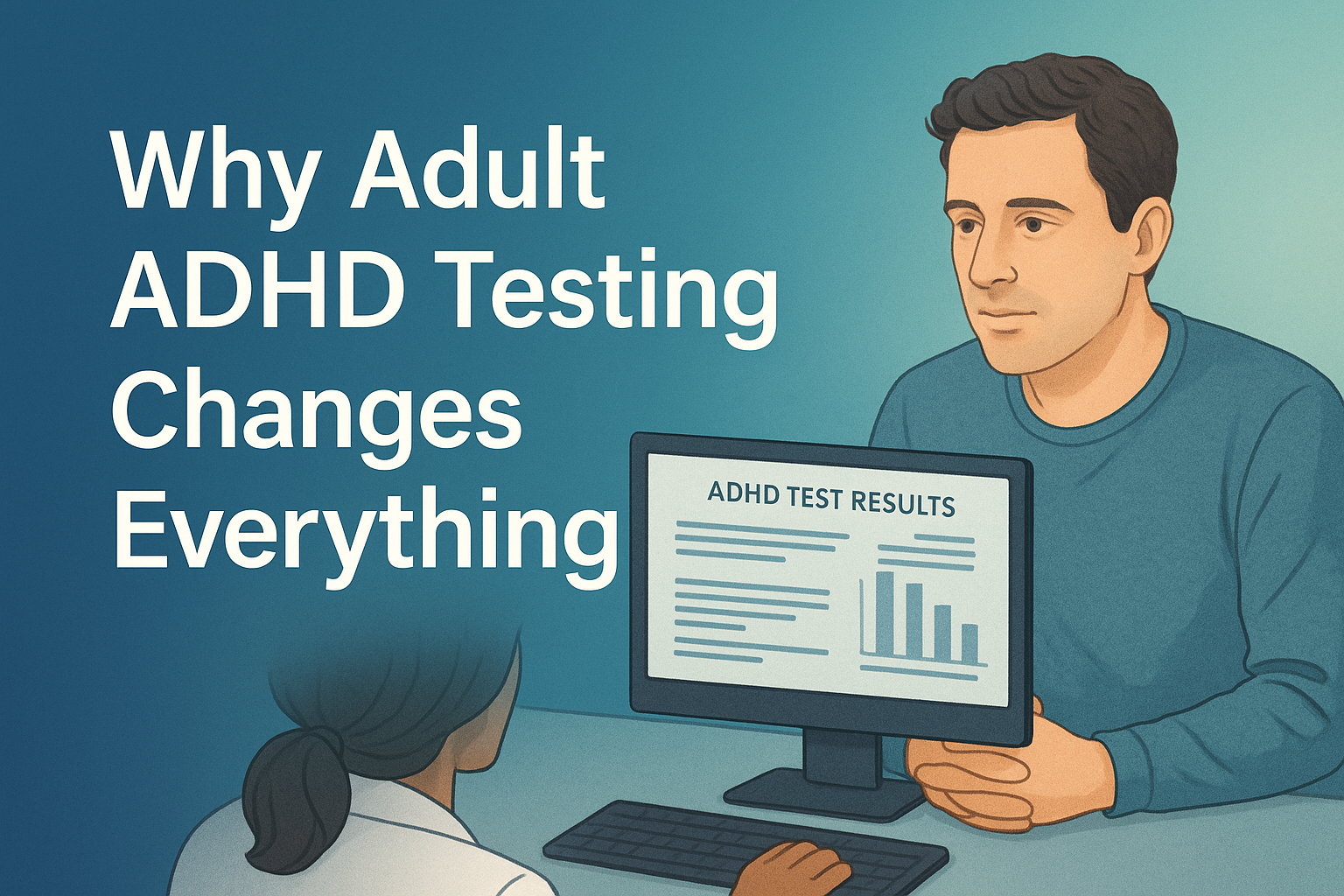
Why Adult ADHD Testing Changes Everything
Adult ADHD testing can transform years of confusion into clarity. Learn why structured ADHD evaluations help adults understand symptoms, prevent misdiagnosis, and create effective treatment plans.
Many adults live for years wondering why everyday tasks feel harder than they should.
They may struggle with:
• Maintaining focus
• Starting important tasks
• Managing time effectively
• Keeping up with work or responsibilities
Often these challenges are misunderstood as laziness, lack of discipline, or stress.
For many adults, ADHD testing becomes the turning point that finally explains these patterns.
A structured evaluation provides clarity, replaces uncertainty, and helps individuals move forward with the right support.
Testing Replaces Guessing
Before testing, many adults spend years trying to figure out what is happening on their own.
Some assume they are simply disorganized. Others believe anxiety or burnout is the only explanation.
A comprehensive ADHD evaluation removes this uncertainty by examining multiple areas of functioning, including:
• Attention regulation
• Impulse control
• Executive functioning
• Emotional regulation
• Functional impairment at work or home
When appropriate, computerized ADHD testing can provide objective data about attention patterns and response time.
If you want to learn more about how testing fits into the diagnostic process, you can read about what happens during an adult ADHD evaluation here.
Clarity Replaces Self-Blame
One of the most powerful outcomes of ADHD testing is emotional clarity.
Many adults report spending years believing they were:
• Lazy
• Unmotivated
• Careless
• “Not trying hard enough”
When testing confirms ADHD, those assumptions are replaced with understanding.
Recognizing that symptoms are connected to a neurological condition — not personal failure — often leads to increased self-compassion and relief.
Accurate Diagnosis Prevents Misdiagnosis
Untreated ADHD can sometimes appear similar to other conditions, including:
• Anxiety
• Depression
• Burnout
• Chronic stress
Without a structured evaluation, ADHD symptoms may be overlooked.
A comprehensive assessment ensures that ADHD is accurately identified and that overlapping conditions are also considered.
You can learn more about how adult ADHD evaluations work here.
Testing Creates a Clear Treatment Path
Testing is not the final step — it is the beginning of a treatment plan.
Once ADHD is confirmed, treatment options may include:
• Medication management
• Executive functioning strategies
• Behavioral support techniques
• Lifestyle adjustments that improve focus and structure
Treatment decisions are individualized based on medical history, symptom patterns, and functional impact.
To learn more about available options, you can review our ADHD treatment and medication management approach here.
Adult ADHD Testing in Pennsylvania and Delaware
At ADHD Philadelphia, we specialize in the evaluation and treatment of adult ADHD.
Our structured assessment process is designed to provide clarity while ensuring responsible, evidence-based care.
Initial consultations begin via secure telehealth for adults located in Pennsylvania and Delaware.
When clinically appropriate, in-person appointments may be scheduled after the initial evaluation.
The Bottom Line
For many adults, ADHD testing changes everything.
It transforms years of confusion into understanding and creates a path toward effective treatment and long-term stability.
If you suspect ADHD may be affecting your work, relationships, or daily functioning, a structured evaluation can provide clarity.

Does Undiagnosed Adult ADHD Shorten Life Expectancy?
Emerging research suggests untreated adult ADHD may increase long-term health risks. Learn how proper diagnosis and structured treatment can improve stability and reduce preventable risks for adults in Pennsylvania and Delaware.
Recent research has raised an important question:
Does untreated adult ADHD affect long-term health and life expectancy?
Emerging data suggests that adults with untreated ADHD may face increased health risks that indirectly impact longevity. These risks are not caused by ADHD itself — but by the behavioral, emotional, and lifestyle patterns that often accompany untreated symptoms.
For adults in Pennsylvania and Delaware, understanding these risks is critical.
Why Would ADHD Impact Long-Term Health?
ADHD is a neurodevelopmental condition that affects executive functioning — including impulse control, planning, and self-regulation.
When symptoms are untreated, adults may experience:
• Increased risk-taking behaviors
• Higher rates of smoking or substance use
• Poor sleep patterns
• Irregular eating habits
• Reduced physical activity
• Higher rates of depression and anxiety
Over time, these patterns can contribute to cardiovascular risk, metabolic concerns, and accidental injury.
It’s Not ADHD — It’s Untreated ADHD
ADHD does not directly shorten life expectancy.
However, untreated ADHD can increase:
• Motor vehicle accident risk
• Substance-related complications
• Mental health comorbidities
• Chronic stress-related health effects
When symptoms are identified early and treated appropriately, many of these risks can be significantly reduced.
How Treatment Improves Long-Term Outcomes
Comprehensive ADHD treatment may include:
• Structured medication management
• Executive functioning support
• Cognitive behavioral therapy
• Lifestyle optimization strategies
Medication, when clinically appropriate, can reduce impulsivity and improve decision-making — which may reduce risky behaviors.
You can learn more about our Medication Management & Stimulant Treatment Policy here.
The Importance of Adult ADHD Diagnosis
Many adults in Pennsylvania and Delaware reach their 30s, 40s, or even 50s before receiving an accurate ADHD diagnosis.
Without understanding the root cause of executive dysfunction, individuals may internalize years of frustration, burnout, and self-blame.
A structured diagnostic process helps clarify whether ADHD symptoms are present and whether other conditions may be contributing to attention and executive functioning difficulties.
If you are unsure how ADHD is formally diagnosed, you can learn more about our adult ADHD diagnosis process here.
Early Identification Matters
When adult ADHD is properly diagnosed and managed:
• Risk-taking behavior decreases
• Emotional regulation improves
• Occupational functioning stabilizes
• Health routines become easier to maintain
Treatment is not just about productivity.
It’s about long-term health stability.
Adult ADHD Care in Pennsylvania & Delaware
At ADHD Philadelphia, adult ADHD evaluation and treatment are structured, safety-focused, and individualized.
Telehealth services are available throughout Pennsylvania and Delaware.
In-person appointments may be scheduled after the initial evaluation when clinically appropriate.
Adults across Pennsylvania and Delaware often wonder whether their symptoms are related to ADHD or anxiety. Understanding the difference can help guide the next step in treatment. Our guide on ADHD vs anxiety in adults explains how these conditions differ.
Take the First Step
If you suspect untreated ADHD may be affecting your health, relationships, or long-term stability, a comprehensive evaluation is the first step toward clarity.

How Treating Undiagnosed Adult ADHD Improves Life for Adults in Delaware and Pennsylvania
Treating undiagnosed adult ADHD can significantly improve focus, productivity, and emotional well-being. Learn how proper diagnosis and treatment help adults in Pennsylvania and Delaware improve daily functioning and long-term stability.
Many adults live for years with undiagnosed ADHD.
They may struggle with focus, organization, and emotional regulation without understanding why everyday tasks feel harder than they should.
For many adults in Delaware and Pennsylvania, receiving a proper ADHD diagnosis can be life-changing.
When ADHD is identified and treated appropriately, improvements often occur across multiple areas of life — including work performance, relationships, and overall mental well-being.
Why ADHD Often Goes Undiagnosed in Adults
Many adults attribute their challenges to stress, burnout, anxiety, or personal shortcomings.
Common experiences include:
• Chronic procrastination
• Difficulty finishing tasks
• Disorganization
• Mental overload
• Emotional frustration
Because ADHD symptoms can overlap with anxiety or depression, the condition may go unrecognized for years.
A structured clinical evaluation helps determine whether ADHD is contributing to these challenges.
You can learn more about our adult ADHD evaluation process here.
Professional and Career Improvements
When ADHD symptoms are properly treated, many adults notice meaningful changes in their work performance.
Common improvements include:
Better Focus and Attention
Adults often find it easier to sustain attention during meetings, projects, and daily work tasks.
Improved Organization and Time Management
Treatment can help individuals create systems that make planning, prioritizing, and completing tasks more manageable.
Increased Productivity
When executive functioning improves, work becomes more efficient and less stressful.
For professionals working remotely or managing complex workloads, these changes can significantly improve career stability.
Stronger Relationships
ADHD can affect communication, follow-through, and emotional regulation.
When symptoms improve, many adults experience:
• Improved listening and communication
• Reduced impulsive reactions
• Better follow-through on commitments
• Less conflict in personal relationships
These changes often lead to stronger connections with partners, family members, and colleagues.
If you’re experiencing chronic focus problems, mental overload, or difficulty finishing tasks, it may help to understand whether ADHD or anxiety is the underlying cause. Our article on ADHD vs anxiety in adults explains the differences and when an evaluation may be helpful.
Improved Emotional Well-Being
Many adults with untreated ADHD experience years of frustration and self-criticism.
After diagnosis and treatment, individuals often report:
• Reduced anxiety and stress
• Improved self-confidence
• Greater emotional stability
• Increased sense of control over daily life
Understanding that ADHD is a neurological condition — not a character flaw — can be profoundly validating.
Research also suggests untreated ADHD may contribute to long-term health risks related to impulsivity and lifestyle instability.
You can read more about how undiagnosed ADHD may impact long-term health here.
ADHD Treatment Options
Treatment for adult ADHD is individualized and may include:
• Medication management
• Executive functioning strategies
• Behavioral support techniques
• Lifestyle adjustments that improve focus and structure
If ADHD is diagnosed, structured treatment options are reviewed based on each individual’s clinical needs.
You can learn more about our ADHD treatment and medication management approach here.
Adult ADHD Care in Delaware and Pennsylvania
At ADHD Philadelphia, we specialize in the diagnosis and treatment of adult ADHD.
Our telehealth model allows adults throughout Delaware and Pennsylvania to access structured evaluation and treatment without long travel times or scheduling barriers.
Initial evaluations begin via secure telehealth appointments.
When clinically appropriate, in-person appointments may be scheduled afterward.
There are no walk-in appointments.
Ready to Begin?
If you suspect ADHD may be affecting your work, relationships, or daily functioning, a structured evaluation can provide clarity.