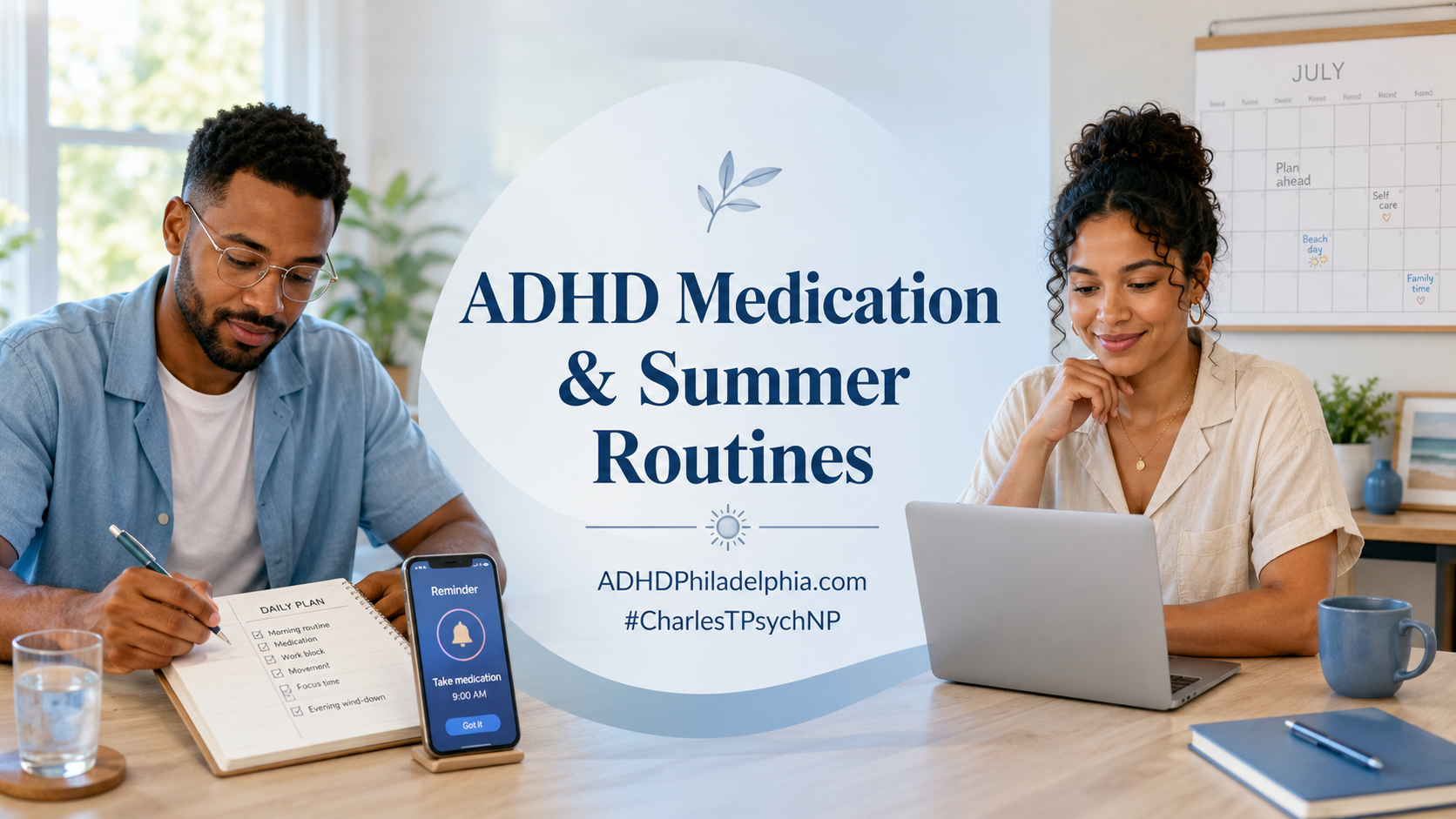
Why Adults With ADHD Struggle to Stay Consistent With Medication and Routines During Summer
Summer can disrupt medication timing, sleep, routines, and follow-through for adults with ADHD. Learn why consistency gets harder and when ADHD treatment support may help.
Summer can change everything.
Wake-up times shift.
Bedtimes drift later.
Travel plans interrupt the week.
Children may be home from school.
Work schedules may become less predictable.
Meals may happen at different times.
Weekends may feel longer.
Vacations may disrupt the calendar.
Family events may crowd the schedule.
For adults with ADHD, these changes can make consistency harder.
This can include consistency with routines, sleep, appointments, daily responsibilities, and medication timing.
An adult may start the summer with good intentions:
“I’m going to stay organized.”
“I’m going to keep my routine.”
“I’m going to stay on top of appointments.”
“I’m going to take my medication exactly as prescribed.”
“I’m going to keep my sleep schedule steady.”
“I’m going to reset after every trip.”
Then summer happens.
The morning routine changes.
The medication reminder gets missed.
The refill date sneaks up.
The appointment is forgotten.
Sleep gets pushed later.
The calendar feels scattered.
The adult feels frustrated and ashamed.
This is not always carelessness.
Adult ADHD can affect executive functioning, including working memory, planning, time awareness, task initiation, organization, emotional regulation, routines, and follow-through. When summer disrupts the structure that supports consistency, medication and daily routines may become harder to manage.
For adults in Pennsylvania and Delaware, repeated difficulty with routines, follow-through, medication consistency, focus, and time management may be one reason to consider adult ADHD testing and treatment.
Why Summer Can Disrupt ADHD Medication Routines
Medication routines often depend on daily structure.
A person may take medication after waking up, before work, with breakfast, after brushing teeth, or before starting the day.
That routine may work well when the schedule is predictable.
But summer can disrupt those cues.
A person may wake up later.
Breakfast may be skipped.
Travel may change the morning routine.
A family event may start early.
Children may interrupt the usual sequence.
Work may begin at a different time.
A person may sleep in after a late night.
The medication may be in a travel bag, not the usual place.
For adults with ADHD, habits often depend on visible cues and repeated patterns. When the cue disappears, the action may disappear too.
This is why ADHD routines need to be simple, visible, and restartable during summer.

Consistency Is an Executive Function Skill
Many people think consistency is just discipline.
For adults with ADHD, consistency is often an executive function challenge.
To stay consistent with medication and routines, the brain has to:
Remember the task
Track time
Notice the cue
Pause distractions
Start the action
Follow the sequence
Plan ahead
Refill medication on time
Attend appointments
Adjust around schedule changes
Return to routine after disruption
That is a lot of executive functioning.
When summer adds travel, family demands, sleep changes, work interruptions, social plans, and less predictable mornings, consistency can become harder.
This is why executive dysfunction can affect medication routines, not just work tasks or household chores.
Medication Should Be Taken Only as Prescribed
If you are prescribed ADHD medication, it is important to take it exactly as directed by your clinician.
Do not change the dose, timing, frequency, or schedule without speaking with your prescriber.
This is especially important for stimulant medications, which are controlled substances and require careful monitoring.
At ADHD Philadelphia, stimulant treatment is monitored closely. Patients receiving stimulant medication are assessed and monitored on a structured basis. Prescription Drug Monitoring Program checks are completed prior to prescribing controlled substances. Additional safety steps may be required when clinically appropriate.
These may include medication follow-up visits, side effect monitoring, urine drug screening, EKGs, in-person appointments, and review of substance use concerns.
Treatment decisions are individualized and based on safety, symptoms, functioning, response, and clinical appropriateness.
Understanding ADHD medication management can help adults approach treatment with more structure and less confusion.
Summer Travel Can Make Medication Planning More Complicated
Travel can be one of the biggest routine disruptors.
A person may pack quickly, leave early, stay in a hotel, visit family, change time zones, or keep medication in a different bag than usual.
This can create problems.
Medication may be forgotten at home.
The morning cue may be missing.
The schedule may shift.
The refill date may happen during travel.
The adult may not have a clear plan for appointments.
Sleep and meals may become inconsistent.
Travel stress may increase emotional overwhelm.
For adults taking prescribed ADHD medication, summer travel requires planning.
This may include checking refill timing, keeping medication secure, following prescribing instructions, and asking the prescriber about travel-related questions before leaving.
For controlled substances, travel planning matters. Medication laws and rules may vary when crossing state or international borders. Patients should speak with their prescriber and review destination-specific requirements when needed.
This is why ADHD after summer travel can involve more than unpacking. It can also involve safely returning to treatment routines.
Sleep Changes Can Affect ADHD Symptoms and Routine Consistency
Summer often changes sleep.
Longer daylight, social events, children’s schedules, travel, heat, screen time, and later nights can all push bedtime later.
For adults with ADHD, sleep disruption can make routines harder to maintain.
Poor sleep can affect:
Focus
Mood
Memory
Patience
Motivation
Time awareness
Task initiation
Emotional regulation
Decision-making
Follow-through
If sleep shifts, the morning routine may shift too.
A person may wake up late, rush, skip breakfast, forget medication, miss planning time, or start the day already behind.
Then the day becomes reactive instead of structured.
Understanding ADHD and mental exhaustion can help adults recognize why summer sleep changes can affect medication routines, work routines, parenting routines, and follow-through.
Refill Timing Can Sneak Up During Summer
Adults with ADHD may struggle with time blindness.
Time blindness can make it difficult to sense how much time has passed, how soon something is due, or how quickly a deadline is approaching.
This can affect medication refills and appointments.
A person may think:
“I still have time.”
“I’ll request it tomorrow.”
“I’ll call after work.”
“I’ll schedule the appointment later.”
“I didn’t realize I was almost out.”
“I forgot the office needed time to process it.”
Then suddenly, the refill date is here.
For ADHD treatment, waiting until the last minute can create stress. This is especially true for controlled substances, which require careful prescribing, monitoring, and pharmacy processing.
The goal is not panic.
The goal is planning.
Adults with ADHD often benefit from visible refill reminders, appointment reminders, and calendar alerts.
This is why ADHD time management is part of treatment success.
Parenting and Family Demands Can Interrupt Treatment Routines
Parents and caregivers with ADHD may have an even harder time staying consistent during summer.
Children may be home.
Camp schedules may change.
Meals may shift.
Family members may need more support.
Noise and interruptions may increase.
Appointments may compete with childcare.
Work and home responsibilities may overlap.
A parent may be focused on everyone else’s needs and forget their own medication routine, sleep routine, meals, appointments, or refill planning.
This can create a painful pattern.
The adult works hard to care for the family but loses the structure needed to care for themselves.
This is why parenting with adult ADHD can make summer treatment routines harder to maintain.
Remote Work Can Blur Medication and Routine Cues
Remote work can be helpful for some adults with ADHD, but it can also blur routine cues.
There may be no commute.
No clear work start.
No office environment.
No external transition.
No consistent morning sequence.
No separation between home tasks and work tasks.
During summer, this can become even more difficult.
Children may be home.
Family plans may interrupt the day.
Household tasks may compete with work.
Travel planning may distract the adult.
The workday may begin later or become scattered.
For some adults, the commute or office routine used to act as a cue for medication, breakfast, planning, or starting work.
Without that cue, the routine may become less consistent.
This is why remote work and adult ADHD can affect treatment routines as well as productivity.
Shame Can Make Routine Problems Worse
Many adults with ADHD feel ashamed when they miss routines.
They may think:
“I should know better.”
“I’m a provider, parent, professional, or adult — why can’t I remember?”
“I was doing well, and now I messed it up.”
“I’m inconsistent again.”
“I can’t trust myself.”
Shame can make the problem worse.
When shame increases, the adult may avoid checking the calendar, avoid calling the office, avoid opening the portal, avoid looking at the medication bottle, or avoid admitting they need help.
Avoidance can then create more missed steps.
This is why ADHD care should be structured, professional, and nonjudgmental.
A missed routine is not a moral failure.
It is information.
It may mean the system needs to be more visible, more realistic, and easier to restart.
Understanding adult ADHD follow-through can help adults separate character from symptoms.
A Simple Summer Medication and Routine Reset
This section is for general education. Always follow your prescriber’s instructions for medication use.
Here are practical ways adults with ADHD can support consistency during summer:
1. Use one visible medication cue
Keep the cue connected to something stable, such as brushing teeth, breakfast, or checking the morning calendar.
2. Use phone reminders
Set recurring reminders for medication, appointments, and refill planning.
3. Keep appointments on one calendar
Use one primary calendar for treatment appointments, work, family plans, and travel.
4. Plan refills early
Do not wait until the last minute. Add a reminder several days before you expect to need a refill.
5. Create a travel medication checklist
Include medication, prescriber instructions, pharmacy information, appointment dates, and travel-related questions to ask before leaving.
6. Protect sleep where possible
A consistent wake time can help stabilize the rest of the day.
7. Use a “restart note”
If the routine gets disrupted, write: “Tomorrow, start with ______.”
8. Ask for help before the system breaks
If you are struggling with consistency, speak with your clinician. Treatment works best when concerns are addressed early.
The goal is not perfection.
The goal is safe, consistent, supported care.
When Routine Problems May Mean ADHD Treatment Support Could Help
Everyone forgets things sometimes.
But if medication routines, appointments, refills, sleep, work, parenting, or daily responsibilities repeatedly become difficult to manage, ADHD may be worth exploring or reassessing.
Adult ADHD testing or treatment support may be helpful if you often struggle with:
Forgetfulness
Medication routines
Appointment follow-through
Refill planning
Time management
Task initiation
Disorganization
Sleep routines
Emotional overwhelm
Work productivity
Parenting demands
Travel disruption
Feeling capable but inconsistent
A thoughtful ADHD evaluation should also consider anxiety, depression, trauma, sleep problems, stress, substance use concerns, medical conditions, medication effects, and other possible explanations.
For adults in Pennsylvania and Delaware, adult ADHD evaluation can help clarify whether ADHD may be contributing to repeated problems with routines, follow-through, and daily functioning.
ADHD Treatment and Medication Management in Pennsylvania and Delaware
ADHD Philadelphia provides adult ADHD testing and treatment for adults in Pennsylvania and Delaware.
Care is designed to help adults better understand symptoms such as poor focus, procrastination, disorganization, time management problems, emotional overwhelm, difficulty with routines, and trouble following through.
Treatment plans are individualized and may include education, behavioral strategies, structure-building, therapy or coaching strategies, lifestyle review, and medication management when clinically appropriate.
For stimulant medication treatment, structured monitoring is required because stimulants are controlled substances. Safety monitoring may include regular follow-up visits, Prescription Drug Monitoring Program review, side effect monitoring, urine drug screening when clinically appropriate, EKG when clinically appropriate, and in-person appointments when needed.
Initial appointments are completed through secure telehealth. In-person appointments may be scheduled after the first online appointment when clinically appropriate. Walk-in appointments are not available.
If summer routines make it harder to stay consistent with treatment, appointments, refills, and daily structure, support may help you move from frustration toward clarity and practical next steps.
To learn more, visit ADHDPhiladelphia.com.
Frequently Asked Questions About ADHD Medication Routines and Summer
Why do adults with ADHD struggle with medication routines during summer?
Adults with ADHD may struggle with medication routines during summer because wake times, sleep schedules, meals, travel, family plans, and daily cues may change.
Should I change how I take my ADHD medication during summer?
Do not change your ADHD medication dose, timing, or schedule without speaking with your prescribing clinician. Medication should be taken exactly as prescribed.
Why do I forget refills and appointments?
ADHD can affect working memory, time awareness, planning, and follow-through. Refill and appointment reminders may need to be visible and set earlier than expected.
Can travel disrupt ADHD treatment routines?
Yes. Travel can change sleep, medication timing, meals, appointment access, refill planning, and daily routines. Speak with your prescriber before travel if you have questions.
Does ADHD Philadelphia provide ADHD treatment in Pennsylvania and Delaware?
Yes. ADHD Philadelphia provides adult ADHD testing and treatment for adults in Pennsylvania and Delaware. Initial appointments begin through telehealth. In-person appointments may be scheduled after the first online appointment when clinically appropriate. Walk-in appointments are not available.
Take the First Step
If summer schedule changes make it harder to stay consistent with routines, treatment appointments, medication planning, and follow-through, ADHD Philadelphia can help you better understand what may be happening.
Adult ADHD can affect routines, emotional regulation, time management, working memory, task initiation, and follow-through. A structured evaluation can help clarify whether ADHD may be contributing to these patterns and whether treatment may be appropriate.
Visit ADHDPhiladelphia.com to learn more about adult ADHD testing and treatment.
Medical Disclaimer
This article is for educational purposes only and is not a substitute for medical advice, diagnosis, or treatment. Do not start, stop, or change medication without consulting your prescribing clinician. ADHD symptoms can overlap with anxiety, depression, sleep disorders, trauma, substance use concerns, medical conditions, medication effects, stress, and other mental health conditions. If you are experiencing symptoms of ADHD or another mental health concern, consult a qualified healthcare professional.
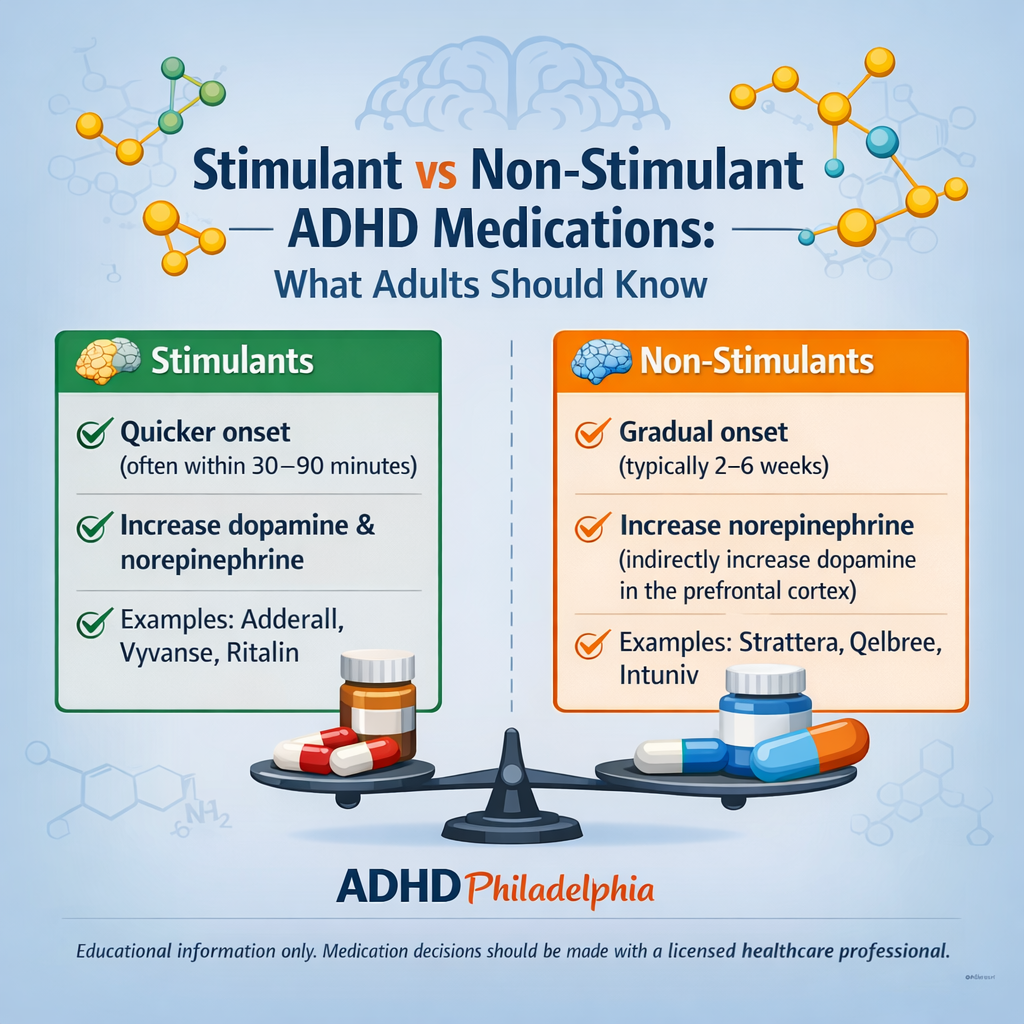
Stimulant vs Non-Stimulant ADHD Medications: What Adults Should Know
Stimulant and non-stimulant ADHD medications work differently in the brain. Learn how each option helps adults improve focus and executive function.
Many adults living with ADHD eventually ask the same question:
“What medication is best for ADHD — stimulants or non-stimulants?”
Understanding the difference can help patients feel more informed and confident about treatment decisions.
At ADHDPhiladelphia.com, we work with adults across Pennsylvania and Delaware who are seeking clear information about ADHD medications and how they affect the brain.
The goal is always the same: help the brain regulate focus, motivation, and executive function more effectively.
Some adults seek treatment for anxiety before realizing their symptoms may actually be related to ADHD. Because the two conditions can overlap, it’s important to understand the difference. Our article on ADHD vs anxiety in adults explains how clinicians distinguish between these conditions.
How ADHD Affects the Brain
ADHD is a neurodevelopmental condition that affects how the brain regulates attention, organization, and impulse control.
The brain regions most involved include:
• Prefrontal cortex
• Anterior cingulate cortex
• Dopamine reward pathways
• Norepinephrine attention systems
These systems help regulate:
• focus
• motivation
• working memory
• task completion
• emotional regulation
When these systems are underactive or dysregulated, everyday tasks can feel significantly harder than they should.
Medication is one of the tools that can help restore more balanced signaling in these networks.
What Are Stimulant ADHD Medications?
Stimulant medications are the most commonly prescribed treatment for ADHD.
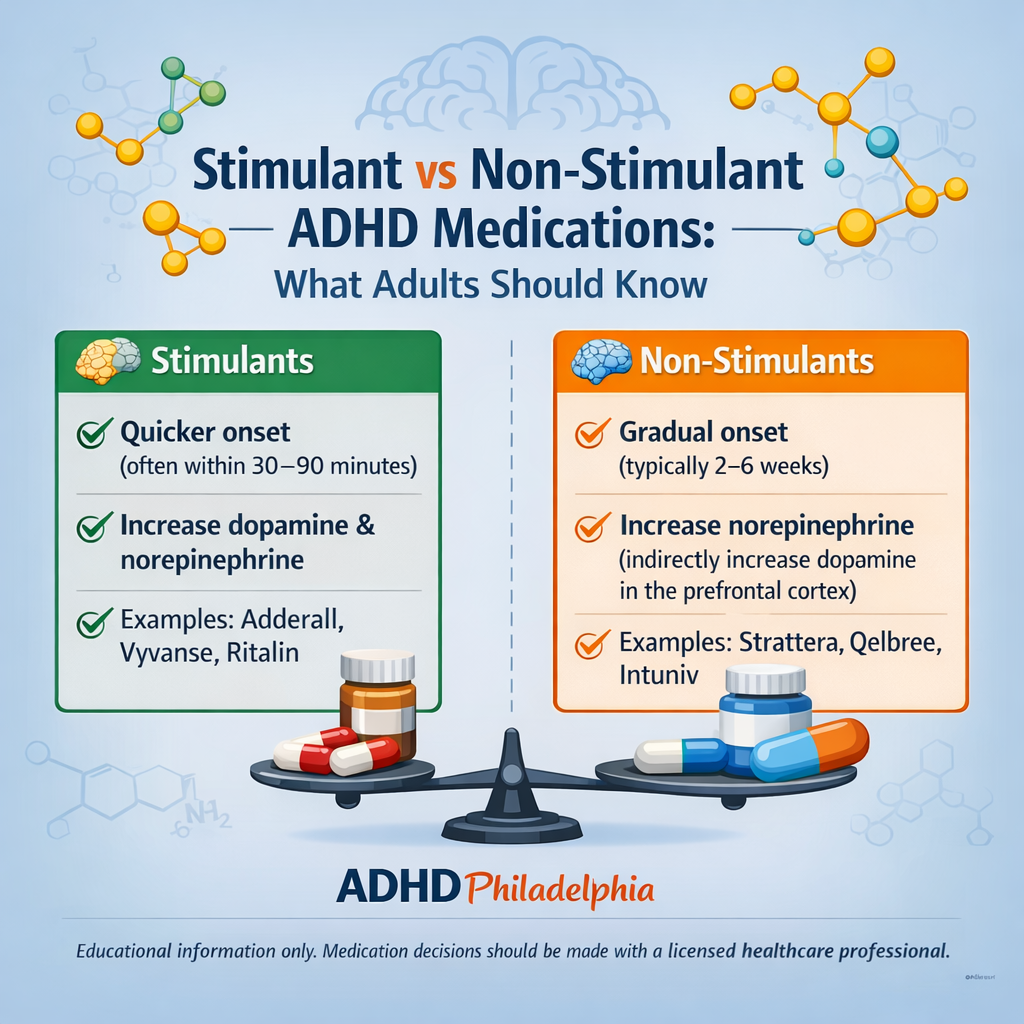
They work by increasing the availability of dopamine and norepinephrine, two neurotransmitters that help regulate attention and motivation.
Common stimulant medications include:
• Adderall (amphetamine salts)
• Vyvanse (lisdexamfetamine)
• Ritalin (methylphenidate)
• Concerta (extended-release methylphenidate)
These medications help improve:
• sustained focus
• mental clarity
• task initiation
• impulse control
For many adults, stimulants work quickly and effectively and are often considered first-line treatment.
What Are Non-Stimulant ADHD Medications?
Non-stimulant medications are another option for treating ADHD.
They typically work more gradually by affecting norepinephrine signaling or other regulatory systems in the brain.
Examples include:
• Atomoxetine (Strattera)
• Guanfacine (Intuniv)
• Clonidine
• Certain antidepressants used off-label
Non-stimulants may be recommended when:
• stimulants cause side effects
• there is a medical reason stimulants are not appropriate
• patients prefer a non-stimulant option
• there is concern about misuse or dependence
These medications often take several weeks to reach full effectiveness.
How Doctors Decide Which Medication Is Best
Choosing the right ADHD medication is a personalized process.
Clinicians typically consider:
• symptom severity
• previous medication history
• sleep patterns
• anxiety or mood symptoms
• work demands
• medical history
The goal is to find a treatment plan that helps the brain function better while minimizing side effects.
ADHD Treatment Is More Than Medication
Medication can be a powerful tool, but it works best alongside other strategies:
• structured routines
• sleep optimization
• exercise
• ADHD coaching
• therapy when needed
Many adults experience meaningful improvement when treatment is individualized and monitored carefully.
ADHD Testing and Treatment in Pennsylvania and Delaware
If you’re an adult struggling with focus, procrastination, or mental overload, an ADHD evaluation may help provide answers.
At ADHDPhiladelphia.com, we provide:
✔ Adult ADHD evaluations
✔ Medication management
✔ Telehealth appointments across Pennsylvania and Delaware
✔ Ongoing treatment monitoring
Many adults discover that ADHD has been affecting their work, education, and daily life for years without realizing it.
The good news is that effective treatments are available.
Schedule an ADHD Evaluation
Learn more or schedule an appointment at:
https://www.ADHDPhiladelphia.com
—
Charles T
Psychiatric Nurse Practitioner
Adult ADHD Specialist

How Do You Know If ADHD Medication Is Working in Adults?
Learn how to tell if ADHD medication is working in adults. Discover what improvement should look like, when adjustments are needed, and how structured monitoring supports safe ADHD treatment in Pennsylvania and Delaware.
One of the most common questions adults ask after starting ADHD medication is:
“Is this actually working?”
For adults diagnosed with ADHD, improvement is not always dramatic. It is often subtle — but clinically meaningful.
Understanding what improvement should look like helps ensure treatment remains safe, appropriate, and effective.
If you are unsure how adult ADHD is diagnosed, you can learn more about our comprehensive evaluation process here.
What Improvement Should Look Like
When medication is properly matched and monitored, adults often notice:
• Improved task initiation
• Reduced procrastination
• Increased sustained attention
• Better organization
• Fewer careless mistakes
• Improved emotional regulation
It may not feel like a “burst of motivation.”
Instead, it often feels like:
“It’s easier to start.”
What Medication Should NOT Do
Medication should not:
• Make you feel euphoric
• Cause severe anxiety
• Dramatically alter personality
• Eliminate normal fatigue
• Replace healthy habits
If side effects outweigh benefits, adjustments are needed.
How Long Does It Take?
Stimulants may begin working the same day.
Non-stimulants may take several weeks.
However, effectiveness must be evaluated over time.
That’s why structured 30-day monitoring is important.
Medication effectiveness should always be evaluated in the context of overall functioning, medical history, and safety considerations.
👉 Learn more about our Medication Management & Stimulant Treatment Policy.
Measuring Functional Improvement
Medication success is measured by:
• Workplace performance
• Academic productivity
• Household task completion
• Time management
• Emotional stability
It is not measured by “feeling different.”
It is measured by functioning better.
When Adjustments Are Needed
You may need adjustment if:
• Benefits are inconsistent
• Focus improves but anxiety worsens
• Sleep becomes disrupted
• Blood pressure increases
• Motivation improves but organization does not
Medication is one tool — not the entire solution.
Comprehensive ADHD treatment often includes behavioral strategies, executive functioning support, and lifestyle optimization alongside medication management.
ADHD Treatment in Pennsylvania & Delaware
At ADHD Philadelphia, medication effectiveness is evaluated through structured follow-up and symptom review.
Treatment decisions are individualized and may include stimulant or non-stimulant options depending on clinical presentation.
You can also read our detailed comparison of stimulant vs non-stimulant ADHD medications here.
Telehealth available throughout Pennsylvania & Delaware.
In-person appointments may be scheduled after the initial visit.
We serve adults in Philadelphia, Montgomery County, Bucks County, Chester County, Wilmington, Newark, Dover, and surrounding communities.
Ready to Begin?
If you are an adult located in Pennsylvania or Delaware and unsure whether ADHD medication may be appropriate, schedule a comprehensive evaluation to review your symptoms, medical history, and treatment options.

Stimulant vs Non-Stimulant ADHD Medication for Adults in Pennsylvania & Delaware
Compare stimulant and non-stimulant ADHD medication options for adults in Pennsylvania and Delaware. Learn how structured diagnosis, $150 per visit medication management, and consistent follow-up support safe and effective treatment.
If you are searching for ADHD medication for adults, you may be wondering:
Should I take a stimulant?
Is a non-stimulant safer?
What is the difference?
The answer depends on your clinical history, symptom pattern, and treatment goals.
At ADHD Philadelphia, medication decisions are made only after a structured diagnostic evaluation has been completed. If you are unsure whether you meet criteria for ADHD, learn more about our Adult ADHD Diagnosis process before considering medication options.
Two Main Categories of ADHD Medication
There are two primary categories used in adult ADHD treatment:
• Stimulant medications
• Non-stimulant medications
Both can be effective. The right choice depends on individual factors.
Stimulant Medications
Stimulants are the most commonly prescribed medications for ADHD.
They work by increasing levels of dopamine and norepinephrine in areas of the brain responsible for attention regulation and executive functioning.
Common Benefits:
• Faster onset of symptom improvement
• Strong effect on focus and task completion
• Improved productivity and mental clarity
Important Considerations:
• Require careful monitoring
• May affect sleep or appetite
• Require monthly follow-up appointments
At ADHD Philadelphia, stimulant medications require monthly monitoring visits to ensure safety, symptom response, and dosage accuracy.
All medication management visits are $150 per appointment.
Structured monitoring supports responsible, evidence-based care.
Non-Stimulant Medications
Non-stimulants may be recommended when:
• Stimulants are not tolerated
• There is a history of side effects
• Anxiety is a significant concern
• A slower, steadier response is preferred
Non-stimulants typically take longer to show full benefit but may provide stable symptom improvement without stimulant-related side effects.
Monitoring Structure:
Follow-up appointments are typically scheduled every 30–90 days, depending on response and stability.
All visits remain $150 per appointment.
Which Is Better?
There is no universal “better” medication.
Treatment decisions are based on:
• Symptom severity
• Medical history
• Co-occurring conditions
• Lifestyle factors
• Functional impairment
• Patient preference
Medication is never prescribed casually.
Diagnosis requires structured clinical evaluation, functional assessment, and screening for overlapping conditions. If you have not yet completed evaluation, visit our ADHD Testing & Evaluation page to understand how diagnosis is established.
What Happens After Starting Medication?
Once medication begins:
• Follow-up schedule is clearly outlined
• Symptom response is reviewed
• Side effects are monitored
• Functional improvement is tracked
• Adjustments are made when clinically appropriate
The goal is not just symptom reduction — it is improved daily functioning.
Telehealth ADHD Medication Management in Pennsylvania & Delaware
Adult ADHD treatment at ADHD Philadelphia begins via secure telehealth consultation for adults residing in Pennsylvania and Delaware.
In-person appointments may be scheduled afterward when clinically appropriate.
There are no walk-in appointments.
Care is structured.
Monitoring is consistent.
Treatment decisions are evidence-based.
The Bottom Line
Stimulant and non-stimulant medications both have a role in adult ADHD treatment.
The key is not choosing a category at random.
The key is accurate diagnosis and structured follow-up.
If you are searching for:
• ADHD medication for adults
• ADHD doctor Pennsylvania
• ADHD psychiatrist Delaware
• ADHD treatment near me
Clarity begins with structured evaluation.