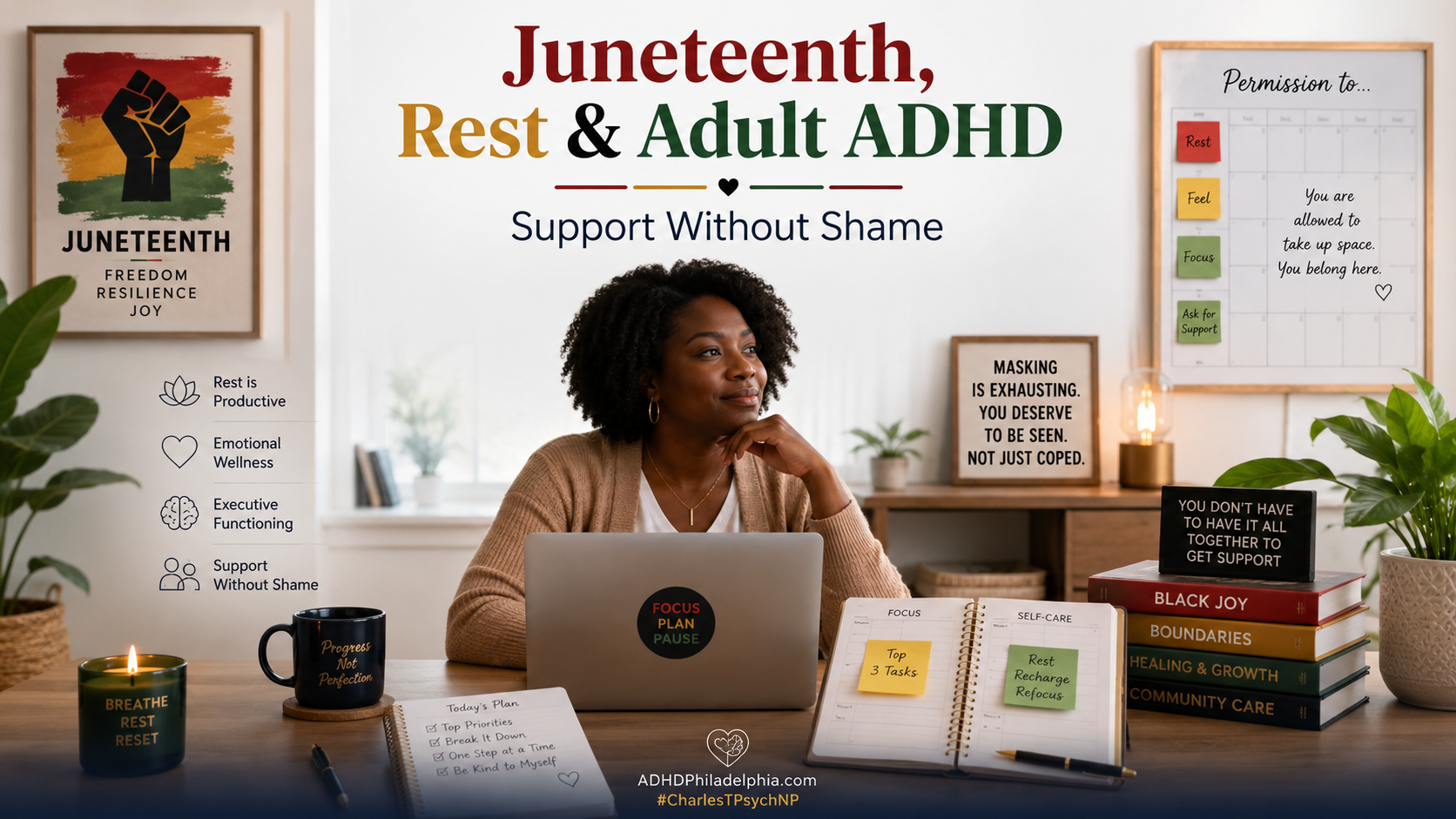
Juneteenth, Rest, and Why Black Adults With ADHD Deserve Support Without Shame
Juneteenth is a time to reflect on freedom, dignity, rest, and being fully seen. For Black adults with ADHD, that includes support without shame, stigma, or being told to simply push harder.
Juneteenth is a meaningful time to reflect on freedom, dignity, history, healing, and what it means to be fully seen.
It is also a meaningful time to talk about rest.
Not just sleep.
Not just taking a day off.
Rest as permission to stop carrying everything alone.
Rest as permission to be honest about mental health.
Rest as permission to receive support without being called lazy, weak, dramatic, undisciplined, or unmotivated.
For some Black adults with ADHD, rest can feel complicated.
A person may have spent years pushing through symptoms, hiding overwhelm, masking disorganization, overworking to avoid judgment, and trying to appear strong even when daily life feels exhausting.
They may think:
“I cannot slow down.”
“I cannot let people see me struggle.”
“I have too much responsibility.”
“I should be able to handle this.”
“I do not want to be judged.”
“I do not want people to think I am making excuses.”
“I just need to try harder.”
But adult ADHD is not an excuse.
It is also not laziness.
Adult ADHD can affect focus, planning, organization, time management, emotional regulation, working memory, task initiation, routines, and follow-through.
For Black adults in Pennsylvania and Delaware, repeated struggles with focus, procrastination, emotional overwhelm, disorganization, burnout, time blindness, and follow-through may be one reason to consider adult ADHD testing and treatment.
Why Rest Can Feel Hard for Black Adults With ADHD
Rest may sound simple, but for many adults with ADHD, rest is not easy.
The brain may keep scanning for unfinished tasks.
The body may feel tense even during downtime.
The mind may replay mistakes.
The calendar may feel overwhelming.
The person may feel guilty for sitting still.
The pressure to catch up may never turn off.
For some Black adults, rest may feel even more complicated because of cultural, family, work, financial, and historical pressures to keep going.
Messages like these can become internalized:
“Work twice as hard.”
“Do not let them see you slip.”
“Handle your business.”
“Stay strong.”
“Do not complain.”
“Keep pushing.”
“Do not give people a reason to judge you.”
Those messages may come from survival, resilience, love, protection, and lived experience.
But when ADHD is present, constantly pushing through can become exhausting.
The adult may not need more shame.
They may need better understanding, better structure, and care that looks at the whole person.
This is why Black adults and ADHD deserve thoughtful, shame-free conversations.
ADHD Shame Can Become Heavy
Many adults with ADHD carry shame.
They may feel ashamed about:
Being late
Forgetting things
Missing deadlines
Avoiding tasks
Losing motivation
Struggling with routines
Feeling emotionally overwhelmed
Starting but not finishing
Not responding to messages
Needing reminders
Falling behind despite trying hard
For Black adults, ADHD shame may overlap with fear of being misunderstood or judged more harshly.
A person may worry that symptoms will be seen as irresponsibility, lack of discipline, attitude, carelessness, or weakness.
So they mask.
They overprepare.
They work late.
They apologize constantly.
They avoid asking for help.
They try to look organized.
They use anxiety to force productivity.
They hide the cost of keeping up.
This can delay care.
This is why ADHD masking can make symptoms harder to recognize and harder to treat.
Rest Is Not the Same as Avoidance
A common fear for adults with ADHD is:
“If I rest, I will never get back on track.”
That fear makes sense.
ADHD can make task initiation difficult. Once a person stops, restarting may feel hard.
But healthy rest is not the same as avoidance.
Avoidance says, “I cannot face this.”
Rest says, “I am allowed to recover so I can return with support.”
Avoidance often increases shame.
Rest should reduce shame.
Avoidance hides from the task.
Rest gives the brain and body a chance to reset.
Avoidance has no plan for return.
Rest can include a small restart plan.
For adults with ADHD, rest often works best when it is structured and compassionate.
That may mean:
A 15-minute reset
A short walk
A meal break
A screen break
A quiet room
A breathing exercise
A written restart note
A simple “next step” list
A calendar reminder to return
The goal is not perfection.
The goal is to build a system that allows recovery without collapse.
This is why ADHD routines should be realistic, flexible, and restartable.

Juneteenth, Rest, and Adult ADHD: Support Without Shame
Executive Dysfunction Is Not a Moral Failure
Executive dysfunction is one of the most misunderstood parts of adult ADHD.
It can affect:
Starting tasks
Finishing tasks
Managing time
Planning ahead
Organizing steps
Prioritizing
Remembering details
Regulating emotions
Switching between tasks
Following through consistently
When executive dysfunction is present, the person may know what needs to be done but still struggle to do it consistently.
That can feel confusing and painful.
A Black adult with ADHD may be intelligent, responsible, hardworking, loving, ambitious, and capable — and still struggle with executive functioning.
This is not laziness.
This is not lack of character.
This is not a failure of willpower.
It may be ADHD.
This is why executive dysfunction should be understood as a clinical issue, not a moral flaw.
Burnout Can Happen When Rest Is Always Delayed
Some adults with ADHD do not rest until they crash.
They push until the task is done.
They push until the deadline passes.
They push until everyone else is okay.
They push until they cannot focus anymore.
They push until their body forces them to stop.
This can lead to burnout.
Burnout may look like:
Mental exhaustion
Emotional numbness
Irritability
Avoidance
Trouble starting tasks
Loss of motivation
Feeling disconnected
Feeling behind all the time
Difficulty responding to messages
Needing more recovery than usual
For Black adults with ADHD, burnout may be intensified by masking, workplace stress, caregiving responsibilities, financial pressure, family expectations, racial stress, or the emotional labor of navigating spaces where they may not always feel fully seen or supported.
This is why ADHD burnout should be taken seriously.
Juneteenth Reminds Us That Being Seen Matters
Being seen in mental health care means more than having symptoms noticed.
It means being listened to.
It means being evaluated carefully.
It means not being dismissed.
It means not being reduced to a stereotype.
It means not being told to just try harder.
It means not having ADHD symptoms mislabeled as laziness.
It means not having anxiety, burnout, trauma, stress, and ADHD all blurred together without careful assessment.
A thoughtful ADHD evaluation should consider the whole person.
That includes:
Current symptoms
Childhood patterns
School and work history
Executive functioning
Emotional regulation
Sleep
Anxiety
Depression
Trauma history
Substance use concerns
Medical conditions
Medication effects
Family history
Cultural context
Functional impairment
Strengths and coping strategies
This is why adult ADHD evaluation can help bring clarity when someone has spent years feeling overwhelmed, misunderstood, or ashamed.
Rest, Support, and Treatment Can Work Together
Rest alone may not solve ADHD.
But rest can be part of a healthier support system.
Adult ADHD treatment may include:
Education about ADHD
Behavioral strategies
Executive-function support
Routine-building
Sleep review
Therapy or coaching strategies
Medication management when clinically appropriate
Regular follow-up
Supportive accountability
Reducing shame
Learning how to restart after disruption
Support does not mean giving up responsibility.
Support means building systems that make responsibility more manageable.
For many adults with ADHD, the goal is not to become a different person.
The goal is to understand the brain better and create supports that fit real life.
When Black Adults May Want to Consider ADHD Testing
Not every struggle is ADHD.
But adult ADHD testing may be helpful if you repeatedly struggle with:
Difficulty focusing
Chronic procrastination
Disorganization
Forgetfulness
Time blindness
Emotional overwhelm
Mental exhaustion
Task avoidance
Trouble starting tasks
Trouble finishing tasks
Inconsistent routines
Work or school struggles
Relationship strain related to follow-through
Feeling capable but inconsistent
Using anxiety to force productivity
Masking symptoms to appear okay
Burnout from constantly trying to keep up
Feeling ashamed for needing support
A structured ADHD evaluation can help clarify whether ADHD may be contributing to these patterns.
ADHD Testing and Treatment in Pennsylvania and Delaware
ADHD Philadelphia provides adult ADHD testing and treatment for adults in Pennsylvania and Delaware.
Care is designed to help adults better understand symptoms such as poor focus, procrastination, disorganization, time management problems, emotional overwhelm, difficulty with routines, burnout, and trouble following through.
Treatment plans are individualized and may include education, behavioral strategies, structure-building, therapy or coaching strategies, lifestyle review, and medication management when clinically appropriate.
Initial appointments are completed through secure telehealth. In-person appointments may be scheduled after the first online appointment when clinically appropriate. Walk-in appointments are not available.
If you have spent years masking, pushing through, overcompensating, feeling overwhelmed, or wondering why daily life feels harder than it looks from the outside, support may help you move from self-blame toward clarity.
To learn more, visit ADHDPhiladelphia.com.
Frequently Asked Questions About Juneteenth, Rest, and Adult ADHD
Why connect Juneteenth with rest and adult ADHD?
Juneteenth is a meaningful time to reflect on freedom, dignity, visibility, and healing. For Black adults with ADHD, that includes the freedom to seek support without shame, stigma, or being told to simply push harder.
Can Black adults have ADHD?
Yes. Black adults can have ADHD, just like adults of any race or background. ADHD can affect attention, executive functioning, emotional regulation, and follow-through.
Why can rest feel hard for adults with ADHD?
Rest can feel hard because ADHD may involve racing thoughts, unfinished tasks, guilt, time blindness, difficulty restarting, and anxiety about falling behind.
Is executive dysfunction laziness?
No. Executive dysfunction can affect planning, task initiation, time management, organization, emotional regulation, and follow-through. It is not laziness or lack of character.
Does ADHD Philadelphia treat children?
No. ADHD Philadelphia focuses on adult ADHD care. Services are for adults in Pennsylvania and Delaware.
Take the First Step
Juneteenth reminds us that dignity, visibility, healing, and being fully seen matter.
If you are a Black adult who has spent years feeling scattered, overwhelmed, inconsistent, anxious, burned out, ashamed, or misunderstood, ADHD may be worth exploring.
Adult ADHD can affect focus, routines, emotional regulation, task initiation, time management, relationships, work, and follow-through.
A structured evaluation can help clarify whether ADHD may be contributing to these patterns and whether treatment may be appropriate.
Visit ADHDPhiladelphia.com to learn more about adult ADHD testing and treatment.
Medical Disclaimer
This article is for educational purposes only and is not a substitute for medical advice, diagnosis, or treatment. ADHD symptoms can overlap with anxiety, depression, sleep disorders, trauma, substance use concerns, medical conditions, medication effects, stress, and other mental health conditions. If you are experiencing symptoms of ADHD or another mental health concern, consult a qualified healthcare professional.

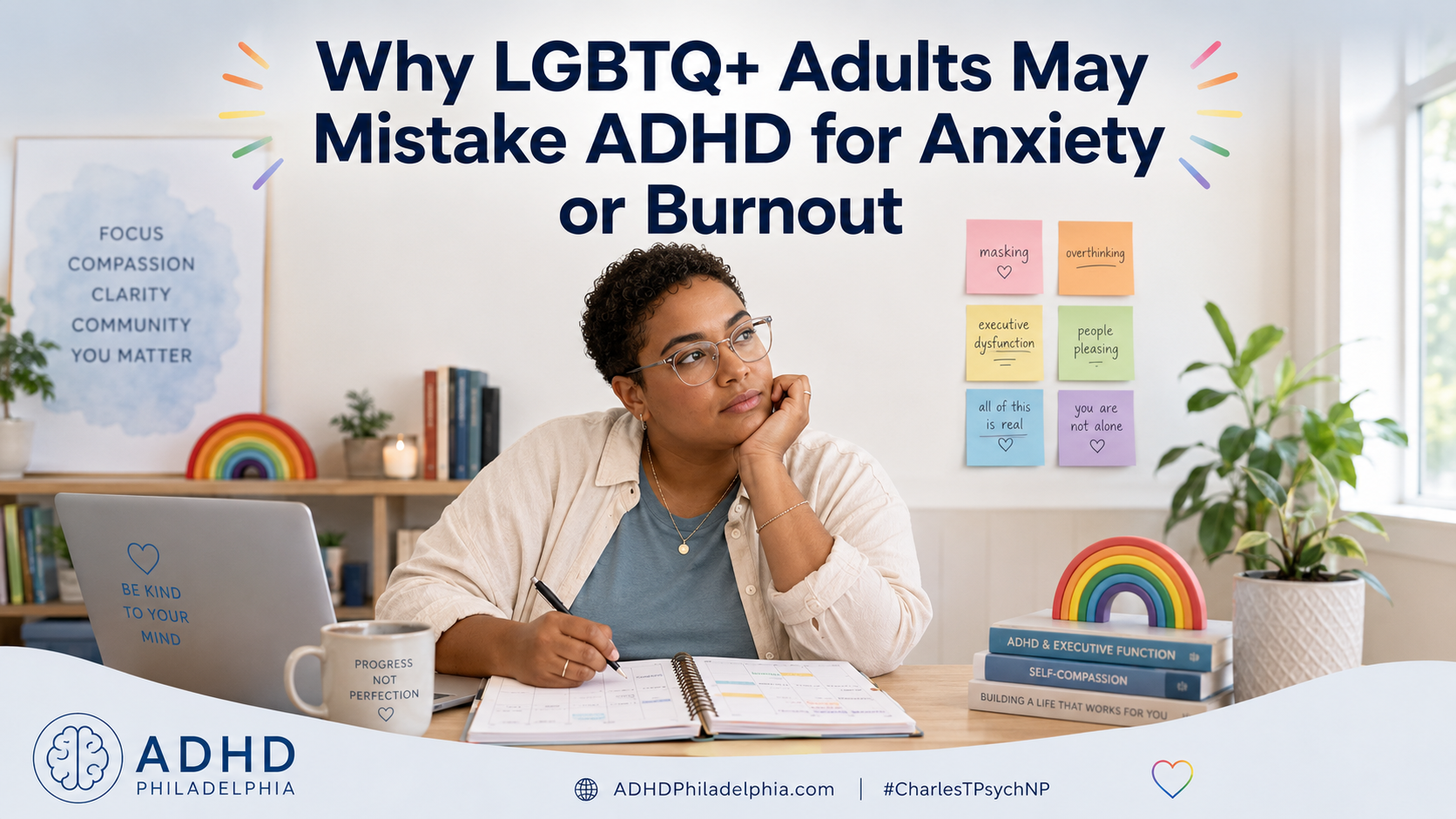
Why LGBTQ+ Adults May Mistake ADHD for Anxiety or Burnout
For some LGBTQ+ adults, ADHD symptoms may be mistaken for anxiety, burnout, stress, or overwhelm. A thoughtful adult ADHD evaluation can help clarify the full picture.
Pride Month is a meaningful time to talk about visibility, identity, and being fully understood.
For some LGBTQ+ adults, years of masking, stress, emotional labor, overcompensating, and trying to appear “fine” can make it hard to understand what is really happening internally.
An adult may think:
“I’m just anxious.”
“I’m just burned out.”
“I’m just overwhelmed.”
“I’m just tired.”
“I’m just bad at routines.”
“I’m just not disciplined enough.”
“I should be able to handle this by now.”
Sometimes anxiety is part of the picture.
Sometimes burnout is part of the picture.
Sometimes depression, trauma, sleep disruption, or chronic stress may also be present.
But sometimes adult ADHD is also involved.
Adult ADHD can affect focus, planning, time management, task initiation, working memory, organization, emotional regulation, routines, and follow-through. When those symptoms are hidden behind anxiety, burnout, or masking, ADHD may go undiagnosed for years.
For LGBTQ+ adults in Pennsylvania and Delaware, repeated struggles with focus, procrastination, emotional overwhelm, routines, organization, and follow-through may be one reason to consider adult ADHD testing and treatment.
Why ADHD Can Look Like Anxiety
Adult ADHD can create anxiety-like experiences.
When tasks pile up, emails go unanswered, deadlines get missed, bills are forgotten, appointments sneak up, and responsibilities feel scattered, the nervous system may stay on alert.
The adult may feel anxious because life feels constantly urgent.
They may worry about:
Forgetting something important
Disappointing someone
Missing a deadline
Being judged
Falling behind
Looking disorganized
Saying the wrong thing
Not being able to keep up
From the outside, this may look like anxiety.
But underneath the anxiety, there may be ADHD-related executive dysfunction.
The person may not simply be worrying for no reason. They may be anxious because their brain struggles to manage time, sequence tasks, remember details, regulate attention, and follow through consistently.
This is why ADHD vs anxiety is an important distinction for adults who have spent years feeling overwhelmed.
Why ADHD Can Look Like Burnout
Burnout can feel like exhaustion, shutdown, irritability, numbness, avoidance, and reduced motivation.
For adults with ADHD, burnout may build after years of trying to compensate without enough support.
The adult may have spent years:
Working late to catch up
Using panic to meet deadlines
People-pleasing
Overpreparing
Hiding mistakes
Trying to appear organized
Apologizing constantly
Saying yes when overwhelmed
Using shame as motivation
Masking how hard daily life feels
Eventually, the system becomes too costly.
The adult may feel like they suddenly cannot keep up anymore.
But the burnout may not be sudden. It may be the result of years of hidden effort.
For LGBTQ+ adults, burnout may be more layered when ADHD-related masking overlaps with identity-related stress, family strain, workplace concerns, rejection sensitivity, or the emotional labor of deciding where it feels safe to be fully honest.
This is why ADHD burnout deserves careful attention.
Masking Can Make ADHD Harder to Recognize
Masking can make adult ADHD difficult to see.
A person may look organized on the outside while internally feeling scattered.
They may look calm while feeling emotionally flooded.
They may look successful while losing sleep to finish work.
They may look agreeable while overcommitting.
They may look focused while fighting distractions.
They may look responsible while privately feeling behind.
For some LGBTQ+ adults, masking may already be familiar.
They may have learned to monitor how much of themselves they share depending on the setting. They may have learned to manage other people’s reactions. They may have learned to appear okay even when they do not feel safe, supported, or understood.
When ADHD masking and identity-related masking overlap, symptoms can remain hidden for years.
This is why ADHD masking can delay diagnosis and increase exhaustion.
Executive Dysfunction Is Often the Missing Piece
Executive dysfunction is one of the most important parts of adult ADHD.
It can affect:
Starting tasks
Finishing tasks
Prioritizing
Planning
Tracking time
Remembering steps
Organizing information
Regulating emotions
Switching between tasks
Following through consistently
This is where many adults feel confused.
They know what needs to be done, but they cannot consistently get themselves to do it.
They may think:
“I know better. Why can’t I do better?”
That question can create shame.
But adult ADHD is not a knowledge problem. It is often a self-management and executive-function problem.
For LGBTQ+ adults who have spent years trying to be accepted, successful, safe, or understood, that shame can become especially heavy.
This is why executive dysfunction should be explored when anxiety and burnout do not fully explain the pattern.
Emotional Overwhelm Can Be Misread
Adult ADHD can affect emotional regulation.
This may show up as:
Feeling easily overwhelmed
Strong reactions to stress
Difficulty calming down after conflict
Sensitivity to criticism
Frustration when plans change
Feeling flooded by decisions
Avoiding tasks because they feel too emotionally loaded
Feeling ashamed after mistakes
For LGBTQ+ adults, emotional overwhelm may also be shaped by identity-related stress, family experiences, workplace concerns, social pressure, relationship strain, past invalidation, or the fear of being misunderstood by providers.
This does not mean every LGBTQ+ adult has the same experience.
It means emotional symptoms deserve context.
A person may have anxiety.
A person may have burnout.
A person may have trauma history.
A person may have ADHD.
A person may have more than one concern at the same time.
This is why ADHD and emotional overwhelm should be evaluated thoughtfully.
Anxiety May Be a Result, Not the Whole Cause
Sometimes anxiety is the main issue.
But sometimes anxiety is partly a result of untreated or undiagnosed ADHD.
For example, an adult with ADHD may feel anxious because they repeatedly experience:
Missed deadlines
Disorganization
Forgotten tasks
Time blindness
Impulsive decisions
Late arrivals
Unread messages
Messy routines
Relationship misunderstandings
Work problems
Task pileups
The anxiety may be real.
But if ADHD is driving the repeated chaos, treating only anxiety may not fully solve the problem.
That is why a thoughtful evaluation should ask:
When did the symptoms begin?
Were focus and organization problems present earlier in life?
Are symptoms present in more than one setting?
Is anxiety mainly triggered by being behind?
Are there long-standing patterns of procrastination, disorganization, time blindness, and follow-through problems?
This is why adult ADHD diagnosis requires more than a quick symptom checklist.
Burnout May Be a Sign the Old System Stopped Working
Many adults with undiagnosed ADHD develop survival systems.
They rely on urgency.
They rely on fear.
They rely on pressure.
They rely on perfectionism.
They rely on pleasing others.
They rely on last-minute adrenaline.
They rely on overworking.
Those systems can work for a while.
But they can become exhausting.
For LGBTQ+ adults, those systems may exist alongside other emotional demands: code-switching, masking, navigating family expectations, evaluating safety in different spaces, or deciding when and where it feels safe to be open.
Eventually, the adult may feel depleted.
They may say:
“I used to be able to push through.”
“I cannot do this anymore.”
“I feel like I am falling apart.”
“I am tired of pretending I am okay.”
“I do not know why basic tasks feel so hard.”
This is not failure.
It may be a signal that the old system was too expensive to maintain.
Why a Full Evaluation Matters
A careful ADHD evaluation should not assume that all symptoms are ADHD.
It should also not assume that all symptoms are anxiety or burnout.
A thoughtful evaluation should consider:
ADHD symptoms
Anxiety
Depression
Trauma history
Sleep problems
Substance use concerns
Medical conditions
Medication effects
Work stress
Family stress
Identity-related stress
Functional impairment
Childhood and adult symptom patterns
Adult ADHD is typically a long-standing pattern, not simply a reaction to one stressful month.
A structured evaluation helps clarify whether ADHD may be part of the picture and whether treatment may be appropriate.
This is especially important for adults who have spent years masking.
When LGBTQ+ Adults May Want to Consider ADHD Testing
Adult ADHD testing may be helpful if you repeatedly struggle with:
Difficulty focusing
Chronic procrastination
Disorganization
Time blindness
Forgetfulness
Emotional overwhelm
Task initiation
Trouble finishing tasks
Inconsistent routines
Work or school problems
Relationship strain related to follow-through
Mental exhaustion
Burnout from overcompensating
Using anxiety to force productivity
Feeling capable but inconsistent
Feeling like you are always masking how hard life feels
For adults in Pennsylvania and Delaware, adult ADHD evaluation can help clarify whether ADHD may be contributing to repeated problems with focus, executive functioning, emotional regulation, routines, anxiety-like stress, burnout, and follow-through.
ADHD Testing and Treatment in Pennsylvania and Delaware
ADHD Philadelphia provides adult ADHD testing and treatment for adults in Pennsylvania and Delaware.
Care is designed to help adults better understand symptoms such as poor focus, procrastination, disorganization, time management problems, emotional overwhelm, difficulty with routines, and trouble following through.
Treatment plans are individualized and may include education, behavioral strategies, structure-building, therapy or coaching strategies, lifestyle review, and medication management when clinically appropriate.
Initial appointments are completed through secure telehealth. In-person appointments may be scheduled after the first online appointment when clinically appropriate. Walk-in appointments are not available.
If you have spent years wondering whether your symptoms are anxiety, burnout, ADHD, or a combination, support may help you move from self-blame toward clarity.
To learn more, visit ADHDPhiladelphia.com.
Frequently Asked Questions About LGBTQ+ Adults, ADHD, Anxiety, and Burnout
Can ADHD look like anxiety?
Yes. Adult ADHD can create anxiety-like stress when disorganization, missed deadlines, time blindness, and task pileups make life feel constantly urgent.
Can ADHD look like burnout?
Yes. Adults with ADHD may experience burnout after years of masking, overcompensating, using anxiety to stay productive, and trying to appear organized or consistent.
Can someone have both ADHD and anxiety?
Yes. ADHD and anxiety can occur together. A thoughtful evaluation can help clarify whether anxiety is the main issue, whether ADHD is contributing, or whether both are present.
Why might LGBTQ+ adults mistake ADHD for anxiety or burnout?
Some LGBTQ+ adults may experience overlapping stress from masking, identity-related concerns, emotional labor, executive dysfunction, and years of overcompensation. This can make ADHD harder to recognize.
Does ADHD Philadelphia provide ADHD testing for LGBTQ+ adults?
ADHD Philadelphia provides adult ADHD testing and treatment for adults in Pennsylvania and Delaware. Care is individualized, respectful, and focused on understanding the whole person.
Take the First Step
If you are an LGBTQ+ adult who has spent years feeling anxious, burned out, scattered, overwhelmed, or inconsistent, ADHD may be worth exploring.
Adult ADHD can affect focus, emotional regulation, task initiation, time management, routines, work, relationships, and follow-through.
A structured evaluation can help clarify whether ADHD may be contributing to these patterns and whether treatment may be appropriate.
Visit ADHDPhiladelphia.com to learn more about adult ADHD testing and treatment.
Medical Disclaimer
This article is for educational purposes only and is not a substitute for medical advice, diagnosis, or treatment. ADHD symptoms can overlap with anxiety, depression, sleep disorders, trauma, substance use concerns, medical conditions, medication effects, stress, and other mental health conditions. If you are experiencing symptoms of ADHD or another mental health concern, consult a qualified healthcare professional.

Why LGBTQ+ Adults With ADHD Struggle With Masking and Burnout
Some LGBTQ+ adults with ADHD spend years masking symptoms, overcompensating, people-pleasing, and trying to appear “fine.” Over time, this can lead to burnout, emotional exhaustion, and delayed ADHD diagnosis.
Pride Month is a meaningful time to talk about visibility, identity, and the importance of being understood.
For some LGBTQ+ adults with ADHD, being understood has not always felt easy.
They may have spent years trying to appear calm, organized, successful, agreeable, productive, or emotionally steady — even when they were struggling inside.
They may have learned to hide parts of themselves.
They may have learned to monitor how they speak.
They may have learned to overprepare.
They may have learned to avoid asking for help.
They may have learned to push through exhaustion.
They may have learned to appear “fine.”
When adult ADHD is also present, masking can become even more complicated.
An adult may be masking ADHD symptoms, identity-related stress, emotional overwhelm, anxiety, burnout, or all of these at the same time.
This can lead to years of self-blame.
“I should be able to keep up.”
“I should be more consistent.”
“I should not be this tired.”
“I should not have to work this hard to appear normal.”
“I should be able to do what everyone else seems to do.”
But adult ADHD is not a character flaw.
Adult ADHD can affect focus, planning, time management, emotional regulation, task initiation, working memory, organization, routines, and follow-through. When a person spends years hiding those struggles, burnout can build slowly.
For adults in Pennsylvania and Delaware, repeated struggles with focus, overwhelm, task initiation, routines, emotional exhaustion, and follow-through may be one reason to consider adult ADHD testing and treatment.
What Is ADHD Masking?
ADHD masking is when a person hides, suppresses, or compensates for ADHD-related struggles so others do not see how hard daily life feels.
Masking can look like:
Overpreparing for simple tasks
Working late to catch up
Pretending to understand instructions
Hiding missed deadlines
Avoiding tasks that reveal difficulty
Apologizing constantly
People-pleasing
Saying yes when overwhelmed
Trying to look organized
Using anxiety to force productivity
Copying other people’s routines
Acting calm while internally flooded
Avoiding help because of shame
Masking can help someone survive socially or professionally, but it can also become exhausting.
The person may look functional from the outside while privately feeling overwhelmed, scattered, and emotionally drained.
This is why ADHD masking can make adult ADHD harder to recognize.
Why Masking Can Be Especially Exhausting for LGBTQ+ Adults
Not every LGBTQ+ adult has the same experience. Identity, family, culture, work, community, safety, and support systems all matter.
However, some LGBTQ+ adults have spent years learning how to monitor themselves in different environments.
They may think carefully about:
Who knows their identity
How safe a setting feels
How much of themselves to share
How others may react
Whether they will be misunderstood
Whether they will be judged
Whether they need to hide stress
Whether they can be fully honest with a provider
When ADHD is also present, the person may be masking multiple things at once.
They may hide executive dysfunction at work.
They may hide emotional overwhelm in relationships.
They may hide disorganization at home.
They may hide burnout from family.
They may hide identity-related stress in professional settings.
They may hide how much effort it takes to appear okay.
This can create a heavy emotional load.
That does not mean LGBTQ+ identity causes ADHD. It does not.
It means the experience of ADHD may be shaped by the person’s real life, including identity, safety, stress, relationships, and the need to feel understood.
This is why LGBTQ+ ADHD content matters during Pride Month and beyond.
Masking Can Delay ADHD Diagnosis
Many adults with ADHD are not diagnosed until later in life because they have developed strong coping strategies.
They may be high-achieving.
They may be creative.
They may be responsible.
They may be helpful to others.
They may appear calm.
They may be successful at work.
They may have learned how to hide disorganization.
But hidden struggle is still struggle.
A person can look successful and still have ADHD.
They may finish work, but only after intense stress.
They may meet deadlines, but only by losing sleep.
They may maintain relationships, but only by overexplaining and over-apologizing.
They may keep a job, but feel constantly afraid of being exposed as disorganized.
They may appear emotionally steady, but feel overwhelmed inside.
When symptoms are hidden, ADHD may be mislabeled as only anxiety, depression, burnout, trauma, or stress.
A careful evaluation should look at the whole picture.
This is why adult ADHD diagnosis should include a thoughtful discussion of masking, functioning, and the cost of keeping up.
Burnout Can Build When ADHD Is Constantly Hidden
Burnout is not just feeling tired.
Burnout can feel like emotional shutdown, mental exhaustion, reduced motivation, irritability, avoidance, numbness, or feeling unable to keep pushing.
For adults with ADHD, burnout may build when the person spends years trying to force consistency through pressure, fear, urgency, or perfectionism.
The adult may think:
“I just need to try harder.”
“I just need a better planner.”
“I just need to stop procrastinating.”
“I just need to be more disciplined.”
“I just need to keep pretending I am okay.”
But trying harder without the right support can become exhausting.
For LGBTQ+ adults with ADHD, burnout may be connected to both ADHD-related masking and identity-related stress. The adult may be working hard to manage symptoms while also navigating belonging, safety, relationships, self-expression, family expectations, workplace stress, or past invalidation.
This is why ADHD burnout can feel so deep.
Executive Dysfunction Can Make Burnout Worse
Executive dysfunction is one of the most important parts of adult ADHD.
It can affect the brain’s ability to:
Start tasks
Finish tasks
Plan ahead
Prioritize
Track time
Switch between tasks
Remember steps
Regulate emotions
Organize responsibilities
Follow through consistently
When executive dysfunction is present, the adult may know what needs to be done but still struggle to do it.
That mismatch can be painful.
The person may think, “I know better, so why can’t I do better?”
Then shame builds.
Shame can lead to more masking.
Masking can lead to more exhaustion.
Exhaustion can lead to more avoidance.
Avoidance can lead to more consequences.
Consequences can lead to more shame.
This cycle can eventually become burnout.
This is why executive dysfunction should not be dismissed as laziness or lack of motivation.
Anxiety Can Become a Coping Tool
Many adults with ADHD use anxiety to function.
They wait until the pressure becomes intense enough to act.
They use deadlines to create urgency.
They use fear of disappointing others to complete tasks.
They use shame as motivation.
They use panic to push through.
This can work temporarily.
But it is not sustainable.
Over time, anxiety-based productivity can lead to exhaustion, irritability, poor sleep, emotional overwhelm, and burnout.
For LGBTQ+ adults, anxiety may also come from other sources: identity-related stress, family concerns, workplace safety, social pressure, discrimination, rejection sensitivity, or fear of being misunderstood.
When ADHD and anxiety overlap, it can be difficult to know what is driving what.
This is why ADHD vs anxiety is an important topic for adults who have spent years feeling overwhelmed.
Emotional Overwhelm Can Be Part of ADHD
Adult ADHD can affect emotional regulation.
This may include:
Feeling easily overwhelmed
Reacting strongly to stress
Difficulty calming down after conflict
Sensitivity to criticism
Frustration when plans change
Feeling flooded by decisions
Avoiding tasks because of emotional intensity
Feeling ashamed after making mistakes
For LGBTQ+ adults, emotional overwhelm may be shaped by life experiences, support systems, identity safety, family relationships, work stress, or past invalidation.
Again, this does not mean every LGBTQ+ adult experiences the same stress.
It means emotional symptoms deserve context.
An adult can have ADHD and anxiety.
An adult can have ADHD and trauma history.
An adult can have ADHD and depression.
An adult can have ADHD and identity-related stress.
An adult can have multiple overlapping concerns.
This is why ADHD and emotional overwhelm should be evaluated carefully.
People-Pleasing Can Hide ADHD Struggles
Many adults with ADHD become people-pleasers.
They may say yes to avoid disappointing others.
They may overcommit.
They may apologize constantly.
They may hide when they are behind.
They may agree to plans before checking their capacity.
They may try to be easygoing even when overwhelmed.
They may work harder than everyone realizes to avoid criticism.
For LGBTQ+ adults, people-pleasing may also be connected to a long history of trying to stay safe, accepted, or understood.
People-pleasing can temporarily reduce conflict, but it can increase burnout.
The adult may become overloaded with responsibilities they did not have the capacity to accept.
Then ADHD symptoms worsen.
Tasks pile up.
Messages go unanswered.
Sleep gets worse.
Routines collapse.
Shame increases.
Avoidance grows.
This is why adult ADHD care should include honest conversations about capacity, boundaries, and realistic routines.
Masking Can Affect Relationships
Masking can also affect relationships.
If someone is always trying to appear okay, it may be hard for partners, friends, family, or coworkers to understand how much support they need.
The adult may hide:
How overwhelmed they feel
How hard it is to respond to messages
How much they struggle with planning
How exhausting social events can be
How hard transitions feel
How much shame they carry
How often they feel behind
This can create misunderstandings.
A loved one may think the adult does not care.
A coworker may think the adult is inconsistent.
A partner may think the adult is avoiding responsibility.
A friend may think the adult is distant.
But many adults with ADHD care deeply. They may struggle because ADHD affects working memory, emotional regulation, attention, time awareness, and follow-through.
This is why adult ADHD follow-through matters in relationships, not only at work.
Burnout May Look Like “Suddenly Falling Apart”
A person may function for years and then feel like everything suddenly falls apart.
But burnout is often not sudden.
It may be the result of years of hidden effort.
Years of compensating.
Years of masking.
Years of anxiety-driven productivity.
Years of overcommitting.
Years of poor sleep.
Years of trying to appear organized.
Years of carrying shame privately.
Eventually, the system stops working.
The adult may notice:
More missed deadlines
More emotional exhaustion
More avoidance
More irritability
More trouble starting tasks
More trouble finishing tasks
More difficulty with routines
More shutdown after work
More difficulty responding to messages
More fear of being judged
This does not mean the person failed.
It may mean the system they were using was too costly to maintain.
This is why late ADHD recognition can feel both painful and relieving.
Inclusive ADHD Care Matters
Inclusive ADHD care is not about making assumptions.
It is about listening carefully.
It means using respectful language.
It means not assuming someone’s relationship structure, family support, identity, stress, or goals.
It means understanding that symptoms happen inside a real life.
It means recognizing that ADHD, anxiety, depression, trauma, sleep, burnout, and identity-related stress can overlap.
It means creating enough safety for the person to speak honestly.
For adults who have spent years masking, this matters.
A person may not fully explain symptoms if they do not feel safe or understood.
They may minimize struggles.
They may laugh things off.
They may say, “It’s not that bad.”
They may leave out important context.
They may describe the surface problem but not the internal cost.
A careful ADHD evaluation should invite a fuller picture.
That is especially important when masking has been part of the person’s survival strategy.
When ADHD Testing May Be Helpful
Not every experience of masking or burnout is ADHD.
But adult ADHD testing may be helpful if you repeatedly struggle with:
Difficulty focusing
Chronic procrastination
Disorganization
Time blindness
Forgetfulness
Emotional overwhelm
Mental exhaustion
Task initiation
Trouble finishing tasks
Inconsistent routines
Work or school struggles
Relationship strain related to follow-through
Feeling capable but inconsistent
Using anxiety to force productivity
Burnout after years of overcompensating
Feeling like you are always masking how hard things are
A thoughtful ADHD evaluation should also consider anxiety, depression, trauma, sleep problems, stress, substance use concerns, medical conditions, medication effects, and other possible explanations.
For adults in Pennsylvania and Delaware, adult ADHD evaluation can help clarify whether ADHD may be contributing to repeated problems with focus, routines, emotional regulation, executive functioning, masking, burnout, and follow-through.
ADHD Testing and Treatment in Pennsylvania and Delaware
ADHD Philadelphia provides adult ADHD testing and treatment for adults in Pennsylvania and Delaware.
Care is designed to help adults better understand symptoms such as poor focus, procrastination, disorganization, time management problems, emotional overwhelm, difficulty with routines, and trouble following through.
Treatment plans are individualized and may include education, behavioral strategies, structure-building, therapy or coaching strategies, lifestyle review, and medication management when clinically appropriate.
Initial appointments are completed through secure telehealth. In-person appointments may be scheduled after the first online appointment when clinically appropriate. Walk-in appointments are not available.
If you have spent years masking, compensating, people-pleasing, or wondering why daily life feels harder than it looks from the outside, support may help you move from self-blame toward clarity.
To learn more, visit ADHDPhiladelphia.com.
Frequently Asked Questions About LGBTQ+ Adults, ADHD Masking, and Burnout
What is ADHD masking?
ADHD masking is when a person hides, suppresses, or compensates for ADHD-related struggles so others do not see how hard daily life feels.
Can masking delay an ADHD diagnosis?
Yes. Masking can delay ADHD diagnosis because the person may appear organized, calm, or successful while privately struggling with focus, overwhelm, procrastination, and follow-through.
Why might LGBTQ+ adults with ADHD experience burnout?
Some LGBTQ+ adults may experience burnout when ADHD masking, identity-related stress, anxiety, emotional labor, executive dysfunction, and overcompensation build over time.
Is burnout always ADHD?
No. Burnout can have many causes, including stress, work demands, trauma, depression, anxiety, sleep problems, caregiving, and medical factors. ADHD may be one part of the picture for some adults.
Does ADHD Philadelphia provide ADHD testing for LGBTQ+ adults?
ADHD Philadelphia provides adult ADHD testing and treatment for adults in Pennsylvania and Delaware. Care is individualized, respectful, and focused on understanding the whole person.
Take the First Step
If you are an LGBTQ+ adult who has spent years masking, overcompensating, people-pleasing, or feeling burned out from trying to appear okay, ADHD may be worth exploring.
Adult ADHD can affect focus, routines, emotional regulation, task initiation, time management, relationships, work, and follow-through.
A structured evaluation can help clarify whether ADHD may be contributing to these patterns and whether treatment may be appropriate.
Visit ADHDPhiladelphia.com to learn more about adult ADHD testing and treatment.
Medical Disclaimer
This article is for educational purposes only and is not a substitute for medical advice, diagnosis, or treatment. ADHD symptoms can overlap with anxiety, depression, sleep disorders, trauma, substance use concerns, medical conditions, medication effects, stress, and other mental health conditions. If you are experiencing symptoms of ADHD or another mental health concern, consult a qualified healthcare professional.

Why Adults With ADHD Feel Mentally Exhausted Before the Day Even Starts
Many adults with ADHD wake up already overwhelmed. Learn why mental exhaustion, task overload, decision fatigue, and executive dysfunction can make the day feel hard before it starts.
Some adults with ADHD wake up and already feel behind.
The day has barely started, but their mind is already full.
Emails.
Work tasks.
Bills.
Laundry.
Appointments.
Messages.
Errands.
Paperwork.
Family responsibilities.
Unfinished projects.
Things they forgot yesterday.
Things they meant to do last week.
Things they are afraid they will forget today.
Before their feet even hit the floor, the day can already feel heavy.
For adults with ADHD, mental exhaustion is not always about doing too much physically. Sometimes it comes from the constant effort of trying to manage attention, time, emotions, tasks, routines, and responsibilities with a brain that struggles with executive functioning.
Many adults with ADHD are not lazy. They are tired from managing life with a brain that has to work harder to organize, prioritize, initiate, and follow through.
For adults in Pennsylvania and Delaware, this pattern may be one reason to consider adult ADHD testing and treatment if mental exhaustion, overwhelm, poor focus, and difficulty completing tasks are affecting daily functioning.
Why ADHD Can Make the Day Feel Heavy Before It Begins
Adult ADHD can affect the brain’s ability to organize and regulate effort.
That means a person may wake up knowing what needs to be done but still feel unable to begin. The problem is not always a lack of desire. It may be that the brain is trying to process too many demands at once.
Instead of the day appearing as a clear sequence — first this, then that, then the next thing — everything may appear at the same time.
The work deadline.
The unpaid bill.
The messy kitchen.
The unanswered text.
The appointment that needs to be scheduled.
The laundry that needs to be moved.
The email that feels too uncomfortable to open.
The task that has already been avoided for too long.
When everything feels equally urgent, the brain may struggle to choose a starting point.
This can create a frozen feeling.
The person may sit, scroll, delay, overthink, or move from task to task without completing anything. From the outside, this may look like procrastination. Inside, it may feel like overload.
This is one reason executive dysfunction can make daily life feel exhausting before the day has even fully started.
Mental Exhaustion Is Not the Same as Laziness
Many adults with ADHD have been told, directly or indirectly, that they are lazy, inconsistent, careless, or not disciplined enough.
But laziness means a person does not want to make an effort.
Many adults with ADHD are making effort all day long.
They are trying to remember what they forgot.
They are trying to catch up.
They are trying to organize their thoughts.
They are trying to manage emotions.
They are trying to start tasks that feel too big.
They are trying to appear functional at work, school, home, or in relationships.
They are trying to hide how overwhelmed they feel.
That effort can become exhausting.
A person may look like they are doing very little while their brain is working extremely hard. This is especially true when tasks involve planning, prioritizing, paperwork, scheduling, organizing, decision-making, or follow-through.
For adults with ADHD, the exhaustion often comes from the gap between knowing what to do and being able to consistently do it.
That gap can create shame.
And shame makes everything heavier.
Understanding ADHD and emotional overwhelm can help adults recognize that self-blame is not a strategy and shame does not improve executive functioning.
The “Invisible To-Do List” Can Drain the ADHD Brain
Many adults with ADHD carry an invisible to-do list everywhere they go.
It is not just written on paper. It is running constantly in the background.
Call the pharmacy.
Reply to the email.
Pay the bill.
Schedule the appointment.
Wash the clothes.
Finish the work project.
Check the school message.
Return the form.
Clean the car.
Find the missing document.
Text someone back.
Remember the thing that keeps being forgotten.
This invisible list creates mental noise.
Even when the person is not actively working on a task, their brain may still be carrying the weight of it. That creates a feeling of never being fully at rest.
For adults with ADHD, unfinished tasks often do not stay quietly in the background. They may keep resurfacing as guilt, anxiety, dread, irritation, or mental clutter.
The person may feel tired before they have done anything because their brain has already been trying to hold too much.
This is one reason ADHD task overload can make starting the day feel overwhelming.
Decision Fatigue Can Start Early
Decision fatigue happens when the brain becomes tired from making too many decisions.
For adults with ADHD, decision fatigue can show up early in the day because even basic tasks may require more mental steps than people realize.
What should I do first?
What should I wear?
What should I eat?
Should I answer this email now?
What task is most urgent?
Do I have enough time for this?
What did I forget?
Where did I put that thing?
Should I clean first or work first?
What happens if I choose the wrong thing?
When the brain struggles to prioritize, small decisions can become mentally expensive.
This can make the morning feel exhausting.
The adult with ADHD may not be avoiding the day because they do not care. They may be overwhelmed by the number of choices, transitions, and steps required just to begin.
A brain that struggles with planning and prioritizing may need fewer choices, clearer routines, and more visible next steps.
That is why ADHD decision fatigue can make simple mornings feel complicated.
Poor Sleep Can Make ADHD Symptoms Worse
Sleep problems can make focus, motivation, mood, and executive functioning worse.
Adults with ADHD may struggle with sleep for several reasons. Some have racing thoughts at night. Some procrastinate bedtime because they finally have quiet time. Some lose track of time. Some feel more alert later in the evening. Others may have anxiety, stress, medication timing issues, or sleep disorders that affect rest.
When sleep is poor, the next day becomes harder.
The brain has less energy for planning.
Emotional regulation becomes harder.
Focus becomes weaker.
Irritability may increase.
Procrastination may worsen.
Working memory may feel worse.
The person may feel defeated before the day begins.
This can create a cycle.
ADHD makes it harder to manage bedtime.
Poor sleep makes ADHD symptoms worse.
Worse symptoms make the next day harder.
The harder day leads to more avoidance and late-night catch-up.
Then sleep gets worse again.
This is why a proper evaluation should consider sleep, stress, anxiety, depression, and other factors that may worsen attention.
For some adults, adult ADHD evaluation can help clarify whether ADHD, sleep problems, anxiety, depression, or another concern may be contributing to mental exhaustion.
ADHD Burnout Can Make Mornings Feel Impossible
Many adults with ADHD are not just tired from one difficult day.
They are tired from years of overcompensating.
They have spent years trying harder, staying up later, apologizing more, masking symptoms, creating new systems, failing at those systems, blaming themselves, and starting over again.
Eventually, this can become burnout.
ADHD burnout may feel like:
Mental exhaustion
Emotional numbness
Avoidance
Difficulty starting tasks
Loss of motivation
Irritability
Feeling stuck
Feeling constantly behind
Needing more recovery time
Feeling overwhelmed by basic responsibilities
Feeling like even small tasks are too much
Burnout can make the morning feel impossible because the person is not starting from neutral. They are starting from depletion.
A person who is burned out may need support, treatment, rest, structure, and a more realistic plan. They may not need another harsh self-improvement speech.
They may need care.
This is why ADHD burnout should be taken seriously when mental exhaustion begins affecting work, home, relationships, or daily functioning.
Why Mornings Can Be Especially Hard With ADHD
Mornings require many executive function skills at once.
Waking up.
Transitioning out of bed.
Remembering the plan.
Managing time.
Choosing clothes.
Preparing food.
Finding items.
Checking messages.
Getting children ready.
Starting work.
Leaving on time.
Switching from home mode to work mode.
For adults with ADHD, each of these steps can create friction.
A person may lose track of time, get distracted, forget something, misplace something, or get stuck deciding what to do first.
If they already feel behind, the morning becomes even heavier.
This is especially true for adults who are parenting, working remotely, managing school, balancing multiple jobs, or dealing with major life transitions.
Understanding why adult ADHD gets worse during major life transitions can help adults recognize why symptoms may become more noticeable when routines, sleep, responsibilities, and expectations change.
The Problem May Be the Start-Up Cost
For adults with ADHD, starting a task can have a high mental start-up cost.
The task itself may not be difficult, but getting into the task can feel hard.
For example:
Opening the laptop may lead to seeing too many emails.
Cleaning the kitchen may require deciding where everything goes.
Starting paperwork may bring up anxiety about mistakes.
Making a phone call may require remembering details and dealing with uncertainty.
Beginning a work project may require sorting unclear priorities.
The task is not one step. It is many hidden steps.
That hidden complexity can make the brain resist starting.
This is why adults with ADHD often need the first step to be small, specific, and visible.
Instead of “get my life together,” try “write down three tasks.”
Instead of “clean the house,” try “clear the counter.”
Instead of “catch up on everything,” try “reply to one important message.”
Instead of “fix my schedule,” try “choose the first appointment to make.”
Small does not mean insignificant.
Small is often how the ADHD brain gets moving.
This is why adult ADHD follow-through often improves when the next step is clear and realistic.
Treatment Can Help Reduce the Daily Mental Load
ADHD treatment is not about becoming perfect.
It is about reducing impairment.
For adults who feel mentally exhausted before the day even starts, treatment may help by improving clarity, focus, planning, emotional regulation, and follow-through.
Treatment may include:
Education about ADHD
Behavioral strategies
Executive function support
Environmental changes
Sleep and routine review
Therapy or coaching strategies
Medication management when clinically appropriate
Monitoring of symptoms, side effects, and functioning
The right treatment plan depends on the person’s symptoms, medical history, mental health history, substance use history, sleep patterns, goals, and clinical needs.
At ADHD Philadelphia, care is individualized and monitored over time. Initial appointments are completed through secure telehealth for adults in Pennsylvania and Delaware. In-person appointments may be scheduled after the first online appointment when clinically appropriate. Walk-in appointments are not available.
When appropriate, ADHD treatment for adults can help reduce the cycle of mental exhaustion, avoidance, task overload, and shame.
A Simple Morning Reset for Adults With ADHD
The goal is not to create a perfect morning.
The goal is to reduce friction.
Try this simple reset:
1. Start with one visible list
Write down only three tasks for the morning. Not twenty. Three.
2. Choose the first physical action
Do not write “be productive.” Write “open laptop,” “start coffee,” “put laundry in washer,” or “send one email.”
3. Reduce choices
Choose clothes, breakfast, or the first task the night before when possible.
4. Use a timer
Set a 10- or 15-minute timer to begin. The goal is not to finish everything. The goal is to start.
5. Create one early win
Do one small task that creates relief.
6. Avoid punishment language
Replace “I’m already failing” with “I am restarting.”
For adults with ADHD, the ability to restart matters more than having a perfect routine.
You Are Not Weak Because Your Brain Is Tired
If you wake up mentally exhausted, it does not mean you are weak.
It may mean your brain has been carrying too much for too long.
Adult ADHD can affect focus, task initiation, planning, emotional regulation, time management, routines, and follow-through. When these symptoms affect work, school, home, relationships, parenting, or daily functioning, evaluation and treatment may help.
Many adults with ADHD are not struggling because they lack discipline.
They are struggling because their brain needs better support.
If you are an adult in Pennsylvania or Delaware and you often feel mentally exhausted before the day even starts, ADHD Philadelphia can help you explore whether ADHD may be part of the picture.
Visit ADHDPhiladelphia.com to learn more about adult ADHD testing and treatment.
Frequently Asked Questions About ADHD and Mental Exhaustion
Can ADHD make you feel mentally exhausted?
Yes. ADHD can make daily life mentally exhausting because the brain may work harder to manage attention, planning, organization, emotional regulation, time management, and follow-through.
Why do I wake up already overwhelmed?
Waking up overwhelmed may happen when your brain is carrying too many unfinished tasks, decisions, responsibilities, and worries. For adults with ADHD, task overload and executive dysfunction can make the day feel heavy before it begins.
Is ADHD fatigue the same as laziness?
No. ADHD-related fatigue is not laziness. Many adults with ADHD are putting in significant mental effort to manage responsibilities, even when it does not look productive from the outside.
Can ADHD treatment help with mental exhaustion?
ADHD treatment may help reduce mental exhaustion by improving focus, structure, planning, task initiation, emotional regulation, and follow-through. Treatment may include behavioral strategies, education, therapy, lifestyle changes, and medication management when clinically appropriate.
Does ADHD Philadelphia provide adult ADHD treatment in Pennsylvania and Delaware?
Yes. ADHD Philadelphia provides adult ADHD testing and treatment for adults in Pennsylvania and Delaware. Initial appointments begin through telehealth. In-person appointments may be scheduled after the first online appointment when clinically appropriate. Walk-in appointments are not available.
Take the First Step
If you are an adult in Pennsylvania or Delaware and you often feel mentally exhausted before the day begins, you do not have to keep pushing through without answers.
Adult ADHD can affect focus, motivation, organization, emotional regulation, time management, and follow-through. A structured evaluation can help clarify whether ADHD may be contributing to these patterns and whether treatment may be appropriate.
Visit ADHDPhiladelphia.com to learn more about adult ADHD testing and treatment.
Medical Disclaimer
This article is for educational purposes only and is not a substitute for medical advice, diagnosis, or treatment. ADHD symptoms can overlap with anxiety, depression, sleep disorders, trauma, substance use concerns, medical conditions, and other mental health conditions. If you are experiencing symptoms of ADHD or another mental health concern, consult a qualified healthcare professional.
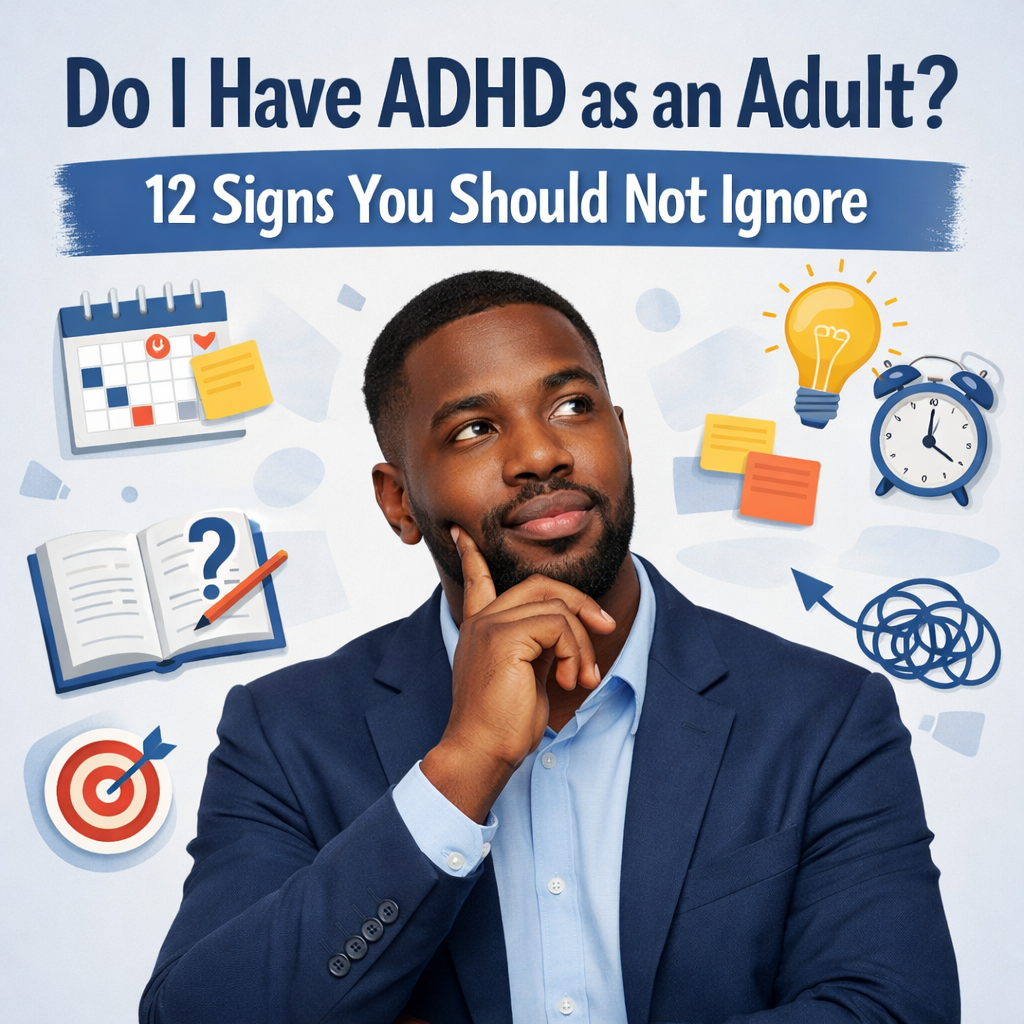
Do I Have ADHD as an Adult? 12 Signs You Should Not Ignore
Many adults struggle with focus, procrastination, or mental overload without realizing ADHD may be the underlying cause. Learn the 12 common signs of adult ADHD and when to consider a professional evaluation.
Many adults spend years believing they are simply disorganized, unmotivated, or easily distracted.
However, for many people, these experiences are actually related to Attention-Deficit/Hyperactivity Disorder (ADHD).
ADHD is often associated with childhood, but research shows that many individuals reach adulthood without ever receiving an evaluation or diagnosis. As responsibilities increase—careers, finances, relationships, and family life—symptoms may become more noticeable.
If you’ve ever wondered whether ADHD might explain ongoing struggles with focus, organization, or productivity, understanding the common signs can be an important first step.
Adults located in Pennsylvania and Delaware who want to understand the process can learn more about the structured evaluation process here.
Why ADHD Often Goes Undiagnosed in Adults
Many adults with ADHD performed reasonably well in school or developed coping strategies that masked symptoms.
For example, someone might have relied on:
• working extremely long hours
• using constant reminders and alarms
• depending on last-minute pressure to complete tasks
These strategies can work temporarily. However, as life becomes more complex, these coping mechanisms may stop working as effectively.
This is often when adults begin asking whether ADHD could be contributing to ongoing challenges.
12 Signs of ADHD in Adults
While ADHD affects people differently, there are several patterns that frequently appear in adults.
1. Difficulty Starting Tasks
Many adults with ADHD describe knowing exactly what needs to be done but struggling to begin the task.
This is sometimes referred to as task initiation difficulty, which is related to executive function.
2. Chronic Procrastination
Procrastination with ADHD often has less to do with laziness and more to do with how the brain regulates motivation and attention.
3. Difficulty Maintaining Focus
Adults with ADHD may struggle to stay focused during long meetings, reading tasks, or detailed projects.
4. Forgetfulness
Missing appointments, forgetting deadlines, or misplacing important items are common experiences.
5. Feeling Mentally Overwhelmed
Managing multiple responsibilities simultaneously can feel mentally exhausting.
6. Trouble Organizing Tasks
Many adults with ADHD report difficulty prioritizing tasks and organizing complex projects.
7. Frequently Losing Items
Keys, phones, wallets, and documents often seem to disappear.
8. Difficulty Following Through on Projects
Starting projects with enthusiasm but struggling to complete them is a common pattern.
9. Restlessness
Adults with ADHD may feel internally restless or mentally “on edge.”
10. Racing Thoughts
The mind may jump rapidly between ideas, making it difficult to maintain sustained attention.
11. Difficulty Managing Time
Deadlines can feel distant until they suddenly become urgent.
12. Burnout from Constant Effort
Many adults with ADHD work significantly harder than others just to maintain organization and productivity.
Over time, this can lead to ADHD-related burnout.
How ADHD Is Evaluated in Adults
An ADHD diagnosis involves a structured clinical evaluation that examines:
• childhood history of symptoms
• current functional challenges
• executive functioning patterns
• possible overlapping conditions
Adults interested in ADHD testing can learn more about how the process works here.
Testing helps support the diagnostic process, while the clinical evaluation ensures the diagnosis is accurate.
When to Consider an ADHD Evaluation
If ADHD symptoms are interfering with work, school, or daily functioning, a professional evaluation may help clarify whether ADHD is contributing to these difficulties.
Adults located in Pennsylvania and Delaware can schedule an ADHD consultation through ADHD Philadelphia.
In-person appointments may be available after the initial telehealth appointment when clinically appropriate. Walk-in appointments are not available.
Final Thoughts
Many adults spend years wondering why focus, organization, or productivity feels harder than it should.
Understanding ADHD and receiving an appropriate evaluation can provide clarity and help guide treatment options when appropriate.
Educational content such as this can help individuals better understand the symptoms and evaluation process for ADHD.
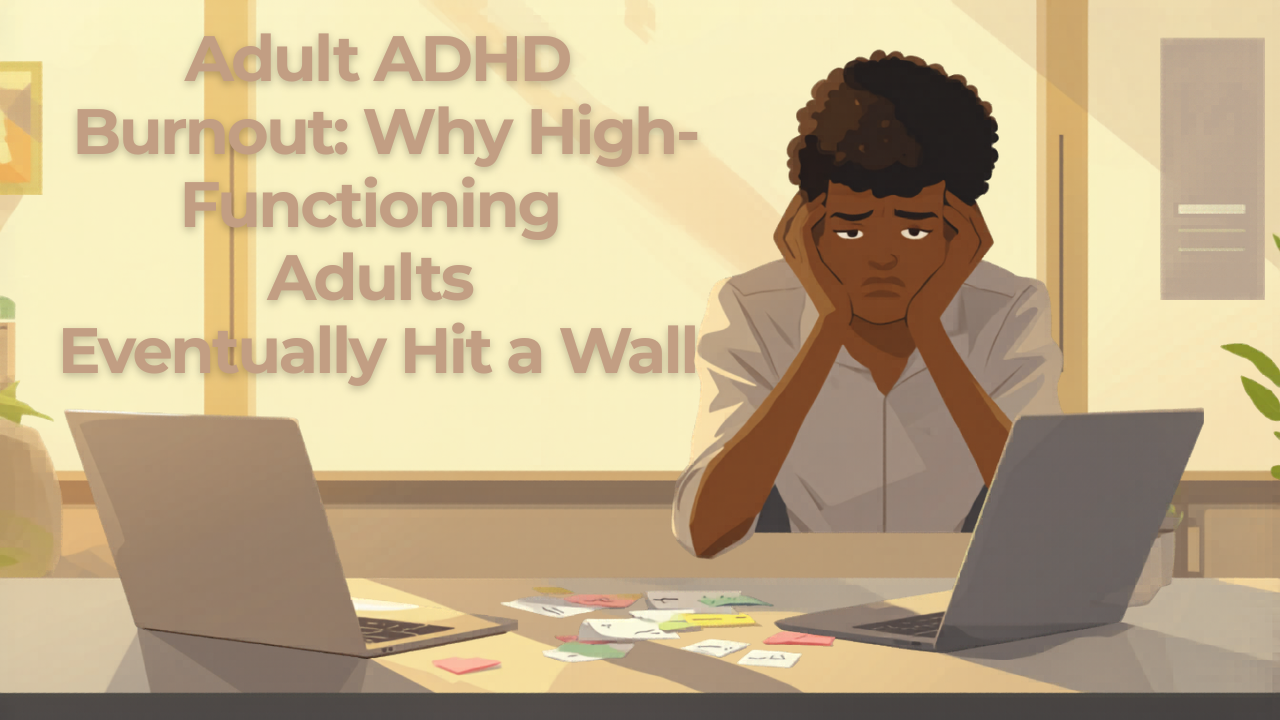
Adult ADHD Burnout: Why High-Functioning Adults Eventually Hit a Wall
Adult ADHD burnout is common among high-functioning professionals who have spent years compensating for attention difficulties. Learn how ADHD evaluations work for adults in Pennsylvania and Delaware and how diagnosis and treatment can help restore focus and productivity.
Many adults with ADHD spend years pushing themselves to keep up with responsibilities at work, school, and home. They develop systems, reminders, and coping strategies to stay organized and productive.
From the outside, they may appear successful and high-functioning.
But internally, many adults with ADHD experience a constant mental effort just to maintain focus, complete tasks, and manage daily responsibilities.
Over time, this effort can lead to something many adults describe as ADHD burnout.
For individuals who have lived for years without understanding their symptoms, burnout can feel confusing and overwhelming.
Understanding how ADHD burnout develops is often the first step toward finding effective support and treatment.
What ADHD Burnout Looks Like in Adults
ADHD burnout is not simply feeling tired from a busy week.
It often develops after years of managing attention difficulties without proper support or diagnosis.
Adults experiencing ADHD burnout may notice:
• Difficulty starting tasks they previously managed
• Feeling mentally exhausted even after small responsibilities
• Increased procrastination
• Emotional frustration with themselves
• Trouble organizing thoughts or priorities
• Reduced motivation despite wanting to succeed
Many adults describe feeling as though their brain has simply “hit a wall.”
In reality, ADHD burnout is often the result of long-term cognitive overload.
If these experiences sound familiar, learning more about the Adult ADHD diagnosis process in Pennsylvania and Delaware can help clarify whether ADHD may be contributing to these patterns.
Why High-Functioning Adults Often Go Undiagnosed
Many adults with ADHD performed reasonably well in school and early career environments.
Because of this, teachers, parents, and employers may never have suspected ADHD.
Instead, these individuals often relied on:
• Working longer hours than others
• Using intense effort to stay organized
• Constant reminders and lists
• Last-minute deadline pressure to trigger productivity
While these strategies can work temporarily, they often become unsustainable as responsibilities increase.
Professionals who maintain strong performance through chronic overwork, urgency, or extensive compensation may not realize how much ADHD is affecting them until those strategies become difficult to sustain. Learn more about Adult ADHD Care for Professionals.
Career demands, family responsibilities, financial stress, and complex schedules can make ADHD symptoms more noticeable.
This is why many adults seek an ADHD evaluation later in life, sometimes in their 30s, 40s, or even 50s.
If you are wondering whether ADHD may be affecting your attention or productivity, you can learn more about ADHD testing and evaluation for adults in Pennsylvania and Delaware.
How ADHD Evaluations Help Adults Move Forward
An ADHD evaluation helps determine whether attention difficulties are related to ADHD or another condition affecting focus and executive functioning.
At ADHD Philadelphia, the evaluation process is designed to be structured, transparent, and accessible for adults.
The evaluation generally includes two steps.
ADHD Consultation
The first step is a clinical consultation conducted through secure telehealth.
During this visit we discuss:
• Current attention and focus concerns
• Childhood ADHD symptom history
• Work and daily functioning
• Medical and mental health history
• Screening for other conditions that can affect attention
Consultation cost: $150
ADHD Testing
When appropriate, structured ADHD testing may be recommended.
This may include evidence-based questionnaires and computerized testing designed to support the diagnostic process.
Testing cost: $150
Total evaluation cost: $300
This transparent structure allows adults to receive a thorough evaluation without the extremely high costs sometimes associated with large neuropsychological testing programs.
ADHD Treatment After Diagnosis
If ADHD is diagnosed, treatment options may include:
• ADHD medication management
• Executive functioning strategies
• Behavioral approaches for attention regulation
• Lifestyle strategies to support productivity and focus
Medication is not required for every patient, but when appropriate it can significantly improve attention regulation and daily functioning.
Learn more about ADHD treatment and medication management for adults in Pennsylvania and Delaware here:
Telehealth ADHD Evaluations in Pennsylvania and Delaware
Many adults prefer telehealth evaluations because they allow them to complete their consultation from home.
At ADHD Philadelphia, telehealth ADHD consultations are available for adults located in:
• Pennsylvania
• Delaware
In-person appointments may be scheduled after the first telehealth appointment when clinically appropriate.
When to Consider an ADHD Evaluation
Adults often consider ADHD testing when they notice patterns such as:
• Difficulty focusing at work
• Struggling to complete projects
• Feeling mentally scattered or overwhelmed
• Chronic procrastination
• Difficulty transitioning between tasks
An ADHD evaluation can help determine whether ADHD may be contributing to these challenges and whether treatment options may help improve daily functioning.
Long-term ADHD burnout often develops when individuals spend years trying to compensate for attention and executive functioning challenges without support. The constant effort required to stay organized, meet deadlines, and manage responsibilities can eventually lead to exhaustion and overwhelm. This is why understanding why adults with ADHD feel overwhelmed and how treatment can help is an important step toward recovery.
Schedule an ADHD Evaluation
If you live in Pennsylvania or Delaware and believe ADHD may be affecting your focus, productivity, or daily functioning, an evaluation may be the next step.
Appointments are available through secure telehealth.
Book an ADHD consultation here: Same-day appointment.
Why Adult ADHD Makes Decision-Making So Mentally Exhausting
Adults with ADHD often feel mentally drained by everyday decisions. Learn how executive dysfunction and working memory overload contribute to decision fatigue—and how proper ADHD testing and treatment can help.
Many adults with ADHD end the day feeling mentally depleted — even when they didn’t complete anything extraordinary.
The exhaustion isn’t always physical.
It’s cognitive.
Small decisions accumulate:
What to prioritize
When to respond
How to structure the day
What to say in a conversation
What to ignore
For an ADHD brain, every one of those choices carries extra weight.
Executive Dysfunction and Decision Load
Decision-making depends heavily on executive function. The brain must:
Hold multiple variables in working memory
Weigh consequences
Inhibit distractions
Filter irrelevant input
Choose and commit
In adult ADHD, working memory and inhibitory control require more effort. That means each decision consumes more mental energy than it would for someone without ADHD.
Why Even Simple Choices Feel Draining
When executive systems fatigue quickly, the brain has fewer resources left for sustained effort.
This can look like:
Avoiding decisions
Overthinking minor details
Delaying responses
Feeling paralyzed by options
Snapping after a long day
Over time, adults may internalize the belief that they are indecisive or inefficient — when in reality, their cognitive load is simply higher.
The Link Between Decision Fatigue and Burnout
When decision fatigue accumulates daily, it contributes to burnout.
Mental exhaustion increases emotional reactivity, reduces task initiation, and weakens follow-through — reinforcing the very patterns we discussed earlier in the week.
It’s not laziness.
It’s overload.
How ADHD Treatment Reduces Mental Exhaustion
When adult ADHD is properly identified, treatment aims to:
Improve executive efficiency
Reduce working memory strain
Support structured decision-making
Decrease cognitive overload
Many adults report clearer thinking and reduced mental fatigue once ADHD is addressed directly.
At ADHD Philadelphia, evaluation begins with structured telehealth appointments. In-person visits are scheduled after the initial online evaluation when appropriate. There are no walk-ins, allowing care to remain focused and individualized.
If decision-making feels disproportionately exhausting, ADHD may be part of the explanation.
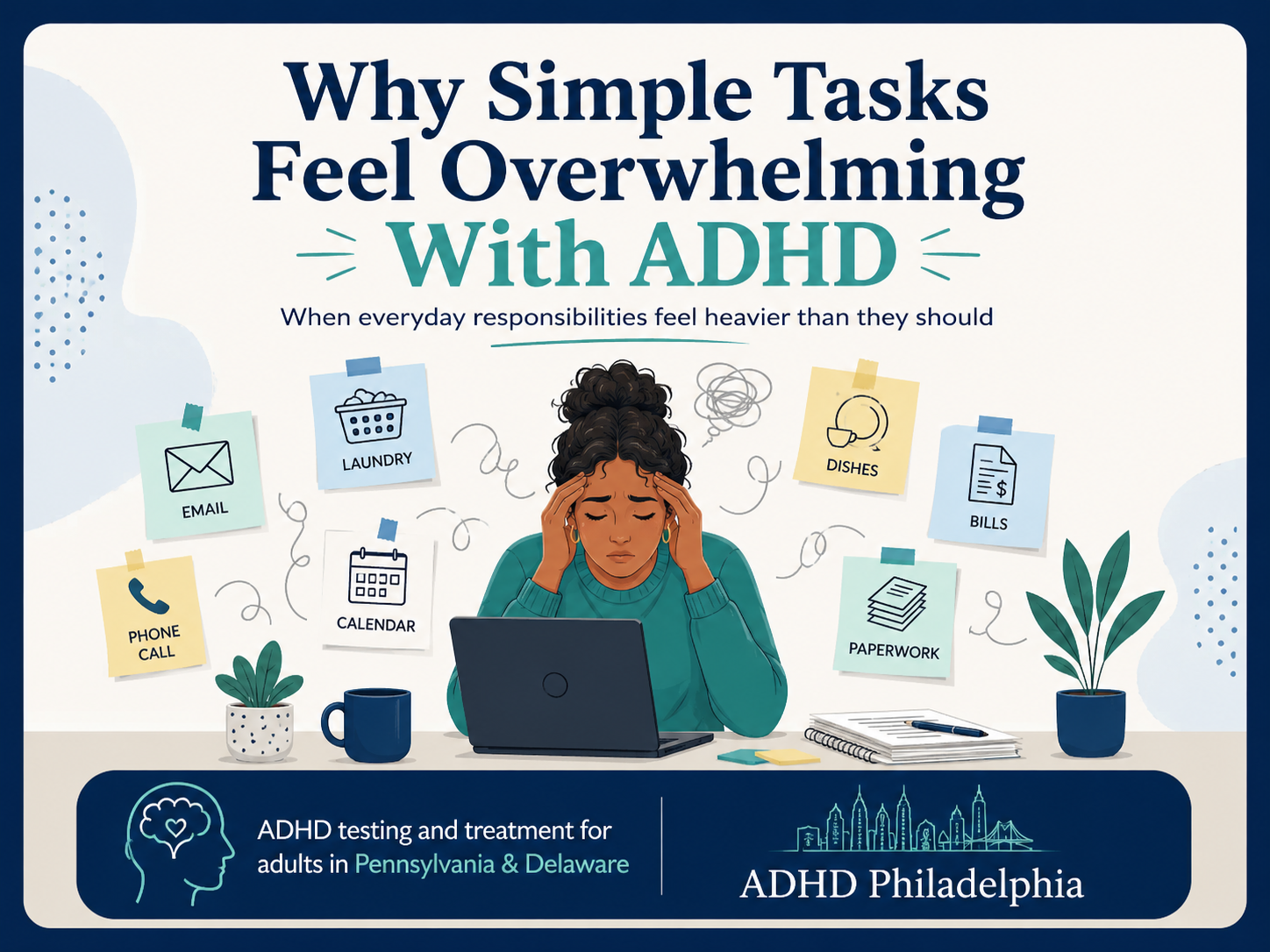
Why Adult ADHD Makes Simple Tasks Feel Overwhelming
Simple tasks can feel overwhelming for adults with ADHD. Learn how executive dysfunction, task initiation, working memory, emotional overload, and decision fatigue can make everyday responsibilities feel harder.
For many adults with ADHD, the hardest tasks are not always the biggest ones.
Sometimes the most frustrating tasks are the small ones.
Answering an email.
Starting laundry.
Returning a phone call.
Scheduling an appointment.
Paying a bill.
Cleaning one room.
Opening a form.
Putting groceries away.
Starting a work project.
From the outside, these tasks may look simple. But for adults with ADHD, simple tasks can feel strangely heavy, frustrating, or emotionally exhausting.
This can lead to shame.
Many adults think, “Why can’t I just do this?”
They may know the task matters.
They may want to finish it.
They may understand the consequences.
They may even have time.
But the task still feels hard to begin.
Adult ADHD can affect executive function, task initiation, working memory, emotional regulation, time awareness, planning, and follow-through. When these brain-based skills are strained, even ordinary responsibilities can feel bigger than they should.
At ADHD Philadelphia, we work with adults in Pennsylvania and Delaware who struggle with focus, procrastination, disorganization, emotional overwhelm, task initiation, and daily follow-through. A structured ADHD evaluation can help clarify whether ADHD may be contributing to these patterns.
Learn why even small responsibilities can remain unfinished in our complete guide to task initiation in adults with ADHD.
Initial appointments begin through secure telehealth. In-person appointments may be scheduled after the first online appointment when clinically appropriate. Walk-in appointments are not available.
Why Simple Tasks Are Not Always Simple With ADHD
A task may look simple from the outside, but internally it may involve many hidden steps.
For example, “pay the bill” may actually require:
Finding the bill
Opening the account
Remembering the password
Checking the due date
Reviewing the balance
Deciding which account to use
Making the payment
Saving confirmation
Remembering whether autopay is set up
Following up if something looks wrong
That is not one step. That is a sequence.
For adults with ADHD, sequencing can be difficult when executive function is overloaded. The brain may see the entire task at once and feel flooded before the first step begins.
That is why a task that “should only take five minutes” can sit unfinished for days.
A structured adult ADHD testing and evaluation process can help clarify whether difficulty starting simple tasks, procrastination, forgetfulness, disorganization, and executive dysfunction may be related to ADHD.
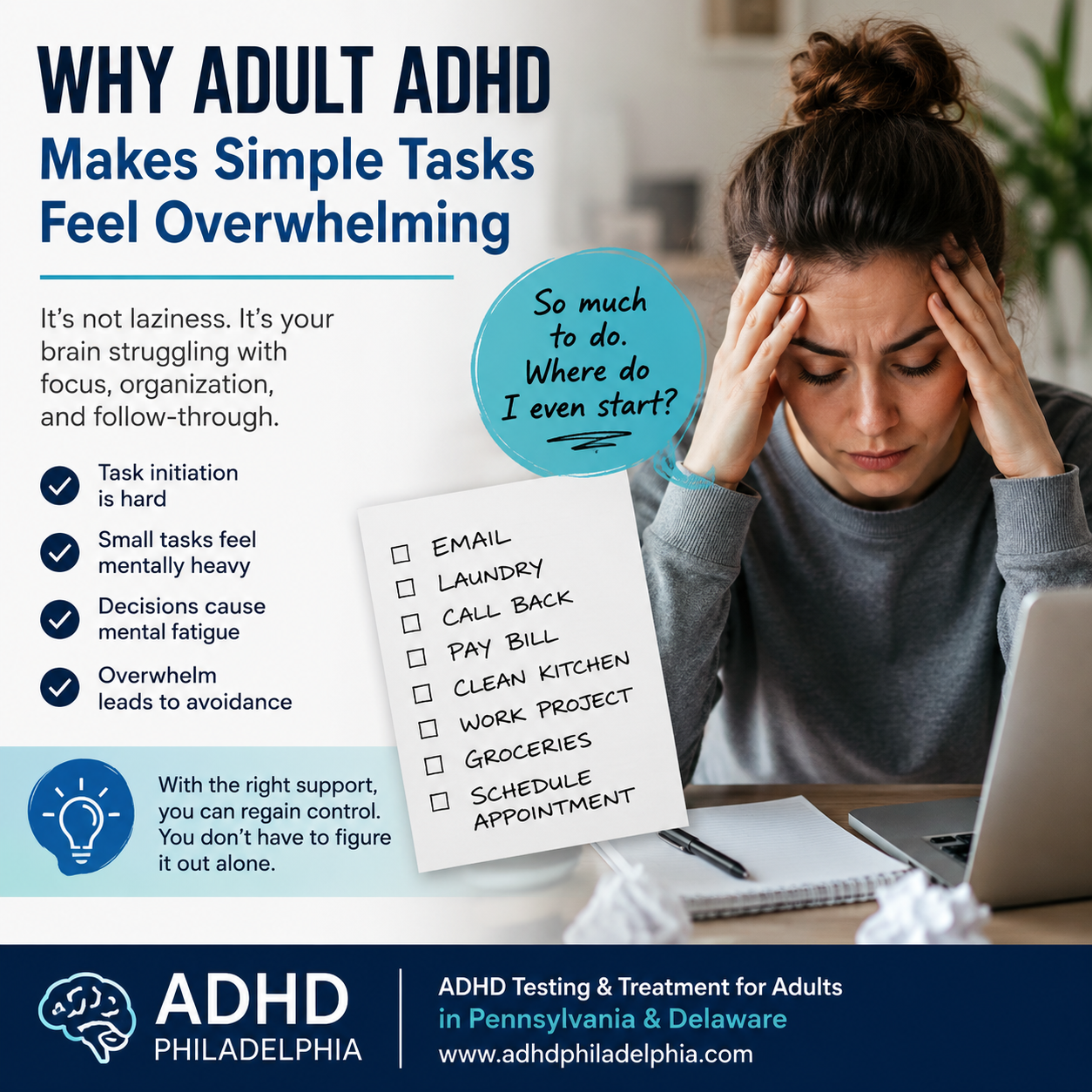
ADHD and Executive Function
Executive function refers to the brain skills that help people manage daily life.
These skills include:
Planning
Prioritizing
Starting tasks
Remembering steps
Managing time
Organizing information
Regulating emotions
Switching between tasks
Finishing responsibilities
Following through over time
When executive function is strained, even small tasks can feel mentally complicated.
The adult may know what needs to be done but struggle to organize the steps, begin the task, stay focused, and finish completely.
This is not about intelligence. Many adults with ADHD are bright, capable, creative, and hardworking. The problem is often not knowing what to do. The problem is activating the brain to do it consistently.
Problems with executive function in adults can affect planning, working memory, organization, emotional regulation, time management, task initiation, and follow-through.
Task Initiation: The Hardest Part Is Starting
One of the most common ADHD-related struggles is task initiation.
Task initiation is the ability to begin a task without needing extreme urgency, pressure, panic, or outside prompting.
Many adults with ADHD say:
“Once I start, I’m usually okay.”
“The hardest part is getting going.”
“I keep thinking about it, but I still don’t do it.”
“I know what to do, but I feel stuck.”
Simple tasks often become overwhelming because the brain struggles to start.
The person may delay, scroll, clean something else, overthink, avoid, or wait until the task becomes urgent. Then they may rush under pressure and feel guilty afterward.
This cycle can repeat for years before the person realizes ADHD may be involved.
Many adults feel stuck because adult ADHD can make follow-through difficult even when you care, especially when task initiation, planning, working memory, and consistency are affected.
Working Memory Can Make Small Tasks Harder
Working memory is the ability to hold information in mind while using it.
For adults with ADHD, working memory can be inconsistent.
This may look like:
Walking into a room and forgetting why
Opening a laptop and forgetting the original task
Starting one chore and getting pulled into another
Losing track of steps
Forgetting what was just read
Forgetting to return to an unfinished task
Misplacing important items needed to complete the task
A simple task may fall apart because the brain loses the thread.
The adult may start with good intentions but get interrupted, distracted, or mentally overloaded. Then the task disappears from awareness until later, when guilt returns.
Many adults with ADHD struggle because ADHD can make it hard to regain momentum after interruptions, especially when working memory and task switching are affected.
Emotional Overwhelm Can Attach to Small Tasks
Simple tasks can become emotionally loaded.
An email may trigger dread.
A bill may trigger shame.
Laundry may trigger defeat.
A form may trigger frustration.
A voicemail may trigger anxiety.
A cluttered room may trigger embarrassment.
Once emotion attaches to the task, the task feels heavier.
The adult may avoid the task not because they do not care, but because the task creates an uncomfortable emotional reaction.
Avoidance brings temporary relief. But the task remains unfinished, which increases guilt and stress. Over time, the task becomes even harder to face.
This is one reason adults with ADHD often feel trapped in cycles of avoidance and self-criticism.
Many adults struggle because adult ADHD can cause chronic overwhelm, especially when emotions, decisions, unfinished tasks, and executive function demands pile up.
Stress Makes ADHD Feel Worse
Stress can make ADHD symptoms harder to manage.
Under stress, adults with ADHD may experience:
Worse focus
More emotional reactivity
More avoidance
More procrastination
Poorer time awareness
Reduced patience
More mental fatigue
More difficulty starting tasks
More difficulty finishing tasks
Stress does not just sit beside ADHD. It can amplify ADHD symptoms.
This creates a loop.
The task feels overwhelming.
The adult avoids it.
Avoidance creates guilt.
Guilt increases stress.
Stress makes the task feel harder.
The task remains unfinished.
Breaking that loop often requires structure, support, and a better understanding of what is happening.
For many adults, understanding ADHD vs anxiety in adults is important because both can affect concentration, restlessness, sleep, motivation, emotional regulation, and daily functioning.
Why Simple Tasks Pile Up
Adults with ADHD may delay small tasks because each one feels slightly uncomfortable, boring, unclear, or mentally demanding.
But small tasks do not stay small forever.
One email becomes twenty.
One bill becomes a late fee.
One basket of laundry becomes several.
One missed call becomes an awkward follow-up.
One cluttered counter becomes a room that feels impossible to clean.
Once tasks pile up, the brain has even more difficulty deciding where to begin.
This creates a stuck feeling.
The adult may look around and feel overwhelmed by everything at once.
Recognizing adult ADHD symptoms can help explain why small tasks pile up when focus, planning, time awareness, emotional regulation, and follow-through are affected.
Decision Fatigue Makes Small Tasks Feel Bigger
Small tasks often require decisions.
Should I answer this email now?
What should I say?
Where should this paper go?
Do I need to call or can I do it online?
Should I clean first or work first?
Do I have enough time?
What if I do it wrong?
For adults with ADHD, decision-making can become exhausting.
The brain may overthink, compare too many options, or search for the perfect starting point. This can make even a basic task feel mentally heavy.
When every task requires a decision, the day becomes draining.
For many adults, ADHD can make decision-making hard because executive dysfunction affects prioritizing, organizing options, managing uncertainty, and moving from thought into action.
Why Adults With ADHD Often Blame Themselves
Many adults with ADHD have spent years being told they should “just try harder.”
They may have heard:
“You’re smart, but you don’t apply yourself.”
“You just need discipline.”
“You’re overthinking it.”
“It only takes five minutes.”
“Why didn’t you just do it?”
After hearing this enough, many adults begin to believe the problem is character.
But untreated ADHD is not a character flaw.
When task initiation, working memory, time awareness, emotional regulation, and executive function are impaired, daily responsibilities can require more effort than others realize.
Understanding ADHD can reduce shame and help adults approach the problem with better tools instead of more self-criticism.
Many adults feel relief when they learn that ADHD treatment can help explain patterns they once blamed on laziness or lack of discipline.
How to Make Simple Tasks Easier
The goal is not to force your brain to work like everyone else’s.
The goal is to reduce friction.
Here are practical ways to make simple tasks easier when ADHD is involved.
1. Shrink the Task
If a task feels too big, make the first step smaller.
Instead of “clean the kitchen,” try:
Clear one counter
Put away five items
Load five dishes
Throw away visible trash
Wipe one surface
Instead of “catch up on email,” try:
Open the inbox
Answer one message
Delete five emails
Flag three important messages
The smaller the first step, the easier it may be to begin.
Many adults with ADHD need smaller starting points because ADHD can make adults feel stuck even when they know what to do.
2. Make the Task Visible
Out of sight can quickly become out of mind.
Adults with ADHD often benefit from making tasks visible.
This may include:
Whiteboards
Sticky notes
Open checklists
Calendar reminders
Phone alarms
Visible bins
Paper trays
Task cards
Timers
A task that is visible is easier to return to.
The goal is not to remember everything. The goal is to build a system that remembers for you.
After diagnosis, adult ADHD treatment may include education, executive function strategies, lifestyle changes, and medication management when clinically appropriate.
3. Use a Timer to Start
A timer can reduce the emotional weight of a task.
Instead of committing to finishing everything, commit to starting for a short period.
Try:
Five minutes
Ten minutes
One song
One small section
One visible step
This helps the brain stop treating the task like an all-or-nothing demand.
Sometimes momentum appears after starting. Sometimes it does not. Either way, beginning for a short time is still progress.
Starting small can help because adult ADHD can make follow-through difficult even when you care, especially when the brain struggles to activate without urgency.
4. Remove Unnecessary Decisions
If a task requires too many choices, simplify it.
Choose the same bill-paying day each week.
Use one laundry basket system.
Keep one place for keys.
Use one calendar.
Create one morning checklist.
Use one folder for forms.
Decide on one “first task” for each workday.
Reducing decisions lowers mental load.
Adults with ADHD often need fewer decisions, not more pressure.
This is why ADHD can make routines hard to maintain, but simple external systems can reduce decision fatigue and make daily tasks easier to repeat.
5. Consider ADHD Evaluation if This Pattern Is Long-Standing
Everyone avoids tasks sometimes.
But if simple tasks have felt overwhelming for years, and the pattern affects work, school, home, relationships, finances, or daily functioning, ADHD evaluation may be helpful.
This is especially true if the task overwhelm comes with:
Poor focus
Procrastination
Disorganization
Time blindness
Forgetfulness
Emotional reactivity
Difficulty starting
Difficulty finishing
Trouble keeping routines
Feeling behind despite trying hard
A structured evaluation can help determine whether ADHD may be contributing and whether treatment may help.
A careful adult ADHD diagnosis and evaluation reviews symptoms, history, impairment, executive functioning, and other possible explanations before treatment planning begins.
ADHD Testing and Treatment in Pennsylvania and Delaware
ADHD Philadelphia provides adult ADHD testing and treatment for adults in Pennsylvania and Delaware.
Care is designed to help adults better understand symptoms such as procrastination, poor focus, forgetfulness, disorganization, emotional overwhelm, task initiation problems, and difficulty following through.
A structured evaluation may include a clinical interview, symptom review, earlier life patterns, functional impairment review, executive function assessment, and screening for overlapping concerns.
Treatment may include ADHD education, executive function strategies, behavioral tools, lifestyle review, and medication management when clinically appropriate.
Adults searching for ADHD testing in Pennsylvania and Delawarecan begin with a structured telehealth evaluation through ADHD Philadelphia.
After diagnosis, adult ADHD treatment may include education, executive function strategies, lifestyle changes, and medication management when clinically appropriate.
Medication Management When Clinically Appropriate
Medication may be discussed if ADHD is diagnosed and treatment is clinically appropriate.
This conversation should include education, informed consent, medical history, psychiatric history, medication history, safety considerations, and follow-up expectations.
Stimulant medications are controlled substances and require responsible monitoring.
At ADHD Philadelphia, treatment response, side effects, functioning, safety, and appropriateness are reviewed during follow-up care. For stimulant medication, follow-up is typically required every 30 days for safety monitoring, treatment response, and dosage adjustments.
ADHD Philadelphia also reviews the prescription drug monitoring program as part of controlled-substance prescribing procedures.
Patients can review the Medication Management & Stimulant Treatment Policy to better understand ADHD Philadelphia’s expectations for stimulant medication monitoring, controlled-substance safety, follow-up visits, and treatment requirements.
When clinically appropriate, ADHD medication management for adults may support focus, task initiation, emotional regulation, and daily functioning as part of a monitored treatment plan.
Telehealth ADHD Care in Pennsylvania and Delaware
ADHD Philadelphia provides adult ADHD evaluation and treatment for adults in Pennsylvania and Delaware.
Initial appointments begin through secure telehealth. This can make care more accessible for busy adults, professionals, students, parents, remote workers, healthcare workers, and people who have struggled to begin the evaluation process.
In-person appointments may be scheduled after the first online appointment when clinically appropriate. Walk-in appointments are not available.
Adults searching for ADHD testing in Pennsylvania can begin with a structured telehealth evaluation through ADHD Philadelphia.
Adults searching for ADHD testing in Delaware can also begin with a secure telehealth evaluation through ADHD Philadelphia.
Adults searching for adult ADHD testing in Philadelphia can begin with ADHD Philadelphia’s structured evaluation process.
Adults searching for ADHD testing in Wilmington, Delaware can begin care through ADHD Philadelphia’s Delaware telehealth services.
Frequently Asked Questions About ADHD and Simple Tasks
Why do simple tasks feel overwhelming with ADHD?
Simple tasks can feel overwhelming because ADHD affects executive function skills such as planning, task initiation, working memory, time management, emotional regulation, and follow-through.
Is this laziness or ADHD?
It is not possible to diagnose based on one symptom, but many adults with ADHD struggle to start and finish simple tasks despite caring deeply. If this pattern is long-standing and affects daily functioning, ADHD evaluation may help.
Why do I avoid tasks that only take a few minutes?
Small tasks may trigger emotional discomfort, decision fatigue, uncertainty, boredom, or executive function overload. Avoidance may bring temporary relief but usually increases stress later.
Can ADHD treatment help with task initiation?
Yes. ADHD treatment may help improve focus, task initiation, planning, emotional regulation, routines, and follow-through. Treatment may include education, behavioral strategies, executive function tools, and medication management when clinically appropriate.
Does ADHD Philadelphia treat adults in Pennsylvania and Delaware?
Yes. ADHD Philadelphia provides adult ADHD testing and treatment for adults in Pennsylvania and Delaware. Initial appointments begin through telehealth. In-person appointments may be scheduled after the first online appointment when clinically appropriate. Walk-in appointments are not available.
Take the First Step
If simple tasks feel heavier than they should, you are not alone.
Adult ADHD can affect focus, task initiation, working memory, emotional regulation, organization, time management, and follow-through. A structured evaluation can help clarify whether ADHD may be contributing and whether treatment may be appropriate.
ADHD Philadelphia provides adult ADHD testing and treatment for adults in Pennsylvania and Delaware.
Schedule an adult ADHD evaluation today through ADHD Philadelphia.
Medical Disclaimer
This article is for educational purposes only and is not a substitute for medical advice, diagnosis, or treatment. If you are experiencing symptoms of ADHD, anxiety, depression, sleep problems, substance use concerns, or another mental health concern, consult a qualified healthcare professional.
You’re Not Lazy: Why Adult ADHD Feels Like Burnout
Adult ADHD often feels like chronic burnout rather than hyperactivity. Learn why untreated ADHD leads to exhaustion and how proper treatment can restore focus, energy, and emotional balance.
Many adults with ADHD don’t feel hyper — they feel exhausted.
By the time people reach adulthood, ADHD often looks less like excess energy and more like burnout, overwhelm, and emotional fatigue. Tasks feel harder than they should. Motivation comes in short bursts. And no matter how much effort you put in, it never seems consistent.
That’s not a character flaw. It’s executive dysfunction.
Executive function controls planning, task initiation, emotional regulation, and follow-through. When ADHD goes untreated, adults often compensate by overworking, masking symptoms, or pushing themselves until burnout sets in.
This is why so many adults with ADHD are first diagnosed with anxiety or depression. The emotional toll is real — but the root cause is often neurological, not motivational.
When adult ADHD is properly identified and treated, many people report:
Less mental exhaustion
Improved task initiation
Better emotional regulation
A greater sense of control over daily life
At ADHD Philadelphia, care begins with a structured telehealth evaluation, followed by in-person appointments when appropriate. There are no walk-ins — care is intentional and personalized.
If burnout feels like your baseline, ADHD may be the missing piece.
👉 Schedule a same-day ADHD evaluation:
https://www.adhdphiladelphia.com/book-a-same-day-appointment