
Stimulant vs Non-Stimulant ADHD Medication for Adults in Pennsylvania & Delaware
Compare stimulant and non-stimulant ADHD medication options for adults in Pennsylvania and Delaware. Learn how structured diagnosis, $150 per visit medication management, and consistent follow-up support safe and effective treatment.
If you are searching for ADHD medication for adults, you may be wondering:
Should I take a stimulant?
Is a non-stimulant safer?
What is the difference?
The answer depends on your clinical history, symptom pattern, and treatment goals.
At ADHD Philadelphia, medication decisions are made only after a structured diagnostic evaluation has been completed. If you are unsure whether you meet criteria for ADHD, learn more about our Adult ADHD Diagnosis process before considering medication options.
Two Main Categories of ADHD Medication
There are two primary categories used in adult ADHD treatment:
• Stimulant medications
• Non-stimulant medications
Both can be effective. The right choice depends on individual factors.
Stimulant Medications
Stimulants are the most commonly prescribed medications for ADHD.
They work by increasing levels of dopamine and norepinephrine in areas of the brain responsible for attention regulation and executive functioning.
Common Benefits:
• Faster onset of symptom improvement
• Strong effect on focus and task completion
• Improved productivity and mental clarity
Important Considerations:
• Require careful monitoring
• May affect sleep or appetite
• Require monthly follow-up appointments
At ADHD Philadelphia, stimulant medications require monthly monitoring visits to ensure safety, symptom response, and dosage accuracy.
All medication management visits are $150 per appointment.
Structured monitoring supports responsible, evidence-based care.
Non-Stimulant Medications
Non-stimulants may be recommended when:
• Stimulants are not tolerated
• There is a history of side effects
• Anxiety is a significant concern
• A slower, steadier response is preferred
Non-stimulants typically take longer to show full benefit but may provide stable symptom improvement without stimulant-related side effects.
Monitoring Structure:
Follow-up appointments are typically scheduled every 30–90 days, depending on response and stability.
All visits remain $150 per appointment.
Which Is Better?
There is no universal “better” medication.
Treatment decisions are based on:
• Symptom severity
• Medical history
• Co-occurring conditions
• Lifestyle factors
• Functional impairment
• Patient preference
Medication is never prescribed casually.
Diagnosis requires structured clinical evaluation, functional assessment, and screening for overlapping conditions. If you have not yet completed evaluation, visit our ADHD Testing & Evaluation page to understand how diagnosis is established.
What Happens After Starting Medication?
Once medication begins:
• Follow-up schedule is clearly outlined
• Symptom response is reviewed
• Side effects are monitored
• Functional improvement is tracked
• Adjustments are made when clinically appropriate
The goal is not just symptom reduction — it is improved daily functioning.
Telehealth ADHD Medication Management in Pennsylvania & Delaware
Adult ADHD treatment at ADHD Philadelphia begins via secure telehealth consultation for adults residing in Pennsylvania and Delaware.
In-person appointments may be scheduled afterward when clinically appropriate.
There are no walk-in appointments.
Care is structured.
Monitoring is consistent.
Treatment decisions are evidence-based.
The Bottom Line
Stimulant and non-stimulant medications both have a role in adult ADHD treatment.
The key is not choosing a category at random.
The key is accurate diagnosis and structured follow-up.
If you are searching for:
• ADHD medication for adults
• ADHD doctor Pennsylvania
• ADHD psychiatrist Delaware
• ADHD treatment near me
Clarity begins with structured evaluation.

Do I Need ADHD Testing as an Adult in Pennsylvania or Delaware?
Not every adult needs computerized ADHD testing. Learn when ADHD testing is helpful, how structured evaluations work, and what to expect during adult ADHD diagnosis in Pennsylvania and Delaware.
If you are searching for “ADHD test for adults” or wondering whether you need ADHD testing before treatment, it is important to understand how adult ADHD is properly diagnosed.
ADHD testing can be helpful — but not every adult requires computerized testing to receive an accurate diagnosis.
At ADHD Philadelphia, diagnosis begins with a structured clinical evaluation conducted through secure telehealth appointments for adults residing in Pennsylvania and Delaware.
What Is ADHD Testing?
ADHD testing refers to structured tools used to measure:
• Attention regulation
• Impulse control
• Executive functioning performance
Testing may include:
• Computerized attention assessments
• Behavioral rating scales
• Symptom questionnaires
• Functional performance measures
Testing provides objective data. However, testing alone does not determine diagnosis.
For a full overview of structured diagnostic criteria, visit our Adult ADHD Diagnosis page.
Do All Adults Need ADHD Testing?
Not always.
Some adults present with a clear clinical history that supports diagnosis through structured interview and impairment review alone.
In other cases, testing strengthens diagnostic confidence — especially when symptoms overlap with anxiety, depression, trauma, or sleep concerns.
Testing decisions are made during your initial evaluation.
For a detailed breakdown of how testing fits into the full assessment process, visit our ADHD Testing & Evaluation page.
Why Online ADHD Quizzes Are Not Enough
Online ADHD quizzes can raise awareness, but they are not diagnostic tools.
A complete adult ADHD evaluation requires:
• Structured clinical interview
• Childhood symptom review
• Functional impairment assessment
• Screening for overlapping conditions
• Professional medical judgment
Diagnosis requires evidence of persistent symptoms and measurable functional impairment.
What Happens After Testing?
If ADHD is diagnosed:
• Treatment options are discussed
• Behavioral strategies may be recommended
• Medication may be considered when appropriate
Stimulant medications require monthly follow-up appointments.
Non-stimulant medications typically require follow-up every 30–90 days depending on stability.
All appointments are $150 per visit.
Structured monitoring supports safe, responsible care.
Telehealth ADHD Evaluation in Pennsylvania & Delaware
Adult ADHD evaluations begin via secure telehealth appointments.
In-person visits may be scheduled afterward when clinically appropriate.
There are no walk-in appointments.
The Bottom Line
ADHD testing is a tool — not a shortcut.
Accurate diagnosis requires structure, clinical judgment, and functional assessment.
If you are searching for:
• ADHD testing near me
• ADHD test for adults
• ADHD evaluation Pennsylvania
• ADHD assessment Delaware
Clarity begins with structured evaluation.
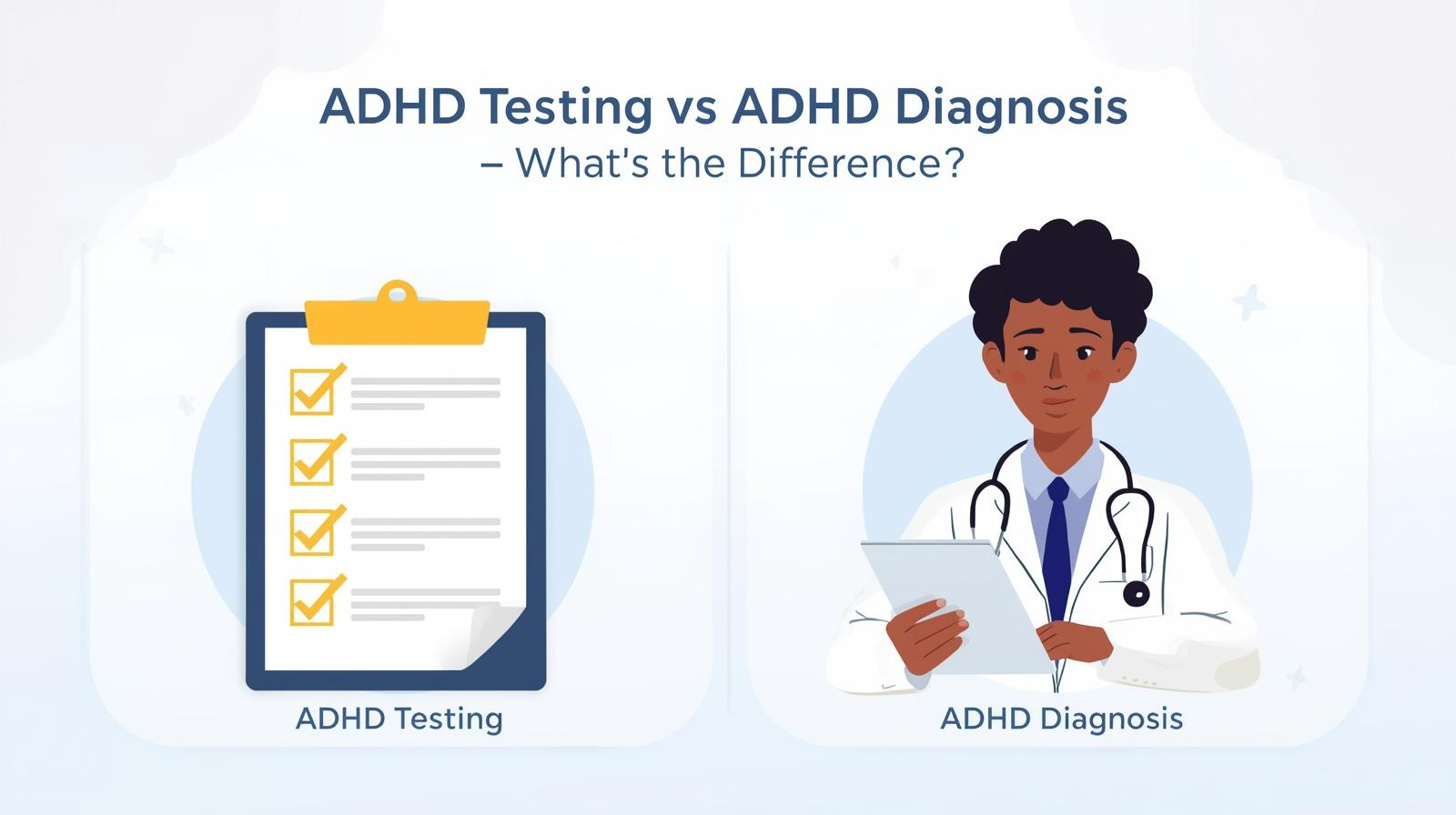
ADHD Testing vs ADHD Diagnosis — What’s the Difference?
ADHD testing and ADHD diagnosis are not the same. Learn how adult ADHD is evaluated in Pennsylvania and Delaware and why structured clinical assessment matters more than online quizzes.
If you are searching for “ADHD testing near me” or “ADHD diagnosis in Philadelphia,” you may not realize that ADHD testing and ADHD diagnosis are not the same thing.
Understanding the difference can prevent confusion — and ensure you receive the right evaluation.
At ADHD Philadelphia, we provide structured adult ADHD evaluations across Pennsylvania and Delaware, beginning with telehealth appointments and moving to in-person visits when clinically appropriate.
What Is ADHD Testing?
ADHD testing refers to objective tools used to measure attention, impulsivity, and executive functioning.
Testing may include:
Computerized attention assessments
Behavioral questionnaires
Symptom rating scales
Collateral reports when appropriate
Testing provides objective data. It measures performance patterns.
However, testing alone does not equal a diagnosis.
What Is ADHD Diagnosis?
ADHD diagnosis is a clinical decision made after reviewing:
Childhood history
Current symptoms
Functional impairment
Work and academic impact
Emotional regulation patterns
Rule-outs for overlapping conditions
Diagnosis requires clinical judgment.
Testing supports diagnosis — but does not replace a structured evaluation.
Why Testing Alone Is Not Enough
Some individuals complete online ADHD tests and assume the results confirm ADHD.
Online quizzes are not diagnostic tools.
A formal ADHD diagnosis requires:
Persistent symptoms
Functional impairment
Clinical interview
Medical and psychiatric review
Testing provides information.
Diagnosis provides clarity.
Do Adults Need ADHD Testing?
Not every adult requires computerized testing.
In some cases, a structured clinical interview is sufficient.
In other cases, testing strengthens diagnostic confidence.
The decision depends on:
Symptom presentation
History clarity
Functional impairment
Differential diagnosis considerations
A professional evaluation determines what is appropriate.
ADHD Evaluation in Pennsylvania & Delaware
Adult ADHD evaluations at ADHD Philadelphia begin with secure telehealth consultation.
After the initial appointment:
ADHD testing may be recommended
In-person visits may be scheduled when clinically appropriate
Treatment planning is discussed
There are no walk-in appointments.
The Bottom Line
ADHD testing measures performance.
ADHD diagnosis requires structured clinical evaluation.
If you are searching for ADHD testing in Philadelphia or ADHD evaluation in Delaware, make sure you are receiving a complete diagnostic process — not just a test.
Clarity begins with structured evaluation.

Why Adult ADHD Makes Follow-Through So Difficult Even When You Care
Many adults with ADHD care deeply but still struggle to follow through. Learn how executive dysfunction affects task initiation, time management, consistency, and daily responsibilities.
Many adults with ADHD care deeply about their responsibilities.
They care about their work.
They care about their relationships.
They care about their health.
They care about their families.
They care about doing what they said they would do.
But caring does not always make follow-through easier.
This is one of the most painful parts of adult ADHD. Many adults know exactly what needs to be done, but they still struggle to start, stay consistent, finish tasks, or repeat the same helpful behavior over time.
From the outside, this can look like laziness, avoidance, irresponsibility, or lack of discipline. But for many adults with ADHD, the real issue is executive dysfunction.
Adult ADHD affects the brain systems involved in planning, time management, organization, motivation, emotional regulation, working memory, and task completion. That means follow-through is not simply about willpower. It is often about how the brain manages action.
At ADHD Philadelphia, we work with adults in Pennsylvania and Delaware who have spent years asking themselves, “Why can’t I just do what I know I need to do?” For many, ADHD testing and treatment finally help explain the pattern.
Follow-Through Is an Executive Function Skill
Follow-through sounds simple, but it actually requires several executive function skills working together.
To follow through on a task, the brain has to:
Remember what needs to be done
Prioritize the task
Estimate how long it will take
Start the task
Ignore distractions
Manage frustration
Stay with the task long enough to finish
Return to the task if interrupted
Repeat the behavior consistently over time
For adults with ADHD, one or more of these steps may break down.
This is why a person may have strong intentions but poor execution. They may genuinely care and still forget. They may want to finish and still get distracted. They may understand the consequences and still delay until the last minute.
The problem is not always motivation. The problem is often the brain’s ability to organize behavior over time.
A structured evaluation can help determine whether adult ADHD testing and evaluation may explain ongoing struggles with follow-through, procrastination, disorganization, time management, and executive dysfunction.
Why Caring Is Not Always Enough
Many adults with ADHD feel confused because they care so much.
They may say:
“I know it matters.”
“I really meant to do it.”
“I was planning to start.”
“I do not understand why I keep putting it off.”
“I care, but I still cannot seem to follow through.”
This can create shame because the person assumes that if they cared enough, they would do it.
But ADHD often creates a gap between intention and action. The desire is there. The goal is there. The consequences may even be clear. But the brain struggles to activate, organize, and sustain the behavior.
This is especially true when tasks are boring, repetitive, emotionally uncomfortable, unclear, delayed in reward, or not immediately urgent.
Many adults with ADHD can perform well in high-pressure situations because urgency gives the brain stimulation. But routine, maintenance-based tasks can feel much harder. Paying bills, answering emails, cleaning, scheduling appointments, finishing paperwork, or keeping up with daily routines may feel unusually difficult.
This does not mean the person does not care. It means their brain may need more structure, support, and treatment.
For many adults, adult ADHD diagnosis helps explain why caring, trying harder, and making promises may not be enough when executive function challenges interfere with action.
Task Initiation: Why Starting Feels So Hard
One major reason adults with ADHD struggle with follow-through is difficulty starting tasks.
Task initiation is the ability to begin something without needing extreme pressure, panic, or urgency. For adults with ADHD, starting can be one of the hardest parts.
A task may sit on the to-do list for days, weeks, or months. The person may think about it constantly, feel guilty about it, and still not start.
This can happen because the task feels too large, too boring, too emotionally uncomfortable, too unclear, or too disconnected from immediate reward.
The adult with ADHD may not be avoiding the task because they do not care. They may be stuck because their brain cannot easily shift from intention into action.
Common signs of task initiation problems include:
Waiting until the last minute
Needing pressure to start
Feeling frozen by simple tasks
Avoiding tasks that feel unclear
Starting easier tasks instead of important ones
Feeling mentally blocked even when the task matters
Knowing what to do but not being able to begin
Treatment can help adults understand these patterns and build systems that make starting easier.
Many adults seek help because ADHD-related procrastination can make even important tasks feel difficult to start until urgency or stress takes over.
Working Memory: Why Adults With ADHD Forget What They Meant To Do
Another reason follow-through is difficult is working memory.
Working memory is the ability to hold information in mind long enough to use it. Adults with ADHD may fully intend to do something, but the intention disappears once another demand appears.
They may walk into a room and forget why they went there.
They may remember an errand at the wrong time.
They may forget to respond to a message after reading it.
They may miss a deadline because it was not visible enough.
They may start one task and lose track of the original task.
This is not always carelessness. It may be a working memory problem.
Adults with ADHD often need external systems to hold information outside the brain. Reminders, calendars, visible lists, alarms, written plans, and structured routines can help reduce the pressure on working memory.
Treatment can also help by improving attention regulation and helping patients build realistic systems they can actually use.
Problems with executive function in adults can affect working memory, organization, time awareness, planning, and the ability to complete tasks consistently.
Time Blindness: Why Deadlines Sneak Up
Many adults with ADHD struggle with time blindness.
Time blindness means the brain has difficulty sensing, estimating, or managing time. A person may know a deadline exists but not feel it until it becomes urgent.
They may underestimate how long something will take.
They may overestimate how much time they have.
They may lose hours to distractions.
They may run late even when they tried to be on time.
They may feel like time is either “now” or “not now.”
This creates major follow-through problems.
A task that is not urgent may not feel real yet. Then suddenly, the deadline becomes immediate, stress increases, and the person rushes to finish. This pattern may work sometimes, but it often leads to burnout, mistakes, missed opportunities, and emotional exhaustion.
Treatment can help adults develop better planning systems, use external time supports, and reduce dependence on last-minute panic.
Many adults with ADHD struggle because ADHD can make routines hard to maintain, especially when time blindness, distractibility, and inconsistent motivation interfere with daily structure.
Emotional Overwhelm Can Block Follow-Through
Follow-through is not only about attention. It is also about emotion.
Many adults with ADHD avoid tasks because the task triggers discomfort. It may bring up boredom, frustration, shame, fear of failure, uncertainty, guilt, or anxiety.
For example:
An email may feel emotionally loaded.
A bill may bring up shame.
A project may feel too big.
A phone call may feel awkward.
A messy room may feel overwhelming.
A form may feel confusing before it even begins.
When the emotional weight of a task feels too high, the ADHD brain may avoid it. The person may distract themselves, switch tasks, scroll, clean something else, or wait until urgency becomes stronger than discomfort.
This can become a cycle.
Avoidance brings temporary relief.
The task remains unfinished.
Guilt increases.
The task feels even heavier.
Follow-through becomes harder.
ADHD treatment can help patients understand this cycle and develop strategies to lower the emotional barrier to starting.
Many adults with ADHD struggle with follow-through because adult ADHD can cause chronic overwhelm, making everyday responsibilities feel heavier and harder to begin.
Decision Fatigue Makes Follow-Through Harder
Follow-through also becomes harder when every task requires too many decisions.
Adults with ADHD may struggle with questions like:
Where do I start?
What is most important?
How long should this take?
What if I do it wrong?
Should I do this now or later?
What should I handle first?
When the brain has to make too many decisions before beginning, the task can become paralyzing. This is called decision fatigue.
Instead of starting, the person may freeze, delay, or switch to something easier. They may spend more time thinking about the task than doing the task.
This is why simple, clear, structured plans are important for adults with ADHD. The fewer decisions required at the point of action, the easier follow-through becomes.
For many adults, ADHD can make decision-making hard because executive dysfunction affects prioritizing, organizing options, and moving from thought into action.
Why Adults With ADHD Can Follow Through Sometimes
One confusing part of ADHD is inconsistency.
An adult with ADHD may follow through beautifully in one area and struggle deeply in another. They may perform well at work but struggle at home. They may meet deadlines for others but not for themselves. They may manage a crisis effectively but struggle with routine chores.
This inconsistency often causes people to misunderstand ADHD.
They may think, “If I can do it sometimes, why can’t I do it all the time?”
ADHD symptoms often change depending on interest, urgency, novelty, structure, stress level, reward, and accountability.
Tasks that are interesting, urgent, challenging, or externally structured may be easier. Tasks that are boring, repetitive, delayed in reward, or self-directed may be much harder.
This is why adults with ADHD often do not need more shame. They need better systems, better understanding, and appropriate treatment.
Many adults feel relief when they learn that ADHD treatment can help explain patterns they once blamed on laziness or lack of discipline.
Why Remote Work Can Make Follow-Through Worse
Remote and hybrid work can be especially difficult for adults with ADHD.
Working from home often removes external structure. There may be fewer transitions, fewer visual reminders, less accountability, and more distractions. The day can become blurry.
Adults with ADHD may struggle to:
Start work on time
Transition between tasks
Avoid household distractions
Manage emails and messages
Stay organized without external structure
Stop working at a healthy time
Prioritize tasks without immediate feedback
Remote work can be helpful for some people, but for adults with untreated ADHD, it can also expose executive function challenges that were previously hidden by office routines.
Treatment can help adults build structure into the workday and reduce reliance on urgency or panic.
For remote and hybrid workers, adult ADHD treatment may help improve structure, focus, time management, and follow-through during the workday.
ADHD Follow-Through Problems Are Not Moral Failures
Many adults with ADHD carry years of shame.
They may have been called lazy, irresponsible, messy, dramatic, forgetful, careless, or unreliable. Over time, they may begin to believe those labels.
But ADHD-related follow-through problems are not moral failures.
They are often signs of impaired executive functioning, attention regulation, working memory, emotional regulation, and time management.
This does not mean adults with ADHD are not responsible for their actions. It means they may need different tools, clinical support, and treatment strategies to function more consistently.
Understanding ADHD can replace shame with strategy.
Recognizing adult ADHD symptoms can help people understand that problems with follow-through, procrastination, distractibility, emotional overwhelm, and inconsistency may have a clinical explanation.
How ADHD Treatment Can Improve Follow-Through
ADHD treatment can help adults improve follow-through by addressing the underlying symptoms that make consistency difficult.
Treatment may include:
ADHD education
Executive function strategies
Medication management when clinically appropriate
Behavioral tools
Environmental structure
Sleep and lifestyle review
Support for routines and planning
Monitoring of symptoms and treatment response
The goal is not to become perfect. The goal is to reduce friction.
With treatment, adults may find it easier to start tasks, stay focused, remember responsibilities, manage emotions, reduce procrastination, and complete more of what they begin.
For some patients, medication may help improve attention, mental clarity, and task initiation. For others, non-medication strategies and structured systems are central. Many adults benefit from a combination of approaches.
At ADHD Philadelphia, treatment is individualized and monitored over time.
When clinically appropriate, ADHD medication management for adults may support focus, task initiation, emotional regulation, and follow-through as part of a structured treatment plan.
ADHD Evaluation in Pennsylvania and Delaware
Adults in Pennsylvania and Delaware can begin ADHD evaluation through ADHD Philadelphia using secure telehealth appointments.
Telehealth can make it easier for busy professionals, parents, students, entrepreneurs, healthcare workers, and remote employees to access care without unnecessary travel barriers.
In-person appointments may be scheduled after the first telehealth appointment when clinically appropriate. There are no walk-in appointments.
The evaluation process may include a review of symptoms, history, executive functioning, impairment, medical and mental health factors, and overlapping conditions that may affect focus and follow-through.
The goal is diagnostic clarity and a practical treatment plan.
Adults searching for ADHD testing in Pennsylvania can begin with a structured telehealth evaluation through ADHD Philadelphia.
Adults searching for ADHD testing in Delaware can also begin with a secure telehealth evaluation through ADHD Philadelphia.
When to Consider ADHD Testing
You may want to consider ADHD testing if you regularly struggle with:
Starting tasks
Finishing tasks
Following through on promises
Time management
Chronic procrastination
Disorganization
Forgetfulness
Missed deadlines
Emotional overwhelm
Inconsistent routines
Difficulty completing responsibilities
Feeling like you care but cannot execute consistently
If these patterns have affected your work, relationships, school, home life, finances, or self-confidence, an ADHD evaluation may help.
Many adults do not seek help because they think they should be able to fix the problem on their own. But if the same patterns keep repeating despite effort, it may be time to look deeper.
If follow-through problems are affecting daily life, adult ADHD testing may help clarify whether ADHD is contributing to difficulties with focus, procrastination, organization, and consistency.
Frequently Asked Questions About ADHD and Follow-Through
Why do adults with ADHD struggle to follow through?
Adults with ADHD may struggle with follow-through because ADHD affects executive function skills such as task initiation, planning, prioritizing, working memory, time management, emotional regulation, and sustained attention.
Does struggling with follow-through mean I am lazy?
No. Many adults with ADHD care deeply and still struggle to follow through. ADHD can create a gap between intention and action. This does not mean the person is lazy. It may mean their brain needs better support, structure, and treatment.
Why can I follow through sometimes but not all the time?
ADHD symptoms often change depending on interest, urgency, structure, reward, accountability, and emotional stress. This is why adults with ADHD may perform well in some situations but struggle in others.
Can ADHD treatment improve follow-through?
Yes. ADHD treatment may help improve focus, task initiation, planning, time management, emotional regulation, and consistency. Treatment may include education, executive function strategies, behavioral tools, and medication management when clinically appropriate.
Does ADHD Philadelphia treat adults with follow-through problems?
Yes. ADHD Philadelphia provides adult ADHD testing and treatment for patients in Pennsylvania and Delaware. Initial appointments begin through telehealth. In-person appointments may be scheduled after the first online appointment when clinically appropriate. No walk-in appointments are available.
Take the First Step
If you care deeply but still struggle to follow through, you are not alone.
Adult ADHD can make it difficult to start tasks, finish responsibilities, stay consistent, manage time, and keep promises even when your intentions are sincere.
The answer is not more shame. The answer may be better understanding, better systems, and appropriate treatment.
If you are an adult in Pennsylvania or Delaware and think ADHD may be affecting your follow-through, ADHD Philadelphia can help you take the next step.
Schedule an adult ADHD evaluation today through ADHD Philadelphia.
Medical Disclaimer
This article is for educational purposes only and is not a substitute for medical advice, diagnosis, or treatment. If you are experiencing symptoms of ADHD, anxiety, depression, sleep problems, substance use concerns, or another mental health concern, consult a qualified healthcare professional.

Why ADHD Makes Decision-Making Hard and 3 Ways to Make It Easier
Adult ADHD can make even simple decisions feel exhausting. Learn why decision fatigue, executive dysfunction, overwhelm, and task initiation problems make choices harder — and how treatment can help.
If you have adult ADHD, even simple decisions can feel exhausting.
You may spend too much time deciding what task to start, what message to answer, what to eat, what to buy, what to clean first, or whether to do something now or later. You may overthink, second-guess yourself, avoid the decision completely, or feel mentally drained before you even begin.
This is not laziness.
For many adults with ADHD, difficulty making decisions is connected to executive dysfunction, decision fatigue, emotional overwhelm, and difficulty prioritizing. The brain may know that a choice needs to be made, but it struggles to sort options, compare consequences, manage uncertainty, and move into action.
At ADHD Philadelphia, we help adults in Pennsylvania and Delaware understand how ADHD affects focus, motivation, executive function, and daily decision-making. With proper evaluation and treatment, many adults can learn to make decisions with more clarity and less mental exhaustion.
Why ADHD Makes Decision-Making Hard
Decision-making requires several executive function skills working together.
To make a decision, the brain has to:
Recognize that a choice needs to be made
Identify the options
Compare possible outcomes
Prioritize what matters most
Manage uncertainty
Control emotional reactions
Choose a direction
Move into action
For adults with ADHD, this process can become overwhelming. The brain may get stuck comparing too many options, worrying about the wrong choice, or searching for the “perfect” answer.
Even small decisions can feel heavy because the ADHD brain may struggle with prioritizing, working memory, emotional regulation, and time awareness.
This is why adults with ADHD may spend more energy thinking about a decision than actually making it.
Difficulty making decisions is often connected to executive dysfunction in adults with ADHD, especially when the brain struggles with planning, prioritizing, working memory, and task initiation.
ADHD and Decision Fatigue
Decision fatigue happens when the brain becomes tired from making too many choices.
For adults with ADHD, decision fatigue can happen quickly because the brain may already be working harder to manage attention, filter distractions, regulate emotions, and organize tasks.
A simple day can become packed with decisions:
What should I do first?
Should I answer this email now?
What should I eat?
Should I start work or clean up first?
Which task matters most?
Did I forget something?
What if I make the wrong choice?
By the time an adult with ADHD reaches an important decision, the brain may already feel overloaded.
This can lead to avoidance, procrastination, irritability, impulsive decisions, or shutting down completely.
Many adults with ADHD struggle with decision fatigue because adult ADHD can cause chronic overwhelm, making everyday choices feel heavier and more mentally exhausting.
Why Small Decisions Can Feel So Big
One of the confusing parts of adult ADHD is that small decisions can sometimes feel as difficult as major ones.
Choosing what to eat may feel draining.
Picking which task to start may feel impossible.
Deciding what to wear may take too long.
Choosing how to respond to a message may become stressful.
Trying to organize a messy room may feel paralyzing.
This happens because the ADHD brain may have trouble filtering what matters from what does not.
Instead of quickly identifying the next best step, the brain may treat every option as equally important. That can create mental gridlock.
The person may think:
“What if I pick the wrong thing?”
“What if I start with the wrong task?”
“What if this takes too long?”
“What if I forget something more important?”
This can make the decision feel emotionally bigger than it is.
When decision-making problems affect daily life, adult ADHD testing and evaluation can help determine whether executive function challenges may be contributing to the pattern.
The ADHD Brain Wants Urgency, Interest, or Reward
Adults with ADHD often make decisions more easily when something feels urgent, interesting, or rewarding.
That is why a person may struggle to plan ahead but suddenly make decisions quickly when a deadline is hours away. Urgency gives the brain stimulation. Pressure can temporarily sharpen focus.
But this creates a difficult cycle.
The person may delay decisions until the last minute. Then stress rises, urgency kicks in, and the decision finally gets made. This may work sometimes, but it often leads to burnout, rushed choices, missed details, and emotional exhaustion.
Without urgency, decisions can feel unclear or unmotivating.
This is why adults with ADHD often benefit from external structure, simplified choices, routines, deadlines, reminders, and treatment strategies that reduce reliance on last-minute panic.
For many adults, adult ADHD can make follow-through difficult even when you care, especially when motivation depends on urgency, pressure, or immediate reward.
Decision Paralysis and ADHD
Decision paralysis happens when a person becomes so overwhelmed by options that they cannot choose.
Adults with ADHD may experience decision paralysis when:
There are too many options
The task feels too vague
The outcome feels uncertain
The decision feels emotionally loaded
There is fear of making the wrong choice
The task has no immediate reward
The person does not know where to start
Decision paralysis can look like doing nothing, but internally the brain may be working very hard.
The adult may be thinking, comparing, worrying, planning, and second-guessing without moving forward.
This is mentally exhausting.
Over time, decision paralysis can affect work, home responsibilities, relationships, finances, school, health routines, and self-confidence.
Decision paralysis is often connected to task initiation problems, which is one reason starting tasks can be so hard with adult ADHD.
ADHD, Perfectionism, and Fear of the Wrong Choice
Many adults with ADHD also struggle with perfectionism.
They may feel like they cannot move forward until they know the best option, the right order, the perfect plan, or the safest choice.
This can make decisions take much longer than necessary.
Perfectionism may sound like high standards, but in adult ADHD, it can become a form of avoidance. If the person is afraid of making the wrong choice, they may delay choosing at all.
They may keep researching.
They may keep comparing.
They may ask multiple people for reassurance.
They may restart the plan repeatedly.
They may avoid the decision until someone else decides or the deadline passes.
Treatment can help adults recognize when perfectionism is creating paralysis and learn how to choose a “good enough” next step.
Many adults feel stuck because ADHD and motivation problems can make it difficult to move from thinking into action, especially when a decision feels uncertain or emotionally uncomfortable.
ADHD and Emotional Overload During Decisions
Decision-making is not only logical. It is emotional.
Adults with ADHD may experience strong emotional reactions during decisions. They may feel pressure, guilt, shame, fear, frustration, or anxiety.
A simple decision may trigger thoughts like:
“I should already know what to do.”
“Why is this so hard for me?”
“What if I disappoint someone?”
“What if I mess this up again?”
“Why can everyone else handle this?”
When emotions become intense, the brain may have an even harder time choosing clearly.
This can lead to avoidance, impulsive decisions, emotional shutdown, or overexplaining.
Adults with ADHD often need strategies that reduce emotional pressure before making decisions.
For some adults, ADHD and emotional intensity can make decisions feel more stressful because feelings may rise quickly and interfere with clear thinking.
3 Ways to Make Decisions Easier With ADHD
The goal is not to make perfect decisions.
The goal is to reduce friction, lower mental overload, and make it easier to move forward.
Here are three practical ways to make decision-making easier with adult ADHD.
1. Use Default Options
Default options reduce the number of choices your brain has to make.
Instead of deciding from scratch every time, you create a pre-decided option that becomes your standard.
Examples include:
Eating the same breakfast on workdays
Having a default work outfit
Using the same morning routine
Keeping the same grocery list basics
Having a set bill-paying day
Using one main calendar
Choosing a default workspace
Creating a standard bedtime routine
Adults with ADHD often do better when fewer decisions are required at the moment of action.
Defaults are not boring. They are supportive.
They free up mental energy for the decisions that actually matter.
Using default options can help because ADHD can make routines hard to maintain when every step requires a new decision.
2. Limit the Number of Choices
Too many options can overwhelm the ADHD brain.
Instead of asking, “What should I do today?” narrow the choice.
Ask:
“Which of these two tasks should I start first?”
“Do I want option A or option B?”
“What is the next smallest step?”
“What would help me move forward for 10 minutes?”
Reducing choices helps the brain stop scanning endless possibilities.
For example, instead of choosing from 20 tasks, pick the top three. Then choose one.
Instead of deciding what to clean in the whole house, choose one room. Then choose one surface.
Instead of deciding what to do with your entire day, choose the next 15-minute action.
Smaller choices reduce overwhelm and make movement easier.
Breaking choices into smaller steps can help because adult ADHD can make simple tasks feel overwhelming when the brain sees too many steps at once.
3. Choose “Good Enough” and Move Forward
Adults with ADHD often wait for the best choice, but waiting for the perfect choice can keep them stuck.
A helpful question is:
“What is good enough to keep me moving?”
This does not mean being careless. It means choosing progress over paralysis.
For many daily decisions, the perfect answer is not necessary. You only need the next workable step.
Instead of asking:
“What is the best possible option?”
Try asking:
“What is the next reasonable option?”
Instead of asking:
“What if this is wrong?”
Try asking:
“Can I adjust later if needed?”
Action often creates clarity. Once you begin, the next step becomes easier to see.
With the right support, adult ADHD treatment can help patients reduce decision paralysis, improve follow-through, and build practical systems for daily life.
When Decision-Making Problems Affect Daily Life
Everyone struggles with decisions sometimes.
But if decision-making problems are interfering with your work, relationships, finances, health, home responsibilities, or emotional well-being, it may be time to consider whether ADHD is part of the picture.
You may want to consider an ADHD evaluation if you often:
Overthink simple choices
Avoid decisions until the last minute
Feel mentally drained by routine decisions
Freeze when tasks have too many steps
Regret decisions often
Need urgency to make progress
Feel overwhelmed by options
Procrastinate because you do not know where to start
Make impulsive choices to escape the stress of deciding
Feel ashamed about how hard decisions feel
These patterns can be frustrating, but they are also understandable when viewed through the lens of executive function.
Recognizing adult ADHD symptoms can help explain why decision-making, prioritizing, procrastination, emotional regulation, and follow-through may feel harder than they should.
How ADHD Treatment Can Help With Decision-Making
ADHD treatment can help adults make decisions with less mental strain.
Treatment may include:
ADHD education
Executive function strategies
Medication management when clinically appropriate
Behavioral tools
Routine building
Environmental structure
Sleep and lifestyle review
Support for planning and prioritizing
Ongoing monitoring of symptoms and treatment response
For some adults, medication may improve attention, mental clarity, and task initiation. For others, behavioral strategies and structure are the most important tools. Many adults benefit from a combination.
The goal is to make decisions easier by reducing overload and improving the systems that support daily functioning.
At ADHD Philadelphia, care is individualized and monitored over time.
When clinically appropriate, ADHD medication management for adults may support focus, task initiation, planning, and decision-making as part of a structured treatment plan.
ADHD Evaluation in Pennsylvania and Delaware
Adults in Pennsylvania and Delaware can begin ADHD evaluation through ADHD Philadelphia using secure telehealth appointments.
Telehealth can make care more accessible for busy professionals, students, parents, entrepreneurs, healthcare workers, remote employees, and adults who have struggled to begin the evaluation process.
In-person appointments may be scheduled after the first telehealth appointment when clinically appropriate. There are no walk-in appointments.
A structured evaluation can help determine whether ADHD is contributing to decision fatigue, procrastination, poor focus, task initiation problems, emotional overwhelm, or inconsistent follow-through.
Adults searching for ADHD testing in Pennsylvania can begin with a structured telehealth evaluation through ADHD Philadelphia.
Adults searching for ADHD testing in Delaware can also begin with a secure telehealth evaluation through ADHD Philadelphia.
Frequently Asked Questions About ADHD and Decision-Making
Why does ADHD make decisions so hard?
ADHD can affect executive function skills such as planning, prioritizing, emotional regulation, working memory, and task initiation. These skills are important for making decisions and moving into action.
Is decision paralysis a symptom of ADHD?
Decision paralysis can be common in adults with ADHD, especially when there are too many options, unclear priorities, emotional pressure, or fear of making the wrong choice.
Why do small decisions feel exhausting with ADHD?
Small decisions can feel exhausting because the ADHD brain may struggle to filter what matters, compare options efficiently, and move forward without overthinking.
Can ADHD treatment help with decision-making?
Yes. ADHD treatment may help improve focus, task initiation, planning, prioritizing, emotional regulation, and follow-through. Treatment may include education, executive function strategies, behavioral tools, and medication management when clinically appropriate.
Does ADHD Philadelphia evaluate adults for ADHD in Pennsylvania and Delaware?
Yes. ADHD Philadelphia provides adult ADHD testing and treatment for patients in Pennsylvania and Delaware. Initial appointments begin through telehealth. In-person appointments may be scheduled after the first online appointment when clinically appropriate. No walk-in appointments are available.
Take the First Step
If simple decisions feel harder than they should, you are not alone.
Adult ADHD can make decision-making feel exhausting because the brain may struggle with prioritizing, emotional regulation, working memory, task initiation, and executive function.
The answer is not more shame. The answer may be better understanding, better systems, and appropriate treatment.
If you are an adult in Pennsylvania or Delaware and think ADHD may be affecting your decision-making, ADHD Philadelphia can help you take the next step.
Schedule an adult ADHD evaluation today through ADHD Philadelphia.
Medical Disclaimer
This article is for educational purposes only and is not a substitute for medical advice, diagnosis, or treatment. If you are experiencing symptoms of ADHD, anxiety, depression, sleep problems, substance use concerns, or another mental health concern, consult a qualified healthcare professional.

How Treating Undiagnosed Adult ADHD Improves Life in Delaware
Undiagnosed adult ADHD can affect focus, work, relationships, emotional regulation, and confidence. Learn how ADHD treatment can help Delaware adults gain clarity, structure, and better daily functioning.

Many adults in Delaware spend years trying to push through focus problems, procrastination, disorganization, emotional overwhelm, and mental fatigue without realizing that ADHD may be part of the picture.
They may assume they are simply stressed, burned out, lazy, unmotivated, or “bad with time.” But for many adults, the real issue is not a lack of effort. It may be untreated ADHD affecting executive function, attention regulation, motivation, emotional control, and follow-through.
Adult ADHD can affect work, relationships, home responsibilities, finances, school performance, parenting, and self-confidence. In adults, ADHD does not always look like the childhood stereotype of someone who cannot sit still. It may show up as internal restlessness, unfinished tasks, emotional reactivity, chronic lateness, forgetfulness, poor organization, or difficulty completing what you start.
For adults in Delaware, getting properly evaluated and treated for ADHD can be life-changing.
At ADHD Philadelphia, adult ADHD testing, evaluation, and treatment are available through telehealth for patients in Delaware and Pennsylvania. In-person appointments may be scheduled after the first telehealth appointment when clinically appropriate. There are no walk-in appointments.
Why Adult ADHD Often Goes Undiagnosed
Many adults with ADHD were never diagnosed as children. Some performed well enough in school to avoid attention. Others were described as smart but inconsistent, scattered, emotional, forgetful, disorganized, or “not living up to their potential.”
For high-functioning adults, ADHD can be especially easy to miss. They may compensate for years with pressure, perfectionism, urgency, anxiety, overworking, caffeine, or last-minute panic. From the outside, they may seem successful. Internally, they may feel like they are barely keeping everything together.
Undiagnosed adult ADHD may look like:
Difficulty starting important tasks
Trouble finishing projects
Chronic lateness or poor time awareness
Disorganization at home or work
Forgetting appointments, bills, or responsibilities
Feeling overwhelmed by simple decisions
Emotional sensitivity or frustration
Procrastination until urgency creates pressure
Difficulty staying consistent with routines
Mental fatigue from trying to force focus
Low self-esteem after years of feeling behind
These struggles are not character flaws. They may be signs that the brain’s attention and executive function systems need proper support.
Many adults do not realize that adult ADHD diagnosis and evaluation can help explain long-standing patterns with focus, procrastination, disorganization, emotional overwhelm, and inconsistent follow-through.
How Untreated ADHD Affects Daily Life
Untreated ADHD can create a ripple effect across multiple areas of life.
At work, adults may struggle with deadlines, task completion, organization, meetings, emails, documentation, and follow-through. Remote and hybrid work can make symptoms even harder to manage because there is less external structure.
At home, ADHD may affect cleaning, bills, laundry, appointments, meal planning, parenting responsibilities, and daily routines. Many adults know what they need to do but feel unable to consistently do it.
In relationships, ADHD can contribute to missed details, emotional reactions, forgetfulness, interrupting, difficulty listening, or feeling misunderstood. Partners, family members, or coworkers may interpret symptoms as carelessness when the real issue may be attention regulation and executive functioning.
Emotionally, untreated ADHD can lead to guilt, shame, anxiety, irritability, low confidence, and burnout. Many adults blame themselves for symptoms that may be treatable.
Untreated ADHD often affects executive function in adults, including planning, time management, emotional regulation, task initiation, organization, and follow-through.
What Changes After ADHD Is Properly Diagnosed?
A proper ADHD diagnosis can bring clarity. For many adults, the diagnosis helps explain years of patterns that never made sense.
Instead of asking, “Why can’t I just do this?” patients can begin asking, “What support does my brain need to function better?”
That shift matters.
A structured adult ADHD evaluation can help determine whether symptoms are truly related to ADHD or whether another issue may be contributing, such as anxiety, depression, trauma, sleep problems, substance use, medication effects, or chronic stress.
Accurate diagnosis matters because ADHD symptoms can overlap with other conditions. Trouble concentrating, procrastination, emotional overwhelm, restlessness, and low motivation can also appear with anxiety, depression, poor sleep, burnout, trauma, and other mental health or medical concerns.
When ADHD is correctly identified, treatment can be more focused and effective.
A structured evaluation is important because adult ADHD testing in Delaware can help clarify whether symptoms such as poor focus, procrastination, forgetfulness, disorganization, and executive dysfunction are consistent with ADHD or may be better explained by another condition.
How ADHD Treatment Can Improve Life
ADHD treatment is not about changing who you are. It is about helping your brain work with less friction.
Treatment may include medication management, behavioral strategies, education, structure-building, lifestyle changes, executive function tools, therapy referrals when appropriate, or a combination of approaches. The goal is not perfection. The goal is better daily functioning, improved consistency, and less internal chaos.
According to the CDC, adult ADHD treatment may include medication, psychotherapy, education or training, or a combination of treatments. Diagnosis is also a multi-step process because there is no single test for ADHD, and other conditions can produce similar symptoms.
For many adults, treatment may help improve focus, organization, time management, emotional regulation, and follow-through.
After diagnosis, adult ADHD treatment in Delaware may include education, executive function strategies, lifestyle changes, and medication management when clinically appropriate.
Better Focus and Task Completion
Many adults seek ADHD treatment because they are tired of starting things and not finishing them.
They may have notebooks full of ideas, unfinished projects, half-completed tasks, open tabs, unread messages, and important responsibilities that keep getting pushed forward.
This does not always happen because the person does not care. In ADHD, the brain may struggle with task initiation, sustained attention, working memory, prioritization, and motivation. This can make it difficult to begin a task, stay with it, and complete it without getting pulled away by something else.
Treatment can help support sustained attention, reduce distractibility, and improve the ability to stay with a task long enough to complete it.
For Delaware professionals, students, business owners, healthcare workers, parents, and remote employees, this can make a major difference in daily functioning.
One reason adults seek ADHD care is because adult ADHD can make follow-through difficult even when you care, especially when executive function challenges affect task initiation, planning, and consistency.
Improved Time Management
ADHD often affects time awareness. Adults may underestimate how long tasks will take, arrive late despite trying not to, lose track of time, or feel surprised by deadlines even when they knew the deadline was coming.
This can create problems at work, school, home, and in relationships.
Adults with ADHD may say things like:
“I thought I had more time.”
“I was about to do it.”
“I forgot until the last minute.”
“I work better under pressure, but I hate living that way.”
“I know what I need to do. I just cannot seem to start early.”
Treatment can help patients build practical systems for planning, prioritizing, scheduling, and transitioning between tasks. Medication, when clinically appropriate, may also help reduce the mental fog and distractibility that make time management harder.
Better time management can improve work performance, reduce stress, and create more breathing room in daily life.
For many adults, ADHD can make routines hard to maintain because time blindness, distractibility, and task-switching problems interfere with consistency.
Less Overwhelm and Mental Fatigue
Many adults with ADHD feel mentally exhausted because every task requires so much effort.
The brain may struggle to prioritize, filter distractions, remember steps, manage emotions, and organize competing demands. As a result, everyday responsibilities can feel heavier than they should.
Something as simple as answering emails, cleaning a room, paying bills, returning a call, or deciding what to do first can feel overwhelming.
Treatment helps reduce that load by improving support around attention, planning, and emotional regulation.
Patients often describe feeling more clear, more organized, and less mentally scattered once treatment is working. They may still have responsibilities and stress, but they often feel better equipped to manage them.
Many adults seek treatment because adult ADHD can cause chronic overwhelm, especially when the brain has to manage too many tasks, decisions, and responsibilities at once.
Better Emotional Regulation
Adult ADHD does not only affect attention. It can also affect emotional regulation.
Some adults with ADHD experience quick frustration, rejection sensitivity, irritability, mood shifts, impatience, or emotional overwhelm. They may feel embarrassed afterward because their reaction seemed bigger than the situation.
Emotional regulation challenges can affect relationships, parenting, workplace communication, decision-making, and self-confidence.
Treatment can help patients pause, respond more calmly, recognize emotional patterns, and build more effective coping strategies. This can improve communication, reduce conflict, and help adults feel more in control of their responses.
For many adults, understanding ADHD vs anxiety in adults is important because both can affect concentration, restlessness, sleep, emotional regulation, motivation, and daily functioning.
Stronger Relationships
When ADHD is untreated, relationships can suffer.
A partner may feel ignored when the person with ADHD forgets something important. A coworker may feel frustrated by missed details. A family member may mistake distractibility for disinterest. A friend may feel hurt when messages go unanswered.
Over time, these patterns can create shame, defensiveness, resentment, and misunderstanding.
Diagnosis and treatment help create understanding. Once ADHD is recognized, patients can develop systems for follow-through, reminders, communication, routines, and emotional regulation.
This can reduce conflict and help relationships feel less strained.
Treatment does not remove the need for accountability, but it can help adults understand their patterns and build better systems.
Understanding the ADHD Philadelphia patient journey can help adults know what to expect from evaluation, diagnosis, treatment planning, follow-up care, and ongoing monitoring.
More Confidence and Less Shame
One of the biggest changes after ADHD treatment is emotional relief.
Many adults have spent years thinking they were lazy, irresponsible, inconsistent, unreliable, or broken. A diagnosis can help reframe those experiences through a clinical lens.
Treatment helps patients see that ADHD is not a moral failure. It is a treatable condition involving attention regulation, executive functioning, and self-management.
With the right care, adults often begin to rebuild trust in themselves.
They may start finishing more tasks, following through more often, managing emotions more effectively, and understanding their brain with more compassion.
That confidence can affect every part of life.
Many adults feel relief when they realize that ADHD treatment can help explain patterns they once blamed on laziness or lack of discipline.
Why Delaware Adults Benefit From Accessible ADHD Care
Delaware adults need ADHD care that is clear, accessible, and practical.
Whether someone lives in Wilmington, Newark, Dover, Milford, Middletown, Smyrna, Bear, New Castle, Rehoboth Beach, Lewes, or another Delaware community, telehealth can make it easier to begin the process without unnecessary travel barriers.
Telehealth may be especially helpful for adults with ADHD because scheduling, driving, parking, waiting rooms, and travel time can become additional barriers to care.
At ADHD Philadelphia, the first appointment begins through telehealth. In-person appointments may be scheduled afterward when clinically appropriate. There are no walk-in appointments.
This structure allows adults in Delaware to begin ADHD evaluation and treatment in an organized and accessible way.
Adults searching for ADHD testing in Wilmington, Delaware, can begin with a telehealth evaluation through ADHD Philadelphia.
Adults farther south may also benefit from ADHD testing in Dover, Delaware, through ADHD Philadelphia’s Delaware telehealth services.
Adults in New Castle County can also learn more about adult ADHD testing in Newark, Delaware.
What ADHD Philadelphia Does Differently
ADHD Philadelphia focuses on adult ADHD evaluation and treatment in Pennsylvania and Delaware.
The process is designed to provide clarity, not confusion. Patients receive a structured evaluation, a careful review of symptoms, and a treatment plan based on their needs.
Care may include:
Adult ADHD diagnostic evaluation
Review of current and past symptoms
Screening for overlapping mental health concerns
Medication management when clinically appropriate
Education about ADHD and executive functioning
Practical strategies for focus, routines, and follow-through
Ongoing monitoring and follow-up
Transparent treatment expectations
The goal is to help patients understand what is happening, why it matters, and what can be done next.
For stimulant medications, ongoing follow-up is required for safety monitoring, treatment response, and dosage adjustments. ADHD Philadelphia also reviews the prescription drug monitoring program as part of controlled-substance prescribing procedures.
Treatment is individualized and monitored over time.
When clinically appropriate, ADHD medication management for adults may be part of a structured treatment plan that includes monitoring, education, follow-up, and safety review.
When to Consider an ADHD Evaluation
You may want to consider an adult ADHD evaluation if you regularly struggle with:
Focus and concentration
Starting or finishing tasks
Procrastination
Chronic disorganization
Time management
Forgetfulness
Emotional overwhelm
Impulsive decisions
Restlessness
Difficulty staying consistent
Feeling behind despite working hard
Difficulty managing work, school, home, or relationships
Many adults seek ADHD testing after years of feeling frustrated, overwhelmed, or confused by patterns they cannot seem to change.
They are not looking for an excuse. They are looking for an explanation.
They want to understand why they can perform well in some situations but struggle in others. They want to know why urgency helps but routine feels impossible. They want to know why they care but still cannot consistently execute.
If these patterns are affecting daily life, adult ADHD testing and evaluation may help provide clarity and determine whether treatment may be appropriate.
Frequently Asked Questions About Adult ADHD Treatment in Delaware
Can adults be diagnosed with ADHD for the first time?
Yes. Many adults are diagnosed after years of struggling with focus, disorganization, procrastination, emotional reactivity, forgetfulness, or difficulty completing tasks. A proper evaluation reviews current symptoms, earlier life patterns, and functional impairment.
Is ADHD treatment only medication?
No. ADHD treatment may include education, behavioral strategies, executive function support, lifestyle changes, therapy referrals when appropriate, and medication management when clinically appropriate.
Can untreated ADHD affect work performance?
Yes. Untreated ADHD can affect focus, task completion, time management, organization, communication, and follow-through. These challenges can create stress at work, especially for adults in demanding jobs or remote work environments.
Can ADHD affect relationships?
Yes. ADHD can affect listening, emotional regulation, memory, follow-through, and communication. Treatment can help adults better understand these patterns and build strategies that support healthier relationships.
Does ADHD Philadelphia treat adults in Delaware?
Yes. ADHD Philadelphia provides adult ADHD testing and treatment for patients in Delaware and Pennsylvania. Initial appointments begin through telehealth. In-person appointments may be scheduled after the first online appointment when clinically appropriate. No walk-in appointments are available.
What happens after ADHD is diagnosed?
If ADHD is diagnosed, the next step is an individualized treatment plan. This may include education, executive function strategies, behavioral tools, and medication management when clinically appropriate.
Take the First Step
Untreated ADHD can quietly affect almost every part of life. But with the right diagnosis and treatment plan, adults can experience meaningful improvement.
You may become more consistent. You may feel less overwhelmed. You may communicate better. You may finally understand why certain things have always felt harder than they should.
Most importantly, you can stop blaming yourself and start building systems that actually work for your brain.
If you live in Delaware and think ADHD may be affecting your life, ADHD Philadelphia can help you take the next step.
Schedule an adult ADHD evaluation today through ADHD Philadelphia.
Medical Disclaimer
This article is for educational purposes only and is not a substitute for medical advice, diagnosis, or treatment. If you are experiencing symptoms of ADHD, anxiety, depression, sleep problems, substance use concerns, or another mental health concern, consult a qualified healthcare professional.

What ADHD Feels Like in Adulthood: Beyond Distraction
ADHD in adults isn’t just about distraction. It’s the hidden exhaustion, mental clutter, and constant self-doubt that few people see. At ADHD Philadelphia, we help adults recognize what ADHD really feels like and learn how to manage it with clarity, structure, and compassion across Pennsylvania and Delaware.
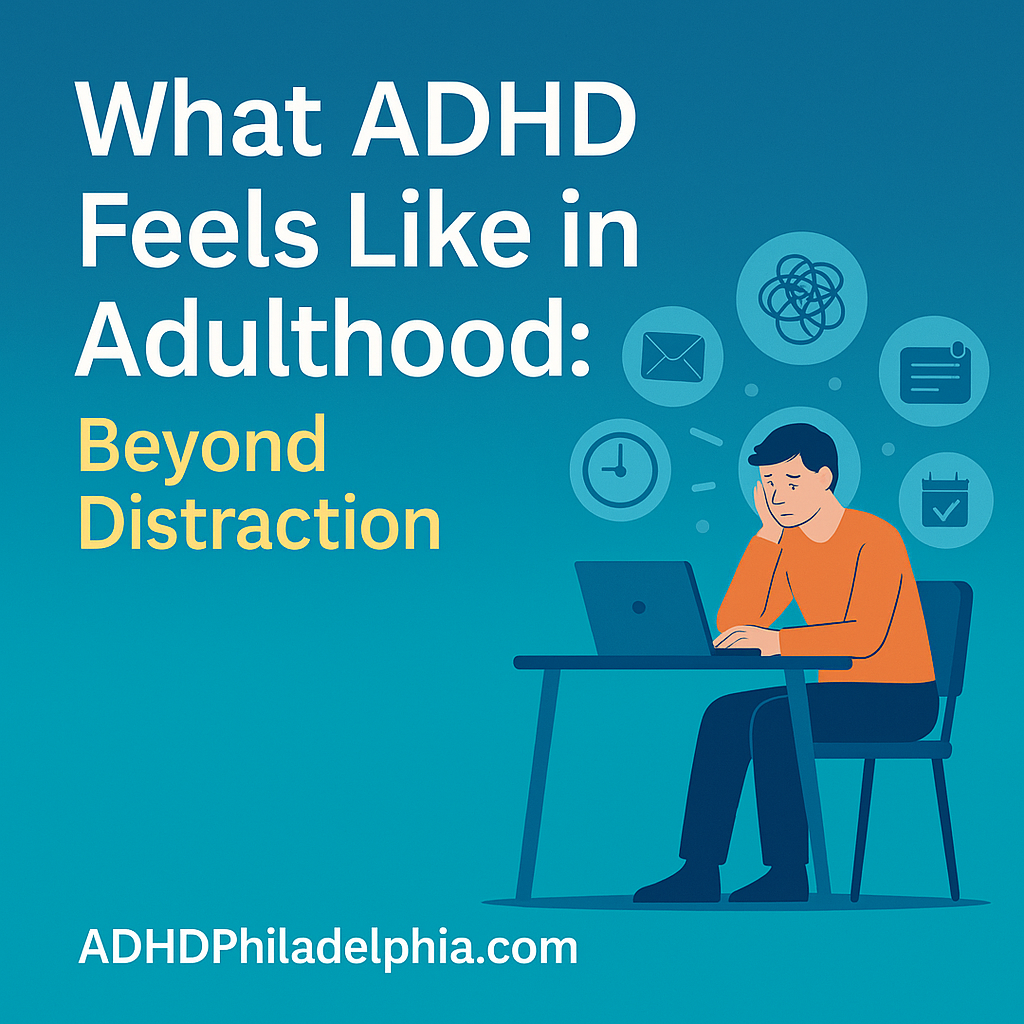
By Charles Thornton, PMHNP-BC — ADHDPhiladelphia.com
It’s More Than “Trouble Focusing”
When most people picture ADHD, they think of someone distracted or restless. But in adults, ADHD is often far more subtle — and far more emotional. It can feel like running a mental marathon every day without ever reaching the finish line.
You might start ten tasks before finishing one. You may overcompensate with caffeine or late nights, then crash into guilt or anxiety when you fall behind. You might be outwardly successful yet constantly feel like you’re barely holding it together.
The Emotional Weight of Adult ADHD
Many adults with undiagnosed ADHD carry years of self-blame. They say things like:
“I know what to do — I just can’t do it.”
“I’m always busy, but I never feel productive.”
“I work twice as hard as everyone else just to stay afloat.”
These feelings aren’t character flaws. They’re the emotional consequences of untreated ADHD — a brain wired for momentum, creativity, and novelty, but often punished for it.
👉Discover how replacing shame with self-awareness changes everything.
How ADHD Affects Daily Life
Adult ADHD impacts every layer of daily living:
Work: Missed details, forgotten deadlines, or difficulty prioritizing.
Home: Disorganization, time blindness, and unfinished tasks.
Relationships: Emotional overreactions, impulsive comments, or forgetfulness mistaken for carelessness.
👉 Learn what happens during a full ADHD evaluation.
At ADHD Philadelphia, our goal is to help you understand these patterns — not just manage symptoms, but build systems that fit your life and strengths.
The Hidden Symptoms
Adult ADHD often shows up as:
Mental fatigue from constant overthinking
Decision paralysis from too many options
Mood swings tied to frustration or rejection sensitivity
Hyperfocus — diving deeply into a task and losing all sense of time
This is why many adults go undiagnosed for years — because ADHD can look like burnout, depression, or anxiety instead.
👉Understand what to expect from your first visit to ongoing treatment.
What Understanding ADHD Changes
Once you see your brain clearly, everything changes. Instead of fighting your natural wiring, you start designing your environment around it.
You realize that the key isn’t willpower — it’s strategy. ADHD treatment at ADHD Philadelphia blends structure, medication (if appropriate), and behavioral techniques that help you stay consistent without burning out.
When you replace shame with science, ADHD stops being a struggle — and starts becoming a superpower you understand.
The ADHD Philadelphia Difference
We don’t just diagnose ADHD; we help you understand it deeply. Our process is built around:
Listening first
Comprehensive, evidence-based testing
Personalized care plans
Compassionate follow-up
Whether you’re a professional, parent, student, or creative, we’ll meet you where you are — and help you move forward with clarity and confidence.
Adults across Pennsylvania and Delaware often wonder whether their symptoms are related to ADHD or anxiety. Understanding the difference can help guide the next step in treatment. Our guide on ADHD vs anxiety in adults explains how these conditions differ.
If you’ve been wondering whether ADHD explains your lifelong patterns of focus, burnout, or overwhelm, now is the time to find out.
Book your evaluation today at ADHDPhiladelphia.com.
Most new clients are seen within 24–48 hours, online or in-person across Pennsylvania and Delaware.
🔗 Related Reading
Why Adult ADHD Testing Changes Everything
The ADHD Patient Journey: From Evaluation to Treatment
Understanding Adult ADHD: Clarity, Compassion, and Confidence

10 Signs You Might Have Adult ADHD and Not Know It
Many adults have ADHD and do not realize it. Learn 10 signs of adult ADHD, including focus problems, time blindness, disorganization, emotional overwhelm, forgetfulness, and inconsistent follow-through.
Many adults spend years struggling with focus, disorganization, procrastination, emotional overwhelm, forgetfulness, and inconsistent follow-through without realizing ADHD may be part of the picture.
They may assume they are lazy, burned out, anxious, unmotivated, scattered, or simply bad at managing time. But adult ADHD can be easy to miss, especially when symptoms do not look like the childhood stereotype of hyperactivity.
In adults, ADHD often shows up as difficulty regulating attention, managing time, organizing tasks, controlling impulses, starting responsibilities, finishing projects, and staying consistent with routines.
At ADHD Philadelphia, we help adults in Pennsylvania and Delaware understand whether ADHD may be affecting work, relationships, home life, emotional regulation, and daily functioning.
Here are 10 signs you might have adult ADHD and not know it.
1. You Struggle to Focus on Tasks That Do Not Interest You
Many adults with ADHD can focus deeply on things that are interesting, urgent, exciting, or rewarding.
But when a task is boring, repetitive, slow, paperwork-heavy, or delayed in reward, focus may disappear quickly.
This may show up as:
Avoiding emails
Delaying paperwork
Zoning out during meetings
Struggling with forms
Skipping boring but important tasks
Needing pressure to finish
Starting something but drifting away
This does not mean you cannot focus. It may mean your brain has trouble regulating attention when the task does not provide enough stimulation.
That is one reason adult ADHD is often misunderstood. People may assume ADHD means someone can never focus, but many adults with ADHD can focus intensely in the right circumstances. The difficulty is focusing reliably when they need to.
A structured evaluation can help determine whether adult ADHD testing and evaluation may explain long-standing problems with focus, distractibility, procrastination, and task completion.
2. You Are Often Late or Misjudge Time
Many adults with ADHD struggle with time blindness.
Time blindness means the brain has difficulty sensing, estimating, or managing time. You may know what time an appointment starts but still underestimate how long it takes to get ready, drive, park, transition, or complete one more task before leaving.
You may say things like:
“I thought I had more time.”
“I was about to leave.”
“I only meant to do one quick thing.”
“I do not know where the time went.”
“I am always rushing even when I try to plan ahead.”
Time problems can create stress at work, school, home, and in relationships. Others may interpret lateness as disrespect, but for adults with ADHD, it may be connected to executive dysfunction, poor time awareness, distractibility, and difficulty transitioning between tasks.
Many adults struggle because ADHD can make routines hard to maintain, especially when time blindness, distractibility, and task-switching problems interfere with daily structure.
3. Your Home, Desk, Car, or Digital Life Feels Disorganized
Disorganization is one of the most common adult ADHD complaints.
It may show up in physical spaces, digital spaces, finances, paperwork, appointments, or daily responsibilities.
You may struggle with:
Cluttered rooms
Piles of laundry
Unopened mail
Lost keys or wallets
Too many browser tabs
Forgotten bills
Messy email inboxes
Important papers in random places
Starting organization projects but not finishing them
This is not always laziness. ADHD can make it harder to create systems, maintain systems, remember systems, and return items to the same place consistently.
Adults with ADHD often know they need organization. The challenge is building systems that are simple enough to maintain when life gets busy.
Problems with executive function in adults can affect organization, planning, working memory, time management, and the ability to complete tasks consistently.
4. You Interrupt, Talk Too Much, or Struggle to Hold Back Thoughts
Adult ADHD can affect impulse control in conversation.
You may interrupt because you are afraid you will forget what you wanted to say. You may talk quickly, finish other people’s sentences, overshare, or jump from topic to topic.
This can affect relationships and work communication.
You may not intend to be rude. Your brain may simply be trying to hold onto a thought before it disappears.
Common patterns include:
Interrupting without meaning to
Talking over people
Changing topics quickly
Feeling impatient in slow conversations
Blurting out thoughts
Oversharing personal details
Realizing afterward that you talked too much
When ADHD is untreated, these communication patterns can create misunderstandings. With awareness and treatment, many adults learn strategies to pause, listen, and respond more intentionally.
Recognizing adult ADHD symptoms can help explain why distractibility, impulsivity, emotional reactivity, disorganization, and inconsistent follow-through may affect daily life.
5. You Feel Emotionally Reactive or Easily Overwhelmed
Adult ADHD is not only about attention. It can also affect emotional regulation.
Some adults with ADHD feel emotions quickly and intensely. They may become frustrated, discouraged, irritated, embarrassed, or overwhelmed faster than they expect.
This may look like:
Low frustration tolerance
Feeling easily criticized
Mood shifts during the day
Strong reactions to small problems
Difficulty calming down
Feeling emotionally flooded
Avoiding tasks because they feel stressful
Regretting reactions later
Many adults with ADHD are misread as dramatic, sensitive, anxious, or moody. Sometimes anxiety or depression may also be present. But emotional regulation challenges can also be part of ADHD.
A careful evaluation matters because ADHD symptoms can overlap with anxiety, depression, sleep problems, and other concerns. The CDC notes there is no single test to diagnose ADHD, and other problems such as sleep disorders, anxiety, depression, and learning disabilities can have similar symptoms.
For many adults, understanding ADHD vs anxiety in adults is important because both can affect concentration, restlessness, sleep, motivation, emotional regulation, and daily functioning.
6. You Forget Appointments, Dates, Tasks, or Conversations
Forgetfulness is another common adult ADHD sign.
You may forget appointments even when they matter. You may read a message and forget to respond. You may walk into a room and forget why you went there. You may miss deadlines, birthdays, errands, or conversations.
This can create guilt and relationship tension.
Others may say, “If it mattered, you would remember.” But with ADHD, forgetting is often connected to working memory and attention regulation, not a lack of care.
Adults with ADHD often need external supports such as calendars, alarms, written lists, visual reminders, automatic payments, and simplified systems.
Treatment can also help by improving attention regulation and helping patients build realistic systems that match how their brain works.
Many adults feel frustrated because adult ADHD can make follow-through difficult even when you care, especially when working memory, distractibility, and task initiation problems interfere with action.
7. You Start Projects With Excitement but Struggle to Finish
Many adults with ADHD are creative, curious, energetic, and full of ideas.
Starting may feel exciting. Finishing may feel much harder.
You may begin a project with motivation, buy the supplies, make the plan, imagine the outcome, and then lose momentum when the task becomes repetitive, boring, detailed, or unclear.
This can happen with:
Home projects
Business ideas
School assignments
Fitness plans
Cleaning projects
Creative work
Books or courses
Budgeting systems
New routines
This pattern can be confusing because the excitement at the beginning is real. The intention is real. The problem is often sustaining attention, motivation, and organization after the novelty fades.
For many adults, ADHD can make decision-making hard because executive dysfunction affects prioritizing, organizing options, managing uncertainty, and moving from thought into action.
8. Simple Tasks Feel Mentally Exhausting
Many adults with ADHD feel tired from tasks that seem simple to others.
Answering emails, making a phone call, cleaning a room, filling out paperwork, scheduling an appointment, paying a bill, or deciding what to do first can feel strangely heavy.
This is because the ADHD brain may have to work harder to organize steps, manage attention, regulate emotion, and move from intention into action.
A “simple” task may actually require many hidden steps:
Notice the task
Remember why it matters
Decide when to do it
Find the needed information
Start the task
Stay focused
Handle frustration
Complete the final step
Follow up if needed
When executive function is strained, even small responsibilities can feel overwhelming.
Many adults seek help because adult ADHD can cause chronic overwhelm, making everyday responsibilities feel heavier, harder to organize, and more difficult to begin.
9. Your Work History Shows Inconsistency, Burnout, or Job-Hopping
Adult ADHD can affect work performance, even in intelligent and capable people.
Some adults with ADHD do well in fast-paced, urgent, interesting, or highly structured environments. But they may struggle in jobs that require long-term planning, paperwork, organization, repetitive tasks, independent deadlines, or sustained focus.
Work-related ADHD signs may include:
Missed deadlines
Difficulty finishing documentation
Trouble managing email
Disorganization
Starting strong but fading later
Job-hopping
Burnout
Conflict over communication
Feeling underemployed
Needing pressure to perform
Remote and hybrid work can make these challenges more noticeable because there is less external structure. For some adults, working from home increases distraction, time blindness, procrastination, and difficulty transitioning between tasks.
For adults struggling at work, adult ADHD treatment may help improve structure, focus, time management, task initiation, and follow-through.
10. You Have Always Felt Like Something Was “Off,” but You Could Not Explain Why
Many adults with ADHD describe a lifelong feeling that something was different.
They may say:
“I always felt behind.”
“I knew I was smart, but I could not stay consistent.”
“I thought everyone struggled this much.”
“I blamed myself for years.”
“I could do well under pressure but not with routines.”
“I kept wondering why life felt harder than it should.”
This experience can be painful. Without the right explanation, adults may build an identity around shame.
A diagnosis can help reframe the story. It does not erase responsibility, but it can help explain why certain patterns kept repeating despite effort.
For many adults, ADHD evaluation is the first step toward clarity.
Many adults feel relief when they learn that ADHD treatment can help explain patterns they once blamed on laziness or lack of discipline.
Why Adult ADHD Is Often Missed
Adult ADHD is often missed because symptoms can be misunderstood.
In childhood, ADHD may have been overlooked if you were quiet, bright, anxious, high-achieving, or not disruptive. In adulthood, symptoms may be hidden by coping strategies, pressure, perfectionism, caffeine, urgency, or overworking.
Adults may also be treated for anxiety, depression, stress, or sleep problems without anyone fully evaluating ADHD.
A comprehensive ADHD evaluation should look at the full picture. That includes current symptoms, childhood patterns, impairment, work and home functioning, emotional regulation, sleep, anxiety, depression, substance use concerns, medical history, and other possible explanations.
The goal is not to force an ADHD diagnosis. The goal is diagnostic clarity.
A structured adult ADHD diagnosis and evaluation can help clarify whether symptoms such as poor focus, procrastination, forgetfulness, disorganization, and emotional overwhelm are consistent with ADHD or may be better explained by another condition.
ADHD Testing in Pennsylvania and Delaware
ADHD Philadelphia provides adult ADHD testing and treatment for patients in Pennsylvania and Delaware.
Initial appointments begin through secure telehealth. In-person appointments may be scheduled after the first online appointment when clinically appropriate. There are no walk-in appointments.
Telehealth can make evaluation more accessible for busy adults, remote workers, parents, students, healthcare workers, business owners, and professionals who have struggled to begin the process.
A structured ADHD evaluation may include:
A detailed clinical interview
Review of current symptoms
Review of earlier life patterns
Assessment of executive functioning
Screening for overlapping concerns
Computerized testing when clinically appropriate
Review of impairment at work, school, home, and in relationships
Discussion of treatment options if ADHD is diagnosed
Adults searching for ADHD testing in Pennsylvania and Delaware can begin with a structured telehealth evaluation through ADHD Philadelphia.
Adults searching for ADHD testing in Wilmington, Delaware can begin care through ADHD Philadelphia’s Delaware telehealth services.
Adults searching for adult ADHD testing in Philadelphia can begin with a structured evaluation through ADHD Philadelphia.
What Happens if ADHD Is Diagnosed?
If ADHD is diagnosed, the next step is an individualized treatment plan.
Treatment may include:
ADHD education
Executive function strategies
Medication management when clinically appropriate
Behavioral tools
Lifestyle and sleep review
Support for routines and planning
Ongoing follow-up and monitoring
Treatment is not about changing who you are. It is about helping your brain work with less friction.
For some adults, medication may improve focus, task initiation, mental clarity, and emotional regulation. For others, strategies and structure are central. Many adults benefit from a combination of approaches.
At ADHD Philadelphia, treatment is monitored over time, and care is based on symptoms, goals, health history, response, and clinical appropriateness.
When clinically appropriate, ADHD medication management for adults may support focus, task initiation, emotional regulation, and daily functioning as part of a structured treatment plan.
Frequently Asked Questions About Adult ADHD Signs
Can adults have ADHD and not know it?
Yes. Many adults are diagnosed later in life after years of struggling with focus, organization, time management, emotional regulation, procrastination, or follow-through.
Can adults with ADHD focus sometimes?
Yes. Many adults with ADHD can focus intensely when something is interesting, urgent, or rewarding. ADHD is often a problem with regulating attention, not a total inability to focus.
Can anxiety or depression look like ADHD?
Yes. Anxiety, depression, sleep problems, stress, trauma, and other conditions can affect focus, motivation, memory, and emotional regulation. This is why a structured evaluation is important.
Is adult ADHD testing just a questionnaire?
No. Questionnaires can be helpful, but adult ADHD diagnosis should involve a clinical evaluation, symptom history, functional impairment review, and screening for overlapping conditions.
Does ADHD Philadelphia evaluate adults in Pennsylvania and Delaware?
Yes. ADHD Philadelphia provides adult ADHD testing and treatment for adults in Pennsylvania and Delaware. Initial appointments begin through telehealth. In-person appointments may be scheduled after the first online appointment when clinically appropriate. No walk-in appointments are available.
Take the First Step
If you recognize yourself in these signs, you are not alone.
Adult ADHD can affect focus, time management, organization, emotional regulation, relationships, work performance, and confidence. But the right evaluation can help you understand what is happening and what treatment options may help.
You do not have to keep blaming yourself without answers.
If you are an adult in Pennsylvania or Delaware and think ADHD may be affecting your life, ADHD Philadelphia can help you take the next step.
Schedule an adult ADHD evaluation today through ADHD Philadelphia.
Medical Disclaimer
This article is for educational purposes only and is not a substitute for medical advice, diagnosis, or treatment. If you are experiencing symptoms of ADHD, anxiety, depression, sleep problems, substance use concerns, or another mental health concern, consult a qualified healthcare professional.