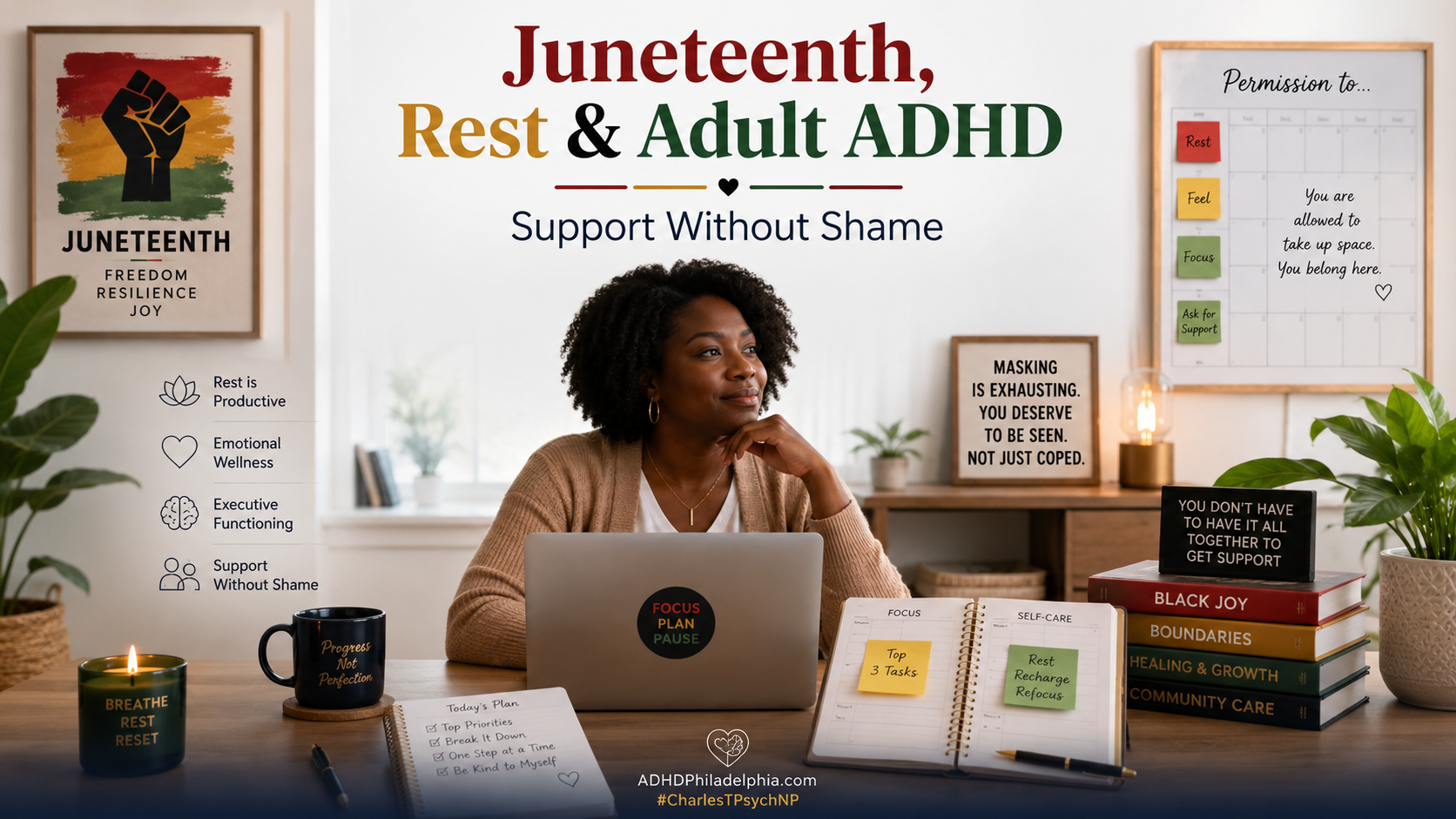
Juneteenth, Rest, and Why Black Adults With ADHD Deserve Support Without Shame
Juneteenth is a time to reflect on freedom, dignity, rest, and being fully seen. For Black adults with ADHD, that includes support without shame, stigma, or being told to simply push harder.
Juneteenth is a meaningful time to reflect on freedom, dignity, history, healing, and what it means to be fully seen.
It is also a meaningful time to talk about rest.
Not just sleep.
Not just taking a day off.
Rest as permission to stop carrying everything alone.
Rest as permission to be honest about mental health.
Rest as permission to receive support without being called lazy, weak, dramatic, undisciplined, or unmotivated.
For some Black adults with ADHD, rest can feel complicated.
A person may have spent years pushing through symptoms, hiding overwhelm, masking disorganization, overworking to avoid judgment, and trying to appear strong even when daily life feels exhausting.
They may think:
“I cannot slow down.”
“I cannot let people see me struggle.”
“I have too much responsibility.”
“I should be able to handle this.”
“I do not want to be judged.”
“I do not want people to think I am making excuses.”
“I just need to try harder.”
But adult ADHD is not an excuse.
It is also not laziness.
Adult ADHD can affect focus, planning, organization, time management, emotional regulation, working memory, task initiation, routines, and follow-through.
For Black adults in Pennsylvania and Delaware, repeated struggles with focus, procrastination, emotional overwhelm, disorganization, burnout, time blindness, and follow-through may be one reason to consider adult ADHD testing and treatment.
Why Rest Can Feel Hard for Black Adults With ADHD
Rest may sound simple, but for many adults with ADHD, rest is not easy.
The brain may keep scanning for unfinished tasks.
The body may feel tense even during downtime.
The mind may replay mistakes.
The calendar may feel overwhelming.
The person may feel guilty for sitting still.
The pressure to catch up may never turn off.
For some Black adults, rest may feel even more complicated because of cultural, family, work, financial, and historical pressures to keep going.
Messages like these can become internalized:
“Work twice as hard.”
“Do not let them see you slip.”
“Handle your business.”
“Stay strong.”
“Do not complain.”
“Keep pushing.”
“Do not give people a reason to judge you.”
Those messages may come from survival, resilience, love, protection, and lived experience.
But when ADHD is present, constantly pushing through can become exhausting.
The adult may not need more shame.
They may need better understanding, better structure, and care that looks at the whole person.
This is why Black adults and ADHD deserve thoughtful, shame-free conversations.
ADHD Shame Can Become Heavy
Many adults with ADHD carry shame.
They may feel ashamed about:
Being late
Forgetting things
Missing deadlines
Avoiding tasks
Losing motivation
Struggling with routines
Feeling emotionally overwhelmed
Starting but not finishing
Not responding to messages
Needing reminders
Falling behind despite trying hard
For Black adults, ADHD shame may overlap with fear of being misunderstood or judged more harshly.
A person may worry that symptoms will be seen as irresponsibility, lack of discipline, attitude, carelessness, or weakness.
So they mask.
They overprepare.
They work late.
They apologize constantly.
They avoid asking for help.
They try to look organized.
They use anxiety to force productivity.
They hide the cost of keeping up.
This can delay care.
This is why ADHD masking can make symptoms harder to recognize and harder to treat.
Rest Is Not the Same as Avoidance
A common fear for adults with ADHD is:
“If I rest, I will never get back on track.”
That fear makes sense.
ADHD can make task initiation difficult. Once a person stops, restarting may feel hard.
But healthy rest is not the same as avoidance.
Avoidance says, “I cannot face this.”
Rest says, “I am allowed to recover so I can return with support.”
Avoidance often increases shame.
Rest should reduce shame.
Avoidance hides from the task.
Rest gives the brain and body a chance to reset.
Avoidance has no plan for return.
Rest can include a small restart plan.
For adults with ADHD, rest often works best when it is structured and compassionate.
That may mean:
A 15-minute reset
A short walk
A meal break
A screen break
A quiet room
A breathing exercise
A written restart note
A simple “next step” list
A calendar reminder to return
The goal is not perfection.
The goal is to build a system that allows recovery without collapse.
This is why ADHD routines should be realistic, flexible, and restartable.

Juneteenth, Rest, and Adult ADHD: Support Without Shame
Executive Dysfunction Is Not a Moral Failure
Executive dysfunction is one of the most misunderstood parts of adult ADHD.
It can affect:
Starting tasks
Finishing tasks
Managing time
Planning ahead
Organizing steps
Prioritizing
Remembering details
Regulating emotions
Switching between tasks
Following through consistently
When executive dysfunction is present, the person may know what needs to be done but still struggle to do it consistently.
That can feel confusing and painful.
A Black adult with ADHD may be intelligent, responsible, hardworking, loving, ambitious, and capable — and still struggle with executive functioning.
This is not laziness.
This is not lack of character.
This is not a failure of willpower.
It may be ADHD.
This is why executive dysfunction should be understood as a clinical issue, not a moral flaw.
Burnout Can Happen When Rest Is Always Delayed
Some adults with ADHD do not rest until they crash.
They push until the task is done.
They push until the deadline passes.
They push until everyone else is okay.
They push until they cannot focus anymore.
They push until their body forces them to stop.
This can lead to burnout.
Burnout may look like:
Mental exhaustion
Emotional numbness
Irritability
Avoidance
Trouble starting tasks
Loss of motivation
Feeling disconnected
Feeling behind all the time
Difficulty responding to messages
Needing more recovery than usual
For Black adults with ADHD, burnout may be intensified by masking, workplace stress, caregiving responsibilities, financial pressure, family expectations, racial stress, or the emotional labor of navigating spaces where they may not always feel fully seen or supported.
This is why ADHD burnout should be taken seriously.
Juneteenth Reminds Us That Being Seen Matters
Being seen in mental health care means more than having symptoms noticed.
It means being listened to.
It means being evaluated carefully.
It means not being dismissed.
It means not being reduced to a stereotype.
It means not being told to just try harder.
It means not having ADHD symptoms mislabeled as laziness.
It means not having anxiety, burnout, trauma, stress, and ADHD all blurred together without careful assessment.
A thoughtful ADHD evaluation should consider the whole person.
That includes:
Current symptoms
Childhood patterns
School and work history
Executive functioning
Emotional regulation
Sleep
Anxiety
Depression
Trauma history
Substance use concerns
Medical conditions
Medication effects
Family history
Cultural context
Functional impairment
Strengths and coping strategies
This is why adult ADHD evaluation can help bring clarity when someone has spent years feeling overwhelmed, misunderstood, or ashamed.
Rest, Support, and Treatment Can Work Together
Rest alone may not solve ADHD.
But rest can be part of a healthier support system.
Adult ADHD treatment may include:
Education about ADHD
Behavioral strategies
Executive-function support
Routine-building
Sleep review
Therapy or coaching strategies
Medication management when clinically appropriate
Regular follow-up
Supportive accountability
Reducing shame
Learning how to restart after disruption
Support does not mean giving up responsibility.
Support means building systems that make responsibility more manageable.
For many adults with ADHD, the goal is not to become a different person.
The goal is to understand the brain better and create supports that fit real life.
When Black Adults May Want to Consider ADHD Testing
Not every struggle is ADHD.
But adult ADHD testing may be helpful if you repeatedly struggle with:
Difficulty focusing
Chronic procrastination
Disorganization
Forgetfulness
Time blindness
Emotional overwhelm
Mental exhaustion
Task avoidance
Trouble starting tasks
Trouble finishing tasks
Inconsistent routines
Work or school struggles
Relationship strain related to follow-through
Feeling capable but inconsistent
Using anxiety to force productivity
Masking symptoms to appear okay
Burnout from constantly trying to keep up
Feeling ashamed for needing support
A structured ADHD evaluation can help clarify whether ADHD may be contributing to these patterns.
ADHD Testing and Treatment in Pennsylvania and Delaware
ADHD Philadelphia provides adult ADHD testing and treatment for adults in Pennsylvania and Delaware.
Care is designed to help adults better understand symptoms such as poor focus, procrastination, disorganization, time management problems, emotional overwhelm, difficulty with routines, burnout, and trouble following through.
Treatment plans are individualized and may include education, behavioral strategies, structure-building, therapy or coaching strategies, lifestyle review, and medication management when clinically appropriate.
Initial appointments are completed through secure telehealth. In-person appointments may be scheduled after the first online appointment when clinically appropriate. Walk-in appointments are not available.
If you have spent years masking, pushing through, overcompensating, feeling overwhelmed, or wondering why daily life feels harder than it looks from the outside, support may help you move from self-blame toward clarity.
To learn more, visit ADHDPhiladelphia.com.
Frequently Asked Questions About Juneteenth, Rest, and Adult ADHD
Why connect Juneteenth with rest and adult ADHD?
Juneteenth is a meaningful time to reflect on freedom, dignity, visibility, and healing. For Black adults with ADHD, that includes the freedom to seek support without shame, stigma, or being told to simply push harder.
Can Black adults have ADHD?
Yes. Black adults can have ADHD, just like adults of any race or background. ADHD can affect attention, executive functioning, emotional regulation, and follow-through.
Why can rest feel hard for adults with ADHD?
Rest can feel hard because ADHD may involve racing thoughts, unfinished tasks, guilt, time blindness, difficulty restarting, and anxiety about falling behind.
Is executive dysfunction laziness?
No. Executive dysfunction can affect planning, task initiation, time management, organization, emotional regulation, and follow-through. It is not laziness or lack of character.
Does ADHD Philadelphia treat children?
No. ADHD Philadelphia focuses on adult ADHD care. Services are for adults in Pennsylvania and Delaware.
Take the First Step
Juneteenth reminds us that dignity, visibility, healing, and being fully seen matter.
If you are a Black adult who has spent years feeling scattered, overwhelmed, inconsistent, anxious, burned out, ashamed, or misunderstood, ADHD may be worth exploring.
Adult ADHD can affect focus, routines, emotional regulation, task initiation, time management, relationships, work, and follow-through.
A structured evaluation can help clarify whether ADHD may be contributing to these patterns and whether treatment may be appropriate.
Visit ADHDPhiladelphia.com to learn more about adult ADHD testing and treatment.
Medical Disclaimer
This article is for educational purposes only and is not a substitute for medical advice, diagnosis, or treatment. ADHD symptoms can overlap with anxiety, depression, sleep disorders, trauma, substance use concerns, medical conditions, medication effects, stress, and other mental health conditions. If you are experiencing symptoms of ADHD or another mental health concern, consult a qualified healthcare professional.

Juneteenth, Mental Health, and Why Black Adults With ADHD Deserve to Be Seen
Juneteenth is a time to reflect on freedom, visibility, and being fully seen. For Black adults with ADHD, that includes being understood beyond stress, burnout, anxiety, masking, or “just trying harder.”
Juneteenth is a meaningful time to reflect on freedom, history, visibility, and what it means to be fully seen.
In mental health care, being seen matters.
Being seen means more than having symptoms noticed.
It means being understood in context.
It means being listened to without being dismissed.
It means not having pain minimized.
It means not having ADHD symptoms mislabeled as laziness.
It means not having anxiety, burnout, trauma, and executive dysfunction all reduced to “just stress.”
It means not being told to simply try harder when the problem may be deeper.
For some Black adults, ADHD may go undiagnosed for years because symptoms are misunderstood, hidden, masked, or explained away.
An adult may spend years thinking:
“I just need to push through.”
“I should be more disciplined.”
“I cannot let people see me struggling.”
“I am too grown to still have trouble with this.”
“I should be able to keep up.”
“I do not want to be judged.”
“I do not want to sound like I am making excuses.”
But adult ADHD is not an excuse.
It is a real condition that can affect focus, organization, time management, task initiation, working memory, emotional regulation, routines, and follow-through.
For Black adults in Pennsylvania and Delaware, repeated struggles with focus, procrastination, disorganization, emotional overwhelm, time blindness, and follow-through may be one reason to consider adult ADHD testing and treatment.
Why Juneteenth and Mental Health Belong in the Same Conversation
Juneteenth is not only about the past. It also invites reflection on what freedom, dignity, access, and healing mean today.
In healthcare, those themes matter.
Many Black adults have had experiences where their concerns were minimized, misunderstood, or not fully explored. Some have learned to delay care until symptoms are severe. Others have learned to function through pain because asking for help did not always feel safe, affordable, or culturally understood.
When ADHD is part of the picture, delayed recognition can have real consequences.
Untreated or undiagnosed ADHD can affect:
Work performance
School history
Relationships
Self-esteem
Sleep routines
Money management
Appointments
Emotional regulation
Parenting demands
Daily responsibilities
Medication consistency
Long-term confidence
This is why Black adults and ADHD should be discussed with care, not stereotypes.

Juneteenth, Mental Health, and Why Black Adults With ADHD Deserve to Be Seen
ADHD Can Be Hidden Behind Strength
Strength is often celebrated.
Resilience matters.
Faith, family, culture, community, and determination can all be powerful sources of support.
But sometimes the pressure to be strong can hide symptoms.
A Black adult with ADHD may be carrying a lot:
Work expectations
Family responsibilities
Financial pressure
Community expectations
Racial stress
Caregiving demands
Fear of being judged
Pressure to avoid mistakes
Pressure to appear calm and capable
From the outside, they may look successful.
Inside, they may feel exhausted.
They may be keeping life together through late nights, anxiety, overworking, masking, and constant self-pressure.
This is why high functioning does not always mean someone is okay.
Sometimes “functioning” means the person has become very good at hiding how hard life feels.
This is why ADHD masking can delay diagnosis and support.
Internal link placement:
In this section, link the bolded phrase below to a masking or exhaustion blog.
ADHD May Be Mistaken for Anxiety, Burnout, or Stress
Many adults do not first ask, “Do I have ADHD?”
They say:
“I am overwhelmed.”
“I am anxious.”
“I am burned out.”
“I cannot keep up.”
“I avoid everything.”
“I start things but do not finish.”
“I am tired of feeling behind.”
“I am smart, but inconsistent.”
Those concerns are real.
Anxiety may be present.
Burnout may be present.
Depression may be present.
Trauma history may be present.
Sleep problems may be present.
Chronic stress may be present.
But ADHD may also be part of the picture.
Adult ADHD can create anxiety-like stress because life feels constantly urgent when tasks pile up, time feels hard to manage, emails go unanswered, appointments sneak up, and responsibilities become overwhelming.
This is why ADHD vs anxiety should be evaluated carefully instead of assuming there is only one explanation.
Executive Dysfunction Is Not Laziness
Executive dysfunction is one of the most misunderstood parts of ADHD.
It can affect:
Starting tasks
Finishing tasks
Planning
Prioritizing
Managing time
Organizing steps
Remembering details
Switching between tasks
Regulating emotions
Following through consistently
A Black adult with ADHD may be hardworking, intelligent, compassionate, ambitious, and responsible — and still struggle with executive functioning.
That struggle may show up as:
Unread messages
Late paperwork
Missed deadlines
Difficulty starting projects
Difficulty finishing projects
Messy routines
Forgotten appointments
Emotional overwhelm
Avoidance
Inconsistent follow-through
This is not laziness.
This is not lack of character.
This may be a brain-based self-management problem that deserves careful evaluation.
This is why executive dysfunction should be taken seriously in adult ADHD care.
Being Seen Means Being Evaluated as a Whole Person
Good ADHD care should not reduce someone to a checklist.
A thoughtful adult ADHD evaluation should consider:
Current symptoms
Childhood history
School and work patterns
Executive functioning
Emotional regulation
Sleep
Anxiety
Depression
Trauma history
Substance use concerns
Medical conditions
Medication effects
Family history
Cultural context
Functional impairment
Strengths and coping strategies
This matters because ADHD symptoms can overlap with other concerns.
It is possible to have ADHD and anxiety.
It is possible to have ADHD and depression.
It is possible to have ADHD and trauma history.
It is possible to have ADHD and burnout.
It is possible to be high-achieving and still have ADHD.
It is possible to look fine and still need support.
Being seen means the full picture matters.
This is why adult ADHD evaluation can help bring clarity.
Why Representation in ADHD Care Matters
Representation matters because people are more likely to seek care when they believe they will be understood.
A Black adult may wonder:
“Will this provider listen?”
“Will I be judged?”
“Will my symptoms be taken seriously?”
“Will they understand why I have pushed through for so long?”
“Will they assume I only need discipline?”
“Will they understand how much I have been masking?”
Inclusive care does not mean making assumptions about someone’s life.
It means asking better questions.
It means listening carefully.
It means respecting lived experience.
It means understanding that symptoms occur inside a real social, cultural, family, and work context.
It means not dismissing ADHD because someone is successful.
It means not assuming every concern is only stress.
It means helping people move from shame toward clarity.
When Black Adults May Want to Consider ADHD Testing
Adult ADHD testing may be helpful if you repeatedly struggle with:
Difficulty focusing
Chronic procrastination
Disorganization
Forgetfulness
Time blindness
Emotional overwhelm
Mental exhaustion
Task avoidance
Difficulty starting tasks
Difficulty finishing tasks
Inconsistent routines
Work or school struggles
Relationship strain related to follow-through
Feeling capable but inconsistent
Using anxiety to force productivity
Masking symptoms to appear okay
Burnout from constantly trying to keep up
Not every struggle is ADHD.
But if these patterns have followed you for years, across different parts of life, a structured evaluation may help clarify what is happening.
ADHD Testing and Treatment in Pennsylvania and Delaware
ADHD Philadelphia provides adult ADHD testing and treatment for adults in Pennsylvania and Delaware.
Care is designed to help adults better understand symptoms such as poor focus, procrastination, disorganization, time management problems, emotional overwhelm, difficulty with routines, and trouble following through.
Treatment plans are individualized and may include education, behavioral strategies, structure-building, therapy or coaching strategies, lifestyle review, and medication management when clinically appropriate.
Initial appointments are completed through secure telehealth. In-person appointments may be scheduled after the first online appointment when clinically appropriate. Walk-in appointments are not available.
If you have spent years masking, pushing through, overcompensating, feeling overwhelmed, or wondering why daily life feels harder than it looks from the outside, support may help you move from self-blame toward clarity.
To learn more, visit ADHDPhiladelphia.com.
Frequently Asked Questions About Juneteenth, Mental Health, and ADHD
Why connect Juneteenth with adult ADHD?
Juneteenth is a meaningful time to reflect on visibility, dignity, freedom, and being fully seen. In mental health care, this includes recognizing when Black adults with ADHD have been overlooked or misunderstood.
Can Black adults have ADHD?
Yes. Black adults can have ADHD, just like adults of any race or background. ADHD can affect attention, executive functioning, emotional regulation, and follow-through.
Why might ADHD be missed in Black adults?
ADHD may be missed when symptoms are mistaken for stress, anxiety, burnout, trauma, lack of discipline, or lack of motivation. Masking, stigma, medical mistrust, and unequal access to care may also delay evaluation.
Does high achievement rule out ADHD?
No. Many adults with ADHD are high-achieving. The question is often how much stress, anxiety, exhaustion, sleep loss, or masking it takes to keep up.
Does ADHD Philadelphia treat children?
No. ADHD Philadelphia focuses on adult ADHD care. Services are for adults in Pennsylvania and Delaware.
Take the First Step
Juneteenth reminds us that being seen, heard, and understood matters.
If you are a Black adult who has spent years feeling scattered, overwhelmed, inconsistent, anxious, burned out, or misunderstood, ADHD may be worth exploring.
Adult ADHD can affect focus, routines, emotional regulation, task initiation, time management, relationships, work, and follow-through.
A structured evaluation can help clarify whether ADHD may be contributing to these patterns and whether treatment may be appropriate.
Visit ADHDPhiladelphia.com to learn more about adult ADHD testing and treatment.
Medical Disclaimer
This article is for educational purposes only and is not a substitute for medical advice, diagnosis, or treatment. ADHD symptoms can overlap with anxiety, depression, sleep disorders, trauma, substance use concerns, medical conditions, medication effects, stress, and other mental health conditions. If you are experiencing symptoms of ADHD or another mental health concern, consult a qualified healthcare professional.