
Why Adults With ADHD Feel Stuck Even When They Know What to Do
Many adults with ADHD know what needs to be done but still feel stuck. Learn why task initiation, overwhelm, emotional resistance, and executive dysfunction can make starting so hard.
One of the most frustrating parts of adult ADHD is knowing what needs to be done — and still feeling unable to start.
The person may know the email needs to be answered.
They may know the laundry needs to be moved.
They may know the appointment needs to be scheduled.
They may know the project is due.
They may know the bill has to be paid.
They may know the room needs to be cleaned.
They may know the next step is important.
And yet, they feel stuck.
This can be confusing, especially for adults who are intelligent, responsible, motivated, and capable in many areas of life. They may think, “If I know what to do, why can’t I just do it?”
For adults with ADHD, the problem is often not knowledge. It is execution.
Adult ADHD can affect executive functioning, including task initiation, planning, prioritizing, emotional regulation, time management, working memory, and follow-through. This means a person can understand the task logically but still struggle to activate the mental energy needed to begin.
That gap between knowing and doing can create shame.
For adults in Pennsylvania and Delaware, this pattern may be one reason to consider adult ADHD testing and treatment if feeling stuck, procrastination, overwhelm, and difficulty completing tasks are affecting daily functioning.
Knowing What to Do Is Not the Same as Being Able to Start
Many adults with ADHD are not confused about what needs to happen.
They may have a list.
They may have reminders.
They may have a calendar.
They may have deadlines.
They may have good intentions.
They may even have a plan.
But starting still feels difficult.
This is because task initiation is a separate executive function skill. It is the ability to begin a task without needing extreme urgency, panic, outside pressure, or emotional intensity to activate action.
For some adults with ADHD, the brain does not easily “switch on” for tasks that are boring, unclear, repetitive, emotionally uncomfortable, or not immediately rewarding.
That is why someone may be able to respond quickly during a crisis but struggle to start a routine task that has been on their list for two weeks.
The issue is not always motivation.
Sometimes it is executive dysfunction interfering with the ability to move from intention to action.
Why the ADHD Brain Gets Stuck
The ADHD brain often responds strongly to interest, urgency, novelty, challenge, and immediate reward.
But many everyday tasks do not offer those things.
Paying a bill may be important, but it is not exciting.
Answering an email may be necessary, but it may feel emotionally uncomfortable.
Cleaning a room may matter, but the reward feels delayed.
Starting paperwork may be important, but it may feel boring or overwhelming.
Scheduling an appointment may be simple, but it may involve several hidden steps.
When a task feels too boring, too vague, too emotionally loaded, or too large, the ADHD brain may resist starting.
The person may sit there thinking about the task, feeling bad about the task, planning to do the task, avoiding the task, and feeling guilty about avoiding the task.
But thinking about a task is not the same as starting it.
This is why ADHD task initiation can be such a major issue for adults.
The Task May Have Too Many Hidden Steps
Many tasks look simple from the outside but contain several hidden steps.
For example, “schedule the appointment” may actually mean:
Find the phone number.
Check insurance.
Look at the calendar.
Decide what day works.
Make the call.
Wait on hold.
Answer questions.
Write down the appointment time.
Add it to the calendar.
Arrange transportation or time off if needed.
That is not one step. That is many steps.
For adults with ADHD, hidden steps can make a task feel bigger than it looks. The person may not consciously break the task down, but their brain senses the complexity and resists starting.
This can happen with email, paperwork, cleaning, scheduling, finances, work projects, school tasks, medication refills, and household responsibilities.
When the task is vague, the brain may freeze.
A more ADHD-friendly approach is to identify only the first visible action.
Not “handle the appointment.”
Instead: “Find the phone number.”
Not “clean the room.”
Instead: “Pick up the clothes from the floor.”
Not “catch up on work.”
Instead: “Open the document.”
Not “fix everything.”
Instead: “Write down the first three tasks.”
This is why ADHD and procrastination are often connected to task complexity, emotional weight, and unclear starting points — not laziness.
Emotional Resistance Can Keep Adults With ADHD Frozen
Sometimes adults with ADHD are not avoiding the task itself.
They are avoiding the feeling attached to the task.
Opening an email may bring fear of criticism.
Checking a bill may bring shame.
Making a call may bring anxiety.
Starting a project may bring fear of failure.
Cleaning a space may bring embarrassment.
Looking at a calendar may bring guilt about what was missed.
Once a task becomes emotionally loaded, it becomes harder to begin.
The adult with ADHD may tell themselves, “I’ll do it later,” but later becomes a way to avoid discomfort. Unfortunately, the longer the task is avoided, the heavier it feels.
This creates a cycle:
The task feels uncomfortable.
The person avoids it.
Avoidance creates temporary relief.
The task grows bigger.
Shame increases.
Starting becomes harder.
Understanding ADHD and emotional overwhelm can help adults recognize that avoidance is not always a lack of caring. Sometimes the task has become emotionally painful.
Feeling Stuck Can Look Like Laziness From the Outside
Adults with ADHD are often misunderstood.
From the outside, it may look like they are ignoring responsibilities, avoiding work, being careless, or not trying hard enough.
Inside, it may feel completely different.
The person may be thinking about the task constantly.
They may be criticizing themselves.
They may be worried about consequences.
They may be mentally rehearsing the steps.
They may feel embarrassed that they have not started.
They may be trying to force themselves into action.
But the task still does not begin.
This is one reason ADHD can be so painful in adulthood. The person may care deeply but still struggle to act consistently.
They may be successful in some areas and stuck in others. They may handle urgent situations well but struggle with routine responsibilities. They may appear capable while privately feeling ashamed.
This does not mean they are lazy.
It may mean adult ADHD symptoms are affecting the bridge between intention and action.
Mental Exhaustion Makes Starting Even Harder
Feeling stuck often becomes worse when the brain is already tired.
Many adults with ADHD wake up carrying an invisible list of unfinished tasks, decisions, responsibilities, worries, and reminders. Before the day even begins, they may already feel mentally overloaded.
When the brain is exhausted, starting becomes harder.
Planning takes more effort.
Prioritizing becomes more difficult.
Small decisions feel bigger.
Emotional regulation becomes weaker.
Avoidance becomes more tempting.
The brain looks for relief instead of action.
This is why adults with ADHD may feel frozen before they even begin the day.
Understanding why adults with ADHD feel mentally exhausted before the day even starts can help explain why task initiation becomes harder when the brain is already overloaded.
Falling Behind Makes the Stuck Feeling Stronger
Feeling stuck becomes even harder when a person is already behind.
One unanswered email becomes ten.
One unpaid bill becomes several.
One messy area becomes the whole house.
One missed deadline becomes a larger project problem.
One delayed task becomes a source of shame.
Once tasks pile up, the brain may not know where to begin.
Everything feels urgent.
Everything feels important.
Everything feels emotionally heavy.
Everything feels like too much.
This can lead to shutdown.
The adult with ADHD may avoid the pile because facing it feels overwhelming. Then the pile grows larger. Then restarting feels even harder.
This is why resetting after falling behind with ADHD often requires a smaller, more compassionate strategy — not a bigger self-punishment plan.
Time Blindness Can Make Starting Feel Less Urgent
Many adults with ADHD struggle with time blindness.
Time blindness means difficulty sensing, estimating, tracking, or managing time accurately.
A deadline may feel far away until it is suddenly urgent.
A task may feel like it will take five minutes but takes forty-five.
The person may believe they have “plenty of time” until time disappears.
They may delay starting because the urgency does not feel real yet.
This can create a frustrating pattern.
The adult with ADHD may not start when the task is important. They may start only when the task becomes urgent. That urgency may create enough pressure to activate action, but it also creates stress, rushed work, and emotional exhaustion.
This is one reason some adults with ADHD live in a cycle of delay, panic, action, exhaustion, and shame.
Understanding ADHD time blindness can help adults build systems that make time more visible and deadlines easier to act on before crisis mode begins.
Why “Just Do It” Does Not Work for ADHD
“Just do it” is common advice.
But for adults with ADHD, it is often not enough.
If the brain is struggling with task initiation, emotional regulation, planning, prioritizing, time awareness, or working memory, then “just do it” does not address the actual barrier.
A more helpful approach is:
Make the task smaller.
Make the first step visible.
Reduce the number of choices.
Create external structure.
Use a timer.
Pair the task with another cue.
Ask for accountability.
Remove unnecessary friction.
Start with the easiest physical action.
Treat restarting as progress.
Adults with ADHD often need systems that reduce the activation cost of starting.
The goal is not to shame the brain into working.
The goal is to support the brain into starting.
This is why ADHD treatment for adults may include education, behavioral strategies, environmental changes, therapy or coaching strategies, and medication management when clinically appropriate.
A Simple ADHD Start-Up Strategy
When you feel stuck, do not start by trying to fix the whole problem.
Start by lowering the barrier.
Try this:
1. Name the task
Write down the task in plain language.
Example: “Reply to insurance email.”
2. Find the first physical action
Ask, “What is the first thing my body has to do?”
Example: “Open laptop.”
3. Shrink the task
Make it smaller than you think it needs to be.
Example: “Read the email only.”
4. Use a short timer
Set a timer for 5–10 minutes.
The goal is not completion. The goal is activation.
5. Create a visible win
Check off the first step, even if the full task is not complete.
6. Restart without punishment
If you stop, restart again.
For adults with ADHD, progress often comes from repeated restarts, not perfect consistency.
When Feeling Stuck May Be a Sign to Consider ADHD Testing
Everyone procrastinates sometimes.
Everyone avoids uncomfortable tasks sometimes.
Everyone feels stuck once in a while.
But if feeling stuck is a repeated pattern that affects work, school, home, parenting, relationships, finances, health responsibilities, or daily functioning, it may be worth considering an ADHD evaluation.
Adult ADHD testing may be helpful if you often struggle with:
Starting tasks
Finishing tasks
Prioritizing
Time management
Procrastination
Emotional overwhelm
Forgetfulness
Disorganization
Follow-through
Avoidance
Task pileups
Feeling mentally frozen
Feeling capable but inconsistent
A thorough evaluation should also consider other possible causes of attention and motivation difficulties, including anxiety, depression, trauma, sleep problems, substance use concerns, medical issues, and stress.
For adults in Pennsylvania and Delaware, adult ADHD evaluation can help clarify whether ADHD may be contributing to feeling stuck, overwhelmed, and unable to follow through consistently.
ADHD Testing and Treatment in Pennsylvania and Delaware
ADHD Philadelphia provides adult ADHD testing and treatment for adults in Pennsylvania and Delaware.
Care is designed to help adults better understand symptoms such as poor focus, procrastination, forgetfulness, disorganization, emotional overwhelm, task initiation problems, and difficulty following through.
Treatment plans are individualized and may include education, behavioral strategies, structure-building, therapy or coaching strategies, lifestyle review, and medication management when clinically appropriate.
Initial appointments are completed through secure telehealth. In-person appointments may be scheduled after the first online appointment when clinically appropriate. Walk-in appointments are not available.
If you are an adult who often feels stuck even when you know what to do, support may help you move from shame and confusion toward clarity and practical next steps.
To learn more, visit ADHDPhiladelphia.com.
Frequently Asked Questions About ADHD and Feeling Stuck
Why do adults with ADHD feel stuck?
Adults with ADHD may feel stuck because of executive dysfunction, task initiation problems, emotional overwhelm, time blindness, unclear priorities, or difficulty breaking tasks into manageable steps.
Is feeling stuck the same as laziness?
No. Feeling stuck with ADHD is not the same as laziness. Many adults with ADHD care deeply and want to act, but their brain struggles to move from intention to action.
Why can I do urgent tasks but not simple tasks?
Urgency can temporarily activate the ADHD brain. Routine tasks may feel harder because they are less stimulating, less immediate, or less emotionally rewarding.
Can ADHD treatment help with task initiation?
ADHD treatment may help improve task initiation by supporting focus, planning, emotional regulation, routines, structure, and follow-through. Treatment may include behavioral strategies, education, therapy, lifestyle changes, and medication management when appropriate.
Does ADHD Philadelphia provide ADHD testing in Pennsylvania and Delaware?
Yes. ADHD Philadelphia provides adult ADHD testing and treatment for adults in Pennsylvania and Delaware. Initial appointments begin through telehealth. In-person appointments may be scheduled after the first online appointment when clinically appropriate. Walk-in appointments are not available.
Take the First Step
If you are an adult in Pennsylvania or Delaware and you often feel stuck even when you know what to do, ADHD Philadelphia can help you better understand what may be happening.
Adult ADHD can affect focus, motivation, task initiation, emotional regulation, organization, time management, and follow-through. A structured evaluation can help clarify whether ADHD may be contributing to these patterns and whether treatment may be appropriate.
Visit ADHDPhiladelphia.com to learn more about adult ADHD testing and treatment.
Medical Disclaimer
This article is for educational purposes only and is not a substitute for medical advice, diagnosis, or treatment. ADHD symptoms can overlap with anxiety, depression, sleep disorders, trauma, substance use concerns, medical conditions, and other mental health conditions. If you are experiencing symptoms of ADHD or another mental health concern, consult a qualified healthcare professional.
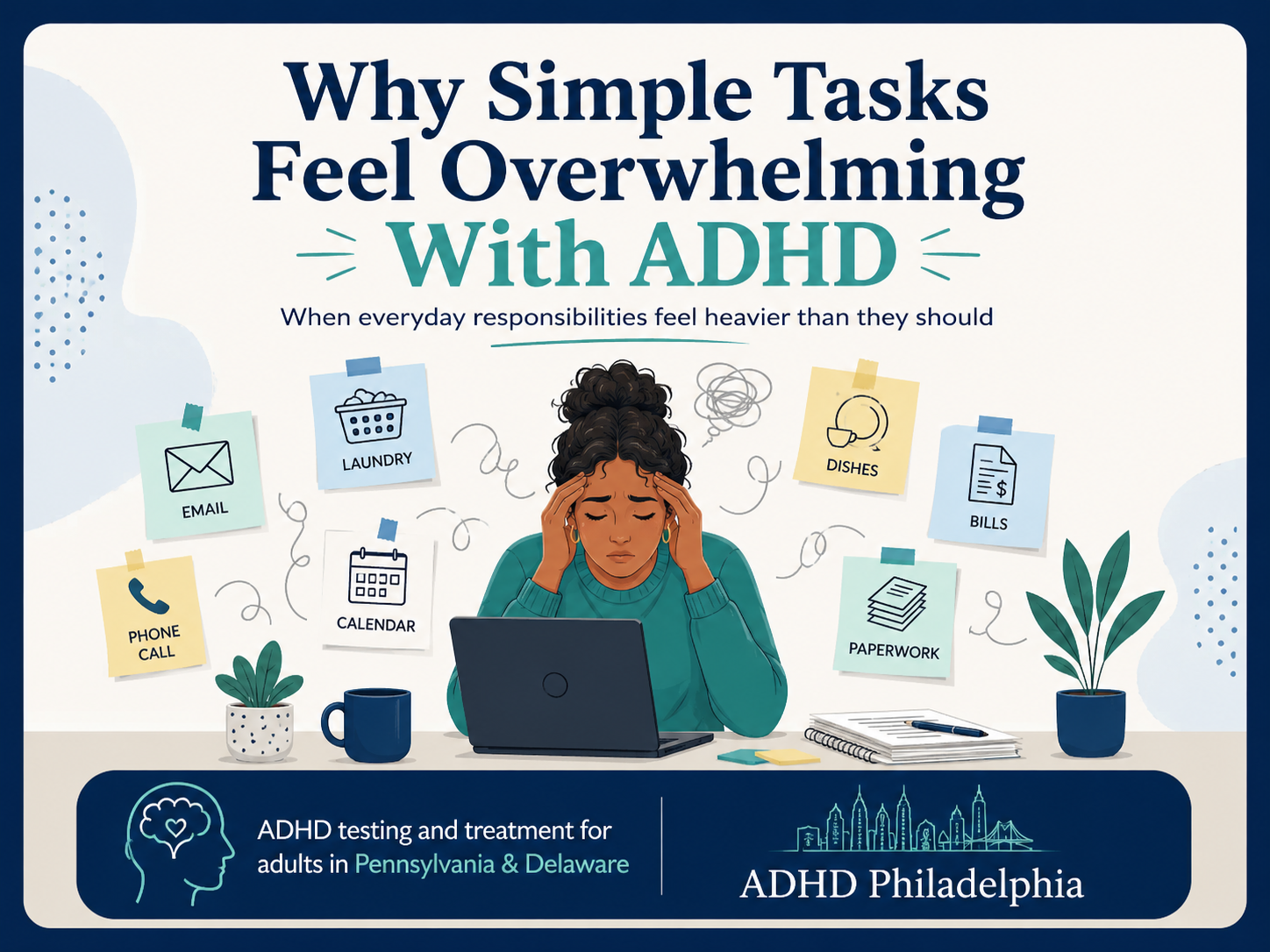
Why Adult ADHD Makes Simple Tasks Feel Overwhelming
Simple tasks can feel overwhelming for adults with ADHD. Learn how executive dysfunction, task initiation, working memory, emotional overload, and decision fatigue can make everyday responsibilities feel harder.
For many adults with ADHD, the hardest tasks are not always the biggest ones.
Sometimes the most frustrating tasks are the small ones.
Answering an email.
Starting laundry.
Returning a phone call.
Scheduling an appointment.
Paying a bill.
Cleaning one room.
Opening a form.
Putting groceries away.
Starting a work project.
From the outside, these tasks may look simple. But for adults with ADHD, simple tasks can feel strangely heavy, frustrating, or emotionally exhausting.
This can lead to shame.
Many adults think, “Why can’t I just do this?”
They may know the task matters.
They may want to finish it.
They may understand the consequences.
They may even have time.
But the task still feels hard to begin.
Adult ADHD can affect executive function, task initiation, working memory, emotional regulation, time awareness, planning, and follow-through. When these brain-based skills are strained, even ordinary responsibilities can feel bigger than they should.
At ADHD Philadelphia, we work with adults in Pennsylvania and Delaware who struggle with focus, procrastination, disorganization, emotional overwhelm, task initiation, and daily follow-through. A structured ADHD evaluation can help clarify whether ADHD may be contributing to these patterns.
Initial appointments begin through secure telehealth. In-person appointments may be scheduled after the first online appointment when clinically appropriate. Walk-in appointments are not available.
Why Simple Tasks Are Not Always Simple With ADHD
A task may look simple from the outside, but internally it may involve many hidden steps.
For example, “pay the bill” may actually require:
Finding the bill
Opening the account
Remembering the password
Checking the due date
Reviewing the balance
Deciding which account to use
Making the payment
Saving confirmation
Remembering whether autopay is set up
Following up if something looks wrong
That is not one step. That is a sequence.
For adults with ADHD, sequencing can be difficult when executive function is overloaded. The brain may see the entire task at once and feel flooded before the first step begins.
That is why a task that “should only take five minutes” can sit unfinished for days.
A structured adult ADHD testing and evaluation process can help clarify whether difficulty starting simple tasks, procrastination, forgetfulness, disorganization, and executive dysfunction may be related to ADHD.
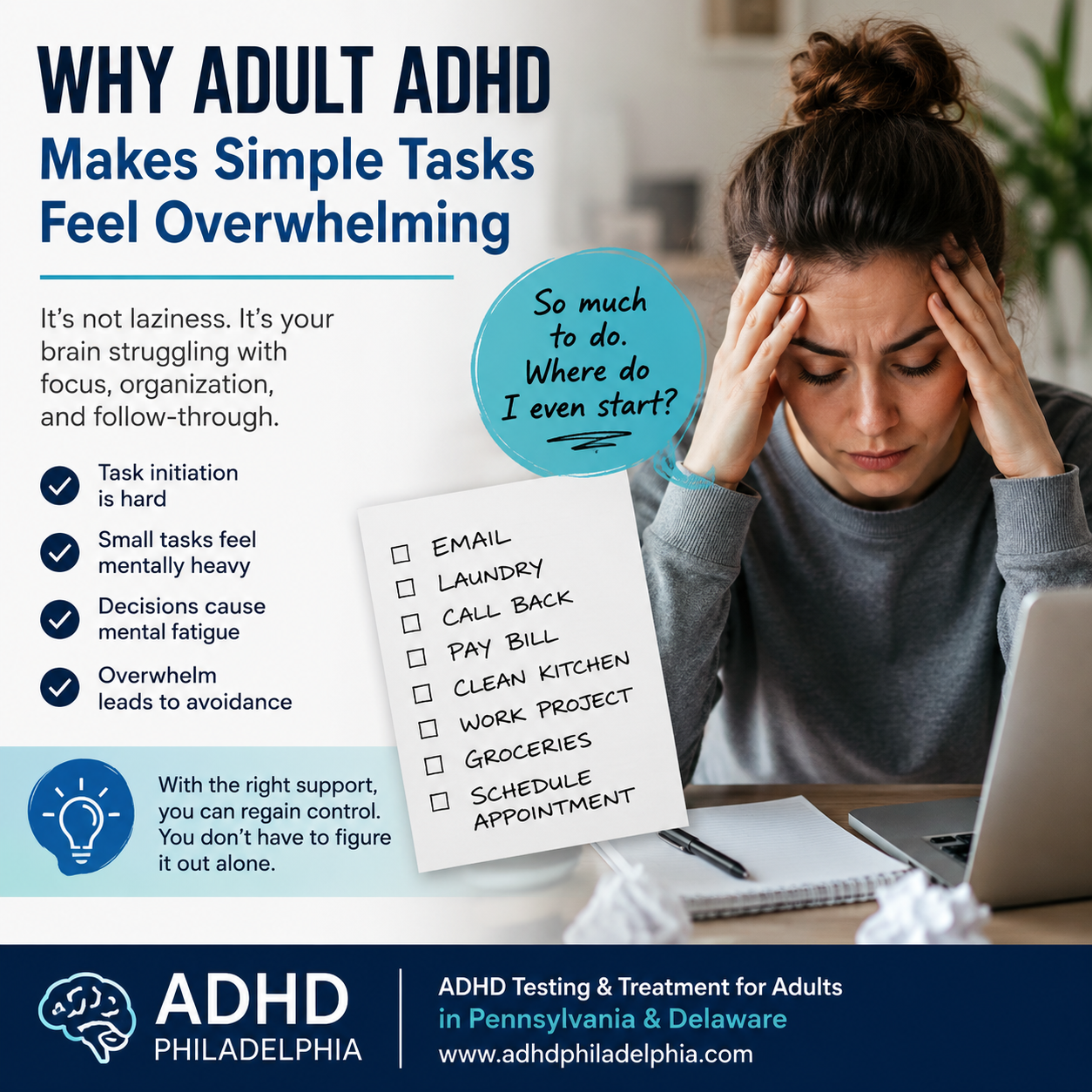
ADHD and Executive Function
Executive function refers to the brain skills that help people manage daily life.
These skills include:
Planning
Prioritizing
Starting tasks
Remembering steps
Managing time
Organizing information
Regulating emotions
Switching between tasks
Finishing responsibilities
Following through over time
When executive function is strained, even small tasks can feel mentally complicated.
The adult may know what needs to be done but struggle to organize the steps, begin the task, stay focused, and finish completely.
This is not about intelligence. Many adults with ADHD are bright, capable, creative, and hardworking. The problem is often not knowing what to do. The problem is activating the brain to do it consistently.
Problems with executive function in adults can affect planning, working memory, organization, emotional regulation, time management, task initiation, and follow-through.
Task Initiation: The Hardest Part Is Starting
One of the most common ADHD-related struggles is task initiation.
Task initiation is the ability to begin a task without needing extreme urgency, pressure, panic, or outside prompting.
Many adults with ADHD say:
“Once I start, I’m usually okay.”
“The hardest part is getting going.”
“I keep thinking about it, but I still don’t do it.”
“I know what to do, but I feel stuck.”
Simple tasks often become overwhelming because the brain struggles to start.
The person may delay, scroll, clean something else, overthink, avoid, or wait until the task becomes urgent. Then they may rush under pressure and feel guilty afterward.
This cycle can repeat for years before the person realizes ADHD may be involved.
Many adults feel stuck because adult ADHD can make follow-through difficult even when you care, especially when task initiation, planning, working memory, and consistency are affected.
Working Memory Can Make Small Tasks Harder
Working memory is the ability to hold information in mind while using it.
For adults with ADHD, working memory can be inconsistent.
This may look like:
Walking into a room and forgetting why
Opening a laptop and forgetting the original task
Starting one chore and getting pulled into another
Losing track of steps
Forgetting what was just read
Forgetting to return to an unfinished task
Misplacing important items needed to complete the task
A simple task may fall apart because the brain loses the thread.
The adult may start with good intentions but get interrupted, distracted, or mentally overloaded. Then the task disappears from awareness until later, when guilt returns.
Many adults with ADHD struggle because ADHD can make it hard to regain momentum after interruptions, especially when working memory and task switching are affected.
Emotional Overwhelm Can Attach to Small Tasks
Simple tasks can become emotionally loaded.
An email may trigger dread.
A bill may trigger shame.
Laundry may trigger defeat.
A form may trigger frustration.
A voicemail may trigger anxiety.
A cluttered room may trigger embarrassment.
Once emotion attaches to the task, the task feels heavier.
The adult may avoid the task not because they do not care, but because the task creates an uncomfortable emotional reaction.
Avoidance brings temporary relief. But the task remains unfinished, which increases guilt and stress. Over time, the task becomes even harder to face.
This is one reason adults with ADHD often feel trapped in cycles of avoidance and self-criticism.
Many adults struggle because adult ADHD can cause chronic overwhelm, especially when emotions, decisions, unfinished tasks, and executive function demands pile up.
Stress Makes ADHD Feel Worse
Stress can make ADHD symptoms harder to manage.
Under stress, adults with ADHD may experience:
Worse focus
More emotional reactivity
More avoidance
More procrastination
Poorer time awareness
Reduced patience
More mental fatigue
More difficulty starting tasks
More difficulty finishing tasks
Stress does not just sit beside ADHD. It can amplify ADHD symptoms.
This creates a loop.
The task feels overwhelming.
The adult avoids it.
Avoidance creates guilt.
Guilt increases stress.
Stress makes the task feel harder.
The task remains unfinished.
Breaking that loop often requires structure, support, and a better understanding of what is happening.
For many adults, understanding ADHD vs anxiety in adults is important because both can affect concentration, restlessness, sleep, motivation, emotional regulation, and daily functioning.
Why Simple Tasks Pile Up
Adults with ADHD may delay small tasks because each one feels slightly uncomfortable, boring, unclear, or mentally demanding.
But small tasks do not stay small forever.
One email becomes twenty.
One bill becomes a late fee.
One basket of laundry becomes several.
One missed call becomes an awkward follow-up.
One cluttered counter becomes a room that feels impossible to clean.
Once tasks pile up, the brain has even more difficulty deciding where to begin.
This creates a stuck feeling.
The adult may look around and feel overwhelmed by everything at once.
Recognizing adult ADHD symptoms can help explain why small tasks pile up when focus, planning, time awareness, emotional regulation, and follow-through are affected.
Decision Fatigue Makes Small Tasks Feel Bigger
Small tasks often require decisions.
Should I answer this email now?
What should I say?
Where should this paper go?
Do I need to call or can I do it online?
Should I clean first or work first?
Do I have enough time?
What if I do it wrong?
For adults with ADHD, decision-making can become exhausting.
The brain may overthink, compare too many options, or search for the perfect starting point. This can make even a basic task feel mentally heavy.
When every task requires a decision, the day becomes draining.
For many adults, ADHD can make decision-making hard because executive dysfunction affects prioritizing, organizing options, managing uncertainty, and moving from thought into action.
Why Adults With ADHD Often Blame Themselves
Many adults with ADHD have spent years being told they should “just try harder.”
They may have heard:
“You’re smart, but you don’t apply yourself.”
“You just need discipline.”
“You’re overthinking it.”
“It only takes five minutes.”
“Why didn’t you just do it?”
After hearing this enough, many adults begin to believe the problem is character.
But untreated ADHD is not a character flaw.
When task initiation, working memory, time awareness, emotional regulation, and executive function are impaired, daily responsibilities can require more effort than others realize.
Understanding ADHD can reduce shame and help adults approach the problem with better tools instead of more self-criticism.
Many adults feel relief when they learn that ADHD treatment can help explain patterns they once blamed on laziness or lack of discipline.
How to Make Simple Tasks Easier
The goal is not to force your brain to work like everyone else’s.
The goal is to reduce friction.
Here are practical ways to make simple tasks easier when ADHD is involved.
1. Shrink the Task
If a task feels too big, make the first step smaller.
Instead of “clean the kitchen,” try:
Clear one counter
Put away five items
Load five dishes
Throw away visible trash
Wipe one surface
Instead of “catch up on email,” try:
Open the inbox
Answer one message
Delete five emails
Flag three important messages
The smaller the first step, the easier it may be to begin.
Many adults with ADHD need smaller starting points because ADHD can make adults feel stuck even when they know what to do.
2. Make the Task Visible
Out of sight can quickly become out of mind.
Adults with ADHD often benefit from making tasks visible.
This may include:
Whiteboards
Sticky notes
Open checklists
Calendar reminders
Phone alarms
Visible bins
Paper trays
Task cards
Timers
A task that is visible is easier to return to.
The goal is not to remember everything. The goal is to build a system that remembers for you.
After diagnosis, adult ADHD treatment may include education, executive function strategies, lifestyle changes, and medication management when clinically appropriate.
3. Use a Timer to Start
A timer can reduce the emotional weight of a task.
Instead of committing to finishing everything, commit to starting for a short period.
Try:
Five minutes
Ten minutes
One song
One small section
One visible step
This helps the brain stop treating the task like an all-or-nothing demand.
Sometimes momentum appears after starting. Sometimes it does not. Either way, beginning for a short time is still progress.
Starting small can help because adult ADHD can make follow-through difficult even when you care, especially when the brain struggles to activate without urgency.
4. Remove Unnecessary Decisions
If a task requires too many choices, simplify it.
Choose the same bill-paying day each week.
Use one laundry basket system.
Keep one place for keys.
Use one calendar.
Create one morning checklist.
Use one folder for forms.
Decide on one “first task” for each workday.
Reducing decisions lowers mental load.
Adults with ADHD often need fewer decisions, not more pressure.
This is why ADHD can make routines hard to maintain, but simple external systems can reduce decision fatigue and make daily tasks easier to repeat.
5. Consider ADHD Evaluation if This Pattern Is Long-Standing
Everyone avoids tasks sometimes.
But if simple tasks have felt overwhelming for years, and the pattern affects work, school, home, relationships, finances, or daily functioning, ADHD evaluation may be helpful.
This is especially true if the task overwhelm comes with:
Poor focus
Procrastination
Disorganization
Time blindness
Forgetfulness
Emotional reactivity
Difficulty starting
Difficulty finishing
Trouble keeping routines
Feeling behind despite trying hard
A structured evaluation can help determine whether ADHD may be contributing and whether treatment may help.
A careful adult ADHD diagnosis and evaluation reviews symptoms, history, impairment, executive functioning, and other possible explanations before treatment planning begins.
ADHD Testing and Treatment in Pennsylvania and Delaware
ADHD Philadelphia provides adult ADHD testing and treatment for adults in Pennsylvania and Delaware.
Care is designed to help adults better understand symptoms such as procrastination, poor focus, forgetfulness, disorganization, emotional overwhelm, task initiation problems, and difficulty following through.
A structured evaluation may include a clinical interview, symptom review, earlier life patterns, functional impairment review, executive function assessment, and screening for overlapping concerns.
Treatment may include ADHD education, executive function strategies, behavioral tools, lifestyle review, and medication management when clinically appropriate.
Adults searching for ADHD testing in Pennsylvania and Delawarecan begin with a structured telehealth evaluation through ADHD Philadelphia.
After diagnosis, adult ADHD treatment may include education, executive function strategies, lifestyle changes, and medication management when clinically appropriate.
Medication Management When Clinically Appropriate
Medication may be discussed if ADHD is diagnosed and treatment is clinically appropriate.
This conversation should include education, informed consent, medical history, psychiatric history, medication history, safety considerations, and follow-up expectations.
Stimulant medications are controlled substances and require responsible monitoring.
At ADHD Philadelphia, treatment response, side effects, functioning, safety, and appropriateness are reviewed during follow-up care. For stimulant medication, follow-up is typically required every 30 days for safety monitoring, treatment response, and dosage adjustments.
ADHD Philadelphia also reviews the prescription drug monitoring program as part of controlled-substance prescribing procedures.
Patients can review the Medication Management & Stimulant Treatment Policy to better understand ADHD Philadelphia’s expectations for stimulant medication monitoring, controlled-substance safety, follow-up visits, and treatment requirements.
When clinically appropriate, ADHD medication management for adults may support focus, task initiation, emotional regulation, and daily functioning as part of a monitored treatment plan.
Telehealth ADHD Care in Pennsylvania and Delaware
ADHD Philadelphia provides adult ADHD evaluation and treatment for adults in Pennsylvania and Delaware.
Initial appointments begin through secure telehealth. This can make care more accessible for busy adults, professionals, students, parents, remote workers, healthcare workers, and people who have struggled to begin the evaluation process.
In-person appointments may be scheduled after the first online appointment when clinically appropriate. Walk-in appointments are not available.
Adults searching for ADHD testing in Pennsylvania can begin with a structured telehealth evaluation through ADHD Philadelphia.
Adults searching for ADHD testing in Delaware can also begin with a secure telehealth evaluation through ADHD Philadelphia.
Adults searching for adult ADHD testing in Philadelphia can begin with ADHD Philadelphia’s structured evaluation process.
Adults searching for ADHD testing in Wilmington, Delaware can begin care through ADHD Philadelphia’s Delaware telehealth services.
Frequently Asked Questions About ADHD and Simple Tasks
Why do simple tasks feel overwhelming with ADHD?
Simple tasks can feel overwhelming because ADHD affects executive function skills such as planning, task initiation, working memory, time management, emotional regulation, and follow-through.
Is this laziness or ADHD?
It is not possible to diagnose based on one symptom, but many adults with ADHD struggle to start and finish simple tasks despite caring deeply. If this pattern is long-standing and affects daily functioning, ADHD evaluation may help.
Why do I avoid tasks that only take a few minutes?
Small tasks may trigger emotional discomfort, decision fatigue, uncertainty, boredom, or executive function overload. Avoidance may bring temporary relief but usually increases stress later.
Can ADHD treatment help with task initiation?
Yes. ADHD treatment may help improve focus, task initiation, planning, emotional regulation, routines, and follow-through. Treatment may include education, behavioral strategies, executive function tools, and medication management when clinically appropriate.
Does ADHD Philadelphia treat adults in Pennsylvania and Delaware?
Yes. ADHD Philadelphia provides adult ADHD testing and treatment for adults in Pennsylvania and Delaware. Initial appointments begin through telehealth. In-person appointments may be scheduled after the first online appointment when clinically appropriate. Walk-in appointments are not available.
Take the First Step
If simple tasks feel heavier than they should, you are not alone.
Adult ADHD can affect focus, task initiation, working memory, emotional regulation, organization, time management, and follow-through. A structured evaluation can help clarify whether ADHD may be contributing and whether treatment may be appropriate.
ADHD Philadelphia provides adult ADHD testing and treatment for adults in Pennsylvania and Delaware.
Schedule an adult ADHD evaluation today through ADHD Philadelphia.
Medical Disclaimer
This article is for educational purposes only and is not a substitute for medical advice, diagnosis, or treatment. If you are experiencing symptoms of ADHD, anxiety, depression, sleep problems, substance use concerns, or another mental health concern, consult a qualified healthcare professional.